
Why Is Bitcoin Rising? A 2026 Investor’s Guide

Bitcoin didn’t just bounce. It absorbed a geopolitical shock, reclaimed ground quickly, and reminded the market that the answer to why is bitcoin rising sits at the intersection of macro stress, regulated capital, hard-coded scarcity, and visible blockchain behavior.
One price move captures that shift well. Bitcoin rose to $71,937 on April 13, 2026 after recovering from a drop to $70,741 tied to President Trump’s Strait of Hormuz blockade order and collapsed US-Iran peace talks, according to Finance Magnates’ market report on Bitcoin’s geopolitical rebound. That’s not the behavior of an asset driven by one narrative. It’s what happens when multiple demand engines start reinforcing each other.
Most coverage stops at a checklist. ETFs, halving, inflation, adoption. Useful, but incomplete. The more important question is how these inputs interact. ETF demand matters more when fresh supply is structurally constrained. Macro uncertainty matters more when investors already have regulated rails to buy Bitcoin. Retail demand in weak-currency economies matters more when long-term holders keep coins off exchanges.
That interaction effect is what turns a rally into a regime shift.
If you’re trying to deal with this market during volatility, it also helps to understand how bull phases tend to emerge after stress, not in a vacuum. A useful companion read is this guide to the cryptocurrency bear market, because many of Bitcoin’s strongest advances begin when sentiment still looks fragile.
Table of Contents
- Decoding the 2026 Bitcoin Surge
- The Macroeconomic Tailwind Pushing Bitcoin Higher
- Wall Streets Stampede The Bitcoin ETF Effect
- The Halving Echo How Programmed Scarcity Drives Price
- Reading the Digital Footprints On-Chain Analysis Signals
- The Hidden Driver Emerging Market Demand
- How to Interpret the Signals and Manage Your Risk
Decoding the 2026 Bitcoin Surge
Bitcoin’s current rally looks stronger when you zoom out from the headline price and study the underlying structure. The market isn’t responding to one catalyst. It’s repricing Bitcoin as a hybrid asset that can attract risk-on capital, hard-money buyers, and global users seeking monetary protection at the same time.
That’s why the 2026 move feels different from a simple momentum burst. One part of the market sees Bitcoin as an ETF-accessible macro trade. Another sees it as a scarce digital reserve asset. A third sees it as usable money in places where local currency confidence is weak. Those are very different buyer profiles, and when they align, price can rise faster than most linear models assume.
Bitcoin is no longer driven by one crowd
A few years ago, Bitcoin rallies were easier to dismiss as speculative reflexes. Today, the buyer base is broader.
- Macro investors look at inflation, rates, and geopolitical risk.
- Institutional allocators care about regulated access, custody, and policy clarity.
- On-chain analysts watch behavior inside the network for signs of conviction.
- Emerging-market users often buy for savings and transfers, not portfolio theory.
Bitcoin rises hardest when demand broadens across different motives, not when one narrative gets louder.
That distinction matters for anyone asking why is bitcoin rising right now. Breadth is often more durable than excitement.
The Macroeconomic Tailwind Pushing Bitcoin Higher
The macro backdrop matters more when inflation refuses to fade. In its March 2026 release, the U.S. Bureau of Labor Statistics reported that CPI increased 3.3% year over year, a reminder that price pressure can stay sticky even after an aggressive tightening cycle. For Bitcoin, that shifts the discussion away from short-term speculation and toward relative monetary credibility.

Bitcoin is behaving more like a macro asset
Bitcoin tends to react fastest when three forces hit at once: inflation that erodes real purchasing power, interest-rate expectations that stay restrictive for longer than markets hoped, and geopolitical stress that raises the appeal of portable, non-sovereign assets. Each factor matters on its own. The more important point is their interaction.
Sticky inflation keeps investors focused on assets with limited supply. Higher-for-longer rates tighten financial conditions, which usually pressures speculative corners of the market. Geopolitical shocks add a separate bid for assets that can move across borders without relying on a domestic banking system. When Bitcoin holds up under that mix, the market is not treating it as a simple risk trade.
The market's reaction during stress reveals an asset's role more clearly than quiet periods do. Bitcoin can still sell off in the first wave of risk reduction. But if it stabilizes and recovers while macro uncertainty remains high, that usually signals a buyer base with more than one motive.
That distinction helps explain why many Bitcoin trading market signals need to be read together rather than in isolation.
Why inflation and rate expectations matter
The mechanism is straightforward. If inflation stays above target, expected real returns on cash and bonds become less attractive unless yields rise enough to offset it. If policy rates remain restrictive, investors also start asking which assets can preserve value without depending on easier central bank policy. Bitcoin enters that conversation because its supply path is fixed in code, while fiat supply and fiscal conditions remain politically managed.
Here is the macro transmission channel:
| Macro signal | How it feeds into Bitcoin demand |
|---|---|
| Sticky inflation | Keeps focus on scarce assets that are harder to dilute |
| Higher-for-longer rates | Pushes investors to separate fragile speculation from assets with a stronger monetary narrative |
| Geopolitical shocks | Increases demand for portable capital outside sovereign systems |
Bitcoin does not trade exactly like gold. It is more volatile, more reflexive, and more sensitive to liquidity conditions. Still, the comparison is useful at the portfolio level. Gold responds to monetary distrust through centuries-old positioning. Bitcoin responds through a global, always-on market with faster capital rotation and a much smaller base asset.
That difference produces a non-obvious result. A difficult macro environment can hurt weaker crypto assets while strengthening Bitcoin's relative position inside the digital asset complex. Investors often reduce exposure broadly at first, then rotate into the asset with the clearest scarcity profile, deepest liquidity, and strongest institutional acceptance.
Practical rule: If inflation stays firm, rate cuts get pushed out, and Bitcoin remains resilient, the market is likely repricing Bitcoin as a macro hedge with risk-asset volatility attached.
That framing also sets up the rest of the rally. Macro pressure creates the demand impulse. ETF access can convert that impulse into measurable inflows. The halving can then tighten new supply just as stronger hands absorb available coins. This is why Bitcoin's biggest advances rarely come from one signal alone. They emerge when macro conditions, market structure, and on-chain behavior start reinforcing each other.
Wall Streets Stampede The Bitcoin ETF Effect
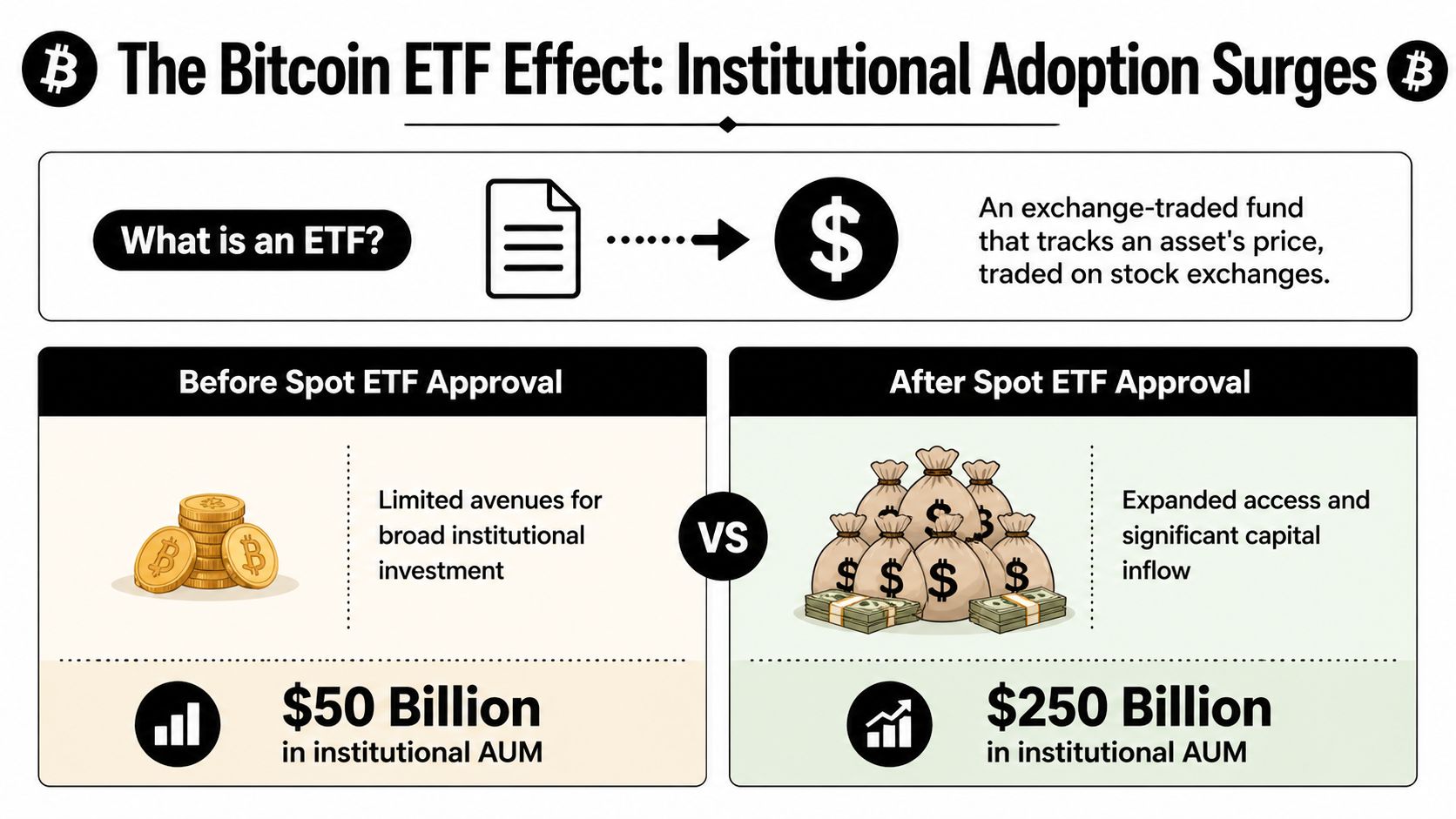
The biggest structural change in Bitcoin isn’t a meme, a chart pattern, or a halving countdown. It’s access. Spot ETF rails changed who can buy Bitcoin, how easily they can buy it, and how comfortably institutions can hold it within traditional portfolio systems.
Why the ETF wrapper changed everything
An ETF is just a wrapper, but wrappers matter in finance. They determine whether an asset can move through brokerage accounts, advisory models, retirement platforms, and institutional compliance frameworks.
That’s why the post-approval environment matters so much more than the average retail trader realizes. Regulatory advancements under the Trump administration helped drive Bitcoin to six all-time highs in 2025, while the total crypto market cap reached $4.4 trillion, according to Investing.com’s year-ahead analysis of Bitcoin, regulation, and ETF-driven adoption. The same report notes milestones including the Genius Act, a softer SEC stance via Project Crypto, and deeper banking integration such as JPMorgan partnerships with exchanges.
That combination matters because institutions rarely buy into legal ambiguity. They buy when custody is cleaner, policy language improves, and product wrappers fit existing workflows.
For traders following this theme closely, Bitcoin market structure often becomes clearer when paired with broader Bitcoin trading analysis and strategy coverage.
Demand is now arriving through regulated pipes
The easiest analogy is infrastructure. Bitcoin used to be a valuable city at the end of a rough road. ETFs built a multilane highway to it.
Here’s what that changes:
- Advisors can allocate more easily: They don’t need to set up native wallets or exchange accounts.
- Institutions can stay inside compliance systems: That lowers operational friction.
- Capital pools can react faster to macro signals: If portfolio managers want exposure, the route now exists.
This creates a market structure effect that many articles understate. ETF demand doesn’t just add buyers. It changes the cadence of buying. Instead of sporadic crypto-native bursts, Bitcoin can now attract steadier allocation flows from investors who think in terms of portfolios, benchmarks, and rebalancing windows.
The ETF story isn’t only about bigger money. It’s about more consistent money.
That consistency matters most when paired with constrained issuance. If fresh demand enters through regulated channels while available supply remains tight, price pressure builds even without euphoric retail conditions.
This is also where Bitcoin intersects with broader digital asset trends. Institutions that arrive through ETFs often don’t stop at Bitcoin. They start exploring tokenization of real-world assets, stablecoin rails, DeFi infrastructure, and eventually the wider Web3 stack. Bitcoin becomes the gateway asset that legitimizes the category.
The Halving Echo How Programmed Scarcity Drives Price
Bitcoin’s supply system is one of the few monetary policies on earth that investors can audit in advance. No committee changes it at a press conference. No surprise issuance appears because growth slowed. The rules are visible, mechanical, and slow-moving.

A simple way to think about the halving
Think of Bitcoin like a gold mine whose output gets cut in half on a fixed schedule. Demand can rise, stay flat, or fall, but the new supply pipeline becomes tighter by design.
That’s the core of the halving effect. It doesn’t guarantee immediate upside. It changes the background pressure in the market. Over time, buyers compete for a more slowly expanding asset base.
The supply-side case is especially strong because Bitcoin’s annual inflation rate fell to 0.85% post-2024 halving, while inflation exceeded 50% in Argentina and 70% in Venezuela, according to Kraken’s explanation of Bitcoin’s price drivers and post-halving scarcity. For a global audience, that contrast is powerful. Bitcoin isn’t scarce in marketing language. It’s scarce in code.
Scarcity only matters when buyers can feel it
Scarcity by itself is not enough. Plenty of assets are scarce and still go nowhere because nobody wants them. Bitcoin’s difference is that scarcity is interacting with stronger demand channels at the same time.
That interaction looks like this:
- New issuance slows
- ETF and macro-driven demand rises
- Long-term holders become less eager to sell
- Available float tightens
- Price has to rise to find willing sellers
That’s the halving echo. Not a magical date on a calendar. A gradual tightening process that becomes more visible when demand turns up.
A short visual explainer helps here:
Bitcoin’s scarcity story also fits a broader digital asset context. In tokenomics, predictable issuance almost always supports stronger long-term narratives than discretionary supply expansion. That’s one reason Bitcoin remains the benchmark asset even as smart contract ecosystems, Layer 2 networks, and DeFi protocols continue evolving around it.
Reading the Digital Footprints On-Chain Analysis Signals
One advantage Bitcoin has over traditional markets is transparency. Public blockchains don’t reveal everything, but they reveal enough to let analysts observe behavior that would stay hidden in equities, bonds, or commodities.

Start with exchange balances
If you only learn one on-chain concept, learn this one. When Bitcoin leaves exchanges and moves into private wallets or custodial vaults, it often signals lower near-term sell intent. Coins sitting on exchanges are easier to trade. Coins moved off-platform are more likely being stored.
That’s why analysts watch exchange balances so closely. A declining exchange balance can suggest a tightening liquid supply environment. It doesn’t mean price must rise tomorrow. It means fewer coins are positioned for immediate sale.
A helpful mental model:
- BTC on exchanges: inventory near the checkout counter
- BTC in long-term storage: inventory locked in a warehouse
- Large net outflows: holders are prioritizing custody over quick liquidity
For readers exploring how public ledgers make this kind of analysis possible, broader blockchain education and market explainers add useful context.
Use on-chain signals as context, not prophecy
On-chain analysis works best when paired with macro and market structure, not when treated like fortune-telling. If coins move off exchanges while ETF demand is healthy and macro conditions favor hard assets, the signal becomes more meaningful. If macro conditions deteriorate and risk appetite collapses, the same on-chain reading may matter less in the short run.
That’s the key analytical leap. On-chain data is strongest as a state-of-market tool.
Watch what holders do, not just what commentators say.
You can also extend this mindset beyond Bitcoin. In DeFi and across Web3, transparent flows help analysts study liquidity migration, collateral behavior, and risk concentration in real time. That transparency is one reason digital asset markets can feel chaotic on the surface yet remain unusually analyzable underneath.
A simple interpretation framework looks like this:
| On-chain observation | Probable read |
|---|---|
| Coins leaving exchanges | Lower immediate sell pressure |
| Coins returning to exchanges | Higher readiness to trade or derisk |
| Calm price during accumulation | Strong hands may be absorbing supply |
| Sharp rallies with low liquid supply | Small demand increases can move price faster |
This is also where many retail investors improve. They stop asking only, “What’s the chart doing?” and start asking, “Who is moving coins, and why?”
The Hidden Driver Emerging Market Demand
Wall Street gets the headlines, but a large part of Bitcoin’s long-term relevance comes from people who aren’t buying it for narrative exposure. They’re buying it because local money doesn’t hold value well enough.
Bitcoin as savings technology, not just a trade
Consider the difference between a portfolio manager in New York and a saver in Nigeria or Turkey. The first asks whether Bitcoin improves returns and diversification. The second may ask whether Bitcoin is a more reliable store of value than the local currency.
That’s not a cosmetic difference. It creates a separate demand engine, one rooted in necessity rather than market fashion.
Bitcoin’s rising price is increasingly supported by demand from high-inflation emerging markets such as Nigeria and Turkey, where users turn to BTC as a hedge against local currency debasement. Google Trends search volume for “Bitcoin Nigeria” spiked 150% during naira devaluations, according to the earlier-cited Kraken research discussed in the halving section.
That kind of demand behaves differently from ETF-driven buying. It is often smaller in ticket size, but more persistent in motive.
Why this demand base matters for price
Emerging-market demand gives Bitcoin something many critics still underestimate: a real-world utility floor. Not a guaranteed floor price, but a durable reason people keep coming back to the asset even when speculative enthusiasm cools.
Three implications follow:
- It diversifies the buyer base: Bitcoin isn’t relying on one geography or one institution type.
- It reinforces the store-of-value narrative: People use it to preserve purchasing power, not just chase upside.
- It connects Bitcoin to actual economic pain points: remittances, savings protection, and access to non-sovereign money.
In weak-currency environments, Bitcoin often functions less like a tech bet and more like emergency monetary infrastructure.
This also helps explain why Bitcoin keeps expanding beyond a narrow crypto-native audience. In developed markets, it plugs into portfolios. In emerging markets, it can plug into daily financial life. That’s a rare combination.
If you’re trying to think like an investor rather than a tourist, it helps to study broader crypto investing frameworks and market psychology, especially because grassroots demand often shows up before mainstream narratives catch up.
How to Interpret the Signals and Manage Your Risk
Bitcoin bull markets rarely run on a single catalyst. The stronger advances usually happen when several demand and supply signals reinforce one another at the same time. If you want to understand why is bitcoin rising, the useful question is not which narrative sounds best. It is whether macro liquidity, ETF flows, on-chain positioning, and post-halving supply are all pointing in the same direction.
A practical dashboard for retail investors
Start with sequence, not headlines.
Macro sets the backdrop. Easier financial conditions, falling real yields, or renewed concern about currency debasement tend to improve appetite for scarce assets. That alone does not produce a sustained move, but it changes the range of outcomes.
Then look at the transmission channel. ETF demand converts broad investor interest into direct spot-market absorption, while the halving reduces the pace of new supply entering circulation. When those two forces operate together, price can move faster than either signal would suggest in isolation.
On-chain data helps confirm whether that pressure is tightening the market. Falling exchange balances, rising dormant supply, and steady long-term holder behavior often signal that available sell-side liquidity is thinning. If ETF inflows remain firm while coins move off exchanges, the market becomes more sensitive to incremental buying.
The last filter is demand quality. A rally driven only by borrowed capital can reverse quickly. A rally supported by institutional allocation, long-term holding behavior, and persistent usage in weaker-currency economies usually has a stronger base.
That is the framework. Look for confirmation across categories, not perfection in any single indicator.
Bullish structure does not remove risk
A constructive backdrop does not make Bitcoin easy to own. It remains a high-volatility asset, and poor sizing can turn a sound thesis into a bad investment outcome.
Position sizing matters more than conviction. An oversized allocation raises the odds that a normal correction forces you to sell at the wrong time. Time horizon matters too. Investors with a multi-year view and traders working on a two-week window are reading the same chart through very different risk constraints.
Technical analysis can help set expectations, but it works best as a timing tool layered on top of a broader thesis. According to Gareth Soloway’s technical analysis, Bitcoin has been forming a pattern since early January 2026 that suggests one more rally after consolidation, with a target at $100,000, a level he describes as a major retracement resistance based on Fibonacci and harmonic principles in his Bitcoin market breakdown on YouTube.
The target is useful because it highlights an area where chart-driven traders may become more active. It is a reference point, not a forecast you should build your identity around.
For readers building a repeatable process, it helps to pair market interpretation with clear rules on entries, exits, and exposure. A practical next step is studying risk-aware trading strategies for crypto markets and then adjusting those ideas to your own drawdown tolerance and holding period.
Build a process you can repeat in a choppy market.
Bitcoin’s rise makes more sense when you view it as an interaction between demand channels and available supply. ETF inflows can tighten spot liquidity. Post-halving issuance can make that tightening matter more. On-chain behavior can confirm whether holders are releasing coins into strength or sitting on them. Investors who track those relationships tend to make better decisions than those reacting to a single headline or a single price target.
3 Comments