
Web3 Gaming News: Your 2026 Guide to Insights
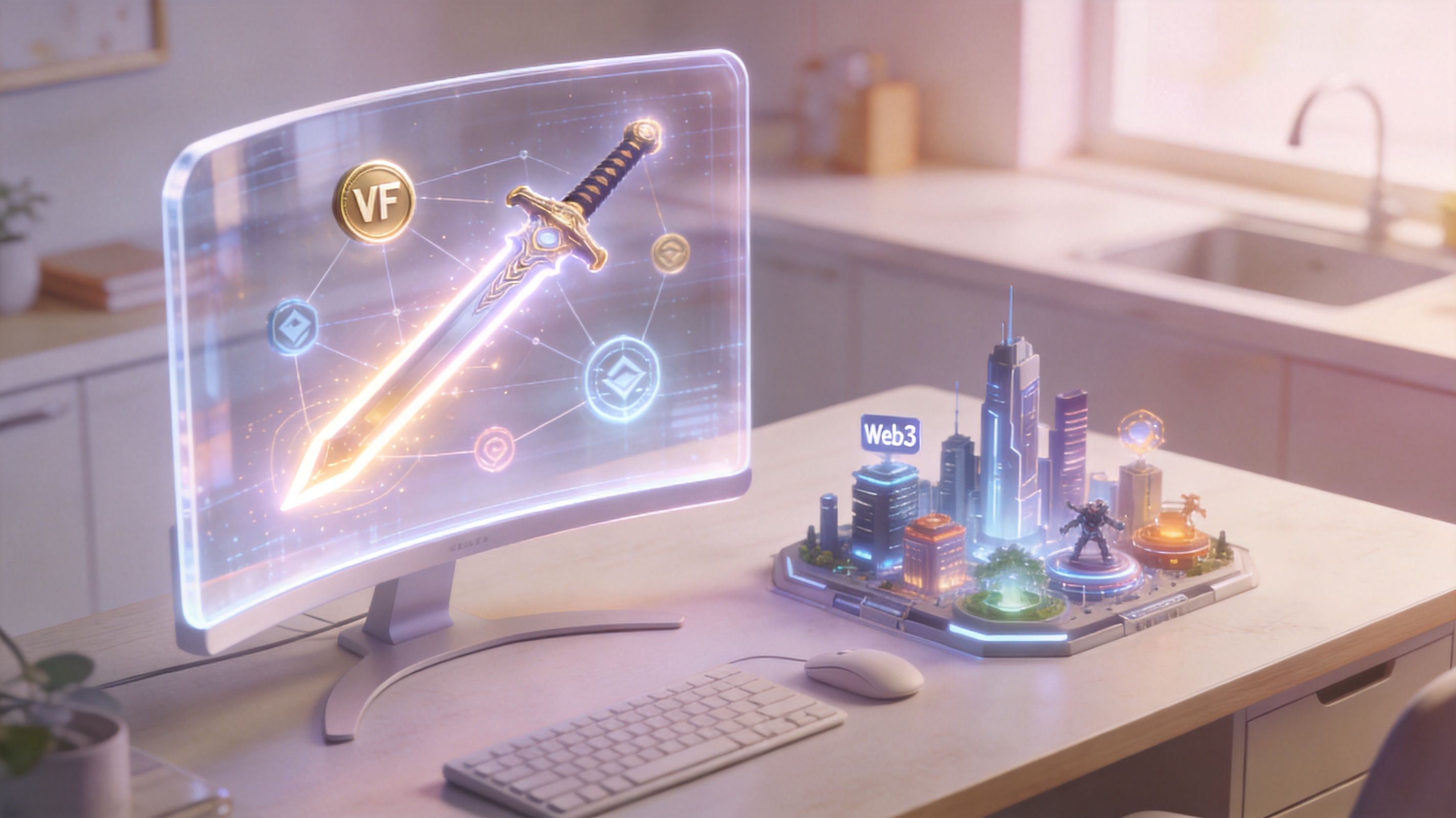
Web3 gaming didn't die when speculation cracked. It got filtered.
That's the most important frame for anyone tracking web3 gaming news in 2026. The market went through a brutal reset, and the reset mattered. In 2025, daily active users fell 17% to 4.8 million in Q2 and more than 300 gaming dApps became inactive, yet the sector also showed that serious capital, infrastructure, and user demand hadn't vanished. According to Binance Square's breakdown of the 2025 shakeout, Web3 gaming market value had already rebounded over 360% from its October 2023 low to USD 34.8 billion by late 2024.
That combination tells you something many surface-level headlines miss. The first era of crypto gaming was mostly about financial extraction disguised as gameplay. The next era is about products that can survive even when token incentives stop doing the heavy lifting.
Table of Contents
- Introduction The State of Web3 Gaming in 2026
- Demystifying Web3 Gaming Beyond the Buzzwords
- The Great Shift to Fun-First and Hybrid Games
- Top Innovations Powering the Next Generation
- Exploring Top Web3 Gaming Ecosystems in 2026
- Market Size Growth and Investor Insights
- Your Hub for Future Web3 Gaming News
Introduction The State of Web3 Gaming in 2026
By 2026, the most useful statistic in Web3 gaming is no longer wallet count or token volume. It is survival. After a multi-year washout, the projects still attracting players and capital tend to share the same traits. They operate more like game companies than token distribution machines.
That shift matters because the sector has already gone through the part many investors usually struggle to price. The hype cycle broke first. Then the business models were forced to prove they could retain users without depending on constant emissions, rising floor prices, or speculative secondary trading. What remains is a harder, more investable category. Teams are building around engagement, lower-friction onboarding, and economies that support play instead of overwhelming it.
What the correction actually tested
The reset tested whether blockchain added durable utility or just temporary excitement.
Studios that survived generally passed three filters:
- Retention quality: Players kept showing up for progression, competition, social loops, or content updates rather than for extraction alone.
- Economic discipline: Teams treated tokens and NFTs as supporting systems, not the entire product thesis.
- Distribution realism: Builders reduced onboarding friction and met players on familiar platforms instead of expecting mass audiences to learn crypto first.
That is the clearest break from the play-to-earn era. Earlier models often treated rewards as customer acquisition spend with no reliable path to self-sustaining demand. In 2026, stronger projects are closer to hybrid consumer platforms. They borrow from free-to-play design, live-service operations, and digital ownership rails, then apply blockchain only where it improves liquidity, portability, or community participation.
One sentence captures the market change. Fun became the filter.
Why this matters for portfolios
For investors, the key question is no longer whether Web3 gaming can produce another speculative spike. The better question is where durable value capture will sit if blockchain games start behaving like normal entertainment products with crypto-native infrastructure underneath.
That pushes attention toward a different set of winners. Studios with measurable retention matter. Chains optimized for low-cost, high-frequency gameplay matter. Wallet, identity, and marketplace infrastructure matter because they reduce user drop-off and increase the odds that asset ownership becomes a feature players use.
The post-hype reality is less dramatic than the 2021 narrative, but far more constructive. If 2021 was about selling the idea of tokenized gaming, 2026 is about identifying which teams can build sustainable ecosystems once speculation stops doing the work for them.
Demystifying Web3 Gaming Beyond the Buzzwords
A lot of web3 gaming news still assumes readers already know the difference between a blockchain game and a traditional online game with a token attached. That shortcut creates confusion. A useful definition starts with ownership, not hype.

What makes a game Web3
A game starts to feel Web3 when three pillars show up together.
- Digital ownership: In-game assets can exist as blockchain-based items, often tied to NFTs or other tokenized records. That means the player holds a transferable asset rather than just a revocable entry in a publisher database.
- Programmable economies: Smart contracts can govern how items move, how rewards distribute, or how marketplaces operate.
- Community participation: Some projects give players a role in governance, ecosystem decisions, or creator-led content loops instead of keeping every rule inside a publisher's closed system.
The easiest analogy is a physical collectible. If you own a rare trading card, you can keep it, trade it, sell it, or display it without asking the card company for permission. A Web3 item aims for that kind of ownership logic. A traditional in-game skin is different. You're often buying access inside a platform the publisher fully controls.
That doesn't mean every blockchain game automatically delivers freedom or interoperability. Many don't. But the design goal changes once ownership becomes part of the product.
Why ownership changes player behavior
Ownership affects more than resale. It changes how players think about time, status, and value.
A player who owns a rare sword, land parcel, cosmetic, or character often behaves less like a renter and more like a participant in an ecosystem. That can deepen attachment, encourage marketplace activity, and support creator economies around the game.
Here's where the investor lens matters. Ownership isn't valuable just because it's on-chain. It becomes valuable when it supports a better game loop or stronger network effect.
| Traditional model | Web3-oriented model |
|---|---|
| Publisher-controlled inventory | Player-held digital assets |
| Closed marketplace or no resale | Open or semi-open market activity |
| Monetization centered on publisher spend | Monetization can include peer-to-peer trading and tokenized items |
| Governance sits with the studio | Governance may include community input |
Web3 gaming works best when blockchain expands what players can do, not when it interrupts what they came to do.
That's also why adjacent narratives like DeFi, Layer 2 infrastructure, and even real-world asset tokenization keep appearing around gaming. Investors are seeing the same underlying theme across sectors. Blockchain creates transferable, programmable ownership. Gaming just happens to be one of the clearest consumer-facing arenas where that idea can become emotionally sticky.
The Great Shift to Fun-First and Hybrid Games
The most important strategic shift in web3 gaming news isn't a new token model. It's a design philosophy change.
Early play-to-earn models attracted attention because they promised a new economic relationship between player and game. The problem was that many of them turned play into labor. Once reward expectations became the main reason to log in, retention got tied to token prices instead of entertainment quality.
Why play-to-earn broke down
The old model carried a structural flaw. If users came primarily for extraction, then declining rewards would often lead to declining engagement. That pushed many studios into a damaging cycle of inflation, subsidy, and churn.
Blockworks' reporting on the sector pivot captures the current direction clearly. The industry is moving toward “fun-first” gameplay over token incentives, and hybrid web2-web3 models are forecasted to improve retention and shape the next cycle.
That forecast matters because it reframes what blockchain should do inside a game. It shouldn't replace game design. It should support it.
Three lessons from the P2E unwind stand out:
- Unsustainable tokenomics fail fast: If rewards depend on constant new inflows, the model eventually gets exposed.
- Players notice weak design: Good economics can't hide repetitive gameplay forever.
- Friction compounds churn: If onboarding is hard and the game loop is mediocre, users don't stay.
What hybrid design gets right
Hybrid games treat blockchain as infrastructure, not identity.
In a hybrid model, a player may enter through familiar web2-style onboarding, enjoy the game without touching a wallet immediately, and later discover optional ownership features, marketplaces, or governance mechanics. That approach does two things at once. It protects the user experience and preserves Web3 upside.
The strongest hybrid projects don't ask players to become crypto users first. They let players become fans first.
This is why the current market is more credible than the noisy years. Studios are learning to hide complexity behind polished interfaces. They're also accepting a simple truth that traditional gaming already proved long ago. Players return for progression, competition, social identity, and content quality. Financial upside can enhance that. It can't substitute for it.
A practical investor takeaway is to evaluate games in this order:
- Would people play it without the token?
- Does ownership deepen engagement rather than distract from it?
- Can the economy function without constant reward inflation?
- Does the studio understand both gaming UX and crypto market behavior?
The projects best positioned for 2026 aren't reviving the old GameFi playbook. They're building games where blockchain feels additive, optional, and economically coherent.
Top Innovations Powering the Next Generation
The next wave of Web3 gaming isn't being enabled by louder marketing. It's being enabled by infrastructure that removes friction players used to hate.
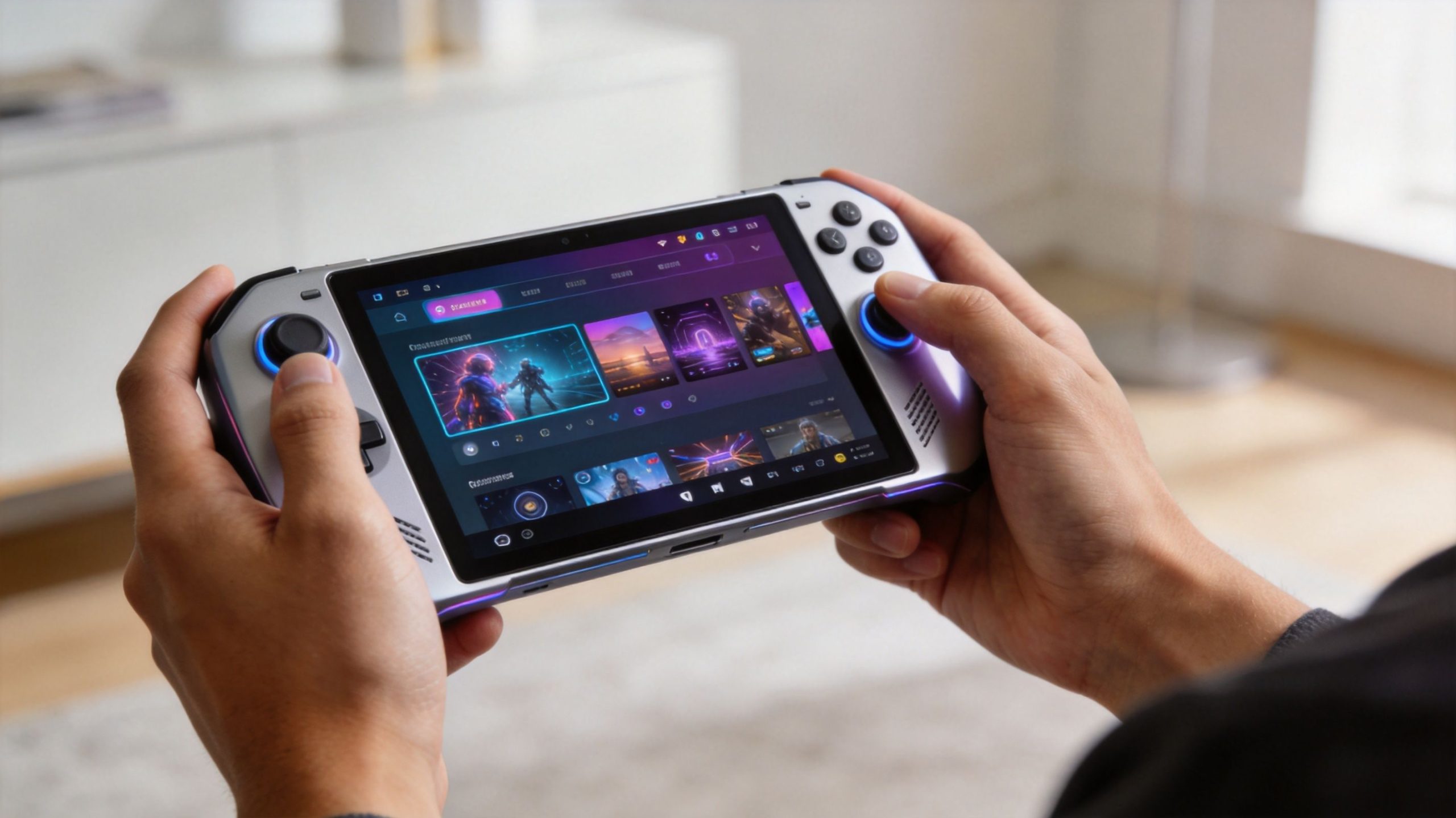
The end of seed phrase onboarding
One of the biggest reasons early blockchain games struggled with mainstream audiences was simple. The user journey felt foreign. New players had to install wallets, store seed phrases, buy gas tokens, sign strange prompts, and understand network behavior before they had any emotional reason to care.
That model is breaking down. According to Infantex's overview of 2026 Web3 gaming trends, a major milestone is “invisible blockchain integration”, where players can log in with social accounts while background MPC wallets, sub-second finality, and gas sponsorship remove the biggest onboarding barriers.
That phrase matters. Invisible blockchain integration means the blockchain is still doing important work, but the player doesn't have to manage every technical step manually.
Key building blocks include:
- MPC wallets: These reduce dependence on seed-phrase-heavy wallet flows.
- Account abstraction patterns: They let applications shape more intuitive transaction experiences.
- Gas sponsorship: The game can pay transaction fees so users aren't forced to hold native gas assets.
- High-performance execution: Faster confirmation times make in-game actions feel closer to standard consumer apps.
Why speed and gas design now matter more than token hype
If a game wants to reach mobile-first or mass-market audiences, transaction design now matters as much as token design. Slow settlement, visible gas friction, and confusing approvals still kill conversion.
The biggest improvement is psychological, not just technical. Players can now approach a blockchain game the same way they approach a normal app. They sign in, start playing, and discover ownership later.
Here's a useful way to think about the before-and-after shift:
| Earlier Web3 UX | Emerging 2026 UX |
|---|---|
| Wallet-first | Account-first |
| Manual gas management | Sponsored or abstracted fees |
| Seed phrase anxiety | Social or email login flow |
| Blockchain visible at every step | Blockchain mostly hidden until needed |
A closer look at the user experience helps explain the competitive edge:
Builder takeaway: In 2026, smooth onboarding isn't a bonus feature. It's table stakes.
This also has spillover effects into adjacent narratives investors follow closely. Layer 2 scaling solutions reduce cost pressure and support more frequent in-game interactions. Better wallet abstractions improve conversion. Smart contract design becomes less visible to the player, but more important to the business. AI can also eventually help studios optimize support flows, personalization, and dynamic economies, though the primary differentiator still starts with core game quality.
Exploring Top Web3 Gaming Ecosystems in 2026
Chains and gaming networks aren't all competing on the same axis. Some emphasize speed. Others focus on tooling, distribution, or game-specific infrastructure. Investors who lump them together usually miss where value is forming.
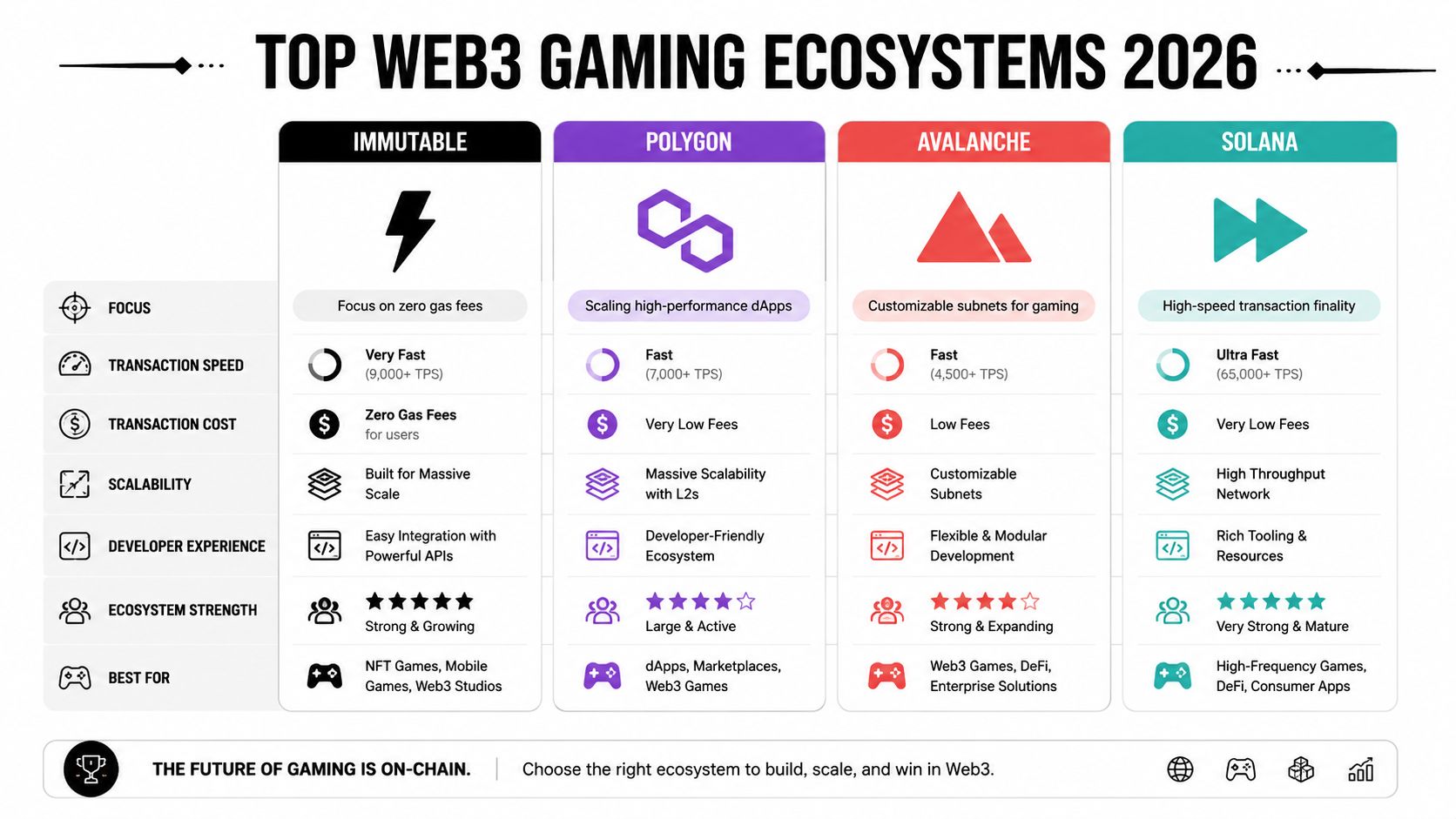
How the leading ecosystems differ
A useful way to compare top ecosystems is to ask what problem each one is trying to solve for developers and players.
| Ecosystem | Core value proposition | What stands out in 2026 |
|---|---|---|
| Immutable | Gaming-focused tooling and infrastructure | Strong identity around Web3 game distribution, asset support, and studio alignment |
| Polygon | Broad scaling environment for high-performance dApps | Familiar Ethereum-adjacent environment and growing relevance for gaming integrations |
| Avalanche | Flexible app-specific design options | Attractive for teams that want tailored environments for gaming experiences |
| Solana | High-speed transaction finality | Strong fit for consumer-facing apps where responsiveness matters |
Each has a different path to the same end state. They want to make blockchain-native gaming feel smooth enough that the average player doesn't think about the chain unless they choose to.
What investors should watch across chains
The chain itself isn't the whole thesis. Ecosystem quality comes from the combination of infrastructure, distribution, developers, and flagship games.
A few practical filters help:
- Developer tooling: Better SDKs, wallet support, and marketplace integration lower launch friction.
- Consumer UX: The ecosystem that makes onboarding easiest has an edge in player acquisition.
- Content quality: Strong chains still need compelling games. Infrastructure without sticky content won't hold users.
- Studio partnerships: Serious game development usually follows platforms that offer reliable support and clear product direction.
Ronin and Avalanche have both benefited from notable game activity in the broader market conversation, and Binance Square highlighted how titles such as Off The Grid helped lift attention around ecosystems including Avalanche, TON, and Ronin in the recent cycle, as noted earlier. That matters because games still drive the narrative more than infrastructure decks do.
The ecosystem winner won't necessarily be the chain with the loudest branding. It'll be the one where developers can ship faster and players can forget they're using crypto at all.
For investors, that creates a split thesis. Some opportunities sit at the chain and infrastructure layer. Others sit at the content and studio layer. The strongest ecosystems usually have both. If one side is missing, the network can struggle to hold momentum.
Market Size Growth and Investor Insights
The long-term case for Web3 gaming is still substantial, but it needs to be separated from short-term token noise. A large market projection is not a reason to buy everything in the category. It is a reason to build a sharper filter.
According to Precedence Research's Web3 gaming market outlook, the global Web3 gaming market was valued at USD 31.49 billion in 2024 and is projected to reach approximately USD 182.98 billion by 2034, growing at a 19.24% CAGR. The same outlook says North America currently dominates, while Asia Pacific is the fastest-growing region.

The long-term bull case
Those projections matter because they point to a market that's moving from niche crypto experimentation toward a more established entertainment and infrastructure category.
The strongest bullish arguments are qualitative as much as quantitative:
- Ownership has product appeal: Players like cosmetics, status items, and tradable assets.
- Blockchain improves settlement and transparency: Smart contracts can make digital economies more programmable.
- Hybrid design expands addressable users: Games don't need to force crypto-native behavior on day one.
- Regional growth broadens opportunity: Faster adoption in Asia Pacific suggests future demand may come from markets that skipped parts of the earlier PC and console playbook.
There's also an adjacent benefit for investors who think across sectors. Web3 gaming sits at the intersection of consumer crypto, NFTs, smart contracts, marketplaces, and sometimes DeFi mechanics. It can act as an onboarding layer for users who won't start with a trading terminal but will start with entertainment.
The risks that still matter
The market projection is not a guarantee. Serious risks remain, and they're not hypothetical.
- Regulatory uncertainty: Projects operating with tokens, NFTs, and cross-border communities still face evolving legal interpretations.
- Smart contract risk: If value lives on-chain, exploit risk matters.
- Scalability and UX trade-offs: Some ecosystems still struggle to balance decentralization, cost, and smooth performance.
- Weak tokenomics: A polished trailer can still hide an economy that only works in favorable conditions.
A disciplined investor should look at projects the way a game operator would, not just the way a token trader would.
Questions worth asking include:
- Is the community durable without speculation?
- Does the development team have actual shipping credibility?
- Is blockchain central to the product advantage, or just attached for fundraising optics?
- Can the economy survive lower market enthusiasm?
The opportunity in Web3 gaming is real. So is the dispersion. A handful of ecosystems and studios may create meaningful value. Many won't. That's why portfolio construction in this segment should favor selectivity over narrative chasing.
Your Hub for Future Web3 Gaming News
The best way to track Web3 gaming now is to stop reading it like a hype category and start reading it like a maturing industry. Look for user experience improvements, game quality, ecosystem durability, and signs that studios understand how to build communities without leaning on unsustainable token incentives.
Where to track signal instead of noise
If you want better signal, focus on a mix of market data, ecosystem updates, and builder commentary.
A practical monitoring stack looks like this:
- Dapp analytics platforms: Use tools like DappRadar to watch ecosystem activity, rankings, and shifting user attention.
- Official ecosystem channels: Follow core updates from networks such as Immutable, Avalanche, Solana, Ronin, and Polygon.
- Industry reporting: Read specialized crypto outlets that cover GameFi, infrastructure, venture shifts, and token design with nuance.
- On-chain product releases: Pay attention to launches, marketplace integrations, wallet upgrades, and major studio announcements.
Don't just track token prices. In this sector, onboarding design and game launch quality often tell you more than a short-term chart.
Why builders need education as much as capital
One underappreciated theme in 2026 is the developer knowledge gap. Funding pressure exposed how many teams understood token issuance better than they understood community design, governance, or sustainable game economies.
That's why education initiatives matter. As crypto.news reported on efforts to bridge the Web3 gaming knowledge gap, foundations such as Starknet have used online gaming webinars to help developers learn the community-driven principles that matter in Web3, especially in contrast with more publisher-controlled Web2 models.
That detail is easy to overlook, but it's strategically important. Better builders usually create better products. Better products create better retention. Better retention supports stronger ecosystems and, eventually, more investable outcomes.
A high-signal routine for following web3 gaming news should include:
- Builder education channels: Watch for webinars, technical explainers, and ecosystem docs.
- Product-first analysis: Prioritize hands-on impressions and gameplay over token marketing.
- Cross-sector awareness: Track AI + crypto experiments, Layer 2 progress, and tokenized asset infrastructure because they often spill into gaming.
- Governance and community health: Strong communities often outlast short-term market cycles.
Follow the teams reducing friction, not the teams recycling slogans.
The investors who understand this category best in 2026 won't be the ones chasing the noisiest GameFi narrative. They'll be the ones noticing where fun-first design, hidden blockchain infrastructure, and disciplined ecosystem building are converging.
Coiner Blog is building the kind of coverage this market needs: practical, skeptical, and closely plugged into crypto's next wave. If you want more analysis on web3 gaming, DeFi, Layer 2 infrastructure, NFTs, AI-blockchain convergence, and the risks behind the headlines, keep an eye on Coiner Blog.