
7 Top Privacy Coins for 2026: Technology and Risks
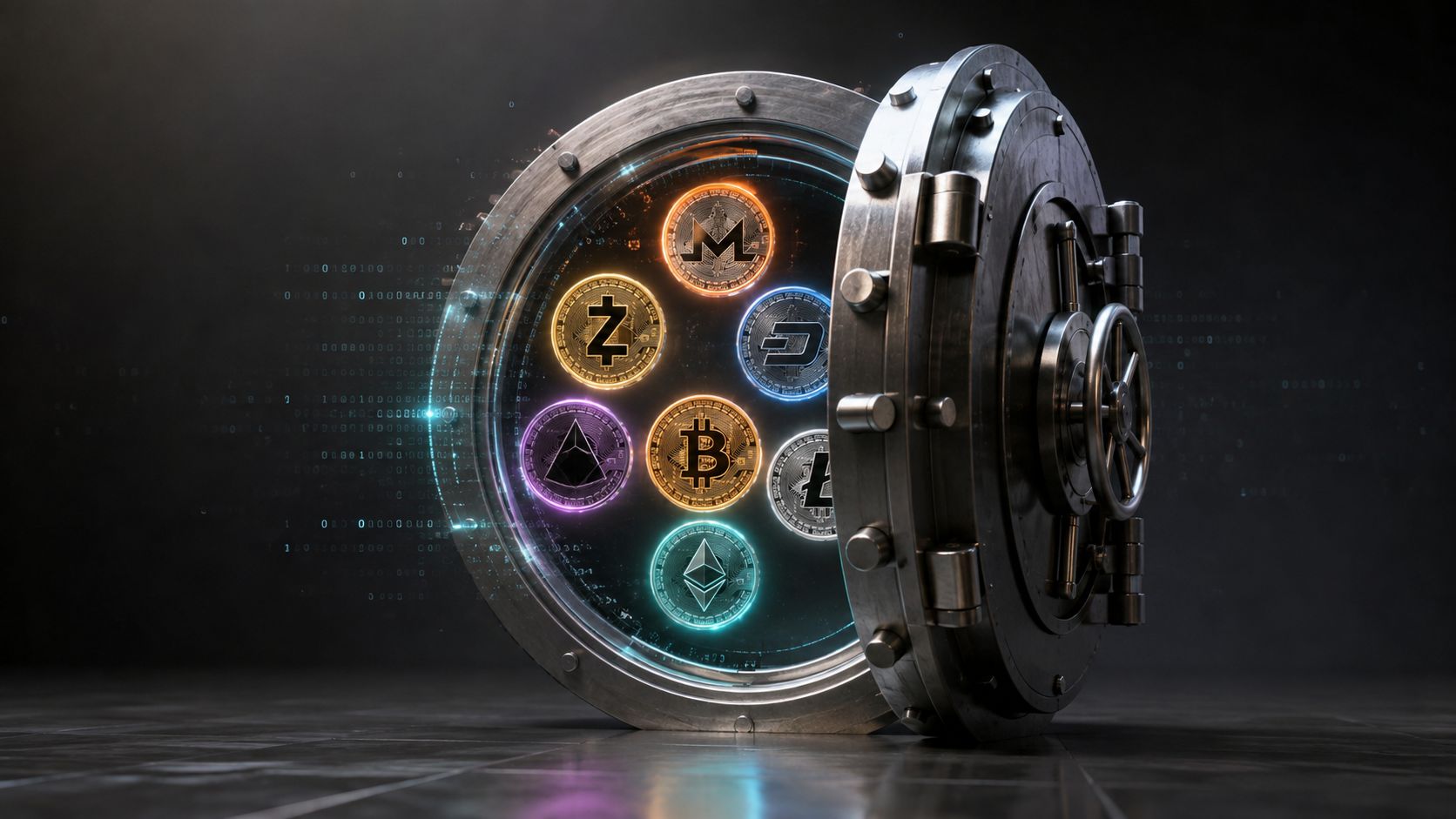
The popular advice says to choose a privacy coin by finding the asset that hides the most. That shortcut misses the central question: what exactly needs privacy? Hiding transaction participants and amounts is a different problem from shielding activity only when users opt in. Encrypting smart-contract inputs, outputs, or application state is different again. The best choice depends on the privacy model, not just the ticker.
This ranking evaluates seven projects by the problem they solve, including private payments, optional shielding, private assets, confidential DeFi, mandatory privacy, and confidential smart-contract execution. It also considers privacy defaults, technology assumptions, practical usability, ecosystem maturity, liquidity, wallet and exchange access, and regulatory exposure. Readers researching proxy high anonymity in 2026 should apply the same distinction between network privacy and the broader identity trail created by exchanges, wallets, and counterparties.
Prices, listings, project details, and legal treatment change quickly, so verify them through recent reputable sources before acting. This article is educational, not personalized financial advice.
Table of Contents
- 1. Monero XMR
- 2. Zcash ZEC
- 3. Firo FIRO
- 4. Beam BEAM
- 5. Pirate Chain ARRR
- 6. Secret Network SCRT
- 7. Oasis Network ROSE
- Top 7 Privacy Coins Comparison
- How to Assess Privacy Coins Safely
1. Monero XMR
Monero ranks first for the most direct privacy problem, private peer-to-peer payments. Its design hides the sender, receiver, and amount on every transaction through ring signatures, stealth addresses, and RingCT, rather than asking users to activate a separate private mode. That default matters because privacy can weaken when users choose the wrong address, route, or wallet setting.
The network also uses RandomX, a CPU-friendly proof-of-work algorithm intended to support broader participation in mining than hardware designs that favor specialized equipment. Monero's mature ecosystem includes GUI and command-line wallets, hardware-wallet support, community documentation, and network-layer privacy protections. The project's official resources are available through getmonero.org.
Why default privacy changes the user experience
A default-private system reduces one major operational failure: forgetting to shield a payment. That makes Monero a stronger fit for users who want consistent confidentiality and fungible digital cash, rather than selective disclosure or private application execution. Its long-running community and broad node participation also give the project a comparatively mature operational foundation.
Practical rule: A privacy default protects users from one class of mistake, but it doesn't erase exchange records, identity checks, wallet compromise, or careless payment disclosures.
The tradeoff is access. Some centralized venues have removed Monero, including Binance in 2024, which can make deposits, withdrawals, and fiat exits harder. Monero transactions also carry a larger data burden and lower throughput than some non-private Layer 1 networks. Anyone comparing custodial access with a no-KYC crypto wallet should still verify local rules, wallet provenance, and withdrawal support before transferring funds.
2. Zcash ZEC
Zcash addresses a different problem, optional shielded transfers. It uses zero-knowledge proofs to let users conceal sender, receiver, and amount in shielded transactions, while transparent transfers remain visible. That flexibility can suit users who want privacy in some situations and public verifiability in others, but it creates a key usability tradeoff: privacy depends on the route users take.
The Orchard shielded pool uses Halo 2 proving technology, and Unified Addresses aim to make transparent and shielded flows easier to manage. Zcash also has an active development and governance process supported by a development fund. The project's official site is z.cash, while a plain-English explanation of the underlying concept is available in this guide to zero-knowledge proofs.
The privacy setting is part of the risk model
Zcash's cryptographic research pedigree is a major strength. Shielded transactions can protect sensitive details without requiring the network to reveal them publicly, and the wallet experience has improved around shielded flows. Fees are also generally positioned as low-cost for users, though the practical route depends on wallet and exchange support.
The weakness is behavioral and infrastructural. If users transact transparently, the chain exposes the same basic payment information that public networks reveal. A smaller effective anonymity set can result when only a portion of activity uses shielding. Security also deserves attention, because a counterfeiting vulnerability in Orchard was disclosed in July 2026 and remains an issue for users reviewing current project communications.
Zcash has also attracted strong market attention. CoinMarketCap's privacy category recorded a sector snapshot on August 24, 2026, with Zcash at about $14.07 billion and Monero at about $8.04 billion, alongside a combined privacy-coin capitalization of about $39.94 billion. Those figures describe market concentration, not the quality of a user's privacy.
3. Firo FIRO
Firo is aimed at private assets, not merely private transfers. Its Lelantus Spark system is designed to conceal sender, receiver, and amount, while Elysium and Spark Assets extend the privacy architecture to custom tokens. That gives Firo a more specialized thesis: privacy should apply to the assets built on the network, not only to the native coin.
Official wallets use Spark addresses as the default direction for everyday activity, which can reduce the chance that users accidentally remain in a less private mode. FiroPoW is designed to remain friendly to GPU miners and resistant to specialized ASIC and FPGA dominance. Readers can review the project's current documentation at firo.org.
A privacy pool for more than one asset
The most interesting feature is the relationship between Spark Assets and the shared anonymity pool. If custom assets use the same privacy infrastructure as FIRO, the network can offer a common privacy environment for a broader set of tokenized instruments. That matters for tokenization use cases where balances, transfers, or ownership patterns shouldn't be fully exposed to every observer.
Firo's development history also reflects a sustained research focus, moving from Zerocoin through Sigma and Lelantus toward Spark. Its roadmap emphasizes private assets and integrations, which gives the project a clearer differentiation than copying a private-payment model.
The limitations are practical. Firo has less market depth and fewer major exchange listings than the largest privacy coins, so execution may be more difficult. Its masternode structure adds operational complexity for participants, and prospective users should understand the requirements, incentives, and governance implications before treating the network as a simple wallet-payment system.
For investors, that distinction is important. Firo's technology may solve a narrower but valuable problem, while its smaller liquidity profile increases the risk that market access becomes the binding constraint.
4. Beam BEAM
Beam targets confidential DeFi and private digital assets through a Mimblewimble-based Layer 1. Confidential transfers are the default, and cut-through removes certain redundant transaction data from the chain, helping keep the ledger more compact. Beam extends that foundation with confidential assets, a built-in confidential decentralized exchange, NFT tooling, and a virtual machine for confidential decentralized applications.
The project's ecosystem is presented through beam.mw, where users can explore its wallet and network resources. BeamHash III proof of work is GPU-minable, giving the chain a mining model distinct from both ASIC-heavy networks and CPU-oriented RandomX.
Privacy becomes an application layer
Beam's strength is integration. A user or developer can work with confidential transfers, assets, trading, and decentralized applications within one chain rather than stitching together separate privacy tools. That makes Beam especially relevant to builders thinking about private DeFi positions, confidential NFT activity, and application data that shouldn't be visible to every wallet watcher.
Mimblewimble's cut-through also changes how observers interpret the ledger. The chain is designed around compact transaction representation rather than the conventional account-history model, which can support a smaller on-chain data footprint. The benefit comes with a cost: users need to understand Beam-specific tooling, and the design may offer less flexibility or auditability than general-purpose public smart-contract chains.
Liquidity remains the key concern. Beam has smaller exchange support in the United States than large-cap privacy assets, and that affects the route from acquisition to custody to exit. Users shouldn't confuse a technically coherent confidential DeFi stack with broad market availability. For Beam, wallet compatibility, supported trading venues, and application activity deserve as much attention as the privacy mechanism.
5. Pirate Chain ARRR
Pirate Chain solves the problem of mandatory privacy. It uses Sapling zero-knowledge shielded transactions for all transfers and doesn't provide a transparent transaction pool. That design makes the privacy decision simple: users can't accidentally send a transaction publicly because the network requires shielded movement.
The project builds on a Zcash-derived architecture and uses Komodo's delayed proof of work, or dPoW, for periodic notarization intended to strengthen protection against chain reorganization and majority-mining attacks. Official information is available at piratechain.com.
The advantage and cost of forcing privacy
Mandatory shielding can improve practical fungibility because every transaction belongs to the same broad privacy regime. Users don't have to guess whether a counterparty used a transparent address, and wallets can focus their experience around shielded activity. Pirate Chain's light-wallet ecosystem also reflects that narrow purpose.
That simplicity shouldn't be mistaken for universal convenience. A mandatory-private network can create more friction when exchanges, wallets, and counterparties expect transparent transaction formats. Smaller liquidity and narrower exchange availability, especially in the United States, may make acquisition and exit more difficult than the on-chain transfer itself.
The dPoW design adds another consideration. Notarization through Komodo's network can provide an additional security layer, but it also introduces an external dependency that users and investors need to understand. The security model isn't identical to a self-contained proof-of-work chain.
Pirate Chain therefore ranks highly for a specific user preference, always-on privacy, but lower for ecosystem breadth. It may appeal to users who believe optional privacy creates too many behavioral weaknesses. It may be a poor fit for anyone who needs broad exchange access, simple institutional custody, or easy movement between public and private environments.
6. Secret Network SCRT
Secret Network moves privacy beyond payments into confidential smart-contract execution. Secret Contracts run inside trusted execution environments, or TEEs, so applications can process encrypted inputs, outputs, and state. This model supports private tokens through the SNIP-20 standard, viewing keys for controlled disclosure, and cross-chain integrations designed to bring programmable privacy into a broader Web3 environment.
The network uses Cosmos-based tooling and staking, while SCRT serves as the fee and staking token. Developers can review the ecosystem through scrt.network, and readers exploring the changing assumptions behind cryptographic systems can consult this discussion of the future of cryptography.
Smart contracts need a different privacy model
Secret's core contribution is programmability. A private payment hides a transfer, but a private contract can hide application inputs, user positions, business logic, or state while still executing rules. That opens use cases in confidential DeFi, private data markets, identity-aware applications, and Web3 products that need selective disclosure rather than total public visibility.
The tradeoff is the TEE threat model. Users must trust particular hardware and the security assumptions surrounding that hardware, including the possibility of implementation flaws or compromised environments. That differs from a design relying primarily on publicly verifiable cryptographic proofs.
SCRT itself also shouldn't be described as a default-private payment coin. Users often wrap tokens, including sSCRT, to obtain the relevant privacy behavior inside the network. The result is a separation between the privacy of an application and the privacy of the native token. Secret is therefore better understood as privacy infrastructure for smart contracts than as a direct Monero alternative.
7. Oasis Network ROSE
Oasis Network is designed for confidential computation and privacy-preserving applications. Its modular architecture separates consensus from ParaTimes, allowing specialized runtimes to address different performance and privacy requirements. Confidential ParaTimes, including Sapphire, use trusted execution environments to support encrypted transactions and confidential smart contracts, with EVM compatibility for developers familiar with Ethereum-style application tooling.
The official network resources are available at oasisprotocol.org. ROSE supports fees and staking, but the token itself isn't automatically private. Privacy arrives through the selected ParaTime or runtime, not through every base-layer transfer.
Infrastructure privacy isn't coin privacy
Oasis may be useful for builders who want confidential compute while retaining a public chain's broader verifiability and developer familiarity. Its modular design can separate workloads, letting applications choose an environment suited to privacy, scalability, or other execution needs. That makes the network relevant to confidential DeFi, data tokenization, AI-related applications, and enterprise-oriented Web3 systems when those applications require protected inputs or state.
The same architecture creates an analytical trap. A privacy-enabled runtime doesn't mean that holding ROSE provides private digital cash. Users need to identify where the transaction occurred, which assets were wrapped or moved, and what information remains visible on the consensus layer.
Oasis also relies on TEE assumptions, so its security model differs from Monero's default-on transaction privacy and Zcash's zero-knowledge shielding. Hardware trust, runtime security, wallet support, and application implementation all matter. The project can rank among the top privacy coins by category exposure, but it belongs in a different comparison set from private-payment networks.
Top 7 Privacy Coins Comparison
| Protocol | Implementation Complexity 🔄 | Resource Requirements ⚡ | Privacy Effectiveness ⭐ | Ideal Use Cases 💡 | Key Advantages 📊 |
|---|---|---|---|---|---|
| Monero (XMR) | Moderate, built-in ring sigs, stealth addresses and RingCT with user-friendly wallets | CPU-friendly RandomX mining; larger tx sizes → higher bandwidth/storage | ⭐⭐⭐⭐⭐, privacy-by-default on-chain for all transactions | Peer-to-peer cash, fungibility-focused transfers | Default strong privacy, broad node base, mature tooling |
| Zcash (ZEC) | High, modern zk-proofs (Orchard/Halo 2) and optional shielded flows add complexity | High proving/resource cost for shielded txs (improving); low fees on-chain | ⭐⭐⭐, very strong when shielded; optional privacy reduces anonymity set | Selective privacy needs, research, regulatory-aware privacy | Audited/peer-reviewed zk tech, unified addresses, improving UX |
| Firo (FIRO) | Moderate, Lelantus Spark complexity but default Spark addresses simplify UX | GPU-friendly FiroPoW mining; tokenization stack (Elysium) adds tooling needs | ⭐⭐⭐⭐, strong default privacy including private assets | Private tokens/assets, everyday private payments with default shielding | Long privacy-research lineage, default wallet privacy, private asset support |
| Beam (BEAM) | Moderate, Mimblewimble (cut-through) requires interactive tx tooling and VM for dApps | Lower on-chain data footprint; GPU-minable; confidential VM adds runtime cost | ⭐⭐⭐⭐, strong confidential transfers; compact chain improves scalability | Confidential DeFi/NFTs, private assets and compact-chain use cases | Native confidential DEX/assets, reduced chain size, integrated UX |
| Pirate Chain (ARRR) | Moderate, Sapling-only mandatory shielding simplifies UX but adds protocol deps | Higher proving cost; uses Komodo dPoW notarization (external dependency) | ⭐⭐⭐⭐⭐, shielded-only by design maximizes practical anonymity set | Maximum-privacy transfers, fungibility-critical use cases | Always-private UX, dPoW adds extra 51% resistance |
| Secret Network (SCRT) | High, TEEs + encrypted smart-contract state; different development model | Requires TEE-enabled nodes and staking; bridge/runtime overhead | ⭐⭐⭐, strong programmable privacy but depends on TEE trust assumptions | Privacy-preserving smart contracts, private tokens, data-sensitive dApps | Encrypted state contracts, SNIP-20 private tokens, Cosmos tooling |
| Oasis Network (ROSE) | High, modular ParaTimes and confidential runtimes increase orchestration complexity | ParaTimes require TEE hardware for confidential runtimes; staking and runtime ops | ⭐⭐⭐–⭐⭐⭐⭐, privacy depends on chosen ParaTime; confidential ParaTimes are strong | Confidential compute at scale, data tokenization, specialized privacy runtimes | ParaTime modularity, scalable confidential compute, EVM/TEE combos |
How to Assess Privacy Coins Safely
Start with the problem, not the market-cap list. Choose Monero when the need is consistent private payments. Consider Zcash when optional shielding and selective disclosure matter. Look at Firo for private custom assets, Beam for confidential DeFi and asset tooling, Pirate Chain for mandatory privacy, and Secret or Oasis for confidential smart-contract execution.
The market itself is concentrated. A CoinGecko privacy-coin category snapshot placed Monero around $8.39 billion and Zcash around $14.07 billion in major 2026 market snapshots, with both among the category's more liquid names. Another Forbes-linked market snapshot estimated the combined sector at $22.7 billion in January 2026, with Monero and Zcash accounting for 85% of it. Market leadership can help with liquidity and venue access, but it doesn't prove that a network provides the right privacy for your use case.
Separate the technology from the token
This distinction is essential for SCRT and ROSE. Secret Network can execute confidential contracts, but SCRT isn't automatically a private coin. Oasis can provide confidential ParaTimes, but ROSE's base token doesn't inherit every runtime's privacy property. By contrast, Monero's core payment design is privacy-first, while Zcash makes privacy dependent on shielded use.
Evaluate each project across several practical questions:
- Define the data to protect: Decide whether the priority is payment participants, amounts, asset balances, contract inputs, application state, or business logic.
- Check the default: Confirm whether privacy is mandatory, automatic, optional, or limited to a specific runtime, wallet, address type, or wrapped asset.
- Understand the trust model: Distinguish ring signatures, zero-knowledge proofs, Mimblewimble, and TEEs. Hardware-based confidentiality carries different assumptions from cryptographic proof systems.
- Test the workflow: Review wallet recovery, viewing keys, address formats, transaction modes, and counterparty compatibility. Use official wallet software and test with small amounts.
- Verify the route: Check current exchange listings, deposits, withdrawals, liquidity, and local legal treatment before moving funds.
Regulation can alter access faster than technology changes. Dubai's updated 2026 framework reportedly prohibited privacy coins across the Dubai International Financial Centre and onshore Dubai from January 12, 2026, including issuance, listing, and trading of anonymity-enhanced assets such as Monero and Zcash, according to Bitcoin.com's report. India's Financial Intelligence Unit also ordered exchanges to stop trading Monero, Zcash, and similar privacy assets on January 23, 2026, as reported in this regulatory brief.
European access has its own future constraint. Crypto.news reported that Regulation (EU) 2024/1624 is scheduled to take effect on July 10, 2027, and will bar regulated crypto-asset service providers from offering accounts or services that anonymize transactions. The rule reportedly doesn't ban peer-to-peer ownership, but regulated on-ramps and off-ramps may need to restrict or delist privacy assets.
Before risking funds, review network security, development activity, token economics, custody options, and current market data. Use secure wallets, keep recovery material offline, test unfamiliar transaction paths with small amounts, and treat this ranking as an analytical framework rather than financial advice.
Coiner Blog publishes balanced guides and analysis on privacy coins, Bitcoin, Ethereum, DeFi, Web3, tokenomics, Layer 2 networks, AI and crypto, and real-world asset tokenization. Visit Coiner Blog to follow practical coverage that explains both blockchain opportunities and the risks behind changing markets.