
What Is Restaking? a Clear Guide to How It Works in 2026

Restaking is a mechanism that reuses already-staked ETH to secure additional blockchain services through a restaking protocol such as EigenLayer, earning extra rewards on top of base staking yield. The model scaled from launch to more than $19.3 billion in locked restaking by late November 2024, based on over 6.25 million ETH.
That growth explains why “what is restaking” has become a practical question rather than a purely technical one. Restaking changes what staked ETH does, who can impose rules on it, and how many systems can penalize the same economic collateral. In 2026, the more useful question isn't whether restaking offers another reward stream. It's whether the token, vault, or staking product you hold still includes restaking exposure at all.
Table of Contents
- Restaking in 2026 and Why It Matters Now
- How Restaking Works Step by Step
- Restaking vs Native Staking and Liquid Staking
- Slashing Mechanics and Shared Security
- The 2026 Unbundling Debate
- Systemic Risk Versus Isolated Smart Contract Risk
- Practical Checklist Before You Restake
Restaking in 2026 and Why It Matters Now
By 2026, the restaking market held roughly $13.45 billion in total value locked and generated more than $527,000 per day in fees, according to recent market coverage. Those figures show an active market, while the 2026 product debate asks a harder question: does a token still carry restaking exposure, or does it represent only a narrower staking position?
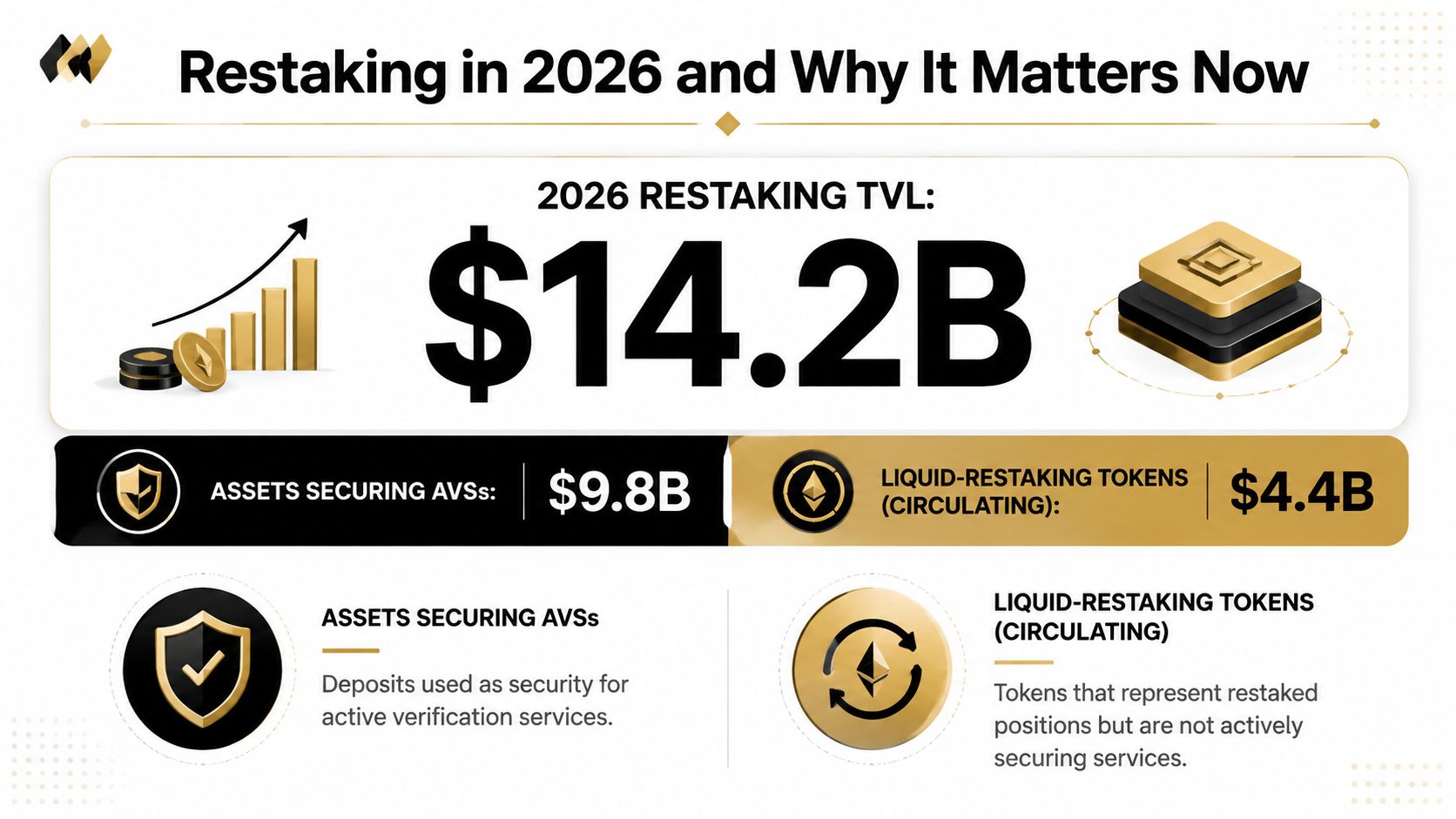
Restaking addresses a practical problem. A bridge, oracle, data-availability system, rollup service, or another Web3 application needs economic security. Building an independent validator set takes time, capital, and operating expertise. Restaking lets that service use collateral already securing Ethereum instead of creating a separate security economy.
From single-purpose stake to shared security
Ethereum staking normally gives ETH one main role, securing Ethereum's proof-of-stake consensus. Restaking adds other duties. Through a protocol such as EigenLayer, a staker or liquid-staking token holder can make the same underlying economic value available to Actively Validated Services, commonly called AVSs.
Each AVS can set its own duties, rewards, and penalties. Operators run the required software and perform validation work. Delegated stakers accept the possibility that their associated stake may be penalized if those rules are broken. The benefit is capital efficiency. The tradeoff is shared exposure across several security domains.
Practical rule: Extra rewards aren't free yield. They compensate for additional technical, operational, liquidity, and slashing risk.
Restaking first launched on Ethereum mainnet in June 2023. By April 2024, EigenLayer had introduced its Operator and AVS mainnet, while reports said 3.6 million ETH, worth more than $12 billion at the time, had been deposited. By late November 2024, coverage estimated that more than 6.25 million ETH, equivalent to about $19.3 billion, was locked, according to the EigenLayer restaking market overview.
The 2026 unbundling debate gives those figures useful context. Market value alone cannot show what a deposit secures, which operators control it, or whether a liquid token actively secures an AVS. A product may separate ordinary staking from restaking, reducing shared exposure while changing its reward profile. That distinction matters for users comparing tokens, vaults, and staking services. Teams hiring for this infrastructure can consult a guide for Web3 recruiters when assessing validator-operations and engineering skills.
How Restaking Works Step by Step
EigenLayer provides a useful model, although interfaces and asset routes differ across restaking protocols. The process starts with a user who already holds staked ETH, either through native Ethereum staking or through a liquid-staking token such as stETH.
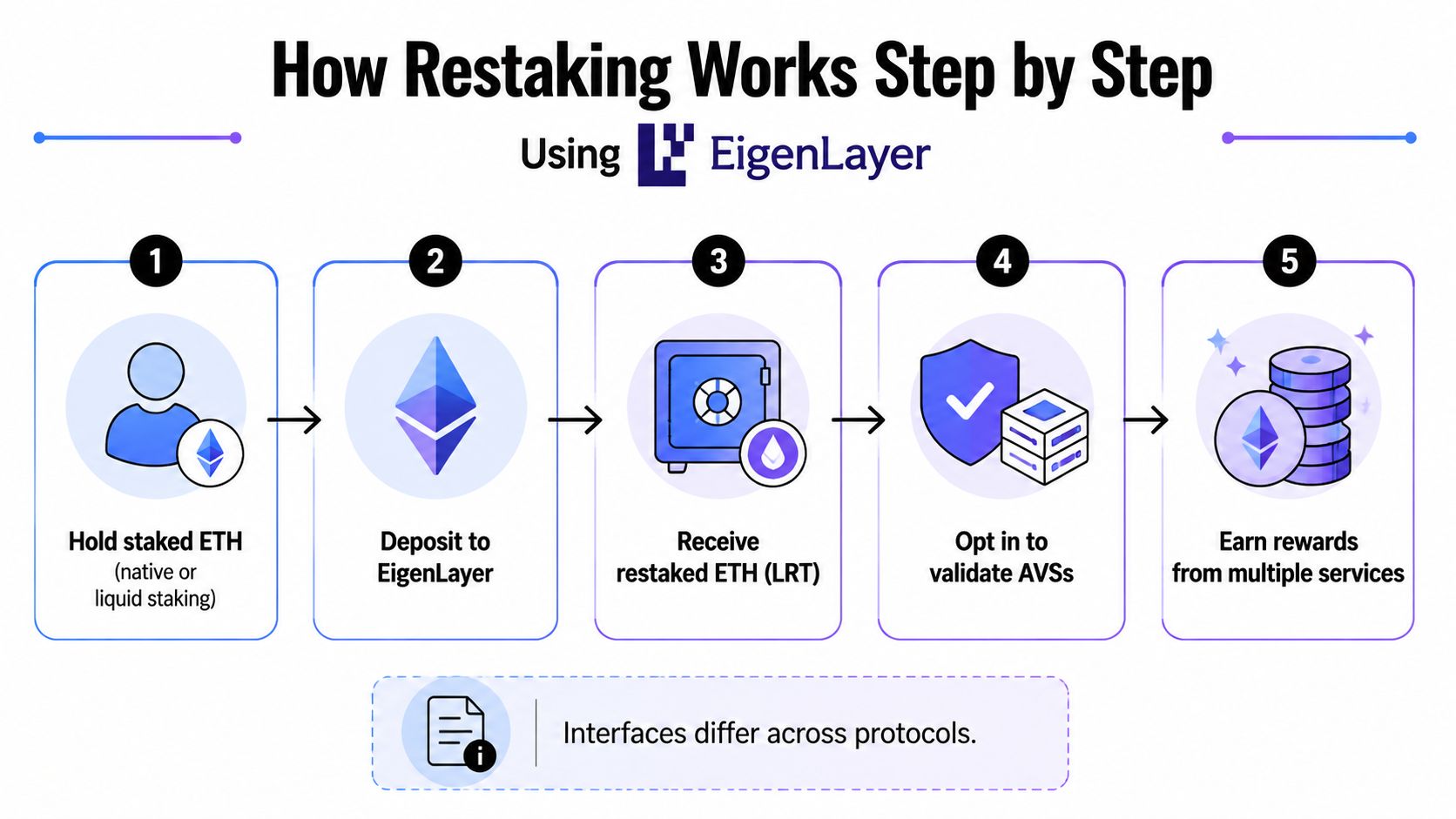
The five-part workflow
Hold a supported staking position. The user begins with native staked ETH or an eligible liquid-staking token. Liquid staking can make the position transferable, but it doesn't remove the underlying validator and protocol dependencies.
Deposit or delegate through the restaking protocol. The user deposits the supported asset into EigenLayer or uses a supported delegation route. Delegating control to an operator doesn't necessarily transfer ownership of the underlying ETH. Depending on the design, the user may receive a receipt or liquid-restaking token representing the position.
Choose an operator. Operators run validator infrastructure and the software required by participating AVSs. The staker can delegate security to an operator instead of installing and maintaining every component personally.
Opt into AVSs. The operator selects one or more services, such as a bridge, oracle network, data-availability system, or coprocessor. Each AVS publishes performance requirements, reward terms, and slashing conditions. The operator must follow those rules to remain eligible.
Receive rewards and manage the exit. The user can earn base Ethereum staking rewards plus additional incentives associated with the AVSs. Fees and penalties depend on protocol-specific accounting, and the user must understand the exit process before accepting the position.
The key relationship is straightforward:
staker provides collateral, operator performs the work, AVS defines the rules, and the protocol enforces the accounting.
If an operator runs three AVSs, the delegated position faces three independent sets of service rules. That doesn't mean every service will penalize the stake at once, but it does mean the operator's software, monitoring, and governance decisions affect a wider risk surface.
A short explainer can make the process sound like a yield strategy. Technically, it's closer to signing several security agreements with one pool of collateral.
Restaking vs Native Staking and Liquid Staking
The easiest way to understand restaking is to separate it from the two activities it builds on. Native staking secures Ethereum directly. Liquid staking creates a transferable representation of that staked position. Restaking extends the security commitment to additional services.
| Feature | Native Staking | Liquid Staking | Restaking |
|---|---|---|---|
| Primary purpose | Secure Ethereum consensus | Secure Ethereum while creating a transferable receipt | Reuse staked collateral to secure AVSs |
| Security target | Ethereum | Ethereum | Ethereum plus additional services |
| User liquidity | Governed by Ethereum withdrawal and exit rules | Provided through a liquid-staking token and redemption or market liquidity | May be represented by a liquid-restaking token, with added exit dependencies |
| Main reward source | Base Ethereum staking rewards | Base staking rewards reflected through the derivative | Base staking rewards plus additional AVS incentives |
| Main added risk | Validator performance, Ethereum rules, and withdrawal delays | Smart contracts, token pricing, governance, and redemption liquidity | AVS slashing, operator behavior, restaking contracts, liquidity, and correlated failures |
| Core distinction | Direct network participation | A liquid representation of staking | Additional security obligations and rule sets |
Native staking is the most direct model. A validator or delegated operator follows Ethereum's consensus rules, and the staker receives the network's base staking rewards. The position may face withdrawal delays, operational failures, or Ethereum-level slashing, but it isn't automatically exposed to an external AVS.
Liquid staking changes the form of the exposure. The protocol issues an asset such as stETH that represents a claim on staked ETH. Users can potentially use that token across DeFi, including lending markets and decentralized exchanges, but they add smart-contract, governance, redemption, and market-liquidity dependencies. The Ethereum proof-of-stake guide provides useful background on the base layer before you assess the extra layers.
Restaking adds a different type of risk. It doesn't merely make staked ETH easier to trade. It gives additional services permission to define conditions under which the associated stake can be penalized. Ethereum's staking documentation explains that each added application can introduce its own slashing conditions and that withdrawals may face extra delays, as described in the Ethereum staking documentation.
That distinction matters when comparing tokens. A liquid-staking token isn't automatically a restaking token, and a token marketed as liquid restaking may represent assets that aren't currently active across every advertised service. Read the current product documentation, operator allocation, AVS list, and redemption terms instead of treating a ticker or headline yield as a complete risk description.
Slashing Mechanics and Shared Security
Restaking's central technical feature is the ability to enforce additional rules against collateral that already participates in Ethereum staking. EigenLayer's whitepaper describes a system in which a staker who behaves adversarially while participating in an AVS can have ETH slashed and frozen, preventing further participation on EigenLayer. The document also says that ETH withdrawn from Ethereum consensus participation through EigenLayer can remain subject to an AVS's on-chain slashing contract.
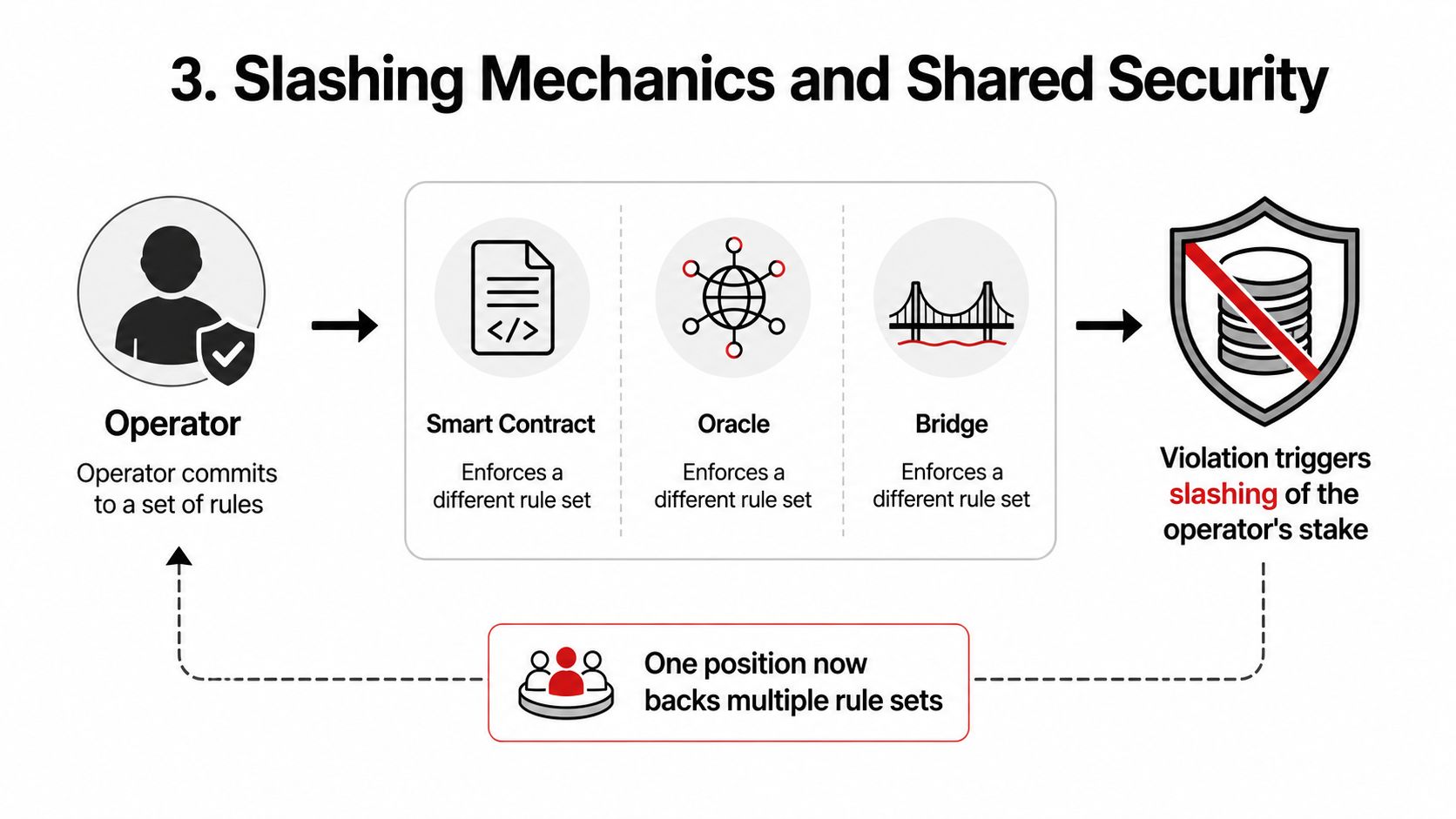
One position, several rule books
Suppose an operator validates an oracle AVS and signs an invalid report. The AVS needs a way to prove the violation, identify the responsible operator, and direct the penalty through the relevant on-chain contracts. The delegated stake can then be reduced or frozen according to that service's rules.
The important point isn't only the size of the penalty. It's the scope of the commitment. The same economic position may support an oracle, a bridge, and a data-availability service, with each system defining different performance or honesty requirements.
EigenLayer's documentation identifies two broad concerns:
- Operator collusion: Multiple operators could coordinate an attack against several AVSs at the same time.
- Unintended slashing: A software or contract vulnerability could penalize honest operators.
The enforcement design can also extend beyond the moment a user tries to exit. Withdrawal controls and slashing contracts can preserve a service's ability to enforce a valid penalty after the user has stopped actively participating, subject to the protocol's defined rules and delays. That's why an apparent exit button doesn't always mean immediate removal from every obligation.
What users should verify in 2026
Plan notes surrounding EigenLayer's 2026 deployment status distinguish between available liquid-staking and liquid-restaking routes and native ETH restaking. Native ETH restaking on EigenLayer remains not yet live on mainnet as of 2026, so users shouldn't assume every route offers identical enforcement guarantees or technical behavior.
This distinction affects custody, withdrawal, and slashing analysis. An LST route may inherit the liquid-staking protocol's contracts and validator arrangements. An LRT route may add another token contract, accounting layer, and operator-allocation process. Users need to identify which component controls delegation and which contract can impose penalties.
Shared security means shared collateral, not shared responsibility. Each AVS still has its own rules, software, and failure modes.
The 2026 Unbundling Debate
Ether.fi's weETH split gives the 2026 debate a concrete example. Ether.fi is removing restaking from weETH, leaving the token focused on Ethereum staking, while the restaked share is expected to fall to zero in Q3 2026 as EigenLayer withdrawal credentials are removed later in 2026. The change was reported by CoinDesk's report on weETH.
For holders, the practical question changes. A liquid-staking token may represent base staking only, active AVS exposure, or a product whose design has recently changed. The token's name and past reward history cannot answer that question on their own.
Why protocols are separating the layers
Unbundling can make risk attribution clearer. A pure staking token connects more directly to Ethereum staking. A separate restaking product can then identify its operators, AVSs, slashing conditions, fees, and exit rules instead of placing every exposure inside one token.
The structure also separates user preferences. Someone seeking Ethereum staking exposure does not have to accept every AVS-related risk. Someone who wants restaking can select that layer deliberately and review its terms. The tradeoff is that extra incentives may have depended on subsidies, temporary emissions, or arrangements spanning several protocols, so separating the products can also expose how those returns were generated.
This does not prove that restaking was fictitious or that every reward was unsustainable. A product can support genuine economic activity and still become easier to evaluate after its risk components are split.
| Token | Issuer | Base Staking Component | Restaking Component | Status in 2026 |
|---|---|---|---|---|
| weETH | Ether.fi | Ethereum staking exposure | Being removed from the product | Ether.fi said the restaked share would fall to zero in Q3 2026 |
| ezETH | Renzo | Ethereum staking exposure | Depends on the active product and allocation design | Check current documentation before assuming exposure |
| Similar LRTs | Varies by issuer | Usually represented through an underlying staking position | Depends on operator and AVS participation | Treat each token as a separate product |
The final row carries the broader lesson. Product names do not establish current exposure. Governance decisions, withdrawal-credential changes, operator migrations, and revised reward programs can change which services a token supports.
Holders of weETH, ezETH, or similar tokens should review the issuer's current contract information, redemption process, AVS allocation, and reward source. Historical branding is not proof that restaking exposure remains active.
Systemic Risk Versus Isolated Smart Contract Risk
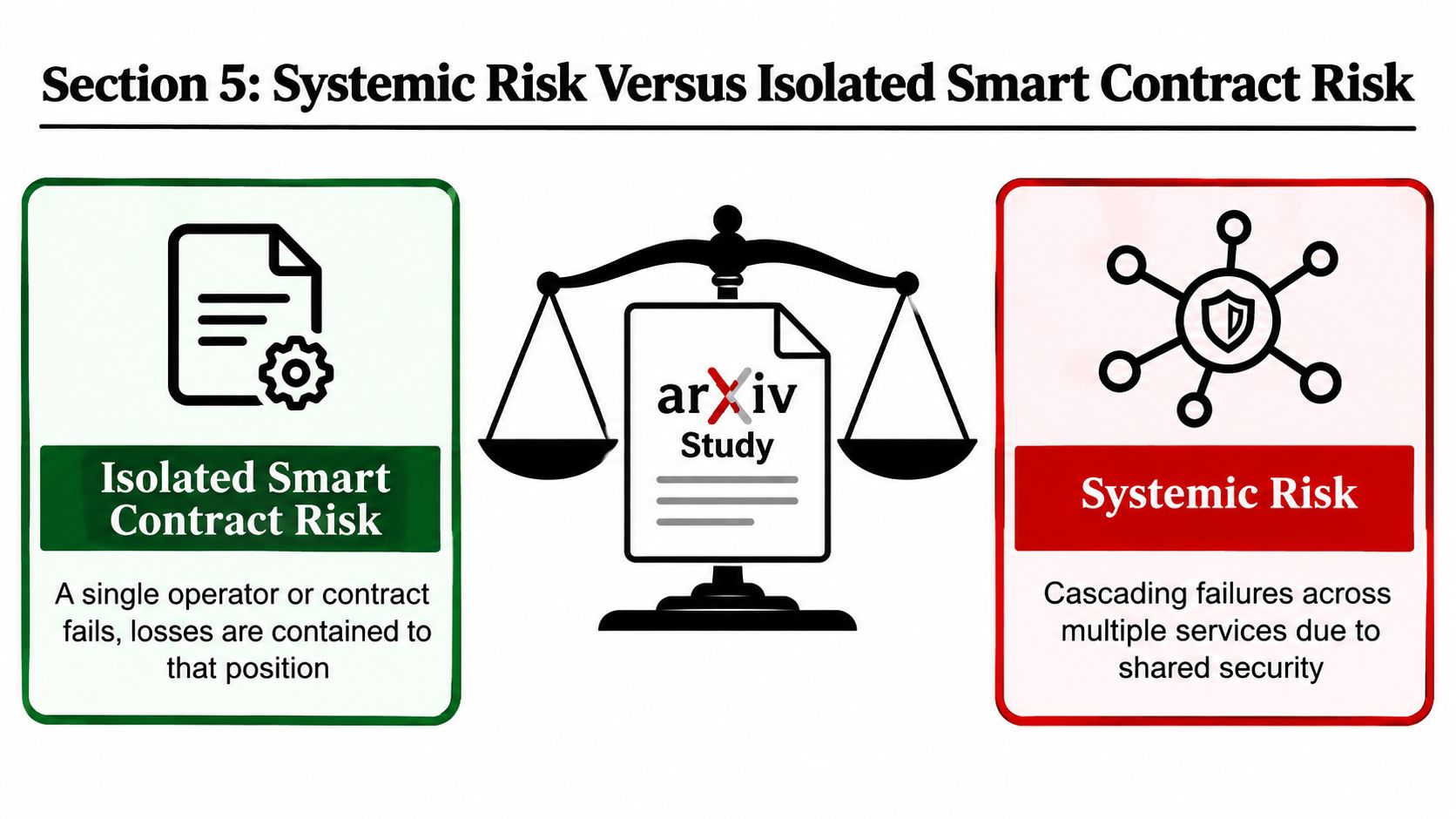
“Restaking is dangerous” is too broad to guide a decision. The useful distinction is between isolated loss and systemic contagion, especially as the 2026 unbundling debate separates base staking exposure from restaking services.
An isolated event might involve one operator, one AVS, or one restaking contract. A software defect could slash a position, while a smart-contract exploit could affect users of one protocol. That loss might be severe for those users yet remain contained within the protocol, without reaching Ethereum's wider validator set. Our smart contract basics guide provides further context on how individual contract exploits occur.
Systemic risk requires correlation. Failures across several operators or services could reduce confidence, trigger penalties across reused stake, or create pressure that spreads through linked products. The key question is whether a local failure stays local or reaches a shared dependency.
What the evidence says
An arXiv study of restaking risk, using data from January 2024 to April 2025, identified bridge exposure as another risk surface for liquid restaking. It also found that Renzo's liquid-restaking assets at that time did not pose systemic risk to the restaking ecosystem. The study judged cascading slashing through restaking unlikely to threaten Ethereum's network security because restaking represented a low percentage of total staked ETH.
That conclusion does not make individual protocols safe. It limits the claim. Restaking can still create contract, bridge, operator, governance, and liquidity risks without automatically threatening Ethereum as a whole.
Risk distinction: A protocol can be fragile for its users without being large enough to destabilize Ethereum.
Concentration links the two channels. If many users depend on the same provider, operator group, bridge, or AVS, an incident that starts locally can affect more positions at once. The 2026 market remains concentrated around a major provider, so operational and governance failures may reach many users even while network-level risk stays limited.
A practical assessment asks three questions:
- Position risk: Which contract or operator could directly penalize this deposit?
- Correlation risk: Do several AVSs depend on the same operator, software stack, bridge, or governance process?
- Network risk: Is reused collateral sufficiently large and concentrated for simultaneous failures to affect Ethereum's broader security assumptions?
For users, position risk is usually the immediate concern. Researchers and protocol designers also need to monitor whether shared dependencies could turn separate incidents into systemic contagion.
Practical Checklist Before You Restake
Restaking requires more than comparing reward rates. Before depositing ETH or an LST, identify the obligations attached to the position and decide whether you can tolerate the exit constraints if those obligations change.
Start with the operator
Review the operator's history, infrastructure, geographic distribution, monitoring practices, and AVS whitelist. A reputable operator can still make a software mistake, but unclear infrastructure or concentrated control makes it harder to understand where failure could originate.
Ask:
- Which AVSs does the operator currently support?
- Can the operator opt into new services without a fresh user decision?
- Does the operator explain its incident response and monitoring process?
- Are several services relying on the same infrastructure or signing setup?
- What happens if the operator stops performing duties?
The operator's reward share matters, but it shouldn't replace a review of technical controls. A higher advertised return generally reflects a more demanding or more layered risk profile, not a guaranteed improvement.
Inspect each AVS
Don't treat “shared security” as one uniform exposure. A bridge, oracle, and data-availability service can impose different duties and different consequences for failure.
Check the service's:
- Function: Determine whether it provides bridge verification, oracle data, data availability, or another type of validation.
- Slashing terms: Find the exact behavior that can trigger a penalty and who can initiate enforcement.
- Governance: Review how the service changes its rules, contracts, or operator requirements.
- Dependencies: Identify bridges, external data, upgrade keys, and shared software.
- Reward source: Separate protocol fees from temporary incentives or token distributions.
For a broader comparison of staking returns and their tradeoffs, readers can use this crypto staking APY guide as a starting point, then verify current protocol documentation directly.
Run a personal risk audit
Decide how much of your investable capital you're willing to place in restaked positions. Consider whether your holdings depend on one operator, one issuer, one bridge, or one redemption venue. Diversification only helps if the positions don't share the same failure point.
Track AVS governance proposals and operator changes after depositing. Confirm how undelegation works, how long withdrawals can take, and whether a position remains subject to penalties during an exit window. If the service adds a new obligation or changes its enforcement model, be ready to undelegate rather than treating the original product description as permanent.
Coiner Blog offers practical cryptocurrency guides and balanced analysis across Ethereum, DeFi, Web3, smart contracts, and emerging blockchain infrastructure. Visit Coiner Blog to follow clear explanations of evolving crypto products and make better-informed decisions about restaking exposure.