
What Is EVM and Why It Powers Ethereum Smart Contracts

The Ethereum Virtual Machine, or EVM, is the deterministic runtime that every Ethereum node uses to execute smart-contract bytecode and reach identical results. It runs within a block gas structure targeting 15 million gas and allowing a hard cap of 30 million gas, so execution remains bounded even when demand changes.
You may encounter the EVM when you sign a token swap in a wallet, deploy a DeFi contract, bridge assets to a Layer 2 network, or inspect a failed transaction on a block explorer. The wallet interface makes the action feel simple, but behind that click, Ethereum must interpret bytecode, charge for each operation, update shared state, and let the network agree on the result.
The useful mental model is a stack of responsibilities. Consensus determines which block and transaction order the network accepts. Execution runs the EVM and calculates state changes. Smart contracts provide the programs that users and applications call. Once those layers are clear, gas fees, accounts, opcodes, EVM-compatible chains, and post-Merge architecture become much easier to understand.
Table of Contents
- A Quick Answer for the Curious Reader
- How the EVM Fits Into Ethereum's Bigger Picture
- Inside the EVM's Execution Model
- Gas, Opcodes, and Why Computation Costs Money
- How an EVM Transaction Actually Gets Processed
- EVM Compared to eWASM and Other Virtual Machines
- EVM Compatibility Across Chains and Developer Tools
- Security Risks, Common Misconceptions, and FAQ
A Quick Answer for the Curious Reader
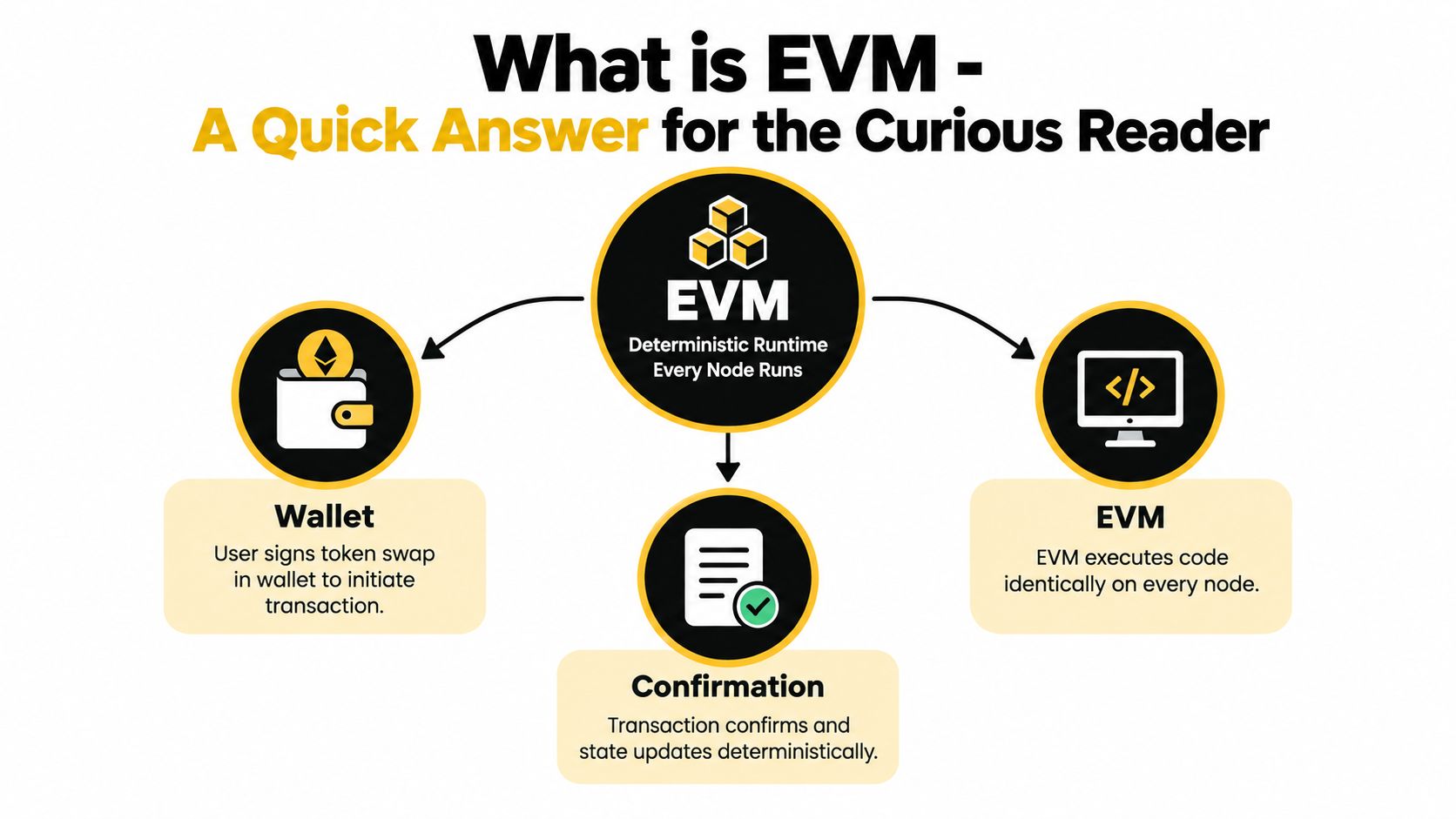
Suppose you're swapping one token for another through a decentralized exchange. Your wallet creates and signs a transaction, the network places it into a block, and the exchange contract executes its rules. The EVM is the shared runtime that interprets those rules, so Ethereum nodes can independently process the same transaction and arrive at the same state.
That word, deterministic, matters. The EVM isn't one physical computer in a data center, and it isn't a server that users connect to directly. Each participating node runs its own implementation of the execution environment. Given the same valid transaction, contract bytecode, and prior blockchain state, those nodes must calculate the same output.
Ethereum's fee model changed materially on August 5, 2021, when the London hard fork activated EIP-1559 at mainnet block 12,965,000. Before London, Ethereum used a first-price auction for gas. After London, a transaction pays a protocol-set base fee plus an optional priority fee, while the base fee is burned, creating a more predictable fee market and long-term deflationary pressure. The change followed development work that began in 2018 and continued through 2019 to 2021, as documented in Ethereum's fork history.
A practical way to explore Ethereum's broader architecture is through this Ethereum overview for beginners. Keep three questions in mind as you read: who orders the transaction, what code executes it, and which state changes does that execution produce? The consensus layer answers the first, the EVM handles the second, and the resulting Ethereum state records the third.
How the EVM Fits Into Ethereum's Bigger Picture
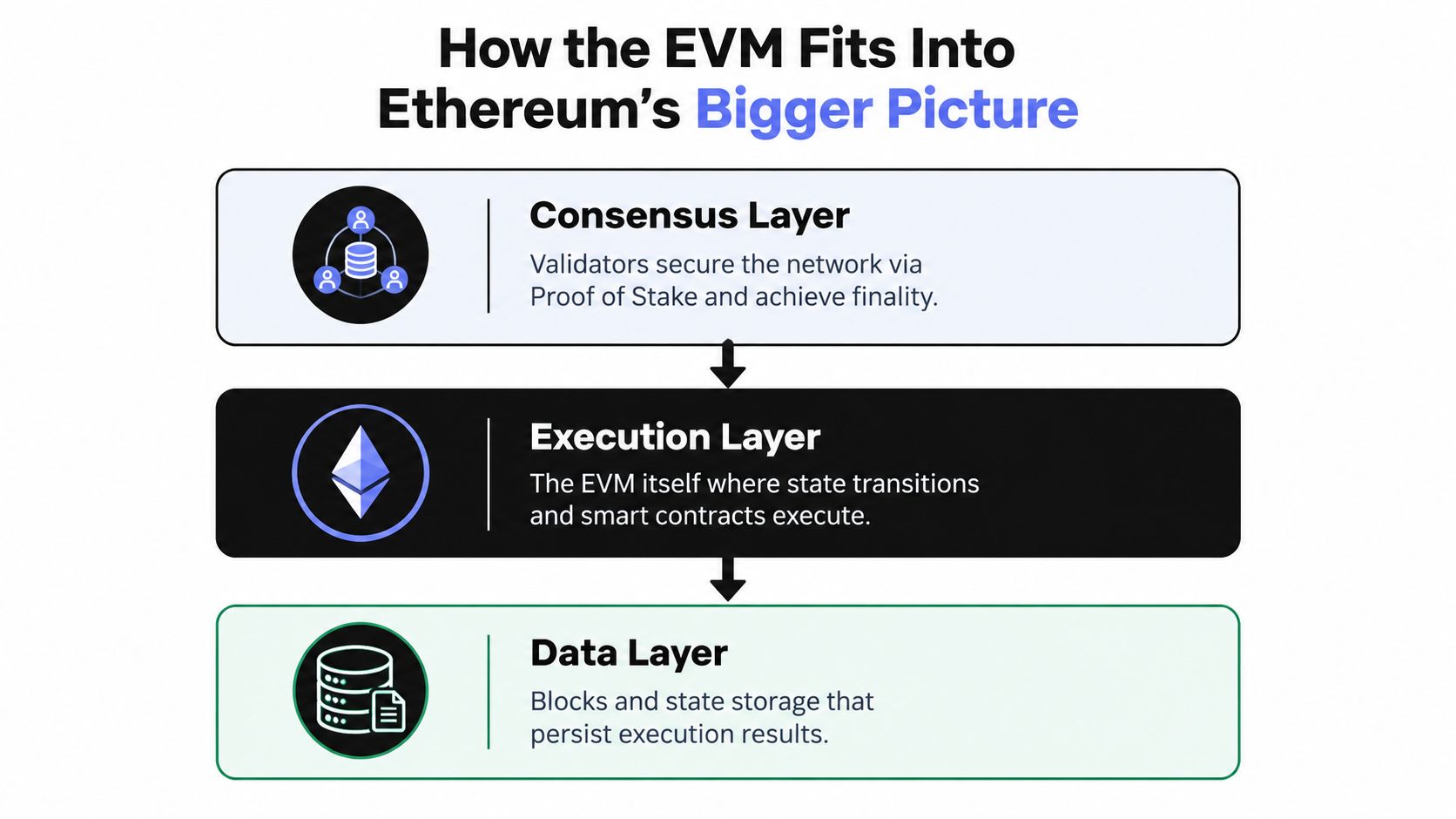
The EVM is the heart of Ethereum's execution layer, but Ethereum is larger than the runtime itself. A useful architecture separates the network into consensus, execution, and data responsibilities. Each layer performs a different job, and confusing them creates many of the misconceptions surrounding validators, smart contracts, and transaction finality.
The consensus layer uses proof of stake to coordinate validators, block proposals, attestations, and finality. Ethereum completed its transition from proof of work to proof of stake through the Merge on September 15, 2022, replacing proof of work for mainnet block production. The EVM continued running as the execution layer, so smart-contract bytecode and its behavior remained intact while validator incentives and block-proposal mechanics changed, as explained by Ethereum's institutions documentation.
The execution layer receives an ordered transaction payload and applies the EVM rules. It checks signatures and balances, interprets bytecode, charges gas, reads and modifies state, and returns the resulting state transition. The data layer preserves blocks, transactions, receipts, and state information so nodes can verify and replay what happened.
Why the post-Merge split matters
Before the Merge, people often described a single mining node as both ordering transactions and executing them. Today, the responsibilities are separated between consensus clients and execution clients. The consensus side coordinates the proposed block, while the execution side, using clients such as Geth, Nethermind, or Erigon, evaluates the transactions through the EVM.
That separation doesn't make execution optional. A validator can propose or attest to a block, but the block still needs a valid execution payload. The EVM remains a deterministic state machine, not a globally shared laptop. Every node that verifies the payload replays the relevant instructions locally and checks that the resulting state agrees with the protocol rules.
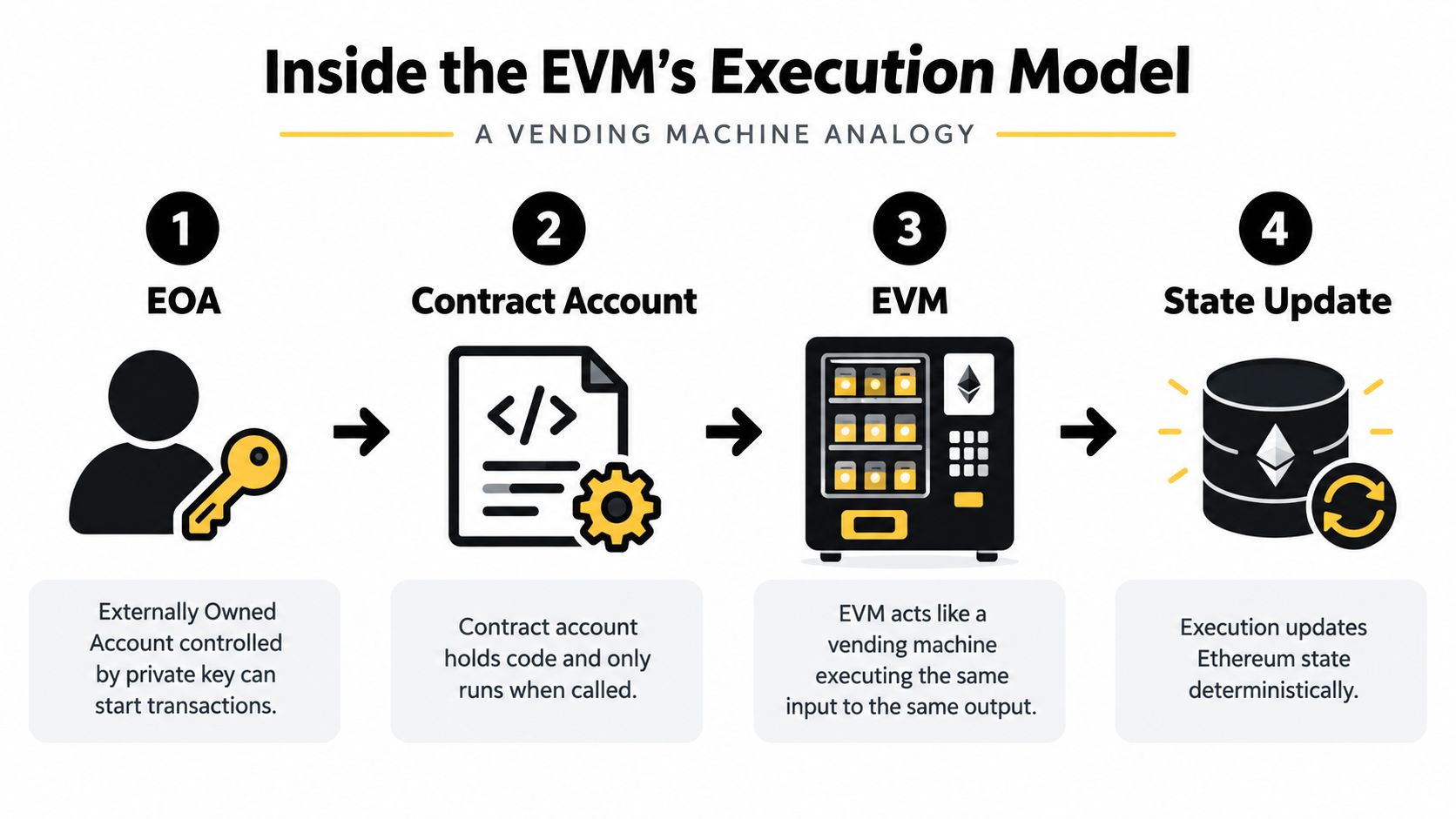
Accounts make the analogy more concrete. An externally owned account resembles the customer operating a vending machine, because a private key authorizes the initial request. A contract account resembles the machine itself, because its code determines what happens when another account calls it. The machine doesn't make an independent decision, and a contract account doesn't spontaneously initiate a transaction. It responds within the rules encoded in its bytecode.
Inside the EVM's Execution Model
A developer usually writes Solidity or another high-level language, not raw EVM instructions. The compiler transforms that source into bytecode, and the EVM consumes the bytecode as a sequence of low-level opcodes. This separation is similar to writing an application in a human-friendly language and compiling it into instructions a processor can execute.
The EVM is a quasi-Turing-complete execution environment defined by the Ethereum Yellow Paper. Its computation is deliberately bounded by gas, which prevents unlimited loops and resource exhaustion. It uses a stack-based architecture with 256-bit words, a design that fits the large integer arithmetic and cryptographic operations common in smart contracts, according to Ethereum's EVM documentation.
Accounts and the call path
An externally owned account, or EOA, is controlled by a private key and can start a transaction. A contract account is controlled by deployed code. When a user calls a contract, the EVM loads the relevant code, places call data and values into the execution context, then processes instructions one by one.
The EVM maintains temporary working areas and persistent contract storage. A calculation can use the stack and memory without permanently changing the blockchain, while a storage operation changes the contract's durable state. That distinction explains why a contract that performs arithmetic can have a very different gas profile from one that writes balances, ownership records, or token metadata.
Consider a simple addition. The compiled bytecode places two values on the stack, invokes ADD, and leaves the result available for the next instruction. If the contract instead needs to persist that result, it may use SSTORE, which writes to contract storage and carries a much heavier resource cost. The EVM doesn't care whether the original source was Solidity, Vyper, or another compiler-supported language. It cares about valid bytecode and protocol-defined execution rules.
This model creates a direct link between coding style and user fees. Developers cache repeated storage reads, batch related operations, avoid unnecessary contract creation, and reduce external calls because each choice changes the instructions and state accesses the EVM must process.
Gas, Opcodes, and Why Computation Costs Money
Gas is a metered execution budget, not merely a unit on a fee screen. It limits how much work a transaction can force Ethereum nodes to perform. The EVM reference documentation illustrates the uneven schedule: ADD costs 3 gas, MUL costs 5 gas, and SLOAD costs 2,100 gas for a cold access versus 100 gas for a warm access. Contract creation carries a minimum intrinsic cost of 32,000 gas.
| Opcode | Operation | Approximate Gas Cost | Why It Matters |
|---|---|---|---|
ADD |
Adds stack values | 3 gas | Pure arithmetic is comparatively cheap |
MUL |
Multiplies stack values | 5 gas | More work than addition, but still lightweight |
SLOAD |
Reads contract storage | 2,100 gas cold, 100 gas warm | Persistent state access can dominate execution cost |
| Contract creation | Deploys contract code | 32,000 gas minimum intrinsic cost | Deployment has a substantial fixed execution burden |
The price difference reflects what nodes must do. Arithmetic works with values already available in the execution context. Storage reads and writes interact with persistent state, while external calls may trigger additional execution and state access. An NFT mint, for example, can update ownership, balances, token identifiers, and metadata references, so its gas behavior is driven less by the math than by the state it touches.
From signature to state change
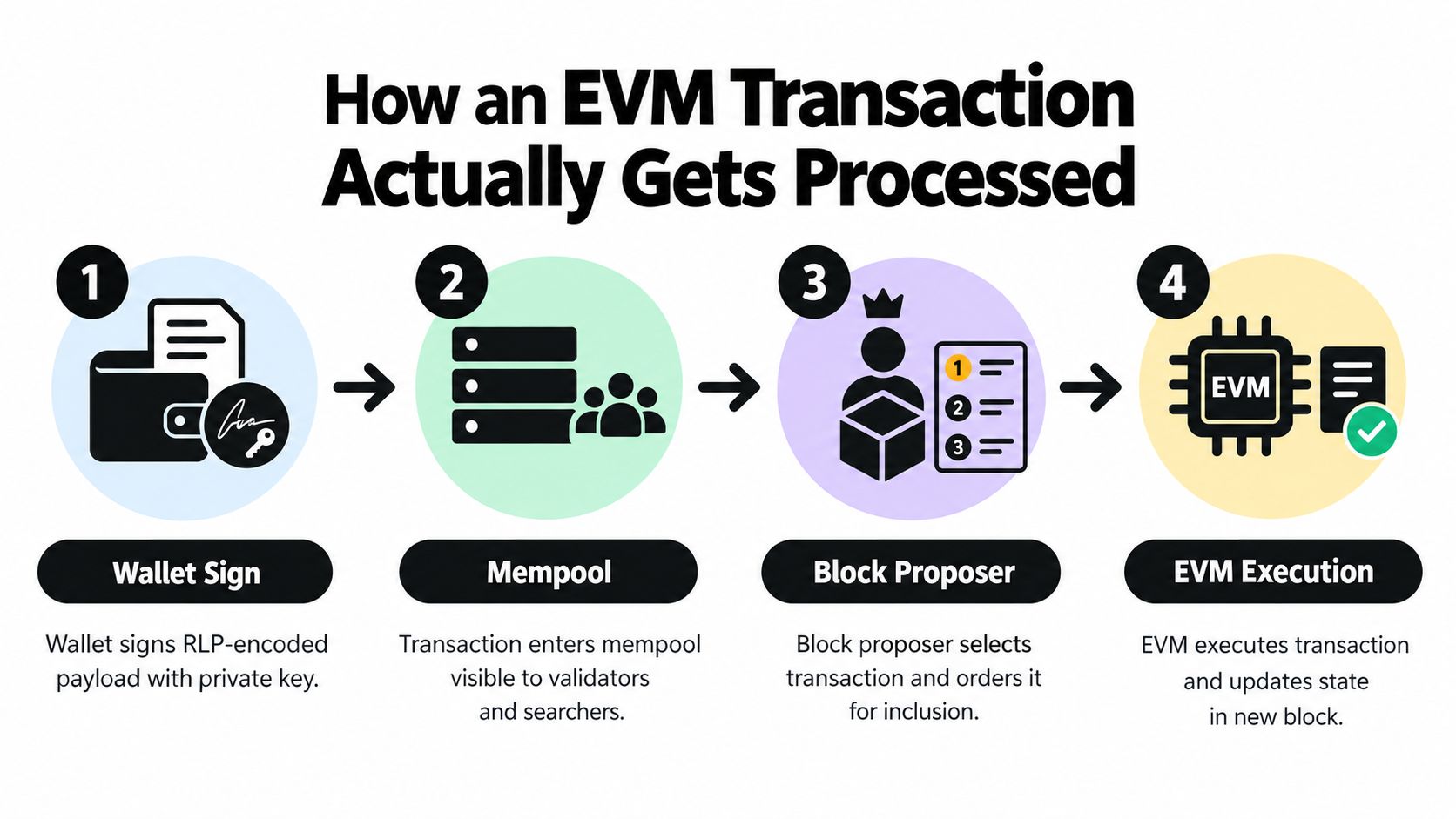
After you sign a transaction, it enters the mempool and becomes visible to actors selecting and ordering transactions. A proposer can include it in a block, and the execution client runs the transaction through the EVM. The consensus layer then coordinates agreement around the block, while execution clients verify that the payload produces the claimed result.
EIP-1559 divides the transaction fee into a burned base fee and an optional priority fee paid to the block producer. The GASPRICE opcode returns the effective gas price required by the EIP-1559 specification, as described in EIP-1559's formal proposal. Users therefore aren't bidding against one another in the old first-price format, although congestion still affects the base fee and users can add a priority fee when they want inclusion incentives.
Practical rule: Optimize state access before obsessing over tiny arithmetic savings. A cheaper calculation rarely offsets needless storage reads, writes, or external calls.
The block gas target of 15 million gas and hard cap of 30 million gas allow block capacity to flex with demand while remaining bounded, according to Frontiers' analysis of Ethereum's gas structure. That constraint is one reason developers use batching and why users sometimes prefer Layer 2 scaling solutions for applications that generate frequent transactions.
How an EVM Transaction Actually Gets Processed
A transaction begins in a wallet, but the wallet doesn't execute the contract. It prepares a signed payload containing the sender's intent and authorization. After signing, the transaction enters the mempool, where validators, proposers, and searchers can observe it before inclusion.
A block proposer chooses transactions and determines their order within the block. Ordering matters for decentralized exchanges, liquidations, and other applications whose outcomes depend on the state immediately before execution. The proposer sends the selected payload to the execution client, which runs each transaction in order and calculates the new state.
The fee mechanics come from EIP-1559. Each transaction pays the current base fee, which the protocol burns, and may include a priority fee for the block producer. The base fee responds to congestion through the block's gas usage, while the optional tip gives users a way to signal urgency. The execution client also enforces the transaction's gas limit, so an operation that consumes its available budget fails rather than running without bound.
Inclusion isn't the same as finality
Execution happens when the transaction is included in a block and the execution client validates its state transition. Additional blocks provide increasing confidence that the transaction won't be reorganized. Ethereum's proof-of-stake design then provides economic finality through the consensus layer, rather than through the EVM alone.
The post-Merge design uses a consensus client for validator coordination and an execution client for transaction processing. An engine API passes execution payloads between those components. That division helps explain why “the validator processed my contract” is an incomplete description. The validator participates in consensus, while the execution client performs the contract computation that determines balances, storage, logs, and receipts.
For users, the visible experience remains a wallet confirmation followed by a pending and then confirmed transaction. For developers, the distinction affects node configuration, debugging, block production, and the interpretation of failed execution. A transaction can be validly signed yet revert inside the EVM, or execute successfully while waiting for broader consensus confidence.
EVM Compared to eWASM and Other Virtual Machines
Virtual-machine comparisons become useful only when they separate raw execution performance, determinism, ecosystem maturity, and developer friction. The EVM's stack and 256-bit word design aren't optimized for every workload, but they support an established smart-contract ecosystem and familiar tooling. Alternative runtimes make different trade-offs rather than making the EVM obsolete.
| Virtual Machine | Performance Approach | Determinism | Ecosystem Maturity | Developer Experience |
|---|---|---|---|---|
| EVM | Metered stack execution with 256-bit words | Strong deterministic rules | Extensive Ethereum tooling and contract history | Solidity, Vyper, Remix, Hardhat, Foundry |
| eWASM | WebAssembly-oriented execution model | Designed for deterministic blockchain execution | Limited compared with the EVM | Potentially broader language support, but less established |
| BPF | Efficient compiled execution and parallel runtime designs | Protocol-defined execution remains necessary | Strongest in its own ecosystem | Different account, program, and tooling model |
| Move | Resource-oriented programming model | Deterministic execution under chain rules | Smaller developer pool than the EVM | Strong asset-safety concepts, with a distinct learning curve |
eWASM attracted attention because WebAssembly can offer a more modern compilation target and support additional languages. In practice, its tooling and deployment path haven't displaced the EVM's established workflow. The EVM's 256-bit words can look inefficient for ordinary arithmetic, yet they fit common cryptographic and large-integer operations used by Ethereum contracts.
Solana's BPF-based Sealevel runtime emphasizes parallel execution, but parallelism requires careful handling of account access and can introduce different composability constraints. Move, used by ecosystems including Aptos and Sui, focuses on resource safety and asset behavior. That design can prevent certain classes of mistakes, but developers familiar with Solidity still face a new language and programming model.
The sensible choice depends on the application. Builders often choose the EVM for ecosystem reach and tooling, BPF-oriented environments for throughput-oriented designs, and Move for resource-focused asset safety.
The EVM remains a strong default for teams that value portability across Ethereum, rollups, and other compatible networks. It isn't automatically the right runtime for every application, especially when parallel execution or specialized asset semantics matter more than compatibility with Ethereum's existing stack.
EVM Compatibility Across Chains and Developer Tools
“EVM-compatible” usually means more than a chain accepting a Solidity contract. At the practical level, compatibility can include the opcode set, bytecode behavior, gas schedule, account model, and JSON-RPC interface. The closer a network stays to those expectations, the more easily developers can reuse wallets, libraries, deployment scripts, explorers, and contract testing habits.
Networks such as Polygon, BNB Chain, Avalanche C-Chain, Arbitrum, Optimism, and Base use EVM-oriented environments to attract applications and developers already familiar with Ethereum. The exact implementation and operating assumptions can differ, so bytecode portability doesn't guarantee identical fees, transaction ordering, security, or finality. Non-EVM ecosystems such as Solana and Move-based networks require different tools and often different architectural decisions.
A realistic builder workflow
A typical path looks like this:
- Write the contract: Use Solidity or Vyper to define application rules, token behavior, DeFi logic, or real-world asset tokenization functions.
- Compile the source:
solcconverts the source into deployment and runtime bytecode, along with an ABI that front ends use to encode calls. - Test locally: Remix provides an accessible browser-based starting point. Hardhat or Foundry supports more elaborate scripting, fork testing, deployment management, and continuous integration.
- Deploy and inspect: A wallet submits the deployment transaction, an execution client runs the initialization code, and a block explorer displays the resulting contract address and activity.
The user-facing benefit is familiar interaction. MetaMask and Rabby can work across many EVM networks, while explorers can present recognizable address and transaction formats. Bridges and cross-chain messaging tools then connect assets and contract calls across Layer 2 networks and Ethereum, though those connections introduce their own trust assumptions.
| Chain | Consensus | Typical TPS | Notable Tooling |
|---|---|---|---|
| Ethereum | Proof of stake | Varies with demand and protocol limits | Geth, Nethermind, Erigon, Remix, Hardhat, Foundry |
| Polygon | EVM-oriented network consensus | Varies by network conditions | Ethereum-compatible wallets and developer tooling |
| Arbitrum | Rollup-based Ethereum scaling | Varies by network conditions | Ethereum tooling, Solidity, Hardhat, Foundry |
| Optimism | Rollup-based Ethereum scaling | Varies by network conditions | Ethereum tooling, Solidity, Hardhat, Foundry |
| Base | Rollup-based Ethereum scaling | Varies by network conditions | Ethereum wallets and common EVM frameworks |
The Solidity guide from Coiner Blog can help connect contract source code with the bytecode the EVM executes. Compatibility reduces development friction, but it doesn't remove the need to review chain-specific documentation, fee behavior, bridge design, and security assumptions.
Security Risks, Common Misconceptions, and FAQ
The EVM executes code exactly according to its rules, which makes it predictable but not automatically safe. A reentrancy bug can let an external contract call back into a function before the first call finishes. An unchecked external call can hide failure, an arithmetic mistake can corrupt accounting, and an unlimited token approval can give a compromised or malicious contract ongoing spending authority.
Users should review approval requests, avoid signing transactions they don't understand, and revoke permissions they no longer need. Builders should apply checks-effects-interactions patterns, use safe arithmetic practices, validate return values, test failure paths, and treat bridges and rollup sequencers as explicit trust assumptions. MEV can also affect execution through sandwiching, liquidation competition, and transaction-order manipulation.
Misconceptions worth removing
- The EVM isn't a single machine: Nodes execute the same rules independently.
- Gas doesn't pay miners: After the Merge, Ethereum uses proof of stake, and EIP-1559 burns the base fee while the optional priority fee goes to the block producer.
- EVM-compatible doesn't mean EVM-secured: A compatible chain can have different validators, sequencers, bridges, governance, and failure modes.
- Solidity isn't the EVM: Solidity is a source language. The compiler turns it into bytecode that the EVM executes.
Frequently asked questions
What does the EVM do?
It executes smart-contract bytecode and applies the resulting state transition under Ethereum's protocol rules.
Is the EVM part of Ethereum?
Yes. It is Ethereum's execution environment, distinct from the consensus layer that coordinates validators and finality.
Why does gas exist?
Gas meters computation and state access, limits resource exhaustion, and connects execution demand to transaction fees.
Can an EVM contract run on another chain?
Often, if that chain supports compatible bytecode and interfaces. Developers still need to check differences in gas costs, security, tooling, and bridge assumptions.
Does EVM compatibility guarantee low fees?
No. Compatibility makes tools and code easier to reuse, but congestion, block limits, execution design, and chain demand still shape the user experience.
Coiner Blog publishes practical guides on Ethereum, Solidity, Layer 2 networks, wallets, DeFi, Web3, tokenomics, and emerging areas such as AI and crypto and real-world asset tokenization. Visit Coiner Blog to keep building a clearer, more risk-aware understanding of the systems behind crypto applications.