
What Is Solidity? a Practical Guide to Smart Contracts

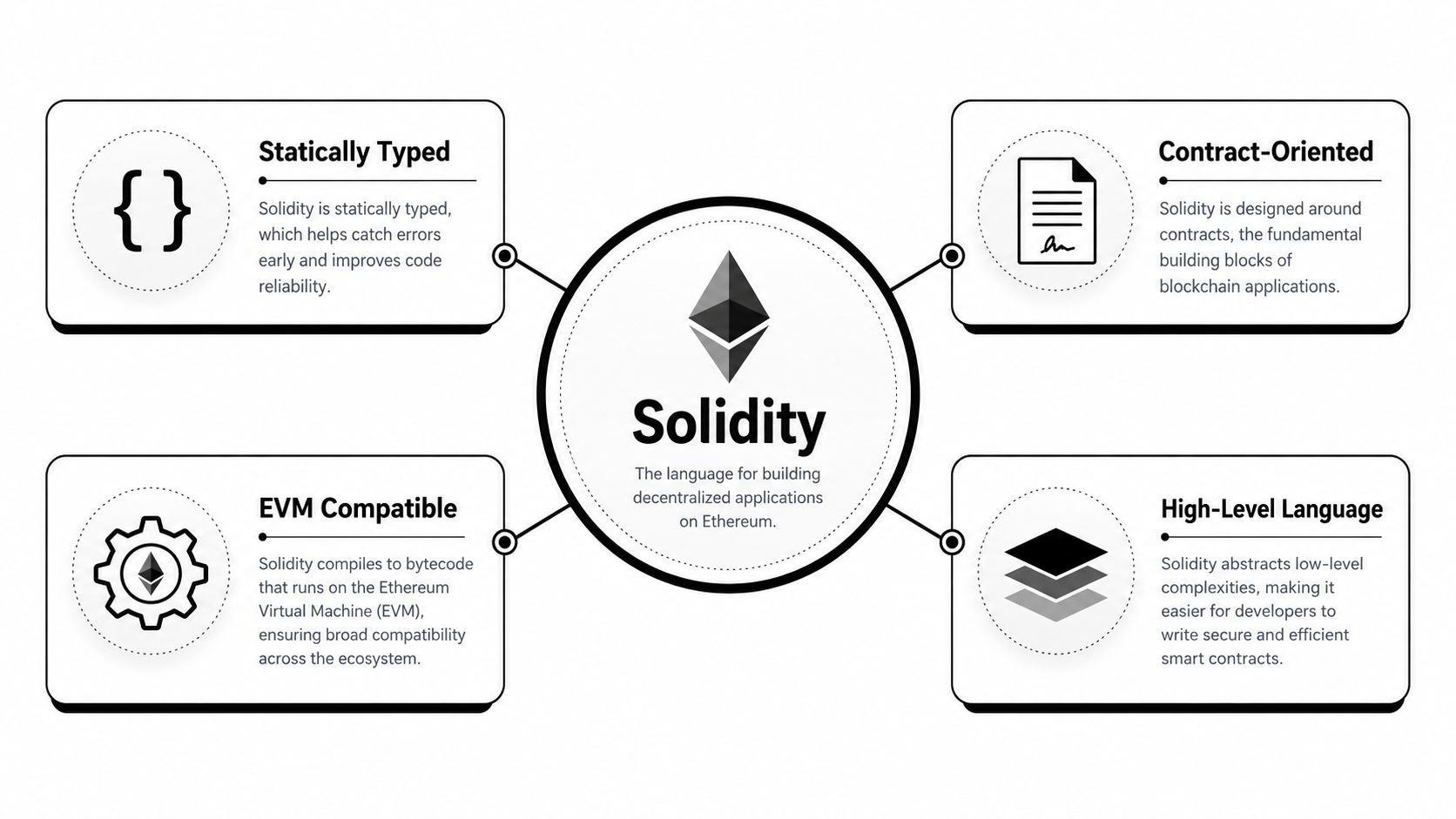
Solidity is a statically typed, contract-oriented programming language that compiles to EVM bytecode. In practice, that means it gives you the rulebook a blockchain executes, not a normal app that runs on a server.
What people usually miss is that learning Solidity is less about memorizing syntax and more about understanding where those contracts run, how they behave across Ethereum and other EVM chains, and why small mistakes can move real value.
Table of Contents
- What Solidity Is and Why It Matters
- How Solidity Came to Power Ethereum
- The Building Blocks of a Solidity Contract
- From Source Code to On-Chain Execution
- Real-World Use Cases Powered by Solidity
- Solidity vs Vyper and the Modern Tooling Stack
- Security Pitfalls Every Solidity Developer Must Respect
- Your Next Steps and Beginner FAQ
What Solidity Is and Why It Matters
Solidity is the language most newcomers meet when they step into Ethereum, but it's better understood as the language of deployed rules. A Solidity contract doesn't behave like a traditional web app, where a backend responds to requests. It behaves more like a public machine-readable agreement that the network can execute.
A rulebook, not a normal app
That distinction matters because the contract lives in a blockchain environment, not on one company's server. If you write a contract that handles token balances, membership rules, lending logic, or ownership, the network enforces those rules exactly as written. That is why people use Solidity for smart contracts, DeFi, NFTs, and other on-chain applications tied to Ethereum and the wider EVM world.
For beginners, the simplest mental model is this. A Solidity file describes how a contract should behave, and once deployed, that behavior becomes part of the blockchain state. It's closer to publishing a public rulebook than shipping a traditional product update.
Practical rule: If a contract would be expensive or impossible to reverse after deployment, treat every line like production infrastructure from day one.
Why the language feels different from JavaScript or Python
Solidity borrows familiar ideas from mainstream languages, but it is not trying to be a general-purpose app language. It is built for contracts that must compile to the Ethereum Virtual Machine, where execution is constrained and every operation has cost and risk. That's why type discipline, explicit state changes, and careful external calls matter so much.
If you're coming from JavaScript or Python, expect more ceremony and fewer shortcuts. If you're coming from systems work, expect the blockchain to behave like a hostile runtime where safety is part of the design, not an afterthought.
For a plain-language companion on contract basics, this smart contract primer helps connect the language to the idea of self-executing blockchain logic.
How Solidity Came to Power Ethereum
Solidity rose with Ethereum because the network needed a language that could express contract logic in a form developers could read, while still compiling into something the EVM could run. It was proposed in 2014 as a high-level, object-oriented language for smart contracts on the Ethereum Virtual Machine, and it was first released in July 2014, becoming the core language for contract development on Ethereum and EVM-compatible chains (GeeksforGeeks introduction to Solidity).
Why Ethereum needed a dedicated contract language
Ethereum was built for more than moving value. Bitcoin showed that a blockchain could transfer money, but Ethereum made on-chain programs a native part of the system. That required a language developers could write, one that would still compile into something the EVM could execute predictably.
Solidity filled that gap because it connected readable source code with low-level execution. It gave developers contracts with state, functions, events, and reusable abstractions, without making them work directly in bytecode. That design helped Ethereum become the main home for general-purpose smart contracts, and it is why many people use Solidity as shorthand for the broader EVM ecosystem.
Why “Ethereum's language” really means more than one network
Today, Solidity is tied not just to Ethereum mainnet, but to the whole family of EVM-compatible chains. The same contract patterns can often move across several execution environments, even though fees, tooling, and network behavior differ from chain to chain. Learning Solidity, then, is usually about more than one network.
That broader reality also explains why beginners can get confused by articles that treat Solidity as if it belongs only to Ethereum itself. The language sits inside a larger deploy-and-execute stack, and the chain underneath it changes the economics and the day-to-day operating details. A contract that behaves one way on one EVM chain may still demand different deployment choices, different fee planning, and a different security review on another.
Solidity became the default because it solved a real design problem, not because it sounded elegant on paper.
For readers who want a broader view of how contract applications are built across the stack, this Web3 application development guide is a useful companion read.
The Building Blocks of a Solidity Contract
A Solidity contract file is a bundle of declarations that tell the EVM what data to keep, what actions users can call, and what events the chain should record. The key point is that the language is object-oriented and statically typed, and its core types reflect the EVM's 256-bit architecture. According to the Solidity documentation, uint and int are 256-bit types, bytes32 is a 32-byte value, and address is 160 bits (Solidity docs PDF).
Reading the basic parts of a file
A beginner contract usually starts with the contract keyword, then defines state variables that live on-chain, plus functions that read or change those variables. Functions can be public, external, internal, or private, which controls who can call them. That visibility is one of the first details beginners need to read carefully, because it shapes what the network can do with your contract.
A modifier is a reusable guard around a function. You can think of it as a check that runs before the main logic, often used for access control or preconditions. Events are different. They don't change state, but they give wallets, explorers, and indexers a reliable log of what happened.
A simple token-like example
// SPDX-License-Identifier: MIT
pragma solidity ^0.8.0;

contract SimpleVault {
    address public owner;
    uint256 public balance;

    event Deposited(address indexed from, uint256 amount);

    modifier onlyOwner() {
        require(msg.sender == owner, "Not owner");
        _;
    }

    constructor() {
        owner = msg.sender;
    }

    function deposit() external payable {
        balance += msg.value;
        emit Deposited(msg.sender, msg.value);
    }

    function withdraw(uint256 amount) external onlyOwner {
        require(amount <= balance, "Insufficient balance");
        balance -= amount;
        payable(owner).transfer(amount);
    }
}
This tiny contract shows the usual building blocks. owner is stored on-chain, deposit changes state and emits an event, and onlyOwner wraps the withdrawal check. Real contracts are more complex, but the structure is the same.
When you see uint256, prefer thinking of it as the default integer size, not a random spelling choice. That habit helps later when you start caring about storage layout, ABI encoding, and gas costs.
For readers who want the token standard context, this ERC-20 explainer is a helpful follow-up.
From Source Code to On-Chain Execution
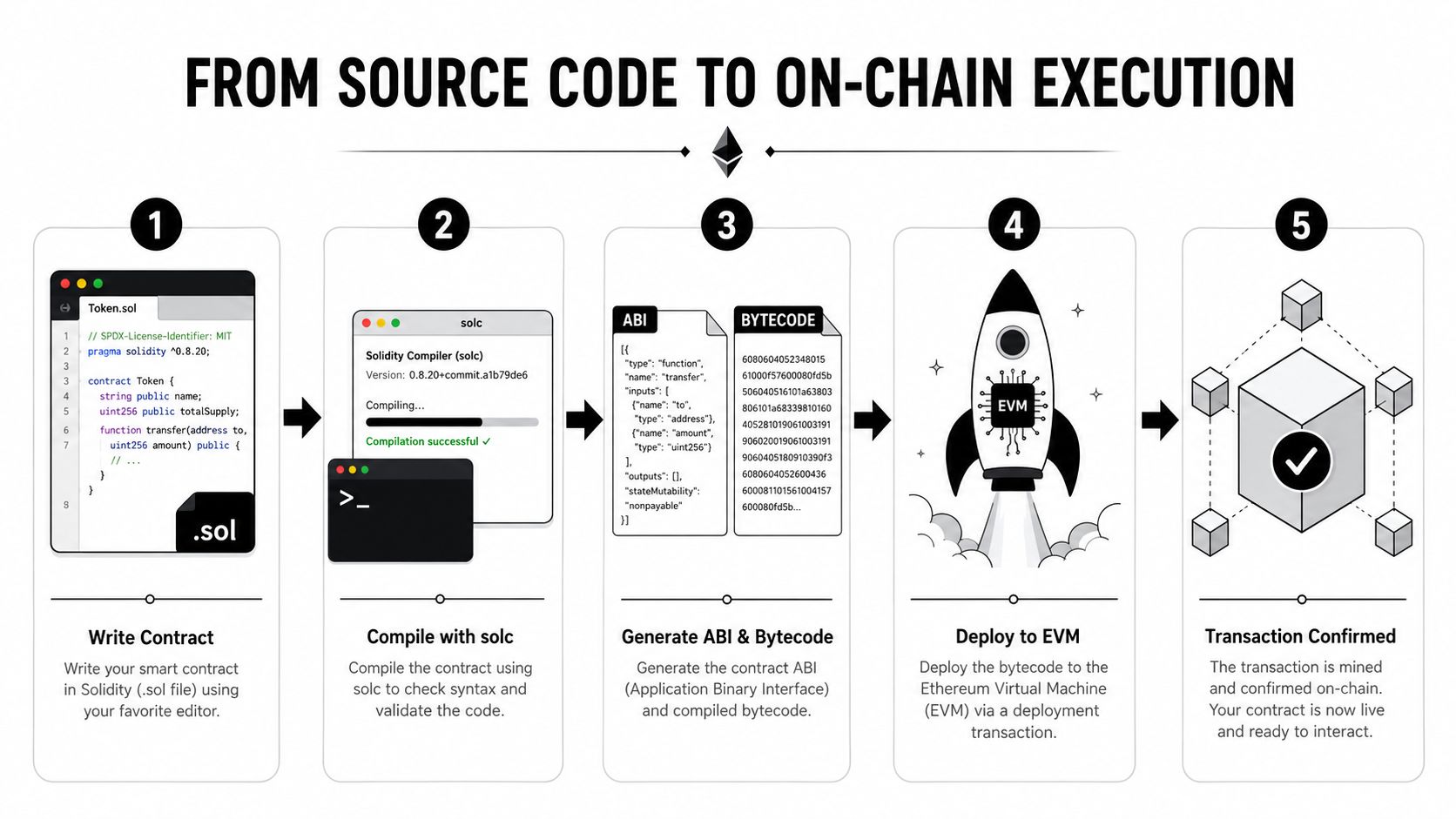
Solidity source code starts in an editor, but it does not run there. A developer compiles it into bytecode and an ABI, then deploys that output to a blockchain where the EVM can execute it. The language and the runtime are related, but they are not the same thing.
What actually happens after you save a .sol file
The usual workflow starts with writing a contract in a tool like Remix, Hardhat, or another editor-integrated environment. Compilation turns readable source into EVM bytecode, which is the form the network understands, and the ABI describes how outside software should talk to the contract. Deployment then places the bytecode on-chain, where it becomes part of the network's shared state.
After deployment, every node that runs the network can validate the same contract logic. That's the key difference from a standard server app. There isn't one machine serving your contract, there's a distributed system agreeing on its result.
Why gas and chain context matter
Gas is the cost of EVM work. It's not an abstract fee layer, it's the metering system that keeps computation bounded. A single Solidity source file can also feel different across Ethereum mainnet and Layer 2 networks because the execution environment, fee dynamics, and surrounding infrastructure are not identical even when the contracts are EVM-compatible.
That's why developers should think in terms of source, bytecode, and runtime context. A contract is not just “written once and done.” It's compiled for a specific execution model, then deployed into a specific network with its own economics.
For developers tracking event streams from live systems, Anaxer websocket streams is a useful reference point for understanding how off-chain tools keep pace with on-chain activity, even though the article focuses on another chain.
Here's a short lifecycle video that makes the path from source to execution easier to visualize.
Real-World Use Cases Powered by Solidity
Most meet Solidity through products, not syntax. A lending protocol, a decentralized exchange, or a game item marketplace all depend on contracts that decide what exists, who owns what, and what actions are allowed. The appeal is that the logic is enforced by the chain, not by a company database.
DeFi, NFTs, and GameFi each use the language differently
In DeFi, Solidity often governs pooled funds, collateral checks, swaps, or interest logic. The contract doesn't just record a number, it enforces the conditions under which assets can move. That's why DeFi users care so much about correctness. A bad state transition can break the economics of the whole protocol.
In NFTs, a contract can track unique ownership or batch-minted assets. ERC-721 and ERC-1155 style designs use Solidity to determine who owns a token, how transfers work, and which metadata a wallet should display. The actual media may live elsewhere, but the ownership logic lives in the contract.
In GameFi, the contract often verifies that a player really owns an item, can equip a character, or can trade a sword or skin. The language shifts from finance into gameplay, but the technical pattern is the same. Solidity becomes the rule engine behind digital ownership.
Why the use cases keep expanding
The same language is also showing up around payment rails and tokenized assets, because contracts can encode conditional transfer logic that traditional systems would handle in a private backend. For a practical angle on payment flows, this crypto payment gateway guide for 2026 is useful background reading.
The takeaway is not that Solidity “does everything.” It's that it gives builders a public execution layer for assets, permissions, and business rules. That makes it a core language for Web3, but also a language that demands more caution than a normal product stack.
If a contract touches assets, it should be designed like financial infrastructure, even when the front end looks like a game or a simple app.
Solidity vs Vyper and the Modern Tooling Stack
Solidity is the dominant default, but it isn't the only language in the EVM world. Vyper is the best-known alternative, and its philosophy leans toward simplicity and auditability, while Solidity offers richer syntax and a larger ecosystem. The trade-off is real, and teams choose based on team skill, existing libraries, and tooling rather than ideology.
Solidity and Vyper solve different problems
Solidity's strength is breadth. It has the mature ecosystem, a wide range of examples, and deep support from frameworks and libraries. Vyper narrows the feature set, which can make code easier to reason about, but it also means fewer language features and a smaller surface area to build on.
For day-to-day development, that difference shows up in learning curve and workflow. Solidity is often the first language beginners see because it sits at the center of Ethereum and EVM-compatible development. The 2024 Solidity Developer Survey reflects that centrality, with 684 developers from 91 countries responding, 42.4% saying Solidity was the language they used most, 32.7% naming it their favorite, 43.7% using it daily, and 88.9% reporting compiler version v0.8.x (2024 Solidity Developer Survey results).
The tools matter as much as the language
A modern Solidity workflow usually includes Remix for quick browser experiments, Hardhat for testing and deployment, and sometimes Truffle in older codebases that still matter. MetaMask sits on the user side, letting people sign transactions and interact with deployed contracts from a wallet.
Those tools change how you learn. Remix helps you understand the language quickly. Hardhat helps you test logic before real funds are involved. MetaMask reminds you that contract code doesn't live in isolation, it interacts with wallets, chains, and users.
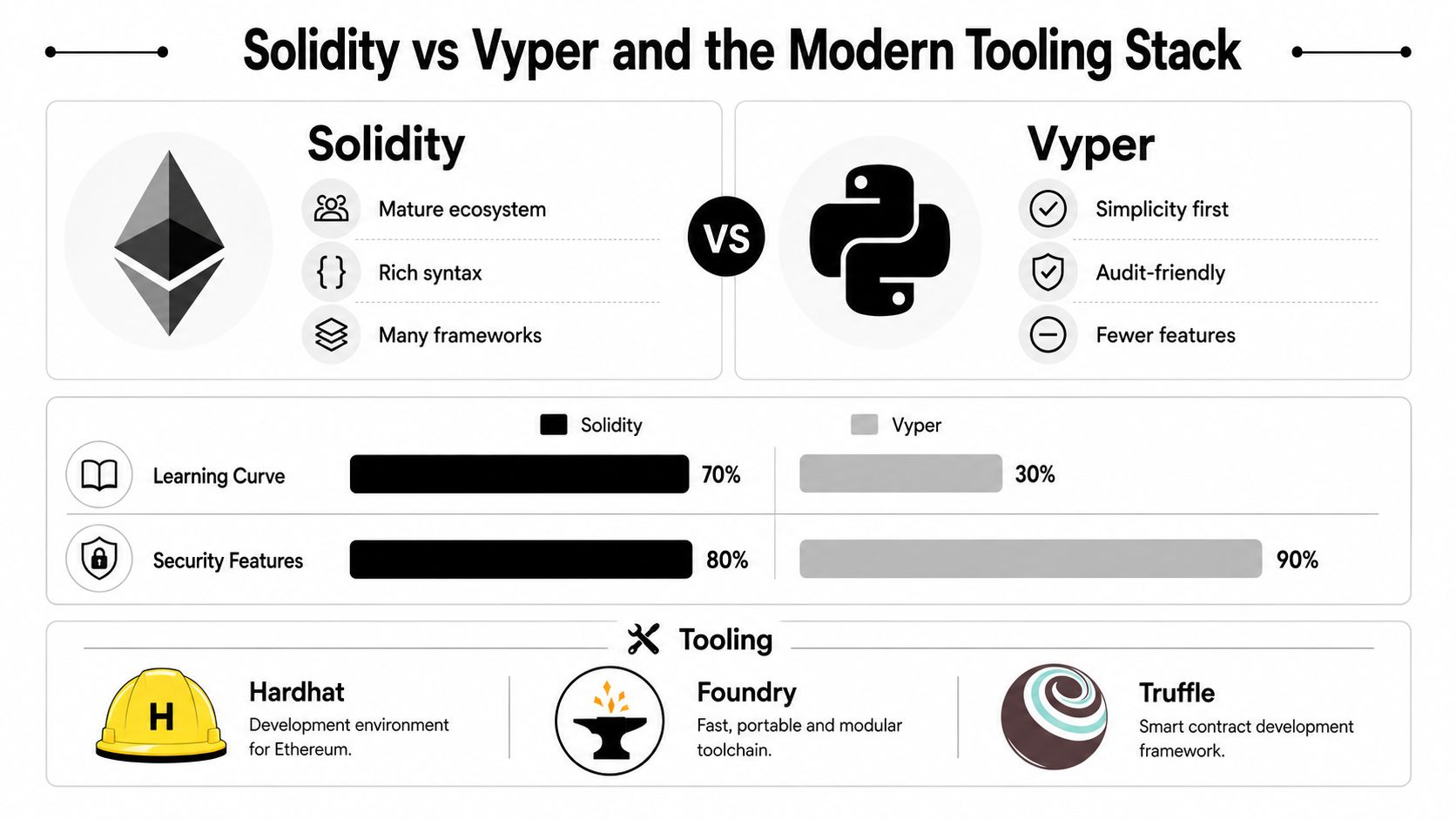
For a quick orientation on the full development stack, keep the distinction clear. Solidity is the contract language, Hardhat and Remix are developer environments, and MetaMask is part of the interaction layer.
Security Pitfalls Every Solidity Developer Must Respect
Solidity's biggest danger is that it feels approachable before it feels dangerous. That mismatch is why many beginners ship code they wouldn't trust with real money. Academic work has even formalized the language into Featherweight Solidity, which shows how complex its semantics are and why rigorous verification matters (Featherweight Solidity paper).
Why small bugs turn into financial damage
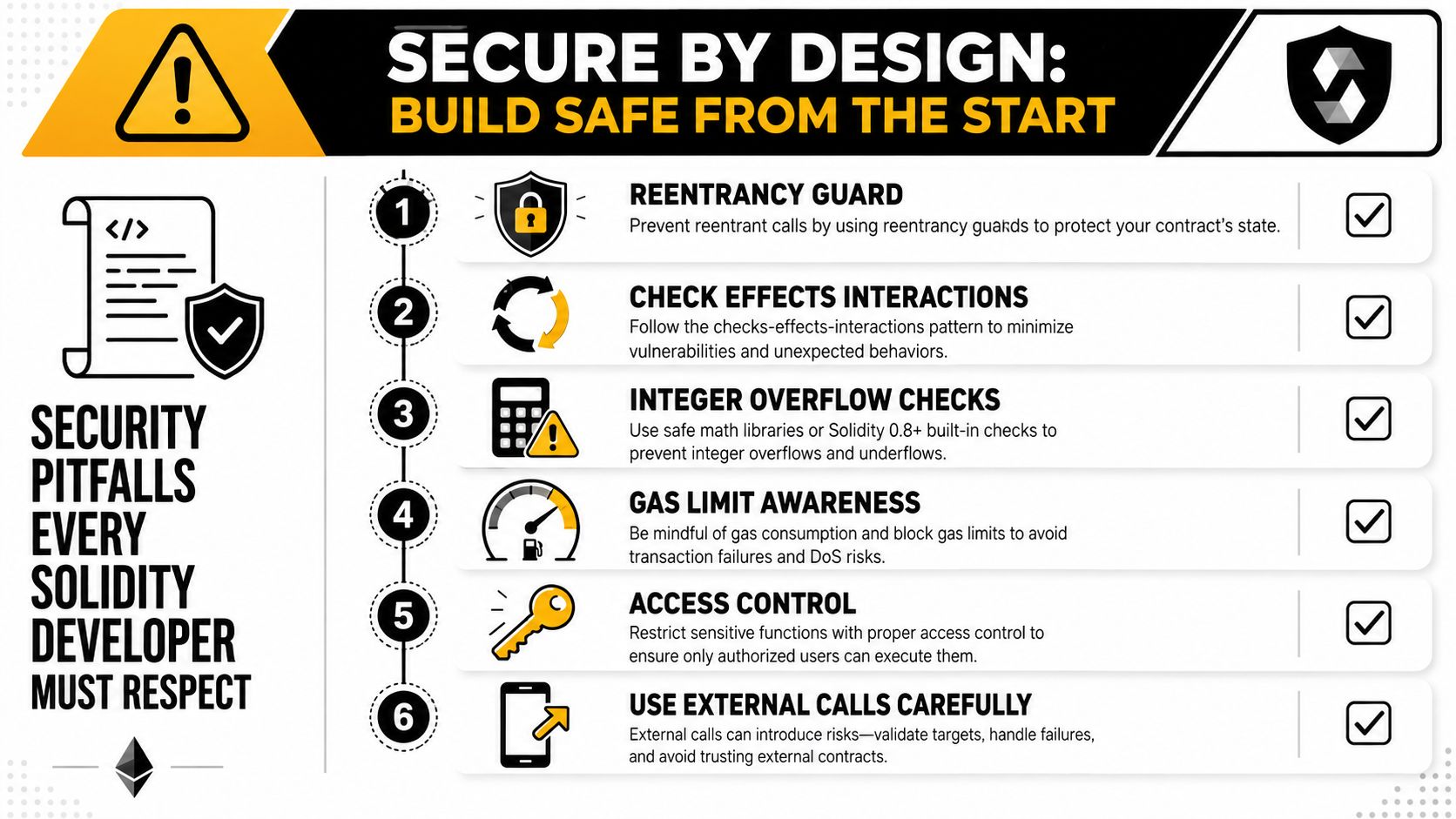
The classic example is reentrancy, where a contract makes an external call before finishing its own internal state updates. That pattern has drained protocols because the contract briefly exposes a vulnerable state to another contract. The core lesson is simple. If your contract sends value or calls outside code, you need to be deliberate about order, assumptions, and failure handling.
Other common mistakes include weak access control, unsafe external calls, and bad randomness sources. Solidity 0.8.x has made integer overflow far less likely in normal arithmetic, but that doesn't make all numerical mistakes disappear. Developers still need to reason carefully about types, bounds, and state transitions.
Defensive habits that belong in every project
- Reentrancy Guard: Add explicit protections where external calls and value transfers create a loop back into your contract.
- Checks Effects Interactions: Validate inputs first, update state second, and call external contracts last.
- Access Control: Keep admin actions narrow and obvious, because a missing permission check can be catastrophic.
- Test Everything Important: Cover edge cases, failure paths, and malicious interactions before touching mainnet.
- Use Audited Libraries: Trusted building blocks like OpenZeppelin reduce the chance of reinventing security bugs.
- Treat External Calls as Untrusted: Assume the callee may revert, re-enter, or behave unpredictably.
A Solidity contract doesn't fail like a web page fails. It can lock funds, leak value, or produce a permanent mess that's expensive to unwind.
The security mindset is part of learning the language, not a later specialization. If you're not ready to think like an attacker, you're not ready to deploy value-bearing contracts.
Your Next Steps and Beginner FAQ
What should you do after you understand the basics of Solidity? Start with the smallest safe loop and keep each step visible. Read the official language docs, open Remix, compile a tiny contract, and make one change at a time so you can see how that change affects storage, functions, and events. After that, move to a local EVM, then a test network, and leave mainnet for the point where you can explain every line of your contract and every failure case it creates.
A practical learning path
- Read and Run: Open the Solidity docs, paste a simple example into Remix, and compile it yourself.
- Change One Thing: Edit a state variable, a function, or an event, then watch how the contract behaves after redeployment.
- Test Locally: Use a framework like Hardhat to simulate calls before you expose anything to public users.
- Deploy on a Testnet: Practice the full flow of compile, deploy, and interact with a contract in a public environment.
- Review Security Early: Treat access control, external calls, and upgrade patterns as core topics, not advanced extras.
If you want a broader view of how contracts fit into full applications, this Web3 development guide is a useful companion once the basics are familiar.
Beginner FAQ
Is Solidity hard to learn if I know JavaScript?
The syntax is usually manageable. The harder part is the blockchain mindset, especially state, permissions, and irreversible execution. A JavaScript developer still has to adjust to the fact that contract code can control real assets and every mistake can be permanent.
Can I become productive quickly?
You can usually write something that compiles before you can write something that deserves to hold value. Simple contracts come first. Contracts that can survive hostile input, bad assumptions, and changing chain conditions take more care.
Do Solidity contracts behave the same on every EVM chain?
The source code often travels well across EVM chains, but the runtime context does not stay identical. Fees, tooling, and chain-specific behavior can change how the same contract feels in practice, so testing on the target chain matters.
Should I start with mainnet?
Start with examples, then local testing, then testnets. Mainnet should come only after you understand how deployment, interaction, and failure work in a live setting.
Solidity rewards patience. Once you understand how source code becomes bytecode, how the EVM shapes execution, and why security has to be built in from the start, the language stops feeling mysterious and starts feeling like a serious tool for multi-chain development.