
Stable Coin News Today and What It Means for You
Stablecoins have moved far beyond their original role as a parking place between crypto trades. The market held around USD 0.3 trillion in the first quarter of 2026, equal to roughly 13% of total crypto market capitalization, according to CoinDesk Data's stablecoin and tokenized assets report. That scale changes what stable coin news means for ordinary users. A reserve problem can affect DeFi liquidity, a licensing decision can remove a token from an exchange, and a payment integration can change how businesses move money across borders.
The challenge is separating meaningful infrastructure news from short-lived market noise. This guide focuses on the developments that affect payments, treasury operations, settlement, regulation, reserves, and user risk, while keeping the mechanics accessible for readers who use Bitcoin, Ethereum, Web3 applications, Layer 2 networks, or DeFi protocols.
Table of Contents
- Introduction to Stable Coin News That Actually Matters
- How Stablecoins Work Without the Jargon
- Why Stablecoins Became Crypto Core Infrastructure
- Decoding Recent Headlines From Depeggings to Reserve Audits
- Regulation Around the World and What Is Live Now
- How to Assess Stablecoin Risk Like a Pro
- What to Watch Next for DeFi NFTs and Crypto Gaming
Introduction to Stable Coin News That Actually Matters
You check the market before work and see three headlines. One says a stablecoin briefly traded below its intended value. Another announces a new reserve report. A third describes legislation that may affect which tokens U.S. businesses can issue. None of the headlines looks connected, yet each can influence whether your exchange accepts a deposit, whether a DeFi pool remains liquid, or whether a company can settle an international invoice using a blockchain.
That's why stable coin news needs a practical filter. Start by asking what changed for users. A temporary price deviation may be a liquidity event, a reserve concern, or a data error. A reserve disclosure matters only when it explains what backs the token, where those assets sit, and how holders can redeem. A regulatory headline matters most when it identifies the jurisdiction, the effective date, the permitted issuer, and the venues affected.
The market's concentration makes this filter more important. CoinDesk Data reports that USD Coin and Tether together represented approximately 87% of the stablecoin market in the period covered. News involving either issuer can therefore have wider consequences than an announcement about a small, isolated token.
Use the rest of this guide in two ways:
- For daily monitoring: focus on peg behavior, reserve disclosures, licensing decisions, exchange support, and payment adoption.
- For personal decisions: check redemption rights, issuer supervision, reserve quality, liquidity, and smart contract exposure before holding a token in a wallet or DeFi protocol.
The point isn't to react faster than everyone else. It's to understand whether a headline changes the reliability, availability, or usefulness of the money-like token you're using.
How Stablecoins Work Without the Jargon
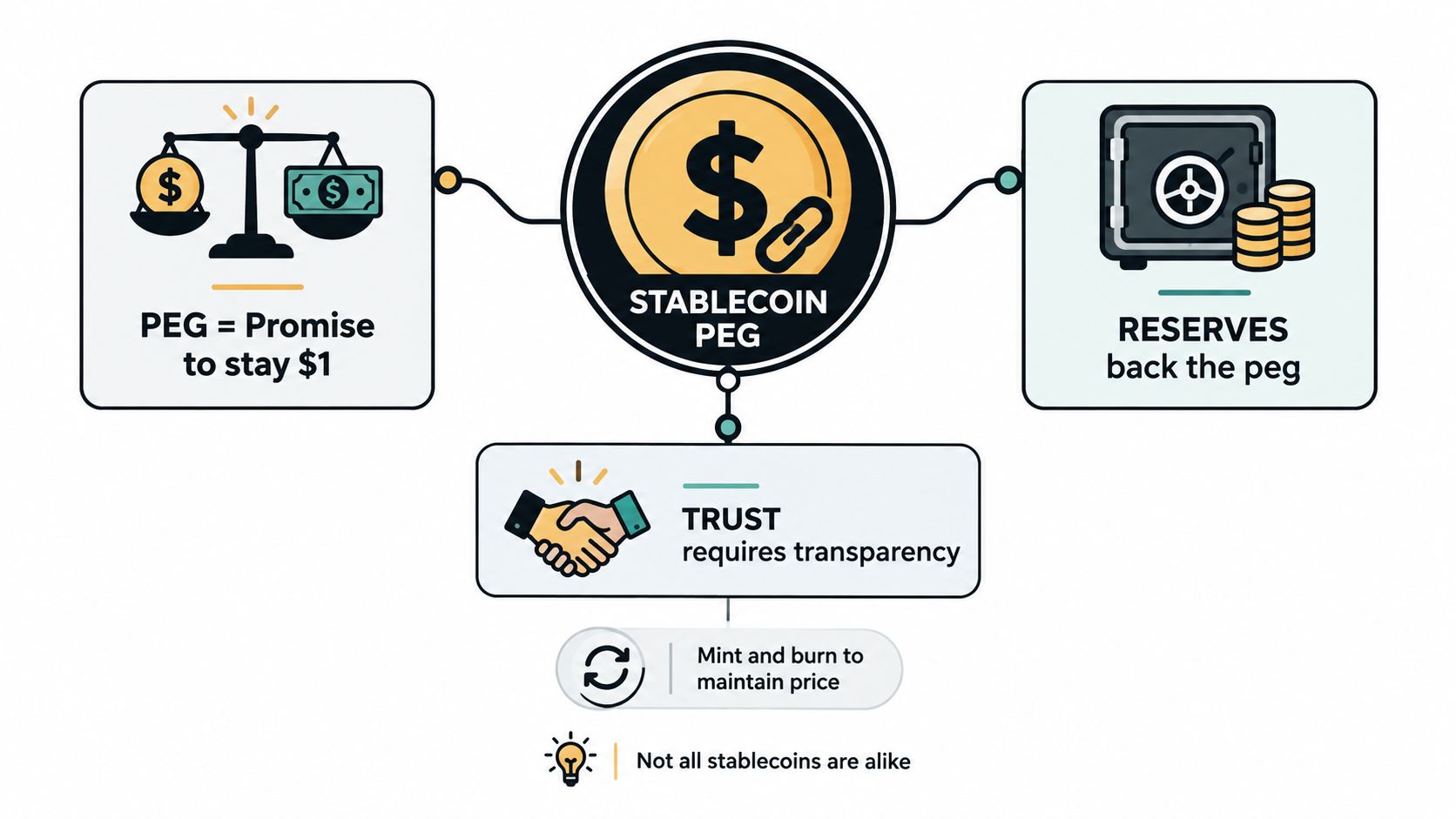
A stablecoin is a blockchain token designed to track an external reference value, commonly one U.S. dollar. Think of the peg as a promise that one token should remain close to that reference, not as a guarantee that the token can never move.
The process has four basic parts:
- Issuance: An issuer creates tokens when eligible users or institutions provide the required assets.
- Reserves or collateral: The issuer, protocol, or smart contract holds something intended to support the token's value.
- Trading: Users buy and sell the token on exchanges, wallets, payment systems, and decentralized applications.
- Redemption or adjustment: The system removes tokens from circulation, adds collateral, changes incentives, or relies on arbitrage to bring the market price back toward its target.
The main designs
Fiat-backed stablecoins rely on assets such as cash, bank deposits, short-duration U.S. Treasury bills, overnight Treasury repurchase agreements, and money-market funds. A reserve overview citing Circle's USDC disclosures describes a structure in which most reserves sit in short Treasuries and repos, with the remainder in cash. The key question is whether holders have a credible path to redemption, whether the token appears to trade near its target.
Crypto-backed stablecoins use other digital assets as collateral, often with extra collateral posted to absorb price swings. Smart contracts manage deposits, borrowing, liquidations, and token supply. This model can be transparent on-chain, but it exposes users to collateral volatility, oracle failures, congestion, and liquidation risk.
Algorithmic designs attempt to maintain value through supply changes, incentives, or relationships with other tokens rather than relying entirely on conventional reserves. Their stability depends on market confidence and the system's ability to respond during stress. The collapse of Terra's ecosystem remains a useful warning about how a mechanism can appear stable until confidence disappears. A plain-language backgrounder on that event is available in this explanation of Terra.
Why the blockchain matters
Ethereum became an important settlement layer because stablecoins can interact with wallets, exchanges, lending markets, decentralized exchanges, and smart contracts. Layer 2 networks can offer a different settlement environment, but users still need to check whether the exact token, bridge, contract, and redemption route are supported.
For a practical example of moving value with stablecoins, readers can explore Pay crypto transfers. The central lesson is simple: a stablecoin combines a value promise with a software system, and both parts can fail.
Why Stablecoins Became Crypto Core Infrastructure
Stablecoins have grown into a liquidity layer for trading, payments, and settlement. Their role now resembles shared operating cash for digital markets: traders can leave a volatile position, while businesses can move value without waiting for every transfer to pass through traditional banking rails. Market capitalization remained near USD 300 billion after strong growth, according to IMF-linked market reporting summarized by CoinDesk Data. Other 2026 market readings placed the sector above USD 315 billion, with reports of new all-time highs above USD 321 billion in April 2026.
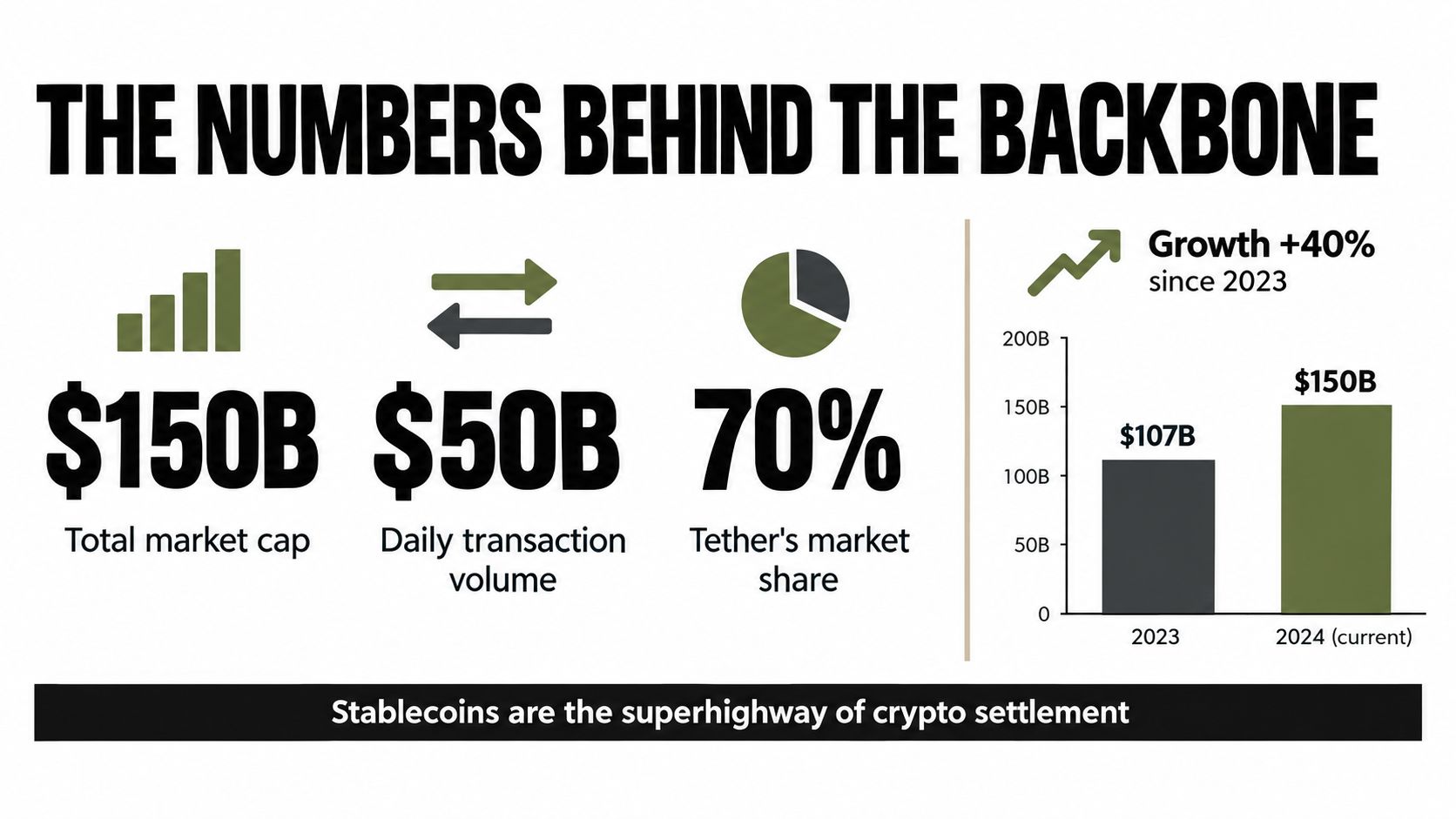
Scale is only one part of the story. Concentration creates another source of importance. Tether and USD Coin accounted for approximately 87% of the market, according to the cited CoinDesk Data reporting. When two issuers supply most available liquidity, their reserve policies, technical reliability, compliance decisions, and exchange relationships can affect the wider crypto economy.
From trading balance to operating cash
A trader may use a stablecoin to exit a volatile position without converting immediately to bank currency. A DeFi user may supply it to a lending market or pair it with another token on a decentralized exchange. A business can use the same basic instrument for treasury transfers, vendor settlement, or cross-border payment workflows.
This shift from trading balance to operating cash explains why payments and treasury activity deserve attention in stable coin news. Zero Hash reports that active stablecoin usage grew 146% year over year in 2025, transaction volume rose 690%, and active users spanned 106 countries. The report describes stablecoins as core financial infrastructure, reflecting their expanding role in payment and treasury systems.
The market is also becoming less exclusively dollar-centered. A 2026 report cited by Zero Hash found that non-USD stablecoin supply grew about 90% year over year through February 2026, reaching USD 1.2 billion, while unique holder addresses rose from roughly 40,000 to more than 1.2 million since January 2023. These figures suggest demand for local-currency settlement, although the dollarized ecosystem remains much larger.
Practical reading rule: Give greater weight to headlines affecting payment and settlement rails than to news about speculative activity built on top of them.
For a practical map of stablecoin applications across real-world payments and finance, check the corridor, treasury process, exchange, and application involved. The key question is whether the token can operate reliably where you need it, not whether it is popular.
Decoding Recent Headlines From Depeggings to Reserve Audits
Stablecoin headlines often describe different events as if they carried the same risk. They don't. A brief exchange deviation, a delayed reserve report, a delisting, and a new law require separate forms of analysis.
Reading a depeg
A depeg means the market price moved away from the intended reference. First check the size, duration, venue, and redemption conditions. A price displayed on one thinly traded exchange may not represent the broader market. A deeper concern appears when multiple venues show weakness, liquidity disappears, or holders can't access a credible redemption route.
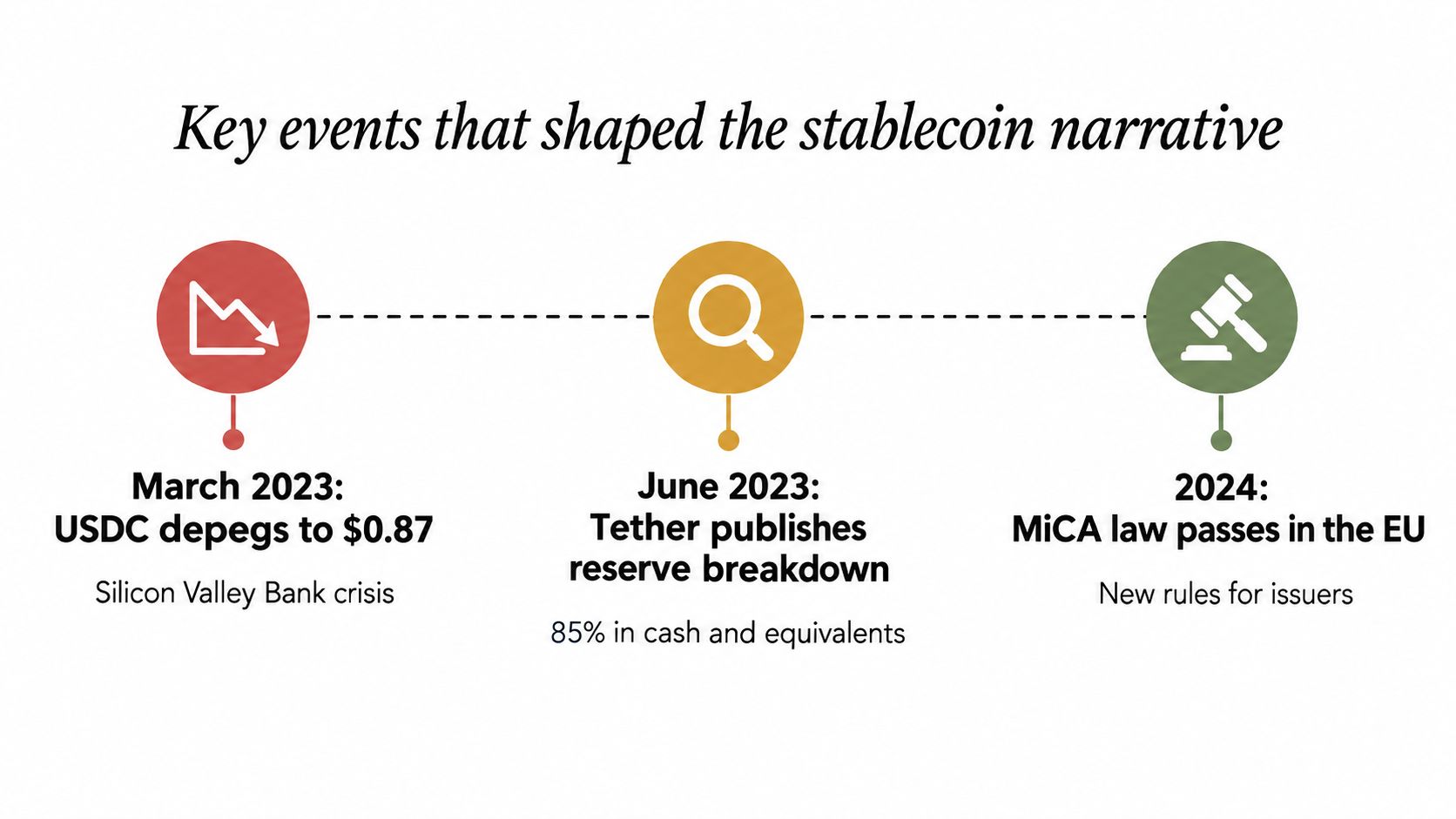
The March 2023 USDC event is a useful example because it connected a banking shock to a blockchain token. The New York Federal Reserve's 2026 update explains that Circle disclosed reserves held at Silicon Valley Bank after the bank entered receivership, followed by a fall in USDC's secondary-market price and notable outflows. The lesson is that “stable” doesn't mean isolated from traditional finance.
Reading reserves and audits
A reserve disclosure should answer practical questions. What assets back the supply? Are they liquid? Who controls them? Does an independent firm provide an attestation, or has the issuer published a full audit with a broader opinion? Can holders redeem directly, and under what eligibility and timing conditions?
An attestation can provide useful information without eliminating custody, legal, banking, market, or operational risk. Treat reserve reporting as evidence to evaluate, not as a substitute for understanding the issuer's structure.
Reading listings and policy announcements
An exchange listing may improve access, but it doesn't prove solvency. A delisting may reflect local compliance rules, unsupported custody arrangements, liquidity concerns, or a venue's internal risk policy. Policy announcements deserve the same care. Confirm whether the rule is proposed, enacted, effective, or still awaiting implementation.
For a visual explanation of how earlier events shaped the narrative, review the embedded video below.
Before acting on a fast-moving headline, compare the issuer's official communication with market data, legal text, exchange notices, and independent reserve information. Avoid treating social media screenshots or anonymous posts as confirmation.
Regulation Around the World and What Is Live Now
Stablecoin regulation isn't one global switch. The same token may be usable in one market, restricted in another, and unavailable through a particular platform because the venue follows a stricter local regime.
| Jurisdiction | Status | Key Requirement |
|---|---|---|
| European Union | MiCA has applied since 30 June 2024. | Issuers and offerings must follow the applicable MiCA framework, including authorization and reserve-related obligations. |
| Hong Kong | The Stablecoins Ordinance took effect on 1 August 2025. Hong Kong issued its first two licences on 10 April 2026. | Relevant issuers need to operate within the licensing regime and meet its supervisory requirements. |
| United States | The GENIUS Act was signed on 18 July 2025. Full operation is not expected until January 2027. | Only a permitted payment stablecoin issuer may issue such coins in the United States. |
| G20 jurisdictions | The policy direction is moving toward implementation. | The IMF described nearly all FSB member jurisdictions as planning new stablecoin rules or revisions to existing frameworks. |
The U.S. framework is especially important for businesses because the Congressional Research Service summary of the GENIUS Act states that the law created a federal framework for payment stablecoins and restricts issuance in the United States to permitted payment stablecoin issuers.
The broader policy objective is also becoming clearer. The IMF-linked regulatory report connects the G20 policy push with a solid legal claim, an effective stabilization mechanism, and prudential requirements for global stablecoins. In plain terms, regulators want holders to know what they own, how the peg is supported, and who supervises the issuer.
Businesses should check the jurisdiction of the issuer, the location of the customer, the permitted use, and the platform's compliance obligations. Retail users should expect availability to vary by exchange and region. A practical overview of the policy environment is available in this guide to stablecoin regulation.
How to Assess Stablecoin Risk Like a Pro
A stablecoin can look calm on a price chart while carrying meaningful legal, reserve, liquidity, custody, or software risk. Evaluate the structure before evaluating the yield, convenience, or popularity.
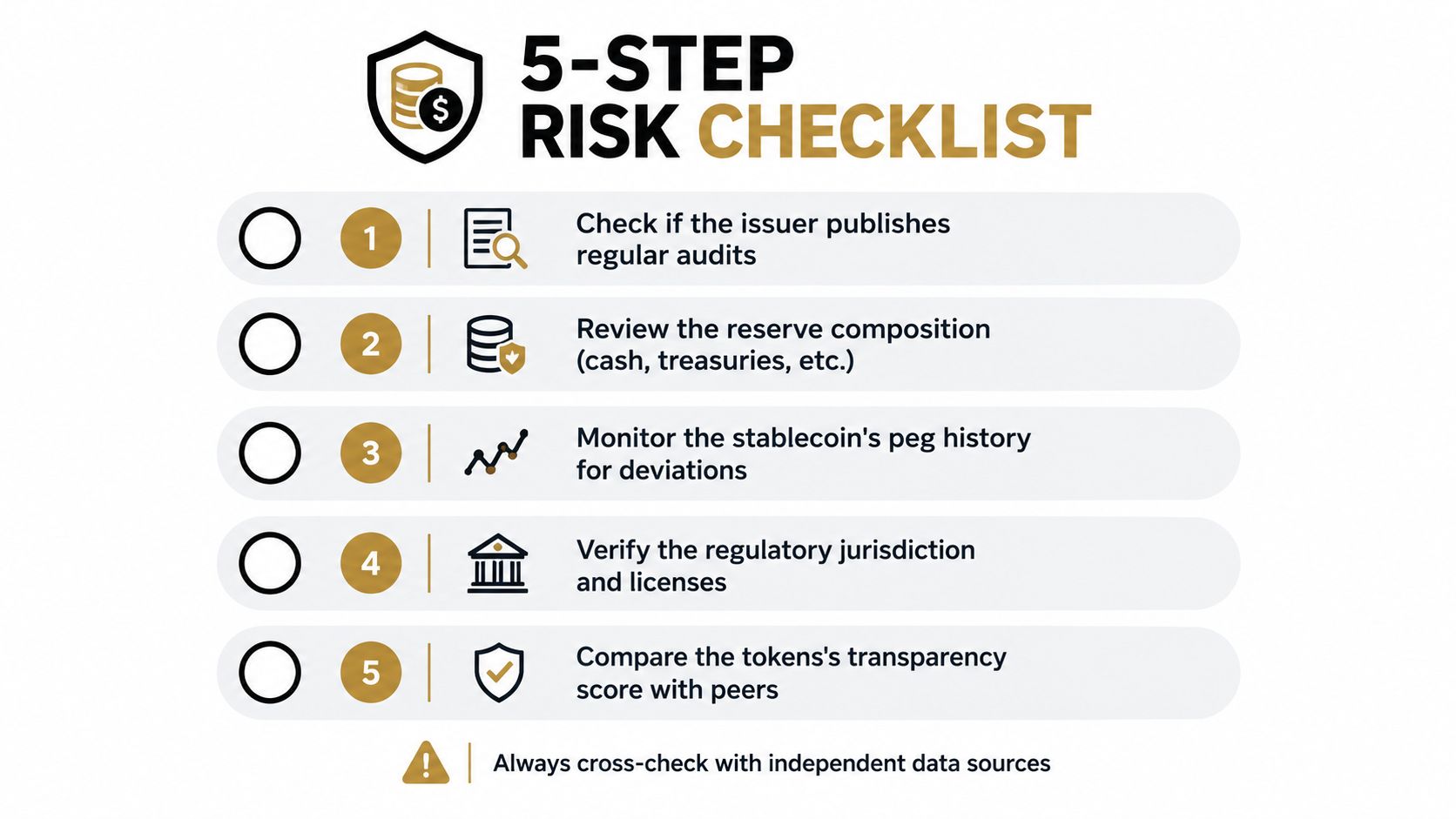
Five questions to ask
- What holds the peg? Identify whether the token is fiat-backed, crypto-backed, algorithmic, or hybrid. Each design creates different failure points.
- What exactly sits in reserve? Look for cash, bank deposits, Treasury bills, repos, money-market funds, or volatile collateral. A reserve label isn't enough. You need to understand liquidity and custody.
- What happened during stress? Review the token's peg history across multiple venues. A brief deviation may have a different meaning from persistent weakness, blocked redemptions, or thin liquidity.
- Who can issue and redeem it? Check the issuer's legal entity, licensing status, redemption terms, and geographic restrictions. A token can be technically transferable while remaining difficult for you to redeem directly.
- What software and market risks remain? Inspect the smart contract, upgrade authority, bridge exposure, oracle dependencies, and DeFi pool depth. A strong issuer cannot remove every protocol risk.
Risks that don't show in the price
The BIS 2026 Annual Economic Report argues that current stablecoins don't reliably provide singleness, elasticity, and integrity. Its concern is that tokens may not consistently redeem at par into central bank money, lack elastic liquidity support, and contain design features that weaken anti-money-laundering controls and cross-ledger interoperability.
Stablecoins can also transmit shocks into traditional markets. A 2026 BIS working-paper report describes causal links between stablecoin flows and conventional foreign-exchange prices. That's why issuer capital buffers, liquidity requirements, and limits on concentrated currency exposure are increasingly discussed as prudential safeguards.
Risk discipline: Don't ask only whether a token is at its target today. Ask whether the issuer, reserves, redemption channel, code, and market liquidity could function under pressure.
This isn't personalized financial advice. It's a due-diligence framework for deciding what additional information you need before holding a stablecoin or deploying it in DeFi.
What to Watch Next for DeFi NFTs and Crypto Gaming
The most useful stablecoin watchlist follows activity, not slogans. In DeFi, monitor whether lending markets, decentralized exchanges, and payment applications use stablecoins for recurring settlement rather than short-lived incentives. In treasury systems, look for integrations that support reconciliation, redemption, compliance, and movement between bank accounts and blockchain wallets.
Ethereum remains important for smart-contract composability, while Layer 2 networks can provide alternative environments for transfers and application activity. The relevant question isn't which chain sounds fastest. Check whether the stablecoin is native or bridged, whether major wallets support it, and whether users can exit into a reliable liquidity venue.
NFT marketplaces and crypto gaming add different demands. An NFT platform may use stablecoins for creator payments and secondary sales. A game economy may use them for purchases, rewards, or marketplace settlement. These uses can reduce dependence on volatile tokens, but they don't make the surrounding project safe. Smart contract bugs, custodial failures, weak game economics, and questionable tokenomics still matter.
Real-world asset tokenization creates another area to monitor. Stablecoins can provide the settlement leg for tokenized funds, credit instruments, or other claims, but the off-chain asset, legal ownership, servicing process, and redemption mechanism need separate review. AI and crypto projects may also use stablecoins for automated payments, yet an autonomous transaction system adds permission, security, and oversight questions.
Watch for five signals:
- Recurring payment volume: Businesses using stablecoins for regular settlement provide stronger evidence of utility than promotional announcements.
- Local-currency support: Non-USD options may show whether the sector can serve users outside dollar-focused corridors.
- Transparent reserves: Clear, current disclosures reduce uncertainty, though they don't remove all risk.
- Regulated access: Licensing and venue support can determine whether users can legally acquire, hold, and redeem a token.
- Stress performance: The response to market, banking, or FX shocks reveals more than a quiet price chart.
Stablecoin news is becoming infrastructure news. Read it through the lens of who uses the token, what backs it, where it's permitted, and how easily users can exit.
Coiner Blog publishes guides and analysis on stablecoins, DeFi, Ethereum, Bitcoin, NFTs, crypto gaming, Web3, and blockchain risks. Visit Coiner Blog to follow practical coverage that helps you assess new developments without chasing hype.