
Web3 Application Development: Your Ultimate 2026 Guide

Most web development waves promise reinvention. Few come with a market projection as large as USD 2.25 billion in 2023 to USD 33.53 billion by 2030, at a 49.3% CAGR from 2024 to 2030, as estimated by Grand View Research's Web 3.0 market report. That projection matters because it turns Web3 from a curiosity into a serious engineering category.
For developers, that changes the question. It's no longer “Is blockchain interesting?” It's “Which parts of web3 application development are worth learning, and how do you build something users can trust and use?” The answer isn't just smart contracts. It's architecture, wallets, storage, indexing, security, UX, Layer 2 trade-offs, and a realistic understanding of what should go on-chain and what absolutely should not.
If you're a strong Web2 developer, you're closer than you think. State management, API design, frontend composition, testing discipline, and deployment hygiene still matter. What changes is the trust model, the cost model, and the fact that production mistakes become public and hard to reverse.
Table of Contents
- Why Web3 Development Is Your Next Big Move
- Understanding Web3 Application Architecture
- Assembling Your 2026 Web3 Development Stack
- Building Your First dApp A Step-by-Step Guide
- Advanced Topics Data Storage and Indexing
- Essential Practices for Security and Deployment
- Frequently Asked Questions about Web3 Development
Why Web3 Development Is Your Next Big Move
Developers have poured into Web3 since 2019, according to an Electric Capital finding cited in Unicsoft's guide to building a Web3 application. That pace tells you something useful. This is no longer a niche for protocol researchers alone. Product engineers, frontend specialists, and backend developers are all needed, especially the ones who can turn blockchain constraints into usable software.
Web3 application development pays off when you care about trust boundaries, not just features. A dApp changes who controls state, how users authorize actions, and what happens when code fails. In Web2, teams can patch a backend bug, reverse a bad transaction, or update access rules. In Web3, contract logic is exposed, transactions are signed by users, and mistakes can become permanent very quickly. If you want a quick refresher on the model behind that shift, this overview of what Web3 technology is is a useful companion.
Why developers should care
The opportunity is not "building on-chain." It is deciding what belongs on-chain and accepting the trade-offs that come with that choice.
Strong Web3 developers usually start with three questions:
- What must be verifiable by anyone? Ownership, settlement, core permissions, and scarce asset logic usually belong on-chain.
- What needs speed or flexible querying? Search, feeds, analytics, notifications, and large files usually stay off-chain.
- What will users pay to do? Every transaction adds cost and waiting time, so the chain should handle only actions worth signing.
Practical rule: Put product logic on-chain only when shared trust, asset custody, or portability across apps justifies the extra cost and complexity.
That judgment is what separates a useful dApp from an expensive demo.
Why this shift feels different from earlier trends
Many tech shifts give developers new frameworks. Web3 changes the operating constraints. Users do not just submit forms. They approve transactions from wallets, pay network fees, and expect visible proof that an action happened. That forces better thinking about transaction design, failure recovery, and user education.
The failure modes are different too. A weak React component can annoy users. A weak contract can freeze funds, break permissions, or create an exploit path that bots find before your team does. Ownership can also move beyond your product. If you issue assets or identity primitives on-chain, another app can integrate them without asking your backend for permission.
That is what attracts serious builders. Web3 rewards engineers who can make sharp architectural calls, keep the on-chain surface area small, and treat security as part of product design from day one.
Understanding Web3 Application Architecture
Web3 architecture makes more sense when you stop treating it like magic and start treating it like a different stack composition. The modern ecosystem got here quickly. An Electric Capital report, cited by Unicsoft's guide to building a Web3 application, noted that over 80% of Web3 developers joined the community after 2019. That influx helped turn experimental tooling into a practical engineering environment.
If you need a baseline refresher on the underlying trust model, this guide to blockchain technology basics pairs well with the architectural view below.
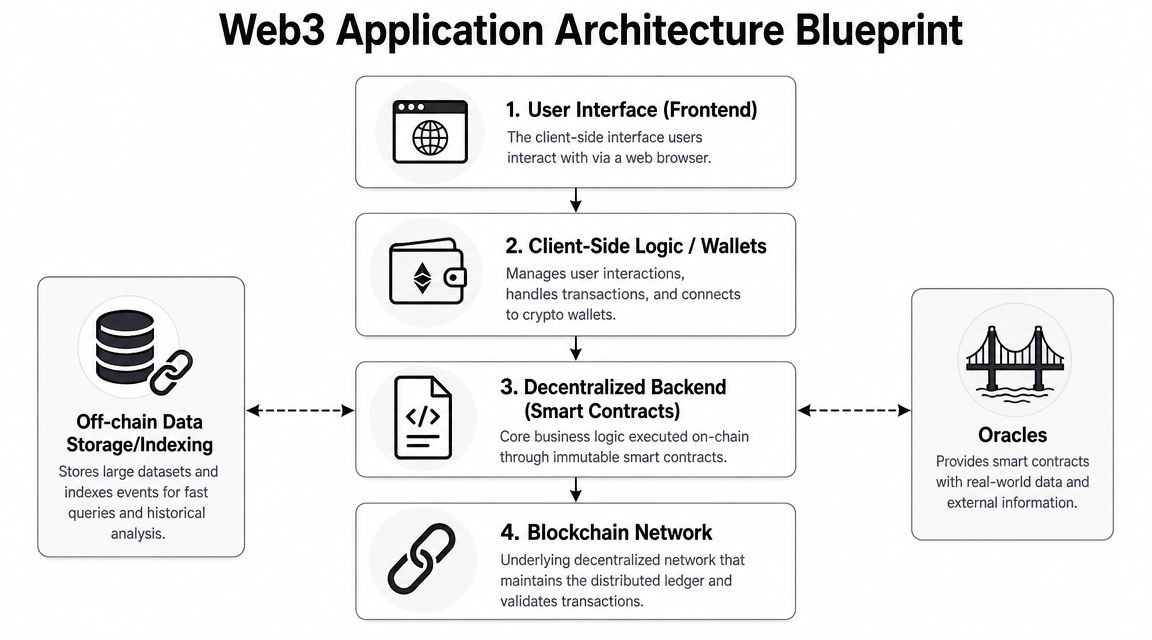
How the Web2 mental model maps to Web3
A useful comparison is MERN versus a standard dApp stack.
| Web2 layer | Web3 equivalent | What changes |
|---|---|---|
| Frontend | Frontend plus wallet connection | The UI still matters, but user actions can trigger signed transactions |
| Backend API | Smart contracts | Core rules become public, deterministic, and harder to change |
| Database | Blockchain state plus off-chain storage | On-chain writes are expensive and limited |
| User auth | Wallet identity | Login becomes signature-based, not username-password based |
The key shift is that your backend logic is no longer fully private or fully mutable. Smart contracts are transparent. Their interfaces are stable once deployed unless you intentionally design for upgrades. That forces stronger up-front design.
The layers that matter in practice
Most production dApps rely on five working parts.
- Blockchain network: This is the execution and settlement layer. It stores critical state and enforces contract logic.
- Smart contracts: These replace parts of your backend. They define permissions, asset movement, and business rules.
- Wallet layer: Wallets act as identity, signing, and transaction approval interfaces.
- Frontend application: Usually a web app that reads chain state, prepares transactions, and explains what the user is about to sign.
- Off-chain services: Storage, indexing, and sometimes oracle connections fill the gaps blockchains aren't designed to handle well.
Good Web3 architecture is mostly about deciding what not to put on-chain.
A common beginner mistake is treating the chain like a general-purpose application server. That leads to poor UX, high costs, and awkward data access patterns. Another mistake is treating the wallet like a drop-in login button. It isn't. It's a consent surface, a security boundary, and often the most fragile part of the user journey.
The mature approach is simpler. Keep contracts narrow, verifiable, and auditable. Push bulky data and query-heavy features off-chain. Build the frontend as a translator between human intent and signed blockchain actions.
Assembling Your 2026 Web3 Development Stack
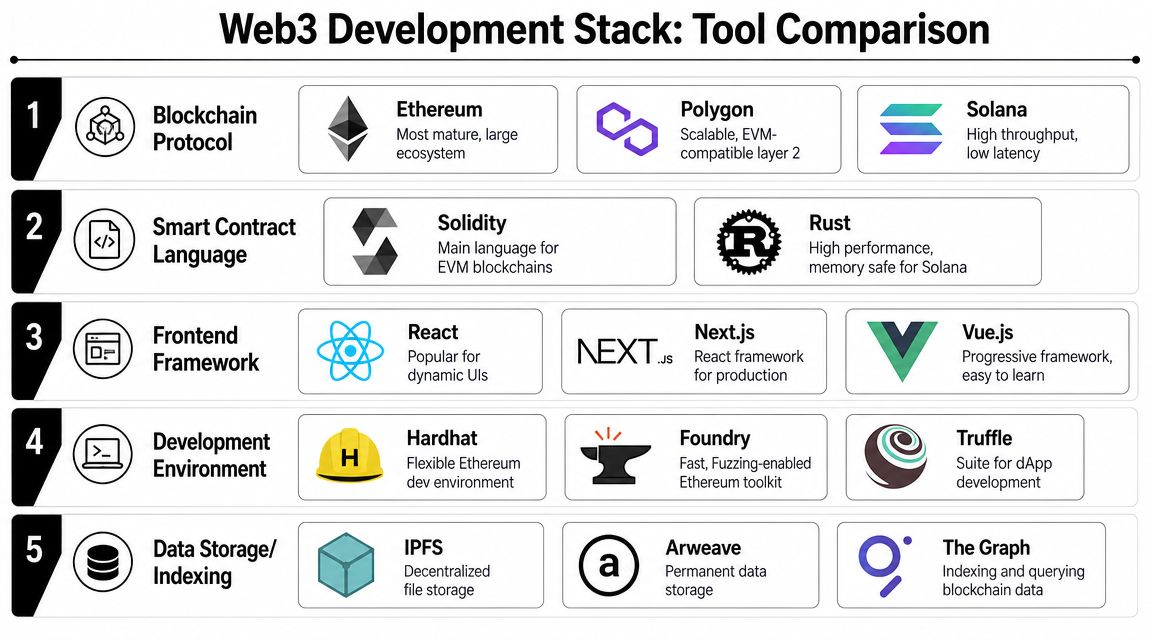
Tool selection in web3 application development should follow your product shape, not social media hype. The stack that works for a DeFi protocol isn't automatically right for a game, an identity product, or tokenized real-world assets. Still, a practical default exists, and it's much easier to start with proven pieces than to over-optimize early.
A production-oriented stack often includes React or Next.js for the frontend, Solidity with OpenZeppelin libraries for smart contracts, and Hardhat or Truffle for development and testing. Syncrasy Tech's Web3 stack guide also emphasizes minimizing gas through efficient code and considering Layer 2 networks for lower transaction costs and better throughput.
A visual comparison helps before making any tooling calls.
The starter stack I'd recommend
For most first-time EVM builders, this stack is hard to beat:
- Frontend: Next.js if you want a structured production app. Plain React also works well.
- Contract language: Solidity for EVM compatibility and ecosystem support.
- Contract libraries: OpenZeppelin for standards, access control, and battle-tested building blocks.
- Development environment: Hardhat if you want broad familiarity and plugin support. Truffle still appears in many guides and legacy projects.
- Chain interaction: Web3.js is a common choice for chain communication in many stacks.
- Storage: IPFS for decentralized file storage when you need metadata or user-uploaded content off-chain.
That setup keeps cognitive load manageable. You can learn contract development, testing, wallet flows, and deployment without introducing five experimental abstractions at once.
Here's a good beginner-friendly video walkthrough before you wire your own stack:
Choosing tools by trade-off, not hype
The best tool choice usually depends on what hurts most in your product.
| Decision | Lean this way when | Watch out for |
|---|---|---|
| Ethereum mainnet | Security and ecosystem depth matter most | Higher transaction friction |
| Layer 2 | You expect frequent user actions | Bridge and ecosystem complexity |
| Next.js | You want a structured app and production-friendly frontend patterns | Slightly more framework overhead |
| React | You want simplicity and already know the ecosystem well | You'll assemble more of the app shape yourself |
| OpenZeppelin | You want standard implementations and safer defaults | Don't inherit blindly without understanding permissions |
A few decisions matter more than beginners expect:
- Gas model: If your app triggers lots of writes, contract design matters as much as chain choice.
- Wallet support: Wallet UX can decide whether non-crypto users stay or leave.
- Data access: If your frontend needs rich historical views, indexing will become necessary quickly.
- Upgrade policy: If your product is changing fast, immutable contracts may slow you down.
Use the most boring secure stack you can tolerate for v1.
The popular mistake is overengineering. Developers mix multiple chains, custom account systems, unusual tokenomics, and complex proxy logic before they've shipped one solid user flow. What works better is a narrow first release on an EVM-compatible path with predictable tooling, clear contracts, and a frontend that explains transactions well.
Building Your First dApp A Step-by-Step Guide
A lot of first dApps fail for a simple reason. The team tries to ship three systems at once: smart contracts, wallet UX, and a new product idea. The faster path is smaller. Build one user action that benefits from on-chain trust, then get the full loop working from wallet connection to confirmed transaction.
A public guestbook is a good first project because it forces the right decisions without burying you in protocol complexity. A user connects a wallet, submits a short message, signs a transaction, and the app shows the result. That is enough to teach contract design, frontend integration, transaction handling, and the difference between reading chain state and writing to it.
If you're comparing wallet UX while learning, this explainer on Phantom Wallet is useful context, even if your first build uses an EVM wallet such as MetaMask.
Start with one on-chain responsibility
Define the single job the chain must do. For a guestbook, that usually means one of these approaches:
- store a capped set of short entries on-chain
- emit an event for each signed post and keep the contract state minimal
- enforce a rule such as one post per address per day
Those options look similar in a tutorial. They behave differently in production.
Storing messages on-chain is easy to reason about, but every write costs more and your data model becomes harder to change. Event-first designs are cheaper and often better for feeds or histories, but your frontend will depend on indexing sooner. Rate limits reduce spam, but they also create edge cases around timestamps, repeat users, and support requests from people who do not understand why a transaction reverted.
For a first build, prove one trust-sensitive workflow. Skip profiles, follows, reactions, moderation, NFTs, and tokens until the basic transaction path feels solid.
A simple user flow looks like this:
- The user connects a wallet.
- The frontend reads existing entries.
- The user submits a message and signs the transaction.
- The contract validates the input and updates storage or emits an event.
- The frontend reflects pending, confirmed, or failed state clearly.
Write the contract before the UI
Web2 developers often want to start with screens. In dApp work, the contract is the product boundary. If the rules are vague, the frontend will drift into assumptions the chain does not support.
For a guestbook contract, decide these points early:
- Do you store messages or just emit events?
- What is the maximum message length?
- Will duplicate posts be allowed?
- Do you need owner permissions for pausing or moderation?
- What should happen when input is empty, too long, or sent too often?
A contract for this kind of app is small, but the trade-offs are real. On-chain strings are expensive. Arrays that grow forever look harmless in testing and become painful once reads get heavier. Returning large lists from a single function can also create frontend and RPC issues. In practice, event logs plus indexed reads scale better for public activity views.
Useful defaults:
- define custom errors or clear revert messages
- emit events for every meaningful state change
- keep storage layout simple
- make constants explicit, such as message length limits
- write tests for rejection paths, not just successful posts
The bug I see most often in first projects is not a dramatic exploit. It is a mismatch between UI expectations and contract rules. The button says “Post message,” but the contract rejects the input because the string is too long, the wallet is on the wrong network, or the address already posted recently. That gap is where user trust drops fast.
Deploy to testnet and test the real transaction flow
Local tests catch logic errors. They do not tell you whether the app feels understandable once a wallet is involved.
Deploy to a public testnet such as Sepolia and use the app like a normal user would. Switch accounts. Reject a signature. Submit a transaction with too little patience and see whether the UI explains what is happening. Trigger a revert on purpose. Many web2 assumptions break in these situations. A page request is instant. A blockchain write is not.
Keep the first frontend small:
- wallet connect
- network check
- read path for guestbook entries or recent events
- form submission
- visible transaction states: awaiting signature, pending, confirmed, failed
The frontend has to interpret more than contract responses. It needs to handle account changes, chain changes, RPC delays, and users who close the wallet popup halfway through the action. A plain interface with clear transaction copy beats a polished UI that hides what the wallet is asking the user to approve.
Three habits save time here:
- Show pending state immediately: after the wallet signs, users need confirmation that the app is waiting on the network
- Translate errors into plain language: “execution reverted” helps nobody outside the dev team
- Separate reads from writes: reads should be fast and quiet, writes should be deliberate and fully explained
Build in this order
This sequence keeps your risk low and makes debugging much easier:
| Stage | Goal | Common mistake |
|---|---|---|
| Local contract build | Validate syntax, storage choices, and function design | Locking in UI flows before contract behavior is settled |
| Local tests | Catch edge cases and regression bugs | Testing only successful inputs |
| Testnet deployment | Verify wallet prompts, gas behavior, and network configuration | Treating deployment as the finish line |
| Frontend integration | Connect contract reads and writes to a usable interface | Hiding transaction status or revert reasons |
That order matters because contract mistakes are expensive to fix after users depend on them. Frontend mistakes are cheaper. Make the hard-to-change layer boring first.
Keep version one plain. If users can connect a wallet, understand what they are signing, submit a message, and see the result without confusion, you have built a real dApp. The next improvements usually become obvious once people touch it: better indexing, cleaner event history, clearer copy around failed transactions, and better spam controls. That feedback is far more useful than adding features before the first user flow works.
Advanced Topics Data Storage and Indexing
Gas costs punish bad storage decisions fast. Teams coming from Web2 often discover this after they have already modeled the chain like Postgres and built a UI that depends on queries the EVM does not support well.
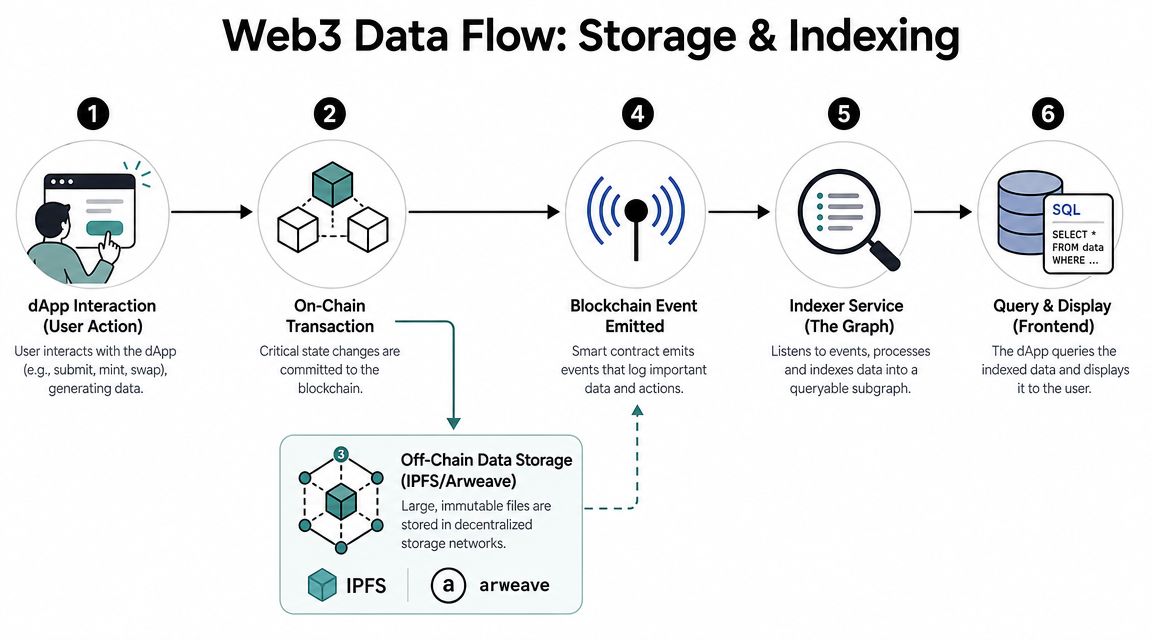
Many first dApps hit the same wall. The contract works, but the app feels slow, indexing lags behind user actions, and simple screens such as activity feeds or asset galleries become expensive to build. The fix is architectural, not cosmetic. Store only the data that must be verified on-chain. Move everything else into systems designed for retrieval, history, and files.
Why blockchains are poor application databases
A blockchain is good at preserving shared state under strict rules. It is bad at full-text search, filtering large record sets, sorting historical activity, and serving media.
That creates predictable failure modes:
- storing images or large metadata blobs directly in contract storage
- keeping detailed user profiles on-chain when only a small hash or pointer needs verification
- asking the frontend to scan logs block by block to rebuild history
- designing screens around joins, pagination, and search that the chain cannot answer efficiently
I usually frame the decision this way: what does a validator need to agree on, and what does the product only need to display quickly? Those are different problems, and they belong in different layers.
A storage pattern that holds up in production
For most dApps, a practical split looks like this:
- On-chain: balances, ownership, permissions, settlement rules, and hashes that anchor off-chain content
- Decentralized storage: files, images, JSON metadata, and other payloads that are too large or too expensive to store in contract state
- Event logs: append-only records of actions your indexer can consume
- Indexing layer: a query service that turns raw chain activity into application-friendly data models
IPFS is still the common choice for content-addressed files. Filecoin can make sense when persistence guarantees matter more and you want an incentive layer around storage. Traditional cloud storage also appears in real systems, usually during early-stage development or for non-sensitive cached data, but that choice changes the trust model. Developers should make that trade-off explicit instead of treating centralized storage as if it were equivalent.
A simple rule helps. If the user must be able to verify it independently, anchor it on-chain. If the user mainly needs to fetch it quickly, store it off-chain and keep a verifiable reference.
Indexing is usually the missing layer
Smart contracts are not query engines. They expose state and emit logs. Your frontend still needs a way to answer practical questions: Which NFTs does this wallet own across collections? What proposals did this user vote on? What happened in the last 24 hours?
That is where indexing earns its keep.
Tools such as The Graph can map contract events and state into entities your app can query without forcing every client to replay chain history. For smaller projects, a custom indexer using RPC providers, a message queue, and a database can be easier to control. The trade-off is maintenance. Managed indexing gets you to market faster. Custom indexing gives you more freedom around schema design, backfills, and multi-chain aggregation.
Neither option is automatically better. The right choice depends on query complexity, chain support, expected traffic, and how much operational burden the team can own.
Common gotchas new teams miss
Event design matters more than many developers expect. If the contract does not emit the fields your product needs, the indexer has to guess, re-read storage, or miss context entirely. I have seen teams save a little gas by trimming event fields, then spend weeks compensating for that decision in the backend.
Watch for these problems early:
- Unstable metadata URIs: if content can change without notification, users and marketplaces may show inconsistent results
- No content pinning plan: storing a CID is not enough if nobody guarantees availability
- Poor event coverage: missing IDs, actors, or timestamps makes indexing harder than it needs to be
- Frontend dependence on direct RPC reads for history: this works in demos and breaks under real usage
- Reorg handling: indexers need a strategy for chain reorganizations, especially on faster or lower-cost networks
The cryptography choices behind storage, proofs, and integrity checks also keep changing. Developers who want the longer-term context should read this look at the future of cryptography because storage design is tied to how trust and verification evolve.
Choose for your product, not for ideology
NFT marketplaces, games, social apps, and DAO tools do not stress the stack in the same way. A game may care more about asset delivery and fast reads than immutable long-form history. A governance app may care far more about event integrity, proposal snapshots, and auditability. A social product may need aggressive indexing and caching or it will feel broken no matter how good the contracts are.
Good Web3 architecture comes from separating truth, storage, and query concerns early. Teams that do this well spend less time fighting their own stack and more time improving the product.
Essential Practices for Security and Deployment
Security is the line between a prototype and a product. In Web3, users often sign irreversible actions. That changes everything about your standards. A smart contract bug isn't just a defect. It can become a permanent exploit path or lock funds inside logic you can't safely patch.
Recent industry guidance also gets one critical point right: mainstream adoption depends on UX that explains risk, approvals, and irreversibility, not just cleaner interfaces. Rapid Innovation's guide to building Web3 applications highlights that better onboarding must include clear communication around custody, approval, and security trade-offs. For broader context on where cryptography is heading, this look at the future of cryptography is worth reading.
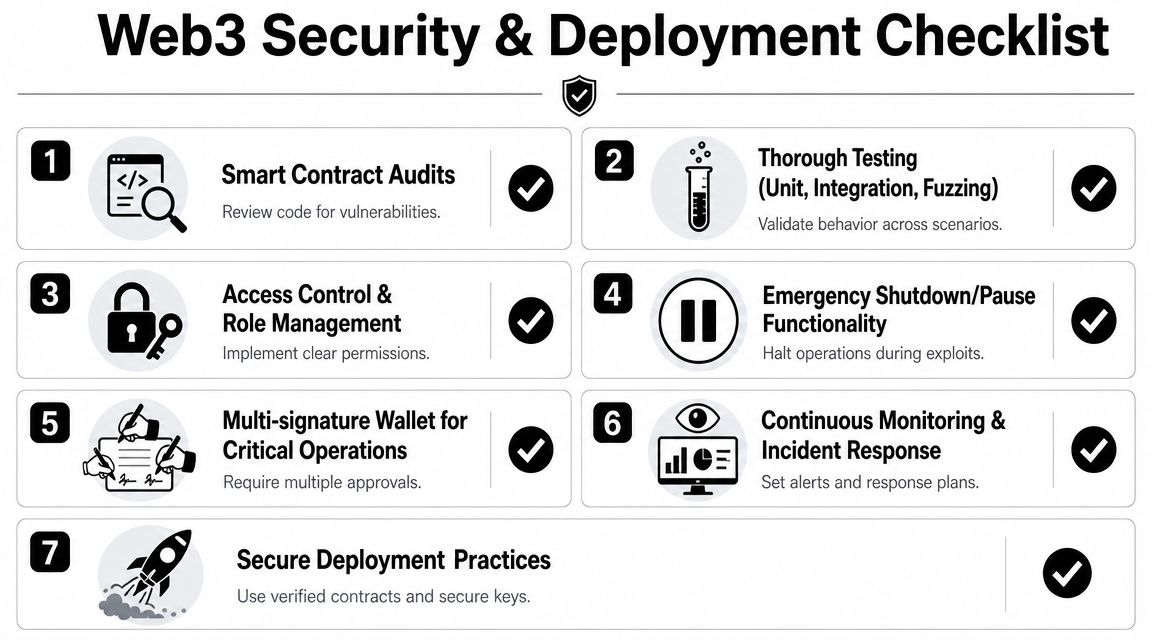
Security starts with design, not audits
Audits matter, but they don't rescue bad architecture. Strong projects reduce attack surface before a third party ever reviews the code.
Focus on these habits:
- Use standard libraries: OpenZeppelin exists for a reason. Rewriting token or access-control logic rarely ends well.
- Minimize privileged actions: Every admin path becomes a trust and key-management problem.
- Test adversarially: Write tests for misuse, not just intended use.
- Emit clear events: Monitoring and incident response depend on observability.
- Plan pause and recovery logic carefully: Emergency controls can save a protocol, but they also introduce power and governance questions.
The most common amateur mistake is building custom logic for standard problems. The second is treating upgradeability as free flexibility. Upgradeable contracts solve real product issues, but they add complexity, storage-layout discipline, and governance risk.
Deployment is a product decision too
Deployment isn't the end of engineering. It's the start of operating a public system.
Users need to understand:
- what they are approving
- whether an action is reversible
- which wallet or network they should be using
- how to verify they are interacting with the correct contract
That means your deployment checklist should include both technical and UX safeguards.
| Area | Good practice | Weak practice |
|---|---|---|
| Contract code | Reuse proven modules and verify behavior with tests | Ship hand-rolled logic with minimal review |
| Admin control | Limit roles and document powers clearly | Hide broad owner privileges |
| User approvals | Explain what each signature does | Rely on wallet popups alone |
| Monitoring | Track contract events and suspicious activity | Wait for users to report problems |
Security communication is part of security itself.
If your dApp asks for approvals without context, hides irreversible actions behind polished buttons, or assumes users understand custody, you're building fragility into the product. The strongest teams ship with technical controls and plain-language warnings side by side.
Frequently Asked Questions about Web3 Development
How much does it cost to build a Web3 app
Cost depends less on the label "Web3" and more on the number of failure points you introduce.
A simple app that connects a wallet and calls a small set of audited contracts is one budget category. A product with custom contracts, account abstraction, indexing infrastructure, admin tooling, analytics, monitoring, and a serious security review is a different project entirely. The expensive parts usually show up around integration and operations, not just contract code.
Teams new to dApps often underestimate four line items: audit time, test coverage, indexer setup, and post-deployment monitoring. If the product handles assets, treat those as part of the build, not optional cleanup work.
Do I need to support multiple chains from day one
Usually no.
Start with one chain that fits the product. If users will perform frequent low-value actions, transaction cost and confirmation speed matter more. If your product depends on established liquidity, stable tooling, or a specific ecosystem, that should drive the choice instead.
I usually advise teams to design the app so chain-specific pieces stay isolated. Keep contract addresses, RPC configuration, and indexing logic modular. That gives you room to expand later without forcing cross-chain complexity into version one.
What trends should developers watch next
Two shifts matter right now. Better interoperability tooling, and more products using AI on the off-chain side for search, risk scoring, support flows, or developer tooling.
The architectural question is more useful than the trend itself. Will this feature touch consensus-critical logic, or can it stay off-chain where iteration is cheaper and safer? In many cases, AI should inform the app, not control the contract. Cross-chain support follows the same rule. Add it when it serves a clear user or liquidity need, not because it sounds future-proof.
What should I learn first as a Web2 developer
Learn the pieces in the order you will trip over them in a real build:
- Solidity basics and contract testing
- Wallet UX, signatures, and transaction states
- Event indexing and off-chain reads
- Gas-aware data structures and contract patterns
- Security review habits, permissions, and upgrade risk
Web2 developers usually pick up syntax fast. The harder adjustment is accepting that production mistakes are public, state is harder to change, and user errors can become irreversible asset loss.
How do I avoid beginner mistakes
Keep the first version narrow. Use proven libraries. Test unhappy paths, not just the demo flow. Document every privileged action. Avoid custom token mechanics unless they solve a real product requirement.
Also spend time on user protection. A lot of Web3 product failures start as UX failures. Blind signature prompts, unclear approvals, and fake contract pages all create trust problems that good code alone will not fix. This guide on how to avoid common crypto scam patterns is worth reading because the same patterns that fool users also expose weak spots in dApp design.
If you want more practical analysis on blockchain technology, decentralized applications, crypto risks, Layer 2 trends, NFTs, tokenization, and the next wave of Web3 infrastructure, explore Coiner Blog. It's a strong resource for readers who want clear explanations without hype, especially when the goal is making smarter decisions as a builder, user, or investor.