
What Is Web3 Technology: Your 2026 Guide

If the internet feels more crowded, more profitable, and less user-controlled than ever, the central question isn't what new app comes next. It's who owns the value created online.
That question gets to the heart of what is Web3 technology. Most explainers stop at slogans like "the decentralized internet." That's not wrong, but it misses the economic shift. Web3 changes where data lives, who controls digital assets, how applications coordinate trust, and who captures upside when a network grows.
For traders, builders, creators, and curious users, that matters now because Web3 has moved beyond a purely speculative label. It sits at the intersection of blockchain infrastructure, smart contracts, digital identity, tokenomics, DeFi, Layer 2 scaling, and a broader push away from platform dependency. If you're following crypto markets, product design, or internet business models, you can't afford to treat it as just another buzzword.
Table of Contents
- Beyond the Hype What Is Web3 Technology Really
- From Read-Only to Read-Write-Own The Internet's Evolution
- The Building Blocks of Web3 A Look Under the Hood
- Real-World Web3 Applications You Can Use Today
- The Investor's Dilemma Benefits vs Risks in Web3
- Your First Steps How to Safely Engage with Web3
- The Next Wave Emerging Trends Shaping the Future of Web3
Beyond the Hype What Is Web3 Technology Really
What changes when users can own part of the internet experience instead of renting access from a platform?
That is the practical way to frame Web3. It is a redesign of online services around user-held assets, shared settlement rails, and software that can run without a single company controlling the ledger, the rules, or the exit door. The technical stack matters, but the fundamental shift is economic. Web3 changes who holds the asset, who captures the fee, and who keeps access when a platform changes policy.
The term has been around for years. Gavin Wood introduced "Web 3.0" in the blockchain context in 2014, and the idea moved into mainstream crypto and venture conversations during the last market cycle. That history matters because it separates the underlying design goal from the speculative mania that later formed around tokens.
Here is the core question: where should digital ownership live? In Web2, it usually sits inside a company's database. In Web3, the goal is to move at least part of that ownership to open networks where assets, identity markers, and transaction history can be verified independently of any one app.
That does not automatically make the product better.
In practice, Web3 only earns its keep when the architecture solves a real problem. The strongest cases tend to involve assets that need to move across platforms, payments that benefit from direct settlement, communities that need transparent rules, or markets where users care about custody and transfer rights. If none of that matters, a standard database is often faster, cheaper, and easier to maintain.
A useful comparison is property rights online. Web2 platforms usually grant access under terms they can revise. Web3 systems try to give users direct control over assets through wallets and smart contracts. The trade-off is clear. Users gain portability and self-custody, but they also take on more responsibility, more friction, and more exposure to irreversible mistakes.
That trade-off is why serious analysts do not judge Web3 by decentralization slogans. They ask narrower questions. Does this product reduce platform dependency? Does it create a new market that only works with programmable ownership? Does the token add real coordination value, or is it just a fundraising wrapper?
Those questions also shape where capital is flowing. Infrastructure, stablecoin payments, tokenized real-world assets, and wallet-based identity keep attracting attention because they point to measurable shifts in user behavior and business models, not just ideology. Industry gatherings such as the Consensus crypto event are useful for tracking that shift early, since the discussions usually center on custody, compliance, settlement, and tokenization before those themes show up in polished consumer products.
From Read-Only to Read-Write-Own The Internet's Evolution
The fastest way to understand what is Web3 technology is to stop treating it as a standalone invention. It's part of an internet progression.
Web1 was mostly static. You visited websites, read pages, clicked links, and left. Web2 made the web interactive. Users could publish, comment, stream, sell, and socialize at scale. That created enormous value, but it also concentrated power in platforms that aggregated user data, attention, and network effects.
Web3 tries to add a missing layer: native digital ownership. Not just access to an account, but possession of assets and credentials that can move across applications.
Why the ownership layer matters
In Web2, your game items, creator audience, loyalty points, and even identity usually exist inside someone else's database. If the company changes terms, removes features, or shuts down access, your bargaining power is limited.
In Web3, the design goal is different. Assets can sit in a wallet you control. Transactions can settle on a shared ledger. Applications can read common state instead of forcing every user into a separate silo.
That shift is why wallet education matters so much. Before using on-chain apps, many users start by understanding tools such as Phantom Wallet, because wallets are often the bridge between passive internet use and actual digital ownership.
Web1 vs Web2 vs Web3 A Generational Shift
| Characteristic | Web1 (The Read-Only Web) | Web2 (The Social Web) | Web3 (The Decentralized Web) |
|---|---|---|---|
| User role | Reader | Creator and participant | Owner, participant, and stakeholder |
| Main experience | Static pages | Social apps, marketplaces, cloud platforms | Wallet-based apps, tokenized systems, shared ledgers |
| Data control | Site operators | Large platforms | Distributed across networks and user-controlled keys |
| Monetization | Ads, subscriptions, basic commerce | Platform-driven ads, creator monetization, app stores | Tokens, protocol fees, digital assets, direct peer-to-peer exchange |
| Identity | Separate logins per site | Platform accounts and social graphs | Wallets, on-chain credentials, decentralized identity |
| Asset portability | Limited | Usually locked inside platforms | Designed to be transferable across apps and wallets |
| Trust model | Website operator | Platform intermediary | Network consensus plus smart contract logic |
A simple way to read that table is this:
- Web1 gave us information
- Web2 gave us participation
- Web3 aims to add ownership
Web3 doesn't replace the entire internet. It inserts an ownership and settlement layer where centralized databases create friction, lock-in, or trust problems.
That distinction matters because many products won't benefit from full decentralization. A notes app, food delivery service, or basic photo editor often doesn't need a blockchain. But financial protocols, digital collectibles, tokenized assets, interoperable game economies, and programmable identity systems often do.
The Building Blocks of Web3 A Look Under the Hood
If Web3 is an ownership-centric internet model, its stack has to do three jobs well. It has to store shared state, execute rules, and give users a way to control assets. Everything else sits on top of those functions.
The easiest analogy is a house. The blockchain is the foundation. Smart contracts are the structural framework and embedded rules. dApps are the rooms people use. Tokens, wallets, DAOs, and Layer 2 networks make that house usable at scale.
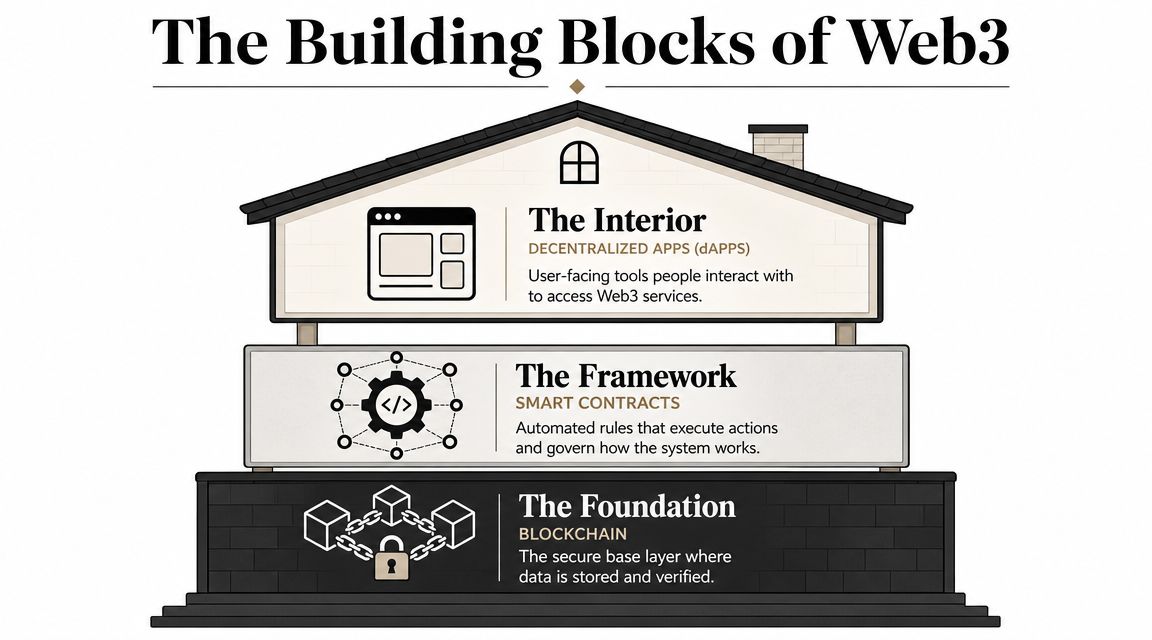
Blockchain as the foundation
A key technical difference in Web3 is the ownership model created by distributed ledgers. Instead of storing the authoritative record on one company's server, the state is replicated across many nodes, making confirmed records immutable and verifiable, as explained in Coursera's Web3 overview.
That matters because ownership becomes auditable. If a token, stablecoin, NFT, or governance right exists on-chain, anyone can verify its movement and current holder using the network's record rather than trusting a company's private database.
Still, the foundation comes with friction:
- Consensus adds cost: Public chains can be slower and more expensive than centralized systems.
- Transparency changes privacy assumptions: Public records improve auditability, but they also expose activity patterns.
- Chain choice matters: Security, fees, tooling, and ecosystem depth vary widely.
Smart contracts wallets and tokens
Smart contracts are software that executes agreed rules on-chain. If a decentralized exchange defines how trades settle, or a lending protocol defines how collateral behaves, that logic typically lives in smart contracts.
Tokens are the economic units those contracts manage. Some are fungible, like utility or governance tokens. Others are non-fungible, representing unique items, memberships, game assets, art, ticketing rights, or credentials.
Wallets are where the user experience gets real. A wallet isn't just an account. It's a key manager and signing tool that lets you prove control over assets and approve actions. That's powerful, but it shifts responsibility to the user.
Lose your password in Web2 and support might help. Lose control of your wallet keys in Web3 and there may be no one to reverse the damage.
That trade-off sits at the center of Web3 UX. Self-custody provides autonomy. It's also unforgiving.
For readers interested in the deeper security side of this model, the future of cryptography is tightly linked to how wallets, signatures, privacy, and trust systems evolve.
DAOs dApps and Layer 2 rails
Once the foundation and framework are in place, user-facing applications sit on top.
dApps are decentralized applications that connect wallet interaction, smart contract logic, and interfaces people can use. A DeFi dashboard, NFT marketplace, blockchain game, or identity tool can all be dApps.
DAOs try to coordinate governance around shared treasuries, protocol upgrades, or community direction. In practice, some DAOs work best as transparent coordination systems. Others collapse under low participation, concentration of voting power, or unclear accountability.
Layer 2 networks are critical because many base chains struggle with cost and throughput under demand. Layer 2s handle transactions in a more scalable way while anchoring back to a more secure base layer. In user terms, they often mean faster confirmations and lower fees.
A practical Web3 stack often looks like this:
- Base chain for security
- Layer 2 for cheaper execution
- Smart contracts for rules
- Wallet for user control
- dApp interface for usability
- Token model for incentives and ownership
When these pieces fit, Web3 products feel coherent. When they don't, users get a mess of bridges, signatures, gas fees, and failed transactions.
Real-World Web3 Applications You Can Use Today
The most useful way to evaluate Web3 isn't by ideology. It's by asking where it already does something that centralized software handles poorly.
Many Web3 elements are still emerging, but the concept has moved from theory toward active use cases. McKinsey notes that the more grounded way to judge Web3 is through on-chain activity, developer growth, and sector-specific adoption in areas like DeFi and NFTs, rather than through broad claims about decentralization alone, as outlined in McKinsey's explainer on what Web3 is.

DeFi works when settlement matters
Decentralized finance is still the clearest proof that Web3 can do more than tell a story. Users can swap assets, provide liquidity, borrow, lend, and manage collateral without opening an account at a bank in the traditional sense.
Where DeFi works:
- Programmable settlement: Rules are visible in smart contracts.
- Interoperability: Protocols can compose with each other.
- Continuous access: Markets don't wait for branch hours.
Where it doesn't:
- Complex interfaces: New users face approvals, slippage, gas fees, and bridge risk.
- Contract risk: If code is flawed, capital is exposed.
- Incentive distortion: Token rewards can attract mercenary liquidity rather than durable usage.
The strongest DeFi products usually solve a narrow problem well. The weakest try to manufacture yield narratives without real utility.
NFTs are bigger than collectibles
NFTs were widely introduced through profile pictures and digital art, but that framing was always too narrow. A non-fungible token is better understood as a unique on-chain record that can represent ownership, access, or provenance.
That opens up more practical use cases:
- Ticketing: Transferable, verifiable event access
- Membership: Token-gated communities or perks
- Gaming items: Portable items with market value
- Identity layers: Credentials and reputation signals
- Media rights: Direct creator-to-fan distribution models
The challenge is that not every item benefits from tokenization. If an asset never needs to be transferred, verified independently, or used across systems, an NFT may add more friction than value.
A useful reference point for crypto-native digital economies is the rise of gaming ecosystems. Coiner Blog has covered examples in this space, including the Infinite World game, where ownership mechanics and game economies intersect.
Gaming identity and virtual economies
Gaming is one of the most natural environments for Web3 because players already understand digital scarcity. They buy skins, trade items, grind for status, and assign value to virtual goods.
Web3 gaming tries to make those goods user-held rather than publisher-held. In theory, that creates stronger incentives for players and opens secondary markets. In practice, the model only works when the game is fun first and tokenized second.
Field note: A game doesn't become better because it has tokens. It becomes investable only if the economy supports a product people would use without speculative rewards.
Virtual worlds and metaverse-style applications operate on similar logic. Land, identity, membership, and in-world items become tokenized primitives. The opportunity is obvious. So is the risk of building empty worlds optimized for narratives instead of users.
For readers who prefer a visual walk-through before connecting wallets or trying dApps, this overview gives a helpful practical primer.
The Investor's Dilemma Benefits vs Risks in Web3
Web3 attracts capital for the same reason it attracts skepticism. It offers a credible redesign of ownership, but it asks users and investors to tolerate unfinished infrastructure, volatile markets, and more direct exposure to failure.
That tension is why the investment case exists. If you only focus on upside, you miss the structural hazards. If you only focus on scams and broken UX, you miss why serious developers and institutions keep building around digital assets, tokenization, and on-chain coordination.

Where Web3 creates real upside
The strongest Web3 opportunities usually come from structural advantages, not hype cycles.
- Transparent settlement: Public ledgers make it easier to verify transfers, reserves, and transaction history.
- Programmable assets: Smart contracts can automate financial logic, royalties, access controls, and treasury rules.
- Portable ownership: Users can move assets between wallets, marketplaces, and applications.
- Creator economics: Communities can coordinate around tokens, memberships, and direct monetization paths.
- New market design: Protocols can reward contributors, bootstrap liquidity, and align participants through tokenomics.
For investors, that means the most interesting projects often aren't the loudest. They're the ones solving custody, infrastructure, identity, data availability, compliance, or real asset settlement in ways Web2 systems struggle to replicate cleanly.
Where the model still breaks down
The downside case is just as real.
Smart contract exploits can drain funds quickly. Governance can become theater if token voting is concentrated. Bridges and cross-chain tools add attack surface. Wallet UX still confuses ordinary users. Regulation remains uneven across jurisdictions. A project can have an elegant whitepaper and still fail because nobody wants the product.
A sober risk framework should include:
Technical risk
Bugs, oracle failures, bridge vulnerabilities, and poor contract design.Economic risk Unsustainable token incentives, reflexive borrowing, weak treasury management, and shallow liquidity.
Behavioral risk
Chasing narratives, overtrading, ignoring custody, and treating governance tokens like equity when they may not function that way.Regulatory risk
Rules around token issuance, custody, disclosure, and market access can change fast.
Bear markets tend to expose whether a protocol had users, or just incentives. That's why studying crypto bear market conditions is often more useful than reading bull-market marketing.
From a practitioner's view, Web3 works best when investors stop asking "Will this token moon?" and start asking "What part of the stack does this project own, and why can't a normal database do the job?"
Your First Steps How to Safely Engage with Web3
What changes the moment you enter Web3? You stop acting like an account holder and start acting like your own bank, permissions manager, and fraud desk.
That shift matters more than any token thesis. In Web2, a bad click usually leads to a password reset or a support ticket. In Web3, one careless approval can expose assets immediately, and there may be no practical way to reverse it. The upside is direct control over assets and access. The cost is operational responsibility.

Start with wallet hygiene
A wallet such as MetaMask, Phantom, Rabby, or a hardware wallet is the control point for everything that follows. If the wallet setup is weak, the rest of your strategy does not matter.
Use a practical baseline:
- Write recovery credentials offline: Keep seed phrases out of cloud notes, screenshots, email drafts, and chat apps.
- Separate spending from storage: Use one wallet for testing dApps and another for long-term holdings.
- Read every signing prompt: A large share of user losses starts with approvals nobody fully reviewed.
- Use a hardware wallet for meaningful balances: Extra signing steps reduce the chance of impulsive mistakes.
- Clear stale approvals: Token allowances and site permissions often stay active long after you stop using an app.
"Not your keys, not your crypto" is a custody rule, not a slogan.
A practical beginner checklist
Start with small amounts and repeat simple actions until the flow feels familiar. The goal in your first few weeks is not return. It is error reduction.
Choose a wallet that fits the chain you want to use
MetaMask is common on Ethereum-compatible networks. Phantom is widely used on Solana. Rabby is often preferred by active DeFi users because transaction details are easier to inspect before signing.Send a test amount first
Practice receiving, sending, swapping, and checking network fees before you move serious value. Small tests catch address mistakes, wrong-network transfers, and bad assumptions cheaply.Stick to established applications at the start
New users usually lose money through phishing, fake interfaces, and permission mistakes before they ever encounter more complex smart contract risk.Learn the difference between sign, approve, and send
These actions do different things. An approval can let a contract spend tokens later, sometimes up to a high limit if you accept the default setting.Use multiple research inputs
Read official documentation, check recent community discussion, and look for independent security reviews when they exist. Coiner Blog is one educational brand in the space, but broad coverage is available across many reputable crypto resources on the web.Treat urgency as a warning sign
Fake support messages, cloned websites, and airdrop scams are common. Slow decisions usually beat fast losses.
One more habit separates careful users from expensive learners. Bookmark the exact URLs of the wallets and dApps you use, then access them from those bookmarks instead of search results or direct messages. A convincing phishing page does not need to hack the blockchain. It only needs to get you to sign.
A strong first month in Web3 should feel almost boring. You are building process discipline, not chasing excitement. Learn how wallets behave, how fees change, how approvals work, and how to confirm what a transaction will do before you sign it. That discipline is where user and economic advantage starts. It lets you access open financial rails and digital ownership directly, without handing the entire relationship to a platform.
The Next Wave Emerging Trends Shaping the Future of Web3
The future of Web3 won't be defined by one token category. It will be shaped by the parts of the stack that reduce friction, connect on-chain systems to real economic activity, and make digital ownership useful outside crypto-native circles.
That matters because Web3 is no longer a tiny niche from a market perspective. Grand View Research estimated the global Web 3.0 market at USD 2.25 billion in 2023 and projects it could reach USD 33.53 billion by 2030, with a projected compound annual growth rate of 49.3% from 2024 to 2030, according to Grand View Research's Web 3.0 market report. In the same report, North America held 37.3% of global revenue in 2023, while Asia Pacific was expected to be the fastest-growing region. That doesn't prove every project is valuable. It does show that serious capital sees Web3 as infrastructure, not just speculation.
AI crypto and programmable ownership
AI and crypto are increasingly discussed together because they solve different but complementary problems. AI helps with generation, analysis, recommendation, and automation. Crypto helps with ownership, coordination, payments, and verification.
That combination can support:
- Autonomous agents that transact on-chain
- Smarter dApps that personalize actions without fully centralizing control
- Provenance layers for digital media and model outputs
- Machine-to-machine payment flows
The key question isn't whether AI and blockchain can be mentioned in the same pitch deck. It's whether blockchain adds enforceable ownership or settlement to workflows where AI already creates value.
Layer 2 and real-world asset rails
Layer 2 scaling is likely to become standard infrastructure rather than a niche technical topic. Users want cheaper transactions, faster confirmations, and less friction. Developers want access to broad liquidity without forcing every interaction onto expensive base-layer execution.
Real-world asset tokenization is another major direction. Bonds, credit products, funds, invoices, real estate claims, and other off-chain rights can be represented on-chain, making transfer, reporting, and settlement more programmable. The hard part isn't minting a token. It's linking that token to legal enforceability, compliant issuance, and trusted data.
The strongest Web3 trend isn't "everything moves on-chain." It's that assets and workflows where auditability and programmable settlement matter most move first.
Why this trend still matters
The cleanest investment thesis for Web3 in the next cycle isn't about replacing the whole internet. It's about upgrading the parts of the internet where ownership, settlement, and interoperability are currently fragmented.
That's why the winners may come from places that look boring at first glance: wallets, middleware, Layer 2 rails, compliance tooling, stablecoin infrastructure, tokenization platforms, identity protocols, and developer tooling. Consumer apps will still matter, but infrastructure tends to capture more durable value when a platform shift is early.
Web3's future depends less on slogans and more on whether teams can make self-custody safer, interfaces simpler, and tokenized systems more useful than their centralized alternatives. If they do, the question won't be "what is Web3 technology" anymore. It will be which parts of daily digital life still make sense without it.
Coiner Blog publishes practical coverage of cryptocurrency, blockchain, NFTs, crypto gaming, DeFi, and emerging Web3 trends for readers who want clearer analysis and fewer recycled talking points. If you want more grounded crypto explainers and market-focused guides, visit Coiner Blog.
9 Comments