
Crypto Casino Free Spins: The Ultimate 2026 Guide

Most crypto casino free spins aren't valuable because they're large. They're valuable because the terms let you turn a bonus into something you can withdraw. That's the part most guides skip.
The market itself shows why these offers matter. Crypto casino free spins moved from a niche interest to a structured bonus market in the late 2010s, and by 2026 documented offers commonly ranged from 10 to 200 spins according to CryptoSlate's coverage of crypto casino free spins. Once a promo format becomes that common, it stops being a novelty and becomes a pricing game. Casinos compete on headline numbers. Smart players compare effective value.
That difference matters more in crypto than many newcomers expect. In Web3-style gaming, users are already used to wallets, token incentives, and platform-specific rules. Free spins fit naturally into that world. But a flashy bonus banner doesn't behave like a clean airdrop, a DeFi yield stream, or a transparent smart contract reward. It behaves like a marketing offer with conditions, friction points, and platform risk.
If you want to evaluate crypto casino free spins like a seasoned player instead of a bonus chaser, focus on the mechanics that decide whether the offer is worth your time at all.
Table of Contents
- Why Free Spins Are More Than Just a Gimmick
- The Mechanics of Crypto Free Spins Explained
- Decoding the Fine Print Wagering and Restrictions
- A Step-by-Step Guide to Claiming Spins Safely
- The Red Flag Checklist Spotting a Crypto Casino Scam
- FAQ Tax Legal and Future Trends
Why Free Spins Are More Than Just a Gimmick

Free spins became infrastructure for acquisition
Free spins stopped being a novelty a long time ago. Crypto casinos now use them as a pricing tool, a conversion tool, and a retention tool. The offer on the homepage gets attention, but the critical design work happens in the terms: which slot you can use, how long the spins last, what counts toward withdrawal, and how much of any win you can keep.
That shift changes how players should read these offers. A 100-spin promo can be worse than 20 spins if the game has low hit frequency, the winnings face heavy wagering, or the cashout cap is tight. The headline number is marketing. The effective value is what matters.
I treat free spins the same way I treat any bonus. I ask one question first: what is the realistic path from bonus to withdrawable balance? If that path is narrow, the spins are just a controlled demo. If the terms leave room to convert a decent hit into real money, the offer has actual value.
Practical rule: Judge free spins by expected usable value, not by spin count.
This also fits the broader logic behind blockchain-based reward systems. Crypto casinos borrow the same retention playbook seen across tokenized products, where incentives are structured to shape user behavior over time. For wider context, this overview of Web3 gaming helps explain why reward design matters so much in crypto products.
Why this matters beyond gambling
Free spins also create real-world admin once winnings leave the casino. A small bonus win can turn into wallet transfers, token swaps, and taxable events depending on where you live and how you move funds. That is easy to ignore when the offer feels casual, but it becomes a problem later if records are messy. Readers who play with crypto regularly should review EndureGo Tax insights on crypto before treating bonus-related winnings as off the books.
The short version is simple. Free spins can be useful, but only when the terms let you convert promotional value into actual cashout value. Smart players measure the gap between those two numbers. Casinos count on casual players not doing that.
The Mechanics of Crypto Free Spins Explained
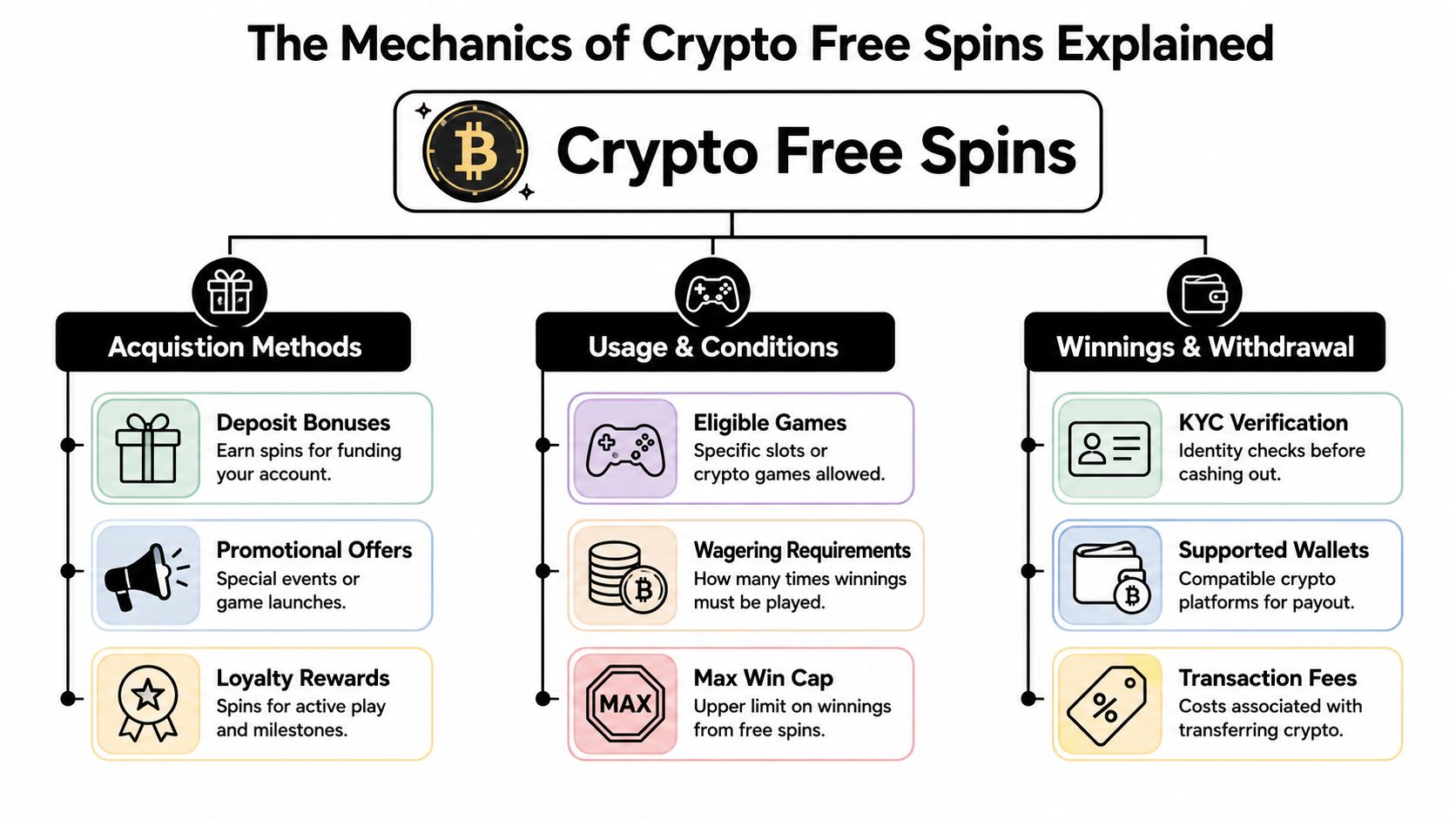
Free spins are usually presented as a gift. In practice, they are a tightly controlled bonus format built to send players toward specific games, specific deposit actions, and specific withdrawal conditions. If you understand how they are issued and how winnings are tracked, it gets much easier to separate a playable offer from a dead-end promo.
The three common ways casinos issue spins
The first group is no-deposit spins. These are the easiest to claim and the easiest to overrate. A casino gives a small batch of spins after registration, email confirmation, wallet connection, or promo activation. The catch is usually on the back end. Winnings may convert to bonus funds instead of cash, and those funds often face stricter limits than deposit-based offers.
The second group is deposit-triggered spins. These sit inside welcome bonuses, first-deposit deals, or reload campaigns. You deposit crypto, meet the minimum amount, and get spins on one slot or a short list of titles. These offers cost more upfront, but they can carry better practical value if the resulting winnings are easier to withdraw.
Then there are loyalty or VIP spins. These are aimed at players who already generate volume on the site. They are less useful for pure bonus hunting, but regular players should still track them because recurring spins can ultimately beat a flashy welcome promo if the site applies lighter restrictions to existing users.
That structure is familiar to anyone who has spent time in crypto products. The operator uses a low-cost reward to shape behavior, then pushes the player toward a deposit or repeat activity. Readers comparing that model with other crypto wagering formats can see the contrast in this guide to DeFi sports betting models.
How the spin flow usually works in practice
A free spin is not just a slot round with the word "free" attached. It sits inside a sequence.
First, the casino assigns the spins to a specific game. Sometimes that game is a popular slot with broad name recognition. Sometimes it is a title the operator wants to promote because the bonus terms are easier to control there.
Next, you use the spins at a fixed stake level. You usually cannot raise or lower the coin value. That matters because the headline offer, such as 50 or 100 spins, says very little until you know the stake per spin.
Then the casino decides how any winnings are classified. This is one of the biggest mechanical details in the whole bonus system. A decent site will show whether spin winnings go straight to cash balance or into a bonus balance that must be wagered again. A weaker site hides that step in the terms and lets the banner do the selling.
Finally, the withdrawal gate kicks in. That is where effective value is won or lost. A 20-spin offer with clean conversion rules can beat a 100-spin offer if the larger one routes every win into a capped, heavily restricted bonus wallet.
Why slots are the default home for free spins
Casinos attach free spins to slots because slots are easy to package inside promos. The game session is fast, the stake can be fixed, and the bonus can be limited to one title without much friction. From the operator's side, that makes free spins cheap to distribute and easy to monitor.
From the player's side, it creates a blind spot. Many players count spins and ignore game quality. That is a mistake. The same number of spins can produce very different practical value depending on the slot's volatility, feature frequency, RTP policy, and whether bonus winnings face a max conversion limit.
I treat the game itself as part of the offer. If the spins are locked to a high-volatility slot, the promo may have more upside but a lower chance of producing usable balance. If the spins are tied to a lower-volatility game, the result may be smaller but more likely to survive the bonus rules. Neither option is automatically better. The right choice depends on whether the terms reward a big hit or cap it.
To make the process more concrete, this walkthrough is worth watching before you start claiming bonuses:
Where Web3 logic could improve the process
Most crypto casinos still run bonuses through centralized tracking. The site decides whether a spin was eligible, whether the wagering target was met, and whether the withdrawal request passes review. That works, but it leaves room for confusion and, on weaker sites, selective enforcement.
A more crypto-native setup would make the bonus state easier to verify. Smart contracts could record issuance, track rollover progress, and show payout conditions in a way that players can check without relying on support chat. Layer 2 rails could also make smaller balance movements less annoying when a player is dealing with bonus funds, cash balance, and wallet withdrawals.
That would not turn a casino bonus into pure DeFi. It would make the mechanics clearer, which is exactly what players need when they are trying to judge the actual value of free spins instead of falling for the headline number.
Decoding the Fine Print Wagering and Restrictions
Headline spin count is the wrong starting point
The actual value of crypto casino free spins is almost never the number printed on the banner. It sits in the terms. CoinCodex's discussion of Bitcoin casino free spins highlights the gap clearly: some offers carry 80x wagering requirements and a 7-day limit, while others have no wagering at all. That's why two promos with similar spin counts can produce completely different real-world outcomes.
A bonus hunter who compares only “100 spins” versus “50 spins” is comparing the wrong variable. What matters is whether the winnings from those spins can survive the rollover, the time limit, the max cashout, and the game restriction.
The best free-spin offer is often the one with fewer spins and cleaner terms.
How to estimate effective value fast
Use a simple review sequence before you claim anything:
- Check the wagering requirement. This tells you how many times bonus winnings must be played through before they can be withdrawn.
- Check the expiry window. A short timer can ruin an otherwise decent offer.
- Check game eligibility. Some casinos restrict spins to one slot or a small list of titles.
- Check the max cashout. Even a strong win may be capped.
- Check whether winnings convert to bonus balance or cash balance. That detail changes everything.
Here's the easiest mental model. Suppose your free spins generate $20 in winnings. If the casino applies a 40x wagering requirement, you'd need to wager $800 before withdrawing. If the same $20 win carried an 80x wagering requirement, the target becomes $1,600. That's not a prediction of what will happen. It's the basic math of rollover.
Newer players get trapped. They see “free” and stop reading. Experienced players read the terms first, then decide whether the spins are even worth activating.
For broader background on how Web3 systems package rules, ownership, and incentives into digital experiences, this guide to Web3 technology is a useful companion read.
Comparison of effective value
Below is a practical comparison framework. It isn't tied to one operator. It's the lens I use when reviewing offers.
| Metric | Offer A (High Spins, High Wagering) | Offer B (Low Spins, Low Wagering) |
|---|---|---|
| Headline appeal | Looks stronger immediately | Looks smaller at first glance |
| Wagering burden | Heavy | Lighter |
| Expiry pressure | Often harsher | Often more manageable |
| Cashout realism | Lower if capped tightly | Higher if terms are clean |
| Best for | Casual trial only | Players who want a realistic withdrawal path |
A few term traps deserve extra attention:
- Selected-slot restrictions: If spins work only on one game, your flexibility disappears. That matters if the slot volatility doesn't fit your goal.
- Max win caps: These terms can effectively flatten the upside of a generous-looking offer.
- Short expiry windows: A tight timer turns a bonus into a race, not an opportunity.
- Bonus-only conversion: If winnings stay locked in a bonus bucket, the path to cash becomes narrower.
Field note: If the terms page makes it hard to understand where winnings go, assume the operator benefits from that confusion.
The strongest habit you can build is to stop asking, “How many spins do I get?” and start asking, “What path do I have from spin to withdrawal?”
A Step-by-Step Guide to Claiming Spins Safely
Check the platform before you chase the bonus
The safest claim process starts before signup.
First, verify that the casino publishes clear licensing information, bonus terms, and supported payment methods. If the site hides those details behind registration walls or support chat, walk away. A legitimate operator wants you to understand the offer before you fund anything.
Second, keep your gambling activity separated from your primary crypto stack. Use a dedicated wallet rather than the same wallet you use for long-term holdings, DeFi positions, or NFT assets. If you need a refresher on wallet security and decentralized internet key management, CoinPay's Web3 wallet explainer gives solid background.
Third, choose a wallet setup that you can monitor cleanly. For newcomers, this guide to beginner-friendly crypto wallets can help you avoid mixing gambling transactions with everything else.
Claim with clean operational habits
Once you've decided the offer is worth testing, use a process instead of improvising.
- Read the activation method: Some spins are auto-credited. Others need a promo code, a qualifying deposit, or a manual opt-in.
- Screenshot the terms: Capture the bonus page, the expiry date, and the key restrictions before claiming.
- Track wagering progress: If the casino provides a counter, watch it. If it doesn't, keep your own notes.
- Confirm withdrawal rules early: Don't wait until after a win to learn whether deposits or verification are required first.
The “no KYC” label is where many players get sloppy. MEXC's coverage of no-KYC crypto casino claims notes that many platforms market low-friction access but still reserve the right to trigger identity verification for larger withdrawals or suspicious activity. That's the operational reality. Crypto rails can reduce payment friction, but they don't guarantee anonymous bonus access in every case.
So if a platform advertises no KYC, translate that into plain English: verification may be delayed, conditional, or selective, not absent.
A few habits make a real difference:
- Keep records from the start: Save deposit hashes, promo codes, and support replies.
- Avoid jurisdiction shortcuts: If the site limits access by region, don't assume you can ignore that without consequences later.
- Test small before scaling: Even if the welcome package looks attractive, start with the smallest sensible exposure and see how the cashier behaves.
Safe claiming isn't glamorous. It is profitable in the long run because it prevents the most avoidable mistakes.
The Red Flag Checklist Spotting a Crypto Casino Scam
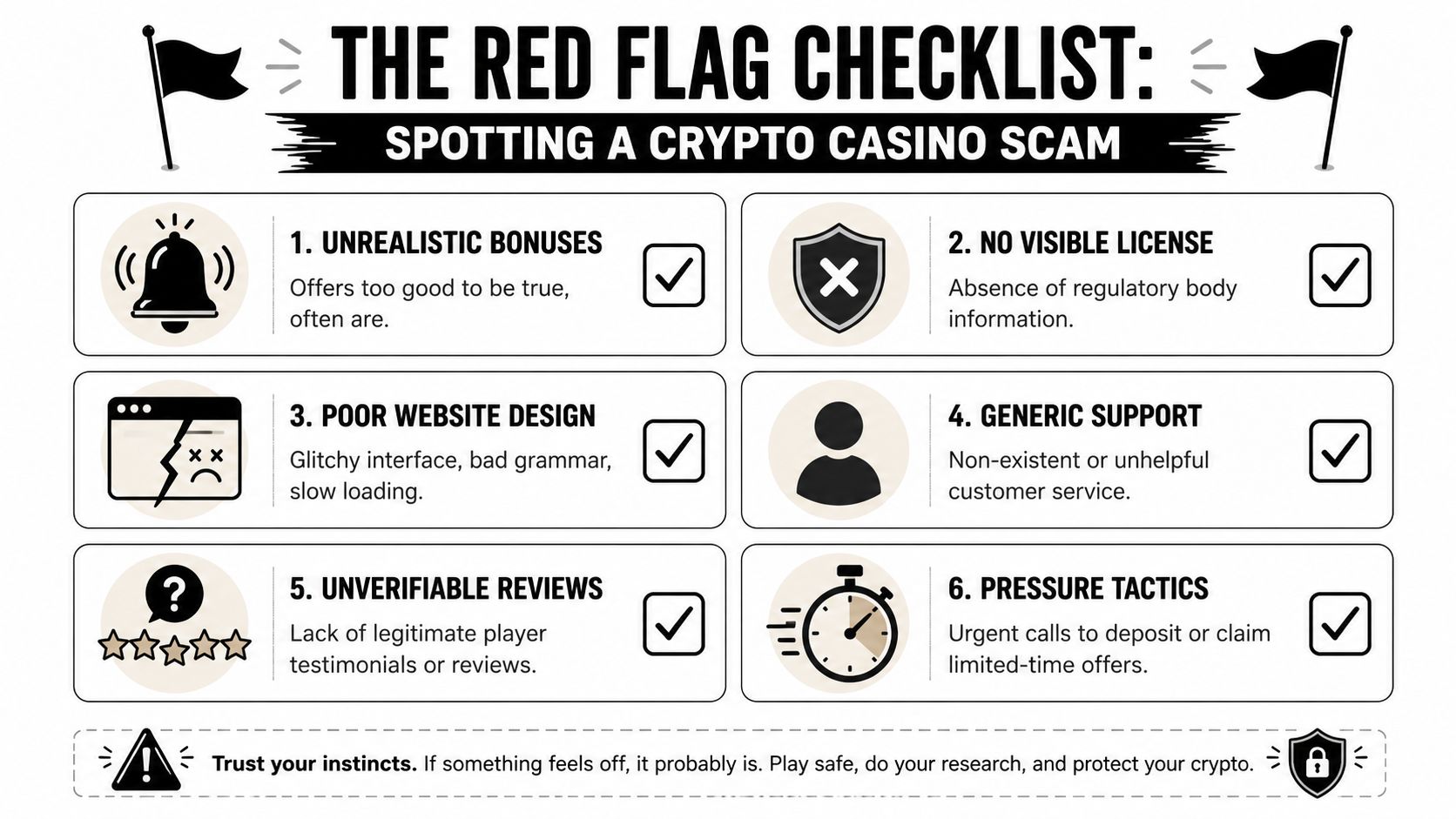
The offers that usually aren't real opportunities
Scammy crypto casino free spins tend to reveal themselves before you ever deposit. You just need to stop reading like a hopeful player and start reading like an analyst.
Watch for these patterns:
- Impossible generosity: If the offer sounds absurdly rich and the terms somehow claim there are almost no conditions, the operator is usually counting on emotion beating due diligence.
- Missing legal pages: A site that promotes bonuses heavily but hides terms, privacy rules, or licensing details is telling you exactly how it handles disputes.
- Required fees after winning: If support says you must deposit extra funds or pay a special fee to release “free spin winnings,” that's a major danger sign.
- Copycat branding: Some scam sites mimic established casino designs, logos, or names closely enough to catch rushed users.
If a casino needs confusion to make its bonus attractive, that's not a promotion. It's a trap.
For a broader defensive playbook, this guide on how to avoid crypto scams is worth keeping nearby.
Site behavior that should stop you immediately
The site itself often tells the story. I pay close attention to behavior more than slogans.
- Broken pages and sloppy grammar: One typo isn't fatal. A whole cashier flow that feels unfinished is a different issue.
- Support that won't answer direct questions: Ask about wagering, max cashout, and eligible games. If answers stay vague, leave.
- Unverifiable reviews: A wall of glowing testimonials on the casino's own site means little if independent discussion is absent or contradictory.
- Pressure tactics: Scammy operators push urgency hard because they don't want you comparing terms or double-checking reputation.
Use a simple rule for self-protection. If you feel rushed, confused, or pushed toward depositing before you understand the bonus, stop. Legitimate casinos want conversion, but they still provide a usable ruleset. Fraudulent ones want irreversible crypto transfers before the friction becomes obvious.
FAQ Tax Legal and Future Trends
Common questions that matter in practice
Are winnings from free spins taxable?
That depends on your jurisdiction and how local rules treat gambling gains, crypto transactions, and asset disposals. The safe approach is to keep records from the beginning and assume that wallet movements tied to winnings may matter later.
Is using a VPN to access geo-restricted bonuses a good idea?
Usually, no. Even if access works initially, withdrawal is where region checks, account reviews, or compliance triggers can appear. A bonus isn't valuable if the payout path becomes contested.
What's the difference between a free spin bonus and a crypto faucet?
A free spin bonus is a promotional offer tied to a casino platform and governed by wagering terms. A crypto faucet distributes small amounts of crypto under a completely different incentive model. One is a gambling promotion. The other is usually a distribution or engagement mechanic.
Keep the legal question separate from the technical question. A wallet can receive funds easily, while a platform can still dispute your right to withdraw them.
Where crypto casino bonuses are heading
The next phase of crypto casino free spins will probably look more personalized and more programmable.
AI-driven targeting is the obvious shift. Casinos already segment users aggressively. AI can push that further by tailoring offers to behavior, device type, preferred games, and deposit patterns. That could mean more relevant promos for players, but it also means more advanced retention design from operators.
Layer 2 infrastructure could improve the user side. Faster settlement and lower transfer friction fit bonus-heavy environments well, especially where users want to move funds between casino balances and self-custody wallets without clunky delays.
Tokenized rewards are another logical direction. Instead of promotions that die inside one platform, some ecosystems may experiment with reward assets that carry utility across broader Web3 environments. That would bring crypto casino incentives closer to the logic of digital ownership, smart contracts, and composable tokenomics.
DeFi-style transparency remains the most interesting long-term possibility. If bonus rules, reward states, and eligibility checks become more transparent, players would spend less time decoding hidden friction and more time making informed decisions.
That future isn't guaranteed. Plenty of platforms still prefer opacity because opacity helps marketing. But the direction of Web3 tooling favors clearer systems, more portable identity and wallet layers, and more automation around rules. If that trend continues, the best crypto casino free spins of the future won't be the ones with the biggest headline count. They'll be the ones with the cleanest path from bonus to usable value.
If you want more practical breakdowns on crypto gaming, Web3 infrastructure, DeFi trends, AI and blockchain, and actual risks behind flashy promotions, explore Coiner Blog. It's a strong resource for readers who want straight analysis instead of recycled hype.