
What Is Web3 Gaming: The Complete 2026 Guide
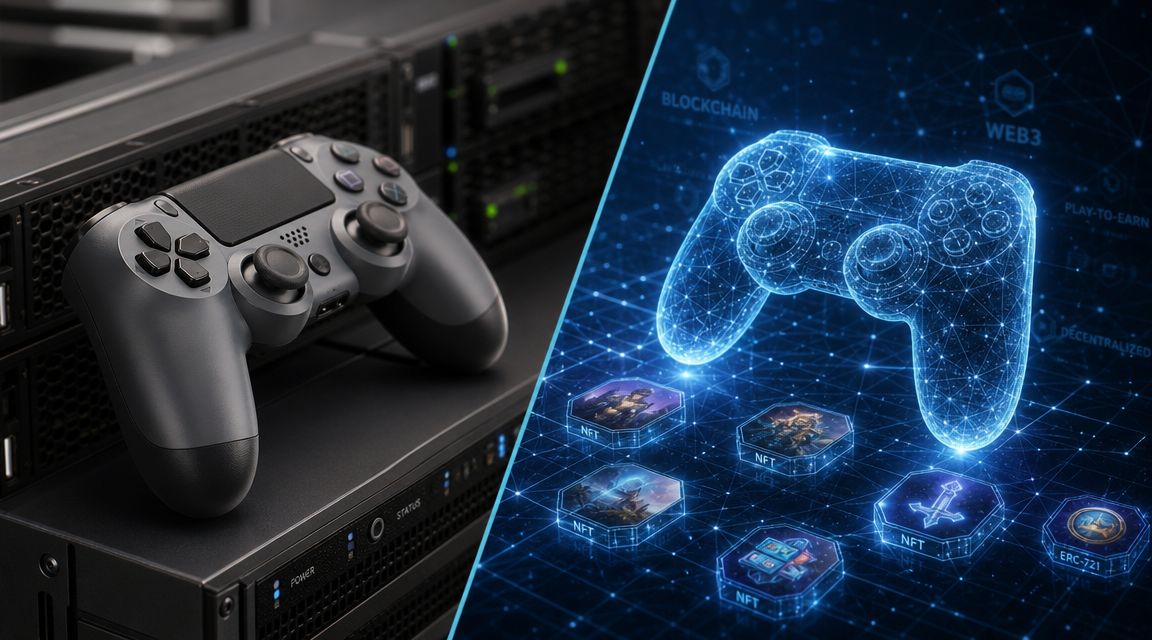
Web3 gaming isn't a fringe experiment anymore. One market forecast valued the global Web3 gaming market at USD 36.19 billion in 2025 and projected it to reach USD 138.39 billion by 2033, implying a 19.34% CAGR from 2026 to 2033, according to SNS Insider's Web3 gaming market report. That single data point changes the conversation. The pertinent question isn't whether the category exists. It's whether investors, builders, and players understand what's being built.
If you've asked what is Web3 gaming, the short answer is simple: it's gaming built around blockchain-based ownership. But the useful answer is deeper. Web3 gaming changes who controls in-game assets, how virtual economies are designed, and where value can accumulate over time. The sector has already moved past the first wave of simplistic token speculation. In 2026, the sharper discussion is about sustainable play-and-own systems, better onboarding, smarter tokenomics, and infrastructure that hides blockchain complexity from the player.
Table of Contents
- Beyond the Hype Why Web3 Gaming Matters in 2026
- Web2 vs Web3 Gaming A Shift from Servers to Sovereignty
- The Technology Powering the Player-Owned Economy
- Inside GameFi How Tokenomics Drives Web3 Economies
- Navigating the Risks and Rewards of Web3 Gaming
- How to Start Your Web3 Gaming Journey Safely
- The Future of Gaming Emerging Trends for 2026 and Beyond
Beyond the Hype Why Web3 Gaming Matters in 2026
Web3 gaming matters in 2026 because the sector has moved past its first failed economic experiment.
Earlier market forecasts already show that serious capital expects this category to remain large. The more useful question is why confidence has held up after the play-to-earn boom faded. The answer is that the industry is changing what it is selling. In 2021 and 2022, many projects sold token emissions wrapped in thin gameplay. In 2026, the stronger teams are building games where blockchain handles ownership, trading, and settlement, while the game itself has to stand on its own.
That is a meaningful shift. Speculative play-to-earn systems depended on a steady flow of new buyers to support token prices and player rewards. Once user growth slowed, many of those economies broke down. Play-and-own is a different model. It treats assets as durable digital property with in-game utility, collectible value, or access rights, not as a paycheck disguised as game design.
Why 2026 feels different
The market is more disciplined now, and the technology stack is better suited to real game operations.
Studios are choosing blockchain features more selectively. They are putting high-frequency gameplay off-chain, keeping ownership records on-chain, and using Layer 2 networks to reduce fees and speed up settlement. That lowers one of the biggest frictions that hurt earlier Web3 titles: players should not have to pay meaningful transaction costs every time they craft, trade, or upgrade an item.
The design priorities have changed too:
- Gameplay leads the product, with tokens and NFTs supporting progression, access, and secondary markets rather than replacing core fun.
- Asset ownership is tied to utility, so items matter because they do something inside the game or community.
- Infrastructure is chosen for cost and throughput, especially as Layer 2s make on-chain transactions more workable for larger player bases.
- Onboarding is getting easier, with many teams reducing wallet friction and hiding more of the blockchain complexity from new users.
This version of Web3 gaming is easier to take seriously because it is less ideological and more operational. Developers are addressing the practical issues that kept the first wave niche: weak game loops, inflationary tokenomics, expensive transactions, and clumsy user experience.
For investors and tech observers, that changes the evaluation framework. The strongest signal is no longer short-term token volume. It is whether a game can keep players engaged without constant financial incentives, while using blockchain to create a more transparent and portable digital economy than closed Web2 systems allow.
That is why 2026 feels different. Web3 gaming is starting to look less like a speculative subcategory and more like a long-term change in how game economies are built.
Web2 vs Web3 Gaming A Shift from Servers to Sovereignty
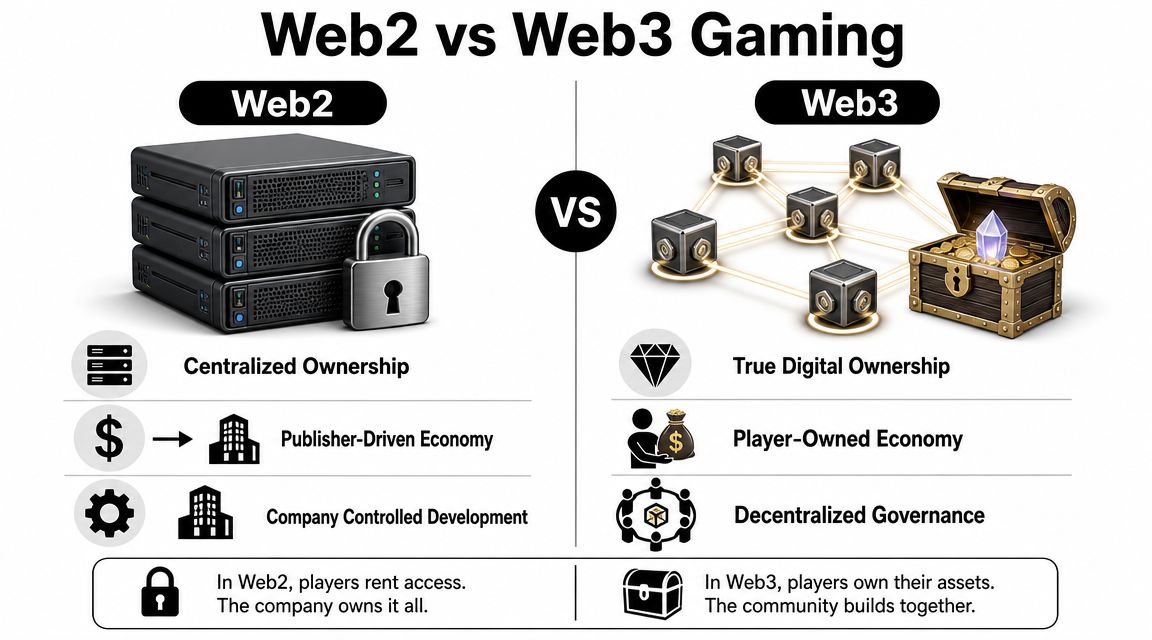
The easiest way to understand Web3 gaming is to compare it with the model most players already know. In Web2 gaming, you pay for access, progression, or cosmetics inside an environment the publisher fully controls. In Web3 gaming, the publisher still builds the game, but the player can hold certain assets directly through a wallet and interact with those assets under open blockchain standards.
Web2 is closer to renting a digital movie from a platform that can change the rules. Web3 is closer to owning a collectible edition you can keep, trade, or move, subject to the game's design and the asset's utility.
Why ownership changes the business model
Gaming is already enormous. The global gaming market reached USD 198.4 billion in 2021, larger than film and music combined, with about 2.5 billion gamers worldwide, according to Galaxy's history of gaming and Web3 research. Web3 gaming doesn't need to invent demand for games. It tries to redesign the ownership layer inside an already massive market.
Galaxy also noted that gaming accounted for over half of blockchain activity in late 2022. That's an underappreciated signal. It suggests blockchain's strongest consumer use case may not be abstract finance alone. It may be digital economies with items, currencies, and identity wrapped around play.
The business implications are substantial:
- Publishers gain new monetization paths through programmable assets and secondary market participation.
- Players gain asset custody that can outlive a single in-game transaction.
- Developers can build around open standards, which creates more room for marketplaces, guild systems, wallets, and DeFi-linked mechanics.
Web2 Gaming vs Web3 Gaming at a glance
| Feature | Web2 Gaming (Traditional) | Web3 Gaming (Blockchain-Based) |
|---|---|---|
| Asset ownership | Publisher controls items in its database | Players can hold blockchain-based assets in wallets |
| Economy design | Closed, platform-specific economy | Open, tokenized economy with tradable assets |
| Trading | Usually restricted or unofficial | Native marketplaces and wallet-based transfers |
| Governance | Company-led updates and policy decisions | Can include token-based or community-led governance |
| Interoperability | Limited | More possible through common token standards |
| Revenue logic | Sales, DLC, subscriptions, in-app purchases | Sales plus tokenized assets, marketplaces, and ecosystem incentives |
Investor lens: The crucial shift isn't that Web3 makes every game decentralized. It's that it changes the location of economic control.
That's why “what is Web3 gaming” is really a question about sovereignty. Not total sovereignty, because studios still control game design and live operations. But partial sovereignty over assets, participation, and value capture. For a market as large as gaming, even partial ownership is a meaningful break from the old model.
The Technology Powering the Player-Owned Economy
The term “blockchain game” often leads to the assumption that the entire game runs on-chain. It doesn't. The practical architecture is more selective, and that's exactly why modern Web3 games can function at all.
Why gameplay stays off-chain
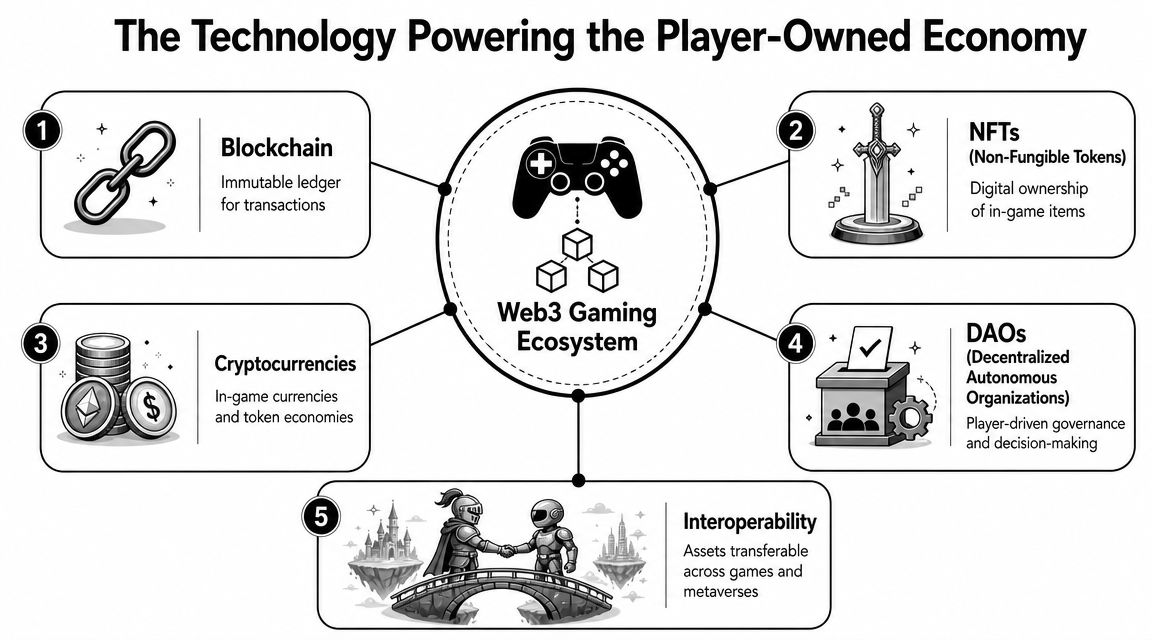
Web3 gaming typically uses a hybrid architecture. Real-time gameplay runs on traditional servers, while blockchain handles high-value events like minting NFTs, settling trades, and recording rewards, as explained in Hedera's Web3 gaming overview. That split matters because blockchains aren't designed for constant, low-latency gameplay state such as movement, combat calculations, or matchmaking.
In plain English, the game engine stays where speed matters most. Ownership and settlement go where verification matters most.
That has two consequences investors should care about:
- Performance is protected. Studios don't need to force every gameplay event through a slow settlement layer.
- Ownership remains auditable. Valuable items, currencies, and rights can still live on-chain with transparent provenance.
A lot of confusion disappears once you see Web3 gaming as infrastructure plus game design, not blockchain replacing the game engine.
A good place to sharpen that foundation is this guide to blockchain technology basics.
The core stack behind Web3 games
The technology stack usually revolves around a few core components.
- Blockchain records ownership and transactions. It acts as the settlement layer for assets and economic activity.
- NFTs represent unique or semi-fungible game assets. Standards such as ERC-721 and ERC-1155 are widely used because they give developers common ways to model items, skins, land, equipment, or batches of inventory.
- Smart contracts automate the rules. They can control minting, rewards, marketplace transfers, crafting logic, or governance processes.
- Wallets act as the user-facing account layer for holding assets and signing transactions.
- DAOs and governance tokens sometimes add a community decision layer around treasury use, updates, or ecosystem initiatives.
This video gives a useful visual overview of how the stack fits together in practice.
A simple technical lens for beginners
If you want the shortest accurate explanation of what is Web3 gaming, use this framework:
- The game itself still runs much like a conventional online game.
- The asset layer is tokenized through blockchain standards.
- The rules layer is automated with smart contracts.
- The access layer is a wallet, often abstracted so the player barely notices it.
Practical rule: If a project says everything is on-chain, ask whether that improves the game or just makes the pitch sound more decentralized.
The best Web3 games don't worship the chain. They use it where it adds clear economic or trust value.
Inside GameFi How Tokenomics Drives Web3 Economies
GameFi sits at the intersection of gaming and DeFi. It's where gameplay, markets, rewards, governance, and tokenized assets start to interact like an economic system rather than a simple product catalog. That's the part many readers find attractive and many projects get wrong.
From play-to-earn to play-and-own
The first generation of GameFi often leaned too heavily on play-to-earn. The pitch was direct: play the game, receive tokens, and potentially monetize your time. The problem wasn't the idea of rewards. The problem was overreliance on token emissions as the main reason to participate.
The better 2026 framing is play-and-own.
That model starts with a different assumption. Players stay because the game loop is good, social, competitive, or collectible. Ownership becomes a secondary advantage. It deepens commitment because users can hold, trade, or display the assets they've earned or purchased.
Open standards matter. ConsenSys's guide for Web3 game developers highlights ERC-721 and ERC-1155 as key building blocks for composable assets, and it argues that blockchain choice should be driven by practical factors like fees, scalability, liquidity, and MAUs. The same source also notes that Ethereum is projected to account for 66.4% of in-game purchase currency share in 2025, which points to a simple truth: ecosystem depth still matters more than tribal chain narratives.
Readers exploring active titles can compare genres and mechanics in this roundup of best play-to-earn games.
What good tokenomics looks like
Strong tokenomics usually separates utility from speculation.
A more credible Web3 game economy often includes:
- Utility functions such as crafting, access, upgrades, marketplace activity, or tournament entry.
- Governance functions that give holders a say in ecosystem direction, treasury usage, or community priorities.
- Asset sinks that remove value from circulation through spending or gameplay progression.
- Controlled interoperability so assets can move where standards and partner ecosystems allow, without breaking balance.
Here's the strategic point many casual observers miss. Tokenomics isn't just about making a coin tradable. It's about deciding whether the game's economy can support long-term engagement without constantly needing new speculative inflows.
A token can support a game economy. It can't substitute for one.
That's why the mature GameFi conversation now overlaps with DeFi design, marketplace liquidity, treasury management, and sometimes Layer 2 infrastructure. The winning projects won't be the loudest token launches. They'll be the ones that make on-chain ownership feel like a natural extension of a game people already want to play.
Navigating the Risks and Rewards of Web3 Gaming
Web3 gaming offers real upside, but the risks are just as real. Anyone approaching the sector as a player or investor needs both sides in view at the same time. A one-sided pitch usually means the speaker is selling something.
Where the upside is real
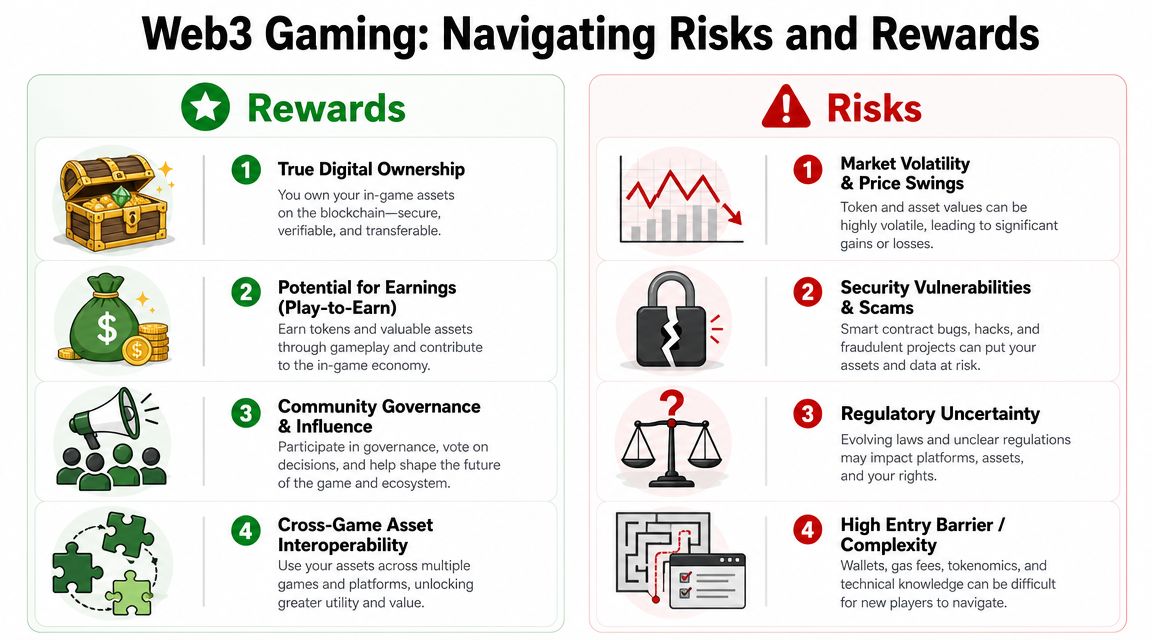
The strongest reward is asset ownership with liquidity. In the Web2 model, a rare skin or item may have social value but no formal property rights outside the publisher's system. In Web3, ownership can be more durable, more transferable, and easier to verify.
Other meaningful advantages include:
- Community participation: Some projects let users influence economic or ecosystem decisions through governance structures.
- Composability: Open standards create room for marketplaces, third-party tools, guild infrastructure, and wallet integrations.
- New monetization paths for studios and creators: Not every benefit belongs to players. Developers can also build stronger secondary economies and partner ecosystems.
The underrated reward is transparency. Smart contracts don't make a game fair by default, but they can make key rules and asset flows easier to inspect.
Where investors and players get burned
Risk starts with market behavior. Tokens tied to Web3 games can swing hard, and asset prices can detach from gameplay value. If you buy into a project mainly because you expect price appreciation, you're no longer analyzing a game. You're speculating on reflexive demand.
Security is the second major issue. Smart contract bugs, fake mint sites, malicious approvals, and wallet-draining scams remain common enough that basic caution isn't optional. If you need a refresher, review these common traps in this guide on how to avoid crypto scams.
Then there's user experience:
- Wallet setup can feel intimidating to mainstream users.
- Gas fees and signing prompts introduce friction.
- Poorly explained tokenomics can obscure where value comes from.
- Regulatory uncertainty can affect how projects structure tokens, rewards, and marketplaces.
The biggest practical risk isn't volatility alone. It's complexity layered on top of volatility.
For investors, that means due diligence has to include product quality, treasury logic, security posture, and user onboarding. For players, it means treating every wallet connection, signature request, and mint page as a security decision.
How to Start Your Web3 Gaming Journey Safely
Entering Web3 gaming safely is less about chasing the newest launch and more about building good habits before you connect your wallet anywhere. The tooling is better than it used to be, but self-custody still puts responsibility on the user.
A practical safety checklist
Start with the wallet. Choose a reputable self-custodial option, learn how seed phrases work, and store that recovery phrase offline. If you're comparing options, this breakdown of best crypto wallets for beginners is a practical starting point.
Then keep your setup simple:
- Use a separate wallet for gaming activity. Don't expose your primary long-term holdings to every game or marketplace.
- Read every signature request carefully. Wallet prompts aren't decoration. They're transaction approvals.
- Expect gas fees. On-chain actions often require network fees, even if the game abstracts some of the process.
- Prefer official channels. Use verified project sites, official Discord servers, and known social accounts.
- Consider a hardware wallet for larger balances or valuable NFTs.
Never share your seed phrase. No support agent, moderator, or game admin should ever need it.
How to evaluate a project before you connect a wallet
Don't start by asking whether a token can pump. Start by asking whether the game looks playable without the token story carrying all the weight.
Check for signs of quality:
- Clear gameplay footage: If you can't tell what players do, that's a warning.
- Transparent asset utility: An NFT should have a role beyond vague collectibility.
- Readable economy design: You should understand why the token exists.
- Honest onboarding: Good teams explain wallets, custody, and fees in plain language.
- A visible community pulse: Look for genuine player discussion, not just price chatter.
A careful approach won't remove every risk. It does filter out a large share of low-quality projects before they cost you money or compromise your wallet.
The Future of Gaming Emerging Trends for 2026 and Beyond
After the 2021 to 2022 boom and bust, Web3 gaming in 2026 looks less like a token speculation cycle and more like a product and infrastructure race. The core question has changed. Which teams can build games that people would play even if token prices stopped moving, while still giving players real control over assets, identity, and participation in the game economy?
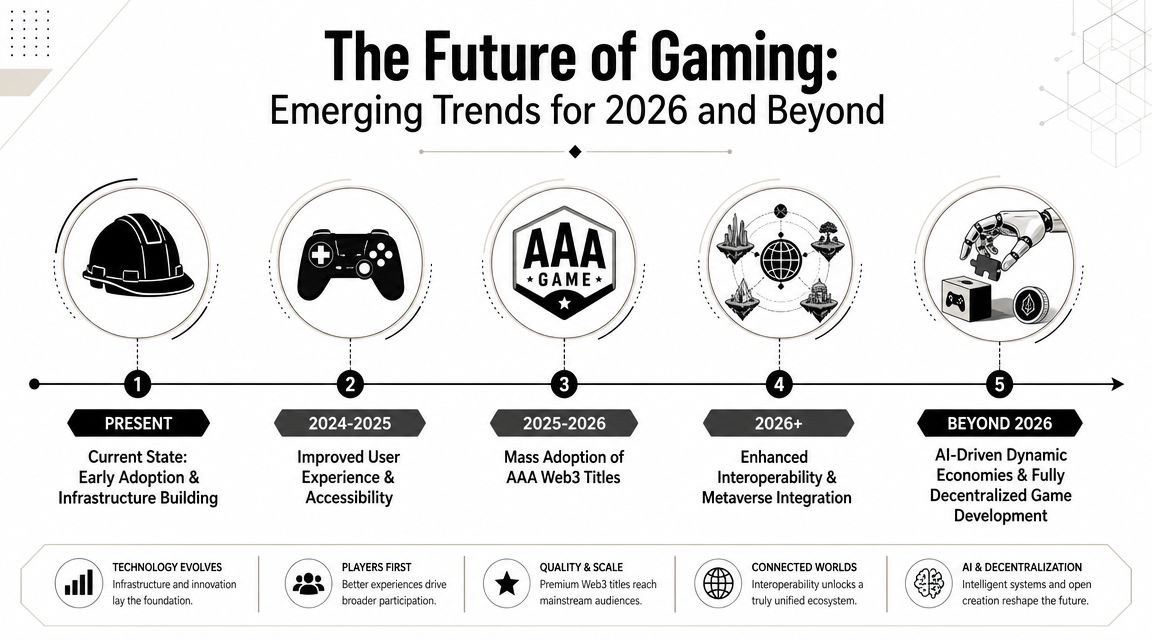
The next battleground is invisible infrastructure
The strongest signal in 2026 is not headline volume. It is the steady shift from visible crypto mechanics to background crypto rails. Alchemy's Web3 gaming directory continues to show an active builder base, and DappRadar's gaming narrative coverage still tracks gaming as one of the sector's recurring themes. That does not mean every project is healthy. It does mean serious teams are still shipping.
What changed is the design target. Early play-to-earn models treated financial rewards as the main retention loop. That worked briefly in bull markets, then broke when user growth slowed and token emissions outpaced demand. The newer play-and-own model starts from a harder premise. Ownership only matters if the underlying game is good enough to retain players without constant subsidy.
That shift explains why infrastructure now matters so much:
- Layer 2 networks reduce transaction costs and improve speed for in-game actions that would feel clumsy on expensive base layers.
- Embedded wallets and account abstraction remove much of the setup friction that scared off mainstream players.
- Off-chain game logic with on-chain settlement keeps gameplay responsive while preserving verifiable ownership where it matters.
- Higher production standards are forcing Web3 teams to compete with traditional live-service games, not just with other crypto projects.
For readers tracking releases, studio funding, chain integrations, and player trends, ongoing coverage in Web3 gaming news is often more useful than token chatter on social media.
Where Web3 gaming could expand next
The next growth phase likely comes from selective integration, not feature stacking.
AI can improve NPC behavior, quest variation, and moderation systems. DeFi can support treasury management, collateralized assets, or player-run markets in games that need those mechanics. Layer 2 infrastructure can make item trades, crafting, and progression updates cheap enough that players stop treating every action like a blockchain transaction.
Interoperability will probably advance more slowly than marketing decks suggest. Shared ownership standards are real. Shared utility across unrelated games is still rare because balancing, art direction, and game design usually matter more than token portability. The more realistic path is narrower. Assets, identity, and reputation may travel across titles within the same publisher network or chain ecosystem before they work across the entire market.
The projects with the best odds in 2026 are not the ones adding more crypto to the player experience. They are the ones using crypto sparingly to improve retention, trust, and economic alignment.
That is also the clearest investment takeaway. The old thesis centered on token velocity and user acquisition through rewards. The stronger thesis now centers on durable game loops, controlled emissions, lower onboarding friction, and infrastructure that makes ownership useful without making gameplay feel like financial software. If Web3 gaming compounds from here, it will do so because play-and-own economies proved they could retain players after speculation faded.
2 Comments