
7 Highest APY Crypto Staking Opportunities for 2026

The highest staking APY in crypto is often the fastest way to misunderstand the trade.
Large proof-of-stake networks can post very different yields, but the headline number only matters after you identify what is funding it. In practice, staking returns usually come from some mix of token inflation, validator revenue, MEV, or newer layers such as restaking. Each source creates a different risk profile, and that is the part many ranking pages skip.
Liquidity matters too. A liquid staking token with a lower stated yield can still be the better position if it keeps capital usable across lending, trading, and collateral strategies. That is why understanding the liquidity of cryptocurrency markets matters alongside APY. Exit conditions, secondary market depth, and peg behavior often have more impact on realized returns than a few extra percentage points on paper.
The smart way to evaluate the highest APY crypto staking opportunities in 2026 is to judge yield quality first. Inflation-heavy rewards can look attractive until emissions slow or token demand weakens. MEV-linked yield can be strong, but it depends on network activity and validator execution. Restaking can add another revenue layer, but it also adds smart contract, slashing, and dependency risk.
This guide focuses on protocols that serious DeFi users use, then examines where the yield comes from and what you are giving up to earn it. That trade-off is the difference between sustainable staking income and a temporary number that looks good only on a dashboard.
Table of Contents
- 1. Ether.fi (eETH / weETH) Tapping Into Restaking Yield
- 2. Stride (stTIA, stATOM) The Cosmos Liquid Staking Hub
- 3. Jito (JitoSOL) Solana Staking with an MEV Boost
- 4. Cosmos Hub (ATOM) High-Yield Native Staking
- 5. Marinade Finance (mSOL) Diversified Solana Staking
- 6. Lido (stETH / wstETH) The Bedrock of ETH Staking
- 7. Rocket Pool (rETH) Decentralized ETH Staking
- Top 7 High-APY Crypto Staking Comparison
- Your Strategy for Sustainable Crypto Yield in 2026
1. Ether.fi (eETH / weETH) Tapping Into Restaking Yield
Ether.fi is one of the clearest examples of why the highest APY in crypto staking usually comes from adding new risk layers, not from some hidden improvement in base staking. With Ether.fi, the primary factor is yield composition. eETH and weETH start with normal ETH validator income, then add restaking exposure, possible AVS-linked incentives, and the extra utility that comes from holding a liquid wrapper you can still deploy in DeFi.
That distinction matters more than the headline number.
Why the yield can exceed plain ETH staking
Base ETH staking yield is relatively modest. Ether.fi tries to raise that return by stacking additional revenue sources on top of validator rewards. In practice, that means you are getting paid for accepting more complexity. The extra yield can come from restaking incentives, security demand from external services, and DeFi positioning opportunities tied to weETH liquidity.
This is why I separate headline APY from yield quality. A point of yield funded by Ethereum staking rewards is different from a point funded by temporary token incentives. A point tied to long-term security demand is different from one tied to short-term farming demand. If you do not know which bucket the return is coming from, you are guessing.
Ether.fi makes sense in a few specific cases:
- You want liquid collateral: weETH can be used across lending markets, DEXs, and other DeFi strategies while the underlying ETH remains productive.
- You understand restaking mechanics: the return is tied to more than validator performance. It also depends on smart contracts, operators, and the health of the broader restaking market.
- You actively manage positions: liquid staking wrappers are most useful for users who will use that flexibility instead of just holding passively.
A related piece of the puzzle is execution flow across Ethereum and adjacent systems. If you want context on how extra transaction value can be extracted around block production, this primer on what MEV is in crypto is worth reading, because a lot of advanced yield products eventually connect back to who captures value in the stack.
Practical rule: If you cannot explain Ether.fi's incremental yield source in one sentence, keep it smaller than your core ETH staking allocation.
The trade-off is straightforward. You still have ETH price exposure, but now you also carry smart contract risk, wrapper risk, restaking design risk, and more moving parts during periods of market stress. For anyone building around portfolio crypto liquidity management, that added flexibility can justify the complexity. For anyone who wants clean, durable yield with fewer dependencies, Ether.fi is better treated as a higher-octane satellite position than a full replacement for simpler ETH staking.
2. Stride (stTIA, stATOM) The Cosmos Liquid Staking Hub
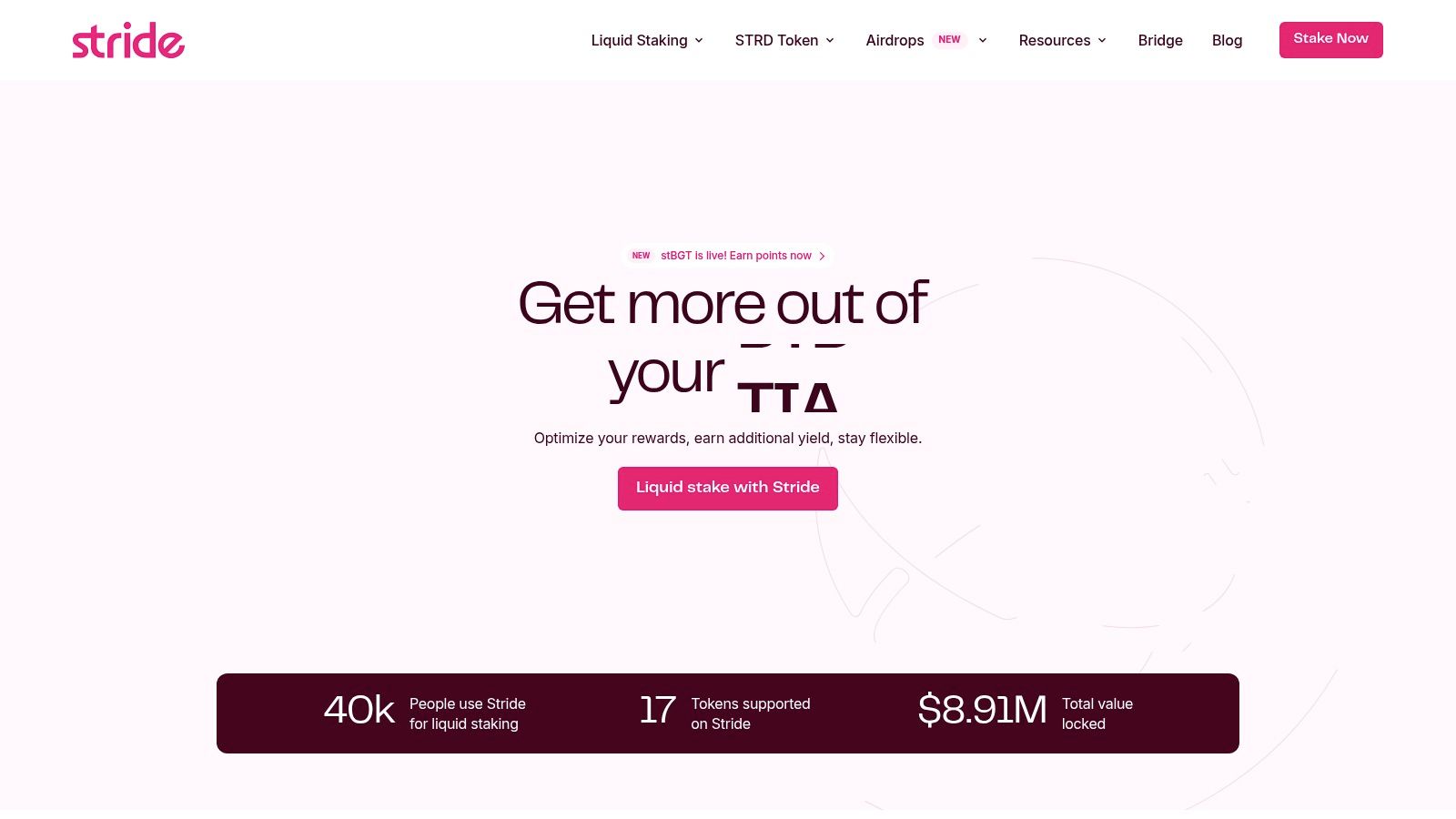
Stride offers one of the cleaner ways to improve yield efficiency inside Cosmos. The headline APY on assets like ATOM and TIA gets attention, but the more important question is where that yield comes from and what changes when you wrap it into a liquid staking token.
In Cosmos, a large share of staking return usually comes from token issuance, not from a fee engine as durable as Ethereum or a specialized revenue stream like MEV. That matters. High nominal yield can still be real income for stakers, but its quality depends heavily on the chain's tokenomics, validator set, and whether demand for the asset keeps pace with emissions.
Stride's role is straightforward. It converts locked staking positions into liquid assets such as stATOM and stTIA, so you can keep collecting staking rewards while still using that capital across IBC-connected DeFi. For users who actively deploy collateral, LP, or rotate between themes, that flexibility has value.
That does not automatically make Stride a better choice than native staking. It changes the package.
The main benefit is capital mobility. Native Cosmos staking often forces a trade-off between earning yield and keeping funds available. Stride reduces that friction, which is useful for anyone building a broader allocation instead of parking tokens in one validator set and waiting. If you are still setting up your broader allocation framework, this guide on how to invest in cryptocurrency for beginners is a decent starting point before adding liquid staking complexity.
The trade-offs are specific and easy to underestimate:
- Yield source stays the same: liquid staking does not improve weak tokenomics. If most of the return comes from inflation, you still hold inflation-funded yield.
- Risk stack gets bigger: you add smart contract risk, interchain messaging risk, and secondary market liquidity risk on top of the base asset and validator risk.
- Peg deviations happen: staked wrappers can drift below the value of the underlying token during stress, especially when holders rush for liquidity.
- DeFi use can help or hurt: extra strategies can raise total return, but they also introduce lending, LP, or liquidation risk.
Stride fits best when you already want Cosmos exposure and have an actual use for the liquid staking token.
That is why I treat Stride as a yield-quality filter, not just an APY booster. If ATOM or TIA deserves a place in the portfolio on its own merits, Stride can improve how that position functions. If the only reason to own the asset is a high printed staking rate, liquid staking does not fix the underlying thesis.
3. Jito (JitoSOL) Solana Staking with an MEV Boost
Jito is one of the few high-yield staking plays where the extra return has a clear economic driver. With Jito, you are not only collecting standard Solana staking rewards. You are also getting exposure to MEV-related tip flow routed through Jito's validator and block engine setup.
That distinction matters.
A lot of staking APY in crypto comes from token issuance. JitoSOL is different because part of its edge comes from real transaction activity on Solana. Yield quality improves when more of the return is tied to network demand instead of simple emissions. It also means the payout can rise or fall with on-chain conditions, trading flow, and validator competition.
Where the extra return comes from
JitoSOL generally aims to outperform plain SOL delegation because it combines base staking rewards with MEV revenue sharing. That does not make it safer. It makes the yield stack easier to evaluate if you understand the mechanism.
If you are new to Solana wallets, set that up first. A walkthrough of how Phantom Wallet works for Solana staking and DeFi will help before you move into liquid staking. If MEV itself is unfamiliar, this guide to MEV in crypto explains the extraction mechanics behind those extra rewards.
Here is the practical case for JitoSOL:
- The yield mix is stronger than pure inflation: part of the return comes from validator rewards, part from MEV tips generated by real network usage.
- The token is useful on-chain: JitoSOL can be deployed across Solana DeFi instead of sitting idle in a native stake account.
- Returns are variable by design: MEV revenue is opportunistic, so the spread over normal SOL staking is not fixed.
- Execution risk still exists: you add smart contract exposure, liquid staking peg risk, and Solana-specific protocol risk on top of validator performance.
I use Jito when I want Solana exposure and I care about where the yield comes from. A higher APY by itself is not enough. JitoSOL makes more sense when the added return is tied to a visible source of value.
Crowding is the main pressure point. If too much capital chases the same trade, excess yield compresses. That is normal in DeFi. Jito still stands out because its premium is easier to explain than many inflated staking offers, and that makes it easier to judge whether the risk-reward is still attractive.
4. Cosmos Hub (ATOM) High-Yield Native Staking
ATOM staking is one of the clearest examples of why headline APY is not enough. The yield is easy to understand, but the trade-off is easy to underestimate. You are mostly being paid for securing the network under Cosmos Hub's tokenomics, not tapping into extra sources like MEV or restaking.
For users who want fewer dependencies, native staking still has real appeal. You can delegate through wallets like Keplr and stay close to the base protocol. That means fewer failure points than liquid staking setups, but it also means less flexibility once your ATOM is bonded.
What makes ATOM yield different
ATOM's yield quality is straightforward. Most of the return comes from staking emissions and network-level rewards rather than from external revenue streams. That makes the model easier to explain than many high-APY offers in DeFi, but it also means the sustainability question points back to ATOM itself. If you are not comfortable holding the asset through volatility, the yield will not save the trade.
Validator choice matters more than many guides admit. Commission rates, uptime, governance posture, and slashing history all affect what you keep. Native staking removes smart contract wrapper risk, but it does not remove operational risk. You are still trusting a validator to do its job properly.
ATOM tends to fit three types of users:
- Long-term ATOM holders: the setup is simple, and the yield source is easier to judge than more engineered products.
- Self-custody users: you keep control of your wallet and delegate directly instead of adding another protocol layer.
- Investors who value clarity over composability: your position is less flexible, but the reward mechanics are more transparent.
For newer users, ATOM can be a good training ground because it forces you to learn the actual constraints of staking. Unbonding periods matter. Validator selection matters. Wallet setup matters too, and a guide to beginner-friendly crypto wallets helps before you start delegating across chains.
I view native ATOM staking as a cleaner yield source, not an automatically better one. The simplicity is the advantage. The cost is liquidity. If you want capital you can move quickly, use in DeFi, or rotate during sharp market swings, bonded ATOM can feel restrictive fast.
That is the primary filter. Native ATOM staking works best when you want exposure to Cosmos Hub first and yield second. If your only goal is to chase the highest APY crypto staking opportunity on the page, ATOM is usually too honest a product for that mindset.
5. Marinade Finance (mSOL) Diversified Solana Staking
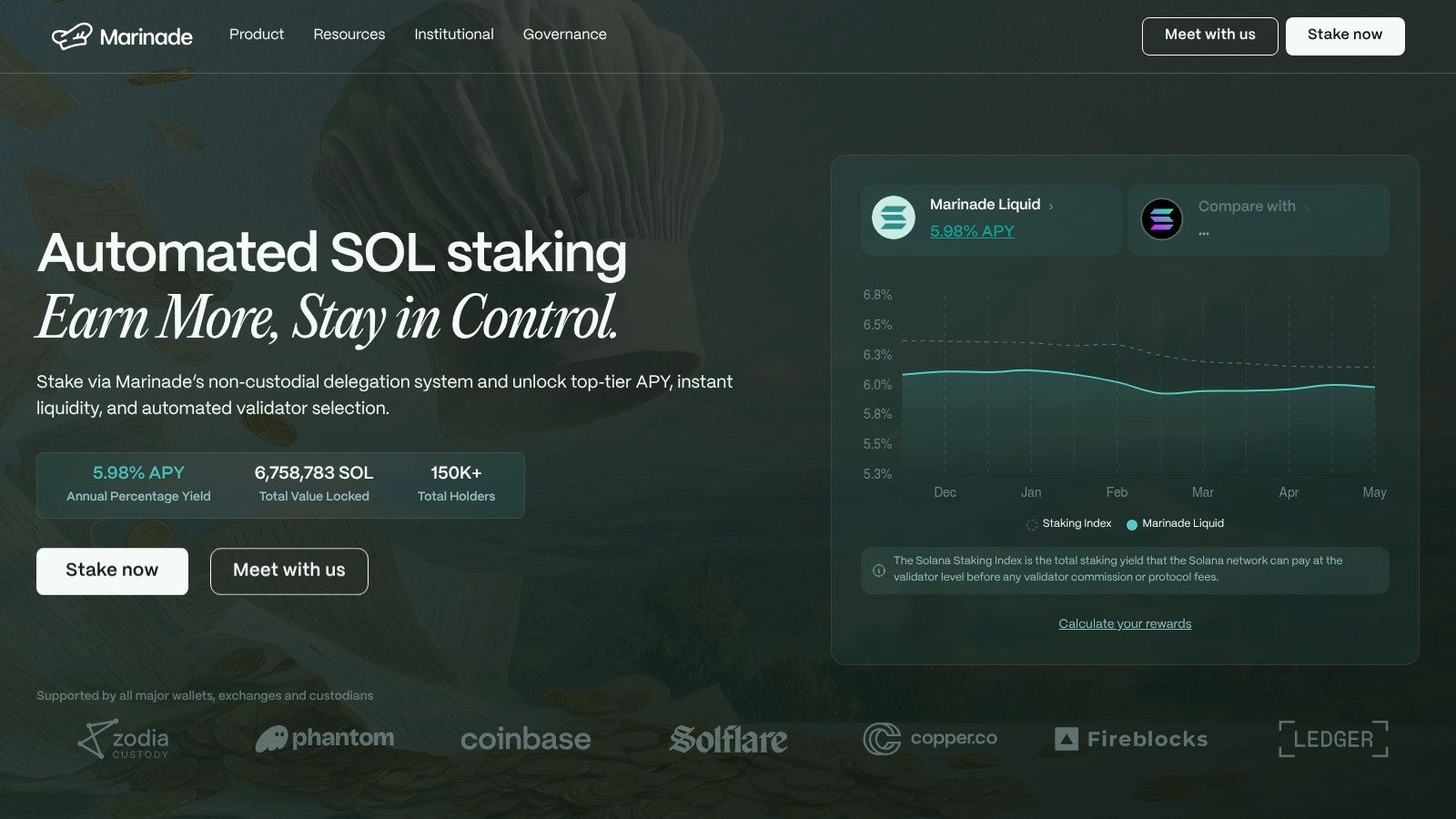
Marinade is one of the cleaner ways to stake SOL without concentrating your risk in a single validator set or chasing every extra basis point on Solana. The headline APY matters less here than the yield mix behind it. With mSOL, the core return still comes from standard Solana staking emissions, while the product edge comes from validator diversification and DeFi usability, not from aggressive reward engineering.

That distinction is important. Marinade does not change the economic source of SOL staking yield. It packages it in a way that is more flexible for users who want liquidity and broader validator exposure. In practice, that usually leads to a more balanced risk profile than products whose extra yield depends heavily on MEV flows or short-term incentive programs.
Marinade is a strong fit in three cases:
- Active Solana users: mSOL is widely usable across wallets, lending markets, and trading venues.
- Stakers who care about validator distribution: Marinade's approach spreads stake instead of pushing users toward one operator or a tight cluster.
- Users who value optional liquidity: liquid staking gives you an exit route that bonded native staking does not, even if speed can come with a swap cost or slippage.
I usually treat mSOL as a base layer position, not a pure yield trade.
That is the right frame for judging yield quality here. If the APY looks attractive, ask what is paying you. With Marinade, the answer is mostly straightforward Solana staking income, plus whatever utility you can get from holding a liquid staking token inside the ecosystem. That makes it easier to evaluate than more stacked products, but it also means your real-world return depends on mSOL liquidity, smart contract risk, and how you use the token after staking.
For newer Solana users, setup still matters. A lot of losses come from wallet mistakes, fake interfaces, and poor transaction review habits long before staking mechanics become the problem. If you need a starting point, use a beginner-friendly crypto wallet guide before adding an LST to your workflow.
Marinade is rarely the highest-upside staking play on the page. It is often one of the more sensible ones for users who want Solana yield that is liquid, diversified, and easier to defend once you look past the headline APY.
6. Lido (stETH / wstETH) The Bedrock of ETH Staking
Lido sets the reference price for ETH staking risk. If you want to judge any ETH yield product, start by asking whether it beats plain stETH on yield quality, liquidity, and usability. Many do not.
Lido remains the core ETH liquid staking protocol because it gives users staking exposure in a form that DeFi already accepts almost everywhere. That matters more than a flashy headline APY. Ethereum staking yield is usually lower than what you will see on inflation-heavy chains or short-term incentive programs, but the source of return is easier to defend. The base yield comes from Ethereum validator rewards, with additional contribution from priority fees and MEV routed through the validator set.
Why lower ETH yield still matters
The mistake I see all the time is comparing ETH staking to a list of exchange marketing numbers and stopping there. As noted earlier, platforms often present top-end staking figures across many assets. That does not mean ETH itself suddenly behaves like a high-emission token. With Lido, the yield story is cleaner. You are mostly earning native Ethereum staking income in liquid form, not chasing returns that depend on aggressive token issuance.
That distinction matters.
Lido's advantage is not raw APY. It is the combination of yield quality and token utility:
- stETH and wstETH are well integrated in DeFi: they are widely used as collateral in lending markets, stablecoin systems, and looped ETH strategies.
- The product is operationally simple: users get validator exposure without running infrastructure or managing a 32 ETH validator.
- wstETH travels well across rollups: the wrapped format is often easier to use in Layer 2 DeFi and cross-chain deployments.
There are trade-offs, and they should be stated plainly. Lido carries smart contract risk, validator set governance risk, and the broader concentration debate that follows any large staking provider. stETH can also trade below ETH during stress, so liquidity matters if you may need to exit quickly instead of holding through redemption dynamics.
For users still sorting out secure custody, starting with one of the best beginner-friendly crypto wallets before moving into stETH is the safer path. Wallet hygiene beats a small yield difference every time.
My practical view is simple. stETH and wstETH are rarely the most eye-catching yield assets in a ranking, but they remain some of the easiest to justify after you examine where the return is generated. That is why Lido still sits near the center of serious ETH yield strategies.
7. Rocket Pool (rETH) Decentralized ETH Staking
Rocket Pool earns its place on any serious ETH staking list because the yield story is cleaner than the headline suggests. rETH does not depend on heavy token emissions or incentive farming. The core return still comes from Ethereum validator rewards, and that usually means a lower posted APY than flashier options, but a better-quality yield source.
Rocket Pool is built for users who care about staking design, not just staking output. If decentralization is part of your risk framework, Rocket Pool stands out because it spreads validator participation more broadly and gives advanced users a real path into node operation.

Why rETH appeals to decentralization-first users
The practical appeal of rETH starts with structure. It uses a non-rebasing model, so value accrues through the token's exchange rate rather than wallet balance changes. That tends to be easier for accounting, cleaner in many DeFi integrations, and simpler for users who dislike rebasing mechanics.
Rocket Pool also offers a different trust profile from larger ETH staking platforms. The protocol is designed around distributed node operators instead of concentrating stake into a smaller operator set. That does not remove smart contract or protocol risk, but it changes the kind of risk you are taking.
For yield-focused users, the key point is straightforward. rETH is usually about steady ETH staking economics with a decentralization premium layered into the product design. You are not buying a boosted APY story. You are choosing a liquid staking token whose return source is easier to justify during periods when speculative yields start to fade.
There is a real cost to that approach. rETH often trails the most aggressive staking opportunities on raw yield, and the node-operator route adds operational overhead, collateral requirements, and execution risk. Running infrastructure is not passive income. It is an ongoing responsibility.
My view is that Rocket Pool fits best for ETH holders who already understand the difference between nominal APY and durable yield. If the goal is to hold a liquid staking asset backed primarily by validator income, while reducing some of the concentration concerns that come with dominant providers, rETH remains one of the strongest options in the market.
Top 7 High-APY Crypto Staking Comparison
| Item | 🔄 Implementation Complexity | Resources Required | 📊 Expected Outcomes | Ideal Use Cases | ⭐ Key Advantages / 💡 Tips |
|---|---|---|---|---|---|
| Ether.fi (eETH / weETH) | Medium–High, native restaking + AVS and bridge flows | ETH, EigenLayer participation, bridges/L2 integrations | Potentially higher net yield than plain LSTs; variable and AVS-dependent | ETH holders seeking amplified staking yield with DeFi composability | ⭐ Higher upside yield; deep DeFi integrations. 💡 Monitor AVS/restaking risks and unwrap flows |
| Stride (stTIA, stATOM) | Medium, IBC and multi-asset staking tooling | Cosmos assets (TIA, ATOM, etc.), IBC-enabled wallets/relayers | Historically higher APRs on some Cosmos assets while retaining liquidity | Cosmos users wanting to capture staking rewards without losing on-chain liquidity | ⭐ Broad Cosmos asset support and IBC composability. 💡 Watch stTOKEN price spreads and bridge/IBC risk |
| Jito (JitoSOL) | Medium, MEV-enabled validator set and LST mechanics | SOL, Solana wallets; integration with Solana DeFi | APYs typically above vanilla SOL due to MEV-sharing; can fluctuate with TVL | Solana users targeting MEV-enhanced staking yield and deep Solana DeFi access | ⭐ MEV-sharing boosts yield; strong liquidity. 💡 Yield compresses as TVL grows; assess smart-contract exposure |
| Cosmos Hub (ATOM) native | Low, simple non-custodial delegation | ATOM, Keplr or compatible wallet, validator selection | Mid-teens APR historically; 21-day unbonding limits liquidity | Users valuing non-custodial control and direct protocol staking | ⭐ Direct staking without extra protocol layers. 💡 Be prepared for 21-day unbonding and validator maintenance |
| Marinade Finance (mSOL) | Low–Medium, liquid staking with validator automation | SOL, Solana wallets, optional institutional custody | Competitive SOL yields; instant-unstake option but may incur costs | Solana users wanting diversified validator exposure plus liquidity options | ⭐ Automated validator spread and audited contracts. 💡 Instant-unstake is convenient but can be costlier |
| Lido (stETH / wstETH) | Low, one-click staking and wide integrations | ETH and standard wallets; broadly supported across DeFi | Reliable liquid ETH exposure with lower base APY but highest composability | Core ETH exposure for portfolios needing liquidity and DeFi composability | ⭐ Deepest liquidity and integrations. 💡 Lower base APY; consider governance/operator concentration |
| Rocket Pool (rETH) | Medium, non-rebasing token + optional node operator complexity | ETH for staking, RPL collateral for node operators | rETH value accrues (non-rebasing); decentralized validator set | Users preferring decentralized ETH staking or running mini-nodes for boosted yield | ⭐ Credibly decentralized with rETH composability. 💡 Running nodes adds operational and RPL-token risk |
Your Strategy for Sustainable Crypto Yield in 2026
The highest APY crypto staking opportunities in 2026 won't all come from the same place, and that's the point. Cosmos-style staking often pays more because token incentives are richer. Solana products can improve yield by capturing validator economics and MEV-linked flows. Ethereum liquid staking and restaking products often compensate for lower base rewards with liquidity, composability, and optionality across DeFi.
That means your first question shouldn't be, “What pays the most?” It should be, “What funds this yield?” If the answer is mostly inflation, you need to think about dilution and long-term token demand. If the answer is MEV, restaking, or collateral reuse, you need to think about smart contract risk, operator quality, and how many extra layers sit between you and the base asset.
A practical portfolio usually mixes yield types instead of concentrating in one. Native staking can reduce dependency on protocols. Liquid staking can improve flexibility. Restaking can raise the ceiling, but it also raises complexity. In my experience, the strongest setups are the ones you can still explain clearly after the market turns ugly and liquidity thins out.
A few principles hold up well:
- Match product to conviction: stake assets you want to hold through volatility.
- Separate headline APY from real value: promotional rates and raw emissions aren't the same as durable yield.
- Respect liquidity constraints: unbonding periods and wrapper discounts matter most when markets move fast.
- Keep smart contract exposure intentional: every extra layer should earn its place.
Crypto is also moving into a broader phase where AI-integrated on-chain services, tokenized real-world assets, Layer 2 liquidity networks, and modular blockchain infrastructure will shape where future staking demand sits. Some of that will create better fee-driven yield. Some of it will create new versions of old risk wrapped in better branding.
The best approach is still boring in the right way. Do your own research. Read the docs. Check where rewards come from. Size positions based on the worst-case path, not the homepage APY. If you focus on yield quality over yield theater, staking becomes a useful long-term strategy instead of a rotating list of regrets.
If you want more practical breakdowns like this, follow Coiner Blog for grounded crypto analysis on staking, DeFi, Web3 infrastructure, wallets, tokenomics, Layer 2 trends, AI and blockchain, and the risks that matter once the marketing copy fades.
1 Comment