
Can You Sell Pi Coins? a Practical 2026 Guide
Pi is now priced around $0.09771 with about $15.05 million in 24-hour volume on one major tracker, and another market feed listed it near $0.1136 with an 11 billion circulating supply and market capitalization near $1.24 billion. You can sell Pi coins only if your balance is KYC-verified, migrated to mainnet, and usable on an exchange that supports your region.
Maybe you've mined Pi for a while, watched the app balance grow, and now you're staring at the same practical question everyone eventually asks, can you turn it into cash? The honest answer is more layered than a simple yes or no, because quoted price and real cash-out access are not the same thing.
Table of Contents
- The Short Answer on Selling Pi Coins Right Now
- How Pi Network Works and Why It Affects Selling
- The Three Gates You Must Pass Before You Can Sell Pi
- Where Pi Coins Can Be Sold and What Each Path Looks Like
- Step-by-Step Preparation Before Your First Pi Sale
- Hidden Risks That Make a Sale Harder Than the Price Suggests
- Common Pi Selling Scams and How to Verify Anything You Trust
- Tax Basics, Record Keeping, and Your Next Move
The Short Answer on Selling Pi Coins Right Now
If you're a Pi miner wondering whether your balance is finally worth something outside the app, the shortest honest answer is this, Pi is priced and traded on several centralized exchanges, but your personal ability to sell depends on more than that quoted price. The network state, your KYC status, your mainnet balance, and your exchange access all matter at once.
That's why the question can you sell Pi coins keeps confusing people. A market tracker can show a live price, yet that doesn't automatically mean every holder can move coins, deposit them, and cash out without friction. Independent guides consistently tie sellability to KYC verification, mainnet migration, and a supporting exchange that accepts your region and the right trading pair.
Practical rule: if the coin can't move out of your Pi environment, you don't have a real sale, you only have a price quote.
Pi's market data also shows why this topic isn't theoretical. One tracker reported PI near $0.09771 with about $15.05 million in 24-hour volume, while another showed PI around $0.1136 with an 11 billion circulating supply and market capitalization near $1.24 billion. Those figures prove there's live pricing and measurable liquidity, but they don't prove every holder has unrestricted cash-out access. CoinGecko's Pi Network market page is useful for checking the live market snapshot.
The rest of this guide follows the actual decision path, not the marketing version. First comes how the network works, then the gates that block or enable a sale, then the actual paths people use, and finally the risks, scams, and tax basics that determine whether a sale really succeeds.
How Pi Network Works and Why It Affects Selling
Pi's design matters because not every crypto token is built for immediate, open movement. Pi uses a Stellar Consensus Protocol / federated Byzantine agreement style architecture, and its smart-contract references subdivide 1 PI into 10,000,000 smallest units, which means the token is technically granular enough for precise transfers. But granular accounting doesn't create liquidity by itself.
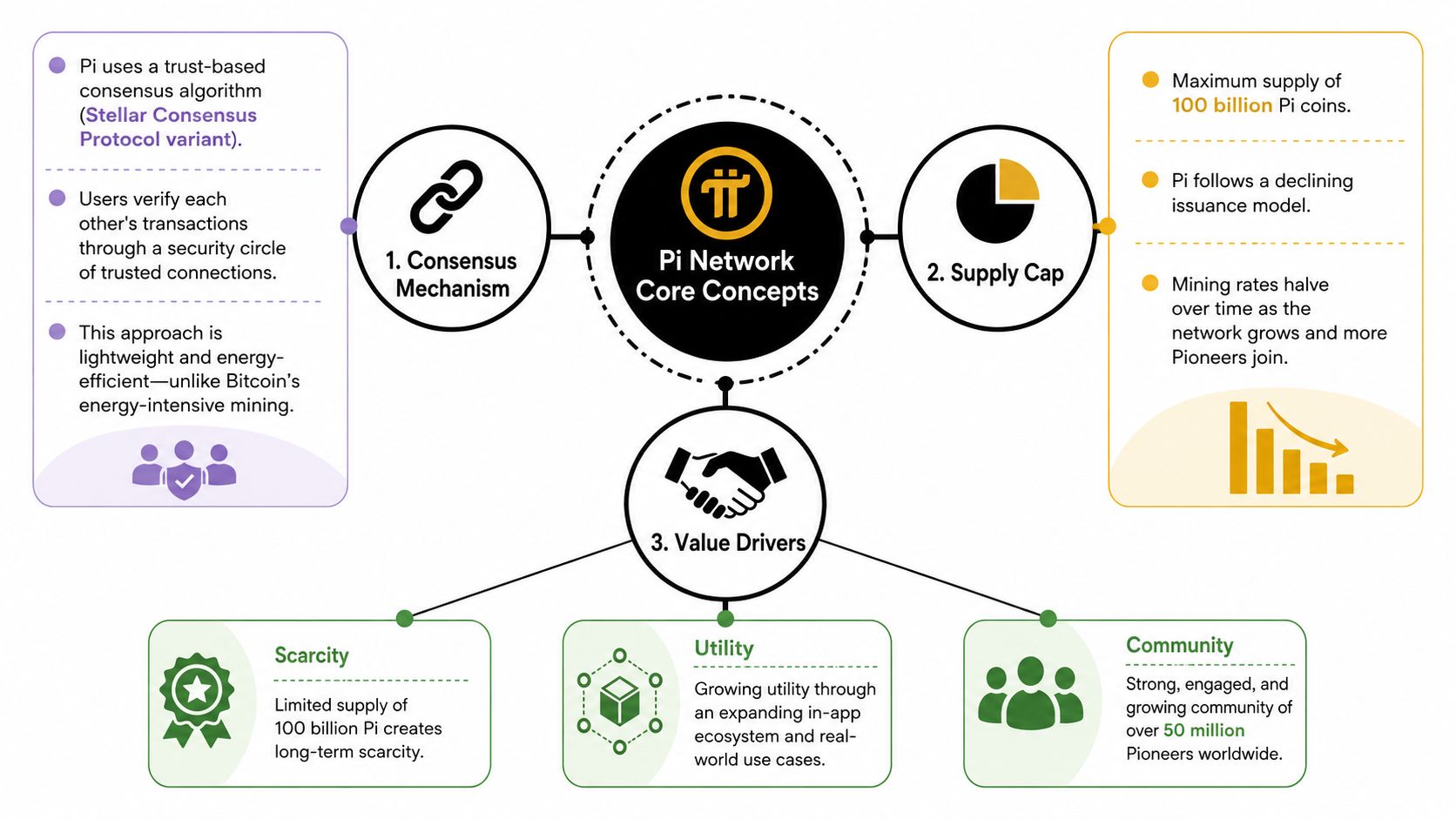
Think of Pi like a gated apartment building before the front gate opens to the street. People can move around inside the building, but that doesn't mean a passerby can walk in, buy an apartment, and leave with the keys. The same logic applies to Pi's enclosed mainnet phase, where internal activity can exist while external transferability stays limited.
Pi's tokenomics also shape sellability. The protocol's maximum supply is capped at 100 billion tokens, but only a smaller portion is circulating at any moment because supply is released through a declining exponential issuance model and migration pacing. That gap matters, because headline supply isn't the same as exchange-ready inventory.
The number on a market chart matters less than the amount that can actually clear on an exchange.
This is also why quoted market prices can vary so much across feeds. When transferability is constrained and inventory is thin, one venue can show one executable price while another shows something noticeably different. For sellers, the practical question isn't just “what is PI worth?” It's “where can my balance move, and who can receive it?”
The Three Gates You Must Pass Before You Can Sell Pi
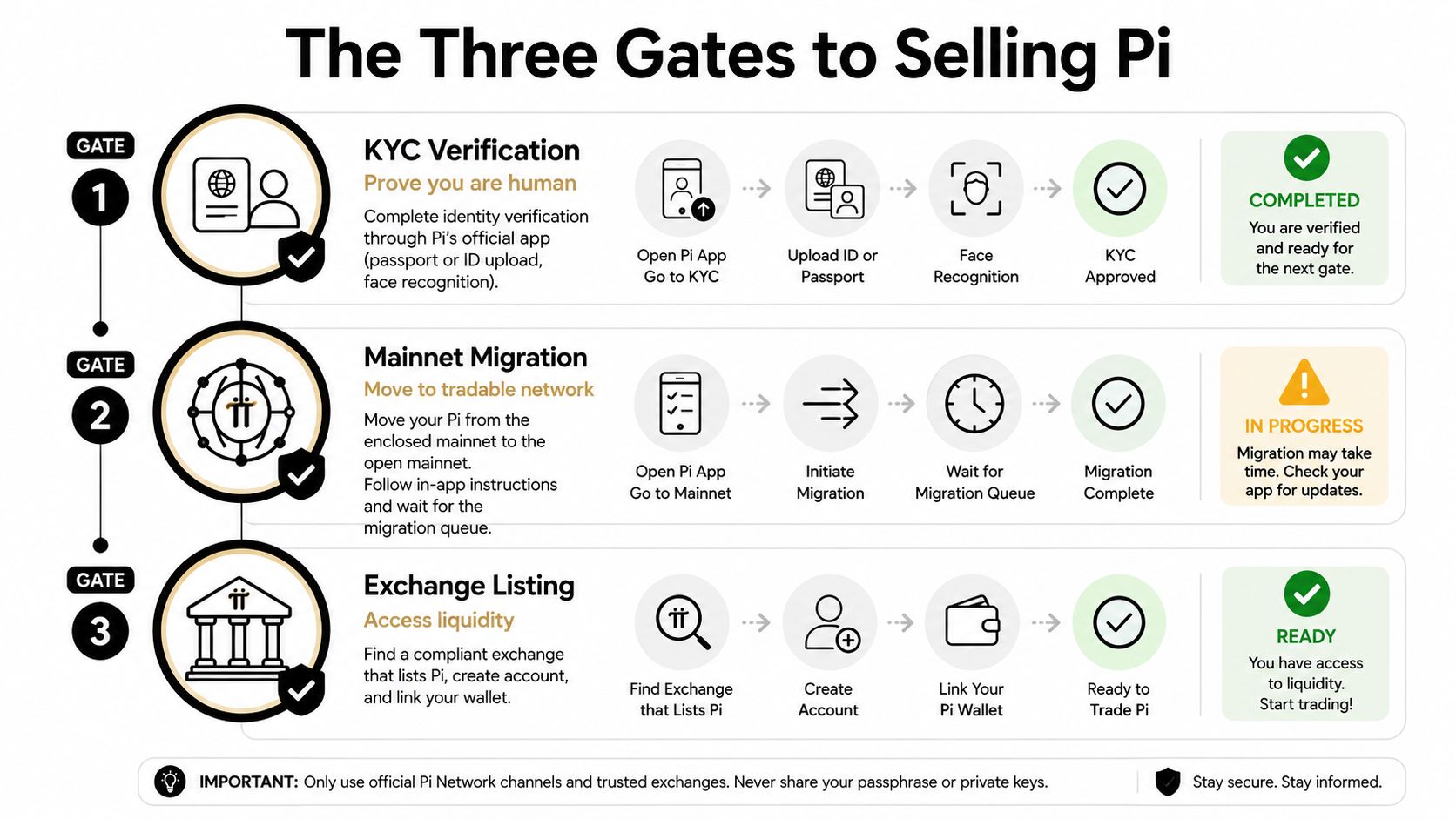
Pi selling usually stops at the same three checkpoints, and each one can block the process on its own. The first is KYC verification, the second is mainnet migration, and the third is wallet custody and transfer access.
KYC verification
KYC is the identity layer. If Pi Network has not verified you, the balance may still appear in your account, but it is not ready to move the way a seller expects. CoinGecko's selling guide and multiple Pi community resources place identity verification as the first checkpoint before any sale attempt.
Mainnet migration
Migration moves what you have mined into the live network state that can be recognized for transfer. If your balance is still pending, locked, or only partly migrated, you do not have the same transfer rights as someone whose coins are already eligible to move. The difference is simple, having Pi is one thing, having Pi that can be sent is another.
Wallet custody
Even after migration is complete, you still need control of the wallet and passphrase that holds the transferable balance. If you lose the passphrase, the practical path to a sale becomes much harder. Self-custody matters here, because control of the keys is what gives you control of the coin. our guide on wallet custody and self-custody principles explains the old warning clearly, not your keys, not your coin.
Without all three gates cleared, a quoted price on screen does not translate into a completed sale.
Where Pi Coins Can Be Sold and What Each Path Looks Like
For most holders, the sale path falls into one of three buckets, centralized exchanges, peer-to-peer arrangements, or decentralized venues. The key difference is whether the platform supports Pi movement and settlement, because that decides if a quoted price can become an actual payout.
Practical Paths to Selling Pi Coins
| Path | Typical Access | Custody | Fiat Off-Ramp | Friction Level |
|---|---|---|---|---|
| Centralized exchange | Eligible users on a supporting venue | Exchange-custodied after deposit | Sometimes available, often region-dependent | Medium |
| Peer-to-peer arrangement | Counterparty-by-counterparty | Usually seller-controlled until transfer | Depends on buyer and payment method | High |
| Decentralized exchange | Limited or unsupported for Pi in current guides | Wallet-custodied | Usually indirect, if available at all | High |
Centralized exchanges dominate the conversation because they offer the clearest workflow. Guides describe Pi pairs such as PI/USDT, and selling usually means depositing Pi, choosing a pair, then placing either a market order or limit order. CoinGecko's guide also states that Pi is sold on centralized exchanges such as Gate.io, Bitget, OKX, and MEXC, while not being supported on decentralized exchanges at the time of writing. CoinGecko's selling guide is a helpful reference for that exchange-side flow.
Peer-to-peer deals can work in theory, but they carry the most trust risk. You are relying on a human counterparty to pay you after, or while, the transfer happens, which is a very different experience from a standard spot trade.
Decentralized exchange routes sound cleaner to crypto users who already live in DeFi, but Pi's current support there is thin or absent in the guides above. That means the polished Web3 version of the story still is not the main practical option for most sellers.
Step-by-Step Preparation Before Your First Pi Sale
A first Pi sale usually goes wrong before the sell order is placed. The safer approach is to check readiness in layers, because each layer depends on the one before it.
Start with your Pi account status and confirm that identity verification is complete. If KYC is still pending, treat it like a stop sign. A sale attempt without verification often leads to delay or failure.
Next, confirm that your transferable balance has moved to mainnet. Many users see a number in the app and assume it is ready, but a visible balance is not the same as a transferable balance. If the coins have not reached the right network state, there is nothing meaningful to send to an exchange.
Then open your wallet and make sure you control the passphrase and can reach the balance without guessing. If you are unsure, pause and secure that first before moving any coins. Operational mistakes here are usually permanent, not temporary.
Finally, identify a supported exchange and read its deposit requirements closely, including memo rules and the exact asset flow it expects. Before you rush into a transfer, revisit the broader self-custody principle in a practical way. This explainer on wallet control is a useful reminder of why ownership and accessibility matter more than a dashboard number.
Readiness check: if you cannot explain where the coins are, who controls them, and how they arrive on the exchange, you are not ready to sell yet.
Hidden Risks That Make a Sale Harder Than the Price Suggests
A quoted price can be misleading when the order book is thin or the transfer path is restrictive. Pi's price history shows why sellers need to think beyond the number on the screen, Yahoo Finance reported a peak of $2.98 in February 2025 and later a decline of 77% to about $0.6722, while also noting 126.6 million coins released in April, a supply event that can add selling pressure. Yahoo Finance's Pi Network report captures how quickly the market can move.
What can go wrong at execution time
- Liquidity risk: if the book is shallow, a seller trying to unload size can push the price down during the trade.
- Spread risk: the gap between bid and ask can be wide enough that the “market price” isn't what you receive.
- Slippage risk: a fast-moving market can fill your order worse than the quote you saw moments earlier.
- IOU risk: some listings and feeds reflect placeholders or synthetic pricing rather than settled Pi from the live network.
Coin Bureau's commentary emphasizes checking PI/USDT spread, deposit enablement, memo handling, and order-book depth before selling, which is exactly the kind of detail that separates a smooth trade from a frustrating one. The liquidity angle matters enough that it deserves its own reference point, and this guide on cryptocurrency liquidity is useful background if you want a broader market lens.
The same principle shows up in market data. One feed can show a price around $0.09771 with about $15.05 million in 24-hour volume, while another shows a different level in the same general period. That gap doesn't just reflect disagreement, it reflects how different venues and liquidity pools can produce different executable outcomes.
If you're selling Pi, treat the last quoted price as a clue, not a promise.
Common Pi Selling Scams and How to Verify Anything You Trust
Pi holders attract scam attempts because they're often impatient, hopeful, or unsure which listings are real. Fake exchange pages, counterfeit migration apps, and “too-good-to-be-true” OTC buyers all target the same weakness, the assumption that a fast solution is a legitimate one.
The safest habit is boring but effective. Use official app channels, verify every exchange domain before logging in, and never share your seed phrase or passphrase with anyone claiming to help you convert Pi. If a buyer asks you to move first and promises later payment, slow down.
P2P trades need special caution because payment reversal, fake screenshots, and middleman fraud are common in informal crypto deals. Escrow can reduce some risk, but it doesn't remove the need for proof, testing, and patience. If you're tempted by a private offer, compare it against the basic scam patterns collected in this crypto scam avoidance guide.
Simple verification habit: trust the platform less than the process, and trust the process less than your own confirmation screens.
A healthy rule is to test with a tiny amount first whenever the venue, address format, or payment route is new to you. In crypto, the cheapest transaction is usually the one that proves the path works before you move the full balance.
Tax Basics, Record Keeping, and Your Next Move
Selling Pi isn't only a market decision, it's also a records decision. In most jurisdictions, crypto disposals can trigger tax reporting obligations, so keep track of the date, sale value, cost basis, and venue for every transaction. If your cost basis is zero for mined coins or otherwise unclear, document that carefully and confirm the local treatment with a tax professional.
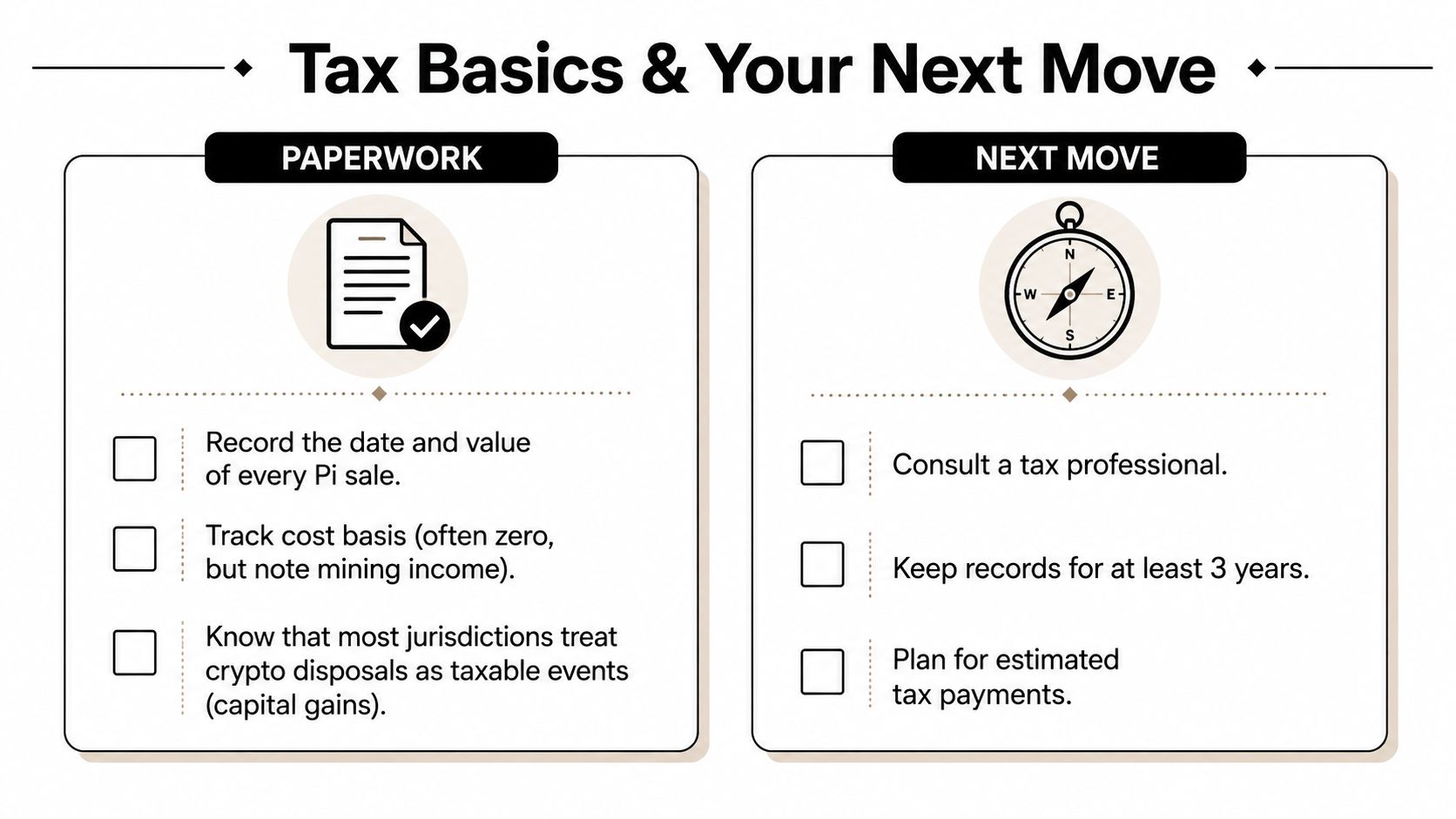
A good habit is to prepare your paperwork before the sale, not after. If you wait until tax season to reconstruct wallet history, exchange confirmations, and withdrawal records, you're making the hardest version of the job for yourself. For a broader checklist on organizing your crypto records, the Receipt Router tax preparation guide is a practical companion piece.
For readers in the U.S. or another major market, the key question is often not whether PI has a market price, but whether the local exchange path and fiat off-ramp work for their account. A token can be tradable in one context and still be hard to convert into cash in another because of regional eligibility, exchange policy, or withdrawal limitations.
Tax and next move checklist
- Record every sale: keep the date, value, and venue for each disposal.
- Track your basis: note what you paid, or document the mining-related basis if that applies in your jurisdiction.
- Save exchange statements: screenshots alone are weak, so keep downloadable records too.
- Check local rules: crypto tax treatment varies, and the burden is on you to verify it.
- Plan before trading: if you expect a larger sale, talk to a tax professional early.
The clearest next move is simple: make sure your Pi is transferable, confirm a supported exchange in your region, and document everything before you touch the sell button.
Coiner Blog publishes practical crypto guides that focus on what works, not just what sounds good on paper. If you want more straightforward explainers on Pi, exchanges, DeFi, and crypto basics, visit Coiner Blog and keep learning before you make your next move.