
Not Your Keys, Not Your Coin: Secure Your Crypto in 2026
A friend once showed me his exchange app during the FTX fallout. The balance was still there on screen, but withdrawals were another story, and that gap between seeing funds and controlling them is the whole point of this rule.
Table of Contents
- The Crypto Mantra That Could Save Your Portfolio
- What “Not Your Keys, Not Your Coin” Really Means
- A Spectrum of Custody Models Explained
- Real-World Risks and Threat Models
- Best Practices for Bulletproof Self-Custody
- Your Next Steps Toward True Crypto Sovereignty
The Crypto Mantra That Could Save Your Portfolio
Crypto veterans didn't adopt this phrase because it sounds clever. They adopted it because too many people learned the hard way that a balance inside an app isn't the same as ownership on a blockchain.
Mt. Gox made that lesson permanent. During the Mt. Gox collapse in 2014, the exchange said it had lost about 850,000 BTC, later found around 200,000 BTC, and the net loss came to roughly 650,000 BTC, a defining event for self-custody advocacy according to this breakdown of the custody lesson behind the slogan.
Years later, the industry got another reminder when FTX failed. Its bankruptcy exposed what happens when users rely on an intermediary for access, settlement, and trust all at once. U.S. authorities later said the exchange had handled billions of dollars in customer funds and was operating without proper safeguards, which brought the old mantra back into everyday conversation.
A balance is not control
If an exchange holds the keys, the exchange decides whether you can move funds right now, later, or at all. That's true whether the problem is insolvency, an internal freeze, a compliance review, or a hack.
Consider the difference between storing cash in a bank vault and carrying cash in your own pocket. The vault may be more convenient for some use cases, and many people will still choose it for part of their holdings, but the money in the vault depends on the institution's rules and condition. The cash in your pocket depends on you.
Practical rule: If a third party can stop your transaction, you don't have full control, even if the app says you own the asset.
That doesn't mean everyone should rush into the most advanced setup on day one. It means custody is the first decision in crypto, not the last. Bitcoin, Ethereum, NFTs, DeFi positions, Layer 2 assets, and tokenized real-world assets all sit on top of the same basic truth. Control starts with keys.
What “Not Your Keys, Not Your Coin” Really Means
The phrase Not Your Keys, Not Your Coin is a shorthand for a simple custody rule. Whoever controls the private key controls the cryptocurrency, because the private key is what authorizes spending on the blockchain, as explained in this overview of why the phrase became central to Bitcoin education.
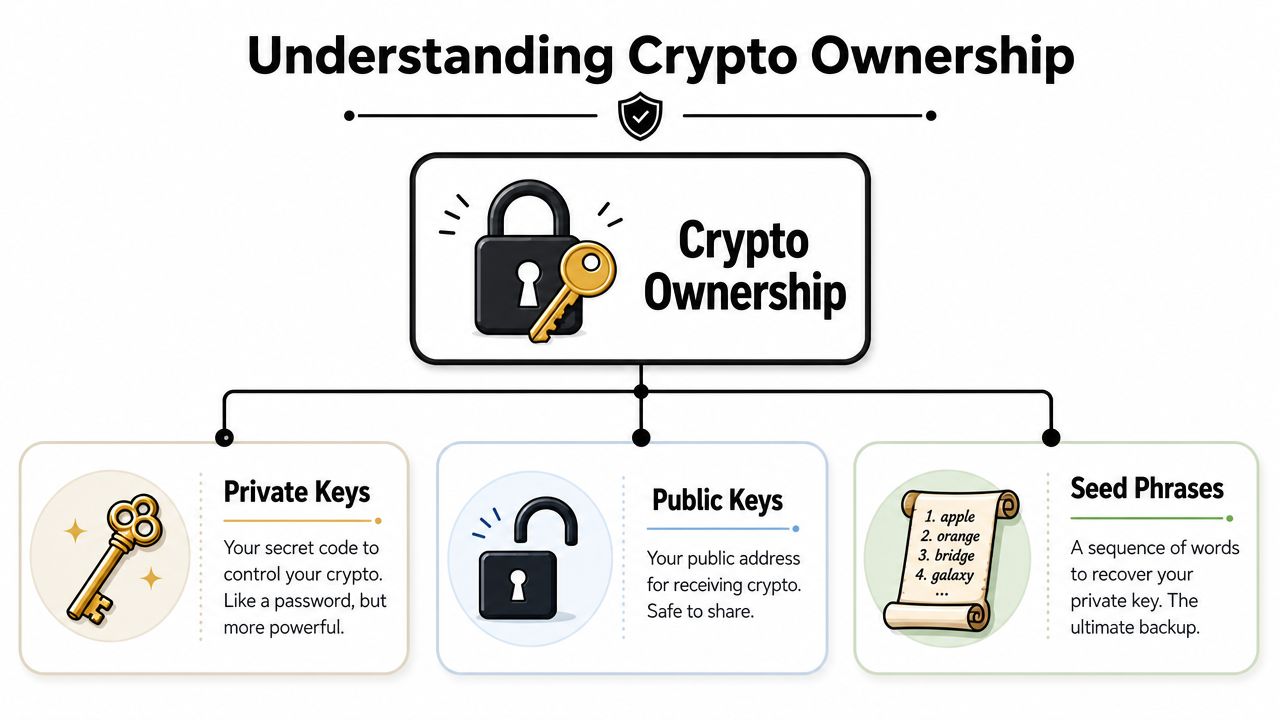
For beginners, the easiest way to understand it is to separate ownership into three parts. The public side receives. The private side signs. The recovery side restores.
The key, the address, and the backup
A public key or wallet address is like your bank account number. You can share it so people can send you crypto.
A private key is closer to the key to your safe. It isn't for receiving funds. It's for authorizing movement of funds. If someone gets it, they don't need your permission.
A seed phrase is the master backup. In practical wallet design, it's the human-readable recovery path that can recreate access to your wallet. If you lose your device but still have the seed phrase, you can usually restore control. If someone else gets the seed phrase, they may be able to restore your wallet too.
That last point matters more than most beginner guides admit. Many users think wallet security starts and ends with downloading MetaMask, Phantom, or a hardware wallet. It doesn't. Security lives in how the keys are generated, how the seed phrase is stored, and how recovery is handled when the original device is gone.
Your wallet doesn't hold coins the way a leather wallet holds cash. It holds the credentials that let you prove control over assets recorded on the blockchain.
For readers getting started with the basics of buying and holding digital assets, a beginner-friendly guide on how to invest in cryptocurrency for beginners is a useful companion before choosing a custody setup.
Why the phrase became foundational
As exchanges became the default entry point for retail users, this principle stopped being academic. By 2021, Bitcoin exchange balances had fallen from roughly 3.0 million BTC in March 2020 to about 2.2 million BTC, a drop of about 27%, according to the industry-cited analysis summarized in the source above. The larger takeaway is straightforward. Millions of coins were already moving away from custodial platforms as self-custody awareness grew.
This is why experienced users say leaving assets on an exchange means holding an IOU, not direct possession. The blockchain may show an address with funds, but if the custodian controls the signing authority, the custodian controls the outcome.
That doesn't make custody binary. It makes it contextual. A trader may accept some custodial exposure for speed. A long-term Bitcoin holder usually shouldn't. A DeFi user on Ethereum or a Layer 2 network may need direct wallet control because smart contracts, token approvals, and onchain identity don't work the same way through a centralized middleman.
A Spectrum of Custody Models Explained
Custody is often talked about as if there are only two choices. Exchange or hardware wallet. In practice, custody sits on a spectrum that runs from maximum convenience to maximum sovereignty, with several useful hybrids in between.
The right choice depends on what you hold and how you use it. A passive Bitcoin holder, an NFT gamer, a DeFi farmer, and a DAO treasury signer shouldn't all use the same setup.
Custodial exchange accounts
Many individuals start their journey here. Coinbase, Binance, Kraken, and similar platforms make onboarding easy. You get fiat ramps, trading tools, and account recovery.
The trade-off is obvious. The platform holds the keys. That makes exchange custody practical for active trading and short-term liquidity, but weak for long-term sovereignty.
Best fit:
- Active traders: People who need fast execution and regular order placement.
- New users: People still learning wallets, gas fees, token standards, and transaction signing.
- Small working balances: Funds kept ready for swaps, bridging, or market access.
Weak fit:
- Long-term cold storage: You're introducing unnecessary counterparty risk.
- DeFi-native activity: Many protocols require direct wallet interaction.
- NFT ownership with utility: Claims, staking, and token-gated access often depend on wallet control.
Software wallets
Software wallets such as MetaMask, Rabby, Phantom, and Trust Wallet move control to the user while keeping access flexible. They work well for Ethereum, Solana, Layer 2 networks, NFTs, GameFi assets, and smart contract interactions.
They are also the most misunderstood category. A hot wallet on your phone or browser is not insecure by default, but it is connected to an online environment where phishing, fake approvals, malicious browser extensions, and spoofed dApps live.
For Solana users comparing one of the most common options, this overview of what Phantom Wallet is helps clarify where a software wallet fits in a broader custody plan.
Software wallets make sense when:
- You interact with dApps often: DeFi, NFT marketplaces, Web3 games, and governance tools need frequent signatures.
- You segment risk: One wallet for minting, another for treasury-like holdings, another for experimental protocols.
- You understand wallet hygiene: Device security and transaction review become part of the job.
Hardware wallets
A hardware wallet is still the cleanest answer for long-term holders. Ledger, Trezor, and similar devices keep signing operations isolated from your everyday internet-facing environment.
That doesn't mean hardware wallets are magic. If you type your seed phrase into a phishing site, approve a malicious transaction blindly, or keep a poor backup, the hardware didn't fail. Your process did.
What works well:
- Bitcoin savings and long-term ETH holdings
- High-value NFTs that don't need daily movement
- Treasury-style storage for serious personal allocations
What doesn't:
- Constant GameFi interaction: Too much friction leads people to make shortcuts.
- Single-wallet everything: One device, one seed phrase, one giant blast radius isn't ideal.
- Unpracticed recovery: A secure setup you can't restore isn't secure enough.
Multisig and smart contract wallets
Custody gets more mature.
Multisig setups split authorization across multiple keys. That's useful for teams, family wealth planning, and larger balances where one lost device or one compromised signer shouldn't be enough.
Smart contract wallets add policy controls on top of raw key ownership. Depending on the chain and wallet design, they can support features like spending rules, delegated permissions, social recovery, session keys for games, or safer account abstraction flows. For DeFi power users and Web3 teams, this is often more practical than relying on one seed phrase forever.
These tools are especially relevant as crypto expands beyond simple holding. AI agents interacting with wallets, tokenized real-world assets, DAO operations, and Layer 2 ecosystems all benefit from more programmable security than a single hot wallet can offer.
| Custody Model | Security Level | Convenience | Sovereignty | Best For |
|---|---|---|---|---|
| Custodial exchange | Moderate, depends on provider | Very high | Low | Traders, beginners, temporary balances |
| Software wallet | Moderate, depends on user hygiene | High | High | DeFi users, NFT collectors, gamers |
| Hardware wallet | High for long-term storage | Moderate | High | Long-term holders, larger balances |
| Multisig wallet | High with proper signer separation | Moderate to low | Very high | Teams, treasury management, larger holdings |
| Smart contract wallet | Varies by implementation and use | High to moderate | High | Advanced users, DeFi power users, programmable security needs |
The best custody setup is the one you'll operate correctly under stress. A perfect design on paper fails if daily habits don't match it.
Real-World Risks and Threat Models
Risk isn't only losing access. It's inheriting the wrong kind of risk for the way you use crypto.
If a third party holds the key, you inherit that party's operational, insolvency, and breach risks. If you hold the key yourself, you take on the burden directly, and a compromised seed phrase can expose multiple accounts while a single private key compromise is narrower, as explained in this summary of the compounded attack surface in crypto custody.
What can go wrong with custodians
Custodial risk is concentrated risk. One provider can have strong branding, slick UX, and a polished app while still creating a single point of failure.
Common failure paths include:
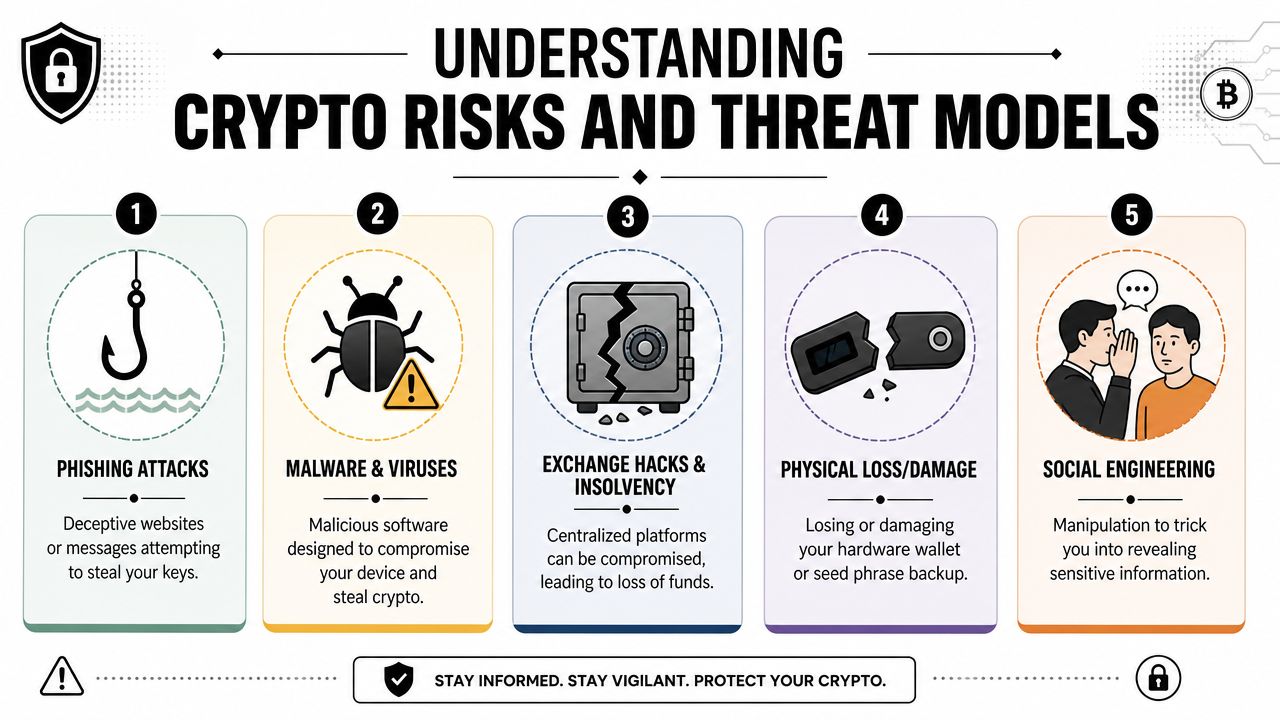
- Account freezes: A compliance review, suspicious login, or internal policy issue can block withdrawals right when you need them.
- Platform insolvency: If the company fails, your claim may become part of a legal process instead of an immediate withdrawal.
- Security breaches: Users inherit the custodian's operational weaknesses, whether they understand them or not.
Anyone who works in security knows this pattern from outside crypto too. Third-party infrastructure creates convenience but also dependency. The logic is similar to what you'll find in a solid guide to cloud security, where centralization can simplify operations while expanding the consequences of a breach or outage.
What can go wrong in self-custody
Self-custody removes the intermediary, but it doesn't remove risk. It changes the shape of risk.
The failure modes are usually more personal and more immediate:
- Phishing: Fake wallet sites, fake support messages, fake airdrops, and fake mint pages.
- Malware: Clipboard hijackers, keyloggers, and device compromise.
- Bad approvals: Signing a malicious smart contract transaction that grants more access than intended.
- Poor backup habits: A damaged recovery card, a lost seed phrase, or an exposed photo backup.
- Physical exposure: Someone finds your backup, coerces access, or steals an unsecured device.
For a broader breakdown of common attack patterns facing everyday users, this guide on how to avoid crypto scams is worth reading alongside any wallet setup process.
Self-custody doesn't forgive sloppiness. The blockchain will execute exactly what you authorize, even when you authorize the wrong thing.
Threat models for different crypto users
A threat model is just a realistic answer to one question. What are you protecting, from whom, and during which actions?
Long-term Bitcoin holder
The main threat isn't daily smart contract risk. It's backup failure, inheritance chaos, and seed exposure. A hardware wallet or multisig approach fits better than a browser wallet.
DeFi power user
The biggest risks are approvals, blind signing, bridge interaction, and experimental protocols. A two-wallet or three-wallet structure works well. One wallet for storage, one for routine DeFi, one for high-risk testing.
NFT collector
The danger often comes from marketplace signatures, fake drops, Discord scams, and token approvals. The best practice is separating your vault wallet from your trading wallet so your prized assets don't sit in the same place as your daily clicks.
NFT gamer or GameFi user
This group signs transactions constantly. Session-based interaction and lower-value operational wallets matter more than forcing a cold-storage workflow onto gameplay. Smart contract wallets may become especially useful here because they can reduce friction without requiring full exposure of a top-level vault.
DAO or small team
One person holding treasury funds is a governance problem, not just a security problem. Multisig is usually the sensible baseline.
Best Practices for Bulletproof Self-Custody
Most advice on self-custody stops too early. It tells you to buy a hardware wallet and calls it a day. The harder part is everything around the wallet: backups, recovery, passphrases, device trust, and daily behavior.
That gap matters because real-world wallet security depends on local key storage, backup hygiene, and recovery design, with trade-offs around seed phrases, PINs, passphrases, and device choice, as discussed in this practical overview of what self-custody means in operation.
Start with this visual checklist, then build your own routine around it.
The non-negotiable rules
- Write the seed phrase offline: Paper is better than a note app. Durable metal backup products can be better than paper for long-term storage if you care about fire, water, and physical wear.
- Never enter the seed phrase into a website: The legitimate use case is wallet restoration into trusted wallet software or hardware flow. Outside of that, assume it's a trap.
- Use a PIN and consider a passphrase: A passphrase adds another layer, but only if you can manage it reliably. Security that you forget is self-sabotage.
- Send a test transaction first: Especially when moving larger amounts, bridging to Layer 2, or withdrawing from an exchange.
- Review every signature request: On Ethereum and EVM chains, bad approvals can be as dangerous as sending funds directly.
A good starter reference for comparing user-friendly options is this roundup of the best crypto wallets for beginners. Use it as a shortlist, not as a substitute for your own process.
Here's a practical video walkthrough that complements the written checklist:
What works and what fails in practice
What works is boring. Separation, repetition, and discipline.
Good operators usually do a few simple things well. They keep a cold wallet for savings. They use a separate hot wallet for DeFi, NFTs, or Web3 experiments. They don't click wallet prompts casually. They practice recovery before they need it.
What fails is overconfidence. People store seed phrases in cloud notes, reuse one wallet for everything, or chase convenience until their security model collapses.
If you're evaluating hot wallet safety or want another perspective on trade-offs in consumer wallet design, this review of Atomic Wallet security is a useful example of the kind of scrutiny users should apply before trusting any wallet with meaningful funds.
Field note: The biggest self-custody mistake isn't buying the wrong wallet. It's building no repeatable routine around the right wallet.
A few advanced habits make a big difference:
- Use wallet segmentation for different activities. Savings, active DeFi, NFT minting, and experimental dApps shouldn't all share the same risk.
- Keep recovery instructions for trusted heirs if you hold serious value. Technical sovereignty without succession planning is unfinished work.
- Treat AI-assisted tools carefully. AI can help summarize transactions or flag suspicious patterns, but it shouldn't replace your own verification when signing onchain actions.
- Prefer mature apps for important assets. New smart contracts, new bridges, and trendy tokenomics experiments can be interesting, but they shouldn't be the first stop for your core holdings.
Your Next Steps Toward True Crypto Sovereignty
The point of Not Your Keys, Not Your Coin isn't paranoia. It's ownership.
Crypto gives you something traditional finance usually doesn't. The ability to hold and move value without asking a gatekeeper for permission. But that freedom only becomes real when your custody matches your goals.

A simple path based on your experience level
If you're new, don't start with an elaborate setup. Move a small amount from an exchange to a reputable software wallet and learn how addresses, confirmations, and backups work.
If you're intermediate, buy a hardware wallet and separate savings from spending. Keep long-term Bitcoin, Ethereum, or higher-conviction holdings in a vault-style environment. Use a different wallet for DeFi, NFTs, GameFi, and smart contract activity.
If you're advanced, look at multisig or smart contract wallets. That's where personal security starts to become operational security. It's especially relevant if you manage family assets, DAO funds, onchain business revenue, or a complex Web3 workflow across Ethereum, Solana, and Layer 2 networks.
Where custody is heading
The good news is that self-custody keeps getting better. Smart contract wallets are making recovery and permissions more flexible. Layer 2 ecosystems are making onchain activity cheaper and more routine. Tokenized real-world assets, AI-linked wallet tooling, and more mature DeFi interfaces will keep pushing custody design toward better usability.
The future won't eliminate responsibility. It should reduce avoidable mistakes.
If you want to think further ahead about privacy, verification, and the next wave of digital security, this perspective on the future of cryptography is a strong next read.
The strongest move you can make today is simple. Pick the custody model that fits your behavior, not your ego. Then run it with discipline.
Coiner Blog publishes practical crypto guides for people who want more than slogans. If you want clear analysis on wallets, DeFi, NFTs, Web3 security, Layer 2 trends, and the next wave of blockchain tools, explore Coiner Blog.
3 Comments