
What Is Slippage in Trading: Protect Your Crypto Trades
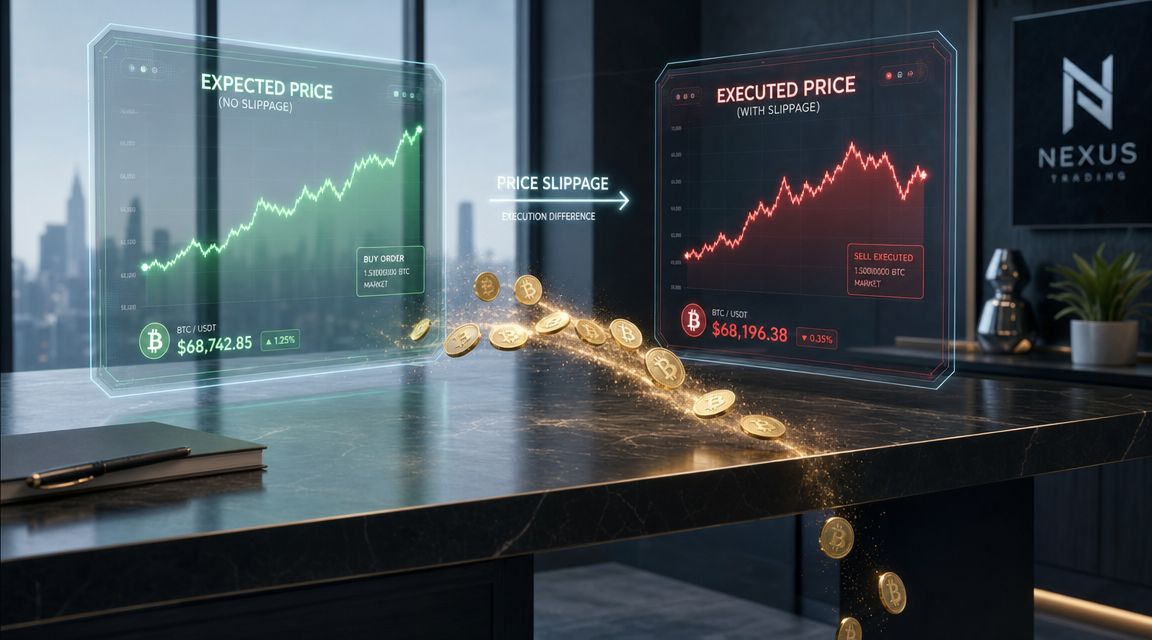
You approve a swap on a DEX, the screen shows one estimate, and the wallet confirms something slightly different. You didn't misread it. The market changed between quote and execution, or the pool couldn't fill your size at the exact displayed price.
That gap is slippage, and if you trade crypto long enough, you'll run into it in DeFi swaps, on centralized exchanges, during NFT mints, and even inside GameFi economies where token prices can move while your transaction is still waiting to land. It matters more now because Web3 trading happens across fragmented liquidity, smart contracts, Layer 2 networks, bots, and mempools, not just one clean exchange screen.
Most newer traders treat slippage as a synonym for “I got a worse price.” That's incomplete. Slippage can also work in your favor. FXCM's execution statistics show 30.83% of all stop, limit, at-market, and entry orders received positive slippage, while 14.64% received negative slippage in that data set, which is a useful reminder that execution quality can improve as well as worsen depending on market conditions and available liquidity, as shown in FXCM's slippage statistics.
Table of Contents
- The Trade You Did Not Expect
- Slippage in Trading Explained
- The Main Causes of Slippage in Crypto and TradFi
- Slippage in Action with Real World Examples
- How Slippage Impacts Your Portfolio and P&L
- Actionable Strategies to Minimize Slippage
- Frequently Asked Questions About Trading Slippage
The Trade You Did Not Expect
You swap ETH for a smaller token on Uniswap, Aerodrome, or PancakeSwap. The interface gives you an estimate. You sign the transaction, wait for confirmation, and receive fewer tokens than the screen implied a few seconds earlier.
That moment is where slippage stops being theory.
It also shows up outside token swaps. During a hyped NFT mint, you think you know your total entry cost, but network conditions shift while your transaction sits in the queue. In GameFi, you try to buy an in-game asset or swap reward tokens after an announcement, and the execution comes through at a different level than expected. The same issue appears on a CEX when you hit market buy on a thin altcoin pair and your order fills across several price levels.
Why this catches so many traders off guard
Crypto makes execution feel instant, but it isn't always instant in practice. A smart contract still has to process your trade. Liquidity still has to exist at the displayed price. Other traders, bots, and arbitrage systems may react before your order settles.
A good mental model is a store shelf with one last popular item left. The sticker says one thing. By the time you reach checkout, demand has surged and the final price changed, or you only get part of what you wanted at that price.
Slippage isn't just a trading term. It's the difference between the trade you planned and the trade the market actually gave you.
That matters whether you're rotating stablecoins, testing a new DeFi protocol, bridging to a Layer 2, or checking the value of a Bitcoin move in BTC to GBP terms. In every case, execution quality affects real returns.
The useful twist is that slippage isn't always bad. Sometimes the market fills you at a better price than expected. Most traders remember the painful fills and forget the favorable ones, which is why slippage gets discussed like a pure penalty instead of a neutral execution outcome that can go either way.
Slippage in Trading Explained
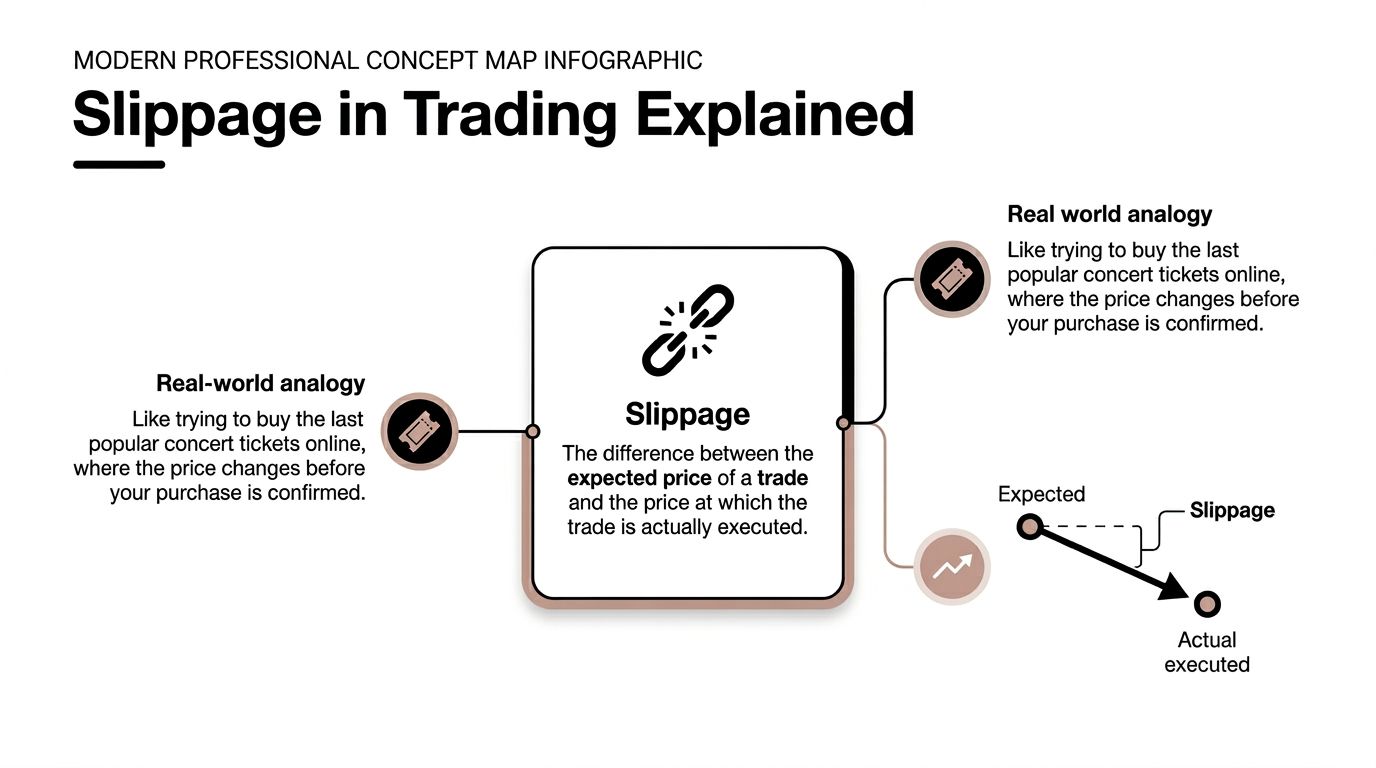
Slippage in trading means the difference between the price you expected and the price your trade gets.
A simple way to think about it
Think about trying to buy the last few concert tickets online. You click when the listed price looks fine, but by the time checkout finishes, demand has shifted and the final number changes. Trading works the same way. You act on one visible price, but the market may move before your order completes.
In formal market structure terms, slippage is defined as the difference between the average execution price and the initial midpoint of the bid ask spread for a given quantity, which means it captures both price movement and the impact of the order itself, as described in Wikipedia's slippage entry).
If you want a complementary primer from a trading education angle, this guide on what is slippage in trading is a useful external resource.
Positive slippage and negative slippage
There are only two directions this can go:
- Negative slippage means you got a worse price than expected.
- Positive slippage means you got a better price than expected.
For a buy order, paying more than expected is negative slippage. Paying less is positive slippage. For a sell order, the logic flips. Selling lower than expected is negative. Selling higher is positive.
Here's where beginners often get tangled up. They assume slippage is the same thing as volatility. It isn't. Volatility is the market moving around. Slippage is how that movement, plus available liquidity and execution mechanics, affects your actual fill.
Practical rule: The quote on your screen is only an invitation. Your fill is the trade that counts.
On crypto platforms, you'll also see slippage tolerance. That setting tells a DEX how much deviation from the quoted price you're willing to accept before the transaction should fail instead of executing. Set it too tight and the trade may revert. Set it too loose and you may give bots or fast market moves too much room.
Crypto offers complexities beyond textbook finance. On-chain execution introduces mempool visibility, smart contract routing, and crypto-native tactics such as MEV in crypto markets, which can push a normal market concept into a very different user experience.
The Main Causes of Slippage in Crypto and TradFi
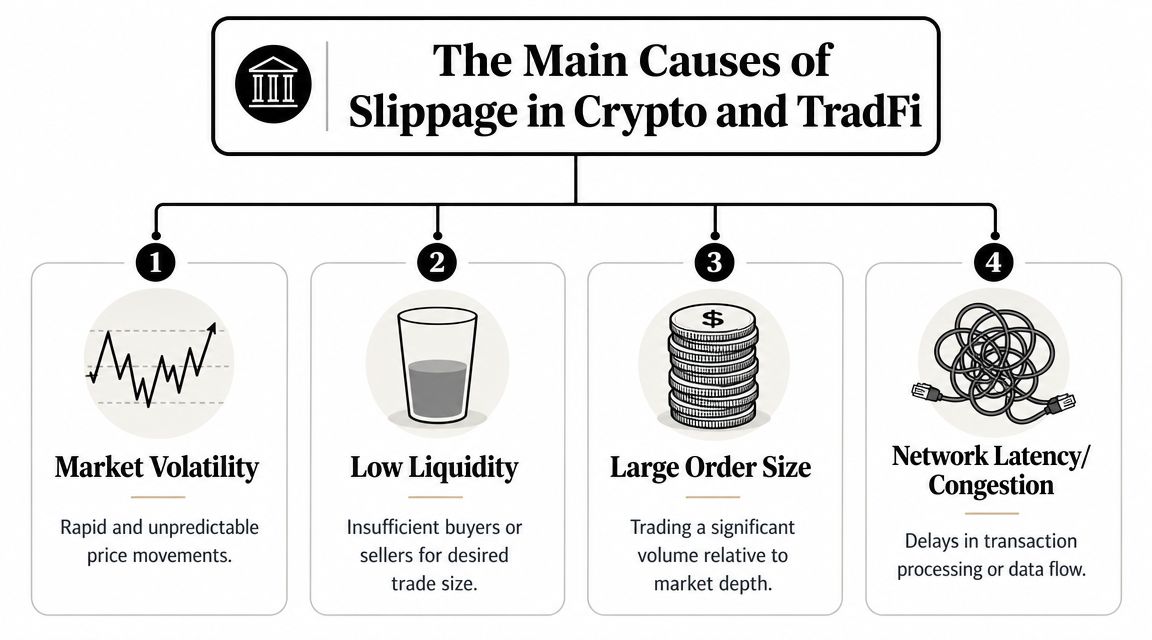
Slippage doesn't come from one source. It usually comes from a mix of price movement, limited liquidity, trade size, and execution delays. In crypto, there's an extra layer. Public blockchain infrastructure lets outside actors react to your transaction before it's finalized.
Volatility changes the quote before the fill
When prices are moving fast, even a small delay matters. That's true in forex, equities, and crypto. It's even more visible during major token listings, macro news, liquidation cascades, or sudden bursts of activity around AI tokens, meme coins, or real-world asset narratives.
On a CEX, your market order may chase a moving book. On a DEX, the quoted output can change between wallet signature and block inclusion. On a Layer 2, execution can feel smoother, but thin pools can still create noticeable price drift.
Liquidity and order size shape the final price
Liquidity is the market's ability to absorb your trade without moving too much. If a market is deep, you can trade with less disruption. If it's shallow, your own order can push price against you.
That's why the same trade size can feel harmless on BTC or ETH but awkward on a smaller altcoin, an NFT floor sweep, or a GameFi token with patchy activity. If you want a broader primer on why this matters, this overview of crypto liquidity helps frame the issue.
A widely used execution view is that slippage is driven by order size, liquidity, volatility, and market impact, and the effect can become non-linear, meaning costs can rise disproportionately as trade size grows or liquidity thins, as explained in Quant Journey's analysis of slippage.
A simple way to visualize it:
- Small trade in deep market: usually limited impact
- Large trade in deep market: may still move price
- Small trade in thin market: can slip more than expected
- Large trade in thin market: often gets expensive fast
MEV adds a crypto native layer of friction
Traditional finance articles often stop at volatility and liquidity. Crypto doesn't.
On public blockchains, pending transactions can sit in the mempool before confirmation. Bots monitor that flow. If they detect a profitable opportunity, they may submit transactions around yours. That's where MEV, or maximum extractable value, enters the picture.
The non-technical version is simple. Your trade becomes visible. A bot sees that your swap may move price. It acts before or around your transaction to capture value, and your final execution can worsen. Traders often describe this as front-running or sandwich behavior, though the exact mechanics vary by chain, wallet route, and protocol design.
In DeFi, slippage can come from the market itself, but it can also come from other actors reacting to your order before it lands.
That's a major reason why crypto traders care so much about routing, private relays, DEX aggregators, and execution settings. In Web3, market structure isn't just the order book. It's also the transaction path.
Slippage in Action with Real World Examples
Abstract definitions help, but slippage makes more sense when you picture an actual trade.
A DeFi swap
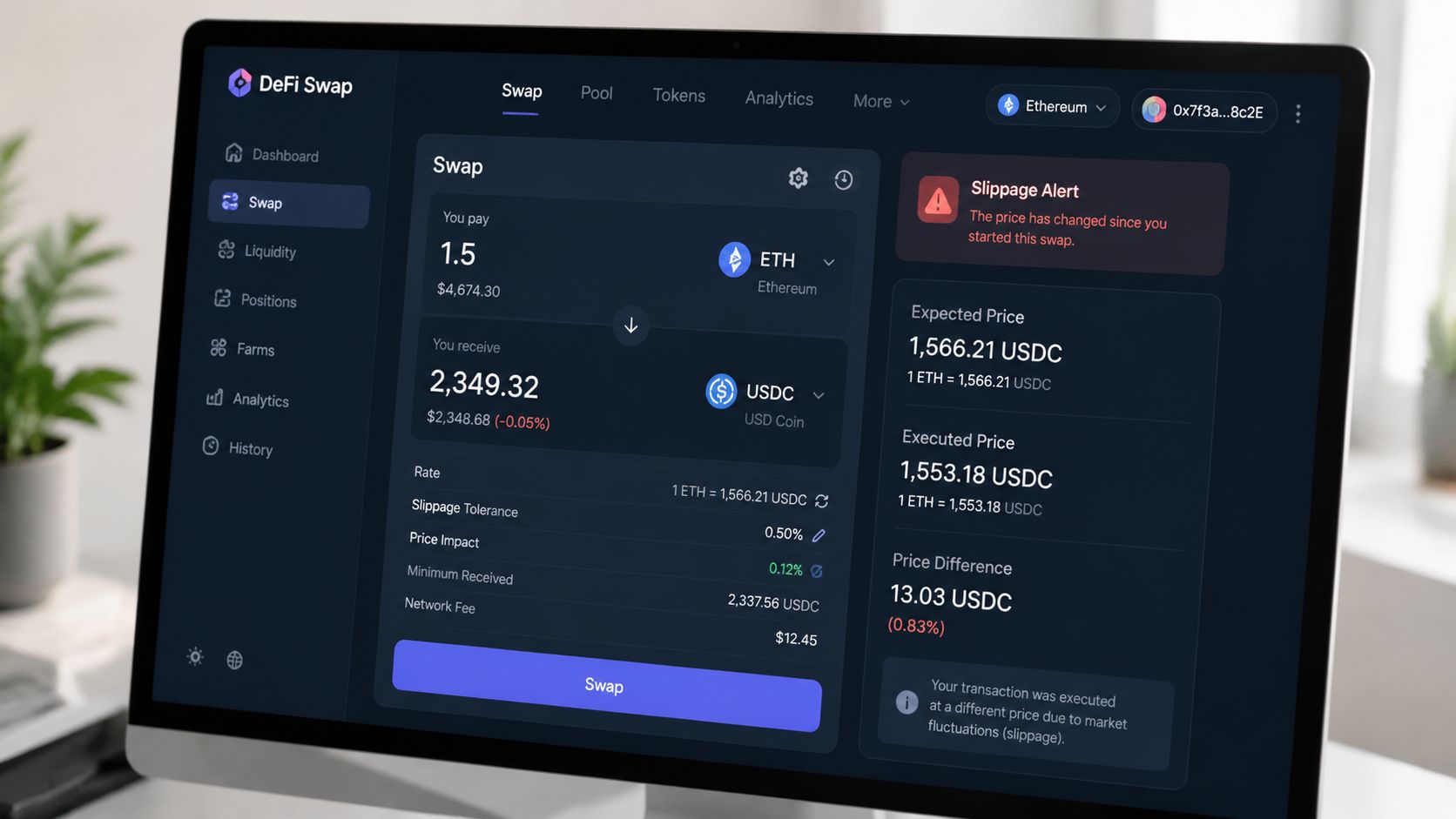
You open a DEX to swap ETH into a newly trending token. The quote looks fine, but the pool is shallow and other buyers are hitting it at the same time. By the time your wallet confirms, the output token amount has dropped.
What happened? Your trade likely moved through available liquidity, and the price curve changed while the transaction was pending. On-chain execution is especially sensitive when tokenomics are volatile, the pair is new, or a narrative has gone hot across Crypto Twitter and Telegram.
An NFT mint
Now take an NFT mint on Ethereum or a busy Layer 2. The mint price may be fixed in the contract, but your all-in entry experience can still shift because network congestion changes transaction conditions and users compete to get included quickly.
This isn't slippage in the exact same format as a spot order book fill, but to the user it feels similar. You expected one cost and one execution experience. The live network gave you another. That's why experienced NFT traders think in terms of execution environment, not just mint price.
A traditional market order
The same principle shows up in stocks and forex. A buy order intended at $1.4040 that fills at $1.4045 has negative slippage, while one that fills at $1.4035 has positive slippage. Educational trading material also points to two practical controls that matter across markets: limit orders and trading during high-liquidity sessions, as outlined by AvaTrade's explanation of slippage.
That same lesson shows up all over crypto history. During periods of stress, confidence can evaporate, liquidity can thin, and execution can get ugly fast. Anyone who has studied collapses and reflexive selling around ecosystems like the Terra crypto breakdown has seen how quickly “the price on the screen” can stop matching the price you can realistically achieve.
A few patterns repeat across all three examples:
- Fast demand changes create execution gaps.
- Thin liquidity makes the gap wider.
- Market orders give up price control for speed.
- Crowded moments are where slippage hurts most.
How Slippage Impacts Your Portfolio and P&L
A single bad fill is annoying. Repeated bad fills become a performance problem.
If you trade actively, slippage acts like a hidden execution cost sitting beside fees, spreads, and gas. It doesn't always announce itself cleanly. You just notice that trades that looked solid on entry don't produce the same result in your actual account.
Small execution gaps add up
This is why slippage matters so much for scalpers, intraday traders, DeFi farmers rotating capital often, and anyone running systematic strategies across CEXs or DEXs. Even when each trade only slips a little, repeated entries and exits can drag down returns.
In professional modeling, slippage is treated as a core cost. A strategy that includes 5 cents of slippage on entry and 5 cents on exit is modeled as a 10-cent round-trip cost, which directly changes whether the system still works after realistic execution assumptions, as described earlier in the slippage framework from Quant Journey.
Why backtests often look better than reality
A backtest with perfect fills is usually too optimistic. It assumes the market always gave you the price you wanted, exactly when you wanted it. Real markets don't work that way.
That's especially true in crypto, where smart contract routing, shallow pools, cross-chain moves, and volatility spikes can distort execution. If you're evaluating whether a strategy is making money, track execution and portfolio drift with dedicated tools, not memory. A roundup of crypto portfolio trackers can help if you're trying to measure real results instead of idealized ones.
If your model ignores slippage, it isn't measuring tradable performance. It's measuring a cleaner world than the one you trade in.
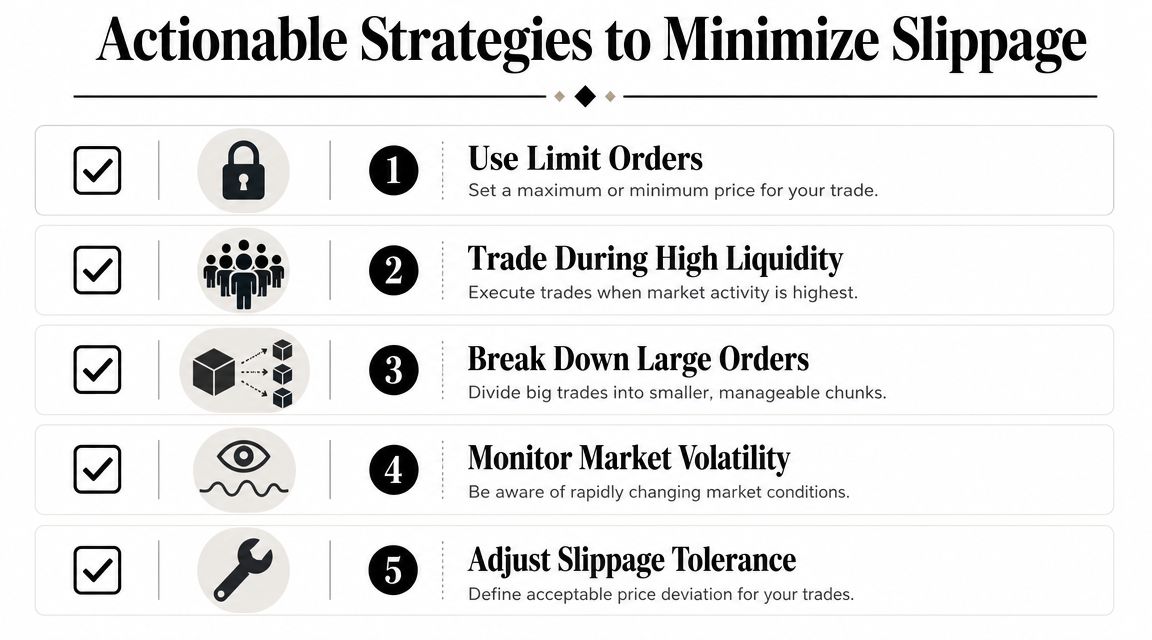
Actionable Strategies to Minimize Slippage
You won't eliminate slippage completely. You can reduce it a lot.
Choose the right order method
The first fix is often the simplest.
- Use limit orders when price matters more than speed: A market order says “fill me now.” A limit order says “fill me only at this price or better.” On centralized exchanges, that's one of the best ways to control nasty surprises.
- Set slippage tolerance carefully on DEXs: Too tight and your trade may fail. Too loose and you may tolerate more movement than you intended. Stable pairs can often use tighter settings than volatile altcoins or low-depth tokens.
- Don't force trades during chaos: If a token is ripping, a mint is overcrowded, or a macro headline just hit, waiting can be the higher-skill move.
Here's a practical walkthrough that complements the checklist below.
Reduce your market impact
If your order is large relative to available liquidity, your own trade can become the problem.
- Break large orders into smaller chunks: This is basic execution discipline. Smaller clips usually disturb the market less than one large sweep.
- Trade when liquidity is stronger: Busy sessions generally offer tighter books, deeper pools, and better execution conditions than dead hours.
- Check route quality on DEX aggregators: Tools like 1inch, Matcha, and other aggregators can search across pools and paths to find better execution than a single venue alone.
Use crypto specific protections
Crypto gives you extra execution risk, but it also gives you extra tools.
- Use private transaction relays when appropriate: This can help reduce exposure to public mempool visibility and some forms of MEV interference.
- Compare venues before swapping: A token may look active on one interface but execute better elsewhere because the liquidity source is different.
- Be careful around NFT mints and GameFi launches: Fast-moving communities, bots, and shallow markets create ugly conditions for impatient transactions.
Execution mindset: Don't ask only, “Do I like this token?” Ask, “Can I enter and exit it efficiently?”
| Technique | How It Works | Best For | Potential Downside |
|---|---|---|---|
| Limit orders | Sets a maximum buy or minimum sell price | CEX spot trading, swing entries, exits with discipline | May not fill if price moves away |
| Slippage tolerance controls | Caps acceptable deviation on a DEX swap | DeFi swaps, volatile token pairs | Too tight can cause failed transactions |
| Order splitting | Divides one large trade into smaller pieces | Larger positions, thinner markets | Takes more time and attention |
| Trading during higher liquidity | Uses deeper markets and stronger participation | Major pairs, active sessions | Opportunity may pass while waiting |
| DEX aggregators and private routing | Searches better paths and can reduce some execution friction | Multi-pool DeFi trading, MEV-aware users | Added complexity for beginners |
Frequently Asked Questions About Trading Slippage
Is slippage the same as the bid ask spread
No. They're related, but they're not the same thing.
The spread is the gap between the best displayed buy and sell prices. Slippage is the gap between the price you expected and the price you got. A wide spread often makes slippage more likely, but they aren't identical.
Is slippage always bad
No. A better-than-expected fill is positive slippage. Traders usually talk about the painful version because that's what hurts performance, but favorable execution does happen.
Which crypto platforms usually help reduce slippage
Platforms with deeper liquidity, better routing, and clearer execution settings usually help. On centralized exchanges, that means strong order books and support for limit orders. In DeFi, aggregators, smart routing, and sensible slippage controls matter a lot.
Can slippage get extreme in crypto
Yes, especially in thin pools, during news-driven moves, in small-cap tokens, or during crowded NFT and GameFi events. The practical defense is position sizing, venue selection, and refusing to trade when conditions are obviously poor.
If you want more plain-English crypto guides like this, plus breakdowns of DeFi, NFTs, blockchain trends, AI and crypto, and practical market education, visit Coiner Blog.
1 Comment