
Mastering Crypto Risk Management: Your 2026 Guide

You're probably in one of two places right now. Either you already hold Bitcoin, Ethereum, a few altcoins, maybe a stray NFT or two, and you've realized that the primary challenge isn't finding exposure. It's building a setup that lets you stay in the market without one bad week, one bad click, or one bad protocol wiping out months of progress.
Or you've been around long enough to know that crypto punishes loose process. A token can rip on a listing rumor, a DeFi pool can look safe until the wrong wallet drains liquidity, and an exchange can feel convenient right up until counterparty risk stops being an abstract term. If you've lived through that kind of whiplash, you already know the issue isn't whether crypto is risky. It's whether your system is stronger than the market's ability to surprise you.
That's why I think about crypto risk management as an operating system, not a checklist. Good systems make ordinary decisions boring. They define position size before entry, custody before yield, and exit rules before narratives get loud. That mindset isn't unique to digital assets either. A lot of the discipline used in modern risk management for financial institutions translates surprisingly well to personal crypto portfolios, even if the tools differ.
If you're already reading bear-market signals and trying to avoid emotional trading, a practical guide to a cryptocurrency bear market helps frame why survival matters more than bravado. The people who last in crypto usually aren't the ones who called every top. They're the ones who built rules they could still follow when the market got ugly.
Table of Contents
- Surviving the Cycle Why Risk Management Is Not Optional
- The Complete Taxonomy of Crypto Risk
- A Repeatable Crypto Risk Management Framework
- Portfolio Tactics Position Sizing and Diversification
- Technical Security On-Chain Safety and Custody
- Navigating Advanced Risks in DeFi NFTs and Gaming
- Your Crypto Risk Management Action Checklist
Surviving the Cycle Why Risk Management Is Not Optional
Many individuals enter crypto through upside and stay because of pain.
You buy a small Bitcoin position, then add Ethereum because it feels like the infrastructure bet. Then a Layer 2 catches your attention, a DeFi app offers yield that looks reasonable, and suddenly your portfolio isn't a portfolio anymore. It's a pile of disconnected bets with no common rules. That usually works fine until the market turns.
What changes the game is realizing that risk management isn't about becoming defensive all the time. It's about staying functional under stress. If your process only works when candles are green, it doesn't work.
The difference between exposure and a system
A lot of crypto habits masquerade as strategy. Holding forever isn't a risk plan. Buying dips isn't a risk plan. Spreading money across many tokens isn't a risk plan if all of them depend on the same market mood, the same liquidity cycle, or the same exchange infrastructure.
Practical rule: A good system answers three questions before you enter any position. How much can I lose, where is it stored, and what would make me exit?
That applies whether you're buying spot Bitcoin, farming in DeFi, using Ethereum Layer 2 networks for lower fees, or experimenting with newer narratives like AI and crypto.
Why long-term participants think this way
The durable edge in crypto isn't prediction. It's repeatability.
That means you define your risk budget before you define your upside story. You decide which assets belong in cold storage, which ones stay liquid for trading, which smart contracts you trust enough to approve, and which opportunities are too messy. Once you do that, market swings still hurt, but they stop controlling your behavior.
The Complete Taxonomy of Crypto Risk
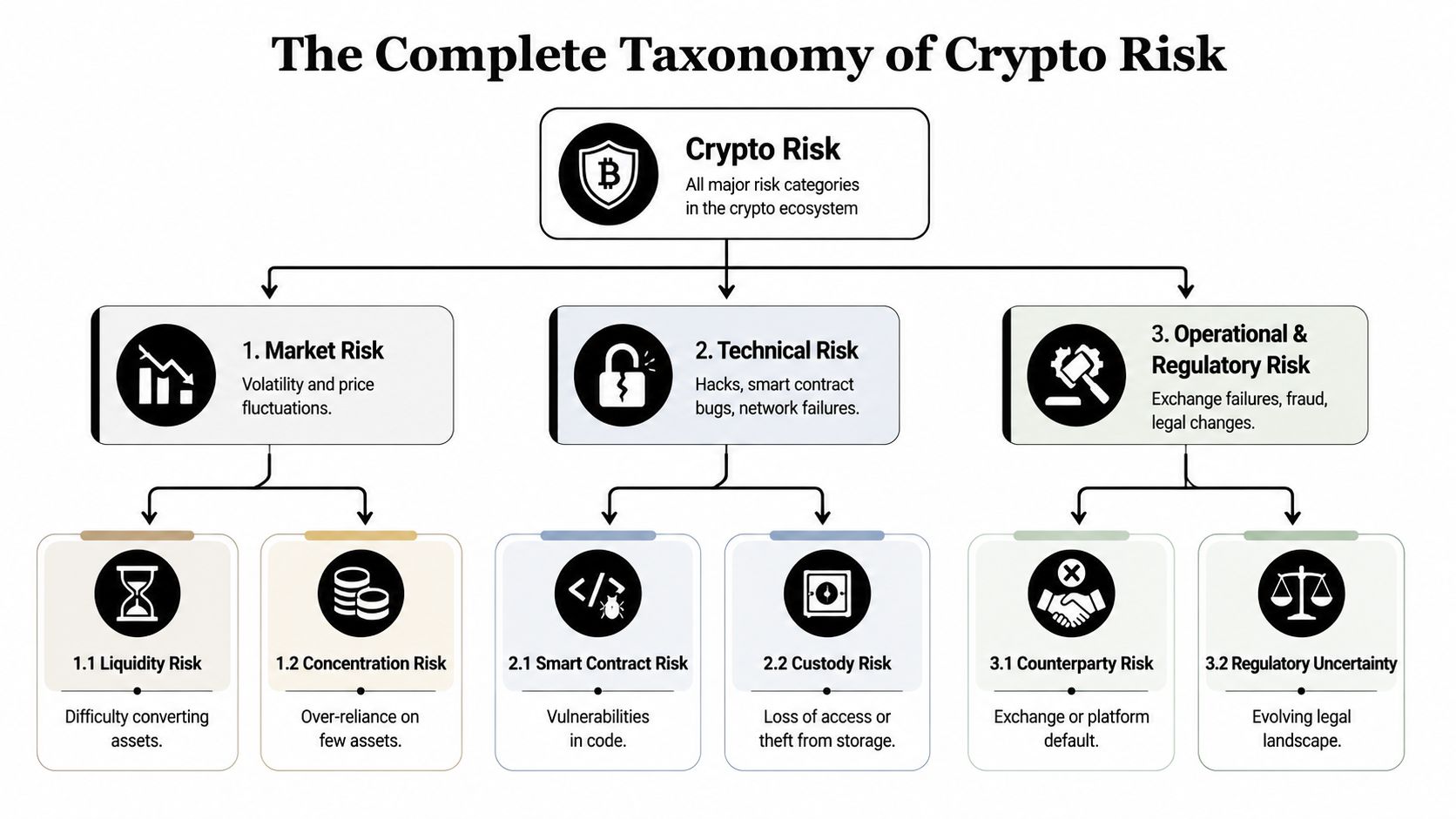
Crypto risk gets oversimplified into “volatility,” but that misses the point. Price swings are only one layer. In practice, losses usually come from a stack of risks hitting at the same time. A weak asset, stored in the wrong place, interacting with a fragile protocol, under unclear legal conditions, can fail in several ways at once.
Risk starts with classification
Institutional players have moved in this direction too. The focus on risk is maturing; 72% of institutional investors now have enhanced risk management frameworks for crypto, with 84% citing regulatory compliance as their top priority, according to CoinLaw's institutional crypto risk management statistics. Retail investors don't need an institutional compliance team, but they do need the same habit of separating one risk from another.
Here's the mental map I use:
| Risk type | What it means | Typical failure mode |
|---|---|---|
| Market risk | Price moves against you | You're right on the asset long term, but get wrecked by timing and volatility |
| Liquidity risk | You can't exit cleanly | The price on screen says one thing, the actual sale price says another |
| Technical risk | Code or network issues break assumptions | A smart contract bug or exploit locks or drains funds |
| Custody risk | You lose access or someone else gains it | Seed phrase exposure, wallet compromise, poor backup hygiene |
| Counterparty risk | A platform fails you | Exchange freezes, withdrawals halt, platform becomes insolvent |
| Regulatory risk | Rules change around you | A service becomes unavailable or assets get trapped by legal uncertainty |
| Operational risk | You make avoidable mistakes | Wrong network, wrong address, bad approvals, phishing, sloppy bookkeeping |
What each category looks like in practice
Market risk is obvious on Bitcoin and Ethereum because they trade constantly and react fast. It's less obvious on smaller tokens, where price may appear stable until liquidity disappears.
Technical risk matters most in DeFi and Web3 apps. Smart contracts can be audited and still fail in edge cases. For higher-value interactions, I care more about code quality and simplicity than marketing.
Custody risk is the dividing line between convenience and sovereignty. If you leave everything on an exchange because the app is easy, you've accepted someone else's controls, someone else's downtime, and someone else's solvency.
Good crypto risk management starts when you stop asking “Will this go up?” and start asking “In what exact ways can this break?”
Counterparty risk is easy to underestimate because centralized platforms usually feel smooth right before they don't. The clean interface can hide poor internal controls.
Regulatory risk shows up differently depending on where you live and which services you use. If your stack depends on a single jurisdiction, one policy shift can become a portfolio problem.
Operational risk is the most personal category. Nobody hacks you if you sign the wrong transaction yourself. Nobody steals your funds if you approve a malicious contract and never revoke access. In crypto, simple mistakes often create permanent outcomes.
That's why I treat portfolio construction and on-chain security as one discipline. A bad trade and a bad wallet decision both come from the same root problem. No system.
A Repeatable Crypto Risk Management Framework
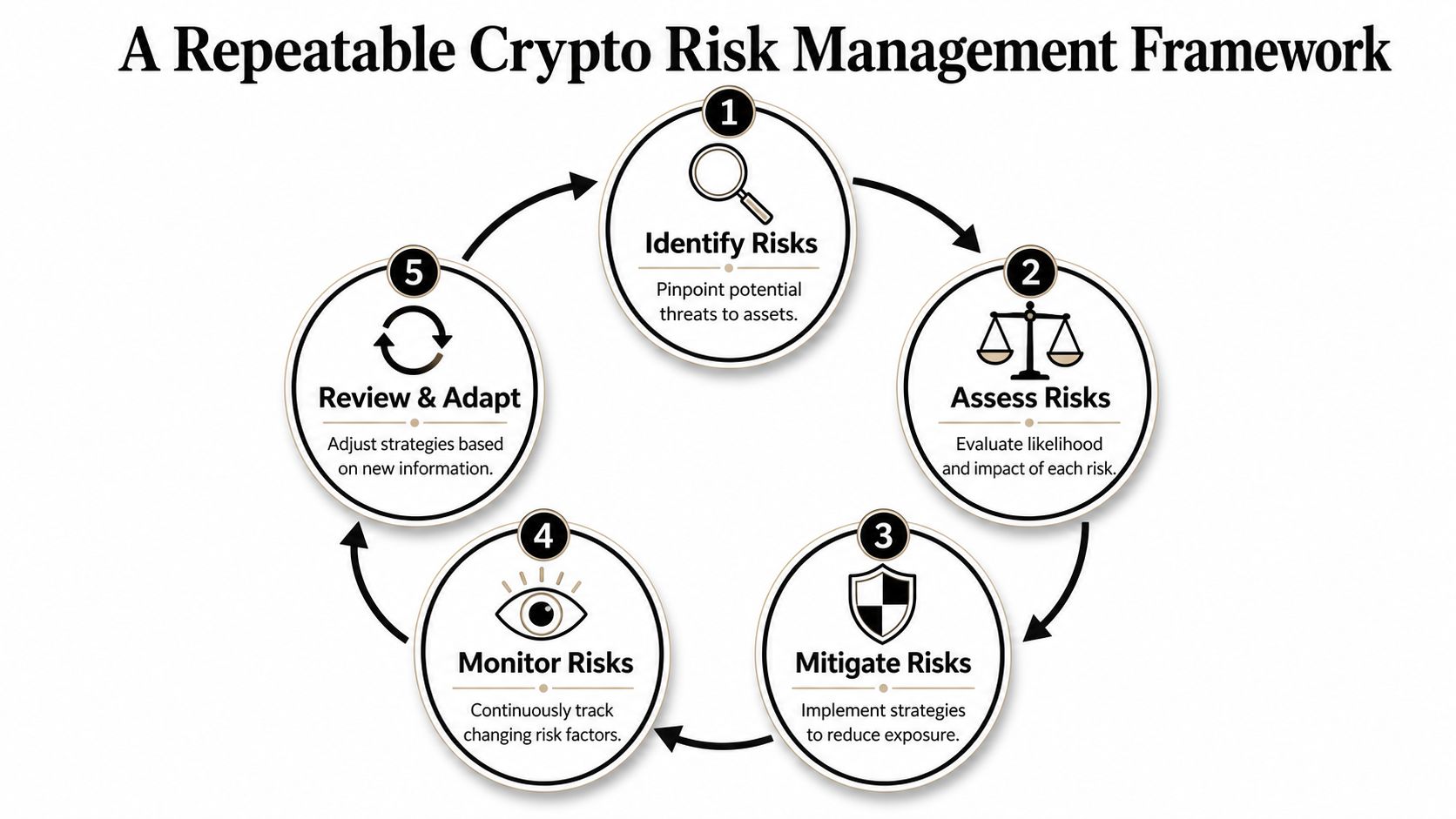
People often consider isolated tactics. Use a stop-loss. Buy blue chips. Move coins to a hardware wallet. Revoke permissions sometimes. Those are useful habits, but they don't become reliable until they live inside a loop you repeat.
The loop that matters
My preferred framework has five parts:
Identify risks
Start with the asset and the venue. Is this Bitcoin in self-custody, ETH bridged to a Layer 2, yield-bearing stablecoins in DeFi, or a low-float gaming token on a thin market? Each setup has a different risk profile.Assess impact
Separate annoyance from portfolio damage. A failed small experiment in a new protocol is one thing. A failure in your main custody setup is another.Mitigate exposure
Rules for mitigation include position caps, wallet segmentation, smaller approvals, avoiding unnecessary bridges, and refusing assets with bad liquidity.Monitor continuously
Crypto changes fast. Tokenomics can shift, governance can drift, and on-chain conditions can deteriorate before price fully reflects it. Monitoring isn't paranoia. It's maintenance.Review and adapt
After a close, a scare, or a mistake, refine the playbook. If a process failed once, tighten it before you need it again.
A lot of people struggle at step two because they don't know how to compare unlike risks. That's where thinking about interpreting security risk scores effectively can be useful, even outside crypto. You're not looking for perfect precision. You're building a consistent way to judge severity and act on it.
Why diversification alone is not enough
Traditional investing teaches diversification as the default answer. In crypto, that's only partly true. During extreme market crashes, the risk reduction benefit of diversifying a crypto portfolio can fall to as low as 2.39% in the “HV-HV” state, according to the Applied Economics study on diversification effectiveness in cryptocurrency markets.
That matters because it explains a common failure mode. People think they're diversified because they own multiple tokens. In reality, they're concentrated in one broad risk bucket: crypto beta under stress.
What robust frameworks do differently
A working system doesn't rely on one protective idea. It layers defenses.
- Capital controls: Smaller position sizes and hard caps on speculative exposure.
- Custody controls: Different wallets for long-term storage, active DeFi use, and testing.
- Protocol controls: Preference for simpler, battle-tested smart contracts over novelty.
- Liquidity controls: Avoiding assets you can't exit when conditions deteriorate.
- Behavioral controls: Predefined responses so fear and greed don't rewrite your plan mid-trade.
If your framework only exists in your head, it won't survive contact with a fast market.
Write it down. Keep it simple enough to follow. Then use it often enough that it becomes your default behavior.
Portfolio Tactics Position Sizing and Diversification
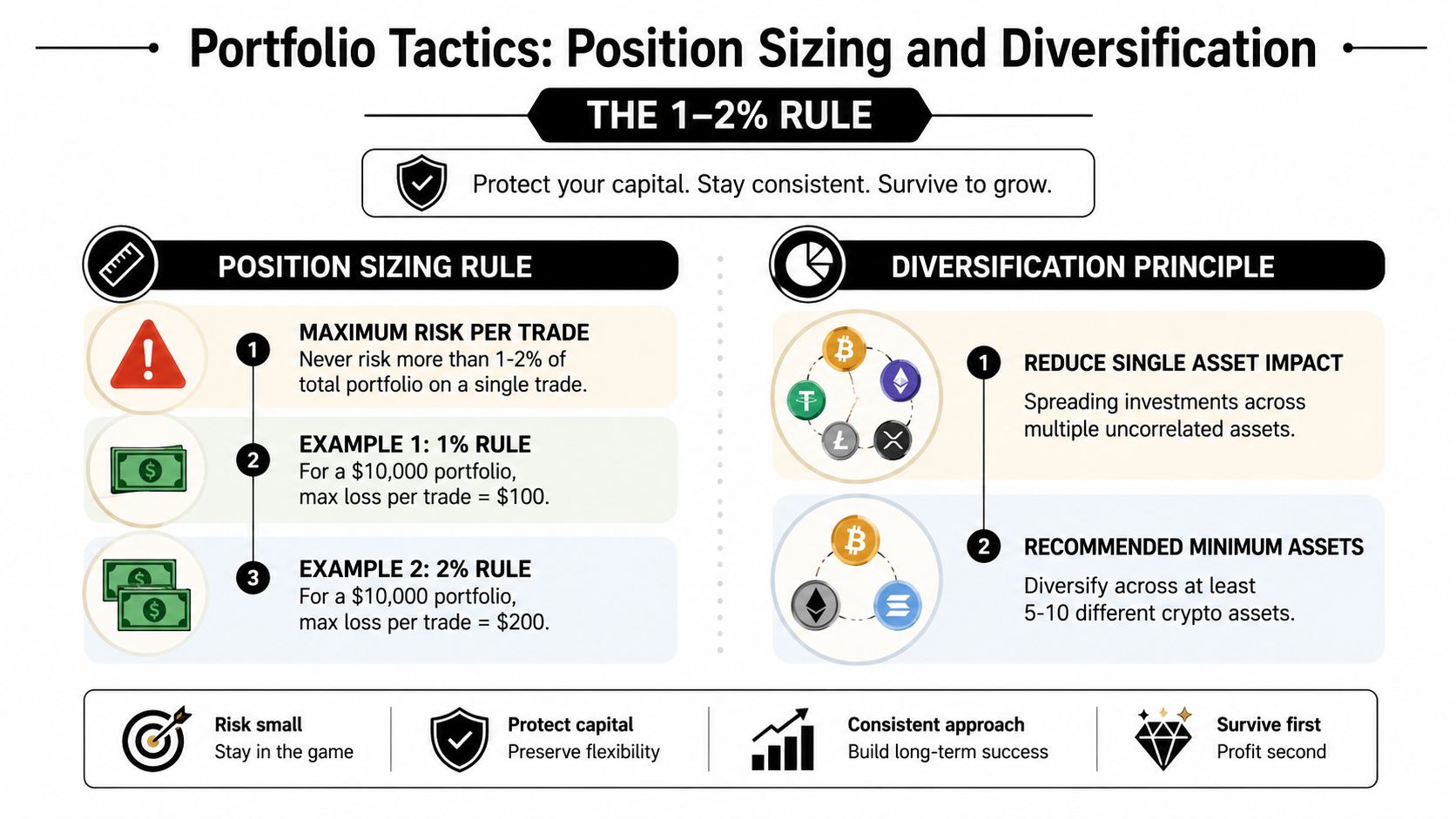
When people ask me for the single most useful lever in crypto risk management, the answer is position sizing. Not narratives. Not entry timing. Not finding the perfect altcoin basket. Size controls how much damage any single mistake can do.
Position size before conviction
The cleanest rule is still the best one. The single most critical rule is risking no more than 1–2% of your portfolio per trade. This ensures that even after 20 consecutive losses, you would still retain approximately 82% of your starting capital, as explained in UEEx's breakdown of cryptocurrency risk management.
That rule matters because crypto punishes oversized confidence. You can be directionally right and still lose if the path is violent enough.
Here's the practical formula:
| Element | How to use it |
|---|---|
| Portfolio risk per trade | Set the maximum loss you'll tolerate on one trade at 1–2% |
| Stop-loss distance | Define how far the price can move before your thesis is invalid |
| Position size | Divide portfolio risk by stop-loss distance |
The math is straightforward when you apply the examples from the same source. With a 5% stop-loss, a 1% portfolio risk implies a 20% position allocation. With a 2% stop-loss, that same 1% portfolio risk allows a 50% position. The point isn't to force large allocations. It's to show that tighter invalidation can support larger size, while wider risk needs smaller size.
The order matters. Decide risk first. Derive size second. Never reverse that because you like the chart.
Build the portfolio in layers
Spot investing needs a different structure from active trading. For longer-term holdings, I prefer a core-and-satellite model. The core handles resilience. The satellites handle upside.
A useful framework comes from The Alpha Factory's crypto risk management framework:
- Core holdings: Maintain a Bitcoin and Ethereum core of at least 60% to reduce volatility exposure.
- Bitcoin allocation: Use roughly 20–40% as the anchor asset.
- Ethereum allocation: Use roughly 10–20% as the smart contract platform allocation.
- Tier 1 altcoins: Keep these around 5–10% per position.
- Speculative Tier 3 positions: Cap these at 2–3%.
- Single altcoin exposure: Never allocate more than 2–5% of the total portfolio to one altcoin position.
This doesn't guarantee safety. It does force honesty. If an idea only deserves a small cap, your allocation should reflect that.
Tools that make discipline easier
You don't need a complex stack, but a few tools help:
- Portfolio tracking: CoinStats, Delta, and Debank make it easier to see concentrated exposure across wallets and protocols.
- Price and on-chain alerts: TradingView alerts plus wallet activity monitoring can catch trouble earlier than a timeline full of rumors.
- Journaling: A plain spreadsheet works. What matters is recording position size, thesis, invalidation, and outcome.
For traders, the 1–2% rule pairs well with a minimum 1:2 risk-reward ratio, which Zipmex explains in its guide to managing risk in crypto trading. That doesn't mean every trade wins. It means your winners don't need to be perfect to offset your losers.
Technical Security On-Chain Safety and Custody
Bad custody can erase a good portfolio. That's the part many people learn too late. They spend hours researching tokenomics, comparing Ethereum rollups, and evaluating DeFi yields, then sign wallet approvals from a browser they barely trust.

Separate spending from storage
The first rule is simple. Don't use one wallet for everything.
I like a three-bucket model:
- Vault wallet: Long-term holdings. Minimal activity. Hardware wallet only.
- Active wallet: Daily on-chain use for swaps, staking, NFTs, or DeFi.
- Test wallet: Small balance for new protocols, mints, bridges, and anything experimental.
That separation limits blast radius. If your active wallet gets compromised, your core holdings shouldn't be anywhere near it. For retail investors, Diamond Pigs' crypto risk management guide recommends limiting total crypto exposure to 1% to 10% of total investable assets depending on risk tolerance, and keeping under 5% of total holdings in a hot wallet while storing the majority in hardware wallets.
If you're still debating why self-custody matters, the principle behind not your keys not your coin remains the right starting point.
Smart contract safety is active work
Most on-chain losses don't come from dramatic Hollywood hacks. They come from routine sloppiness. Unlimited token approvals, spoofed interfaces, fake support accounts, copied links from social media, and signing transactions without reading the prompts.
A few habits reduce that risk fast:
- Use Revoke.cash regularly: Review and revoke old token approvals you no longer need.
- Bookmark critical apps: Don't trust search results or random links in chat rooms.
- Read transaction prompts carefully: Wallet popups often tell you more than the frontend does.
- Start small: Test with a tiny transfer before moving meaningful value.
- Prefer mature protocols: New code has fewer real-world attack hours.
For higher-stakes protocols, audits alone aren't the gold standard. For smart contracts, true technical risk management involves “Formal Verification,” a mathematical proof that code will behave exactly as intended, as described in Chainlink's article on crypto risk management. That doesn't make software invincible, but it's a stronger signal than marketing-heavy security claims.
A quick refresher on wallet hygiene and transaction review provides more help than commonly realized:
When multisig makes sense
Multisignature wallets aren't just for DAOs. They're useful when one key feels like too much single-point-of-failure risk.
If you hold substantial value, share treasury responsibilities, or manage assets across devices and people, a multisig setup can slow down mistakes and raise the bar for theft. The trade-off is convenience. More signatures mean more process. That's exactly why multisig works. It introduces friction where friction is healthy.
Navigating Advanced Risks in DeFi NFTs and Gaming
Many otherwise solid investors often get sloppy in this environment. The interfaces feel playful, the communities move fast, and the assets don't always behave like normal liquid markets. DeFi, NFTs, and GameFi can offer genuine experimentation, but they also combine market risk, technical risk, and liquidity risk in ways that catch people off guard.
DeFi can fail even when your tokens go up
Liquidity provision is the classic example. You can deposit two assets into a pool, collect fees, and still underperform compared to holding the tokens. That's the practical reality of impermanent loss. If one side of the pair moves hard relative to the other, the pool rebalances against you.
That doesn't make DeFi broken. It means the yield headline is only one part of the equation.
A better way to approach it:
- Match strategy to conviction: If you strongly prefer holding one asset, a two-sided pool may fight your thesis.
- Check where yield comes from: Trading fees, emissions, and incentive tokens don't carry the same durability.
- Use tooling before entering: An impermanent loss calculator helps you see how rebalancing can hurt returns even in a rising market.
NFTs and GameFi carry a different kind of liquidity risk
NFTs introduce a harsher problem. Sometimes there is no bid when you need one.
That's why the on-chain illiquidity data matters. The risk of on-chain illiquidity is severe in emerging ecosystems; 85% of new NFT projects lose 90% of their value within six months, according to BTCC's discussion of NFT and liquidity collapse risk. In practical terms, that often means holders end up with assets that can't be sold at any price they'd consider reasonable.
A floor price is not the same thing as liquidity. Screens show listings. Liquidity shows up only when someone actually buys.
GameFi adds another layer. The tokenomics can look healthy until player demand slows, emissions outrun utility, or whales exit faster than the ecosystem can absorb. In those cases, the in-game asset and the governance token can both spiral at once. You don't just lose mark-to-market value. You lose exit paths.
Where AI crypto and tokenized assets fit
AI-linked crypto projects and real-world asset tokenization often attract capital because the narrative sounds grounded. Sometimes that's justified. Sometimes it only changes the wrapper, not the risk.
The same questions still apply. Who controls the contracts? Where is liquidity concentrated? What happens if the token's utility is thinner than its branding? For tokenized assets in particular, blockchain rails don't remove off-chain dependency. They often make it more important to understand who administers redemption, reporting, and legal claims.
In other words, new sectors don't replace crypto risk management. They make disciplined screening even more valuable.
Your Crypto Risk Management Action Checklist
The strongest portfolios I've seen usually don't look exciting from the outside. They look organized. The owner knows how much they can lose on a trade, which wallet holds what, which protocols are approved for use, and which opportunities get ignored even if the timeline gets loud.
That's the difference between a participant and a tourist. The participant has a system.
Run this checklist before you add more risk
- Assess exposure: Decide whether your total crypto allocation matches your real risk tolerance and cash-flow needs.
- Define trade risk: Set your maximum loss per trade before entering. If you can't explain your invalidation, you don't have a trade.
- Size positions mechanically: Use stop-loss distance and portfolio risk to calculate size. Don't round up because you feel confident.
- Structure the portfolio: Keep core exposure in stronger assets and cap speculative positions hard.
- Separate wallets by purpose: Store long-term holdings in cold storage, keep only active funds in hot wallets, and use a burner or test wallet for experiments.
- Review approvals: Revoke stale smart contract permissions and remove old access you no longer need.
- Reduce counterparty dependence: Don't leave meaningful balances on a platform just because it feels convenient.
- Screen protocols: Favor simple, established systems over complexity with a glossy frontend.
- Prepare exits in advance: Know what would make you sell, bridge out, close a farm, or stop using a protocol.
- Keep records: Track entries, exits, wallet locations, approvals, and mistakes. Memory gets fuzzy when markets move fast.
Sustainable participation beats occasional brilliance. In crypto, survival is a competitive advantage.
If your current setup feels messy, that's normal. Systems are frequently developed after avoidable mistakes have already occurred. The important part is tightening the process now, while the stakes are still manageable. Crypto will keep changing. Human error won't. A repeatable system is how you stay exposed to upside without becoming easy prey for downside.
If you want more practical breakdowns like this, from Bitcoin and Ethereum fundamentals to DeFi, NFTs, crypto gaming, Layer 2 networks, tokenomics, and emerging trends across Web3, follow Coiner Blog. It's a solid place to keep sharpening your judgment without the hype.
1 Comment