
Kraken Jesse Powell: His Role, Vision, and Legacy

If you're deciding which exchange deserves your trust, Jesse Powell's name still comes up fast. For some users, he's the founder who helped build Kraken's security-first reputation. For others, he's the face of a combative regulatory posture that keeps creating fresh questions even after he stepped down as CEO.
That tension is why kraken jesse powell still matters in 2026. The story isn't just how he started the company, it's how much influence he may still have as chairman while Kraken operates under heavier scrutiny, more mature leadership, and a less forgiving regulatory climate.
Table of Contents
- Why Jesse Powell and Kraken Still Matter in 2026
- How Jesse Powell Built Kraken From the Mt. Gox Aftermath
- Kraken's Product Evolution Under Powell's Leadership
- The SEC Lawsuit and the Regulatory Pressure on Kraken
- Powell's Ideology and Its Real-World Impact on Kraken
- What Powell's Chairman Role Actually Means After the CEO Handoff
- Outlook for Kraken Under Powell's Continuing Influence
- Practical Takeaways for Users and Investors Tracking Kraken
Why Jesse Powell and Kraken Still Matter in 2026
A lot of crypto users are in the same position right now. They are comparing exchanges, reading about regulation, and trying to decide whether a founder's legacy is a strength or a warning sign. Kraken sits at the center of that decision, because Powell's influence still shapes how the exchange is discussed, how its risk posture is read, and how its public image is judged.
The harder question is not whether Powell still matters. It is how much Powell's chairman role still influences Kraken's strategy, compliance, and growth after Dave Ripley became CEO in April 2023 under the company's succession plan. A chairman can be ceremonial, or involved, and outside reporting leaves room for both readings. The broader governance question around Powell's current influence captures that uncertainty directly.
Why his legacy still reaches into the present
Powell and Kraken were there early, before the market was crowded with polished crypto brands. Kraken's launch timeline shows the company was formed in July 2011 and publicly launched in September 2013, which places Powell in the first wave of Bitcoin exchange infrastructure rather than the later era of consumer-facing apps. He stayed visible through multiple market cycles, so his views still carry unusual weight. The exchange history and leadership milestones are documented here.
That long run matters because crypto exchanges are judged less by slogans than by what happens when markets turn unstable. Powell's record is tied to those moments, from early security concerns to later clashes with regulators. Kraken Jesse Powell is not just a biography search term, it is a shorthand for how one of crypto's oldest major exchanges thinks about trust.
Practical rule: when a founder stays on as chairman, do not ask only whether they still “run” the company. Ask where they still influence capital allocation, risk tolerance, and how the firm talks to regulators.
Kraken remains a useful lens for readers trying to understand the exchange market in 2026. The platform's reputation still reflects Powell's original choices, and the market still reacts to his public posture, even when day-to-day control has moved elsewhere.
How Jesse Powell Built Kraken From the Mt. Gox Aftermath
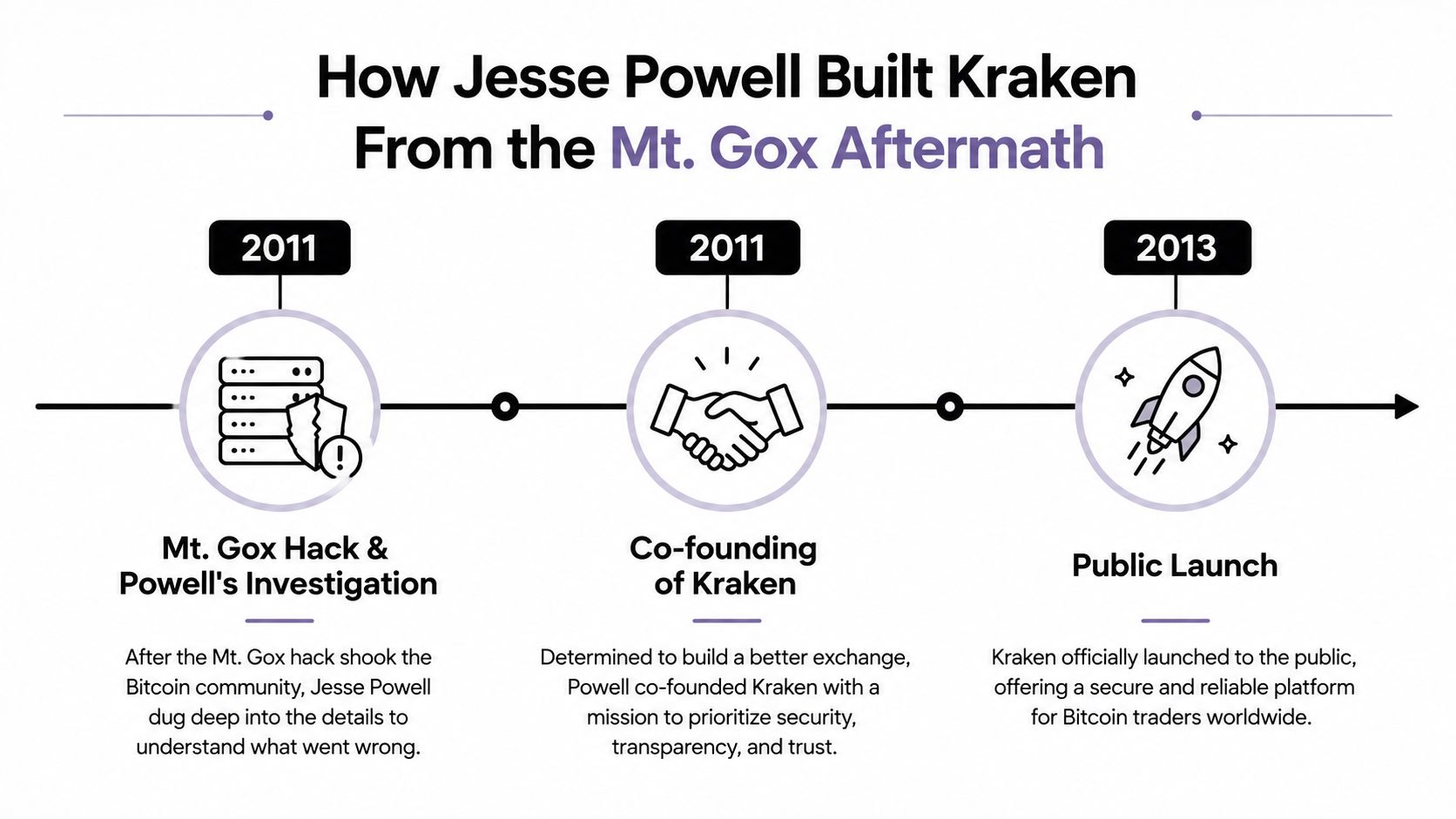
Powell's Kraken story starts with a failure that became a business thesis. After he helped Mt. Gox recover from a 2011 hacking attack, the experience pushed him toward an exchange model built around security rather than speed or hype. Kraken's own history says his conclusion was that the exchange sat at the center of the Bitcoin ecosystem and had to be “professional” and “secure.” Kraken's origin story is laid out here
That framing still helps explain Kraken's identity. Many crypto companies market convenience first and add safeguards later. Powell's approach moved in the opposite direction. He started from the idea that if the exchange itself is not trustworthy, everything built on top of it, trading, custody, market access, breaks down.
The sequence that shaped Kraken
The sequence matters because each step changed the company's DNA. Powell co-founded Kraken in July 2011, and the exchange launched publicly in September 2013. That gap points to a deliberate buildout rather than a rush to market, and it came before the 2017 and 2021 crypto booms that later pulled more users, more borrowed funds, and more risk into the sector. Those milestones are captured in Powell's published profile
His earlier work in virtual goods and online payments also helped shape the exchange's first product instincts. Those industries force builders to think about fraud, settlement, and user trust, which are all issues an exchange faces every day. That background helps explain why Kraken favored a more disciplined operating model instead of trying to win with pure speculation culture.
Why architecture matters more than marketing
For traders, architecture shows up in simple ways. If an exchange can support deep order books, stable execution, and clear fiat rails, users feel the difference as less friction and less slippage. If it cannot, even a slick app will not save it. Powell seemed to understand that early, which is why Kraken's story is so often told through security and structure rather than branding.
His thinking also fit the practical realities of Bitcoin's early market. There was not much room for abstraction. Exchanges had to earn trust trade by trade, and Powell built around that constraint. It is one reason Kraken's origin story still resonates with serious crypto users, especially those who came in through Bitcoin and later expanded into Ethereum, DeFi, or Layer 2 ecosystems.
Kraken's Product Evolution Under Powell's Leadership
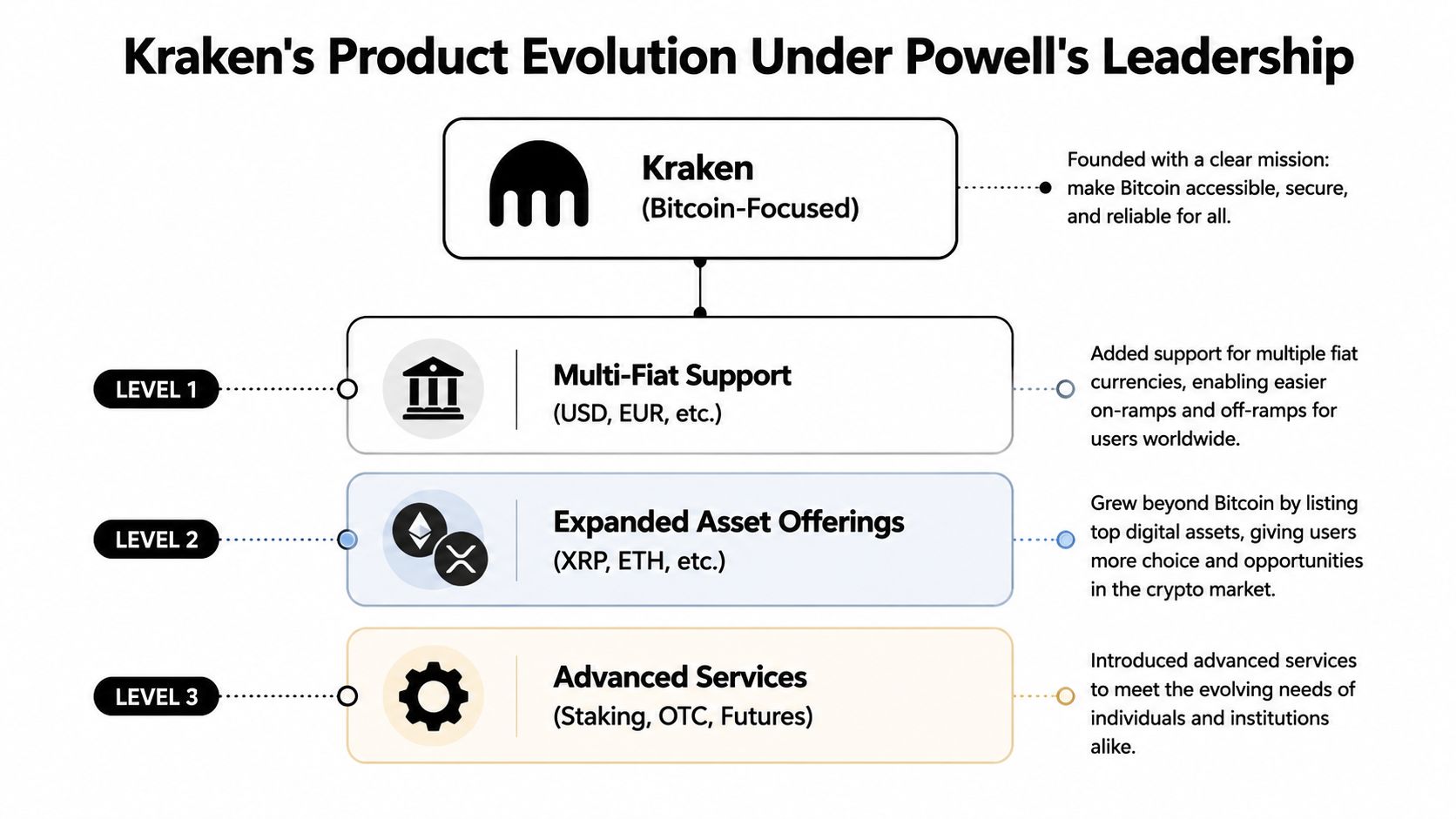
Once Kraken got past its founding phase, Powell's strategic footprint showed up in the product itself. The exchange grew beyond a Bitcoin-only venue and into a platform that supports trading between digital assets and national currencies including USD, EUR, GBP, CAD, and JPY. That shift sounds simple, but in practice it changes what kind of user an exchange can serve and how efficiently it can execute trades. Powell's LinkedIn profile notes that multi-fiat liquidity and euro-volume strength were part of the strategy.
That matters because deep fiat order books can help reduce slippage and improve price discovery, especially for larger orders. For institutions, that's not a cosmetic feature, it's part of the execution stack. It also helps explain why Kraken became known for broader market access rather than just crypto-native speculation.
What the product stack tells you
Kraken's evolution can be read in layers. The first layer is the exchange itself, which gave users a reliable venue for trading. The second layer is fiat connectivity, which made it easier to move between crypto and national currencies without leaving the platform. The third layer is the broader service set, where staking and other advanced market functions matter more for serious users than for casual speculators.
If an exchange's fiat rails are weak, everything else gets harder. Traders notice it in execution quality. Institutions notice it in settlement confidence.
Powell's strategy appears to have focused on making Kraken useful to people who need the market to work, not just people who want exposure to price moves. That distinction becomes clearer when you look at euro liquidity and market share, which were highlighted in his professional profile. In plain English, more liquidity usually means a better trading experience for users who care about execution quality.
Why this evolution still shows up today
The important part isn't that Kraken added features. It's that the exchange grew in a way that stayed aligned with its original security-first logic. Multi-fiat access, stronger liquidity, and broader market tools all support a platform that wants to look credible to both retail and institutional users. That's a tougher balance than it sounds, because every new product also adds compliance, custody, and operational complexity.
Powell's legacy becomes practical instead of symbolic. The exchange he helped build is not just a place to buy Bitcoin. It's a market infrastructure business with a wider footprint, and that footprint was shaped by choices made long before today's compliance environment tightened around the industry.
The SEC Lawsuit and the Regulatory Pressure on Kraken
The legal pressure on Kraken gives Powell's legacy a sharper edge. On February 9, 2023, the U.S. Securities and Exchange Commission charged Kraken entities Payward Ventures and Payward Trading with failing to register their staking-as-a-service program, and the SEC said the program advertised annual returns of up to 21%. That action mattered because it showed how quickly a crypto product can become a securities-law target when regulators decide it functions like an investment contract. The SEC's release spells out the charge.
A later and broader case followed on November 21, 2023, when the SEC sued Kraken, alleging it operated an unregistered exchange and commingled about $33 billion in customer crypto assets with corporate funds. That allegation pushed Kraken into a category few exchanges want, a live test case for how the U.S. wants to regulate crypto market structure at scale. Background reporting on the case and related probe is available here.
What happened in 2023
The sequence matters. The staking case came first, and the exchange case came later. Together, they show regulators were not only questioning one product, they were also examining the wider architecture of Kraken's business. That's important because an exchange can defend a single feature differently than it can defend its broader market role.
In parallel, reporting in 2025 said the Department of Justice closed a criminal probe that followed an FBI search of Powell's Los Angeles home in March 2023. That closure is not the same thing as vindication across the board, but it does separate criminal exposure from civil regulatory pressure. One is about prosecutorial action, the other is about agency enforcement.
| Date | Action | Entity | Reported Status |
|---|---|---|---|
| February 9, 2023 | SEC charged staking-as-a-service program | Payward Ventures and Payward Trading | Civil enforcement action announced |
| March 2023 | FBI search of Powell's Los Angeles home | Jesse Powell | Criminal probe later reported as closed |
| November 21, 2023 | SEC sued Kraken over exchange allegations and commingling claim | Kraken | Civil lawsuit filed |
| 2025 | DOJ closed related criminal probe | Jesse Powell | Probe reported closed |
For readers tracking similar enforcement patterns, this external update on SEC and Ripple disputes provides useful context on how crypto cases can move through the civil process.
Why this became a reference point
Kraken didn't become a regulatory headline just because it was big. It became a reference point because the allegations reached into both product design and asset handling. Those are the areas regulators care about most, since they sit closest to investor protection and market integrity.
The result is a company that now carries both legacy credibility and legacy scrutiny. Powell's name still evokes the early exchange era, but the lawsuits ensure his story is also part of the modern enforcement era. For users, that means Kraken's reputation can't be evaluated on product quality alone. The legal overlay is part of the picture now.
Powell's Ideology and Its Real-World Impact on Kraken
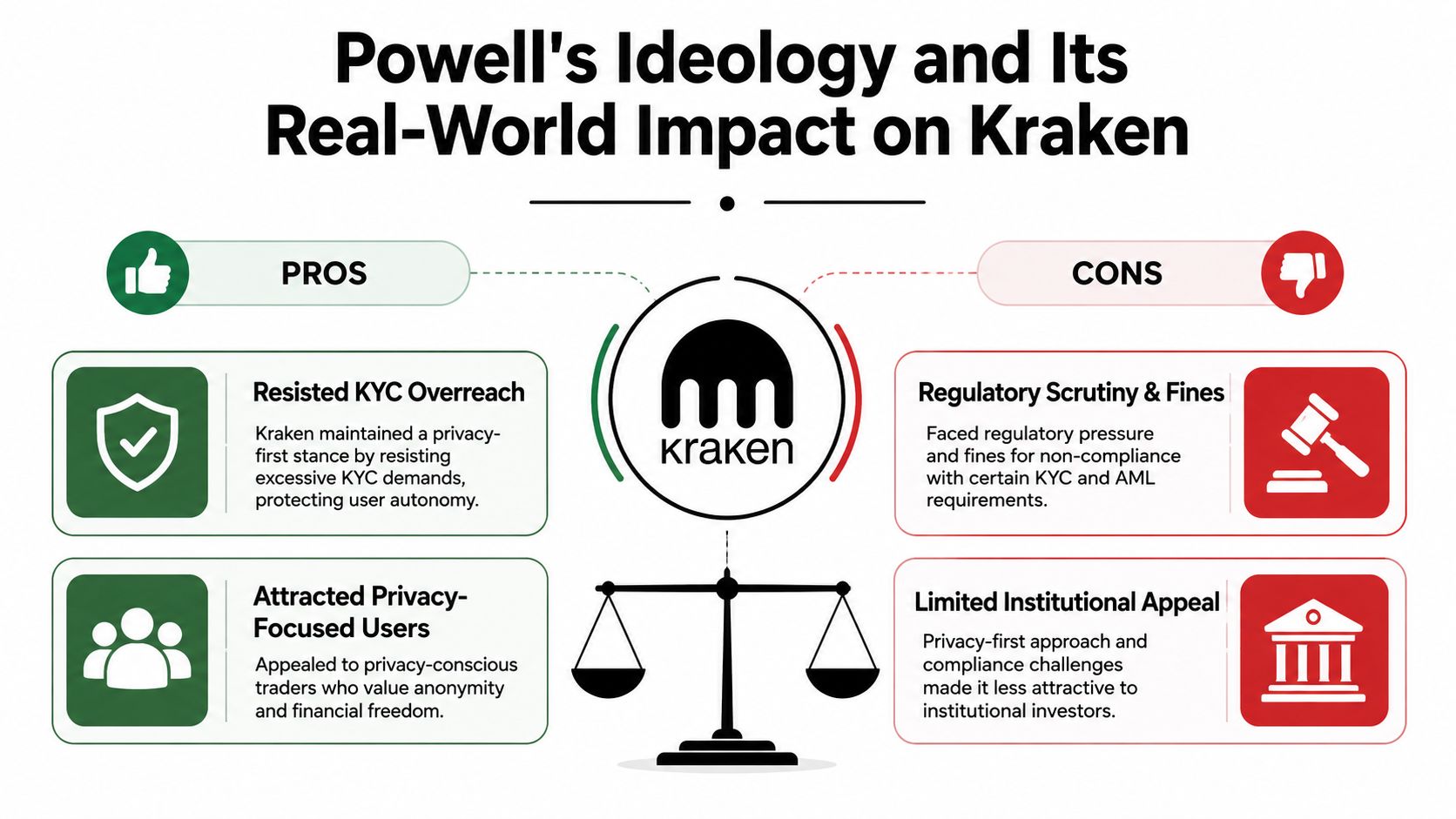
Powell has long been associated with a libertarian, anti-establishment view of crypto. That stance won him admirers among users who value privacy and self-custody, but it also put him at odds with regulators and critics who saw the posture as combative. The question is not whether the ideology is interesting, it's whether it has produced durable business value for Kraken.
Older interviews show his resistance to New York's BitLicense era and his broader rejection of regulatory overreach. More recent reporting also ties him to workplace culture disputes and to a 2024 lawsuit against Rescue California over funds he had wired during the 2021 California recall effort. Politico covered that legal dispute here. That mix of principle and controversy makes it hard to separate brand identity from operational risk.
What the ideology may have helped Kraken win
A strong anti-establishment stance can help a crypto exchange attract users who dislike heavy-handed compliance or want a platform that talks like an industry insider rather than a bank. That's especially true in a market where people still debate privacy, custody, and the role of centralized intermediaries in Bitcoin and Ethereum trading.
It can also create internal clarity. When leadership believes the exchange should defend user autonomy, product and policy decisions often become more consistent. The challenge is that the same clarity can harden into inflexibility when regulators ask for concessions.
The section on Kraken's culture in its own materials shows a company that emphasizes direct participation in its products, not abstraction, which fits Powell's broader worldview. But cultural intensity is not the same thing as market advantage. It can sharpen execution or it can amplify friction.
Where the tradeoff gets harder
The downside is obvious enough. A founder who becomes a lightning rod can pull attention away from product, and that attention may follow the company long after the founder steps back from the CEO seat. If regulators think the posture is adversarial, every new product launch can face more skepticism.
The useful question isn't whether Powell is “right” or “wrong.” It's whether his worldview still helps Kraken win users without making it harder to operate in regulated markets.
That question matters in 2026 because the market has matured. Exchanges now need not only liquidity and strong engineering, but also institutional credibility, governance discipline, and enough regulatory cooperation to stay available in key jurisdictions. Powell's ideology may still resonate with crypto-native users, but the business case is less straightforward than it once was.
For a framework on how users think about self-custody and ownership, this discussion of crypto control principles is a useful adjacent read.
What Powell's Chairman Role Actually Means After the CEO Handoff
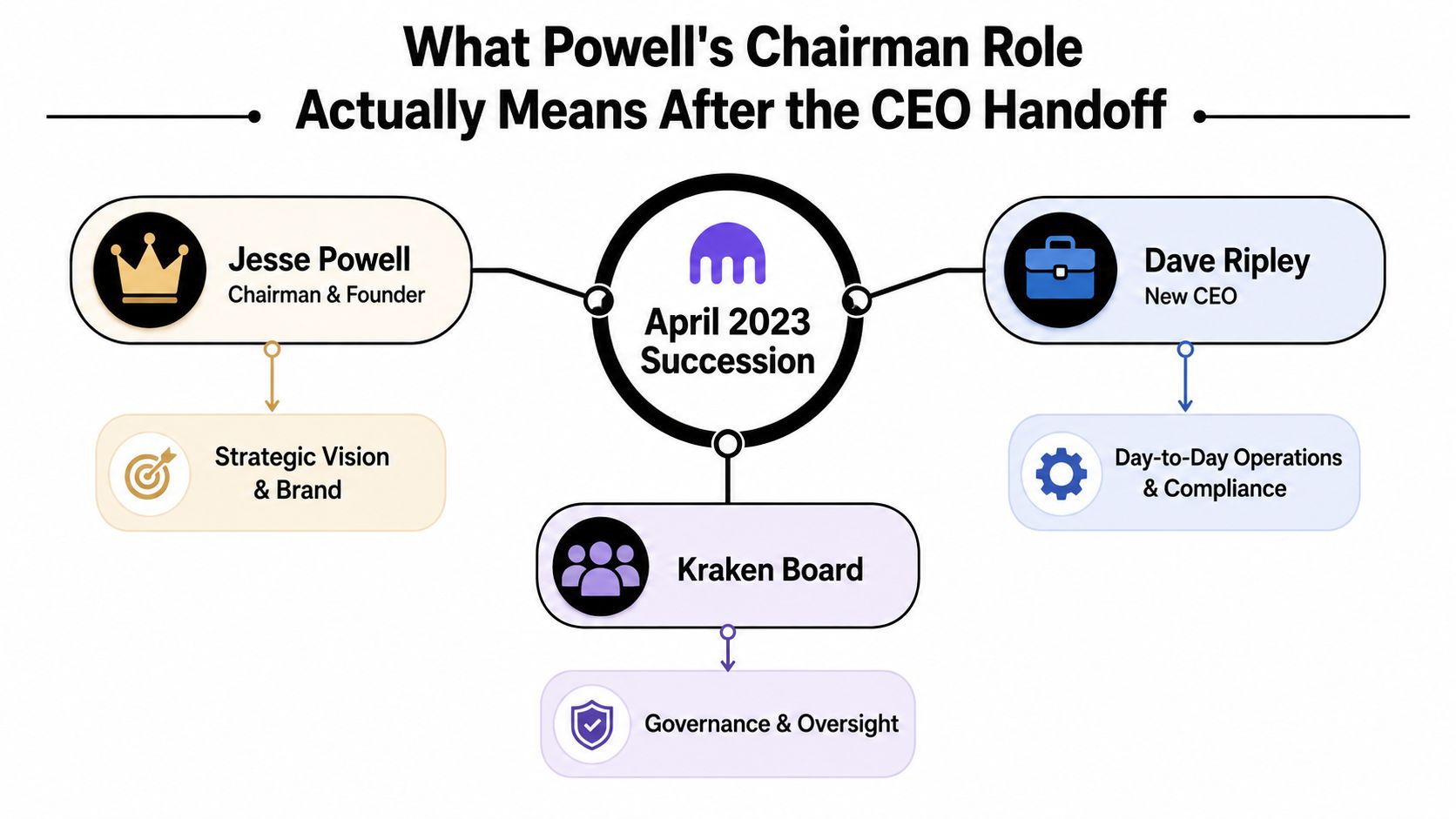
The leadership handoff at Kraken changed the formal chain of command, but it did not make Jesse Powell disappear. He stopped serving as CEO in April 2023, when Dave Ripley took over under the company's announced succession plan. Powell remained chairman, a title that can mean little in some companies and a great deal in others, depending on how much influence the board chair has over strategy, hiring, and public messaging.
That is why his current role matters. Public reporting indicates Powell still has a visible presence at Kraken, while Ripley has continued to run the business day to day. A separate leadership chart from the company's transition period also shows Powell and Ripley in the same governance structure, which reinforces the idea that the handoff was not a clean break from founder influence. This report offers one of the clearer descriptions of Powell's continuing presence.
Symbolic chairmanship versus operational chairmanship
A symbolic chairman mainly protects continuity. The role can signal that the company still respects its founding identity, while leaving product, staffing, and compliance decisions to the CEO and senior management. An operational chairman can have more direct sway, especially if the board chair remains involved in major strategic choices, governance priorities, or the company's public stance on regulation and market structure.
Kraken sits somewhere between those two models. Ripley carries the operating burden, yet Powell's founder status gives him a kind of authority that many board chairs never have. In crypto, that kind of influence is often tied to reputation as much as formal titles, which makes Powell's presence harder to dismiss as ceremonial.
What readers should watch
The practical test is simple. If Powell's role is mostly symbolic, Kraken's strategy and regulatory messaging should increasingly reflect Ripley's leadership alone, with fewer signs of the founder's fingerprints on major moves. If his role is more active, Powell's views may still shape how Kraken talks about regulation, which products it emphasizes, and how aggressively it positions itself against rivals and regulators.
That distinction matters because a founder can keep shaping culture long after leaving the CEO seat. At Kraken, the open question is how far that influence reaches now that the exchange has to balance compliance pressure, product growth, and the demands of a larger institutional audience.
Outlook for Kraken Under Powell's Continuing Influence
Kraken's next chapter will depend on how well it balances three things, compliance credibility, product breadth, and founder influence. That's a difficult mix in any market, and it's harder in crypto, where exchanges compete on both trust and access. The company's institutional push already suggests it wants to look like a serious market infrastructure provider, not just a retail venue.
Recent Kraken institutional materials point to a platform that is thinking about tokenized equities, yield, custody, and broader market connectivity as part of one stack. That doesn't settle the Powell question, but it does show the company wants to compete on more than exchange volume. The more Kraken expands into institutional services, the more important governance clarity becomes.
What would change the case
A stronger bullish case would include clearer separation between Powell's public views and Kraken's regulatory posture, plus continued growth in products that institutions can use. A weaker case would show continued ambiguity around founder influence, more regulatory friction, or a pattern where public controversy keeps distracting from execution.
The 2026 environment will likely reward exchanges that can combine Bitcoin and Ethereum market access with more advanced functionality, including DeFi-adjacent services, custody, and tokenization infrastructure. Kraken seems to be aiming there. Powell's role will matter most if it helps the company stay disciplined without slowing its institutional ambitions.
If his influence is mostly strategic and less public, Kraken may benefit from the continuity. If his views keep becoming part of the headline cycle, the company could end up paying a reputational tax that rivals and regulators notice quickly.
Practical Takeaways for Users and Investors Tracking Kraken
Start with the simplest question. Who makes the decisions, the founder, the CEO, or the board? At Kraken, that answer now matters more than the brand story, because Powell still has a seat as chairman while Ripley runs the company.
Use a founder's public posture as a governance signal, not a personality quiz. If a leader repeatedly clashes with regulators, that can mean principled independence, but it can also mean extra operating risk. For users comparing exchanges, the bigger issue is whether the company's culture produces dependable execution and clear controls. A solid workflow for tracking insider buying can also help investors think more systematically about leadership signals beyond crypto.
- Check the leadership structure: Look at who holds executive authority, who chairs the board, and whether the founder still appears in strategic discussions.
- Watch regulatory disclosures closely: Cases involving commingling, staking, or exchange registration tell you how regulators view the business model.
- Read product decisions as risk signals: If an exchange keeps expanding into staking, custody, or tokenization, ask whether governance has kept pace.
- Compare rhetoric with controls: Strong privacy language is one thing, but transparent operations and clear compliance processes matter more when market stress hits.
For a broader framework on exchange risk, this guide on crypto risk management is worth keeping nearby. The same lens applies whether you're evaluating Kraken, another centralized exchange, or any platform that asks you to trust its infrastructure with your assets.
Coiner Blog covers the crypto stories that matter when the headlines get noisy and the governance questions get real. If you want more reporting on Bitcoin, exchanges, regulation, and the practical risks behind crypto platforms, visit Coiner Blog and keep following the developments that shape how this market works.