
Crypto Trading Strategies That Actually Work in 2026

If you woke up to a Bitcoin liquidation cascade on a weekend and your old guide still told you to “just use support and resistance,” you already know the problem. Crypto trading strategies aren't hard because charts are mysterious, they're hard because crypto never really sleeps, liquidity changes fast, and the same setup can behave differently when derivatives positioning gets crowded.
That's why a serious trader needs a map, not a slogan. The useful way to think about this market is to separate the classic chart-based approaches from the market-structure edges, then attach a real risk rule to each one. For a plain-English refresher on the basics, the Colibri Trader day trading guide is a solid companion piece, especially if you're still sorting out the difference between day trading, swing trading, and longer-horizon holding.
Table of Contents
- Why Crypto Trading Strategies Deserve a Serious Map
- The Main Crypto Trading Strategies Explained
- How Momentum, Mean Reversion, and Breakout Strategies Compare
- Risk Management Rules That Make Any Strategy Viable
- Market Structure Edges That Most Strategy Guides Skip
- Backtesting and Forward Testing Your Strategy
- Matching Strategies to Trader Profiles and Markets
Why Crypto Trading Strategies Deserve a Serious Map
A lot of retail traders start with one bad habit, they take a weekend move personally. Bitcoin rips, liquidations cascade, and the trader who thought “support and resistance” was enough gets forced out of a position before Monday even opens. Crypto's 24/7 structure, extreme volatility, and derivatives plumbing make strategy selection harder than in markets that still have a cleaner session rhythm.
That's why the old habit of treating every move as a simple dip-buy doesn't age well. Bitcoin's early market culture rewarded directional trading, and the market still leans that way, with major pairs like BTC/USDT and ETH/USDT usually offering the tightest spreads and the cleanest technical behavior for active traders. Kraken's education material also frames the standard toolkit clearly, trend following, momentum, range trading, breakout trading, scalping, mean reversion, order flow trading, and pairs trading all sit in the mainstream now, not on the fringe, and the time burden varies sharply by style, from hours of focused monitoring for scalping to only a few checks per session for longer trend following (Kraken day trading strategies).
What you'll get from this guide
It's easier to trade badly than most traders admit. The problem is usually not a lack of effort, it's choosing a style that clashes with your time, account size, temperament, and the part of the market you are trying to exploit.
Practical rule: if you can't explain why your setup should work in one sentence, you probably don't have a strategy yet, you have a guess.
This guide gives you four things. It maps the main approaches, shows how risk management ties them together, brings in the market-structure edges that most guides skip, and matches strategies to trader profiles so you can stop forcing one-size-fits-all advice onto a market that does not care. That matters because a blunt “buy the dip” mindset can drain accounts even when it feels active and disciplined.
The useful part is the map itself. A trader who knows whether they are trading momentum, mean reversion, breakouts, or a structure-driven edge can read the market with more precision and less noise, then size the risk to match the setup instead of the mood.
The Main Crypto Trading Strategies Explained
Crypto strategies make more sense when you group them by how long you're willing to hold risk. Short-horizon tactics need screen time and quick decisions, while slower styles depend more on patience and cleaner trend structure. That's why the first question isn't “What indicator works?” It's “How long can I manage the trade?”
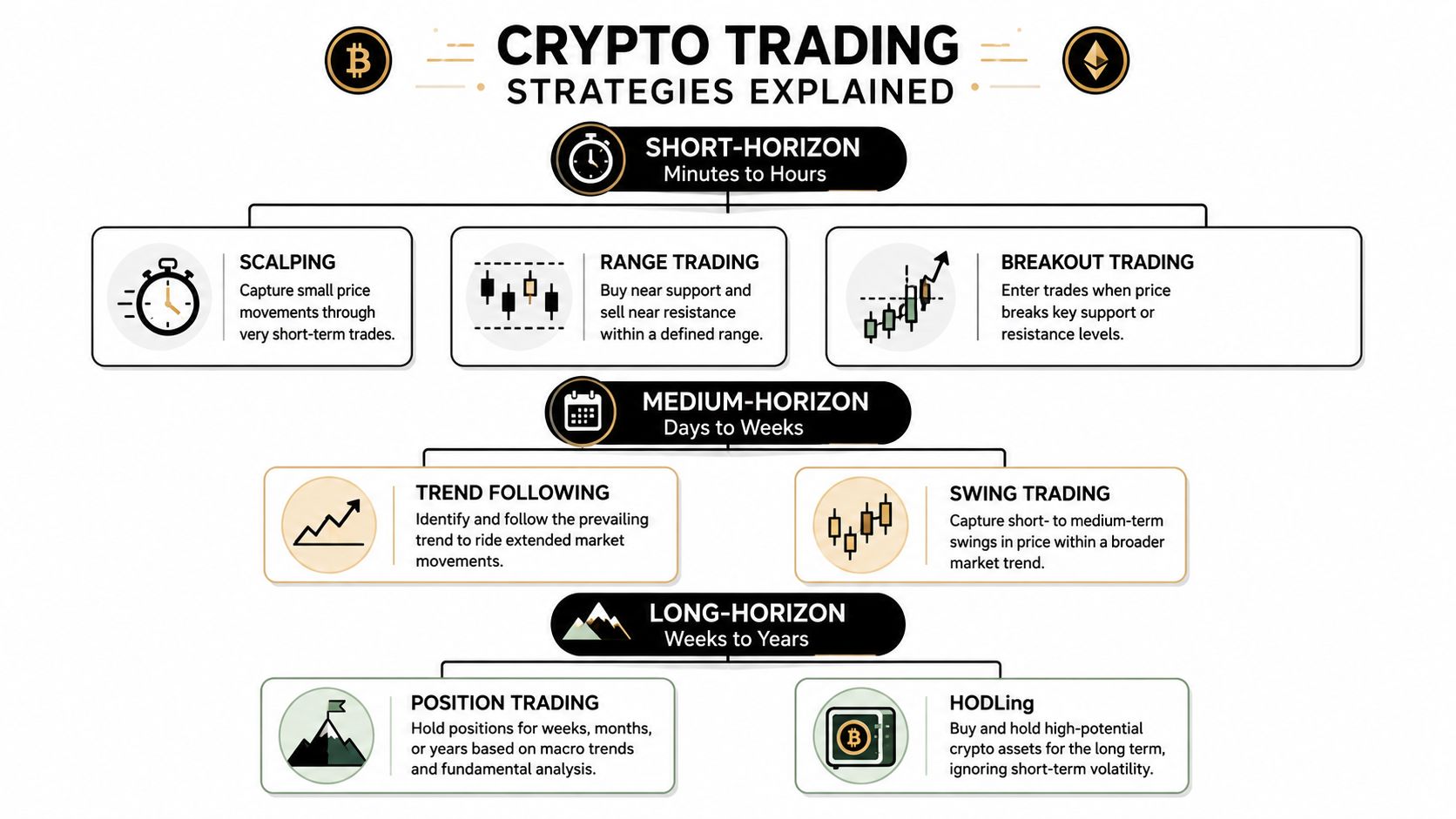
Short-horizon tactics
Scalping is like picking up coins on a moving sidewalk. You're trying to grab tiny edges over and over, usually with a lot of attention and very little room for error. In crypto, that means watching order flow, spreads, and sudden bursts of volume, then getting out fast when the move stalls.
Range trading works when price keeps bouncing between a ceiling and a floor. The trader buys near the lower boundary and sells near the upper one, but only while the range is still intact. This style fits quieter markets and gets punished when a range breaks hard.
Breakout trading waits for price to leave a well-defined area and keep going. Think of it as betting that the coil has finally snapped. The best breakout traders don't just watch the level, they wait for commitment, because a fake-out can look convincing for a few minutes and still fail.
Medium-horizon and longer-horizon styles
Day trading means buying and selling within the same day, so the position never sleeps with you. It's a clean way to focus on intraday momentum without carrying overnight risk, but it still needs structure and a hard exit plan.
Swing trading holds positions for days to weeks. That makes it feel more like surfing a wave than chasing ripples, and it often suits traders who can't sit in front of charts all day. The goal is to catch a chunk of the move, not the exact turn.
Position trading stretches further out and leans on broader trend structure, sometimes across weeks or months. It works best when the trader can tolerate noise without micromanaging every candle.
Dollar-cost averaging, or DCA, spreads purchases on a fixed schedule instead of trying to time one perfect entry. It's less about tactical edge and more about reducing the pressure of choosing the exact bottom.
A useful way to think about the map is simple. Short-horizon styles ask for attention, medium-horizon styles ask for patience, and DCA asks for discipline more than timing skill. If you know which of those you have, half the confusion disappears.
How Momentum, Mean Reversion, and Breakout Strategies Compare
These three approaches dominate active crypto trading because they each answer a different market condition. Momentum assumes strength will continue, mean reversion assumes stretched price will snap back, and breakouts assume a new move starts when resistance finally gives way. The trick is not choosing your favorite, it's matching the regime.
| Strategy | Typical holding time | Best market state | Key indicators | Most common failure |
|---|---|---|---|---|
| Momentum | Minutes to days | Strong directional trend | RSI, MACD, trend filters | Buying too late into exhaustion |
| Mean Reversion | Minutes to hours | Defined range or overextension | Bollinger Bands, range boundaries | Fighting a real trend |
| Breakout | Minutes to days | Compression before expansion | Volume confirmation, key levels | Fake breakout with weak participation |
Momentum works when a market keeps proving the same direction over and over. Traders often lean on RSI and MACD because they help filter whether strength is building or fading, but momentum fails quickly when the move becomes crowded and late buyers are left holding the end of it.
Mean reversion is more patient and more skeptical. It assumes an overbought or oversold move will drift back toward balance, which is why Bollinger Bands and well-defined ranges matter. The danger is obvious, a market can stay stretched longer than your patience or capital can tolerate.
Breakout trading sits between those two mindsets. It doesn't care whether the market has been boring, only whether the level finally breaks with enough volume behind it. On weaker moves, the “breakout” is just noise wearing a disguise.
Strong entries usually come from disagreement resolving, not from one indicator looking pretty.
The best question to ask on any given day is practical, not theoretical. Is the market already trending, is it boxed into a range, or is it compressed and waiting to expand? If you answer that directly, the strategy choice gets much easier.
For a useful algorithmic angle on this, Finzer's article on boost your trading with strategies is worth reading alongside the chart discussion, especially if you're trying to systematize entries instead of trading every wiggle by instinct.
Risk Management Rules That Make Any Strategy Viable
Risk management is where crypto traders either stay in the game or hand the market their capital before the strategy has a chance to work. One industry source says only 10-15% of crypto day traders reach consistent profitability, while nearly 80% of retail traders lose money in their first year, a blunt reminder that a decent entry signal means little if position size is reckless (crypto day trading success stats and strategies).
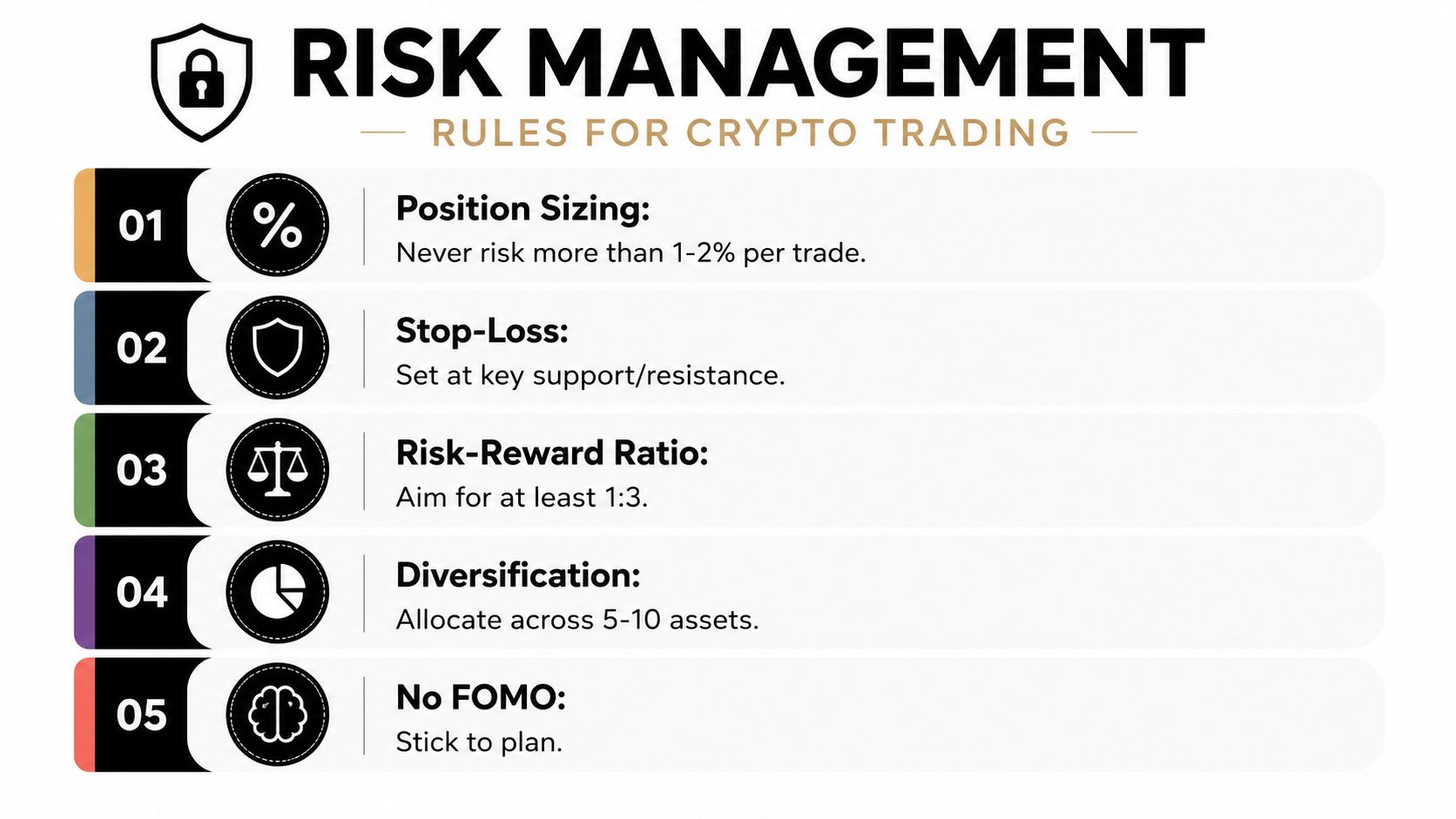
Position sizing comes first
A conservative rule is to risk 1-2% per trade, while a more aggressive 2026 guide suggests 2-3% of total capital per trade, a 1:2 risk-reward ratio, and a daily loss ceiling of 5-8% (crypto day trading success stats and strategies). A separate education source also recommends limiting exposure to about 1% to 2% of portfolio capital per trade (AvaTrade crypto trading strategies). Treat those figures as guardrails, not decoration.
Sizing works like the volume knob on a stereo. Turn it too high and every mistake hurts, even if the idea was good. Keep it controlled and one bad trade stays a setback instead of becoming a hole that takes weeks to climb out of.
Stops and reward targets need to be mechanical
Stops work best when they sit at the point that proves the trade idea wrong, not at an arbitrary dollar loss. ATR-based stops are useful because they adjust to volatility, which matters in crypto's 24/7 market where normal noise can be wide enough to knock out a poorly placed order.
Practical rule: if your stop is inside the market's normal noise, you are not protecting the trade, you are setting up a nuisance exit.
Reward targets matter just as much. A strategy can still be viable with a moderate win rate if the winners are much larger than the losers, but a high win rate with sloppy sizing can still fail hard. That is why borrowed funds demand caution, because a string of small losses can turn into liquidation if the position is too large.
A clear checklist-style reminder is available in Coiner Blog's crypto risk management page, which is a practical companion to the rules above.
Market Structure Edges That Most Strategy Guides Skip
Most retail guides stop at indicators, but crypto's real short-term edges often sit one layer deeper. Funding rates, basis, volatility carry, liquidation flows, and on-chain movement can matter more than a clean-looking chart, especially in a market that now behaves like a multi-venue derivatives system as much as a simple spot market.
Derivatives plumbing can create tradable edges
A less-covered set of crypto trading strategies revolves around funding rates, basis, and options volatility instead of direction alone. Recent practitioner coverage points to cash-and-carry, cross-exchange funding arbitrage, volatility carry, calendar spreads, and pairs trading as distinct approaches, which is useful because it shifts the trader's focus from “Will price go up?” to “Where is the market paying me to take the other side?” (quant strategies 2026).
A simple example is funding-rate trading. If perpetual funding gets overly crowded on one side, a trader can structure a position to capture that imbalance, often by hedging with spot so the goal is not pure price direction. The catch is that these edges are often smaller now than they were earlier in crypto's history, so fees, execution quality, and tooling matter much more than headline theory.
On-chain and event-driven signals still matter
Another overlooked edge comes from liquidity and narrative dislocations. Recent coverage highlights stablecoin reserve changes, whale flows, exchange inflows and outflows, protocol launches, governance votes, and narrative momentum as inputs that can explain price moves better than a pure chart reading in some situations (overlooked crypto trends expert insights for beginners).
That's especially relevant when token supply events hit. Changelly's guide warns traders to stay alert to funding-rate extremes, low-liquidity pairs, and token vesting events, because those can create abrupt moves that don't care about neat technical patterns (Changelly cryptocurrency trading strategies).
The lesson is blunt. In a mature crypto market, short-term returns often come from structure, not just direction. If you ignore the plumbing, you're competing with traders who aren't looking at the same board.
For a deeper microstructure perspective, the internal resource at Coiner Blog's market microstructure page fits well with this lens.
Backtesting and Forward Testing Your Strategy
Strategy ideas are cheap. Evidence costs time. Kraken's framework is the right one here, start with an explicit “if X then Y” market belief, define the exact entry and exit rules, backtest on a large historical sample, then forward-test in real time before putting meaningful capital at risk (Kraken crypto trading strategies).
Turn a hunch into testable rules
A trader who thinks psychological levels matter can't just say, “I'll buy around round numbers.” They need to define the level, the entry trigger, the stop, and the exit. That's the difference between a story and a system.
A practical workflow looks like this:
- Formulate the idea: Write one sentence that starts with “if X happens, then I'll do Y.”
- Backtest the setup: Check a large enough historical sample, ideally across different regimes.
- Measure the results: Track win rate, average R-multiple, max drawdown, and expectancy per trade.
- Forward-test carefully: Paper trade or size down until the live results match the backtest logic.
- Deploy gradually: Increase size only after the strategy behaves consistently.
Don't confuse activity with edge
A common mistake is curve-fitting a setup to one market phase and calling it reliable. Another is ignoring fees, funding, and slippage, which matters more in crypto than many traders want to admit. If a strategy depends on tiny gains, those costs can erase the edge before you notice.
One useful reminder from longer-horizon trading commentary is that a single 30-50% surge can outweigh months of small scalps, which is a good reason to let strong setups run and cut losers fast (why traders shouldn't strategy hop).
For tooling, the internal guide on best AI crypto trading bots can help you think about automation as a testing aid, not a shortcut around discipline.
Matching Strategies to Trader Profiles and Markets
The right strategy depends less on hype and more on your real life. If you have a full-time job, a small account, or limited tolerance for screen time, some styles will punish you no matter how smart you are. If you have time, capital, and a calm decision process, others become realistic.
A part-time investor with about $2,000 is usually better served by swing trading plus DCA on majors like Bitcoin and Ethereum. That mix avoids constant screen watching and keeps the focus on clearer trend moves, but it's a poor fit if you're tempted to micromanage every candle.
A full-time active trader with real screen time can work with momentum and breakout trading on BTC and ETH. That profile needs strict stop placement and a habit of staying out when the market isn't offering a clean structure, because active trading without patience usually turns into overtrading.
A capital-preservationist is the best fit for funding-rate and basis-style trades. This profile cares more about controlled exposure than about flashy upside, but it needs enough capital and operational discipline to handle hedging and execution properly. A DeFi-curious trader can focus on event-driven setups around governance votes, protocol launches, and token releases, though those trades need an even tighter respect for liquidity and slippage.
The wrong fit usually shows up fast. Scalping without reliable screen time is a bad match, and funding-rate arbitrage gets much harder when the account is too small to absorb costs and operational friction. No strategy removes the need for a written plan, a stop, and a size limit.
If you want more practical crypto education like this, keep following Coiner Blog for trading guides, market structure breakdowns, and plain-English analysis that treats risk as seriously as opportunity.
1 Comment