
Best Cloud Mining in 2026: A Realistic Investor’s Guide

Most advice on the best cloud mining platforms starts in the wrong place. It starts with provider names, signup bonuses, and daily payout screenshots. That's backwards.
Cloud mining isn't passive income in the way social posts make it sound. It's a contract business layered on top of one of the most competitive corners of crypto. If you don't understand what you're buying, how fees are extracted, and who controls the underlying operation, you're not investing. You're trusting a black box.
That's why a realistic investor should treat cloud mining less like DeFi yield and more like outsourced infrastructure exposure. It sits inside a maturing crypto service stack. The broader cryptocurrency mining sector was worth more than $7 billion in 2020 and was projected to grow at more than 20% annually from 2021 to 2028, while the cloud mining segment was expected to surpass $110 million in revenue by the end of 2026, according to cryptocurrency mining market statistics compiled by Market.us. That matters because serious operators, not just hobbyists, are shaping the category.
Still, scale doesn't equal safety. Plenty of products survive because they market well in bull cycles and attract confused users in bear cycles. If you need a reminder of how sentiment changes risk appetite, read this look at the cryptocurrency bear market.
Table of Contents
- The Cloud Mining Promise vs The Reality
- Understanding the Mechanics of Cloud Mining
- The Hard Math of Cloud Mining Profitability
- Red Flags Identifying Cloud Mining Scams
- Your Checklist for Evaluating a Provider
- Safer Alternatives for Crypto Income
- Conclusion Is Cloud Mining Worth It in 2026
- Frequently Asked Questions About Cloud Mining
The Cloud Mining Promise vs The Reality
The sales pitch is simple. Rent hash power, avoid hardware headaches, collect crypto. In practice, it's messier.
In practice, the best cloud mining option usually isn't the one with the flashiest dashboard or the smoothest referral funnel. It's the one that survives scrutiny when you pressure-test the economics, the legal structure, and the withdrawal process. Most offers fail one of those three tests.
Why easy income is the wrong frame
Cloud mining attracts beginners because it removes the visible friction of traditional mining. No ASIC sourcing. No facility management. No dealing with heat, noise, or electrical load. That convenience is real.
The problem is that convenience also hides the variables that determine whether a contract has any chance of working. When a buyer can't inspect the machines, audit the operating costs, or verify the payout logic, the provider controls the narrative.
Practical rule: If a platform sells certainty instead of disclosure, walk away.
Professional market, unforgiving economics
The category is real. It isn't just an internet side hustle. But a real market can still be full of bad products and worse contracts.
That's why readers looking for the best cloud mining service should ignore the fantasy of guaranteed passive returns. A better question is this: does the provider operate like a transparent infrastructure business, or like a marketing machine borrowing crypto language?
Understanding the Mechanics of Cloud Mining
Cloud mining is easiest to understand as renting a slice of an industrial computer farm instead of building your own. Someone else buys and runs the machines. You pay for access to the output, directly or indirectly.
That sounds straightforward until you realize there are several product structures hiding under the same label.
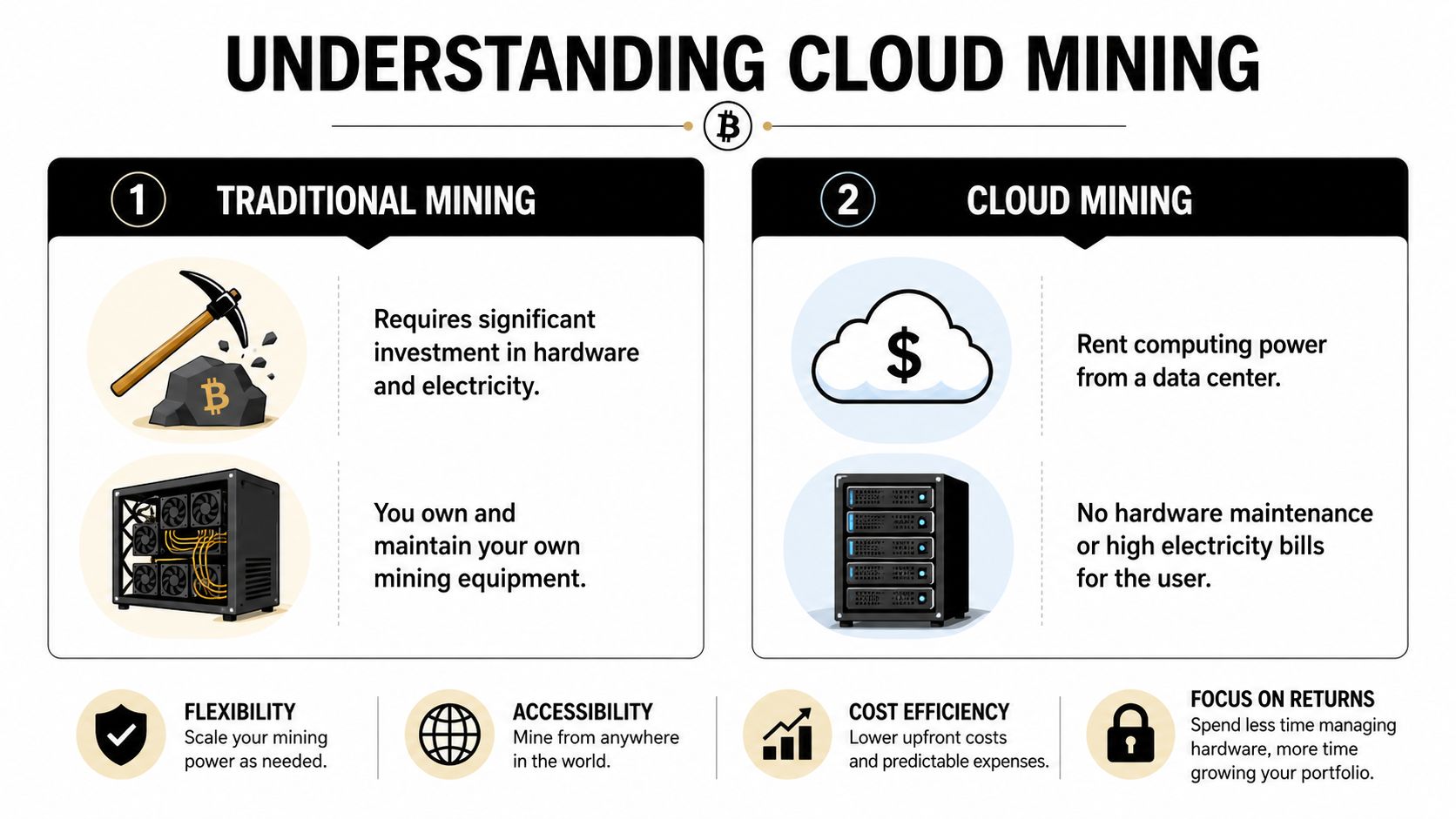
Cloud mining is rented infrastructure
A legitimate service should tell you what asset you're renting, for how long, under what fee model, and with what payout method. If it can't explain that in plain English, it probably doesn't want you to understand the product.
For beginners trying to map the basics of wallets, exchanges, and blockchain exposure before touching mining contracts, this guide on how to invest in cryptocurrency for beginners is a better starting point than most cloud mining landing pages.
Some providers publish enough detail that you can at least inspect the operational logic. If you want to see one example of how a provider presents its mining flow, contract flow, and user journey, review how Labyrinth Mining works from Cascoin and compare that structure against the disclosure standards discussed below.
The three models that matter
A technically sound way to assess the best cloud mining opportunity is to separate traditional hash-rate contracts, hosted mining, and hashpower marketplaces. As explained in BitcoinMining.com's review framework for cloud mining contracts, each model shifts a different part of the risk.
| Model | What you buy | Main risk transfer | Best use case |
|---|---|---|---|
| Traditional hash-rate contracts | Contracted hash power | Counterparty risk and fee risk | Users who want simplicity but accept opacity risk |
| Hosted mining | Ownership of ASIC hardware with outsourced operations | Facility operations are outsourced, hardware exposure stays with you | Buyers who want asset ownership without running a site |
| Hashpower marketplaces | On-demand rented hash power | Flexible pricing but less certainty on fixed output | Traders who want short-term exposure and optionality |
Traditional contracts are the most aggressively marketed. They're also where hidden fees and vague payout formulas often show up.
Hosted mining is more concrete because you supposedly own hardware. But that only helps if the ownership, hosting terms, maintenance responsibilities, and machine delivery rights are documented.
Hashpower marketplaces sit closer to spot pricing logic. They can be more flexible, but they don't guarantee stable outcomes. You're trading predictability for optionality.
Buyers often ask which model is safest. The better question is which model makes the hidden risks easiest to inspect.
The Hard Math of Cloud Mining Profitability
Most cloud mining pages focus on output. Smart buyers focus on spread.
The key variable isn't the advertised daily payout on day one. It's the difference between mined-coin revenue and the provider's all-in cost stack over the life of the contract. According to Token Metrics' cloud mining overview, the best cloud mining platforms are the ones that make hash-rate allocation and payout mechanics transparent, letting users choose coin, contract duration, and hash rate while monitoring payouts. That transparency matters because the economics depend on the spread between revenue and the provider's hidden costs.
What actually determines contract performance
When I review a cloud mining contract, I strip it down to a few inputs:
- Revenue side: Which coin is mined, how payouts are calculated, and whether the provider explains algorithm support and allocation.
- Cost side: Maintenance deductions, power charges if they're separated, withdrawal friction, and any clause that lets the operator suspend an unprofitable contract.
- Time side: Duration matters because difficulty can rise while your contract terms stay fixed.
- Control side: Can you monitor allocation and payout history, or are you expected to trust summary figures?
If the provider doesn't expose these variables, you're not evaluating profitability. You're guessing.
A lot of retail users miss the liquidity angle too. Even if a contract appears workable on paper, your actual outcome depends on how quickly and cheaply you can move the payout asset. That's why understanding the liquidity of cryptocurrency matters when comparing BTC-denominated, altcoin-denominated, or exchange-native payout structures.
A simple breakeven lens
You don't need a complex institutional model to reject bad contracts. You need a disciplined one.
Ask these questions before buying:
- Can the provider show payout history tied to a clear fee schedule?
- Does the contract explain what happens when mining revenue falls below operating cost?
- Are maintenance deductions fixed, variable, or undefined?
- Can you verify whether you're buying actual hashrate or just account credits?
- Is there any termination language that lets the provider end the contract once it stops favoring them?
Here's the issue most “best cloud mining” lists avoid. Contract economics change over time. Rising network difficulty, changing block rewards, and broader post-halving economics can compress or erase the spread that made the contract look attractive at the start.
Don't buy based on early payout screenshots. Buy only if the contract still makes sense after fee drag, difficulty pressure, and withdrawal friction.
A credible operator reduces information asymmetry. It publishes contract terms, payout timing, algorithm support, and the mechanics behind the dashboard. A weak operator leans on vague language like automated earnings, AI optimization, or bonus acceleration without showing the accounting.
That distinction matters far more than brand recognition.
Red Flags Identifying Cloud Mining Scams
The cloud mining market doesn't just include mining contracts. It also includes exchange-branded offers, app-based “free mining,” and products that behave more like acquisition funnels than mining businesses.

That product mix is one reason so many new users get trapped. As noted in KuCoin's roundup of cloud mining platforms, the market mixes traditional cloud mining, hosted mining, exchange-integrated offers, and “free mining” apps. A key warning sign appears when a platform can't explain withdrawal rules, custody risk, or whether you're buying actual hashrate versus promotional credits.
Why the product structure matters
A risky but legitimate contract and a disguised funnel can look similar on the homepage. Both may show dashboards, reward counters, and referral tabs. The difference is in what the user legally and economically owns.
If the product is built around bonuses, locked upgrades, social referrals, and vague language about mining acceleration, step back. You may be looking at a customer acquisition loop, not a mining service.
These are the first signs I check:
- Anonymous operation: No legal entity, no jurisdiction, no named leadership.
- No facility evidence: Stock photos of server rooms aren't evidence.
- Unclear withdrawals: The site talks about earnings but avoids specifics on access.
- Promotional balance confusion: Credits, rewards, vouchers, and hash tokens are used interchangeably.
- Referral dependence: The economics appear to rely more on new signups than on mining output.
For readers who want a broader fraud lens beyond mining, this guide on how to avoid crypto scams pairs well with cloud-specific due diligence.
The scam patterns that keep repeating
Some scams are crude. Others are polished enough to fool experienced retail buyers.
The common pattern is simple. The operator hides the underlying business reality and over-communicates the reward fantasy. If you want a non-crypto explanation of the core structure, review this breakdown of understanding Ponzi scheme mechanics. It helps clarify why steady-looking payouts can be misleading when revenue sources are opaque.
Watch for these behaviors:
- Guaranteed income language: Mining revenue is variable by nature. Guarantees belong in marketing, not in honest operations.
- Fake transparency: A dashboard isn't proof. A contract with verifiable terms is.
- Pressure tactics: Countdown timers, expiring bonuses, VIP tiers, and upgrade ladders push emotion over analysis.
- Custody fog: If you can't tell who controls the coins before withdrawal, you're taking more risk than you think.
This walkthrough gives a useful visual overview of common scam patterns in the space:
If a platform spends more effort explaining rewards than explaining rights, assume the rights are weak.
Your Checklist for Evaluating a Provider
A provider earns trust by making verification possible. You should be able to identify the legal entity, read the contract terms, understand how fees are charged, and confirm how withdrawals and shutdowns are handled. If those basics are missing, the sales page is doing more work than the business itself.
One useful check is whether the company gives enough information for independent review under standard consumer-risk guidance, including clear business identity and contract terms. The U.S. Federal Trade Commission's guidance on spotting investment scams is not written for mining contracts specifically, but the principles apply well here.
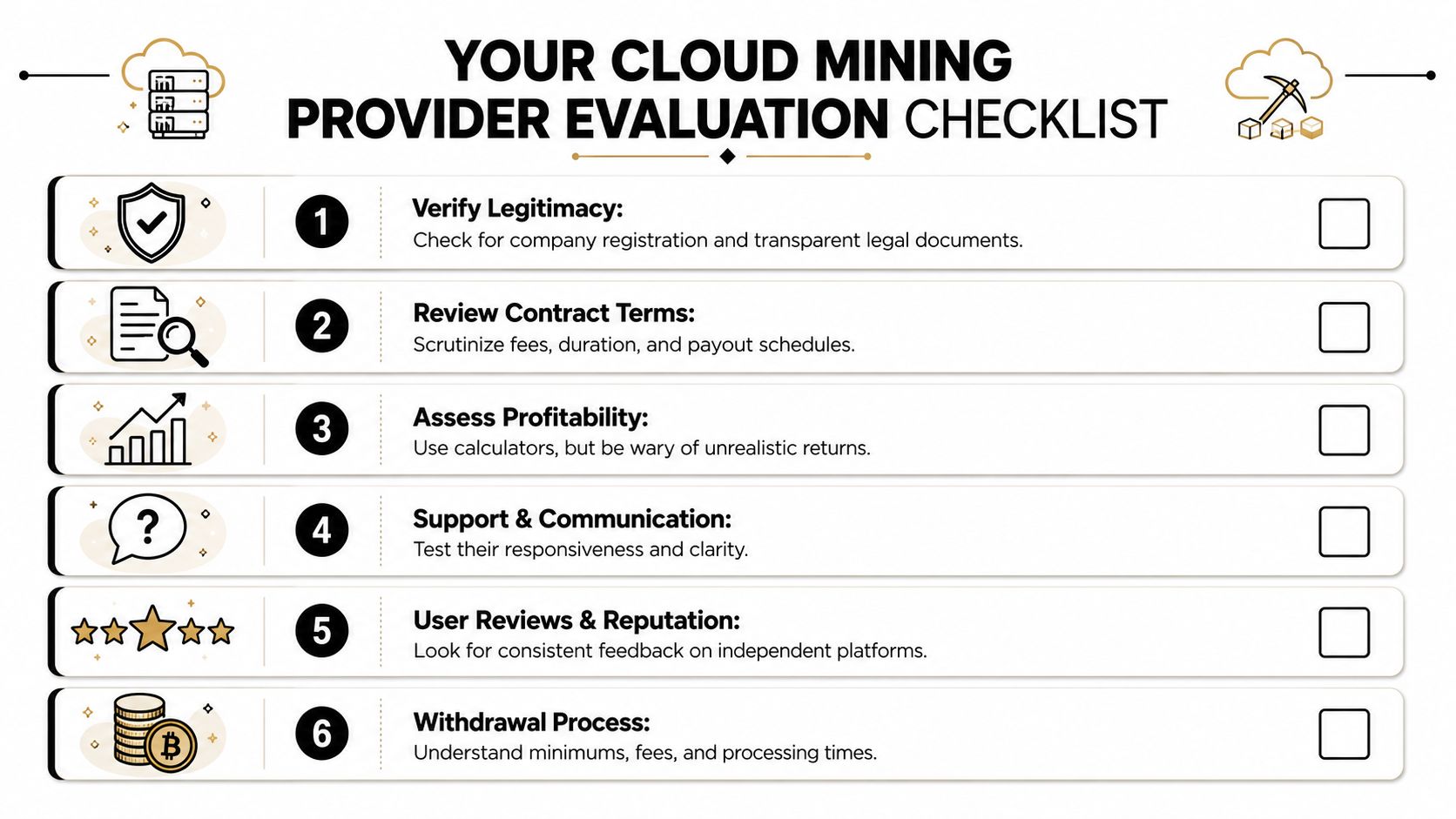
What to verify before depositing anything
Treat this like an underwriting process. Cloud mining buyers get hurt when they judge the site instead of the contract.
Start with legal identity. A real company name, registration trail, jurisdiction, and terms of service will not make a provider honest, but the absence of those items makes enforcement close to impossible.
Then read the contract as if returns will disappoint, because that is the scenario that exposes the underlying economics. Maintenance fees, electricity charges, payout thresholds, and clauses that let the operator suspend an unprofitable contract matter more than the advertised yield. I have seen mediocre-looking offers with tolerable terms beat flashy plans that buried the buyer in deductions.
Operational proof matters too, but it needs to be specific. Facility photos alone prove very little. Look for consistent company records, identifiable hosting details, wallet or payout logic that can be explained clearly, and support answers that match the written terms.
Before committing real size, test the exit path. A small deposit and withdrawal request can tell you more than an hour on the homepage.
- Company record: Verify the legal entity, jurisdiction, and enforceable terms.
- Management and accountability: Named operators with public history are easier to vet than a brand with no accountable humans attached.
- Contract economics: Check whether fees are fixed, variable, or allowed to change after purchase.
- Termination rules: Read the clauses covering suspended payouts, early contract closure, and what happens when mining becomes unprofitable.
- Withdrawal conditions: Review minimums, delays, wallet restrictions, and any manual approval process.
- Support quality: Ask direct questions. Evasive replies usually show up before bigger problems do.
A quick scorecard keeps the decision grounded:
| Check | Pass signal | Fail signal |
|---|---|---|
| Identity | Registered company and clear jurisdiction | Anonymous brand or missing legal terms |
| Economics | Fees and payout formula are written clearly | Revenue promises are clear, costs are vague |
| Contract rights | Suspension and termination terms are specific | Operator can change terms with broad discretion |
| Operations | Verifiable business details and consistent answers | Stock images, recycled claims, contradictory support replies |
| Withdrawals | Clear process, limits, and timing | Hidden minimums, unexplained delays, or manual friction |
If a provider survives this screen, compare it against simpler income strategies before you commit capital. For many retail users, high-APY crypto staking options are easier to evaluate because the risks and mechanics are usually more transparent than a mining contract.
Safer Alternatives for Crypto Income
If your real goal is crypto income, cloud mining is only one route, and often not the most attractive one.
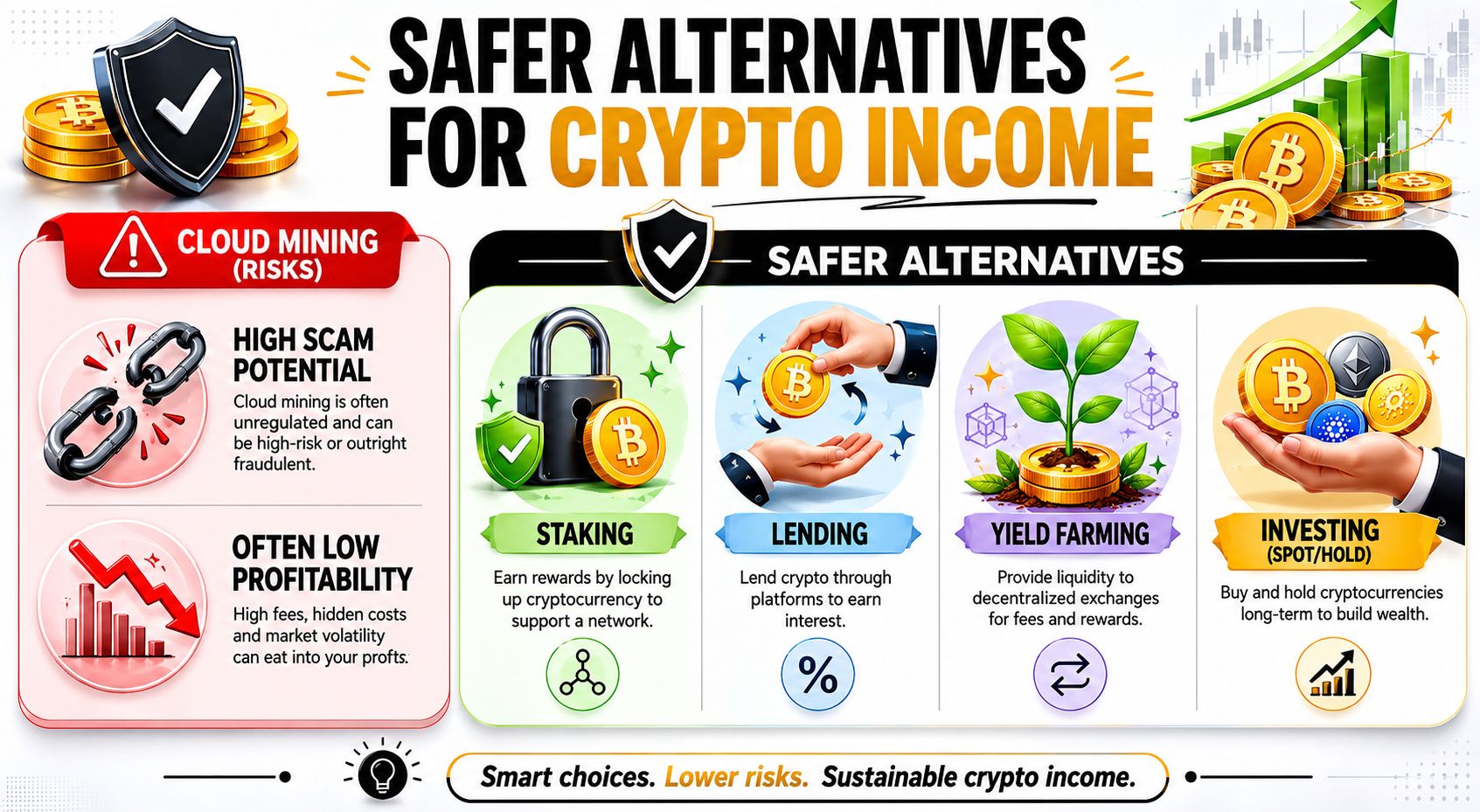
How cloud mining compares with other strategies
Cloud mining appeals because it promises infrastructure exposure without the mess of running hardware. In exchange, you accept counterparty risk, opaque fees, and very limited control.
That's a tough trade when other crypto strategies are easier to understand.
| Strategy | Main advantage | Main drawback | Who it fits |
|---|---|---|---|
| Cloud mining | No hardware management | High counterparty and contract risk | Speculative users comfortable with due diligence |
| Self-hosted mining | Full operational control | Hardware, power, and maintenance burden | Advanced operators |
| Staking | Clearer network role and simpler mechanics | Asset-specific risk and lockup trade-offs | Long-term holders |
| Lending or yield products | Passive structure can be simpler to use | Platform and smart contract risk | Users who understand custody and protocol risk |
| Spot buy and hold | Cleanest exposure to token price | No direct yield unless paired with another strategy | Most retail investors |
Staking is usually the first alternative I mention because the mechanism is easier to audit. You lock assets to support a network rather than renting unseen hash power from a third party. If that route interests you, compare options with this guide to the highest APY crypto staking.
DeFi can also offer income paths through lending and liquidity provision. But the same principle applies. Don't chase yield without understanding tokenomics, smart contract risk, and custody.
The bigger trend is that crypto income opportunities are becoming more diverse. Web3 infrastructure, Layer 2 ecosystems, AI-linked token narratives, and tokenized real-world assets are all pulling user attention. Cloud mining now competes with simpler onchain and exchange-based products, which raises the bar for any platform claiming to be the best cloud mining option.
Better product design exists elsewhere in crypto. That alone makes cloud mining work harder to justify.
Conclusion Is Cloud Mining Worth It in 2026
For most retail users, no. Not in the way it's usually marketed.
The central problem isn't that cloud mining can never work. It's that most buyers approach it as passive income when it should be treated as a high-risk contract tied to changing mining economics. As noted in Crypto.news coverage of cloud mining in 2026, most content focuses on platform names but rarely asks whether returns can survive rising network difficulty and post-halving economics. That's the right question.
The best cloud mining deal on paper can become mediocre fast if fees bite harder than expected, payout assumptions drift, or termination clauses protect only the provider. A slick interface won't save a weak contract.
There is still a narrow case for participation. A knowledgeable, risk-tolerant user might use cloud mining as a speculative slice of a broader crypto portfolio, especially if they can verify the provider, understand the product structure, and model downside without relying on advertised yield.
Everyone else should be skeptical.
If you're looking for straightforward crypto exposure, staking, selective DeFi participation, or holding high-conviction assets usually offers a cleaner risk profile. Cloud mining only makes sense when the operator is unusually transparent and the buyer is unusually disciplined.
Frequently Asked Questions About Cloud Mining
Is cloud mining legal
Cloud mining legality depends on your jurisdiction and on the provider's business structure. The bigger issue for most users isn't legality in the abstract. It's whether the provider is properly disclosed, contractually clear, and offering a mining product rather than a promotional scheme.
Do most people make money with cloud mining
Some do. Many don't.
The users who struggle most are the ones who buy based on advertised payouts and ignore fee drag, contract terms, and withdrawal friction. Profits, when they happen, usually come from disciplined entry, careful provider screening, and realistic assumptions rather than from promotional offers.
What's the difference between cloud mining and staking
Cloud mining means renting hash power or buying exposure to mining output. Staking means locking eligible crypto assets to help secure a proof-of-stake network.
They're different businesses. Cloud mining depends heavily on the provider's operations and honesty. Staking depends more on the underlying network, validator quality, custody choices, and tokenomics.
Can AI, Layer 2s, and tokenization change cloud mining
Not directly in the way marketers often imply. AI can improve operational software, analytics, and customer support around mining businesses, but it doesn't repeal mining economics. Layer 2 growth affects broader blockchain activity and user capital allocation, yet it doesn't change how Bitcoin mining revenue works. Tokenization and real-world asset narratives may pull investor attention toward new sectors, which can make cloud mining look less compelling relative to other Web3 opportunities.
That's the broader lesson. Crypto evolves fast, but bad contracts remain bad contracts.
If you want more no-hype analysis on crypto risks, Web3 trends, DeFi, staking, tokenomics, and blockchain investing, follow Coiner Blog. It's a strong resource for readers who prefer practical guidance over marketing copy.