
What Is BNB: Your Guide to Binance Coin in 2026
BNB stopped being “just the Binance coin” a long time ago. In 2025, it pushed above $1,000 and Binance reported a circulating supply of roughly 139 million to 145 million tokens, with market capitalization in the $130 billion to $140+ billion range and daily trading volumes in the billions, which is why it now sits firmly in the top tier of global crypto assets rather than the exchange-token niche many people still associate it with (Binance's BNB milestone note).
That scale changes the question. “What is BNB?” is no longer a beginner's glossary entry. It's really a question about how one token evolved into the economic base layer for trading, smart contracts, DeFi, Web3 apps, and a broader multi-chain stack tied to one of the most recognizable brands in crypto.
For readers trying to make sense of modern Web3, BNB is a useful case study because it sits at the intersection of centralized exchange utility and blockchain infrastructure. If you want a broader primer on where those ideas fit, this guide to Web3 technology basics gives good background before you go deeper on BNB itself.
Table of Contents
- What Is BNB and Why It Matters in 2026
- The Evolution of BNB From Exchange Token to Ecosystem Fuel
- Understanding BNB Tokenomics Supply Burns and Standards
- BNB Chain vs Ethereum A Tale of Two Blockchains
- The Expansive Utility of BNB Across the Web3 Ecosystem
- How to Buy and Securely Store Your BNB
- Risks and Regulatory Considerations for BNB Holders
What Is BNB and Why It Matters in 2026
BNB is one of the few crypto assets that still matters even if you ignore price charts. Its role has expanded from an exchange perk into the operating asset for a much larger system that includes payments for network activity, decentralized apps, scaling infrastructure like opBNB, and storage-oriented services like Greenfield.
At the simplest level, BNB is the native asset tied to the Binance ecosystem and the token used to pay gas fees across the BNB Chain family. Gas fees are the small charges paid to process actions onchain, similar to paying postage every time you send a letter. If you swap a token, mint an NFT, or interact with a lending app on BNB Chain, BNB is usually the asset that keeps that transaction moving.
That practical role is why BNB still matters in 2026. Crypto users are no longer only buying tokens and waiting. They are using wallets, trading on decentralized exchanges, borrowing, staking, gaming, storing data, and interacting with apps that run across multiple layers of infrastructure. If you are still getting familiar with that broader shift, this guide to how Web3 technology works in practice gives useful context.
BNB also confuses people because it sits in two worlds at once.
- Inside Binance products, it can provide fee-related benefits and platform utility.
- Across BNB Chain, it works as the payment asset for computation and transaction execution.
A good comparison is a token that functions both like a store loyalty credit and like the fuel used by the store's delivery fleet. One role is optional and platform-specific. The other supports the underlying system.
That distinction matters because many explainers still describe BNB as if it were mainly an exchange coin from 2017. That framing is too small for what BNB became. Today, it is better understood as a large utility asset connected to a broad Web3 stack that includes smart contracts, DeFi, Layer 2 scaling through opBNB, and decentralized data infrastructure through Greenfield.
There is also a part many guides gloss over. BNB's reach grew through an ecosystem strongly associated with Binance, and that creates centralization risk alongside utility. In plain English, BNB is more useful than the old “exchange token” label suggests, but it is not as politically neutral or institutionally detached as assets built through looser governance. Both facts can be true at the same time.
If you only view BNB through the lens of trading discounts, you miss the bigger picture. If you ignore the concentration of influence around its ecosystem, you miss the risk. Understanding BNB in 2026 means holding both ideas together. It is infrastructure, and it is infrastructure with clear central points of dependence.
The Evolution of BNB From Exchange Token to Ecosystem Fuel
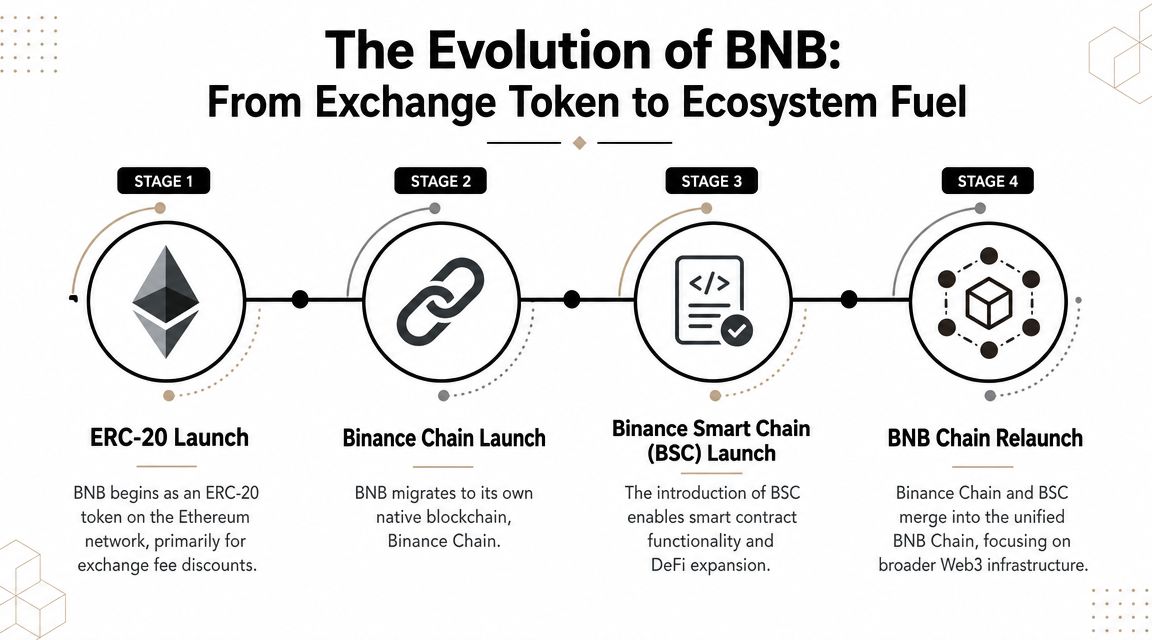
BNB did not stay in its original lane for long. It began as an exchange-linked token, launched on Ethereum as an ERC-20 asset, and later became the native asset used across its own expanding network stack.
That starting point still matters. An ERC-20 token follows Ethereum's common token rulebook, much like a product that begins life inside an established retail chain before moving into its own stores. Early users already knew how to hold, transfer, and recognize assets built on that standard. If you want a clearer foundation on how chains and token standards work, this primer on blockchain technology basics helps.
Why the ERC-20 origin still matters
Many readers assume BNB was always tied to its own chain. It was not. Its Ethereum-based start gave it a familiar on-ramp at a time when Ethereum had the clearest wallet and token infrastructure.
That made adoption easier. Users did not need to learn an entirely new asset format on day one.
The move from Ethereum to BNB's own chain environment changed the token's role in a more important way. It stopped being mainly something users held for platform-related benefits and became something users spent to make the network run. Gas fees are the simplest example. Gas works like postage for blockchain actions. Every token swap, contract interaction, or transfer needs a small payment so validators process it, and on BNB Chain that payment is made in BNB.
How BNB became infrastructure
A significant shift occurred when the ecosystem grew beyond a single chain and a single use case. BNB became the common payment asset and coordination token across a broader stack that includes BNB Smart Chain, opBNB, and Greenfield.
Each piece handles a different job:
- BNB Smart Chain: the main execution layer for smart contracts, DeFi protocols, games, and other apps
- opBNB: a scaling layer built to handle higher-volume activity at lower cost
- BNB Greenfield: a decentralized storage and data layer connected to application infrastructure
A useful way to read this evolution is to compare it to a city growing around one core resource. At first, BNB was closer to a store coupon tied to one business. Later, it became more like the fuel, toll pass, and utility payment used across several parts of the same metro area. Once that happens, demand no longer depends only on one venue. It depends on how much activity the whole system attracts.
That is why describing BNB as only an exchange token now misses the practical reality. Developers may need it to deploy or interact with applications. Users may need it to pay transaction fees. Builders working with opBNB or Greenfield are interacting with a wider Web3 stack in which BNB acts as a base asset, not just a branded perk.
That broader role also brings a tradeoff many guides soften or skip. BNB's growth into ecosystem fuel happened inside a network closely associated with Binance. That association helped coordination, distribution, and product rollout. It also means the system has clearer centers of influence than more loosely governed crypto ecosystems. In plain terms, BNB became more useful by becoming more integrated, but that same integration can increase centralization risk.
For an investor or user, this is the main takeaway. BNB evolved from a token attached to an exchange into an asset that helps power a multi-chain Web3 system. opBNB extends transaction throughput. Greenfield pushes BNB into storage and data infrastructure. The upside is broader utility. The caution is that the backbone is still closely connected to one dominant organization.
Understanding BNB Tokenomics Supply Burns and Standards
BNB's tokenomics matter for a simple reason. They shape how scarce the asset can become, how it functions across different chains, and why BNB is more than a leftover exchange perk.
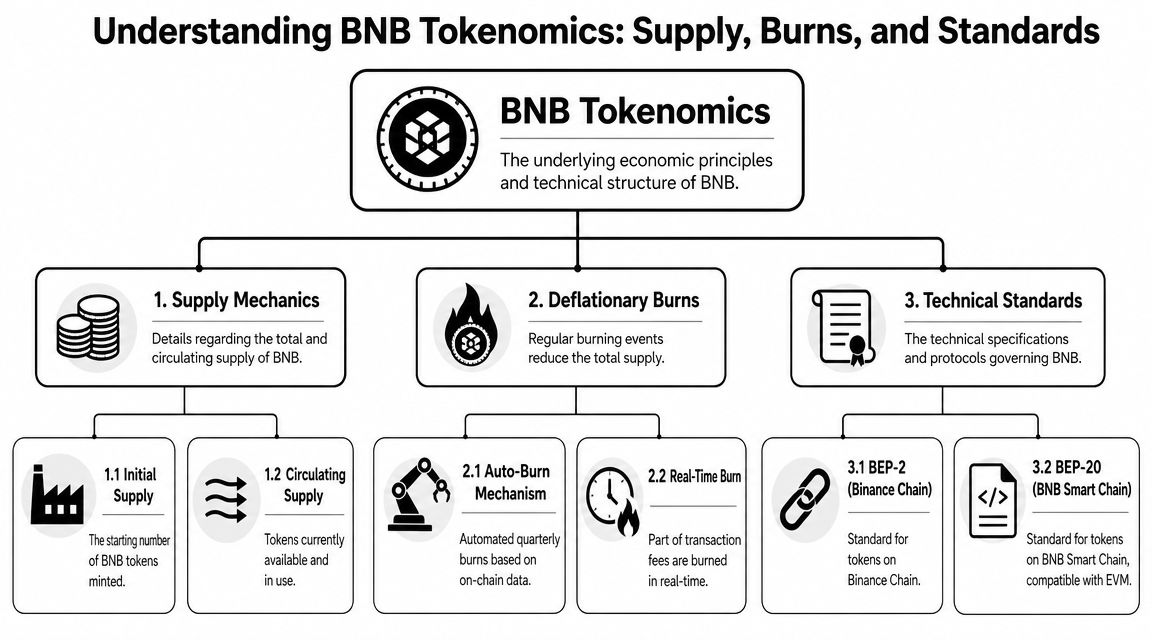
A good starting point is to separate three ideas that beginners often mix together: supply, burns, and token standards. Once those are clear, BNB becomes much easier to evaluate as an asset tied to a growing multi-chain system.
Supply and circulating supply in plain English
Supply works a lot like the stock of goods in a market.
Total supply is the full number of BNB that exists. Circulating supply is the portion that is actively available for trading, holding, or using across the ecosystem. The difference matters because markets respond to what can move, not just to what exists on paper.
That distinction becomes more important with BNB because its role has expanded. An asset used for gas, staking, trading, and application activity across BNB Smart Chain, opBNB, and related infrastructure has different demand dynamics than a token used only for exchange discounts.
Then there are burns, which remove BNB from supply. The practical idea is straightforward. If demand for the ecosystem holds steady or grows while the available token count falls over time, scarcity can increase.
This does not guarantee price appreciation. It does mean BNB is designed with a deflationary element that investors should understand before they treat supply as static.
For readers comparing yield opportunities, supply mechanics matter as much as headline returns. A token with attractive rewards can still lose ground if issuance or dilution offsets those gains. This guide to high-APY crypto staking strategies and dilution tradeoffs is useful background if you want to connect staking rewards with token supply pressure.
One caution is easy to miss. BNB burns may reduce supply, but they do not remove the governance and ecosystem concentration risks discussed earlier. A shrinking supply can support scarcity. It does not make the underlying system decentralized by itself.
Token standards without the jargon
The “BEP” labels are easiest to understand as technical formats for different rails.
BEP-2 was the standard associated with the older BNB Beacon Chain environment. BEP-20 is the standard used on BNB Smart Chain, where smart contracts, DeFi apps, NFT markets, and many wallet interactions take place. If BEP-2 was closer to a ticket for one transit line, BEP-20 is closer to the format used across a much busier city network with more destinations and applications.
For users, the takeaway is practical. The same asset name, BNB, can appear in different technical forms depending on the network you are using.
Why standards matter to users
The token standard affects ordinary tasks more than many guides admit.
| Topic | Why it matters |
|---|---|
| Wallet compatibility | Sending BNB on the wrong network can create recovery problems or leave funds inaccessible until you use the correct chain |
| App access | Smart contract apps on BNB Smart Chain generally expect the BEP-20 version of BNB |
| Fees and convenience | The token format determines how BNB interacts with swaps, staking services, bridges, and other on-chain tools |
Gas fees are a good example. Gas is the small payment required to process activity on a blockchain, similar to paying a road toll each time you use a highway. On BNB Smart Chain and related environments, BNB is the asset commonly used to pay that toll. If you hold BNB in the wrong format or on the wrong network, the asset may still be yours, but it may not be ready for the task you want to perform.
That is why withdrawal screens ask you to choose a network. The choice is not cosmetic. It is a routing decision.
Use the network your wallet and destination app explicitly support. “BNB” is the asset name, but the transfer route still determines whether the token arrives in a usable form.
For long-term holders, token standards can feel like a minor detail until the first transfer goes wrong. For active users across DeFi, opBNB, or other BNB ecosystem tools, they are part of basic operational safety.
BNB Chain vs Ethereum A Tale of Two Blockchains
The most useful way to understand BNB Chain is to compare it with Ethereum. Both support smart contracts and Web3 applications. They diverge in cost, speed, and philosophy.
BNB Chain was built as a low-fee, high-throughput alternative to Ethereum. Nansen notes that BNB Smart Chain launched to address Ethereum's high-fee and slower-confirmation pain points, that upgrades across 2024 and 2025 pushed block times to sub-second levels, and that after the 2025 gas-price reduction, simple transfers often cost about $0.005 to $0.03 (Nansen's BNB Chain analysis). For anyone making frequent small transactions, that changes the user experience dramatically.
Where BNB Chain wins on usability
For retail users, the advantage is easy to grasp. Lower fees make experimentation less punishing.
If you want to swap a small amount on a DEX, mint a low-cost NFT, or interact repeatedly with GameFi and DeFi apps, BNB Chain is often the more forgiving environment. Cheap gas means mistakes cost less, rebalancing costs less, and trying new dApps feels normal instead of expensive.
A good primer on the underlying mechanics is this guide to blockchain technology basics, especially if terms like validators, finality, and smart contracts still feel abstract.
Where Ethereum still leads
Ethereum still holds strengths that matter to serious builders and long-term network thinkers.
Its biggest advantages are usually described qualitatively rather than through one single metric:
- Deeper decentralization culture
- A stronger historical network effect
- A more entrenched position in developer mindshare
- A broad ecosystem of mature tooling, standards, and liquidity
That's why many teams still see Ethereum as the default settlement environment, even when they use Layer 2s or deploy to multiple chains.
BNB Chain often optimizes for affordability and throughput. Ethereum often optimizes for credibility, decentralization, and ecosystem gravity.
BNB Chain vs Ethereum at a Glance 2026
| Metric | BNB Chain | Ethereum |
|---|---|---|
| Primary appeal | Lower-cost, high-throughput usage | Deep decentralization and network effect |
| Transaction cost for simple transfers | Often about $0.005 to $0.03 after the 2025 gas-price reduction | Higher than BNB Chain in many periods, described as the pain point BNB Smart Chain was designed to address |
| Confirmation speed | Upgrades pushed block times to sub-second levels | Generally slower than the BNB Chain profile described by Nansen |
| Retail DeFi fit | Strong for frequent, smaller transactions | Strong, but cost can matter more for smaller users |
| Developer perception | Practical, EVM-friendly, speed-focused | More established, more decentralized, more institutionally and culturally embedded |
The right choice depends on what you value. If cost sensitivity dominates, BNB Chain has a clear edge. If neutrality and decentralization sit at the top of your checklist, Ethereum still has powerful arguments in its favor.
The Expansive Utility of BNB Across the Web3 Ecosystem
The strongest answer to “what is BNB” isn't a definition. It's a list of things people do with it.

BNB has utility at the exchange layer, at the base-chain layer, and inside the app economy built on top of that chain. That spread is why it has remained relevant while many utility tokens faded after their first hype cycle.
Core network uses
At the most basic level, BNB is used to pay gas fees. Gas is the processing fee for using blockchain resources.
A good analogy is ride-hailing. The app may look simple, but someone still pays for the trip. Onchain, BNB is the fare that gets your transaction processed.
BNB also appears in activities tied to network participation and ecosystem coordination, including staking-related functions, governance participation, and incentive structures within the broader chain environment. For users who spend time in DeFi, that makes BNB less like a collectible token and more like operating cash.
Binance platform benefits and onchain activity
Inside the Binance ecosystem, BNB is still widely associated with fee discounts and access-related perks. That's the legacy role many people first learn about.
But the onchain side is now far bigger conceptually. BNB acts as a working asset across decentralized applications such as:
- DEX trading: many users keep BNB on hand to swap assets on platforms like PancakeSwap
- NFT activity: minting, buying, and listing digital collectibles usually requires network fees
- GameFi economies: blockchain games often rely on fast, cheap transactions to keep in-game actions practical
- Web3 apps: social, creator, and consumer dApps need a native token for frictionless payment of network actions
If you're following the gaming side of crypto, this guide to Web3 gaming helps connect why low-cost chains attract game economies in the first place.
Here's a quick explainer for visual learners:
Why utility matters for future trends
BNB's broad utility also positions it for trends that are shaping the next phase of crypto:
- AI plus crypto: autonomous agents and AI-powered apps need cheap transactions if they're going to operate frequently onchain
- Layer 2 scaling: opBNB reflects the same industry-wide push toward cheaper execution at scale
- Real-world asset tokenization: chains with low fees and active users are natural testing grounds for tokenized products
- DeFi maturity: practical chains tend to attract lending, trading, staking, and payments activity
Not every trend will translate into lasting value. But tokens tied to usable infrastructure usually have a stronger foundation than tokens built around pure narrative alone.
How to Buy and Securely Store Your BNB
Buying BNB is usually simple. Storing it properly is where people make mistakes.
Common ways to get BNB
Most users buy BNB on a centralized exchange, with Binance being the most obvious venue because of its direct ecosystem ties. Others acquire it by swapping from another asset through a decentralized exchange on BNB Chain.
The path you choose depends on your goal.
- If you want convenience: a centralized exchange is usually the easiest starting point.
- If you're already onchain: a DEX can be faster for users who already hold compatible assets in a wallet.
- If you plan to use DeFi immediately: buying and withdrawing to a self-custody wallet may make more sense than leaving funds on an exchange.
Storage choices that actually matter
The big distinction is custodial versus non-custodial storage.
If you leave BNB on an exchange, the platform controls the keys. You control access to your account, but not direct custody of the asset. If you move BNB into your own wallet, you control the private keys and the recovery phrase.
That's where the phrase “not your keys, not your crypto” comes from.
Generally, the practical options are:
- Hot wallets: software wallets such as MetaMask or Trust Wallet. These are convenient for DeFi, NFT activity, and daily use.
- Cold wallets: hardware wallets such as Ledger or Trezor. These are better for long-term storage because the keys stay offline.
Write your seed phrase offline, store it securely, and never type it into random websites, forms, or support chats.
If you're unsure where to begin, this roundup of crypto wallets for beginners is a solid starting point because it compares wallet types by use case instead of marketing buzzwords.
A sensible setup for many users is hybrid. Keep a smaller amount in a hot wallet for active Web3 use, and keep the larger balance in cold storage.
Risks and Regulatory Considerations for BNB Holders
BNB's upside is easy to explain. Its risk profile deserves the same clarity.
A major blind spot in many BNB guides is platform and regulatory risk. As CoinMarketCap's explainer notes, many articles describe BNB as a utility token but don't answer the practical question of what happens when someone holds it for exchange-fee discounts, staking, or dApp access while the underlying ecosystem faces legal or operational changes (CoinMarketCap's discussion of BNB platform-risk clarity).
Platform risk is not theoretical
BNB is strongly tied to Binance by origin and still closely associated with the broader Binance ecosystem. That creates a structural tension.
On one hand, Binance's scale and brand recognition helped BNB achieve relevance. On the other, that same connection means headlines around the company can spill into how people perceive the token.
For holders, the practical questions are straightforward:
- If exchange access changes in your jurisdiction, what does that mean for your intended use of BNB?
- If a service is restricted, do you still hold BNB mainly for onchain utility, or was the exchange benefit your core motivation for owning it?
- If ecosystem operations shift, are you prepared to use self-custody and interact directly with the chain?
Why centralization concerns matter
The second issue is governance and control. BNB Chain is widely viewed as making different trade-offs from more decentralized networks. Those trade-offs can improve speed and usability, but they also raise concerns for users who prioritize neutrality and broad validator participation.
That doesn't make BNB unusable. It means you should evaluate it objectively.
A balanced view looks like this:
- Strength: close ecosystem coordination can accelerate product development and user experience.
- Weakness: tighter ecosystem coupling can concentrate risk.
- Strength: a unified brand helps onboarding.
- Weakness: regulatory pressure on the brand can affect sentiment around the token.
Holding BNB isn't just a bet on token demand. It's also a bet that the surrounding ecosystem remains functional, attractive, and accessible.
If you use BNB for gas, staking, DeFi, or Web3 apps, that distinction matters more than most promotional content admits.
Coiner Blog publishes beginner-friendly and analyst-level crypto guides for readers who want more than hype. If you want balanced breakdowns of blockchain technology, DeFi, wallets, NFTs, and emerging Web3 trends, explore the latest articles on Coiner Blog.