
DeFi Sports Betting: Your Ultimate 2026 Explainer

Prediction markets didn't just grow. They hit $63.5 billion in trading volume in their first full year, and Bank of America's early 2026 analysis estimated the potential U.S. market for sports-related event contracts at about $1.1 trillion in annual trading volume, implying roughly $10 billion in annualized revenue for event-betting platforms, according to DeFi Prime's breakdown of sports prediction markets and sportsbooks.
That changes how serious investors should treat defi sports betting. This isn't just a crypto-native version of a sportsbook. It's a new market structure where odds, liquidity, settlement, and sometimes even user ownership move on-chain through smart contracts. The fundamental shift is financial, not cosmetic.
Most coverage stops at the surface. It tells you that Web3 betting is transparent, borderless, and advanced. That's true, but it doesn't help you judge whether a platform is resilient or fragile. The useful question is simpler: how does the machine operate when no central bookmaker is sitting in the middle?
Table of Contents
- The Unstoppable Rise of DeFi Sports Betting
- How DeFi Betting Actually Works The Core Mechanics
- Decentralized vs Centralized Betting A Head-to-Head Showdown
- Exploring the Major Platform Archetypes
- Navigating the Inherent Risks and Challenges
- How to Evaluate a DeFi Betting Platform Yourself
- Placing Your First Decentralized Bet A General Walkthrough
- Frequently Asked Questions about DeFi Betting
The Unstoppable Rise of DeFi Sports Betting
Event contracts tied to sports have gone from crypto curiosity to one of the clearest examples of real-world demand for on-chain markets. In a recent market review, CoinGecko's analysis of prediction markets highlighted how election and sports events helped push activity back into the sector as users looked for faster, more transparent ways to trade outcomes.

DeFi sports betting emerges when betting markets adopt DeFi's core machinery. A user connects a wallet instead of opening a custodial account. Capital sits in contracts or liquidity pools instead of a bookmaker's private database. Prices can move as traders buy and sell exposure, rather than only when a risk team updates a line.
That design choice changes the product at a structural level. A traditional sportsbook mainly sells a packaged experience: deposit, click odds, wait for settlement. A decentralized market is closer to a financial venue where sports outcomes become tradeable claims, and where liquidity, pricing, and settlement are split into separate on-chain functions.
The interesting shift is not cultural. It is mechanical.
Once a match outcome is represented as a token, share, or conditional claim, the market starts behaving less like a betting slip and more like a short-dated derivative. Odds are no longer just house quotes. They become a live price for risk, shaped by collateral in the pool, trader flow, oracle design, and sometimes incentives paid to liquidity providers. That is why the category has attracted attention from traders who would not usually describe themselves as gamblers.
Why this matters now
Traditional sportsbooks bundle four powers into one operator:
- Custody: User funds sit under the platform's control.
- Pricing: The operator sets the line and manages exposure.
- Settlement: The operator decides how and when markets resolve.
- Permissioning: The operator controls access limits, restrictions, and account treatment.
DeFi breaks that bundle apart. One protocol can handle escrow. Another mechanism can price the market through an AMM or order book. An oracle network or validation process can determine the result. Governance tokens may even give users a voice in fee policy or market parameters.
That decomposition is the primary innovation. It turns the sportsbook from a closed business model into an open financial stack that outside capital can fund, inspect, and stress-test.
It also creates a more useful framework for evaluating platforms. The key question is not whether a protocol offers NFL or Premier League markets. The key question is how it sources liquidity, how it prices risk, and who absorbs losses when the market is wrong. Those are the same questions analysts ask of any DeFi primitive. Sports betting wraps them around real-world events instead of token swaps or lending rates.
How DeFi Betting Actually Works The Core Mechanics
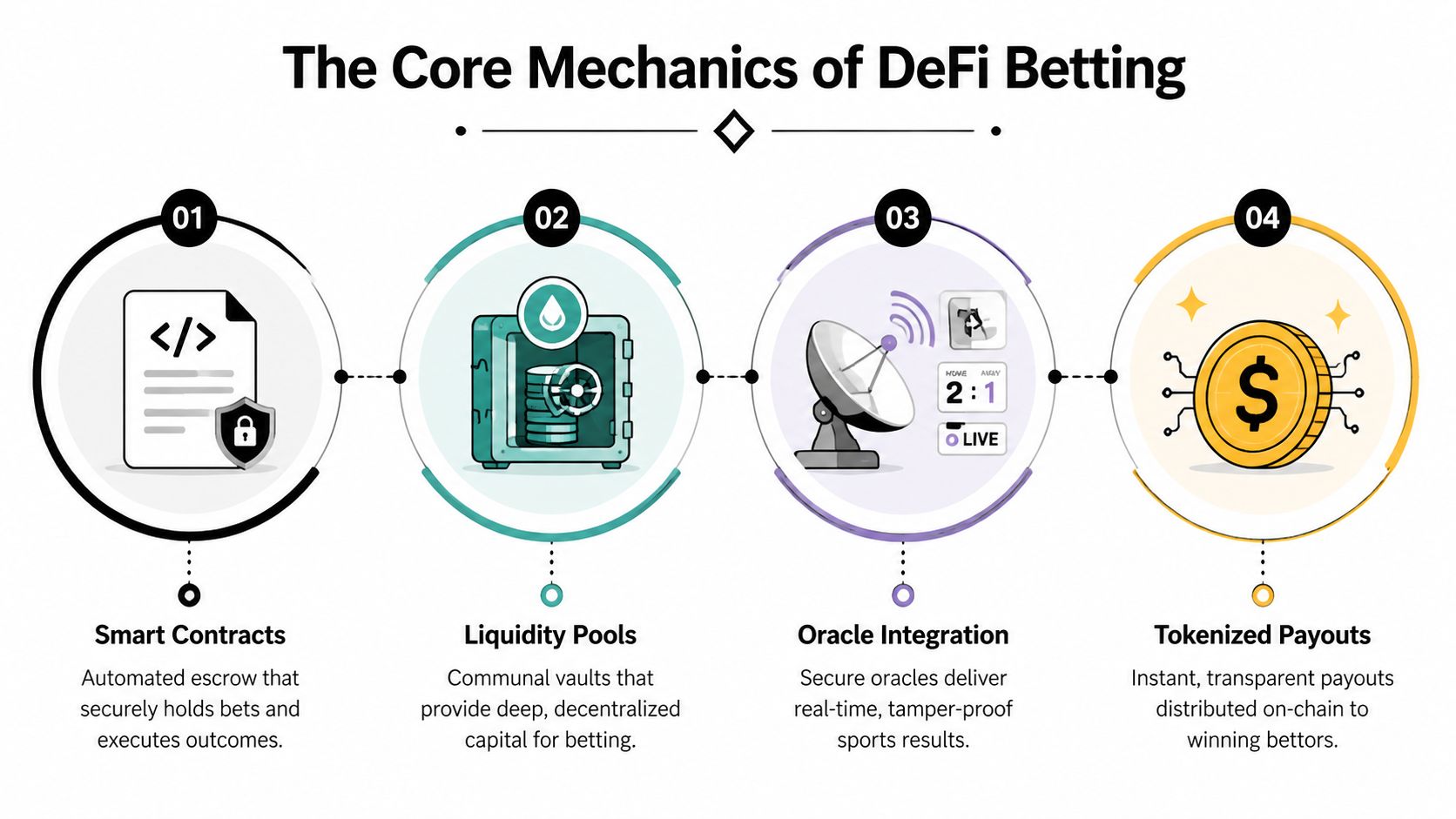
A DeFi betting protocol only works if four systems line up with precision: smart contracts to custody funds and enforce rules, data feeds to import results, liquidity to absorb user flow, and pricing logic to quote odds under changing exposure. If one layer fails, the product stops behaving like a market and starts behaving like an unsecured promise.
Smart contracts replace the house ledger
In a centralized sportsbook, your wager sits inside the operator's internal database. In a decentralized system, a smart contract holds collateral, records the market terms, and executes settlement according to code.
If the market is “Team A wins,” the contract defines:
- what asset users stake
- how odds or payout shares are computed
- when the market closes
- which result feed resolves the event
- how winnings are paid out
That changes the trust model. Users still face risk, especially contract bugs or poor market design, but the rules are visible before capital is committed. In financial terms, the protocol replaces discretionary back-office operations with a public settlement engine.
Oracles and validators determine whether the market can settle cleanly
Sports outcomes do not originate onchain, so a betting protocol needs an external reporting mechanism. That reporting layer is often more important than the front end, because settlement integrity is the product.
According to Bitcoin Betting's explanation of DeFi betting mechanics, some platforms use dual-layer verification that combines oracle feeds with validator networks. Validators post collateral and can be penalized for reporting false outcomes, which turns honesty from a social expectation into an economic requirement. The same source argues that this design, combined with AMM-based pricing, is one reason analysts expect continued growth in crypto sports betting.
The practical point is simple. A good oracle design does not just fetch a score. It defines who can submit a result, how disputes are handled, how long finality takes, and who pays when the reported outcome is wrong. Those details determine whether a protocol can scale beyond low-stakes experimentation.
If a platform cannot explain its resolution process in precise terms, users cannot price its settlement risk.
Liquidity pools become the bankroll
Traditional sportsbooks use their own balance sheet, then hedge exposure if one side of the book gets too crowded. DeFi protocols often outsource that role to liquidity pools funded by outside capital.
LPs deposit assets into a shared pool and earn fees for taking the opposite side of aggregate user flow. In effect, they underwrite the market. Their return depends on whether fee income exceeds losses from informed bettors, adverse selection, and one-sided action during volatile events.
That makes DeFi betting look less like a casino product and more like a specialized derivatives venue. Bettors are expressing a view on an event. LPs are selling that exposure in exchange for yield. The protocol coordinates the trade and enforces collateral rules.
AMMs turn order flow into odds
This is the mechanical layer that determines whether a market feels efficient or fragile. In many DeFi betting systems, odds are not posted by a human trading desk. They are generated by an Automated Market Maker, or AMM, using a formula that updates prices as capital moves between outcomes.
When more money enters one side of a market, three things happen:
- the pool's liability to that outcome rises
- the AMM adjusts the quoted price to reduce further imbalance
- new traders receive worse odds on the crowded side and better odds on the neglected side
That feedback loop is how the protocol manages inventory without a bookmaker manually rewriting lines. It works much like any other AMM in DeFi, except the terminal value is tied to a real-world event rather than an exchange rate between tokens.
Some designs use a baseline probability from an oracle, market maker, or pregame model, then let the AMM move around that anchor as order flow comes in. Others rely more heavily on pure market pressure. The difference matters. A market that depends only on flow can be easier to skew when liquidity is thin. A market with a stronger reference model may price events more efficiently, but it also introduces another layer of operator discretion or model risk.
| Core component | What it does | Why it matters |
|---|---|---|
| Smart contracts | Hold funds and enforce market rules | Replaces operator-controlled custody and settlement |
| Oracles | Import real-world sports results | Connects offchain events to onchain payouts |
| Validators | Confirm outcomes and post collateral | Reduces single-source resolution risk |
| AMMs and pools | Quote odds and supply capital | Keeps markets live without a central bookmaker |
The key insight is that these pieces do not operate independently. Oracle design affects settlement latency. Settlement latency changes capital efficiency for LPs. Capital efficiency influences how much liquidity a pool can sustain. Liquidity depth then shapes how sensitive the AMM is to each new bet. That chain reaction is why two platforms can offer the same match, yet produce very different odds, slippage, and user outcomes.
Decentralized vs Centralized Betting A Head-to-Head Showdown
The fairest comparison isn't “which is better.” It's “which system gives users control over the parts that matter most?”
Where DeFi is structurally better
DeFi betting wins on architecture. Funds often remain in user-controlled wallets until a transaction is signed. Rules are more visible. Settlement pathways are embedded in code instead of internal policy.
A mature protocol can also avoid some familiar sportsbook behavior. If pricing and settlement are rule-based, users face fewer surprises around withdrawals, selective limits, or inconsistent treatment across account sizes.
Centralized books optimize for operator control. DeFi protocols optimize for rule transparency. Those are not the same product, even when the front end looks similar.
There's also a composability advantage. A tokenized bet can interact with other DeFi rails, including stablecoins, Layer 2 infrastructure, and broader wallet-based user identity. That opens the door to products that look more like markets than fixed betting slips.
Where centralized books still have an edge
Centralized platforms still dominate on convenience. Fiat on-ramps are smoother. Interfaces are more familiar. Customer support is simpler for non-crypto users. Most new users would find a standard sportsbook easier to use than a wallet-based dApp.
DeFi can also push complexity onto the user:
- Self-custody: You're responsible for wallet security.
- Gas and bridging: Moving assets across networks can confuse beginners.
- Protocol design risk: Code can fail even when the UI looks polished.
| Feature | Centralized Betting (e.g., FanDuel, BetMGM) | DeFi Sports Betting |
|---|---|---|
| Custody | Platform holds funds | Users often interact through self-custody wallets |
| Odds formation | Operator-controlled | Often market-driven through AMMs or peer flow |
| Transparency | Limited to house disclosures | On-chain rules and settlement logic are more visible |
| Accessibility | Usually jurisdiction-dependent and fiat-native | Often crypto-native and globally reachable, subject to local law |
| Payout process | Managed by operator | Can be automated through smart contracts |
| Ease of use | Better for beginners | Better for users comfortable with Web3 tooling |
The practical conclusion is simple. If you want convenience, centralized books still feel easier. If you want transparent rails and programmable market structure, defi sports betting is far more interesting.
Exploring the Major Platform Archetypes
The category gets easier to read when you stop sorting platforms by brand and start sorting them by market design.

Peer-to-peer exchanges
These platforms try to match bettors directly. One user takes one side, another user takes the other, and the protocol handles escrow and settlement.
The appeal is obvious. Pricing can feel cleaner because there's no obvious “house” taking the opposite side. The downside is just as obvious. Thin markets create bad execution, stale lines, or no match at all.
AMM-native protocols
This model replaces direct counterparties with pooled liquidity. Bettors trade against a pool, while LPs absorb risk and earn fees.
AMM-native design tends to scale better for long-tail events because the protocol doesn't need a perfect buyer-seller match for every ticket. It just needs enough pool depth and a sensible pricing curve. That's why the mechanics discussed earlier matter so much. Weak liquidity design can make a protocol look active while hiding fragility.
Prediction markets and tokenized sports exposure
This archetype treats sports outcomes less like wagers and more like tradable event contracts. Users buy and sell positions whose value converges to a final result.
Some projects are now pushing that idea further by tokenizing sports-linked assets themselves. A notable example is Football.Fun. According to AInvest's report on Football.Fun and Base, the platform accumulated $100 million in TVL within two weeks of its 2025 launch on the Base network.
That number matters, but the structure matters more. Football.Fun pairs Layer 2 efficiency with a tokenization model tied to footballers' performance. In plain English, it takes sports fandom, speculative trading, and on-chain ownership and wraps them into one product. That's a very different model from posting odds on a match.
A useful visual overview of this shift is below.
Football.Fun also illustrates why Base and other Layer 2 environments matter. Low-cost execution makes smaller trades, experimentation, and higher-frequency market activity viable. Without scalable infrastructure, many Web3 betting ideas remain too expensive or too clunky to work.
Navigating the Inherent Risks and Challenges
DeFi sports betting inherits the full risk stack of DeFi, then adds another layer tied to market resolution. You are not only trusting code to hold funds and execute trades. You are also trusting the protocol's pricing model, oracle design, and settlement process to behave correctly under stress.
Technical risk is real
A betting protocol is a chain of dependencies. The smart contracts custody funds and enforce payout rules. Oracles import the match result. Front ends route orders and display market state. If any link fails, users can end up with frozen positions, incorrect settlement, or a market that functions on-chain but becomes hard to access in practice.
This is why "decentralized" needs inspection, not applause.
Your first filter should be technical transparency:
- Read the docs: A serious protocol explains settlement logic, custody design, and how a market opens, trades, resolves, and closes.
- Check audits carefully: An audit reduces uncertainty. It does not remove it, and it says little about future upgrades.
- Inspect admin powers: If a multisig or small operator group can pause markets, change parameters, replace oracle feeds, or upgrade contracts, that discretion belongs in your risk model.
Practical rule: Treat every unaudited or poorly documented betting dApp as experimental software holding real money.
Economic design fails long before a contract explodes
The more subtle failure mode is financial, not technical. A protocol can execute exactly as written and still produce bad outcomes because its liquidity model is weak.
AMM-based betting markets are especially sensitive here. If liquidity is thin, odds move too far on modest order flow, which increases slippage and creates poor execution for users. If LPs are compensated with inflationary tokens rather than fee income that reflects real demand, liquidity often behaves like rented inventory. It appears during incentives and disappears when emissions fall. For a betting venue, that is the equivalent of an exchange whose order book vanishes during peak volatility.
Dashboards often hide this problem. TVL can look healthy while usable depth remains shallow in the markets people want to trade.
Liquidity providers face a different issue. They are not farming yield. They are warehousing outcome risk, adverse selection, and timing risk in return for fees. In practice, an LP often plays the role of the house, but with less control over risk limits than a traditional sportsbook would demand. That distinction matters because many users underestimate how quickly informed traders can extract value from a poorly parameterized market.
Oracle design and settlement integrity matter as much as the odds screen
Sports betting adds an extra attack surface that standard DeFi lending does not face. The protocol must decide what happened in physical reality and convert that answer into an on-chain payout.
That sounds simple until edge cases arrive. Matches can be postponed, abandoned, or statistically corrected after the fact. Different data providers may classify events differently. A protocol with vague rules around extra time, voided bets, or official stat revisions is not finished financial infrastructure. It is a dispute waiting for volume.
The key question is operational. Who resolves contested outcomes, on what data source, and under what fallback process?
Regulation and user protection remain uneven
Legal classification still varies widely by jurisdiction. Depending on the design, the same product can resemble gambling, a prediction market, or a derivatives venue. On-chain access does not change that. It only removes the friction that used to remind users they were crossing legal boundaries.
Basic hygiene still matters:
- Know your local rules: Wallet access is not the same as legal clarity.
- Separate hot and cold funds: Keep only active betting capital in the connected wallet.
- Start small: Test deposits, settlement, and withdrawals before increasing size.
- Follow the money flow: If the token, treasury, fee routing, and liquidity design are hard to explain, pass.
The strongest protocols reduce trust assumptions and make the remaining ones visible. That is the standard worth looking for.
How to Evaluate a DeFi Betting Platform Yourself
Most users evaluate a platform backward. They start with the app, the social buzz, or the token chart. Better analysts start with the plumbing.
A due diligence checklist
Security first. Read audit reports if they exist. Check whether contracts are upgradeable and who controls those upgrades. If the team doesn't explain oracle sources, validator design, or emergency controls, that's a red flag.
Market integrity second. Ask how odds are formed. Is it a genuine AMM, a peer matching engine, or a house-run interface wrapped in Web3 branding? Each model carries different assumptions around slippage, fairness, and hidden operator discretion.
Liquidity quality third. High TVL can be useful, but TVL alone doesn't tell you whether markets are tradable. Look for depth in active markets, sensible spreads, and normal user behavior rather than obvious churn.
Tokenomics fourth. A token should do something real. It might govern parameters, capture fees, support liquidity, or align long-term users with the protocol. If its only purpose is promotional, it's probably temporary fuel rather than durable value.
Use this checklist when reviewing any protocol:
- Team credibility: Is the team public, pseudonymous but respected, or impossible to assess?
- Community quality: Are users discussing product details, or only posting price chatter?
- Settlement design: Who resolves outcomes and what happens when data conflicts?
- Network choice: Does the platform use Ethereum mainnet, Base, Arbitrum, or another Layer 2, and does that choice fit its use case?
- User experience: Can a normal crypto-native user place a bet, monitor it, and settle it without confusion?
The strongest signal isn't hype. It's whether the platform can explain its own mechanics clearly enough for users to challenge them.
That standard sounds simple, but it cuts through a lot of noise in Web3.
Placing Your First Decentralized Bet A General Walkthrough
The process is simpler than many first-time users expect. The hardest part isn't placing the bet. It's understanding the chain, wallet, and asset requirements before you sign anything.
From wallet setup to settlement
Start with a Web3 wallet such as MetaMask or Rabby. Fund it with the asset the platform supports, which is often a stablecoin or the network's native token for gas. If the protocol runs on a Layer 2, make sure your funds are on that same network before you connect.
Then connect the wallet to the betting dApp and review the market carefully. Look at the event terms, market close time, and the settlement rules. On a well-built platform, those rules are visible before you place the trade.
A typical flow looks like this:
- Set up your wallet: Secure your seed phrase and use the correct network.
- Fund the wallet: Hold enough for both the position and transaction fees.
- Connect to the dApp: Verify the site and approve only the permissions required.
- Choose a market: Read the exact outcome wording before confirming.
- Place the bet: Sign the transaction and wait for on-chain confirmation.
- Track settlement: Once the event resolves, the contract or platform interface should reflect the outcome.
- Claim or receive winnings: Some protocols auto-settle, while others require a manual claim transaction.
A few practical habits make a big difference:
- Use a fresh session: Don't connect a wallet with broad, lingering approvals everywhere.
- Double-check market wording: “Will play” and “will score” can be very different contracts.
- Test with a small amount first: You're testing UX and settlement, not just the thesis on the game.
- Watch finality: A signed transaction isn't the same as a completed market resolution.
For crypto-native users, this process quickly becomes routine. For everyone else, the main adjustment is psychological. You're not handing money to a sportsbook. You're interacting with a financial protocol directly.
Frequently Asked Questions about DeFi Betting
Is DeFi sports betting legal
Legality depends on jurisdiction, product design, and how regulators classify the market. Some authorities treat sports event contracts as derivatives or prediction markets rather than traditional sportsbook wagers. That distinction matters because the same front-end experience can map to very different legal regimes.
Wallet access does not create regulatory certainty. Users still need to check local gambling rules, derivatives restrictions, sanctions exposure, and tax treatment.
What's the difference between betting and providing liquidity
They are taking different sides of the market structure.
A bettor buys outcome exposure. If the thesis is correct, the payout comes from the pricing model and the capital on the other side of the market. A liquidity provider funds that market and earns fees, spread, or inventory-based return for absorbing order flow.
The closest analogy is options trading. The bettor acts more like the trader expressing a view on an event. The LP acts more like the market maker, quoting two-sided risk and hoping fee income exceeds adverse selection. On volatile or thinly traded sports markets, that underwriting role can be profitable, but it can also be punished if prices are stale or the pool is poorly calibrated.
Can you lose more than you bet
Usually no, but only in simple spot-style outcome markets where the maximum loss is the stake plus gas fees. That is the cleanest structure and the one many users assume they are trading.
The answer changes once a protocol adds margin, synthetic exposure, or perpetual-style event products. In those designs, liquidation logic, funding payments, or collateral shortfalls can create losses that behave very differently from a basic yes or no wager. The interface may still say "bet," but the economic reality can look much closer to a derivative.
How are disputes handled on-chain
Dispute handling starts with settlement design, not with the dispute itself. A credible protocol specifies the data source, fallback logic, challenge window, and final resolution authority before any capital enters the market.
In practice, that often means an oracle posts the result, a validator or dispute network verifies it, and the contract settles according to pre-set rules. The weak point is not usually code execution. It is the link between a messy real-world event and a clean on-chain outcome. If a platform is vague about postponed games, overturned results, conflicting feeds, or oracle failure, users are underwriting governance risk without pricing it.
That is the central lesson with DeFi sports betting. The product is less a digital sportsbook and more a packaged financial market built on smart contracts, liquidity curves, and data feeds. Strong platforms make those mechanics legible. Weak ones hide them behind simple UX and promotional language.
If you want more grounded analysis like this on DeFi, Web3 infrastructure, tokenomics, crypto gaming, and emerging blockchain markets, follow Coiner Blog. It's a strong resource for readers who want practical crypto insights without the usual hype.
2 Comments