
Mutant Ape Yacht Club: An Investor’s Guide to MAYC NFTs

A BAYC holder opened a wallet in August 2021 and found a strange asset sitting inside: Mutant Serum. That moment captured what made mutant ape yacht club different from most NFT launches. It wasn't just another profile picture drop. It was a designed expansion of an ecosystem that already understood scarcity, status, and financial layering.
Years later, that origin still matters. In a market that has punished weak collections, MAYC remains one of the clearest examples of how tokenomics, rarity engineering, and brand gravity can keep an NFT relevant after hype fades.
Table of Contents
- Welcome to the Club What Is Mutant Ape Yacht Club
- The Genesis of Mutants An Unforgettable Launch
- Decoding the Mutation Serum Mechanics and Rarity
- How to Buy and Sell Mutant Ape NFTs
- The Mutant Ecosystem Utility Community and Roadmap
- MAYC Price History and Market Performance
- Evaluating MAYC as an Investment Risks and Future Outlook
- Frequently Asked Questions About MAYC
Welcome to the Club What Is Mutant Ape Yacht Club
Mutant Ape Yacht Club, usually shortened to MAYC, is Yuga Labs' most important follow-on collection to Bored Ape Yacht Club. It matters because it wasn't built as a loose spinoff. It was built as an extension of an existing NFT economy, with shared branding, linked holders, and a structure that turned one prestigious asset universe into a broader one.
That distinction is critical for investors. A lot of derivative NFT projects tried to borrow prestige from a stronger parent brand. MAYC did more than borrow it. It embedded itself into the BAYC system through serum-based creation, public distribution, and ongoing utility inside the Yuga ecosystem.
For newer participants in Web3, the cleanest way to think about MAYC is this:
- It sits inside the Yuga Labs universe
- It gives holders exposure to a blue-chip NFT brand at a lower tier than BAYC
- It combines culture, rarity, and tokenomics more deliberately than most NFT collections
MAYC also helped normalize a broader thesis that still matters across NFTs, GameFi, and tokenized digital goods. A collection can become more durable when the issuer creates layered ownership rather than one isolated drop. That same logic now appears across Web3 memberships, DeFi-linked collectibles, metaverse assets, and even early experiments around AI-generated identity layers.
MAYC isn't just a cheaper ape. It's a structured second layer of ownership inside one of crypto's most recognized NFT ecosystems.
The collection's importance today comes from that dual identity. It is accessible relative to BAYC, but it is not independent from BAYC. For a savvy investor, that creates both opportunity and constraint. MAYC offers entry into a proven ecosystem, yet its long-term upside depends on how value flows inside that ecosystem.
The Genesis of Mutants An Unforgettable Launch
On launch day, the market was not looking at a routine profile-picture mint. It was watching Yuga Labs test whether a blue-chip NFT brand could expand supply without breaking the social and economic hierarchy that made BAYC valuable in the first place.
Two entry points into the same ecosystem
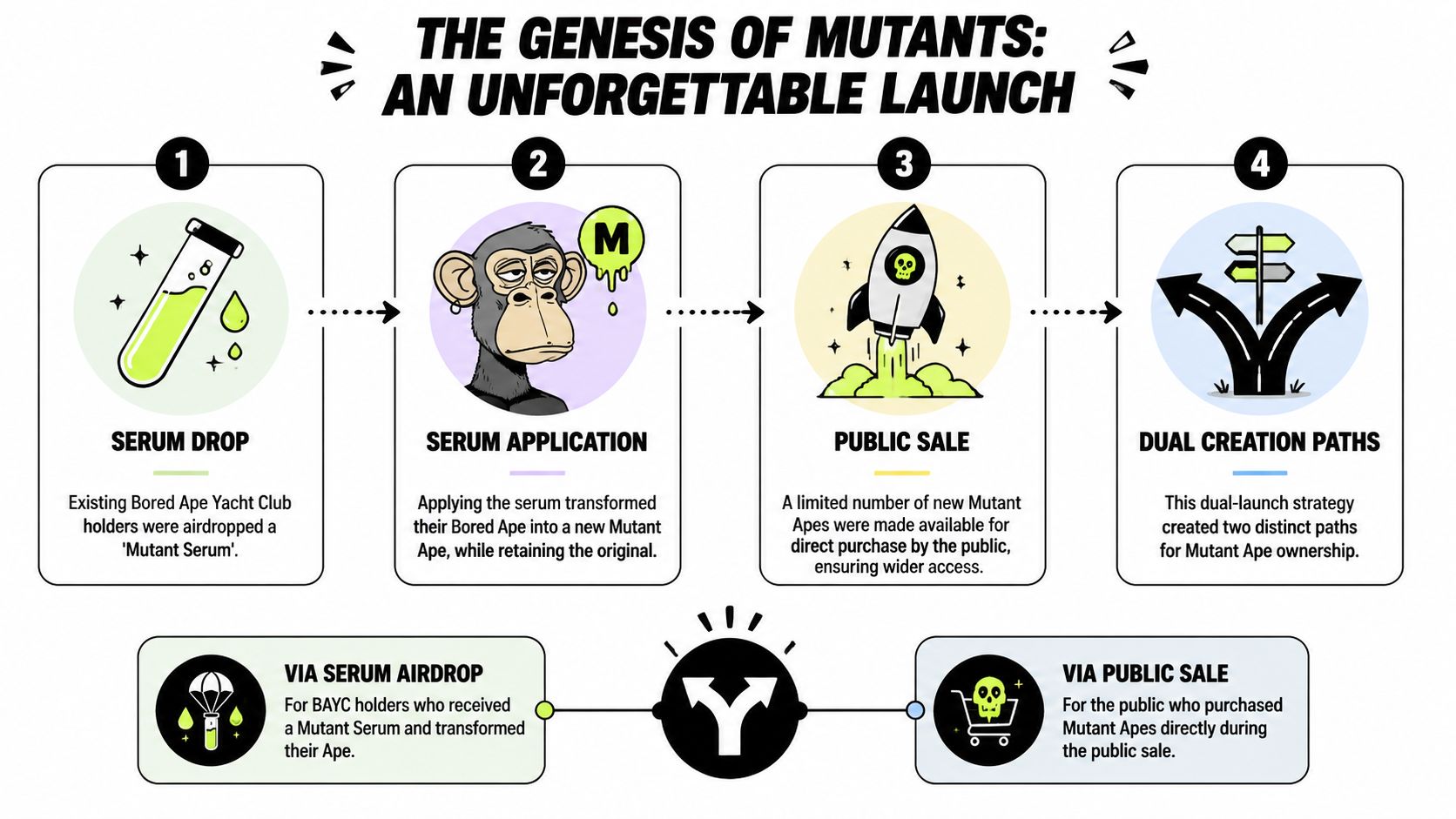
On August 28, 2021, Yuga Labs released MAYC through a split structure that remains unusually well-designed even by current standards. Existing BAYC holders had already received Mutant Serum, which could produce 10,000 new Mutants, while another 10,000 Mutant Apes were sold to the public through a Dutch auction that opened at 3 ETH and cleared rapidly, as summarized by NFT Price Floor's overview of Mutant Ape Yacht Club.
That design choice mattered more than the speed of the sellout.
Yuga gave incumbents a way to expand their exposure without selling their original apes, and it gave new entrants a path into the same brand universe without requiring BAYC-level capital. In a speculative market, that sounds simple. In practice, it solved a hard problem. The project increased total supply while preserving status segmentation between the flagship collection and its lower-cost sibling.
A standard NFT launch usually pushes every buyer through one mint funnel. MAYC created a more durable ownership ladder:
BAYC holders received serum
They could create a second asset tied directly to an existing ape.Public buyers entered through auction
They gained branded exposure without first acquiring BAYC.Both groups landed in the same Yuga network
The collection expanded membership without severing its link to the parent brand.
Why the launch structure still matters
For long-term investors, the key takeaway is not that MAYC sold quickly. Many 2021 collections sold quickly and then disappeared. The stronger signal was structural. Yuga used MAYC to prove it could widen participation and keep BAYC positioned above it rather than beside it.
That distinction helps explain why MAYC held relevance after the hype cycle cooled. It was issued as a second tier inside an existing ecosystem, with built-in provenance, a defined relationship to BAYC, and a larger holder base that could support liquidity over time. Those features gave MAYC a different investment profile from standalone collections that had to build culture, utility, and market depth from zero.
The launch also hinted at what would matter later in a mature NFT market. Capital became more selective. Buyers started favoring collections with credible brand architecture, not just scarcity theater. MAYC fits that shift well because its origin mechanics tied it to Yuga's strongest asset while keeping the entry point materially lower than BAYC.
From an analyst's perspective, that is the legacy of the launch. MAYC was an expansion strategy disguised as a mint, and that is a large part of why it still sits in the serious-investor conversation long after the easy speculation left the sector.
Decoding the Mutation Serum Mechanics and Rarity
A year after launch, the speculative frenzy around profile-picture NFTs had already started to fade. Yet MAYC kept trading, and one reason was hiding in plain sight: Yuga did not treat rarity as a static mint outcome. It built rarity into a process.
That distinction still shapes how serious buyers price Mutants today. A MAYC token is not only a set of traits on a JPEG. It is the result of a specific on-chain event, tied to a finite serum type, an irreversible burn mechanic, and a parent collection that remained intact after mutation.
The three serum classes
The official Mutant Ape Yacht Club collection page on OpenSea describes three serum categories that produced the collection's hierarchy:
| Serum Type | Total Supply | Mutation Effect | Rarity Level |
|---|---|---|---|
| M1 | 7,500 | Baseline mutations | Most common serum tier |
| M2 | 2,492 | More aggressive visual changes | Scarcer tier |
| M3 Mega Mutant | 8 | Extreme transformation | Ultra-rare tier |
Those supply bands did more than create scarcity. They created market segmentation inside the same collection.
M1 established depth and broader accessibility. M2 introduced a meaningful rarity premium without becoming illiquid. M3 sat in a category of its own, functioning less like a standard collectible and more like a trophy asset. In a mature NFT market, that structure matters. Collections hold value better when they serve different buyer profiles without blurring the pecking order.
Why the serum mechanic still matters
Yuga's design choice was unusually efficient. Applying a serum consumed the serum and produced a new Mutant Ape, while the original Bored Ape stayed with the owner, as explained in CoinGecko's MAYC overview. That made MAYC an expansion layer, not a replacement cycle.
For investors, the consequence is straightforward. The mutation event increased ecosystem inventory without forcing BAYC holders to surrender the core asset. BAYC preserved its top-tier status, while MAYC gained immediate provenance, distribution, and cultural legitimacy. Few NFT collections have expanded supply without weakening the flagship brand. Yuga managed it by keeping the two tiers economically linked but clearly separated.
That is a stronger long-term setup than many later NFT experiments, where added supply diluted attention faster than it created new demand.
Reading MAYC rarity the right way
Trait tools can help, but MAYC rarity is not captured by a single rank number. Buyers usually need to evaluate three layers at once:
Serum path
M1, M2, and M3 do not carry the same scarcity profile or buyer demand.Visual trait mix
Certain clothing, fur, and background combinations attract premiums because they are both scarce and visually recognizable.Provenance and context
A Mutant tied to a notable wallet, an early ecosystem participant, or a memorable sale can trade above trait-floor logic.
This multi-layered structure is one reason MAYC has aged better than many 2021 collections. Static rarity systems tend to flatten over time. Process-driven rarity can hold attention longer because collectors are valuing both the object and the event that created it.
That same logic appears in other branded NFT experiments, including licensed drops where scarcity, distribution, and collector psychology intersect differently, such as the Hot Wheels NFT market and release structure. MAYC remains the cleaner example because its supply logic is easier to verify on-chain and more tightly connected to a parent asset with established status.
MAYC rarity comes from three inputs at once: fixed serum supply, irreversible mutation, and a permanent connection to BAYC.
That combination supports the long-term investment case. In a post-hype market, collections with durable value usually have clear hierarchy, auditable scarcity, and a reason to remain relevant after the mint story ends. MAYC checks those boxes more convincingly than many lower-cost PFP collections, while still offering a lower entry point than BAYC for investors who want exposure to Yuga's brand layer without paying flagship pricing.
How to Buy and Sell Mutant Ape NFTs
A buyer who chases the floor on a quiet afternoon can end up overpaying by evening. A seller who lists a rare Mutant like a generic one can leave meaningful value on the table. MAYC trading looks simple on the surface, but the spread between a good decision and a costly one usually comes down to preparation, timing, and trait literacy.
What to prepare before you enter the market
Start with custody and execution. MAYC is expensive enough that basic wallet mistakes matter, and Ethereum gas can change your true entry price more than new buyers expect.
Use a wallet you control
MetaMask remains the standard option for Ethereum NFT trading. For higher-value purchases, pairing it with a hardware wallet reduces the risk of a single compromised device costing you the asset.Fund with ETH
You need enough ETH to cover both the NFT and transaction fees. Keeping a buffer matters if network activity spikes while you're trying to buy.Choose a marketplace with real liquidity
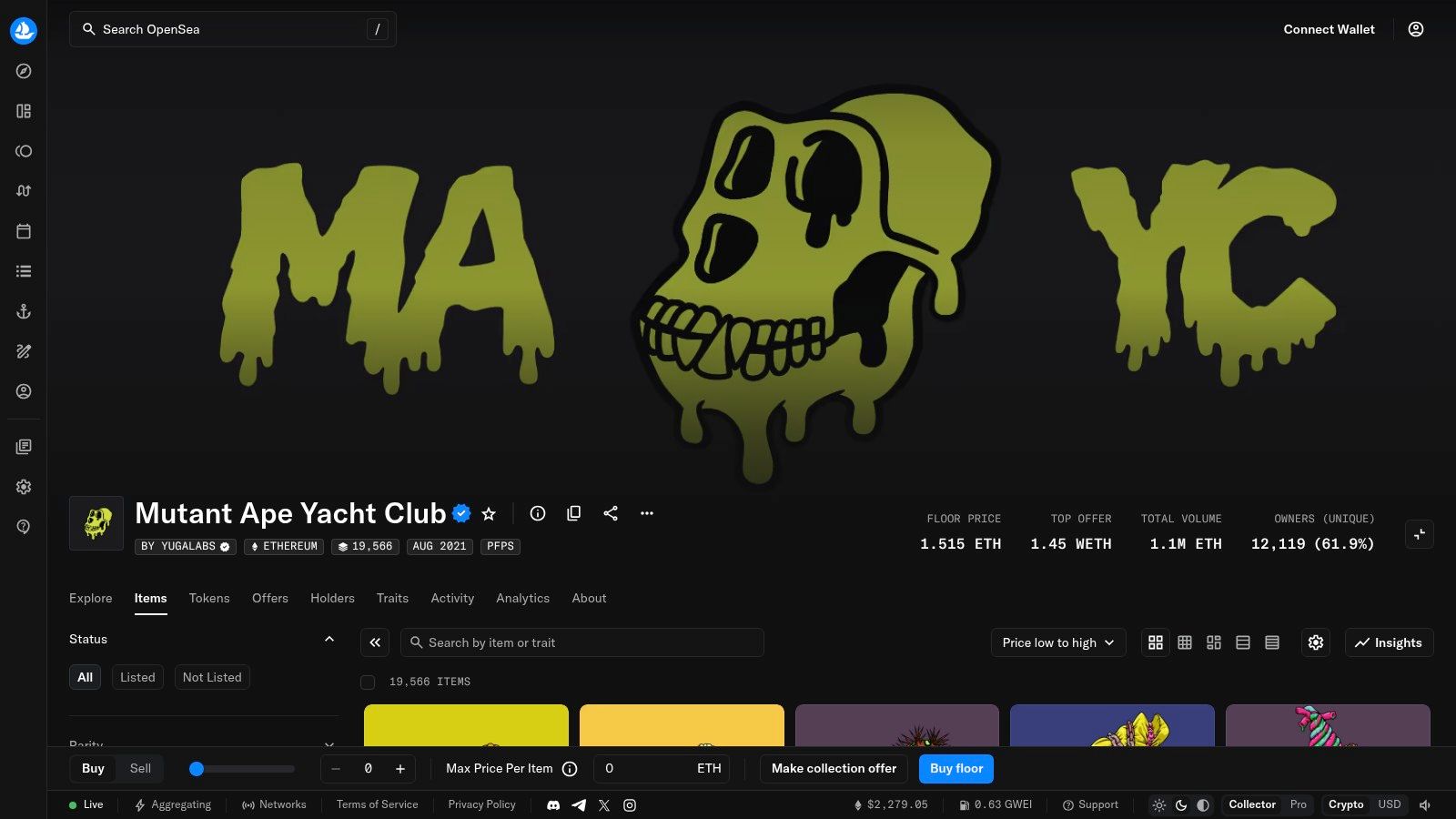
OpenSea and Blur still capture the bulk of serious Ethereum NFT order flow, which gives buyers a better read on floor depth and recent sales.
The setup is straightforward. The harder part is avoiding rushed decisions once capital is ready.
How to evaluate a listing
A MAYC listing should be read like an individual market, not a ticker symbol. Two apes near the same floor can have very different exit prospects a few months later.
Use this checklist before you buy:
Confirm the collection page is authentic
Copycat collections and misleading listings still trap buyers who move too quickly.Review the traits, not just the picture
Some combinations attract sustained collector demand, while others trade close to the floor even in stronger market conditions.Check recent sales and listing depth
A thin floor can move fast. If only a small number of apes are listed near your target price, apparent value can disappear as soon as one or two buyers step in.Decide what exposure you want
A floor Mutant gives cheaper entry into the Yuga ecosystem. A rarer Mutant is a more specific bet on scarcity, collector recognition, and future resale demand.
That distinction matters more in a mature NFT market than it did during the 2021 boom. Investors now tend to reward assets with clearer long-term status inside an established ecosystem. MAYC often fits that profile better than many branded collectibles because it sits inside Yuga's hierarchy and still trades at a meaningful discount to BAYC.
Collectors who study adjacent markets can see a similar pattern in brand-driven drops, where structure and audience shape resale behavior. The Hot Wheels NFT collecting model is a useful comparison because it shows how branded scarcity can support trading activity, even though the buyer base and utility profile differ sharply from MAYC.
Buyer rule: Treat each MAYC as its own position. Entry price, trait quality, and expected liquidity all matter.
Video walkthroughs can help if you want to see the marketplace flow before risking capital:
How sellers should think about liquidity
Selling discipline matters just as much as buying discipline. MAYC is a recognized collection with persistent demand, but liquidity is uneven across the set.
A floor-tier Mutant usually competes on price and speed. A stronger trait profile often justifies patience, better listing presentation, and closer study of comparable sales. Sellers who ignore that difference tend to either wait too long at unrealistic prices or exit too cheaply because they priced a distinctive asset like a commodity.
The long-term thesis also affects sale strategy. If you believe MAYC will continue to hold value as a lower-cost entry into the Yuga ecosystem relative to BAYC, then the decision to sell should be tied to portfolio rotation, tax planning, or a change in the broader NFT cycle, not short-term floor noise alone.
For practical execution, list into active hours, monitor undercutting, and write a description that explains why your ape stands out if it is above floor quality. If your priority is immediate liquidity, price close to recent comparable sales. If your ape has recognizable rarity or provenance, give the market time to find the right buyer.
The Mutant Ecosystem Utility Community and Roadmap
In the 2021 rush, owning a Mutant often looked like a cheaper way to stand near BAYC. In the quieter market that followed, MAYC had to prove something harder. It had to show that demand could survive after speculation faded and that membership in Yuga's orbit still carried economic and cultural value.

Membership inside the Yuga stack
MAYC still works as a lower-cost entry point into the Yuga ecosystem than BAYC, but that framing is incomplete. The better way to view it is as a recurring access asset whose value depends on whether Yuga continues to build products, events, and identity layers that matter to holders.
Yuga's own ecosystem history supports that view. Mutants were included in ApeCoin-related benefits and in Yuga's broader push toward interoperable avatars, branded experiences, and metaverse participation. Those benefits matter less as one-off perks than as evidence of a consistent operating model. Yuga has treated MAYC as part of its core consumer base rather than as a side collection.
That distinction matters for valuation. In a mature NFT market, collections with no clear post-mint role tend to compress toward art-only pricing. MAYC has held a stronger position because ownership has repeatedly linked to community access, ecosystem participation, and visibility inside one of the few NFT brands that still operates at scale.
Utility has changed from hype fuel to downside support
During the boom, utility often served as marketing language attached to rising prices. Today it functions more like downside support. Holders care whether an NFT keeps them connected to future releases, token ecosystems, live events, and digital identity use cases that remain relevant even when trading activity cools.
That makes MAYC different from many older PFP projects. Its investment case does not depend on matching BAYC's prestige. It depends on maintaining a durable gap between "culturally adjacent to Yuga" and "natively inside Yuga." MAYC sits on the right side of that line.
The long-term angle is straightforward. If BAYC remains the flagship social status asset, MAYC can continue to benefit as the broader membership layer with better relative affordability. In a post-hype market, that position can be more resilient than investors first assumed because many buyers no longer want maximum exclusivity at maximum price. They want credible ecosystem exposure with lower capital at risk.
Community, identity, and the roadmap question
Community still matters here, but not in the vague sense often used in NFT marketing. Strong communities produce repeat participation, preserve attention during downcycles, and keep an asset legible to new entrants. MAYC benefits from BAYC adjacency, yet it also has its own holder base, trading identity, and cultural memory from one of the most recognizable expansion collections in NFTs.
The roadmap question is more nuanced. Investors should not underwrite MAYC based on abstract promises. They should watch whether Yuga keeps building environments where a Mutant identity has practical use and social relevance. That includes gaming, avatar portability, token-gated participation, and digital worlds where branded identities carry status or utility. Projects exploring persistent virtual economies, such as the Infinite World Game metaverse model, help explain why that direction still matters.
For a long-term holder, MAYC's appeal is not that every roadmap item will drive price. It is that the collection already occupies a durable slot in a larger ecosystem that has more paths to relevance than a standalone PFP set. In a market that now prices access, brand depth, and survivability more carefully, that is a stronger investment argument than hype ever was.
MAYC Price History and Market Performance
A buyer who entered MAYC near the 2022 peak and held through the unwind learned the hard version of NFT market structure. Brand recognition can slow a drawdown. It does not prevent repricing. That distinction matters because MAYC's chart is less a story of collapse than a story of maturity.
The collection followed the broad arc of the NFT cycle. It surged during the speculative phase, then reset hard as liquidity left the sector. As noted earlier, MAYC once traded at a level that reflected peak demand for Yuga exposure, not just the standalone cash flow or utility that holders could reasonably expect. The correction since then has forced the market to separate temporary hype from durable positioning inside the Yuga ecosystem.
That reset is uncomfortable for late-cycle buyers, but analytically useful. In a mature market, relative strength matters more than absolute peak price. MAYC still clears a test that many former "blue-chip" collections failed. It remains culturally legible, regularly traded, and relevant enough that investors continue to price it as a live asset rather than a historical artifact.
From peak valuation to post-hype repricing
The key takeaway is not that MAYC fell from its highs. Almost every major NFT collection did. The more important point is what the market did after the fall.
For BAYC, top-tier status has historically come from extreme scarcity, stronger signaling power, and tighter alignment with the Yuga brand. MAYC sits one level below that. In a euphoric market, that gap can look massive because buyers pay up for prestige. In a colder market, the spread often gets judged against practical exposure. That is where MAYC's long-term case becomes more interesting. It offers access to the same brand orbit, but at a price point that more investors can justify after speculation has been flushed out.
That does not mean MAYC is insulated. It means its value proposition becomes clearer when capital is selective.
Liquidity matters more than nostalgia
The collection still trades often enough to stay in serious portfolio discussions, and that is a stronger signal than social sentiment. In NFTs, floor price without liquidity can be misleading. A quoted floor only matters if holders can transact near it and if buyers still show up during weak conditions.
MAYC has retained that baseline market function through a prolonged downturn. That alone separates it from many expansion collections that briefly rode a parent brand and then lost relevance. For investors working through a broader crypto bear market environment, this is the right lens. Price damage and market relevance are not the same thing.
A few conclusions follow from that market behavior:
MAYC has moved from momentum asset to benchmarked ecosystem asset
Buyers now judge it against Yuga's broader execution, not just short-term NFT sentiment.Its discount to BAYC can be a feature, not just a weakness
In a risk-aware market, lower entry cost can support demand if holders still get meaningful ecosystem exposure.Liquidity keeps the investment thesis alive
Collections that stop trading lose price discovery, and then valuation becomes mostly theoretical.Future upside likely depends on relative re-rating, not a return to mania
The cleaner bull case is that MAYC strengthens its role as the scalable entry point to Yuga's identity layer.
That last point is the one investors often miss. MAYC does not need to become BAYC to perform well from here. It needs to keep proving that it deserves a durable place beneath BAYC in the same hierarchy. If Yuga's ecosystem continues to matter, a post-hype market may reward that positioning more rationally than the last cycle did.
Evaluating MAYC as an Investment Risks and Future Outlook
The lazy thesis says MAYC is just a cheaper way to buy into Bored Ape culture. The better thesis is more uncomfortable. MAYC gives you meaningful exposure to Yuga's ecosystem, but it may also reveal how value gets distributed unevenly inside that ecosystem.

The bullish case for MAYC
The long-term bull argument rests on four pillars.
Brand gravity
Yuga Labs remains one of the most recognizable names in NFTs.Ecosystem adjacency
MAYC holders sit close to token, metaverse, and community initiatives that smaller collections can only imitate.Structured rarity
The serum system gave MAYC a more durable internal market logic than many copycat projects.Accessibility relative to BAYC
For many investors, MAYC is the practical path into the ecosystem.
This is why MAYC still appears in serious conversations around Web3 identity, tokenomics, and digital asset portfolios. If NFTs regain relevance through gaming, social identity, AI-enhanced avatars, or tokenized memberships, established ecosystem assets may benefit first.
The hard truth about relative performance
The bear case is stronger than many holders like to admit.
According to IQ.wiki's MAYC analysis, post-2022 data shows MAYC's floor price fell by about 92% from its peak to around 1.5 ETH, while BAYC fell about 65% to around 10 ETH. That underperformance suggests the market didn't treat MAYC and BAYC as equal ecosystem claims.
This is the central investment question. If Yuga's universe grows, who captures the upside first?
BAYC may continue to absorb a disproportionate share of prestige and utility, leaving MAYC as the valuable but secondary layer. If that pattern persists, MAYC can remain relevant and liquid while still delivering weaker long-term value retention than its parent.
Serious investors shouldn't ask whether MAYC is good. They should ask whether MAYC captures enough of Yuga's upside to justify its rank below BAYC.
That distinction matters for portfolio construction. A trader may welcome MAYC's volatility. A long-duration collector may prefer the stronger flagship if capital allows. Someone building a diversified NFT basket may use MAYC as ecosystem exposure while keeping position size disciplined. For a broader framework on controlling risk and timing in speculative markets, trading education like best strategies for trading becomes relevant even if the asset class is NFTs rather than liquid tokens.
What next could look like
My read is that MAYC's future won't be decided by nostalgia. It will be decided by integration.
If Yuga keeps building products where branded identity matters, MAYC can preserve relevance. If Web3 leans harder into metaverse access, interoperable avatars, AI-personalized digital identity, and tokenized community layers, MAYC has a credible place in that stack. Layer 2 adoption could also help the wider NFT market by lowering friction for participation, even if the collection's main identity remains tied to Ethereum.
But investors should stay clear-eyed. MAYC is not automatically a bargain because it sits below BAYC. Sometimes a lower-tier asset is discounted for good reason. The opportunity lies in the possibility that the market has already priced in too much pessimism while leaving the ecosystem option value underappreciated.
That's the core thesis. MAYC isn't a blind blue-chip buy. It's a selective bet on second-tier status inside a first-tier brand.
Frequently Asked Questions About MAYC
The fastest way to remove confusion around mutant ape yacht club is to answer the practical questions directly.
| Question | Answer |
|---|---|
| What is MAYC in simple terms? | MAYC is a Yuga Labs NFT collection connected to the Bored Ape Yacht Club ecosystem. It acts as a lower-tier but still meaningful entry into that brand universe. |
| How were Mutant Apes created? | Some came from public sale, while others were created through serum applied by BAYC holders. |
| Does mutating a Bored Ape destroy the original BAYC? | No. The serum process created a new Mutant Ape NFT while the owner kept the original Bored Ape, as established earlier in the article. |
| Are all Mutant Apes equally rare? | No. Serum tier and individual traits both affect rarity. That's why buyers often examine trait composition before purchasing. |
| What makes MAYC different from random derivative NFT projects? | MAYC was issued by Yuga Labs and tied directly into an established ecosystem with real membership utility, token-linked benefits, and brand history. |
| Is MAYC still liquid? | Relative to most NFT collections, yes. Earlier market data in this article showed that it still records meaningful trading activity. |
| Is MAYC better than BAYC as an investment? | Not necessarily. The strongest evidence in this article shows MAYC underperformed BAYC after the market peak, which is a major risk factor. |
| What wallet should I use to buy NFTs? | Many Ethereum users choose MetaMask. If you're learning wallet basics first, this guide to Phantom Wallet helps explain the general logic of self-custody wallets and NFT interactions. |
A final practical note matters here. MAYC makes the most sense for buyers who understand what they're purchasing. This isn't only a collectible. It's an ecosystem-positioned digital asset whose value comes from brand, utility, rarity, and market structure all at once.
If you want more grounded analysis on NFTs, crypto markets, blockchain gaming, DeFi, and the next wave of Web3 trends, visit Coiner Blog. It's a solid place to follow practical research, sharper market context, and investor-focused breakdowns without the usual hype fog.