
Bitcoin Genesis Block: Unveiling Secrets
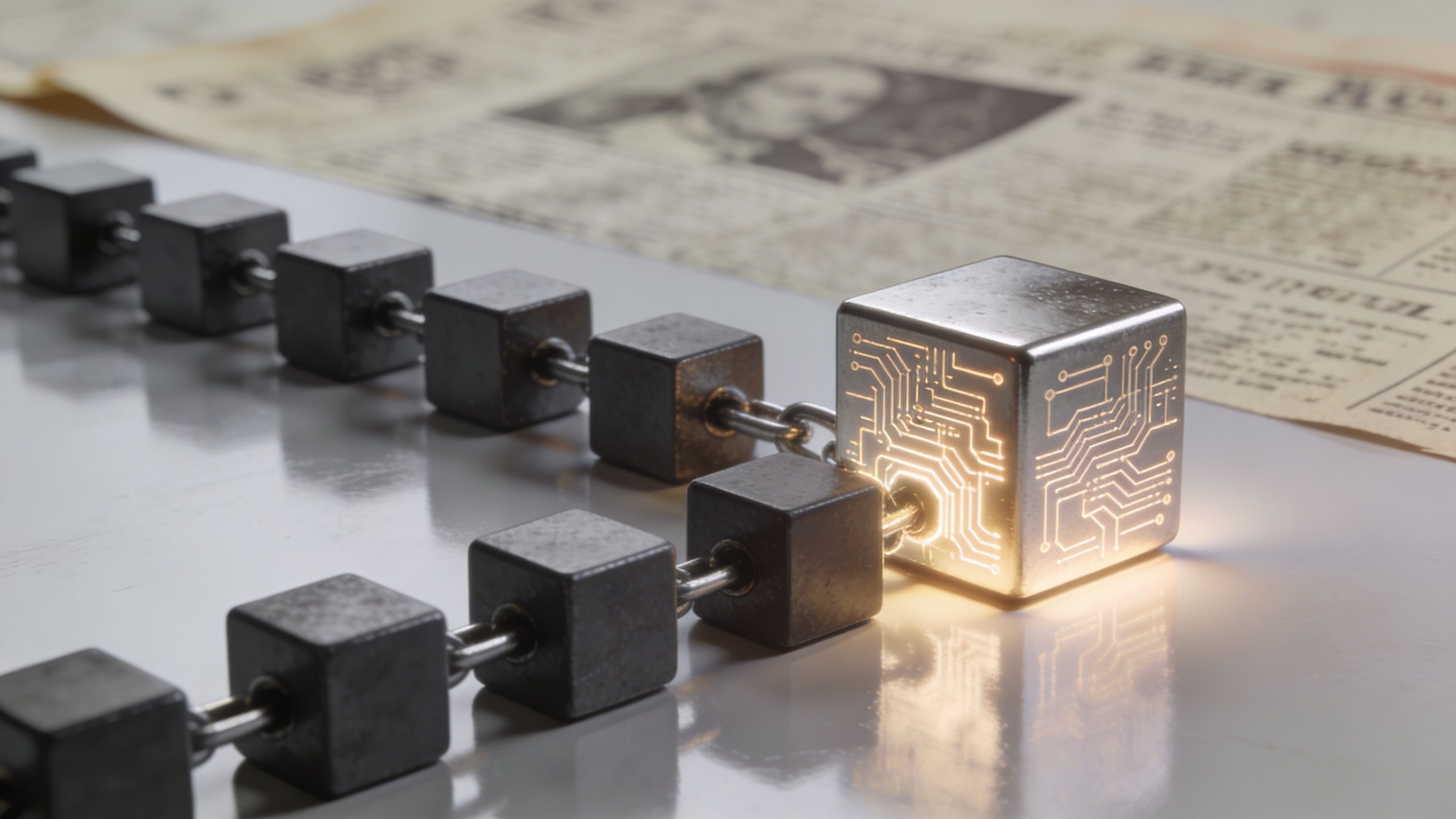
A programmer opens an old client, checks Block 0, and sees a newspaper headline frozen inside a hash-linked record. That tiny artifact still tells one of the clearest stories in crypto: Bitcoin didn’t begin as a meme, a token launch, or a venture-backed app. It began as a response to a trust problem.
If you want to understand why the bitcoin genesis block still matters in 2026, you have to read it as both software and statement. It’s the first block in the chain, the root that every node accepts, and the symbolic starting gun for a financial system built around transparency, scarcity, and verification.
Table of Contents
- The Story of Block 0 Satoshi's Message in a Bottle
- Anatomy of the Genesis Block The Technical Blueprint
- The Mystery of the Unspendable Coins and Protocol Quirks
- Your Guide to Viewing the Genesis Block
- More Than Code The Symbolism of the First Block
- The Genesis Legacy From Bitcoin to DeFi and RWAs
- Frequently Asked Questions About the Genesis Block
The Story of Block 0 Satoshi's Message in a Bottle
Late on January 3, 2009, Bitcoin entered the world with a block that read less like a software log and more like a statement of purpose. In Block 0, Satoshi Nakamoto embedded a line from that day’s newspaper: “The Times 03/Jan/2009 Chancellor on brink of second bailout for banks.”
That sentence gave Bitcoin a birth certificate and a thesis.
It marked the block in time, showing it could not have been created before that headline existed. It also tied Bitcoin’s launch to a specific political and financial backdrop. The global financial system had just been shaken. Bank rescues were in the headlines. Trust in intermediaries looked weaker than many investors had assumed.

A timestamp with intent
New readers often wonder whether the message was just a signature or an inside joke. A better way to read it is as a public marker placed inside the first block so anyone could inspect Bitcoin’s origin without asking permission from a founder, company, or government archive.
That design choice still matters. Bitcoin did not begin with a venture allocation, a private cap table, or a foundation press release. It began with an auditable artifact that any node operator can verify for themselves. Public verification is the core innovation.
The message also framed the project’s ambition with unusual clarity. Bitcoin proposed a system for transferring value in which issuance, ownership, and settlement could be checked by the network instead of trusted to a central balance sheet. For tech investors, that is the important historical point. The Genesis Block was not only the first entry in a ledger. It was the opening move in a new trust model.
Why that message still resonates in 2026
The headline inside Block 0 still feels current because the tension it captured never went away. Markets still argue over monetary credibility, counterparty risk, censorship resistance, and who should control the rails of finance.
That is why the Genesis Block keeps appearing in conversations far beyond Bitcoin itself. Fair launch debates across crypto often use Bitcoin as the reference case. Ordinals brought fresh attention to the idea that block space can carry culture as well as value. Layer 2 networks are extending Bitcoin’s utility without changing the historical weight of the base layer. Even tokenized real-world assets inherit part of this origin story. They are trying to bring bonds, credit, property, and other off-chain claims into systems where verification happens in public.
Seen from 2026, Block 0 looks less like a relic and more like the first chapter of a much larger market structure. If you track where digital assets may be heading next, these crypto predictions for 2025 give useful context for why Bitcoin’s trust-minimized design still anchors so much of the industry.
Anatomy of the Genesis Block The Technical Blueprint
A block contains data, and its header summarizes that data. The Genesis Block matters because it gives us the first working example of Bitcoin’s design, not as theory, but as a live object the network could verify.
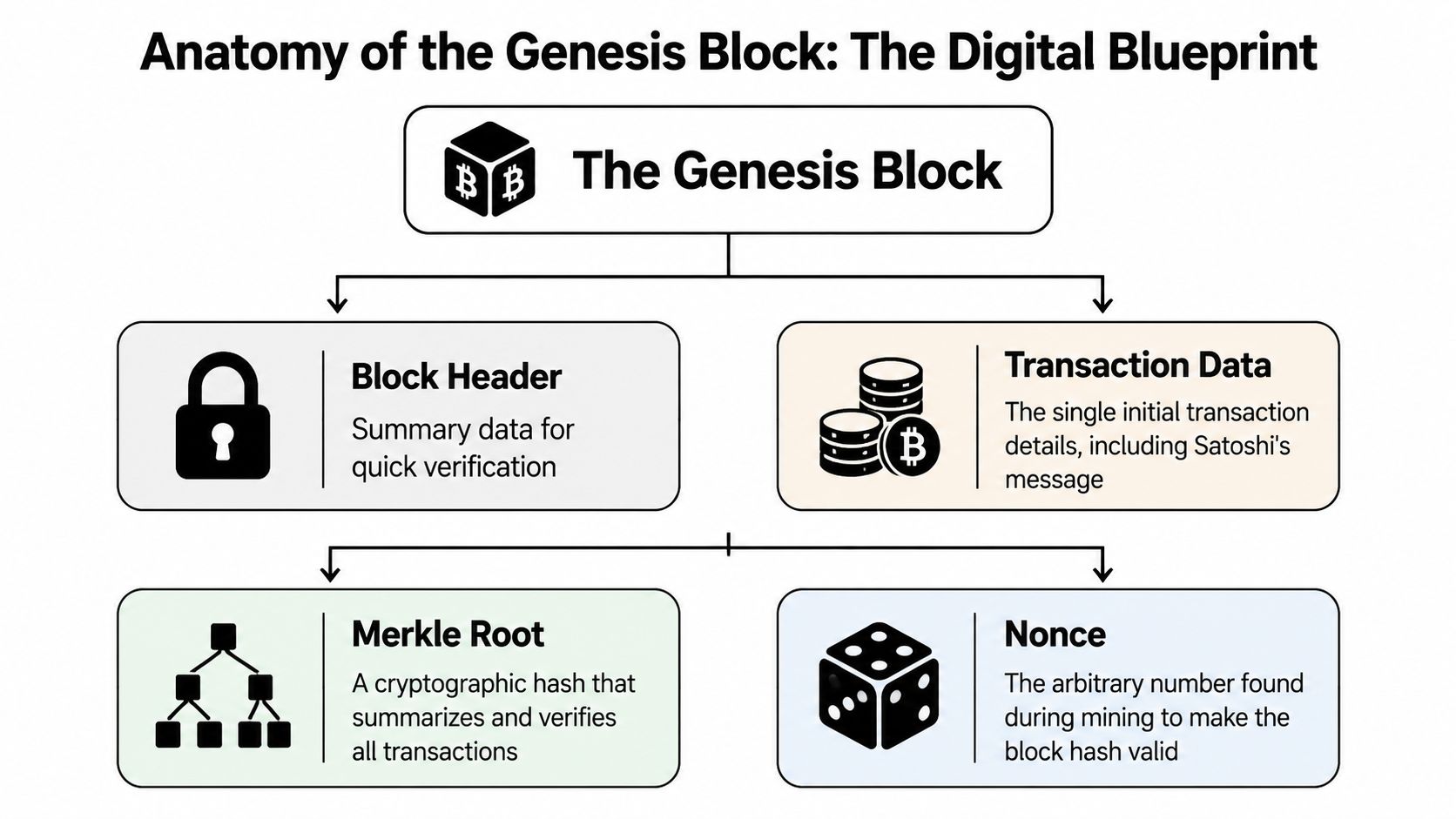
Once you see how Block 0 is put together, several ideas click into place at once. You can see how miners prove work, how nodes check history efficiently, and why later systems such as Layer 2 rollups also depend on compact cryptographic summaries rather than re-reading every piece of raw data from scratch.
What is actually inside the Genesis Block
At a high level, the block has two layers.
The first is the header, a short summary that nodes hash and validate. The second is the transaction data, which records what the block contains. In the Genesis Block, that transaction data is unusually simple because there is only one transaction, the coinbase transaction.
Here are the parts that matter most:
| Component | Plain-English meaning | Why it matters |
|---|---|---|
| Header | The block’s summary record | Lets nodes verify blocks efficiently |
| No previous hash | Nothing came before Block 0 | Marks the chain’s fixed starting point |
| Merkle root | A compact fingerprint of the included transactions | Lets nodes confirm transaction integrity |
| Nonce | A value miners changed during the hash search | Helped produce a valid block hash |
| Coinbase transaction | The special first transaction in a block | Created the first block reward |
The missing previous hash is the easiest part to understand. Every later block points backward to an earlier block. The Genesis Block has no earlier block to reference, so that field is effectively empty. That is what makes it the root of the chain.
The Merkle root is where readers often pause.
A Merkle root is a single digest derived from all transactions in the block. If a block contains many transactions, Bitcoin hashes them in pairs, then hashes those results again, repeating the process until one final value remains. That final value goes into the header. In Block 0, there was only one transaction, so the structure was simple. The idea, though, was built to scale far beyond one transaction.
A useful way to read this is as compression for verification. Instead of carrying every transaction detail inside the header, the block carries one short cryptographic commitment to the full set. That design choice still echoes through crypto infrastructure in 2026. Ordinals rely on the scarcity and permanence of Bitcoin block space. Layer 2 systems use similar commitment logic to post proofs and state summaries. Tokenized real-world assets also depend on the same broad principle: represent larger sets of claims with compact, verifiable records that many participants can check independently.
Why the header matters so much
The header is the part miners work on.
They repeatedly hash the header while adjusting fields such as the nonce until the result satisfies Bitcoin’s difficulty target. If the hash fits the rule, other nodes can verify that fact quickly. This asymmetry is one of Bitcoin’s elegant design choices. Producing valid work is hard. Checking it is easy.
That mechanism also helps explain why Bitcoin became the reference point for fair launch debates. The Genesis Block did not begin with an insider allocation table, a treasury vesting schedule, or a private cap table. It began with a publicly verifiable block structure and an open set of rules that anyone could inspect in the code and on the chain.
The coinbase transaction completes the picture. It is the special transaction that creates the block reward. In the Genesis Block, it generated the first 50 BTC and established the opening subsidy conditions for the network. The block was also hardcoded into early clients so every node began from the same historical anchor.
For readers who want a stronger grounding in the math and security assumptions behind hashing, commitments, and proof systems, this guide to the future of cryptography adds useful context.
The Mystery of the Unspendable Coins and Protocol Quirks
One of the strangest facts in Bitcoin is that the first reward exists, but it can’t be spent. New readers often assume Satoshi chose to leave it untouched for symbolic reasons. The explanation is more technical, and more interesting.
The Genesis Block’s 50 BTC are permanently unspendable because the node excludes the genesis coinbase from its transaction database, so spend attempts are rejected even though the output uses a valid P2PK script. In practical terms, the coins are locked away by protocol behavior, not waiting for someone to wake up and move them.
Why the first 50 BTC can't move
That distinction matters because it says something important about Bitcoin. People don’t get to reinterpret chain rules after the fact just because a historical artifact seems valuable. The software, the consensus rules, and the shared chain history define what’s real.
There’s a broader lesson here for investors looking at tokenomics, fair launches, and vesting claims in newer networks:
- Read the implementation, not just the narrative. A project’s website can say one thing while contract logic says another.
- Genesis conditions matter for years. Early quirks often become permanent parts of a network’s identity.
- Consensus is operational. It lives in code and node behavior, not in branding.
If you spend time evaluating protocol risk, this blockchain security archive is worth bookmarking.
The forgotten pre-genesis clue
There’s another oddity that rarely makes it into mainstream explainers. Satoshi’s initial source code released on BitcoinTalk included an earlier pre-genesis block that never became part of the live Bitcoin chain. Historical code analysis describes it as a placeholder with a different nBits field, which points to manual iteration before the public network launch (CoinGeek discussion of the pre-genesis mystery).
That’s a useful reminder that even iconic systems pass through messy development stages. Bitcoin feels inevitable in hindsight. It wasn’t. Someone had to choose parameters, test assumptions, and discard earlier versions before the world saw Block 0.
The polished mythology came later. The software history still shows the fingerprints of experimentation.
Your Guide to Viewing the Genesis Block
You don’t need a mining rig or a developer background to inspect the bitcoin genesis block yourself. A public block explorer is enough.
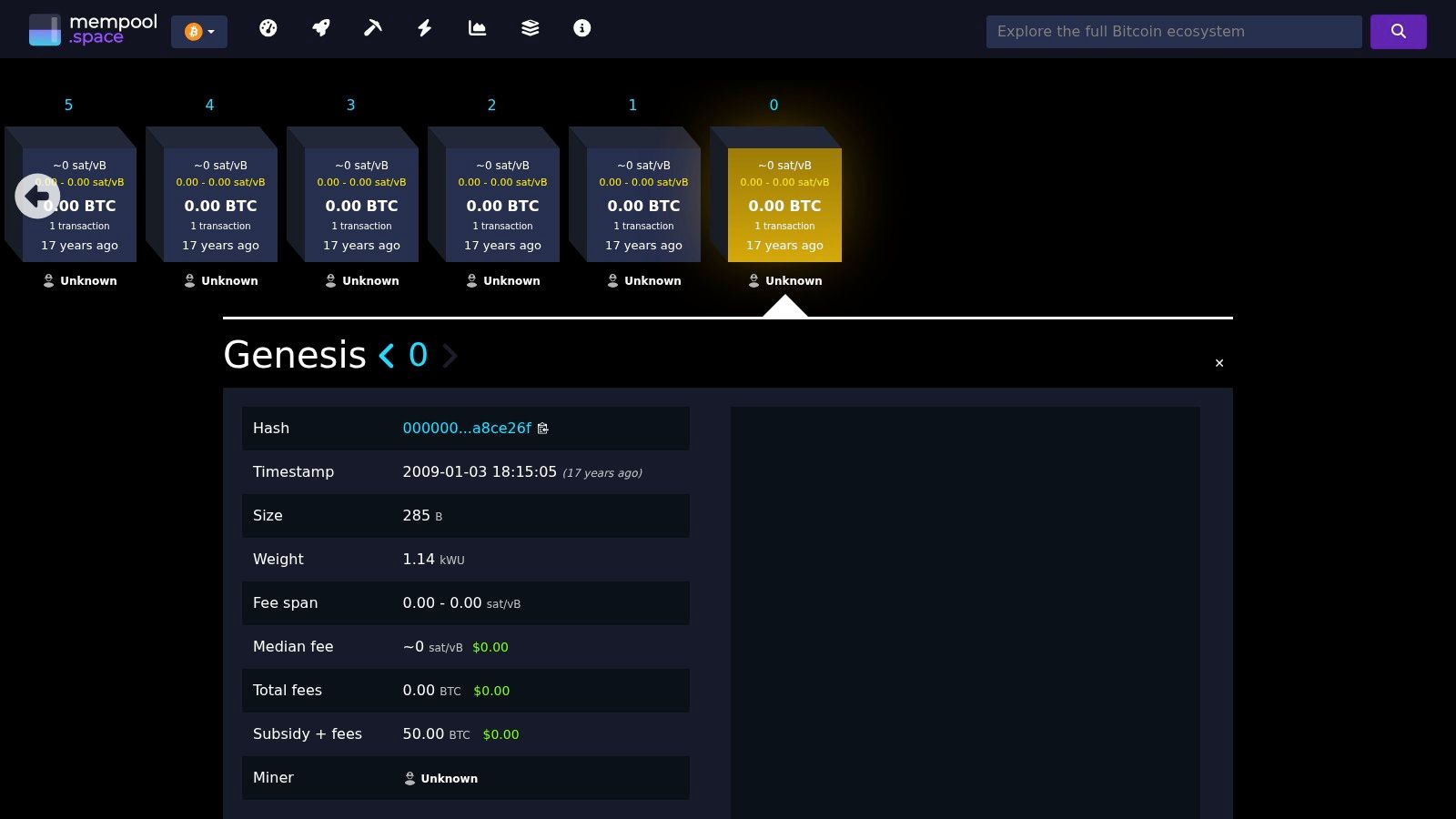
Start with an explorer page that displays Block 0 clearly. The screenshot below gives you a reference point for what you’re looking for.
How to inspect Block 0 on a public explorer
Use this process:
- Open a Bitcoin block explorer. Mempool.space is a common choice because the interface is clean and visual.
- Search for the Genesis Block hash. Enter the known Block 0 hash and load the result.
- Check that it shows block height 0. That confirms you’re looking at the chain’s root.
- Inspect the transaction area. You should see the single coinbase transaction.
- Look for the embedded newspaper text. This is the human-readable clue inside the historical record.
For many readers, this is the moment Bitcoin stops feeling theoretical. You’re not reading a retelling. You’re verifying an artifact.
What to focus on when the page loads
The explorer page can feel busy, so narrow your attention to a few fields:
- Hash: This identifies the block uniquely.
- Height: For the Genesis Block, this should read 0.
- Timestamp: This ties the record to a real moment in time.
- Transaction section: This contains the coinbase transaction and embedded message.
If you want a broader set of walkthroughs and on-chain inspection examples, this blockchain analysis collection covers the mindset behind reading chain data well.
A video walkthrough can also help if you prefer seeing the process rather than reading about it.
Advanced users can verify the same information through their own node with RPC tools. The method is different, but the principle is the same. Don’t trust a summary if you can inspect the record.
More Than Code The Symbolism of the First Block
Technical systems usually don’t get mythology this durable unless they also change how people think. That’s what the bitcoin genesis block did.
Bitcoin didn’t just launch a chain. It introduced a different trust model. Instead of asking users to trust a central operator, it asked them to trust open rules, transparent history, and distributed verification.
Why immutability changed the trust model
The first block became the anchor for every block that followed. Because each new block references the chain behind it, the root matters far beyond its size. It gives the network a shared origin that every honest node can agree on.
That may sound like a narrow engineering detail, but it has philosophical weight. In finance, disagreement over records creates disputes over ownership, priority, and legitimacy. Bitcoin replaced much of that with a public ledger that participants can independently inspect.
This is why the Genesis Block feels constitutional. It didn’t just start a database. It established the rule that the record itself would be public, ordered, and resistant to quiet revision.
Public verification is the real innovation. Digital scarcity only works if nobody can rewrite the origin story.
A constitution written into software
The symbolism goes deeper than anti-bank sentiment. The block’s design combined several principles that later shaped Web3 more broadly:
- Transparency: anyone can inspect the historical record.
- Immutability: chain history becomes harder to alter as the network grows around it.
- Programmatic scarcity: issuance follows rules rather than committee discretion.
- Neutral access: users participate through software, not permission from an institution.
That blueprint influenced far more than Bitcoin maximalism. It informed DeFi ideas about transparent settlement, inspired smart contract systems that expose state changes on-chain, and gave builders a model for creating digital ownership systems with auditable provenance.
It also created a cultural expectation. Crypto users now ask who controls genesis allocations, whether launch conditions were fair, whether code matches public claims, and whether protocol governance can rewrite history. That instinct traces back to the first block.
The market that grew from that seed is now vast, but the enduring lesson is simple. Bitcoin’s origin wasn’t hidden behind a boardroom memo or a cap table. It was published, hashed, and left in public view.
The Genesis Legacy From Bitcoin to DeFi and RWAs
Bitcoin’s first block still casts a long shadow in 2026 because every on-chain system has to answer the same opening question: who set the starting conditions, and can the public verify them?
That question matters far beyond Bitcoin. It sits underneath DeFi launches, Layer 2 rollups, Ordinals, and tokenized real-world assets. The technology changes. The trust problem stays the same.

Why genesis design still matters
The Genesis Block introduced a simple but durable idea. A network should have a public, inspectable point of origin. In Bitcoin, that origin was a block. In modern systems, it might be a contract deployment, a rollup state root, a mint event, or a token issuance schedule. The form differs, but the purpose is the same. Give users a clean starting line they can audit.
That is especially important in RWAs. If a token represents a Treasury bill, a private credit instrument, or a piece of real estate, investors need more than a ticker and a dashboard. They need a chain of custody. Where did the digital claim begin? Who had authority at issuance? Which records can be changed, and which cannot? Bitcoin did not solve off-chain verification for RWAs, but it established the discipline of making the on-chain starting point visible to everyone.
Layer 2 systems inherit the same logic. A rollup begins with an initial state, a sequencer design, and a set of assumptions about how users can exit or verify balances. That is a modern version of the genesis question. Before fees, throughput, or total value locked, serious investors ask whether the launch state was transparent and whether the rules were clear from day one.
Ordinals brought this discussion back to Bitcoin in a different form. By tying inscriptions to satoshis, Ordinals pushed provenance into the spotlight again. The appeal is not only cultural. It is archival. Collectors and builders care about where a digital artifact originated, how it can be traced, and why its history is durable. Those are genesis-era concerns wearing newer clothes.
Fair launches across crypto also owe a debt to Block 0. Bitcoin had no premine, no venture allocation, and no special private sale that gave insiders a separate starting price. Later projects have tried to copy that credibility, sometimes honestly and sometimes only at the branding level. The lesson for investors is straightforward. A project can borrow Bitcoin’s language without borrowing its discipline.
A better way to evaluate modern launches
Genesis design works like a building’s foundation. It is easy to ignore when markets are rising and narratives are loud. It becomes impossible to ignore when stress exposes hidden assumptions.
A practical checklist helps separate genuine transparency from marketing:
| Question | Why it matters |
|---|---|
| Who controlled initialization? | A small group with broad setup powers can shape supply, governance, and censorship risk before the public arrives |
| Is the initial state publicly auditable? | Investors need to inspect contract deployments, rollup parameters, mint logic, and issuance records |
| Can the rules change after launch? | Upgrade paths may be useful, but they also reveal who can rewrite key assumptions |
| How were early tokens or rights distributed? | Insider-heavy allocations often create long-term incentive problems that start at inception |
| Does the on-chain record connect cleanly to the off-chain asset? | RWA systems only earn trust if the digital token and the legal claim stay aligned |
This matters in bear markets as much as bull markets. During periods of stress, speculative stories fade and origin quality matters more. Investors who study what tends to survive a crypto bear market usually end up asking genesis questions, even if they do not use that term.
One more point is easy to miss. As crypto systems become more automated, with agents, bots, and machine-driven execution, the need for a trustworthy starting state grows. Software can process transactions at machine speed, but it cannot repair a dishonest launch design after the fact.
The Genesis Block’s modern legacy is not nostalgia. It is a standard. Block 0 showed that credible systems begin in public, under fixed rules, with a record that anyone can inspect. That standard now shapes how investors judge DeFi launches, how collectors value Bitcoin-native artifacts, how Layer 2 networks earn trust, and how RWA platforms prove that a digital token really starts somewhere real.
Frequently Asked Questions About the Genesis Block
Quick answers to common questions
What is the bitcoin genesis block?
It’s Block 0, the first block of the Bitcoin blockchain and the hardcoded root from which the live network begins.
Who mined it?
The verified historical attribution is Satoshi Nakamoto.
Can the Genesis Block be changed?
Under Bitcoin’s consensus model, changing the root of the chain would break compatibility with the accepted network history. In practice, it functions as the immutable starting point all nodes share.
Can the first 50 BTC be spent?
No. Those coins are treated as unspendable because of how the genesis coinbase is handled by the software.
Did the Genesis Block include normal transactions?
No. It contained a single coinbase transaction.
Why is the newspaper headline important?
It serves as both a timestamp and a statement about the financial environment surrounding Bitcoin’s launch.
Was there anything before the Genesis Block?
There was an earlier pre-genesis block in Satoshi’s initial code, but it was not carried into the live chain.
Why do investors still care about Block 0?
Because it reveals the principles Bitcoin launched with: transparent origin, fixed rules, public verification, and distrust of opaque financial power.
Does understanding the Genesis Block help during bear markets?
Yes. It won’t predict price, but it sharpens your sense of what has lasting value in crypto. This perspective on cryptocurrency bear markets is useful if you’re trying to separate durable fundamentals from noise.
Coiner Blog publishes practical crypto analysis for readers who want more than headlines. If you’re tracking Bitcoin, DeFi, Web3, tokenomics, Layer 2 infrastructure, NFTs, GameFi, and emerging themes like AI and RWAs, explore Coiner Blog for deeper guides and market context.
2 Comments