
Crypto Predictions 2025: An Analyst’s Forecast

A projected $4 trillion total crypto market cap in 2025 changes the frame for this conversation. This isn’t just another cycle call. It suggests crypto is moving from a speculative subculture toward a larger financial and technological stack, with institutional capital, stablecoin payment rails, Layer 2 infrastructure, and tokenized assets all maturing at the same time, according to Galaxy’s 2025 crypto predictions.
That matters because most “crypto predictions 2025” content still treats the market like a one-variable bet on Bitcoin’s price. That misses the essential setup. The more useful question is which combination of macro conditions, regulatory progress, and product adoption effectively turns bullish narratives into durable market structure.
This guide uses a scenario framework instead of a simple list of moon targets. That’s the right lens for a market where ETF inflows, stablecoin legislation, DeFi utility, and AI-linked blockchain infrastructure can all push prices higher, while volatility still punishes weak positioning. If you’re tracking major industry catalysts, events like Consensus and other flagship crypto gatherings are useful because they often reveal which narratives are graduating from marketing into execution.
Table of Contents
- Welcome to the 2025 Crypto Supercycle
- The Three Scenarios for the 2025 Crypto Market
- Decoding the Key Market Drivers for 2025
- On-Chain and Sentiment Indicators to Watch
- Bitcoin and Ethereum Price Predictions for 2025
- Forecasts for Altcoins DeFi and Emerging Sectors
- Actionable Strategies for Investors and Creators
Welcome to the 2025 Crypto Supercycle
After the 2024 ETF launch wave, crypto entered 2025 with a market structure that looks materially different from prior cycles. The core change is not just higher prices. It is the number of independent demand engines now feeding the asset class at the same time.
That distinction matters. A true supercycle case requires more than speculative rotation between majors and altcoins. It requires durable capital inflows, expanding real-world usage, and enough regulatory clarity for new classes of buyers to participate without treating every allocation as an exception.
Why this cycle looks different
Earlier bull markets were driven mainly by retail momentum and a narrow set of crypto-native narratives. In 2025, the setup is broader and more institutional.
- Bitcoin is being priced increasingly as a macro and treasury asset. Published forecasts from major research desks point to strong upside in 2025, but the more important signal is the normalization of listed access vehicles and the growing role of institutional allocation frameworks.
- Stablecoins are becoming payment and settlement infrastructure. That creates recurring transactional demand, which is structurally different from short-lived trading volume.
- Layer 2 networks, DeFi, and tokenization are giving public blockchains a clearer utility case. Durable markets need users, not just holders.
The result is a market that can be strong even if leadership rotates. Bitcoin can absorb institutional flows, Ethereum can capture settlement activity, and selected application layers can grow on the back of actual usage rather than pure beta. That is a healthier setup than a cycle built on one trade crowded by one cohort.
Crypto earns the label "supercycle" only when financial adoption, developer activity, and user behavior reinforce each other across the stack.
Another difference is narrative maturity. In prior cycles, major industry events often centered on future potential. In 2025, the conversation at gatherings such as Consensus, crypto's flagship industry conference is increasingly about implementation, distribution, and regulation. That shift usually appears after an asset class moves from experimental to investable.
What will decide the outcome
The supercycle thesis is plausible, not automatic. Whether 2025 becomes a breakout year or a more uneven expansion depends on three variables that interact with each other.
| Force | Bullish interpretation | Cautionary interpretation |
|---|---|---|
| Macro | Easier financial conditions support risk assets and extend crypto multiples | Tight liquidity keeps capital concentrated in BTC and a small set of quality assets |
| Regulation | Clearer rules expand who can allocate and what products can scale | Delays or fragmented rules slow institutional deployment |
| Technology | L2s, DeFi, AI, and RWAs convert attention into measurable usage | Narratives stay ahead of adoption, and usage fails to justify valuations |
This is why a scenario framework is more useful than a single price target. Investors do not need one heroic forecast. They need a map of the conditions under which the bull case holds, the base case persists, or the bear case takes control.
The Three Scenarios for the 2025 Crypto Market
Roughly every major crypto cycle has been defined by a different bottleneck. In 2025, the outcome is less likely to hinge on raw awareness than on three variables investors can track in real time: liquidity, policy clarity, and whether new infrastructure produces sustained usage. That makes a scenario framework more useful than a single year-end target.
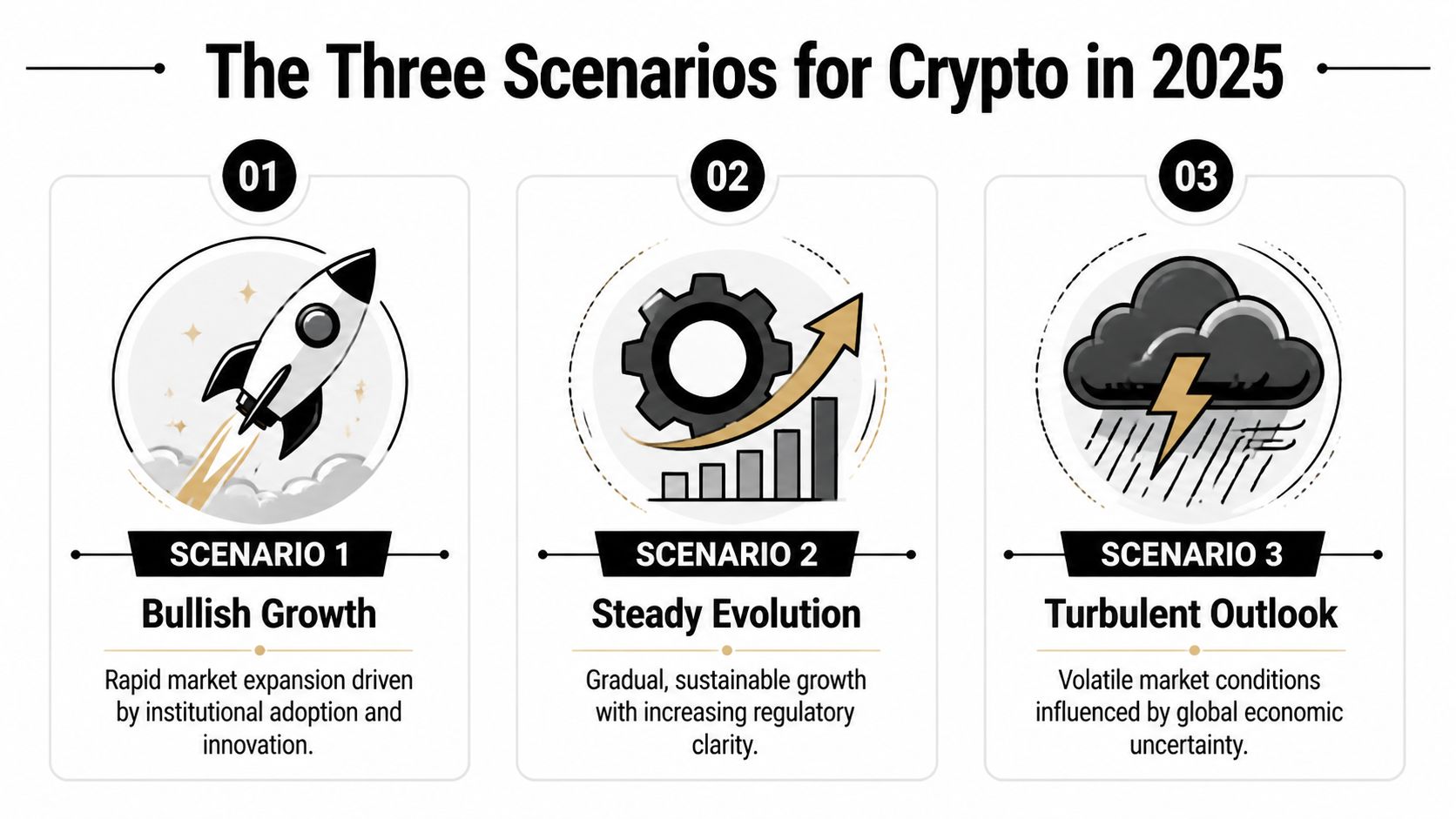
Bull case with broad institutional acceleration
The bull case requires alignment across macro, regulation, and product adoption. Risk appetite has to remain constructive, regulators have to reduce uncertainty enough for larger pools of capital to expand exposure, and the sectors that led the narrative in 2024 have to show durable activity in 2025.
Under that setup, Bitcoin likely trades toward the top end of widely circulated forecasts, while Ethereum and a narrower group of high-quality altcoins catch up later in the cycle. The important point is not the exact number. It is the breadth of confirmation. ETF demand stays firm, stablecoins gain a clearer legal footing, and tokenized assets, Layer 2 networks, and select DeFi protocols post usage that can support valuations.
Leadership also changes in a specific way. Bitcoin remains the reserve asset of the cycle, but market attention broadens only after investors gain confidence that on-chain activity is translating into fees, retention, and repeat demand. In that environment, assets tied to cash-flow-like behavior or clear network utility tend to outperform reflexive launches.
Base case with selective upside and repeated resets
The base case is the most plausible path for many investors because it does not require perfect conditions. Capital keeps entering crypto, but it does so unevenly. Institutions prefer liquid majors and regulated access points. Retail participates, though with shorter time horizons and less tolerance for weak execution.
This produces a market that trends higher in stages rather than in a straight line. Bitcoin holds leadership longer than many expect. Ethereum, stablecoin infrastructure, tokenization, and a subset of DeFi names can still perform well, but only where adoption is visible and incentives are not carrying the entire user base.
Corrections remain part of the process. Investors who want a reference point for that kind of tape should study prior crypto bear market drawdowns and recovery patterns. Even constructive cycles can include sharp repricing when positioning gets crowded or a new theme outruns fundamentals.
Bear case with slower adoption and broken narratives
The bear case does not require a collapse in the long-term thesis for crypto. It requires enough friction to prevent capital from moving beyond the most established assets. A macro shock could tighten financial conditions. Regulatory delays could keep institutions cautious. New sectors could fail to convert attention into persistent users or meaningful revenue.
If that happens, the market narrows fast. Bitcoin may hold up better than the rest of the field because liquidity concentrates in the deepest assets and in stablecoins. By contrast, tokens with weak product-market fit, poor token design, or inflated fully diluted valuations are likely to absorb most of the repricing.
One signal matters here. If rallies are driven mainly by low-quality speculation while fee generation, user retention, and stablecoin activity lag, the market is getting more fragile, not healthier.
A scenario map for 2025
| Scenario | Core drivers | Likely market character |
|---|---|---|
| Bull | Supportive liquidity, clearer rules, strong follow-through in ETFs, stablecoins, L2s, and RWAs | Broad upside, wider sector participation, quality altcoins outperform |
| Base | Mixed macro, incremental regulatory progress, adoption concentrated in proven networks | Higher highs with sharp pullbacks, leadership stays narrow, fundamentals matter more |
| Bear | Tight liquidity, policy setbacks, weak usage in newer sectors | Defensive positioning, capital concentrates in BTC and stablecoins, speculative tokens lag hard |
The practical advantage of this framework is simple. It links each market outcome to observable drivers, so investors can update exposure as conditions change instead of anchoring to one heroic forecast.
Decoding the Key Market Drivers for 2025
Crypto’s path in 2025 will likely be shaped less by headline excitement than by three measurable variables: the cost of capital, the rules governing market access, and whether on-chain products keep converting usage into revenue. Those variables map directly to the bull, base, and bear scenarios outlined above. They also explain why two markets can post similar short-term price gains while carrying very different risk profiles.

Macro conditions set the ceiling and the sequence
Crypto still responds to global liquidity, real rates, and risk appetite. What has changed is the order in which capital now enters the market. In a supportive macro backdrop, flows usually reach Bitcoin first, then Ethereum, then a narrower set of liquid altcoins with clear product demand. In a mixed environment, that progression often stalls after the first step.
That distinction matters for scenario analysis. A bull case needs more than lower rates or softer inflation prints. It also requires risk capital to broaden beyond BTC into networks, applications, and infrastructure with rising usage. A base case can still produce strong headline returns, but leadership stays concentrated and pullbacks remain sharp. In a bear case, tighter liquidity tends to compress duration and speculation at the same time, which usually pushes capital toward Bitcoin and stablecoins rather than out the risk curve.
For investors, the more useful question is not whether macro is “good” or “bad.” It is whether macro conditions support wider participation.
Regulation determines who is allowed to buy, build, and distribute
Policy matters because it changes market structure. Clearer rules reduce compliance uncertainty for asset managers, banks, payment firms, and public companies. That does not create immediate upside on its own, but it expands the set of institutions that can hold crypto exposure, offer related products, or settle activity through blockchain-based rails.
Banking infrastructure plays a quiet but important role here. Even with strong demand, adoption slows if custody, fiat access, and treasury workflows remain operationally awkward. That is why crypto-friendly banking options for investors and businesses deserve more attention than they usually get in market commentary.
The scenario implications are straightforward. In the bull case, regulation improves enough to lower friction across ETFs, stablecoins, and tokenized assets. In the base case, progress is uneven, which keeps adoption concentrated in the most institutionally legible parts of the market. In the bear case, legal uncertainty raises costs, delays product launches, and narrows participation.
Technology has to convert attention into durable demand
The strongest part of the 2025 thesis is not price reflexivity. It is that several crypto categories now have identifiable use cases, recurring activity, and better infrastructure than they did in prior cycles.
Stablecoins are increasingly used for payments, trading collateral, and cross-border settlement. DeFi continues to offer on-chain liquidity, borrowing, and market access without relying on a single intermediary. Tokenized real-world assets are gaining traction because they connect blockchain rails to familiar financial products. Bitcoin-related infrastructure is also improving, which broadens the asset’s role beyond passive holding.
The non-obvious point is that these sectors reinforce each other. Stablecoins improve settlement. DeFi gives those dollars velocity. RWAs bring in new collateral types and users who care more about efficiency than ideology. If those links strengthen, the base case can drift toward the bull case even without euphoric retail participation.
What matters most under each scenario
The market segments most likely to outperform in 2025 share a common profile:
- They address a clear economic function. Payments, collateral, settlement, and blockspace demand are easier to sustain than purely narrative-driven use cases.
- They fit existing behavior. Products tied to trading, treasury management, or dollar access face less adoption friction than products that require a complete user habit shift.
- They can support institutional and retail demand at the same time. That overlap tends to produce deeper liquidity and more durable revenue.
That framework is more useful than a single point forecast. It ties price expectations to observable drivers, and it helps explain why 2025 may reward selectivity more than blanket exposure.
On-Chain and Sentiment Indicators to Watch
Most market participants read predictions passively. Better investors use indicators to test whether those predictions are being confirmed or invalidated in real time. In 2025, that means watching both technical structure and the on-chain context around it.
Technical signals that matter in late-cycle markets
The most concrete technical read in the current setup comes from Bitcoin and Ethereum. In Q4 2025, Bitcoin showed a bullish MACD crossover and an RSI of 68.7, with current pricing at $114,000 projecting a range of $130,000 to $185,000, while Ethereum showed an RSI of 64.2 and a bullish MACD, implying $6,400 to $7,800 from $5,000, according to Gate’s technical indicator analysis for 2025.
That matters because RSI in the upper range doesn’t automatically mean “sell.” In strong trends, it often means momentum is persistent. MACD matters for a similar reason. It helps distinguish a tired bounce from a move that’s still expanding.
A practical checklist looks like this:
- MACD crossovers: Useful for spotting trend continuation, especially when momentum expands rather than fades.
- RSI context: High RSI in a weak market can warn of exhaustion. High RSI in a strong market can confirm strength.
- Moving averages: They help define whether a dip is a breakdown or a retracement.
- Volume confirmation: Breakouts with convincing participation are more trustworthy than low-conviction spikes.
How to use on-chain and sentiment tools without overfitting
On-chain metrics are useful, but many traders misuse them. Indicators like MVRV Z-Score, SOPR, and NVT Signal work best as context tools, not as magic triggers. They can help you ask better questions. Are holders taking profits aggressively? Is value moving on-chain relative to price? Is the network being used in a way that supports the valuation?
The cleaner approach is to combine categories instead of hunting for one perfect signal.
| Indicator type | What it helps answer |
|---|---|
| Momentum tools | Is the trend strengthening or weakening? |
| On-chain activity | Is usage supporting valuation? |
| Sentiment measures | Is the market euphoric, fearful, or skeptical? |
| Market structure | Are leaders holding up, or is breadth collapsing? |
For self-custody users and active traders, wallet behavior can also reveal sentiment shifts. If you’re newer to the tooling side, understanding interfaces like Phantom Wallet and similar crypto wallets helps because wallet activity often becomes your first direct signal of network behavior.
Use indicators to reduce emotional mistakes, not to eliminate uncertainty. Good signals improve decision quality. They don’t remove risk.
Bitcoin and Ethereum Price Predictions for 2025
Roughly two assets still set the market’s center of gravity. Bitcoin absorbs the largest share of institutional attention, while Ethereum remains the main settlement layer for on-chain economic activity. Any serious 2025 forecast starts there, but price targets alone are too blunt. The better framework is scenario-based: what happens to BTC and ETH under different macro conditions, regulatory paths, and adoption curves?

Bitcoin looks like the institutional winner
Bitcoin enters 2025 with the clearest demand map in crypto. Spot products have made access easier for traditional allocators. Corporate treasury interest has become more credible. In a market where capital still prefers the most liquid and politically legible asset first, BTC keeps a structural advantage.
As noted earlier, several major research desks expect a strong year for Bitcoin, with bull-case forecasts reaching well into six figures. The more useful question is what would need to happen for those outcomes to hold. In a bull scenario, easing financial conditions, continued ETF inflows, and broader acceptance of Bitcoin as a reserve-style asset would support a move materially above prior highs. In a base case, Bitcoin still benefits from persistent institutional demand, but upside is moderated by slower capital rotation and tighter liquidity. In a bear case, sticky inflation, delayed rate cuts, or a regulatory shock could cap flows and turn rallies into distribution.
There is also a second-order shift that matters beyond price. Bitcoin is no longer driven only by the "digital gold" narrative. If activity around Layer 2s, wrapped BTC, and Bitcoin-linked DeFi keeps expanding, BTC gains a limited but important utility premium on top of its monetary premium. That does not make Bitcoin an application-first chain. It does broaden the set of buyers and builders who have a reason to care.
Ethereum remains the core smart contract settlement layer
Ethereum’s 2025 outlook depends less on passive inflows and more on whether economically meaningful activity keeps concentrating in its stack. That includes stablecoin settlement, DeFi liquidity, tokenized assets, and the fee base generated by applications that still prefer Ethereum security and distribution despite lower-cost alternatives.
That distinction matters.
Bitcoin can rally on macro positioning alone. Ethereum usually needs both macro support and visible application demand. If stablecoins, tokenized real-world assets, and on-chain financial infrastructure keep growing, ETH has a stronger case in 2025 than headline sentiment often suggests. If on-chain activity fragments across chains without sustained fee capture or value accrual to ETH, the asset can lag even in a broadly constructive market.
Here’s a useful market primer before going further:
A scenario framework for BTC and ETH in 2025
The cleanest way to compare Bitcoin and Ethereum is by matching each asset to the conditions that usually drive outperformance.
| Scenario | Bitcoin outlook | Ethereum outlook | Main drivers |
|---|---|---|---|
| Bull | BTC outperforms prior highs and benefits from sustained institutional inflows | ETH rerates as on-chain activity, stablecoins, and tokenization expand | Easier macro policy, supportive regulation, strong inflows, rising on-chain usage |
| Base | BTC remains the market leader on liquidity and portfolio positioning | ETH appreciates, but performance depends on real usage and fee generation | Mixed macro backdrop, steady but selective adoption, moderate risk appetite |
| Bear | BTC holds up better than most crypto assets because it is the most recognized store-of-value trade | ETH faces more pressure if speculative activity fades and application growth slows | Tight liquidity, weaker flows, regulatory friction, lower transaction demand |
This leads to a practical conclusion. Bitcoin is still the cleaner expression of institutional crypto demand. Ethereum is the cleaner expression of on-chain economic expansion.
For investors, the choice is less about ideological preference and more about market regime. If 2025 is driven by macro easing and large allocator inflows, Bitcoin likely leads first. If the year shifts from access to usage, especially through stablecoins, tokenization, and financial applications, Ethereum’s setup improves materially. In a strong cycle, both can work, but they usually win for different reasons.
Forecasts for Altcoins DeFi and Emerging Sectors
Roughly three quarters of listed crypto assets still trade far below their prior cycle highs. That statistic matters because 2025 is unlikely to reward altcoins evenly. Capital usually returns in waves, and the strongest recoveries tend to cluster around sectors with rising usage, improving distribution, and clearer links between token value and network activity.

A scenario framework is more useful here than a list of moonshot tickers. In a Bull case, liquidity expands beyond Bitcoin and Ethereum, and higher-beta sectors with real revenue or user growth can rerate sharply. In a Base case, performance narrows to protocols that capture fees, support stablecoin activity, or sit inside tokenization rails. In a Bear case, weak tokenomics, inflated fully diluted valuations, and low-retention apps get repriced first.
Stablecoins and RWAs shift the opportunity set
The most durable altcoin tailwind for 2025 is probably not speculative memecoin demand. It is the buildout of stablecoin and real-world asset infrastructure, as noted earlier in the article.
The reason is straightforward. Stablecoins increase the amount of dollar liquidity that can move on-chain. Tokenized treasuries, credit products, and other RWAs give that liquidity somewhere productive to go. If both trends continue, the winners are less likely to be broad "DeFi" bets and more likely to be the protocols that provide issuance, settlement, collateral management, compliance tooling, and liquidity routing.
That changes how investors should assess sector exposure. The question is no longer whether DeFi returns. The better question is which parts of on-chain finance become necessary plumbing.
Bull, Base, and Bear setups across emerging sectors
Altcoin selection in 2025 should start with sector conditions, then move to token-level analysis.
| Sector | Bull case | Base case | Bear case |
|---|---|---|---|
| DeFi | On-chain volumes rise, stablecoin velocity improves, and leading protocols convert activity into fees | Growth continues but stays concentrated in a few blue-chip apps | Emissions-heavy protocols lose users as yields compress |
| Layer 2s | A small group of chains compounds adoption through active apps and sticky liquidity | Usage grows, but value accrues unevenly across ecosystems | Activity fragments and many chains struggle to justify token premiums |
| RWA infrastructure | Regulation clarifies distribution and major institutions expand tokenized products | Adoption rises steadily in treasuries and settlement-focused products | Regulatory delays slow expansion and limit cross-border scale |
| AI x Crypto | Verifiable compute, identity, data provenance, or agent payments find real demand | A few niches work, but most projects remain early experiments | Narrative outpaces usage and rebranded tokens fade |
| NFTs and GameFi | Consumer products with strong retention rebuild category interest | Engagement exists in specific communities, not the whole sector | Speculative demand weakens and low-quality collections lose liquidity |
The market gets selective. A rising tape can lift many tokens for a time, but sustained outperformance usually requires one of three things: fee capture, strategic scarcity, or clear demand for blockspace, data, or settlement.
Where upside looks more credible
The stronger altcoin opportunities tend to share the same traits. They sit inside a functioning product loop, they benefit from growing on-chain activity, and they do not rely entirely on fresh token emissions to hold user attention.
A focused watchlist by theme looks like this:
- DeFi infrastructure: Liquidity routing, oracle networks, collateral management, and cross-chain messaging can benefit if on-chain finance becomes more institutional.
- Selective Layer 2 ecosystems: The better setups are chains with measurable application demand, not just incentives and announcements.
- RWA-linked protocols: The more credible projects connect tokenization to compliant distribution, transparent reserves, and recognizable assets.
- AI-crypto coordination layers: The interesting subset involves verification, identity, data ownership, and machine-to-machine payments.
- Consumer crypto with retention: NFTs and GameFi still have upside, but only where users return for utility, status, or in-app economies.
For active investors, execution matters as much as thesis quality. A disciplined process for entries, exits, and position sizing matters more in altcoins than in majors, especially when narratives rotate quickly. As a result, practical crypto trading strategy frameworks can improve decision quality.
The key distinction for altcoins in 2025
This cycle should be less forgiving of weak token design. Markets are more crowded, users are more selective, and many tokens now launch into an environment where investors pay closer attention to vesting schedules, treasury behavior, and actual demand.
A useful dividing line is whether the token sits inside a product that users would choose even without incentives.
| Sector | Stronger setup | Weaker setup |
|---|---|---|
| DeFi | Tokens tied to settlement, liquidity, or infrastructure | Pure emissions with weak retention |
| L2s | Networks with active applications and sticky users | Chains with little economic activity |
| AI x Crypto | Verifiable coordination and ownership use cases | Narrative-driven rebrands |
| NFTs and GameFi | Utility, identity, and creator economics | Short-lived speculation cycles |
Altcoin upside gets more credible when the token is a claim on usage, not just a vehicle for attention.
That is the sharper way to read crypto predictions for 2025. The biggest gains outside Bitcoin and Ethereum may come from sectors that look less exciting on social media and more relevant to how capital, payments, and digital ownership move on-chain.
Actionable Strategies for Investors and Creators
A good forecast is only useful if it changes behavior. In 2025, the highest-probability mistake is not missing upside. It’s participating in the upside without a framework for drawdowns, liquidity shifts, or narrative rotation.
A practical portfolio framework
The strongest closing advice for this cycle is simple. Respect volatility even in a bullish market. Expert forecasts of a volatile 2025 bull run highlight a major gap in investor strategy, and one effective approach is allocating 20–30% of a portfolio to stablecoins and resilient utility projects to hedge against the 30–50% drawdowns seen in past cycles, according to Crypto Research Report’s 2025 outlook.
That’s a more mature framework than going fully risk-on. It gives investors room to buy dislocations, protect conviction, and avoid forced selling during corrections.
A practical approach could include:
- Core exposure: Keep your highest conviction in Bitcoin and Ethereum if your goal is broad crypto beta with stronger liquidity.
- Risk-managed growth sleeve: Use a smaller allocation for high-conviction altcoins tied to DeFi, Layer 2s, or tokenized asset infrastructure.
- Stable reserve: Hold dry powder in stablecoins so volatility becomes an opportunity rather than a threat.
- Execution discipline: Use predefined rules for entries, trims, and invalidation points rather than reacting to social sentiment.
If you trade actively, this matters even more. Strong tactics usually come from process, not prediction. Studying practical trading frameworks and execution habits can help reduce the usual late-cycle mistakes.
Portfolio rule: The best portfolio in a bull market is often the one that can survive being wrong for longer than the crowd can.
Where builders and creators should focus
For founders, creators, and operators, 2025 looks strongest in segments where crypto improves an existing workflow rather than inventing a fictional one.
The most attractive areas are likely to include:
- Stablecoin-based products for payments, treasury, and cross-border activity.
- RWA infrastructure that helps issuers, investors, or platforms bring traditional assets on-chain.
- DeFi tooling that simplifies access, compliance-aware workflows, and risk visibility.
- Consumer Web3 products where ownership, identity, or creator monetization improve the experience.
- AI-linked blockchain systems where transparency, coordination, and programmable incentives are essential.
Builders should be more skeptical of pure launch theater. Products with clear users, clear distribution, and clear economics have a better chance than projects optimized for token excitement alone.
The broad takeaway from crypto predictions 2025 is this. The market still rewards vision, but it’s increasingly paying for utility.
If you want more grounded analysis like this, follow Coiner Blog for practical guides on Bitcoin, Ethereum, DeFi, Web3, NFTs, crypto gaming, and the market signals that count when conditions change.
3 Comments