
Consensus Crypto Event 2026: Your Ultimate Guide

More than 20,000 attendees and representation from $4 trillion in assets under management make Consensus Miami 2026 less like a normal conference and more like a live operating system for the crypto industry, according to Consensus event information. If you work in Web3, DeFi, tokenization, smart contracts, crypto media, or institutional digital assets, that concentration of people and capital changes the value of attending.
The consensus crypto event matters because it compresses a year of market conversations into a few days. Builders test narratives in real time. Investors compare tokenomics, infrastructure, and founder quality face to face. Journalists find the gap between stage talk and hallway reality. Regulators hear what teams are building, not just what gets posted on X.
After attending Consensus across multiple market cycles, one thing becomes clear. People who treat it like a trade show usually leave with a tote bag and a blur. People who treat it like a strategic campaign leave with partnerships, sharper market context, and a much stronger network.
This is the practical version of the guide. It focuses on how to use Consensus for your crypto career, whether you're a founder raising, an investor sourcing, a developer tracking Layer 2 design choices, or a reporter chasing signal in a noisy market.
Table of Contents
- Welcome to the Super Bowl of Crypto
- The Genesis and Evolution of Consensus
- Decoding the Agenda and Core Themes for 2026
- Who Attends Consensus and Why It Matters
- Choosing Your Pass and Planning Your Attack
- Mastering Networking Press and Side Events
- How Coiner Blog Will Cover Consensus 2026
- Is Attending Consensus Worth It For You
Welcome to the Super Bowl of Crypto
Consensus sits in a category of its own. Plenty of events claim to be where crypto meets finance, policy, and builders. Few manage to put all three in the same building for several days with enough density to matter.
That’s why people who’ve been around a while don’t judge Consensus by the keynote list alone. They judge it by what materializes around it. A stablecoin partnership that was stuck in legal review. A tokenization startup finally getting a meeting with the right allocator. A journalist getting a straight answer off-camera that tells them where the market is really moving.
The best way to think about the consensus crypto event is as a force multiplier. If you already have a product, thesis, media angle, or hiring goal, the event can accelerate it. If you show up without one, the sheer volume of sessions, side events, dinners, and inbound noise can bury you.
Why veterans keep coming back
Consensus works because it attracts multiple layers of the market at once. You get protocol teams discussing scaling and smart contracts, institutional players discussing custody and market structure, and founders refining tokenomics in response to what capital wants. That mix is rare.
For readers who track the broader crypto event landscape, Consensus is the annual checkpoint where narratives either harden into business strategy or fade under scrutiny.
Practical rule: Don’t attend Consensus to “see what’s happening.” Attend to validate one thesis, advance one commercial objective, and meet one category of people you can’t efficiently reach online.
What works and what doesn’t
What works:
- Pre-booked meetings: Calendars fill early, especially for investors, exchange teams, and media.
- Focused attendance: Pick a narrow lane like DeFi infra, Layer 2 tooling, or tokenized assets.
- Fast follow-up: The people who win often send notes and next steps the same day.
What doesn’t:
- Session hoarding: Sitting in talks all day feels productive, but usually isn’t.
- Random networking: Wandering the expo floor without a target burns energy.
- Overpitching: Discerning attendees can spot desperation in two minutes.
Consensus rewards clarity. The sharper your objective, the more valuable the event becomes.
The Genesis and Evolution of Consensus
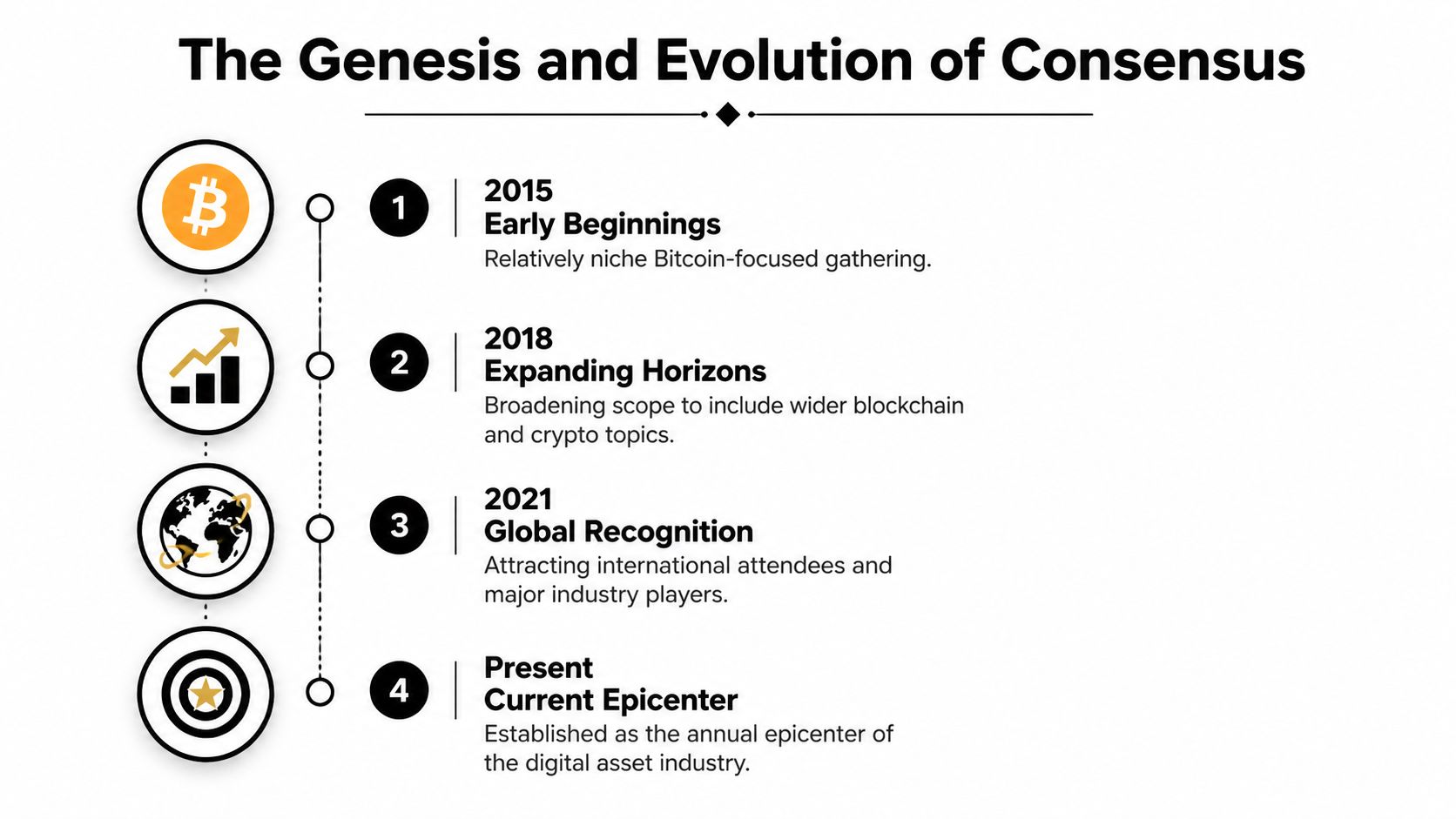
Consensus didn’t start as the giant industry machine people know today. It began as a relatively niche, Bitcoin-focused gathering and expanded alongside the market’s own evolution into a broader blockchain, digital assets, and Web3 ecosystem.
From niche gathering to industry benchmark
The growth is one of the clearest signals of how far the industry has moved. The 2017 edition drew over 2,700 attendees with more than 50 panels and workshops and over 200 speakers, while the 2022 Austin event grew to more than 20,000 attendees from over 100 countries, a sevenfold increase within five years, according to IQ Wiki’s overview of Consensus by CoinDesk.
That scale shift matters because conferences usually expand after an industry becomes legible to outsiders. Early on, events are mostly insiders talking to insiders. Later, they become crossover zones where asset managers, policy staff, founders, infrastructure providers, and media all need to be present.
Consensus followed that path. It moved from a narrow blockchain gathering into a festival-like market hub with large speaker rosters, exhibitor presence, and cross-sector participation. By the time that happened, attending was no longer just about learning what crypto was. It was about determining how crypto fit into finance, compliance, software, and global capital formation.
Why the event became a market signal
A conference becomes influential when decisions happen there, not just presentations. That’s the line Consensus crossed.
When institutional firms show up, the tone changes. Conversations become less ideological and more operational. People ask about stablecoin rails, custody design, settlement risk, tokenization workflows, compliance boundaries, and how smart contract systems can plug into existing financial infrastructure. Builders stop pitching abstraction and start pitching implementation.
A useful comparison is Paris Blockchain Week coverage and positioning. Strong events can gather founders and investors. Consensus became something bigger because it consistently drew the people who could translate a narrative into policy, capital allocation, or enterprise deployment.
The real story of Consensus isn’t just that it got bigger. It’s that the consequences of attending got bigger.
The event now reflects industry maturity
Consensus now acts as a barometer for the market’s priorities. In bull phases, people arrive looking for momentum, partnerships, and narrative leadership. In tougher cycles, they come looking for durable business models, infrastructure resilience, and who can still execute when liquidity isn’t easy.
That’s why experienced attendees pay attention to what gets serious airtime. If tokenization, AI-blockchain integration, or Layer 2 infrastructure dominate serious meetings rather than just stage buzz, that usually tells you where teams are budgeting, hiring, and building.
A mature conference doesn’t just mirror the industry. It filters it. Consensus has become one of the clearest places to see which ideas survive that filter.
Decoding the Agenda and Core Themes for 2026
More than 200 sessions and 500-plus speakers can waste your week if you treat Consensus like a content buffet. The useful approach is triage. Build a schedule that serves your job, your pipeline, and the conversations you need to have before everyone flies home.
According to the Consensus Miami 2026 agenda overview, the event spans 6 stages, 3 summits, 6 content tracks, over 200 sessions, and more than 500 speakers. That density matters because its core value is rarely in sitting through panels from morning to evening. It comes from choosing the right sessions, skipping the wrong ones, and leaving enough white space for meetings that can change your quarter.
How experienced attendees read the program
I sort the agenda into three operating buckets.
Directly relevant sessions
These tie to your current work or investment focus. A DeFi builder should screen for stablecoins, market structure, custody, liquidity design, and tokenomics. Infra teams should prioritize scaling, wallets, interoperability, and smart contract security.Cross-functional sessions
These are often where the edge is. Founders building tokenization products need to hear policy discussions. Investors should spend time in technical rooms to test whether a category has real developer traction. Journalists get better stories when they hear how products fail in practice, not just how they are marketed on stage.Intentional meeting gaps
Good operators do not overbook panels. A 20-minute coffee with a payments lead, exchange counsel, ETF analyst, or institutional custody team can produce more usable information than three polished fireside chats.
That mix changes by role. Builders should bias toward implementation detail. Investors should bias toward market structure and legal assumptions. Reporters should bias toward contradiction. If the stage narrative says one thing and private meetings say another, follow the private meetings.
The themes that deserve real attention in 2026
Some topics will get stage time because they are fashionable. Others will matter because budgets, product roadmaps, and regulatory calendars are forcing decisions. Those are the themes worth tracking.
TradFi and DeFi convergence
This category has matured. The interesting questions are no longer abstract debates about whether institutions will come on-chain. The useful questions are operational. How do stablecoins move through treasury workflows? How do tokenized assets settle? What compliance controls can be built into smart contracts without breaking the product?
The trade-off is plain. Institutions want efficiency and auditability, but they also need permissions, legal clarity, and accountable counterparties. Crypto-native teams want composability and speed, but they often underestimate how much process large firms need before deployment. The projects that get traction at Consensus are usually the ones that can explain both sides of that equation.
Real-world asset tokenization
RWA panels can be noisy, so listen for specifics. Serious teams talk about issuance mechanics, transfer restrictions, reporting obligations, servicing, redemption, and where custody risk sits.
This category attracts a higher-quality buyer than many trend-driven corners of crypto. People in these rooms are usually evaluating whether a product can survive legal review and operational due diligence. If a founder cannot explain who the asset manager, transfer agent, qualified custodian, or regulated wrapper is, the pitch is still early.
AI and blockchain integration
This theme is easy to overhype and still worth watching. The strong use cases usually involve verification, agent payments, provenance, audit trails, identity, and machine-to-machine coordination. The weak use cases staple a token onto an AI wrapper and call it infrastructure.
A quick filter helps. Ask what improves because crypto is added. If the answer is verifiability, incentives, settlement, or ownership, there may be substance. If the answer is brand positioning, move on.
Layer 2, interoperability, and the user cost problem
Scaling remains a live issue because users still care about fees, speed, liquidity access, and reliability. Consensus panels on Layer 2s tend to reveal who has shipped real product and who is still selling theoretical throughput.
Listen for uncomfortable details. Good teams will talk openly about bridging risk, fragmented liquidity, wallet friction, failed onboarding, and the cost of supporting multiple environments. For readers following the technical direction behind these debates, future cryptography trends shaping blockchain infrastructure help explain why some architectures keep compounding advantages while others stall.
Use the location to interpret the message
Consensus branding travels, but local priorities do not.
Miami will likely produce more discussion around U.S. market structure, tax treatment, enforcement posture, election-year policy spillover, and the compliance burden facing firms that want institutional distribution. Hong Kong tends to frame the conversation differently. The emphasis is more often on cross-border coordination, licensing pathways, regional capital formation, and how East-West market access is developing.
That difference changes what a smart attendee should ask. A founder selling into U.S. institutions should pressure-test legal assumptions and disclosure requirements. A team operating across Asia should spend more time on jurisdiction design, partner structure, and what can be distributed in each market.
Read the agenda with that lens and the event gets more useful. You stop chasing headlines and start identifying where products can ship, where capital is lining up, and where your next serious opportunity is likely to come from.
Who Attends Consensus and Why It Matters
Thousands of company representatives show up to Consensus each year, and the useful signal is not the crowd size. It is the concentration of people with budget, distribution, policy influence, and publishing power in one place. CoinDesk has highlighted that the attendee base skews heavily toward senior decision-makers. Treat that as a working assumption the moment you walk in.

That mix is why Consensus works as a career tool instead of just an industry gathering. A founder can meet a custody partner before lunch, a potential lead investor in the afternoon, and a reporter who will shape the category narrative before dinner. An analyst can compare market structure views across exchanges, protocols, and regulators in a single day. A journalist can test whether a hot story survives contact with people who operate the rails.
Senior rooms reward precision
Consensus punishes vague positioning fast.
Founders get more traction when they explain one painful problem, one clear buyer, and one reason they can win now. Investors respond better to specifics on retention, margins, compliance assumptions, treasury risk, and distribution than to broad category storytelling. Journalists remember the team that can answer hard questions in plain English.
I have found that the unwritten rule is simple. Respect the other person's time. If your opening takes three minutes and still does not explain what you do, the meeting is already slipping.
What each group is actually trying to get done
Institutional investors and venture firms
Investors come for filtered deal flow and market calibration. They want to see which founders understand execution in practice, not only on a pitch deck. That means product distribution, governance design, token supply mechanics, legal structure, and whether the business can survive a rough cycle.
The last point matters more than many first-time attendees expect. A team that can explain how it operates during a crypto bear market and prolonged risk-off cycle usually earns more respect than one promising straight-line growth.
Good investor meetings move quickly from vision to diligence. Expect questions about customer concentration, chain dependency, security assumptions, partner exposure, and what breaks if liquidity dries up.
Builders and developers
Builders attend for answers they cannot get from Discord threads and Zoom calls. They need wallet partners, infrastructure vendors, market makers, auditors, indexers, fiat ramps, hiring leads, and honest product feedback from people outside their own ecosystem.
That is why passive attendance underperforms here. A developer who only sits through technical panels may leave smarter, but not necessarily closer to shipping, integrating, or getting users. The builders who get the most from Consensus usually split time between sessions, expo-floor product demos, and targeted meetings with teams who can remove one operational bottleneck.
A quick pulse-check from the wider community helps too:
Policymakers and regulatory professionals
This group listens differently. They are not there to be impressed by jargon. They want to hear how products handle custody, disclosures, privacy, settlement finality, consumer risk, and cross-border constraints.
These conversations rarely produce an instant win, but they are useful in a different way. Founders get an early read on how their product sounds to people who think in terms of enforcement, market integrity, and legal defensibility. That can save months of wasted effort.
Why journalists, creators, and operators should care
Consensus compresses access better than almost any event in crypto. Reporters can pressure-test a narrative against multiple sources in the same building instead of piecing it together over weeks. That makes weak stories fall apart quickly and strong ones get sharper.
For creators, NFT teams, and gaming operators, the value is often outside their usual circle. The right conversation may be with a payments team, cloud provider, licensing partner, exchange listing group, or brand lead looking for distribution experiments. Those meetings do not always happen on stage. They happen in hallways, lobby bars, and side-event lines.
The practical takeaway is simple. Watch who keeps getting pulled into quiet follow-up meetings. Those are usually the people creating actual momentum, and they tell you more about where the market is heading than a polished panel ever will.
Choosing Your Pass and Planning Your Attack
Pass selection matters less than people think, but bad planning makes any pass feel overpriced. The smartest attendees start with objective first, pass second.
Some people need the broadest access because they’re raising, sourcing, reporting, or managing many meetings across the venue. Others only need enough access to reach specific sessions and side conversations. What doesn’t work is buying the biggest pass and assuming that solves the strategy problem.
Consensus 2026 Pass Comparison
Because pass names and availability can change, use the structure below as a decision tool rather than a price promise.
| Pass Type | Best For | Key Access | Estimated Price Range |
|---|---|---|---|
| Pro Pass | Investors, senior operators, active dealmakers | Broad conference access, premium networking utility, higher meeting flexibility | Premium |
| Builder Pass | Founders, developers, product teams | Agenda access focused on technical and startup value, useful for hackathon and ecosystem engagement | Mid-range |
| Expo Pass | First-timers, students, local attendees, selective networkers | Expo floor and lighter access for targeted meetings | Lower-cost entry |
| Media or Partner Access | Journalists, sponsors, ecosystem organizations | Varies by role and accreditation | Varies |
Build an event plan before you land
A strong plan is simple. It answers three questions.
What outcome matters most
Pick one primary outcome:
- Fundraising: You need investor targets, a clear deck, and a short pitch.
- Business development: You need a partner list and a reason each meeting matters.
- Research: You need a question set, not just a session list.
- Job hunting: You need introductions and proof of work ready on your phone or laptop.
If everything is the priority, nothing is.
What deserves your best energy
Consensus is physically and mentally draining. Protect your best hours. Schedule the highest-value meetings when you’re sharp, not after a long dinner or after six straight panels.
A lot of attendees make the same mistake in down markets too. They assume fewer flashy announcements mean less value. In reality, quieter cycles often produce better conversations because the tourists have left. That’s especially true if you’ve already studied tougher market conditions, including themes discussed in crypto bear market strategy guides.
What you’ll skip on purpose
This is the hidden edge. Say no early.
- Skip low-fit panels: If the title sounds broad and promotional, it probably is.
- Skip filler meetups: Not every invite is worth the transit time.
- Skip overstacking: Leave room for spontaneous conversations.
Field note: The best Consensus schedules look underbooked on paper and overperform in reality.
Mastering Networking Press and Side Events
The main conference matters, but the side ecosystem is where many of the highest-value interactions happen. Breakfasts, happy hours, founder dinners, investor salons, private demos, protocol meetups, media briefings. That’s where people drop the panel voice and start speaking plainly.

Past event data indicates 25% of attendees reported closing a business deal at Consensus, and startups can use Hackathon and PitchFest as direct routes to visibility and capital, with a prize pool exceeding $500k, according to event coverage on Consensus 2026 opportunities. That tells you something important. The commercial value is real, but it usually goes to people who approach the event with intent.
The hallway strategy works better than the stage sprint
Here’s what works better than most newcomers expect.
- Coffee lines: Short, low-pressure, surprisingly effective. People are between obligations and more willing to talk.
- Targeted side events: A niche breakfast for stablecoin infrastructure or tokenization founders often beats a giant party.
- Speaker follow-ups: Don’t chase speakers before they go on. Catch them after, when the crowd thins and your question can be specific.
- Small group dinners: These create better memory and trust than loud receptions.
What usually fails is trying to meet everyone. At Consensus, breadth feels exciting but depth closes loops.
How founders should approach press and investors
Founders need two versions of the pitch.
The first is the 30-second version. It should answer:
- what you do
- who it’s for
- why now
- what proof you already have
The second is the five-minute version. That’s where you explain architecture, business model, market wedge, tokenomics if relevant, and the primary objection you hear most often.
Press outreach needs the same discipline. Journalists don’t need your grand vision first. They need the news angle. Is there a product launch, a partnership, a funding event, a regulatory angle, or a real user problem being solved? If not, don’t force it.
“I’m building X” is weak. “We help Y users solve Z problem, and we can show how it works today” gets remembered.
Where GameFi and NFT people usually cluster
The gaming and NFT crowd often generates some of the most interesting side conversations because they sit at the intersection of community, infrastructure, IP, monetization, and user experience. They care about wallets, fees, identity, creator economics, and what keeps users engaged after the initial drop or launch.
If you work in GameFi or digital collectibles, look for:
- Hackathon circles: Useful for fast feedback and technical collaborators.
- Creator meetups: Good for partnerships around IP, distribution, and community.
- Infrastructure events: Wallets, scaling teams, and marketplace tooling providers often host strong side gatherings.
This is also where a lot of bad pitches get exposed. NFT and gaming audiences usually have strong instincts for authenticity. They can tell when a project has culture and gameplay versus when it just has token mechanics and a slide deck.
How Coiner Blog Will Cover Consensus 2026
Hundreds of sessions, side events, and off-record conversations happen around Consensus. Readers do not need more volume from us. They need filtration, judgment, and follow-through.
Coiner Blog will cover Consensus 2026 like a working market intelligence exercise. The goal is to help builders spot real demand, help investors separate momentum from durable execution, and help journalists find the stories that still matter after the stage lights go out.
What coverage is worth following
We focus on three outputs.
First, pre-event thesis setting. Before doors open, we map the sectors and questions that deserve attention. That includes stablecoin distribution, tokenization infrastructure, Layer 2 economics, AI-linked crypto products, onchain UX, and the policy questions likely to shape product rollout. Good event coverage starts before the first panel because the useful question is never “what happened?” It is “what changed relative to expectations?”
Second, live signal capture. During the event, we will track where serious operators keep reappearing, which announcements hold up under scrutiny, and which narratives are getting polite applause without real conviction behind them. Consensus always has a gap between what is loud and what is investable. Closing that gap is where useful reporting lives.
Third, post-event verification. The week after Consensus usually reveals more than the week itself. Follow-up matters. Did the “big launch” ship? Did a partnership announcement mean distribution, or just a logo swap? Did a policy talking point reflect legal reality, or conference-stage positioning? We will revisit the claims that deserve checking.
That is the standard.
A practical filter helps readers judge event coverage fast:
- Follow sectors, not hype cycles: Theme reporting is stronger when it tracks customer demand, margins, and product constraints.
- Track repeat appearances in serious rooms: The same founders, funds, and infrastructure teams tend to surface across meetings that actually matter.
- Discount vague announcements: If a team cannot explain users, revenue logic, or launch timing, the headline usually ages badly.
- Watch the plumbing: Custody, compliance tooling, wallets, payments rails, and data infrastructure often tell you more than flashy consumer narratives.
Coiner Blog will also publish tactical takeaways that readers can use after the event. Builders need go-to-market lessons. Investors need sharper sector readouts. Traders often benefit from understanding which narratives may carry into market structure and sentiment, especially if they already use a disciplined framework for practical crypto trading strategies.
Safety and compliance still matter
Consensus creates opportunity. It also attracts sloppy behavior.
We treat security and compliance as part of event coverage because they affect real outcomes. A founder can lose a week of progress from one careless wallet connection. A team member can create legal risk by improvising around token distribution, market access, or promotional language in a crowded side event.
The rule is simple. Separate relationship building from diligence. A good intro earns a next meeting, not instant trust.
Use clean devices if possible. Carry limited assets. Avoid signing anything on-site unless there is a clear operational reason and a controlled setup. If your team may discuss token mechanics, fundraising, listings, or jurisdiction-specific access, decide in advance who can answer those questions and who should politely decline.
Good reporting should reflect that reality too. Consensus is not only a content event. It is a high-density market environment where reputation, security, and judgment all compound fast.
Is Attending Consensus Worth It For You
Consensus is worth it if you can convert access into action. It’s less compelling if you want a passive learning trip and more compelling if you have a clear mission.
Go if you’re a builder who needs partners, customers, hiring leads, or investor conversations in one place. Go if you’re an investor who wants concentrated deal flow and a faster read on which sectors are attracting serious operators. Go if you’re a journalist, analyst, or content creator who benefits from compressing dozens of high-context conversations into a few days.
You can probably skip it if your plan is vague, your calendar is empty, and your only goal is to “network.” Consensus rewards preparation much more than curiosity alone.
A simple filter helps:
- Attend if you can name the people you need to meet and why.
- Attend if you can explain the thesis you want to test.
- Attend if you’ll follow up fast after the event.
- Wait if you’re still too early to articulate what you need from the market.
For many professionals, the consensus crypto event isn’t a cost center. It’s a career accelerator when used well. Treat it like a campaign, not a vacation. If you do go, show up with a sharper strategy than the average attendee and you’ll get far more from it than badge access alone.
If you’re also refining your market approach before or after the event, it helps to revisit practical crypto trading strategies so your conference insights translate into better decisions.
Follow Coiner Blog for practical crypto analysis, event coverage, and grounded guides on Web3, DeFi, tokenomics, AI-blockchain trends, NFTs, and crypto gaming.
3 Comments