
Why Is Crypto Crashing Right Now? the 2026 Dip Explained

Your portfolio opens to a wall of red before breakfast. Bitcoin is sliding, altcoins are dropping harder, and the first explanation racing across social feeds is usually a single headline, a single policy comment, or a single rumor. That framing misses how crypto selloffs spread.
A serious crypto drawdown usually starts with pressure from outside the sector, then accelerates through the market's own plumbing. Tighter financial conditions reduce risk appetite. Lower risk appetite pulls liquidity out of the highest-beta corners of the market. Once prices weaken, heavily margined positions, collateral rehypothecation, perpetual futures funding, and thinner order books can turn an orderly decline into forced selling across centralized exchanges and DeFi.
That chain reaction matters more than any one headline. A rate shock does not stay confined to Treasuries. It raises the hurdle rate for speculative capital, makes cash and short-duration yields more attractive, and pushes funds to cut exposure where volatility is highest. In crypto, that usually means Bitcoin weakens first, alts underperform next, and stressed balance sheets inside the system start to matter all at once.
The core question is not only why prices are falling. It is why the move becomes so violent so fast. The answer is that crypto is being squeezed from both directions at once. Macro conditions are draining demand, while crypto market structure amplifies every marginal seller once support breaks.
Table of Contents
- Feeling the Heat from the Latest Crypto Crash
- The Big Picture Macroeconomic Headwinds
- Inside the Machine Crypto-Specific Triggers
- The Vicious Cycle of Fear and Forced Selling
- Reading the Market Sentiment and On-Chain Data
- How to Navigate the Crash A Plan for Every Investor
- The Long-Term Outlook Is the Crypto Thesis Broken
Feeling the Heat from the Latest Crypto Crash
You check prices before breakfast. Bitcoin is down, ETH is weaker, and the altcoin screen looks worse than the headline implies. By the time US markets open, the damage has spread beyond spot prices into perp funding, DeFi collateral, and risk limits across funds and market makers.
That is why this phase feels so aggressive. A crypto crash rarely moves in a straight line from bad news to lower prices. It usually starts with a macro shock, then passes through market structure. Higher rates, tighter liquidity, or a sudden shift in risk appetite hit BTC and ETH first because they are the assets institutions can sell fastest. From there, losses move into the parts of the market built on thinner liquidity and borrowed capital.
The pressure is layered. Large caps weaken first. Altcoins then absorb a larger percentage drawdown because books are shallower and conviction is weaker. As those prices fall, collateral values inside DeFi and derivatives fall with them. Positions that looked safe at one price stop being safe at another. That is how a broad risk-off move turns into a crypto-specific liquidation event.
Why this crash feels faster than the headline suggests
The visible move is only the last step. The more important question is what happened underneath it.
A common sequence looks like this:
- A macro trigger hits risk assets: Treasury yields rise, growth expectations weaken, or equities reprice.
- Liquid names get sold first: BTC and ETH take the first wave because large holders can exit them quickly.
- Collateral quality deteriorates: Falling majors reduce the value backing loans, perp margin, and DeFi positions.
- Forced selling begins: Exchanges and protocols close positions automatically once maintenance thresholds break.
- Liquidity thins out: Market makers widen spreads and pull size, which makes each new sale move price more.
- Altcoins get repriced hardest: Tokens with weaker liquidity, high FDV, or narrative-driven demand usually see the steepest drawdowns.
Speed matters because it signals structure. A slower decline often reflects investors reassessing growth, adoption, or token economics over time. A violent move usually means discretionary selling has been joined by mechanical selling. Once liquidations start driving the tape, price can overshoot fundamentals in both directions.
That distinction matters for positioning. Selling a fundamentally sound asset into a forced unwind can lock in the worst part of the move. Treating a genuine regime change like a brief flush can be just as costly.
What investors need to isolate early
The key task is separation. A useful framework is to ask which layer is driving the market, and whether that layer is temporary or structural.
| Question | Why it matters |
|---|---|
| Is the first cause macro or crypto-native? | Macro stress can hit strong networks along with weak ones. |
| Is forced selling still active? | Liquidation-driven markets often remain unstable even after the initial drop. |
| Are on-chain and fundamental trends breaking too? | That helps distinguish a cyclical drawdown from thesis impairment. |
The market does not crash for one reason. It crashes because macro pressure hits a system full of over-extended positions, weak liquidity, and reflexive positioning. Once that chain reaction starts, the decline can look irrational on the surface while remaining mechanically coherent underneath it.
The Big Picture Macroeconomic Headwinds
Crypto isn't crashing in isolation. It's reacting to the same conditions that pressure other speculative assets when money gets more expensive and investors get less tolerant of risk.
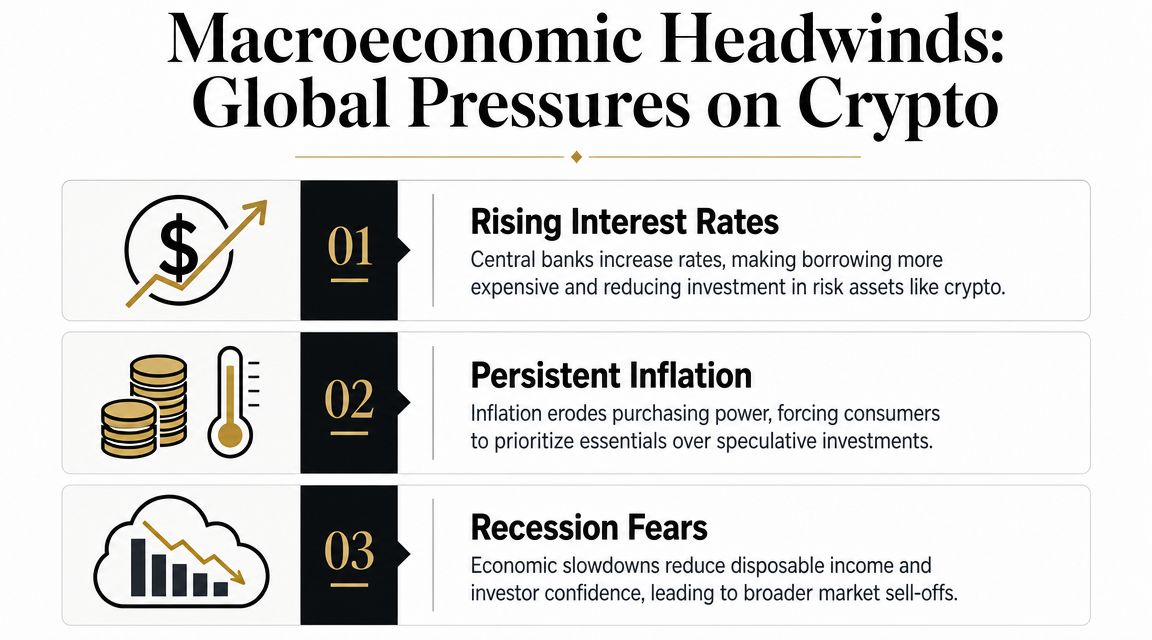
Why rates matter more than most crypto traders admit
The cleanest macro explanation comes from the cost of capital. NerdWallet's explanation of crypto crashes notes that crypto can fall when higher interest rates, inflation, recession fears, or broader market volatility hit risk appetite. It also makes the key point many retail traders miss: when borrowing costs rise and investors can earn safer yields elsewhere, capital rotates out of digital assets.
Think of liquidity like water in a pool. When central banks keep conditions tight, the pool drains. The first things exposed are the assets that depended most on abundant liquidity. Crypto sits near the front of that line.
That's why a market can sell off even when there hasn't been a major protocol failure, a huge hack, or a dramatic regulatory shock. If real yields rise, if the dollar strengthens, or if investors start preferring cash-like returns over volatility, speculative assets usually struggle first.
Why Bitcoin still trades like a risk asset
A common objection comes up every cycle. If Bitcoin is scarce and often framed as an inflation hedge, why does it sell off when inflation worries or yields rise?
Because, in practice, the market still prices crypto more like a long-duration risk asset than a pure monetary hedge. When future growth is discounted more aggressively, capital gets selective. Investors trim positions that need optimism, fresh inflows, and loose financial conditions to sustain premium valuations.
That reality affects more than Bitcoin. It changes flows across the entire stack:
- DeFi protocols face weaker risk appetite and less speculative borrowing.
- Layer 2 ecosystems can keep building, but their tokens may still get repriced with the rest of the market.
- AI and crypto narratives remain compelling, yet narrative strength doesn't immunize tokens from liquidity squeezes.
- Real-world asset tokenization may continue to advance while market prices still decline.
Macro pressure doesn't ask whether a blockchain has strong developers or elegant smart contracts. It asks whether investors want risk today.
What a macro-driven crypto selloff usually looks like
A macro-led drawdown tends to share a few traits:
- Correlations rise: Crypto starts trading more like tech and other risk assets.
- Bad news compounds: Weak data, rising yields, and geopolitical tension all point in the same direction.
- Good crypto news gets ignored: ETF developments, product launches, and ecosystem milestones stop supporting prices.
- Capital gets choosy: Investors hold Bitcoin or cash first, then cut down the risk curve.
That's the backdrop. But macro explains only the initial shove. Crypto's own structure explains why the decline becomes disorderly.
Inside the Machine Crypto-Specific Triggers
Crypto has a market structure problem during drawdowns. Once selling begins, the system can create more selling automatically.

How leverage turns a dip into a liquidation event
The Economics Observatory's analysis of crypto crashes notes that falling prices can trigger “margin trader liquidations,” financial stress at major crypto firms, and stablecoin collapses, creating a vicious downward spiral. That's the mechanical core of many crashes.
A trader using borrowed funds isn't just making a directional bet. They're using borrowed exposure. If the market moves against them, the exchange or venue can force-close the position. That forced close is a market order. Enough of those at once, and the market stops behaving like a normal auction and starts behaving like a cascade.
Here's the simple version:
- A macro headline or large sell order pushes Bitcoin lower.
- Long positions in perpetual futures lose collateral value.
- Exchanges liquidate the weakest positions automatically.
- Those sales push price lower again.
- The next layer of high-risk long positions gets hit.
That's why a modest decline can become a sharp breakdown in a matter of hours. The structure is reflexive.
To stay safe in that environment, traders need to know where operational risk is highest, not just market risk. Basic habits like checking venue quality, wallet permissions, and security practices matter more during panic periods. A good place to review those basics is this guide on how to avoid crypto scams.
Where stress spreads across the crypto stack
The hidden problem is interconnected collateral. Bitcoin and Ether often function as reserve collateral for broader crypto exposure. When they drop, the pressure spreads outward.
That stress can show up in several places:
- Perpetual futures books: Funding becomes crowded, and weak longs are vulnerable.
- DeFi lending markets: Falling collateral values can trigger on-chain liquidations.
- Stablecoin confidence: Even without a full de-peg event, market stress can raise redemption anxiety.
- Exchange balance sheet fears: Traders start asking which firms can handle volatility.
Here's a useful explainer before going deeper into mechanics:
The market structure clues worth watching
If you want to know whether crypto-specific triggers are taking over, watch instruments, not commentary.
| Signal | What it can indicate |
|---|---|
| Open interest | Whether leverage is building into the move |
| Funding rates | Whether longs or shorts are becoming crowded |
| Liquidation maps | Where forced selling may accelerate |
| Stablecoin behavior | Whether traders are seeking exits or safety |
When those indicators look stretched, price can detach from narrative and become mostly about positioning. That's when the crash stops being a simple selloff and turns into a machine.
The Vicious Cycle of Fear and Forced Selling
The core answer to why crypto is crashing right now sits in the overlap between macro pressure and market plumbing. One starts the move. The other accelerates it.
How the doom loop actually forms
A useful contrarian point from CoinMarketCap's discussion of what happened in crypto markets is that many explainers miss the plumbing. A selloff is often a feedback loop. Falling prices trigger liquidations, liquidations deepen the fall, and only then do macro narratives get attached.
That sequence explains why investors often feel confused during crashes. The first move may be sound. The second and third moves often come from structure, not new information.
A practical version of the loop looks like this:
- Macro fear starts de-risking
- Spot prices break key levels
- Derivatives positions get forced out
- On-chain and exchange collateral weakens
- Retail sentiment cracks
- More selling follows because the tape looks worse
At that point, the distinction between “fundamental” and “just amplified positions” stops being useful. They become intertwined. The initial macro shock changes price. The price change changes the structure. The structural unwind then changes sentiment.
What makes this phase so hard to trade
Many traders make their biggest mistake. They look for a single explanation when the market is running on several engines at once.
Most crashes don't move in a straight line from bad news to lower prices. They move from bad news to lower prices to forced selling to panic interpretation.
That's why bear market liquidity matters so much. Thin books, wider spreads, and crowded exits can make even good risk management feel late. If you want a deeper framework for how markets behave when depth disappears, this explainer on the liquidity of cryptocurrency is worth reviewing.
A violent bounce in this environment doesn't necessarily mean the worst is over. It may only mean the first liquidation wave has cleared. A renewed drop doesn't necessarily mean new information has arrived. It may mean the market found the next pocket of trapped overextended positions.
The hidden lesson in all of this
The fastest crashes are rarely pure verdicts on adoption, Web3 utility, DeFi growth, or the viability of smart contract platforms. Often they're the byproduct of excessive reliance on borrowed funds sitting on top of fragile confidence.
Once you understand that, the tape becomes easier to interpret. Not comfortable. Just more readable.
Reading the Market Sentiment and On-Chain Data
If you want to stay rational during a selloff, you need a dashboard that's better than social media.

What to watch before headlines catch up
Start with sentiment, but don't stop there. Tools like the Crypto Fear & Greed Index can help frame whether the market is emotionally stretched, though they work best as context rather than trading signals.
Then add market-based inputs:
- ETF flow direction: Useful as a rough read on institutional appetite.
- Open interest and funding: These show whether positioning is stabilizing or getting more fragile.
- Exchange inflows: Rising deposits can suggest holders are preparing to sell.
- Stablecoin rotation: Traders moving into stablecoins may be seeking shelter, not opportunity.
If you track these regularly, you'll react less emotionally. Portfolio tools can help you keep that view organized. For readers who want a cleaner workflow, this roundup of the best crypto portfolio trackers is practical.
How to read on-chain signals without overfitting
On-chain analysis is powerful, but many investors use it badly. They see a whale move and assume conviction. They see exchange outflows and assume accumulation. The better approach is to read clusters of behavior.
A few examples:
- Exchange balances falling can be constructive, but only if broader risk conditions aren't deteriorating.
- Large wallet movement might signal repositioning, custody changes, or preparation for sale.
- DeFi collateral changes can reveal whether risk is being unwound.
- Layer 2 activity may remain healthy even while token prices fall, which can tell you fundamentals and price action are diverging.
Market habit: Use sentiment indicators to understand mood, derivatives data to understand fragility, and on-chain flows to understand positioning.
That three-part view is far more useful than reacting to isolated screenshots on X or Telegram. It won't call every local bottom, but it will help you distinguish stress, capitulation, and stabilization.
How to Navigate the Crash A Plan for Every Investor
At 2:00 a.m., Bitcoin breaks a widely watched level, funding flips hard negative, and a pocket of forced selling hits thin order books. By breakfast, the chart looks irrational. It usually is not. In crypto, crashes are often the visible end of a chain reaction that started much earlier with tighter liquidity, weaker risk appetite, and too much debt sitting on fragile collateral.
That is why a selloff should be handled as a process problem before it becomes a conviction problem. The investors who come through these periods in one piece usually have rules for sizing, entry, liquidity, and thesis review. They are not trying to win every bounce. They are trying to avoid becoming part of the liquidation loop.
For long-term holders
Long-term holders need to separate price damage from thesis damage. Those are different questions, and mixing them leads to bad decisions.
Ask:
- Has the asset's role in the portfolio changed? Bitcoin, Ether, and core infrastructure tokens should not be judged by the same standard as thin liquidity narrative trades.
- Are fundamentals still advancing? Look at developer activity, product shipping, fee generation, user retention, and whether the chain or protocol still has a reason to exist.
- Was the position sized for a real drawdown? If a correction forces you to sell for risk reasons, the problem may be sizing rather than conviction.
- Has the capital structure become more fragile? Treasury depletion, token supply expansion pressure, or dependence on incentive emissions can matter more in a downturn than community sentiment.
If the thesis is intact, the job is patience and risk control. If the original case depended mostly on momentum, reflexive social sentiment, or a future listing, that should be admitted early. A bear phase punishes denial.
For active traders
Traders are playing a different game. Capital preservation comes first because stressed markets can stay disorderly longer than most positioning models assume.
A tighter checklist helps:
- Cut exposure before hunting reversals: The first bounce after a flush often comes from short covering, not durable demand.
- Trade confirmed levels: In unstable conditions, opinions matter less than whether spot bids, open interest, and volume support the move.
- Watch market structure: Thin books, widening spreads, and unstable basis can turn a good setup into slippage and forced exits.
- Keep timeframes separate: A scalp should not become a swing trade because the market moved against you.
- Track liquidation risk across venues: When perpetuals are crowded and collateral quality is falling, price can overshoot both down and up.
If you need a framework for handling prolonged weakness, this guide to the cryptocurrency bear market is a useful reference for resetting expectations and tightening trade selection.
For newcomers
Newer investors usually ask the wrong first question. They ask whether this is the bottom. The better question is whether they can define their risk before putting on more exposure.
Build a process before you build a bigger position.
That means small sizing, no borrowed capital, and no buying just because an asset is down 30% or 50%. In crypto, a cheap chart can still hide token release schedules, weak treasury management, falling on-chain usage, or collateral stress inside DeFi. A rate shock at the macro level can flow through to lower token prices, then weaker collateral values, then protocol liquidations, then panic selling on exchanges. By the time a newcomer sees the headline, the mechanical part of the move is already underway.
Crashes punish confusion. They also create the fastest education in the market if you stay curious instead of reactive.
The Long-Term Outlook Is the Crypto Thesis Broken
A sharp drawdown always forces the same test. Are we watching a speculative bubble deflate, or are we seeing the core use case lose relevance?
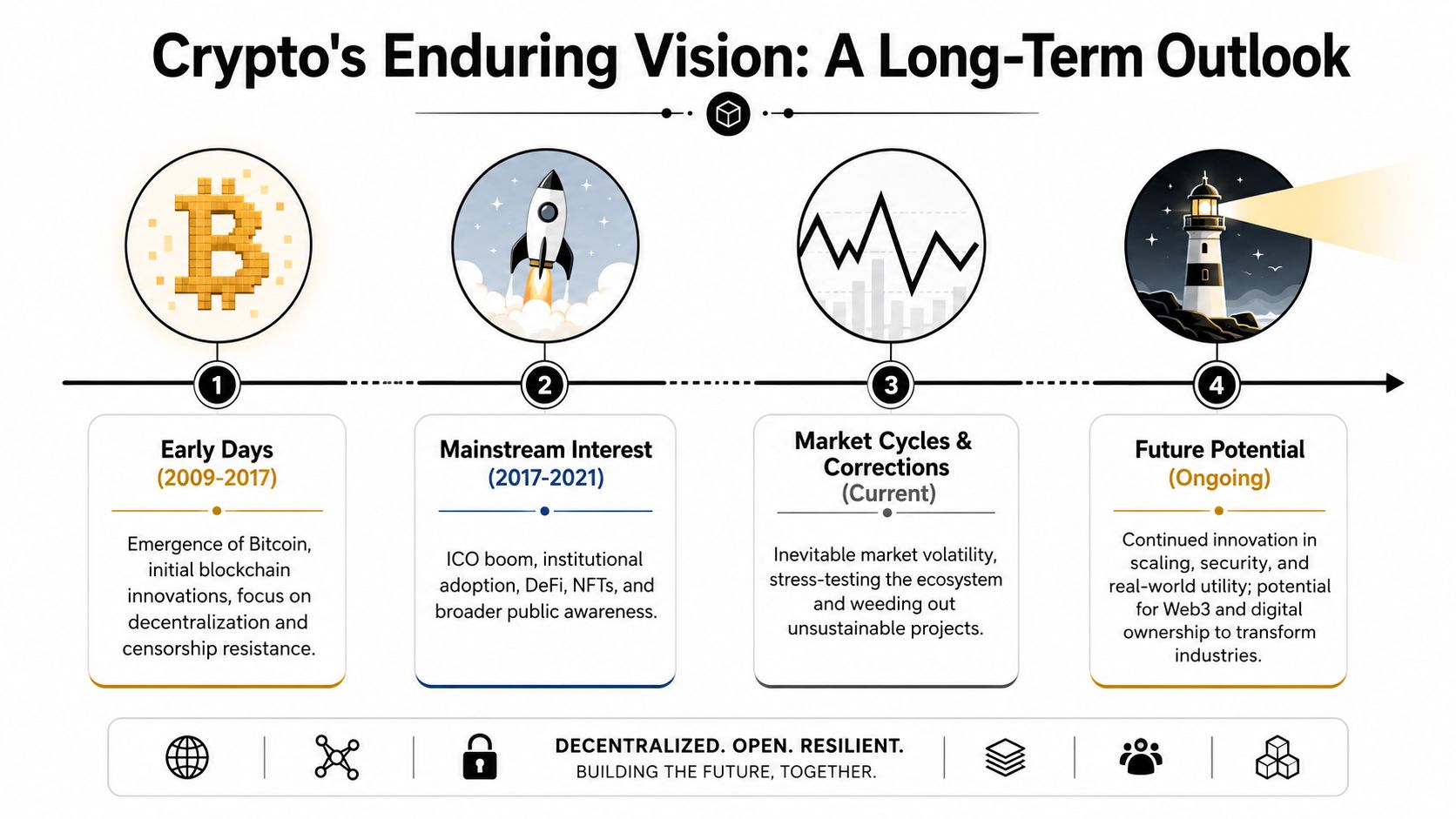
Price damage is not the same as thesis failure
One of the cleaner ways to frame the current selloff comes from Mudrex's explanation of Bitcoin weakness. Bitcoin may be discussed as a hedge against fiat debasement, but in real trading conditions it still behaves like a long-duration risk asset. When yields rise, liquidity tightens, and portfolio managers cut exposure, crypto often gets sold alongside other high-volatility assets.
That matters because it points to a valuation reset, not automatic invalidation of the asset class. The macro shock hits first. Then crypto's internal plumbing amplifies it through crowded positioning, collateral stress, and forced selling. By the time the market reaches capitulation, the chart reflects more than a view on adoption. It also reflects the mechanics of how this market clears risk.
That distinction helps explain why violent price declines can coexist with continued product development, active settlement, and rising experimentation across on-chain financial rails.
What still looks structurally important
The stronger parts of the crypto thesis are easier to judge through utility than price. A token can fall hard and still support a network that processes real activity. A protocol can lose market value and still provide infrastructure that traditional finance cannot replicate easily.
Several areas still deserve close attention:
- Layer 2 scaling: Lower fees and faster settlement improve the odds that blockchains support consumer and enterprise use beyond speculation.
- DeFi market structure: The better protocols are improving collateral standards, risk controls, and execution quality after each stress event.
- Tokenized real-world assets: This remains one of the clearest paths from macro capital markets into on-chain rails.
- Crypto and AI coordination layers: Identity, payments, data provenance, and machine-to-machine transactions are still early, but the direction is credible.
- Digital ownership systems: Programmable assets and open settlement continue to solve transfer, custody, and interoperability problems that closed platforms handle poorly.
None of that guarantees that current valuations are cheap.
It does suggest that the sector should be analyzed in layers. Macro conditions can pressure every token at once. Market structure can force good assets and weak assets lower together. Over a longer cycle, though, capital usually returns unevenly. It moves first toward assets with sticky users, durable fee generation, credible governance, and balance sheets that can survive a long funding drought.
For investors with a multi-year horizon, the better stance is selective optimism backed by strict filters. Stay skeptical of weak tokenomics, treasury-dependent narratives, and ecosystems that only function when subsidies are high. Stay open to infrastructure that keeps attracting developers and users during periods when price action is hostile. For a broader view of where that next cycle could develop, see these crypto predictions for 2025.
The crypto thesis breaks only if the need for censorship resistance, open settlement, programmable money, and digital ownership fades in the world. So far, the opposite appears true. What has changed is the price investors are willing to pay for those future cash flows, network effects, and adoption paths during a period of tighter global liquidity.
1 Comment