
How Many Bitcoins Are Mined Per Day in 2026?

Bitcoin miners currently produce about 450 BTC per day under normal conditions. That figure became the new baseline after the April 2024 halving, when the block reward dropped from 6.25 BTC to 3.125 BTC per block.
That's a much more revealing number than it first appears. If you want to understand Bitcoin's monetary policy, its digital scarcity, and why investors keep watching halvings so closely, daily issuance is one of the cleanest places to start.
A lot of articles stop at the headline math. But the more interesting question is why this number stays so stable over time, why it still varies from day to day, and why a slower flow of new BTC matters far beyond mining itself. It affects market structure, miner incentives, Bitcoin's role in Web3, and even how developers think about Layer 2 systems, DeFi rails, and collateral in a tokenized economy.
Table of Contents
- The Big Number and Why It Matters in 2026
- The Core Calculation Behind Daily Bitcoin Mining
- Bitcoin Halving The Engine of Digital Scarcity
- Beyond the Average Block Time Variance Explained
- How to Verify Daily Bitcoin Mining in Real Time
- The Market Impact of Bitcoin's Shrinking Supply
- Frequently Asked Questions About Bitcoin Mining
The Big Number and Why It Matters in 2026
How many bitcoins are mined per day? Right now, the practical answer is about 450 BTC under normal network conditions. That number matters because Bitcoin doesn't rely on a central bank, a committee, or a policy surprise. Its issuance follows code.
That predictability is the point. New BTC doesn't appear because demand rises or because a government wants more liquidity in the system. It appears as miners add blocks to the chain and collect the programmed subsidy. If you understand the daily issuance rate, you understand the heartbeat of Bitcoin's supply.
For investors, Bitcoin distinguishes itself from almost every other asset in crypto. Many tokens change supply through governance, treasury decisions, emissions schedules, or smart contract updates. Bitcoin's policy is far more rigid, which is part of why people often compare it to digital gold rather than a flexible Web3 utility token.
Practical rule: If you want to understand Bitcoin's scarcity, don't start with price. Start with issuance.
The timing also matters. The post-halving environment has made daily mining output much smaller than it used to be, which makes each new coin a thinner stream entering the market. That doesn't guarantee any price outcome, but it does change the supply backdrop that traders, long-term holders, and institutions are studying.
If you want deeper historical context, the story begins with Bitcoin's earliest design choices in the Bitcoin Genesis Block explainer. That origin story still shapes the system's monetary discipline today.
The Core Calculation Behind Daily Bitcoin Mining
At the protocol level, Bitcoin's daily issuance is straightforward: the network targets about 144 blocks every 24 hours, and each block currently carries a 3.125 BTC subsidy after the April 2024 halving. Multiply those two figures, and the baseline output is about 450 BTC per day.
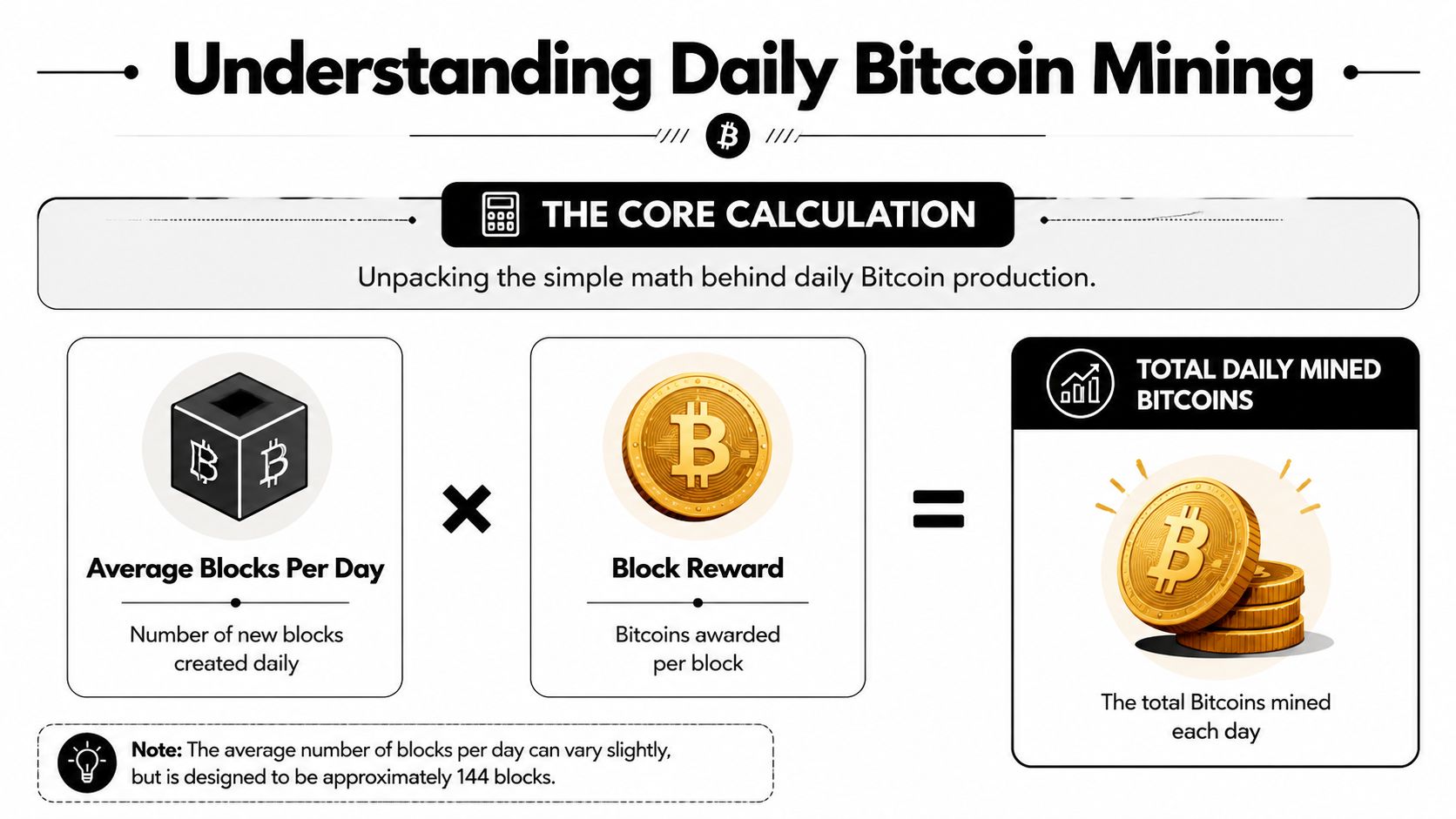
The simple formula anyone can verify
The key is understanding what “about 144 blocks” really means. Bitcoin is designed to produce a new block roughly every ten minutes. Over a full day, that target pace adds up to about 144 blocks. With a block subsidy of 3.125 BTC, the expected issuance is:
- Average blocks per day: roughly 144
- Current block reward: 3.125 BTC
- Expected daily issuance: 144 × 3.125 = 450 BTC/day
That is the average, not a guarantee for every calendar day.
A helpful analogy is a metronome that is set to a steady tempo but does not strike at perfectly even real-world intervals. Bitcoin aims for a ten-minute rhythm, yet blocks arrive early or late because mining is a probability game. That distinction matters for investors who want the actual number, not just the textbook one.
You can also verify the formula yourself. Bitcoin's issuance is visible on-chain, block by block, which makes it very different from assets whose supply changes through governance votes or treasury decisions. If you're new to the relationship between blocks, miners, and network agreement, this guide to blockchain technology basics gives useful background before you check a block explorer.
Why this matters for investors
For investors, the formula is only the starting point. The deeper point is why Bitcoin uses this structure at all. A roughly ten-minute block interval gives the network time to propagate new blocks across the world, reduces accidental chain splits, and creates a monetary schedule that is slow enough to audit but fast enough to keep settlement moving. In game-theory terms, miners are competing in a global lottery with fixed issuance rules, not negotiating supply with each other.
That design has second-order effects. A slower stream of new BTC means fewer fresh coins entering exchanges, custodians, and lending markets at any given time. As issuance keeps falling over Bitcoin's life, that supply constraint can shape liquidity conditions for newer crypto segments too, including BTC-backed DeFi products and Layer 2 ecosystems that depend on Bitcoin as a base asset.
Another useful framing is to separate subsidy from fees. The 450 BTC figure refers to newly issued coins from the block subsidy alone. Transaction fees can raise total miner revenue, but they do not create new bitcoin. For supply analysis, subsidy is the number that matters most.
Bitcoin Halving The Engine of Digital Scarcity
In April 2024, Bitcoin's block subsidy fell from 6.25 BTC to 3.125 BTC. That single rule change cut expected new supply from roughly 900 BTC per day to roughly 450 BTC per day.
That is the halving in plain terms. Every 210,000 blocks, Bitcoin reduces the number of new coins created in each block by 50%. The schedule is automatic, public, and hard-coded into the network's monetary policy.
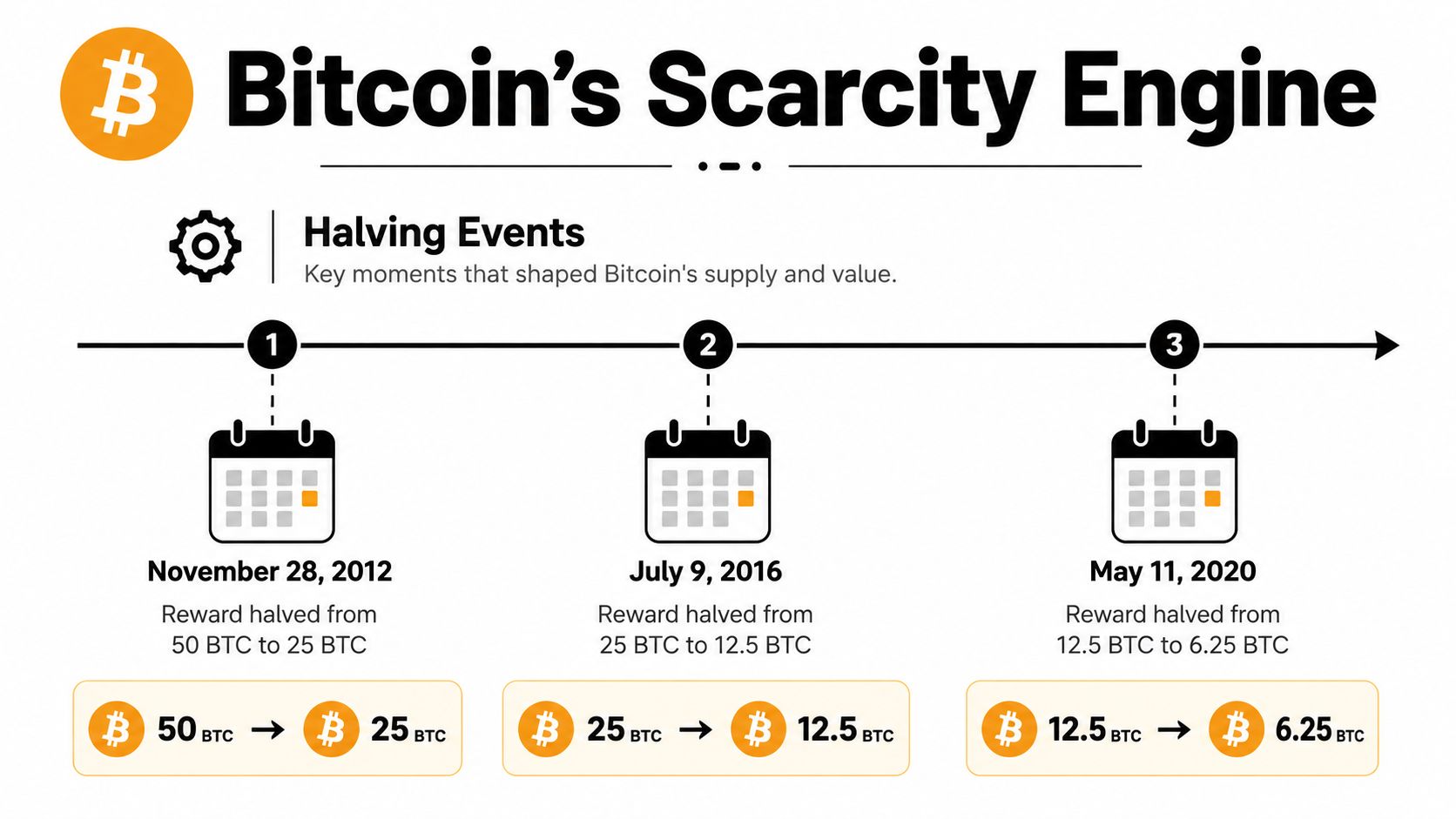
Why halvings matter more than headlines
A halving works like tightening a faucet. The stock of water in the tank still matters, but the flow rate changes immediately. In Bitcoin, that slower flow matters because miners are one of the natural sources of fresh coins entering the market.
The market impact starts with miner behavior. A miner whose revenue is cut in half overnight has only a few options: run more efficiently, earn more from transaction fees, sell a larger share of reserves, or shut down weaker machines. That pressure is part of Bitcoin's design. It forces constant competition and gradually shifts the network away from easy subsidy income.
Bitcoin is unusual because no committee adjusts that supply path in response to market stress, lobbying, or short-term demand. The reward drops on schedule. If you want the historical context behind that mechanism, this Bitcoin halving explained guide is a useful companion.
Three effects matter for investors:
- Miner margins get squeezed: High-cost operators feel the cut first, which can reshape hash rate distribution over time.
- New sell pressure falls: Fewer newly mined coins are available to be sold into the market each day.
- Scarcity becomes easier to model: Investors can estimate future issuance with far more certainty than in most crypto assets.
The game theory is what makes this more than simple arithmetic. Bitcoin does not just reduce issuance. It forces miners, traders, and long-term holders to react to a schedule everyone can see years in advance. That creates a strange mix of predictability and competition. The rule is fixed, but the responses to it are not.
The long road to the final satoshi
Bitcoin is still being issued, and it will be for a long time. What changes after each halving is the slope of the supply curve. New coins continue to arrive, just more slowly each cycle.
That point often gets lost. Scarcity in Bitcoin is not about mining ending soon. It is about the gap between existing supply and new supply getting narrower over time, which makes marginal new issuance less important relative to total circulating coins.
That has second-order effects beyond spot markets. A slower stream of fresh BTC can influence collateral availability in BTC-backed lending, liquidity in wrapped Bitcoin products, and capital allocation across Layer 2 systems that use Bitcoin as the base asset. As issuance declines, existing holders and treasury managers matter more because they control a larger share of coins available for trading, lending, or bridging into other systems.
In other words, halvings reshape incentives across the whole Bitcoin economy, not just the miners who find the next block.
Beyond the Average Block Time Variance Explained
The phrase “about 450 BTC per day” is accurate as an average. It isn't a promise that every calendar day will land on that exact total.
Bitcoin targets an average block time of about ten minutes. But mining is a probabilistic process. Some blocks arrive faster, some slower. That means the number of blocks found in one day can drift above or below the average, even when the system is working exactly as intended.
Why one day is never perfectly average
A good analogy is flipping coins. If you flip enough times, the overall pattern settles into something predictable. But any short stretch can look uneven.
Bitcoin behaves similarly at the block level. A single day might see blocks arrive in quick succession, then a slower patch later. So when people ask how many bitcoins are mined per day, the sharp answer is “about 450 on average,” not “exactly the same amount every day.”
That distinction matters for anyone watching issuance in real time:
- Daily totals can wobble: A specific day's output may differ from the expected average.
- Short-term variance doesn't break the model: Randomness is part of proof-of-work.
- Longer windows are more useful: Weekly and multi-week views better reflect the intended schedule.
How difficulty keeps issuance on track
If randomness were the whole story, Bitcoin would eventually drift away from its target pace. It doesn't, because the network self-corrects through difficulty adjustment.
When more mining power joins the network, blocks would tend to arrive too quickly. When mining power leaves, blocks would tend to slow down. Bitcoin counters that by adjusting the difficulty so the long-run average stays near the intended ten-minute rhythm.
It's similar to a thermostat. The room may warm and cool during the day, but the system keeps pulling conditions back toward the target.
Don't confuse precision with rigidity. Bitcoin is precise over time, not perfectly flat from hour to hour.
That's an important game-theory feature. Miners can compete aggressively, but they can't permanently speed up issuance just by throwing in more machines. The protocol absorbs those changes and pushes the system back toward schedule. For investors, that makes Bitcoin's monetary policy more durable than many people realize.
How to Verify Daily Bitcoin Mining in Real Time
One of Bitcoin's best features is that you can verify the numbers yourself. You don't need a bank statement, an earnings report, or a centralized dashboard that asks for blind trust.
A live block explorer shows the chain in motion. You can inspect recent blocks, check the subsidy, and count how many blocks were produced over a given period.
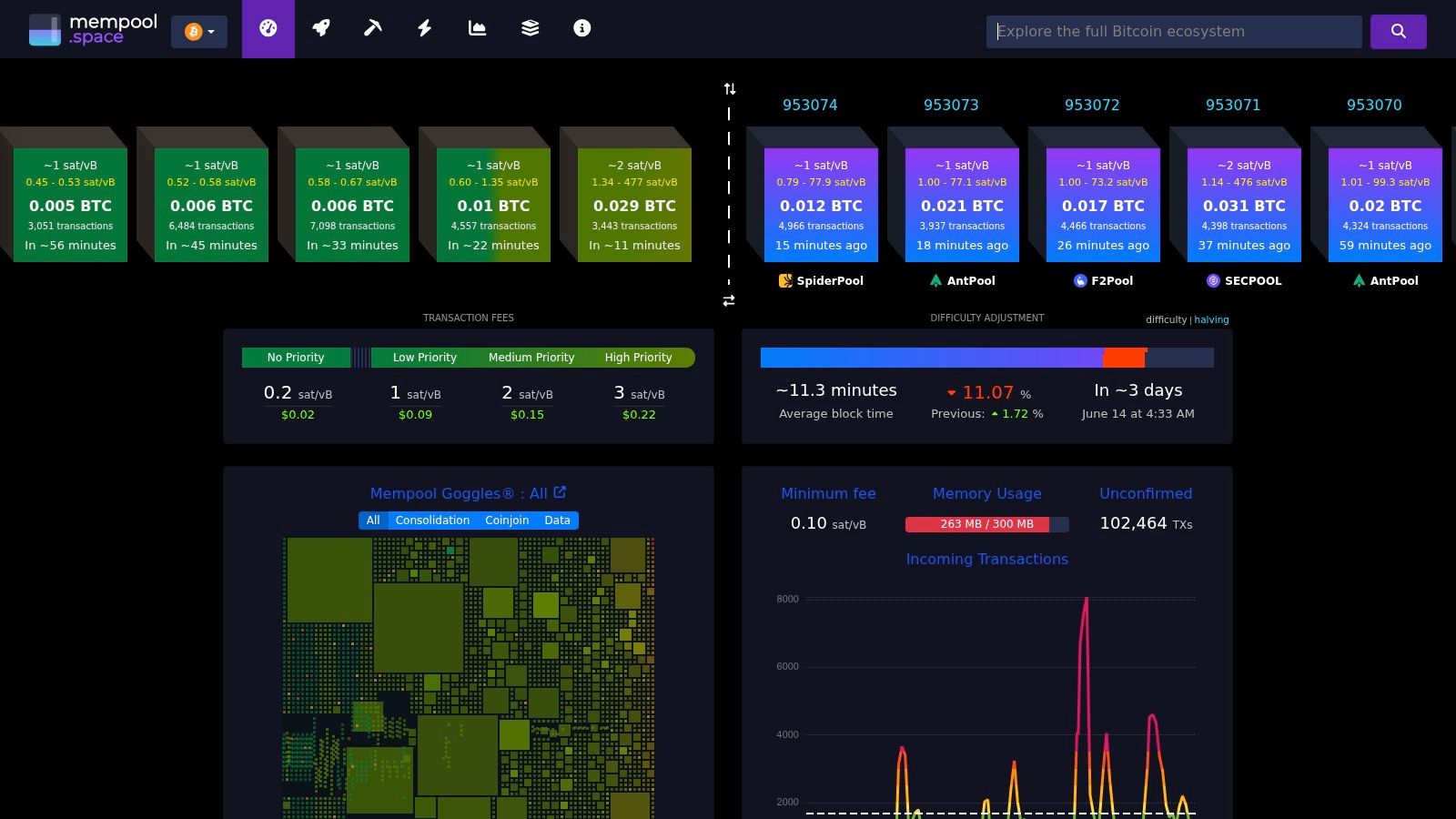
If you regularly follow mining data, this Bitcoin mining topic archive is a useful place to keep learning about miner incentives, network conditions, and proof-of-work mechanics.
What to check on a block explorer
Start with a tool like mempool.space or Blockchain.com. You're looking for a few specific signals, not a wall of metrics.
Use this checklist:
-
Recent block timestamps
Check how quickly blocks have been arriving. This gives you a feel for whether the last several hours were faster or slower than average. -
Coinbase transaction output
Every mined block includes the miner's reward transaction. That's where you can see the block subsidy and the fee component. -
Block count over a day
Count how many blocks were mined across a rolling day. Multiply by the current subsidy to estimate new BTC issued from block rewards. -
Transaction fees
Fees are separate from newly created coins. Beginners often find this distinction confusing. The subsidy creates new BTC. Fees transfer existing BTC from users to miners.
A simple verification workflow
A practical workflow looks like this:
- Open a live explorer: mempool.space is especially readable for non-technical users.
- Review recent blocks: confirm the current reward environment by inspecting newly mined blocks.
- Count a day's production: compare actual block count to the average expectation.
- Separate subsidy from fees: don't lump miner fees into “new bitcoins mined.”
Here's a video walkthrough that helps make the explorer view easier to read before you do it yourself:
Once you do this a few times, the topic becomes much less abstract. You stop repeating a headline number and start seeing Bitcoin's monetary policy operating in public, block by block.
The Market Impact of Bitcoin's Shrinking Supply
Supply doesn't determine price by itself, but it does shape the playing field. Bitcoin's declining issuance is one reason many investors treat it differently from inflationary tokens, governance coins, or app-layer assets.
When new supply slows, the market spends more time dealing with an asset that is increasingly driven by existing holders, miner selling decisions, and demand shifts rather than large ongoing emissions. That changes how people think about long-term positioning.

Scarcity changes how investors frame Bitcoin
A shrinking issuance schedule strengthens Bitcoin's role as a scarce base asset in the broader digital economy. That doesn't remove volatility or risk. It does mean Bitcoin's monetary policy is unusually easy to model compared with many crypto assets whose tokenomics can shift.
This is one reason Bitcoin often sits in a category apart from speculative altcoins. Investors may debate valuation, adoption, or macro sensitivity, but the supply policy is straightforward. That clarity matters when capital rotates through crypto narratives.
If you want to understand why market participants keep tying supply changes to sentiment, this analysis of why Bitcoin is rising offers a useful market-focused lens.
Why this matters for Layer 2, DeFi, and tokenization
The second-order effects are where things get interesting.
A scarce and predictable base asset gives builders a reliable foundation for other systems:
- Layer 2 networks: Developers can use Bitcoin as a settlement anchor while pushing more activity off-chain for speed or lower fees.
- Bitcoin-backed DeFi designs: When teams build lending, borrowing, or collateral frameworks around BTC, predictable issuance improves how they think about long-term supply behavior.
- Tokenized real-world assets: As tokenization expands, some market participants will keep asking which digital assets are credible collateral. Bitcoin's monetary discipline is part of that discussion.
- AI plus crypto systems: AI-driven treasury tools, trading systems, and on-chain agents work better when the monetary base they analyze isn't subject to sudden discretionary supply changes.
The risk side matters too. Scarcity narratives can become oversimplified. Markets still depend on liquidity, regulation, custody, macro conditions, and user behavior. Bitcoin's shrinking supply is powerful, but it doesn't operate in a vacuum.
Frequently Asked Questions About Bitcoin Mining
Do miners earn only newly created BTC
No. A miner's payout has two parts: the block subsidy and transaction fees. The subsidy is new BTC entering circulation. Fees are existing BTC paid by users to compete for block space.
That split matters because miner revenue and new supply are not the same thing. If fees rise during periods of heavy network activity, miners can earn more even though no extra BTC is being created.
How many bitcoins are left to mine
Only a small share of Bitcoin's total supply remains unissued, as noted earlier in the article. The exact figure changes over time because new coins are added block by block, not all at once.
The practical point is simpler than the snapshot. Most BTC already exists, and the remaining supply enters circulation on a fixed schedule that keeps slowing over time.
What happens when all 21 million BTC are mined
Mining does not stop when the last bitcoin is issued. The network still needs miners, or whatever set of hash-power providers exists then, to order transactions and secure the chain. Their compensation shifts from a mix of subsidy plus fees to fees alone.
That raises an important long-term question: will fee revenue be high enough to support strong security? Analysts debate that issue because it depends on future demand for block space, the growth of Layer 2 systems, and how much activity settles back to Bitcoin's base layer.
Does energy use relate to network security
Yes. In proof of work, energy spending is part of the cost of attacking the network. The higher the cost to produce valid blocks, the more expensive it becomes to rewrite history.
A useful analogy is a vault with a lock that costs money to keep engaged every minute. Bitcoin's security budget works in a similar way. Miners keep paying ongoing costs, and that continuous expense helps protect the ledger from cheap manipulation.
Why is the number of bitcoins mined per day a common question
Because it is the fastest shortcut to Bitcoin's monetary policy. If you understand daily issuance, average block timing, and halvings, you understand why Bitcoin behaves differently from assets with flexible supply.
It also leads to better questions. Instead of asking only for the headline number, informed investors start asking why the daily total can drift above or below the average, how to verify issuance in real time, and what a slower supply curve means for custody demand, DeFi collateral design, and Layer 2 adoption.
If you want more clear, data-grounded crypto explainers, follow Coiner Blog for practical analysis on Bitcoin, blockchain infrastructure, Web3 trends, DeFi, NFTs, tokenomics, AI and crypto, and the risks that matter just as much as the upside.