
Mini Royale Nations Explained: Gameplay, NFTs, and Earning
You can spend ten minutes in a browser game and still not know what you're looking at. Mini Royale Nations is one of those titles, the match starts fast, the menus look familiar to anyone who has touched a shooter, and the crypto layer only becomes clear once you ask where the ownership lives, how the economy flows, and whether the earning part still matters.
Table of Contents
- What Mini Royale Nations Is
- How the Shooting Gameplay Loop Works
- The Hybrid Off-Chain and On-Chain Design
- Battle Pass, NFTs, and the Season 1 Vikings
- Wallets, Marketplaces, and Token Flows
- Play-to-Earn in 2026 and Whether It Still Holds Up
- Risks, Scams, and Security Checklist
- Outlook and Who the Game Makes Sense For
What Mini Royale Nations Is
A new player clicks into a match, picks a loadout, and starts shooting. That first session sits inside a browser-based FPS with a social-strategy layer built around nations, clans, alliances, and land ownership, all tied to Solana's asset model rather than a purely cosmetic NFT wrapper. That mix is why Mini Royale Nations stood out as an early milestone in blockchain gaming, not just another token-themed shooter. The team described the live launch on December 16, 2021 in its one-year launch post as the first live multiplayer game on Solana, and the same launch marked the rollout of the first on-chain Battle Pass on Solana, with 10,000 Vikings and soldiers minted on Magic Eden for Season 1, Vikings.
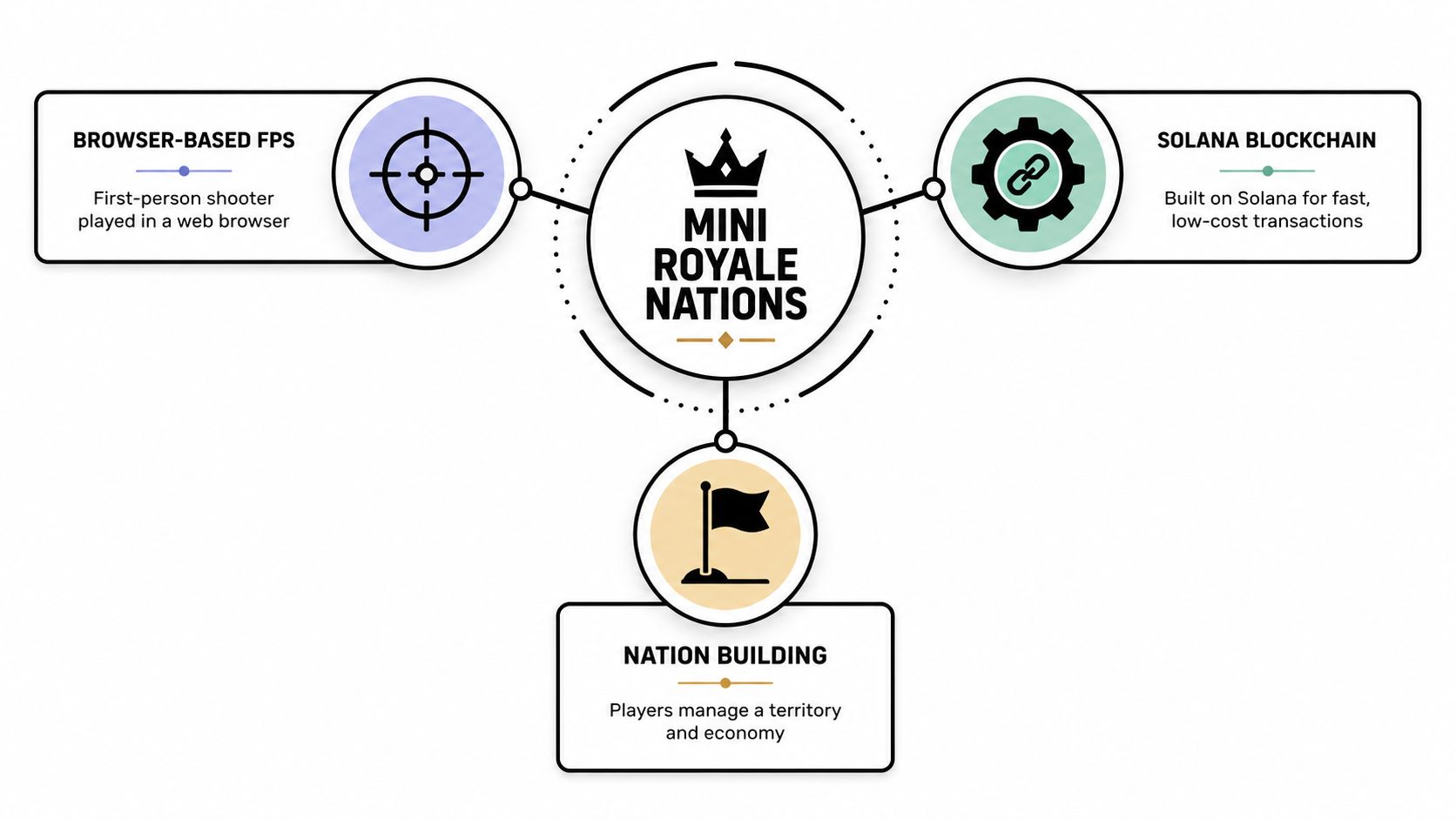
Three layers sit underneath the name
The easiest way to understand the game is to separate the experience into three parts. First is the shooter itself, which is the part players notice immediately. Second is the blockchain layer, which handles ownership, trading, and reward assets. Third is the social frame, the “nations” idea, which gives the game a community identity that goes beyond a standard deathmatch loop.
For newcomers trying to separate Web2-style gameplay from on-chain systems, a basic overview of Web3 gaming helps set the frame. Mini Royale Nations uses that split clearly. The match can feel familiar even if the ownership layer and reward flow live elsewhere.
That framing has a long historical echo. The broader micronation tradition first showed up in recorded form in the 1800s and expanded sharply in the 1960s and 1970s. The history of micronationalism points to Sealand, established in 1967 on an abandoned World War II gun platform in the North Sea outside the UK's then three-mile territorial water claim, and to Talossa, founded in 1979 and active online from November 1995. Those examples matter because they show how “nation” can mean identity, rules, and membership, not only territory.
Practical rule: if a Web3 game uses a big conceptual word like “nation,” ask what it changes in play. In Mini Royale Nations, it changes the social layer and the ownership layer more than the moment-to-moment shooting.
For readers trying to judge whether the economy still has useful life in 2026, that distinction matters. The rest of the article examines how the match loop, on-chain assets, and token flows fit together, and where the hard trade-offs show up.
How the Shooting Gameplay Loop Works
The gunplay is the easiest place to start because it behaves like a normal browser shooter before any wallet logic enters the picture. Mini Royale Nations is built for short, low-friction matches, and published coverage says the two main PvP modes, Team Deathmatch and Capture the Flag, run for about 3 minutes with up to 9 players in one source and up to 10 players in another. Spintop's game listing and MMORPG's game page both point to that compact structure. The result is a loop designed for quick starts, quick finishes, and very little downtime.
Loadouts matter more than random drops
Before each match, players pick a loadout, not just a single gun. One review describes that loadout as a character, primary weapon, secondary weapon, and grenade, which means the game pushes you to make a pre-match decision instead of relying entirely on spontaneous loot luck. Yahoo Finance's gameplay overview also says the weapon roster is around 10 different weapons, including assault rifles, submachine guns, a sniper rifle, and a shotgun.
That smaller arsenal is not a weakness by default. In a browser FPS, a tighter set of weapons keeps the learning curve manageable and makes balance changes easier to judge. It also lowers the amount of menu friction before each round, which matters when matches are this short.
Controls are pitched to people who already know PC shooters. A gameplay review describes WASD movement, mouse aim, left-click to shoot, right-click to focus, and spacebar to jump. Another guide adds shift for slow walk, tab for inventory, and hotkeys for swapping weapons, while also noting bunny hopping as part of the movement skill ceiling. This gameplay video makes the control style obvious.
Practical rule: if a browser game gives you familiar FPS controls and a short round timer, it's trying to win on immediate feel, not on complex systems mastery.
That design choice says a lot about the target audience. The game doesn't ask you to study a large map meta or a giant arsenal before you can enjoy a match. It asks you to move, aim, and make quick decisions, then it layers ownership and economy on top of that familiar loop.
The Hybrid Off-Chain and On-Chain Design
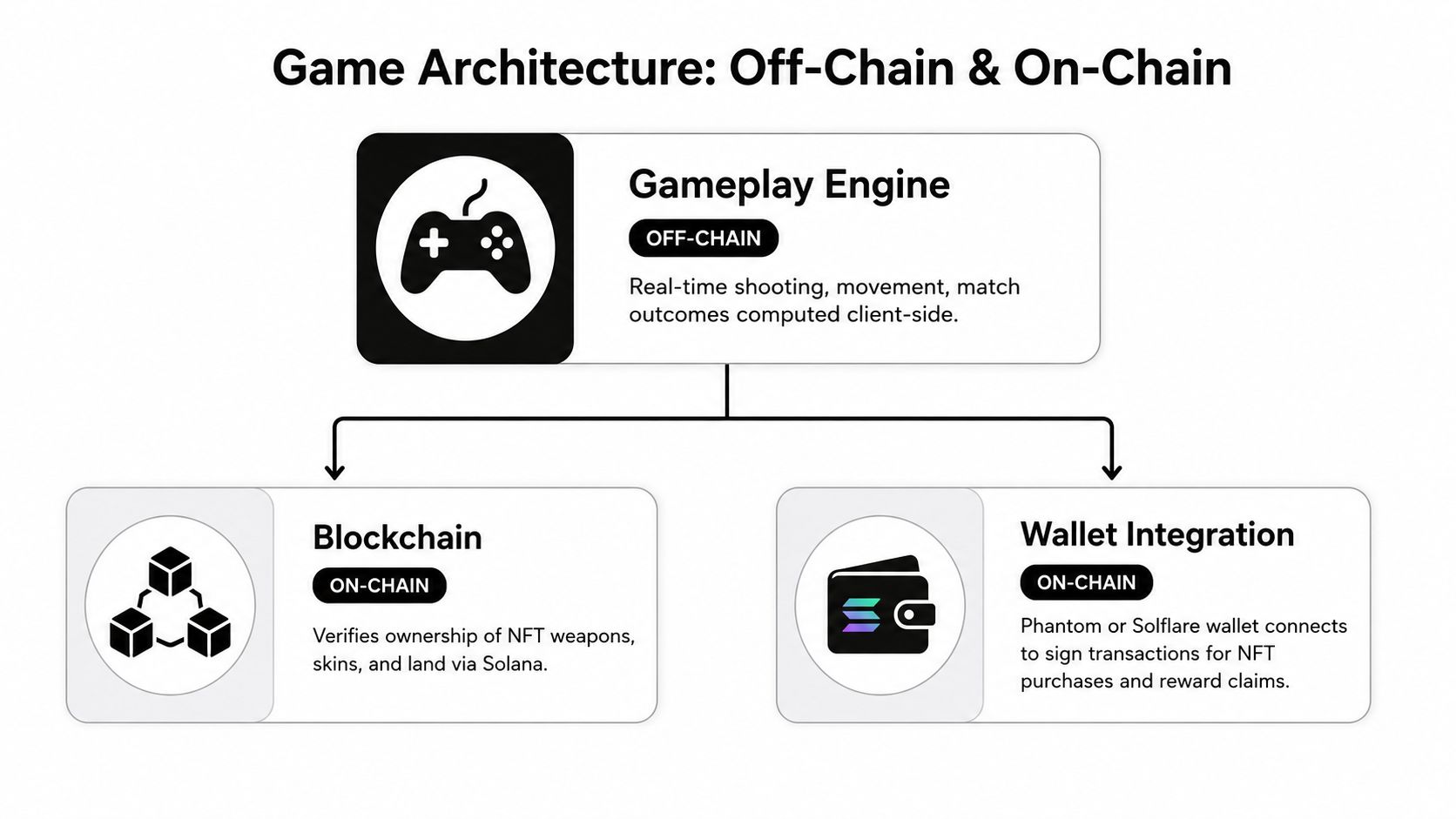
A browser shooter has a simple test: if aiming feels delayed, the whole game suffers. Mini Royale Nations avoids that problem by keeping the browser-based FPS side off chain, while placing assets and the economy on Solana. That split lets combat stay immediate, while ownership, transfers, and rewards can use blockchain mechanics without slowing the match itself.
What stays in the game, and what moves on chain
The project's FAQ says the game is meant to reward players with fungible tokens convertible to fiat or crypto, and that weapons, characters, land, buildings, and tools can exist as NFTs that are bought, borrowed, and sold in an open economy. Faraway's FAQ is the clearest source for that hybrid model. In practice, combat state stays light inside the game client, while ownership and tradable progression assets are recorded on Solana.
That setup fits a shooter because on-chain logic is a poor match for twitch combat. If every shot or movement tick had to wait for blockchain confirmation, the game would feel broken. Instead, the chain is used where persistence matters most, ownership, trading, rewards, and item provenance. For readers who want a broader explanation of how NFTs function as tradable records, this NFT primer is a useful companion.
A simple way to separate the layers is this:
- Off-chain gameplay: movement, aiming, match flow, and moment-to-moment combat.
- On-chain ownership: NFTs, tradable assets, and tokenized rewards.
- Wallet interaction: signing purchases, claims, and asset transfers.
Why decentralization is partial, not total
A lot of Web3 gaming marketing gets fuzzy here. A game can use NFTs and tokens without being “fully on-chain,” and Mini Royale Nations sits in that middle zone. The blockchain gives players verifiable ownership and a marketplace-friendly asset model, but the shooter itself still depends on standard game infrastructure.
That trade-off is practical for a browser FPS that needs responsiveness. Solana is being used for the parts where ownership and transferability matter more than sub-second input handling, while the actual gunplay stays in the game client where it belongs.
For readers comparing this to broader Web3 gaming, this explainer on Web3 gaming helps frame the basic category without pretending every game uses the same architecture.
Battle Pass, NFTs, and the Season 1 Vikings
A season pass in a shooter usually means a ladder of cosmetic rewards and timed progression. In Mini Royale Nations, the Battle Pass sits inside a Web3 ownership layer, so the pass is tied to assets that can be held and traded rather than only tracked inside one account. The launch post says Season 1 began with Vikings, and that 10,000 Vikings and soldiers were minted on Magic Eden as part of the Season 1 Premium Collection. That launch is a useful marker for how the game linked seasonal progression to NFTs from the start.
What a tokenized pass changes
Ownership is the first change. A conventional pass lives under publisher rules and usually disappears when the season ends, while an NFT-backed pass can be bought, sold, or kept as a separate asset if the game supports that flow.
Ownership alone does not guarantee strong utility. The item exists as a tradable object with recorded ownership, but that still leaves open a bigger question, what does it do inside the game? A player may hold a Viking NFT and still treat it mainly as a collectible or a speculative item rather than a direct gameplay advantage. That tension is common in GameFi, and it helps to keep “you own it” separate from “it changes your match results.”
For readers who want the mechanics behind that distinction, this NFT explainer is a useful companion.
Practical rule: ownership is not the same as utility. In Web3 games, a collectible can be real and still be limited in what it changes on the battlefield.
Why the Season 1 mint matters
The Season 1 mint gives the game a concrete historical anchor. It shows that the project was not only talking about blockchain concepts in the abstract, it was shipping a seasonal economy with a named collection and a documented mint size. That is a stronger signal than marketing copy alone.
It also explains why Mini Royale Nations keeps appearing in early blockchain game conversations. A dated launch, a platform-first claim, and a quantified NFT mint place it in the early Solana GameFi timeline, which helps explain why people still look at it when they ask what blockchain shooters were trying to become.
Wallets, Marketplaces, and Token Flows
A Mini Royale Nations session only makes sense once the wallet, the marketplace, and the reward flow are separated in your head. The game client handles the action, while the wallet handles ownership and the marketplace handles transfers, so the Web3 part is really a set of accounting layers around normal play.
What a player does
A player usually begins with a Solana wallet. Wallets such as Phantom or Solflare are common in the Solana ecosystem because they let players sign transactions when they buy, sell, or claim assets. The wallet does not run the match, it approves changes to ownership and balances.
A marketplace sits between the player and the asset. The Season 1 collection was minted on Magic Eden, which shows how NFT distribution and resale can sit outside the game client while still affecting the wider economy. If you want to see why wallet design matters before anyone signs a transaction, deconstructing Phantom Wallet interface is a useful design reference because it shows how much clarity and trust a wallet needs before a user confirms anything.
The game's FAQ says rewards can be fungible tokens convertible to fiat or crypto, but that does not mean every match produces money a player can easily cash out. It means the token layer is intended to be liquid enough for conversion or swap at the wallet level, subject to market conditions and whatever fees sit between the reward and the final payout.
Off-chain and on-chain responsibilities
| Layer | Responsibility | Example |
|---|---|---|
| Off-chain | Real-time play and match logic | A Team Deathmatch round starts and ends inside the game client |
| On-chain | Ownership and transfer of assets | Buying or selling a weapon NFT through Solana |
| On-chain | Reward settlement and claims | Receiving token rewards tied to progression |
| Off-chain | Most combat state | Shooting, movement, and score tracking during a match |
That split is what confuses new players. They assume every in-game action needs a blockchain transaction, but most combat never touches the chain. The game only needs on-chain action when ownership, settlement, or trading changes hands, which keeps moment-to-moment play faster while leaving the economy layer to wallets and marketplaces.
For people comparing this with other asset-based income models, this discussion on how creators can diversify beyond ad revenue is a useful parallel. The mechanics are different, but the same question applies, where does value come from, and how much survives once fees, conversion, and dilution enter the picture?
Play-to-Earn in 2026 and Whether It Still Holds Up
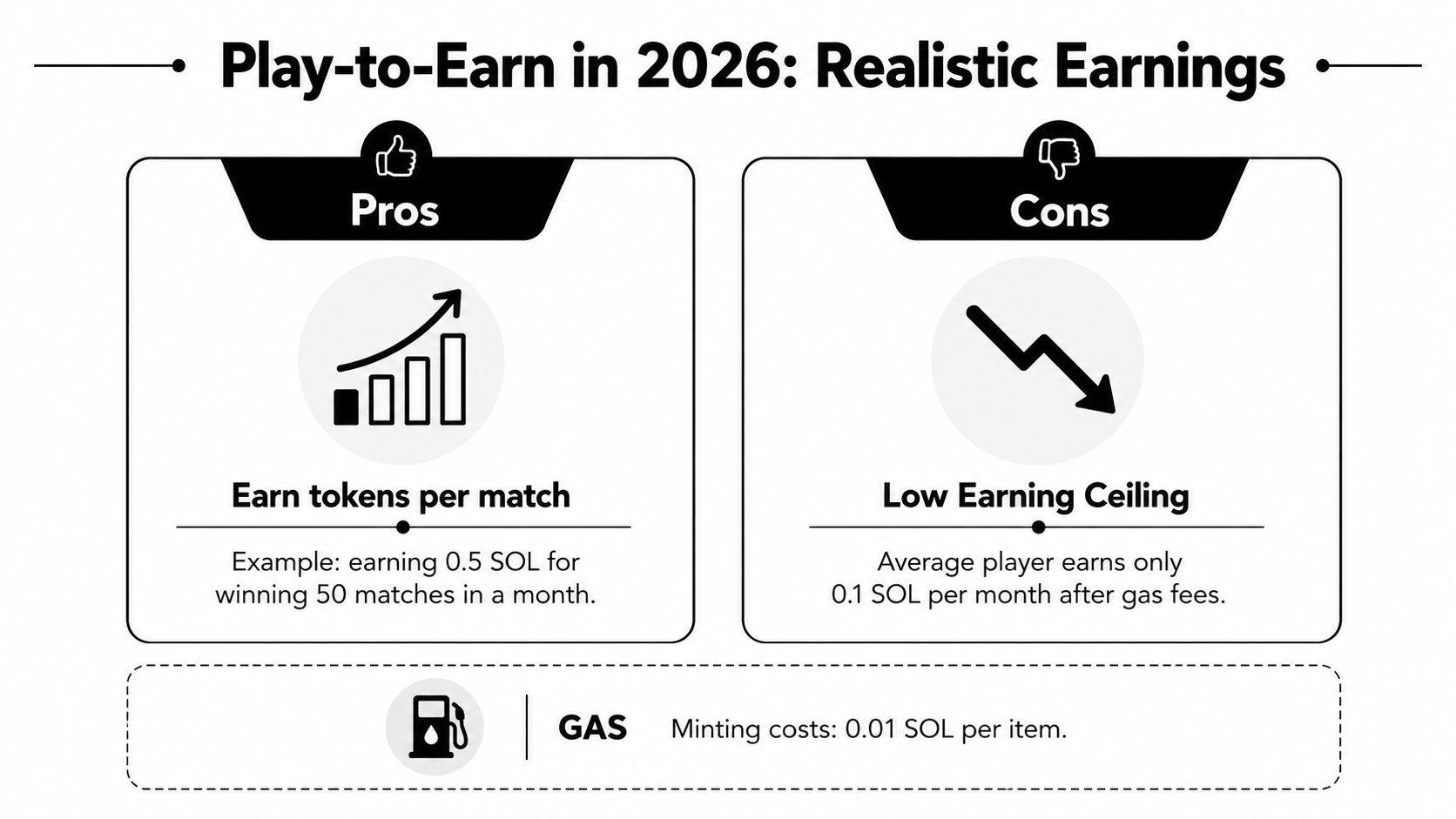
A new player can still enjoy Mini Royale Nations as a browser shooter with collectible ownership built around it, but the harder question is whether that ownership layer still produces value in 2026. Public coverage still leans toward gameplay, how-to-play explanations, and early Web3 framing, while saying much less about active player counts, token velocity, or whether earnings survive dilution and fees. That gap matters, because a token system can look healthy in theory and still feel thin once a normal player tries to turn rewards into something usable.
Why early funding doesn't answer today's question
Faraway's public positioning emphasized a player-driven economy, and reporting around its funding round described a $21 million raise for that idea. The Bridge's coverage gives useful launch context, but it does not show whether the economy still works now. A strong thesis at launch can still lose momentum if rewards outgrow demand or if the token stops feeling relevant to the player base.
That is the right lens for 2026. A token economy can look attractive on paper and still fail the practical test if the average player spends more time than value extracted. Market prices, liquidity, and item resale all matter, but the game still has to feel worth the time.
Trade-offs new players should think about
Mini Royale Nations has a few strengths in theory. It is browser-accessible, matches are short, and the ownership layer is clear enough to understand without a long setup. Those advantages do not guarantee a meaningful earn rate, and they do not guarantee that earnings beat opportunity cost.
The main pressure points are familiar to anyone who has watched GameFi cycles:
- Token dilution, if rewards outpace demand.
- Marketplace friction, if items do not resell easily.
- Fees and spread, which eat into small gains.
- Retention risk, if the player base thins out.
The practical takeaway is simple. If you treat Mini Royale Nations as a fun browser shooter with optional Web3 upside, the experience can still make sense. If you treat it as a dependable income stream, the public record is too thin to support that expectation.
For a broader parallel, diversify beyond ad revenue is the same kind of question creators face when one income stream carries too much weight. The mechanics are different, but the basic issue is the same, where value comes from, and how much survives once fees, conversion, and dilution enter the picture.
Practical rule: if the public record cannot show active economy health, treat earnings claims as unproven until you test the loop yourself.
Risks, Scams, and Security Checklist
A Mini Royale Nations session can be harmless right up until you connect a wallet, approve a transaction, or claim an NFT. At that point, the game sits inside the same Solana risk surface as any other Web3 app. The artwork, branding, and browser access may feel familiar, but smart contract risk, phishing, and bad permissions still apply.
Use a simple pre-flight routine
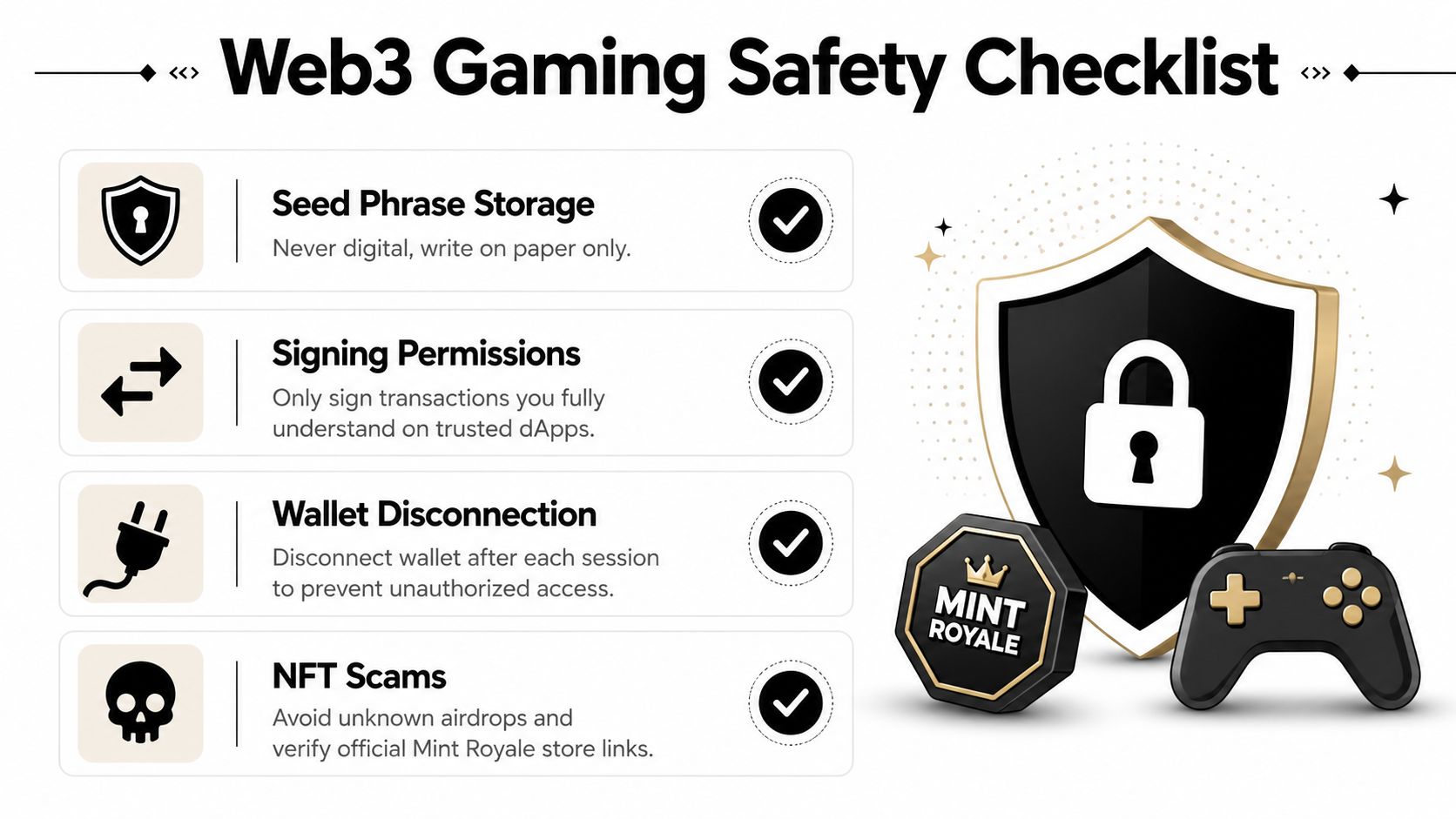
- Seed phrase storage: keep it offline, written down, and never in screenshots or cloud notes. If someone gets the phrase, they get the wallet.
- Signing permissions: read every approval prompt and only sign transactions you understand on trusted dApps. A confusing request is a reason to stop, not click through.
- Wallet disconnection: disconnect after each session so you're not leaving a live approval open longer than necessary.
- NFT scams: ignore unknown airdrops and verify official mint or marketplace links before you click anything. Fake collections often look close enough to fool impatient users.
That routine follows the same logic used in a guide to conducting risk assessments. The aim is simple, reduce the obvious ways a wallet can be drained before you start chasing in-game rewards.
Don't blur security with convenience
Crypto losses often happen when people treat wallet prompts the same way they treat routine browser pop-ups. The wallet is the boundary between a game session and your assets. If you rush through approvals, you are handing control to code you may not understand.
That caution matters even more if you are comparing gameplay upside with token reality. Mini Royale Nations can still be fun as a browser shooter, but the on-chain side only works if the player understands what is being signed, what is being held, and what can be sold later. For a plain-language reminder of common traps, how to avoid crypto scams is worth reviewing before you connect anything.
Regulatory and tax treatment also matters. If you trade NFTs or receive tokens from gameplay, the records can matter later, even if the amounts feel small at the time. That is not legal advice, just a practical reason to keep transaction history organized.
Practical rule: if a transaction prompt does not match what you expected to do in the game, stop and verify the contract or marketplace URL before you approve anything.
Outlook and Who the Game Makes Sense For
Mini Royale Nations makes the most sense today as a low-friction Solana gaming case study, a browser FPS with optional NFT layers, and a reminder that early GameFi ideas were trying to solve real ownership problems, not just chase token attention. The game's short matches, compact weapon pool, and hybrid architecture make it easy to understand even if you're not deep into crypto.
For a curious newcomer, the game is reasonable if you want to learn how Solana gaming feels without installing a heavy client. For an investor, it's more interesting as a historical marker than as a straightforward asset thesis, because the public record still leaves major gaps around live activity, tournament health, and whether the economy is producing meaningful player value today. That uncertainty is the honest answer, not a downside to be hand-waved away.
The signals worth watching are simple. Look for visible live-ops updates, active community discussion that isn't just price chatter, and evidence that the token layer still has real in-game utility. If those signs are thin, treat the title as a fun, early Web3 artifact rather than a live earning engine.
If you want more grounded coverage of crypto gaming, token mechanics, and blockchain projects without the usual hype, visit Coiner Blog for practical analysis you can use before you connect a wallet or chase a game economy.