
How Does NFTs Work? Your 2026 Guide to Digital Assets
You're probably seeing NFTs in three very different contexts at once. A friend treats them like digital collectibles, a developer talks about smart contracts and token standards, and an investor cares about liquidity, marketplaces, and which chain wins. All three are talking about the same thing, but from different layers of the stack.
That's why “how do NFTs work?” often gets muddy. People jump straight to JPEGs, prices, or hype cycles, when the core understanding starts with ownership infrastructure. An NFT is less like the image itself and more like the digital title record that says who owns a specific tokenized item, how it can move, and which blockchain keeps that record public.
Table of Contents
- The Big Picture What Is an NFT Really
- The Anatomy of an NFT Smart Contracts and Metadata
- From Creation to Wallet The NFT Lifecycle
- Beyond Digital Art Expanding NFT Use Cases
- The Market Ecosystem Wallets Marketplaces and Blockchains
- Risks Criticisms and the Future Outlook
- Your Top NFT Questions Answered
The Big Picture What Is an NFT Really
A collector opens a marketplace, clicks “buy,” and sees a new NFT appear in their wallet. The obvious assumption is that they now own the image itself. In practice, what they own is a blockchain token that points to an asset and records who controls that token.
That distinction is the starting point for understanding how NFTs work. An NFT is a unique token on a blockchain. The artwork, music file, game item, event pass, or document connected to it is a separate thing. The token functions more like a verifiable record of ownership or access than the media file itself.
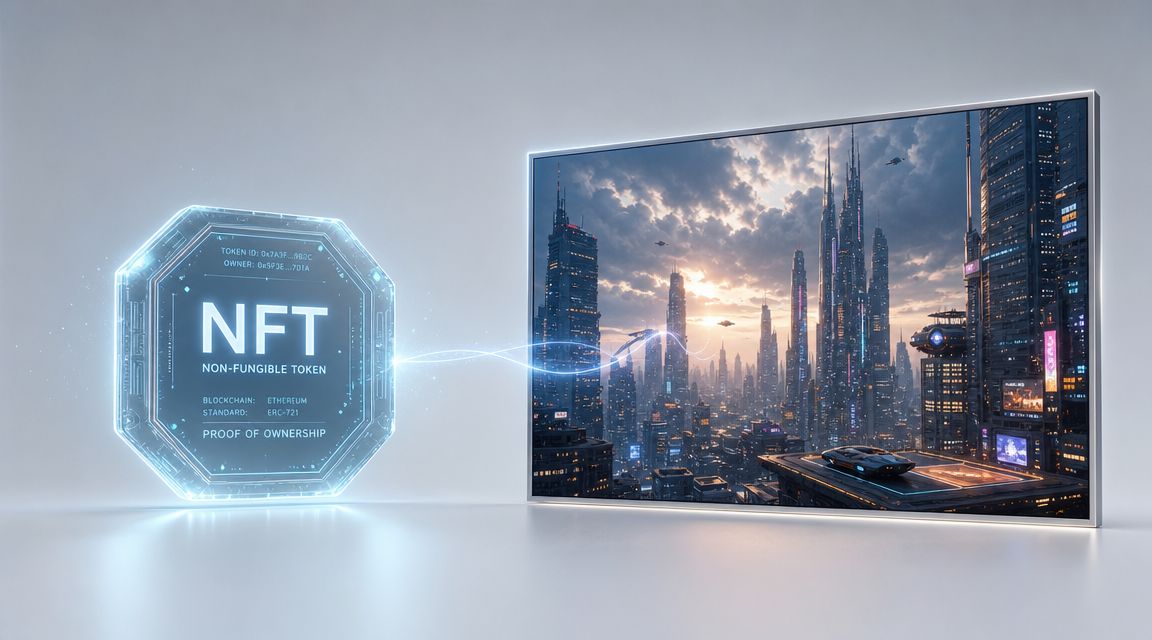
The token is not the file
A useful comparison is a concert ticket. The ticket is not the performance. It is the record that proves your right to enter. NFTs work in a similar way. The token is the verifiable blockchain record. The associated file or benefit is what the token refers to.
That is why copying an image does not copy the NFT itself. Anyone can duplicate a JPEG at the file level, but only one wallet can control a specific token ID on a given contract at a given moment. If you need a refresher on why public ledgers can verify records this way, this overview of blockchain technology basics gives the background.
Practical rule: When someone says “I bought an NFT,” they usually mean they bought an on-chain token linked to an asset, license, membership right, or collectible, depending on how the project is structured.
This design creates real consequences outside the code. It enables verifiable scarcity because the blockchain can show how many tokens were issued and who holds them. It also creates room for confusion, because social value and legal rights do not automatically come bundled with the token. A buyer may hold the NFT while having limited rights to the underlying media, and market prices can swing hard even when the token's ownership record is perfectly clear.
Why the history matters
NFTs make more sense when you view them as an infrastructure idea before you view them as a trend. Developers were trying to answer a specific question: how can a blockchain represent one distinct item, track its provenance, and transfer it between users without treating it like a fully interchangeable coin?
That design goal explains why NFTs now show up far beyond digital art. The same mechanics can support in-game items in GameFi, tokenized memberships, identity credentials, and early experiments with real-world assets, often called RWAs. In each case, the core promise is similar. A token can act as a public, programmable record of ownership, access, or claim.
A few concepts anchor the whole category:
- Uniqueness: each NFT can be identified separately from every other token.
- Provenance: transfer history can be inspected on-chain.
- Programmability: smart contracts can enforce rules around minting, transfers, and utility.
- Interoperability: wallets, apps, and marketplaces can interact with the same token standard.
With that mental model, NFTs stop looking like “images on a blockchain” and start looking like a way to assign digital objects, rights, and claims a visible chain of custody. The technology is straightforward. The harder part is understanding what that record means in practice, where scarcity can be verified on-chain but value still depends on markets, communities, and use case.
The Anatomy of an NFT Smart Contracts and Metadata
An NFT has two main layers. One layer lives on the blockchain and handles the rules of ownership. The other describes what the token represents.
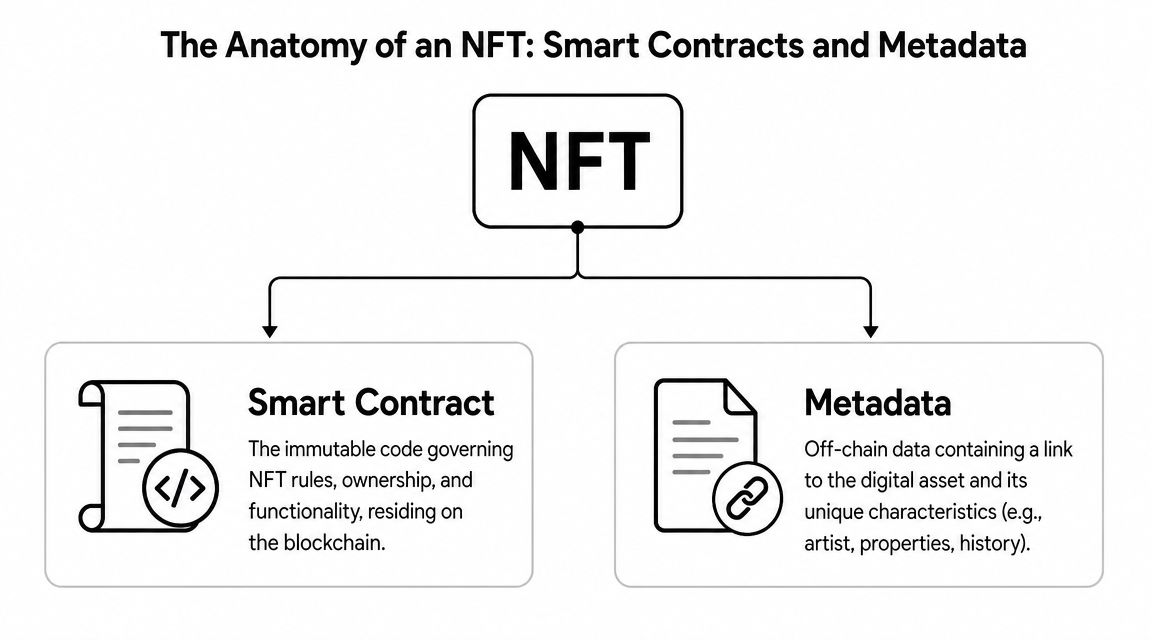
That split explains both the power of NFTs and many of the misunderstandings around them. People often assume the token, the artwork, and the ownership rights are the same thing. They are related, but they are not identical. A better comparison is a car title and the car itself. The title is the official record that says who owns it. The car is the asset. With NFTs, the token is the on-chain record, and the media usually sits elsewhere.
What the smart contract does
A smart contract is code deployed to a blockchain. For NFTs, it acts as a public registry with built-in rules. It decides how tokens are minted, how ownership is tracked, and what conditions apply when someone transfers or sells one.
Ethereum's NFT documentation explains the core pattern clearly: the contract creates a token with a unique token ID, records which wallet owns it, and exposes functions that wallets and marketplaces can read. That is why ownership can be checked publicly without asking a central platform for permission.
A simple breakdown looks like this:
| Component | What it does |
|---|---|
| Smart contract | Defines the NFT collection's rules and records token state on-chain |
| Token ID | Identifies one NFT within that contract |
| Owner address | Shows which wallet currently controls that token |
| Transfer function | Changes ownership when the holder approves a move or sale |
If you build products around NFTs, this architecture clicks faster once you see how Web3 application development connects smart contracts, wallets, and user interfaces.
One detail trips up a lot of readers. A token ID is only unique inside its own contract. Token #1 in one collection is completely different from token #1 in another. The combination of contract address plus token ID is what makes a specific NFT distinct on-chain.
What metadata adds
Metadata is the descriptive record attached to the token. It usually includes the NFT's name, collection, description, traits, creator information, and a link to the associated media file.
The blockchain often does not store the full JPEG, video, or music file inside the token record because storing large files directly on-chain is expensive. Instead, the contract points to a metadata file, often through a token URI. That metadata file then points to the media.
The flow usually works like this:
- A smart contract creates token #123.
- The blockchain records which wallet owns token #123.
- The token points to a metadata location.
- The metadata lists the name, attributes, and media URL.
- Wallets and marketplaces read that metadata to display the NFT.
That design has real-world consequences. Ownership can be verified on-chain, but the viewing experience depends on where the metadata and media are stored. If the file is hosted on a private server, access can break even though the token still exists. If the metadata is stored in a more durable system such as IPFS, the NFT is generally less dependent on a single company staying online.
The strongest guarantee an NFT gives you is verifiable control of the token on-chain. The asset display, attached content, and legal rights depend on the contract design, metadata setup, and terms around the project.
Why standards matter
Standards are what make NFTs usable across wallets, marketplaces, games, and analytics tools. Without them, every collection would behave like its own closed system.
On Ethereum, two standards show up constantly:
- ERC-721: Built for tokens that are individually distinct.
- ERC-1155: Built for cases where one contract may manage both unique items and multiple interchangeable editions.
These standards shape what becomes possible in practice. A marketplace can recognize a collection because it knows how to read the contract. A wallet can display traits because it knows what metadata format to expect. A game can issue items that players later trade elsewhere because other apps can interpret the same standard.
That technical interoperability feeds directly into market behavior. It helps create verifiable scarcity because ownership records are shared and public. It also contributes to volatility, because the same token can move quickly across marketplaces and chains where prices shift with attention, liquidity, and utility. The same mechanics also open the door to newer use cases, including GameFi items, token-gated memberships, and experiments with real-world assets represented by on-chain tokens.
From Creation to Wallet The NFT Lifecycle
Technical definitions help, but NFTs click faster when you follow one through its life.
Consider a digital artist who creates a one-of-one animation and decides to mint it. The file exists first. The NFT comes after. Minting is the moment a blockchain transaction creates the token and links it to the asset's descriptive record.
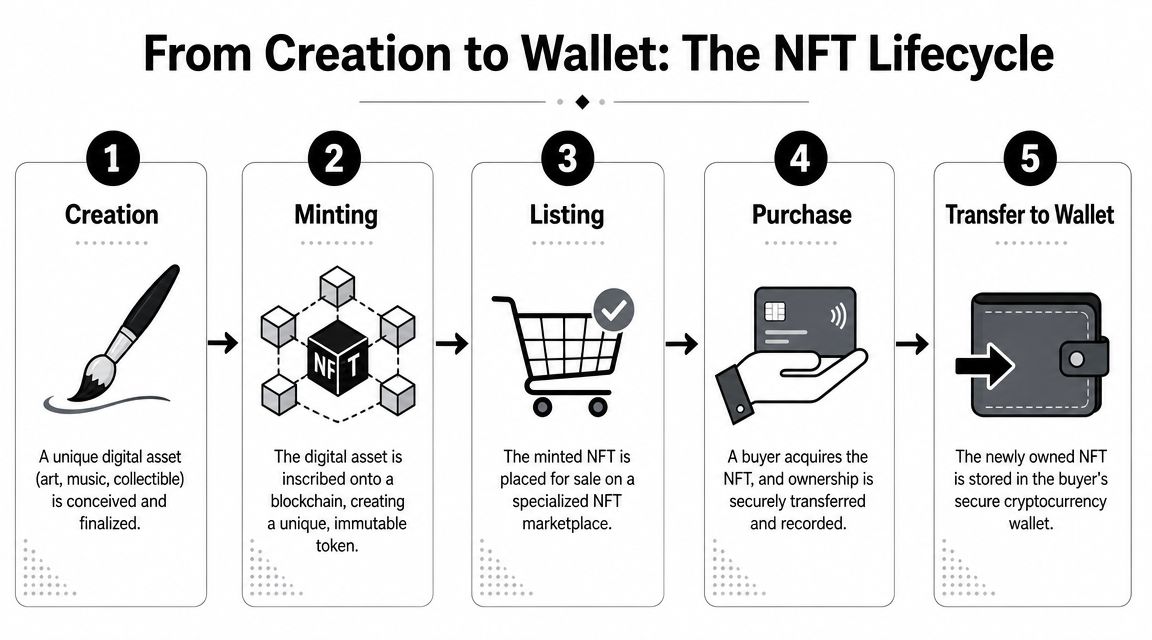
A simple NFT journey
The lifecycle usually looks like this:
Creation
An artist, game studio, music creator, or brand makes a digital asset.Minting
A platform triggers a smart contract transaction that creates a new token. That token gets assigned to the creator's wallet.Listing
The owner authorizes a marketplace to display the NFT for sale under chosen terms.Purchase
A buyer submits payment and signs a blockchain transaction.Transfer
The smart contract updates the owner field from seller to buyer.
That sequence is easier to visualize here:
What your wallet actually holds
A wallet doesn't hold the JPEG in the way a photo app does. It holds the private keys that let you control the blockchain address associated with the NFT.
That distinction matters because people often say “my NFT is in my wallet” as shorthand. What's really happening is this: the blockchain shows your wallet address as owner of a token, and your wallet lets you prove you control that address by signing transactions.
If you're new to wallet UX, this guide on what Phantom Wallet is is useful because it shows how wallets act as your login layer across Web3 apps.
Where marketplaces fit
Marketplaces such as OpenSea, Blur, and Magic Eden are best understood as interfaces. They aren't the NFT itself. They read blockchain data, display collections, surface metadata, and let users initiate purchases.
That means a marketplace is often more like a storefront window than a vault. If the marketplace disappears, the token's on-chain record doesn't automatically vanish with it. The critical dependency is whether the ownership record remains on-chain and whether the metadata and media remain accessible.
Here's the practical version:
- Minting creates the token.
- Wallets control the token.
- Marketplaces expose the token to buyers.
- Blockchains record the transfer.
Once you see the roles separately, the lifecycle feels much less mysterious.
Beyond Digital Art Expanding NFT Use Cases
Digital art made NFTs famous, but art is only one application. The deeper pattern is simple: NFTs are useful when an asset is unique, traceable, and meant to move between users or platforms.
That's why the strongest use cases often appear where ownership status matters more than the media attached to it.
GameFi and in-game ownership
Gaming is one of the most intuitive fits. A sword, character skin, racing car, or land parcel can exist as an NFT because players care about possession, rarity, and transferability.
Traditional games already contain scarce digital items. The difference in Web3 gaming is that the item can live in a user-controlled wallet and potentially move through external marketplaces or companion apps. That changes the player relationship from “licensed access inside one game database” to “tokenized asset with portable ownership signals.”
For readers tracking that corner of the market, this breakdown of Web3 gaming shows why GameFi keeps experimenting with NFT inventory systems.
Real-world assets and credentials
NFTs also fit cases where a blockchain record can represent a claim tied to something outside the chain.
Examples include:
- Event tickets that can be verified and transferred more transparently
- Membership passes that provide access to communities or products
- Certificates and credentials that need tamper-resistant proof
- Luxury goods records that track provenance
- Property-related claims in tokenized real-world asset systems
This doesn't mean the blockchain replaces law, logistics, or custody. It means the NFT can serve as a verifiable digital wrapper around a claim, permission, or authenticated record.
The best NFT use cases usually appear when the token reduces friction around verification, not when it tries to force scarcity onto something nobody wanted to own.
Media membership and identity
A third category sits between collectibles and utility. Think digital identity markers, creator memberships, or token-gated access.
Some people use NFTs as:
- profile-linked identity objects
- access keys for chats, events, or communities
- music or media collectibles tied to fan relationships
- domain-style naming assets in Web3 ecosystems
AI may push this category further. As AI-generated media spreads, provenance becomes more valuable. A signed, on-chain token won't solve every authenticity problem, but it gives creators and collectors a way to anchor authorship claims and track provenance more transparently than ordinary file sharing does.
That's one reason NFTs keep resurfacing even after the speculative wave cooled. The ownership primitive still has real design space.
The Market Ecosystem Wallets Marketplaces and Blockchains
Buying an NFT involves three separate systems working together. If one feels confusing, the whole experience feels confusing.
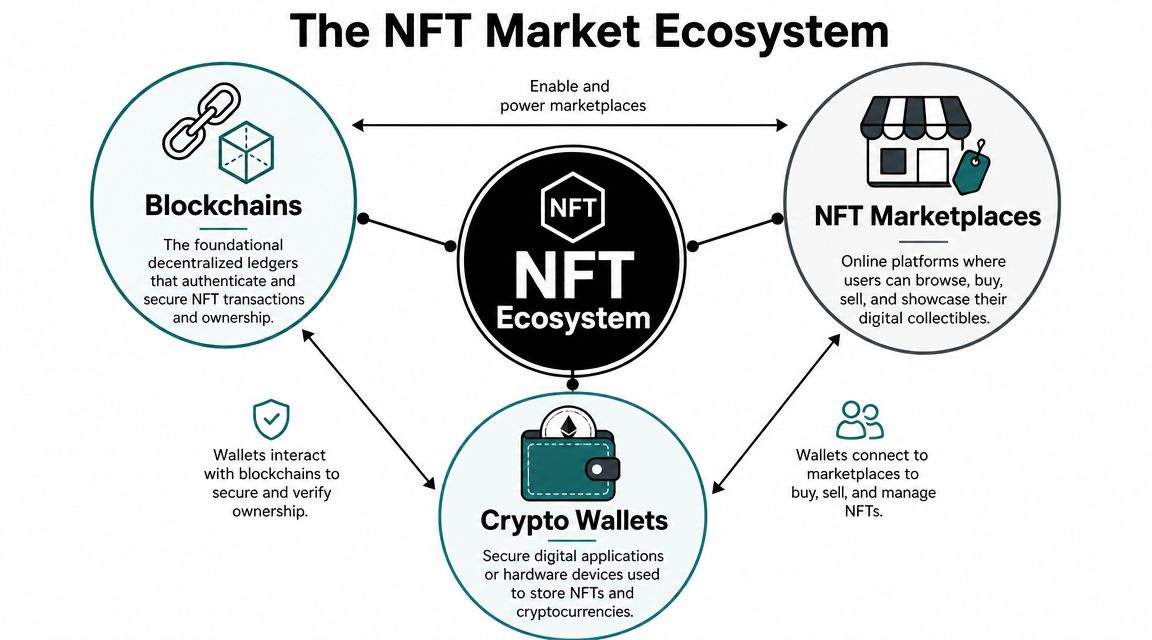
A wallet works like the keyring for your on-chain identity. A marketplace works like the exchange venue where listings, bids, and discovery happen. The blockchain works like the settlement layer and public registry. Put differently, the wallet signs, the marketplace surfaces options, and the blockchain records the result.
That division matters because NFTs are not just files for sale. They are records managed by smart contracts, displayed through interfaces, and controlled by private keys. The technical design directly shapes practical outcomes. It affects who can verify ownership, how easily a buyer can resell, what fees they pay, and how much trust they place in the surrounding infrastructure.
The three moving parts
Here is the ecosystem at a glance:
| Part | Primary role | What users notice most |
|---|---|---|
| Wallets | Hold keys and sign transactions | Security, convenience, compatibility |
| Marketplaces | Help users discover, buy, and sell NFTs | Liquidity, interface, creator tools |
| Blockchains | Store token ownership and execute contract logic | Fees, speed, security, network effects |
Each layer answers a different question.
The wallet answers, "Who controls this NFT?"
The marketplace answers, "Where is it listed, and who wants it?"
The blockchain answers, "What does the ledger say, and under which rules?"
A tool like MetaMask or Phantom does not "store" the JPEG in the everyday sense. It stores the keys that let you control the token linked to your address. That is closer to a car title than the car itself. The NFT may point to media through metadata, but the wallet is what lets you prove control over the token and approve transfers.
Marketplaces sit on top of that system. They index collections, display metadata, show floor prices, and package blockchain activity into something a buyer can use. OpenSea, Blur, Magic Eden, and other venues do not replace the chain. They read from it, add search and trading tools, and make liquidity easier to find.
Why chain choice changes the experience
Blockchains are where the tradeoffs become obvious.
Ethereum became the reference point for NFTs because its standards, tooling, and marketplace support matured early. That history gave creators and collectors a shared base of wallets, contracts, and buyer attention. But the same design choices that made Ethereum influential also brought higher fees during busy periods, which pushed many projects toward alternative chains and Layer 2 networks.
For a creator, chain choice affects mint cost, royalty logic, and where buyers are already active. For a collector, it affects confirmation times, transaction fees, and whether a wallet or marketplace supports the asset cleanly. For a game studio or an RWA project, it can affect much more than convenience. It can shape whether transfers are cheap enough to happen often and whether the token is easy to integrate into a broader product.
Common tradeoffs include:
- Security and decentralization: More established chains often have deeper validator sets, stronger tooling, and longer operating histories.
- Fees: High gas costs can make low-priced NFTs hard to trade profitably.
- Speed: Faster finality changes how auctions, in-game assets, and frequent transfers feel.
- Liquidity concentration: Buyers and sellers tend to cluster where attention already exists.
- Compatibility: Wallet support, marketplace indexing, and smart contract standards vary by chain.
A good way to frame it is infrastructure fit. An art drop aimed at high-end collectors may choose one chain for status and marketplace depth. A GameFi project that expects constant low-value item trades may prefer lower fees and faster settlement. A tokenized real-world asset system may care most about auditability, compliance tooling, and long-term record integrity.
Wallet risk and marketplace risk are different
Users often bundle every NFT problem into "the market," but the risks come from different layers.
A wallet problem is usually a custody problem. You signed a bad approval, exposed your seed phrase, or connected to a malicious site. A marketplace problem is usually a venue problem. Fake collections, poor metadata display, thin liquidity, or weak moderation can distort what buyers think they are purchasing. A blockchain problem is different again. It relates to network congestion, contract bugs, or the limits of the token standard itself.
That is why basic wallet hygiene matters as much as picking the right collection. If you want a practical checklist, this guide on how to avoid crypto scams covers the common traps around phishing links, fake mint pages, and harmful signature requests.
The main takeaway is simple. NFT markets are not one thing. They are a stack.
And that stack explains both the promise and the friction. The same architecture that gives NFTs verifiable scarcity and portable ownership also creates fragmented user experiences, chain-specific silos, fee differences, and uneven liquidity. Once you see wallets, marketplaces, and blockchains as separate layers, the market stops looking random and starts looking like infrastructure choices with real economic consequences.
Risks Criticisms and the Future Outlook
A useful way to judge NFTs is to separate what the technology proves from what the market decides. The blockchain can verify that a specific wallet controls a specific token. It cannot guarantee that the token will stay valuable, easy to sell, or tied to media that people still care about next year.
That distinction explains much of the debate around NFTs. An NFT works like a car title, not the car itself. The title can be authentic, properly recorded, and easy to verify. The resale price still depends on demand, condition, reputation, and whether anyone wants it.
Ownership is verifiable. Value is negotiated.
NFTs are strong at recording provenance, transfer history, and contract-defined rules such as royalties or access rights. They are weak at creating lasting demand on their own.
That matters in practice. A collection can have clean on-chain records, transparent metadata, and a legitimate smart contract, yet still lose attention fast. Verifiable scarcity is a technical feature. Market value is a social outcome shaped by community interest, speculation, utility, and timing.
This is also why NFT markets can swing so hard. The ownership layer is stable, but the pricing layer reacts to sentiment.
An NFT can remain perfectly valid on-chain while its market price falls close to zero.
Criticisms usually point to design tradeoffs
Some criticism is aimed at speculation, but a lot of it comes from how NFTs are built.
If metadata is stored off-chain, the token may outlive the media experience people expected to buy. If a project uses weak contract code, holders may face broken transfers, missing features, or unclear permissions. If liquidity is thin, "ownership" becomes harder to turn into cash. These are not side issues. They are direct consequences of the architecture.
Environmental criticism has also shaped the discussion, though the details depend on the chain. Energy use changed materially after major networks adopted more efficient consensus systems, but the criticism pushed builders toward lower-cost and lower-energy infrastructure in gaming, ticketing, and consumer apps.
Security risk is still the everyday risk
For many users, the biggest threat is not a failure of the blockchain. It is a bad signature, a fake mint page, or a scam collection designed to look close enough to the original one.
Common failure points include:
- Phishing sites: Pages that mimic a real mint or marketplace and trick users into signing approvals
- Malicious approvals: Permissions that let a contract move assets later
- Counterfeit collections: Near-identical names, art, and social profiles that confuse buyers
- Metadata dependency: Tokens that point to content that can break, change, or disappear
- Key loss: Wallet credentials stored poorly or lost entirely
Good habits prevent a lot of damage. Slow down before signing. Verify contract addresses. Treat approvals with the same caution you would give a bank transfer. For a practical checklist, read this guide on avoiding crypto scams before connecting your wallet.
Where the future likely gets more interesting
The loudest NFT cycle centered on profile pictures and fast speculation. The more durable future probably comes from NFTs being used as infrastructure.
GameFi is a clear example. A game item represented by an NFT can carry a visible ownership trail, programmable transfer rules, and metadata that changes with gameplay. The token becomes a portable record of an in-game asset, not just a collectible image.
RWAs point in a different direction. A token can represent a unique claim, certificate, deed, or serialized asset where provenance matters. In that setting, the question is less "Is this art rare?" and more "Can multiple parties verify the same record without relying on one private database?"
Other areas are developing for similar reasons:
- Dynamic NFTs: Metadata updates based on game progress, membership status, or real-world events
- DeFi integration: NFTs used as collateral, vault positions, or wrappers for financial rights
- Identity and access: Tokens used for ticketing, memberships, and verifiable credentials
- Lower-cost chains and Layer 2s: Cheaper transactions make consumer use cases easier to test
The long-term outlook depends on whether builders use NFTs where uniqueness, provenance, and transferability do matter. When those traits match the job, NFTs add something a normal database struggles to provide. When they do not, the token is often extra complexity dressed up as innovation.
Your Top NFT Questions Answered
Can someone copy my NFT image
Yes. Someone can often copy or screenshot the image, video, or audio associated with an NFT.
What they can't copy in the same way is the on-chain ownership record for your specific token. That's the core distinction. Copying the media file isn't the same as controlling the wallet address that owns the NFT.
What if a marketplace shuts down
Your NFT doesn't automatically disappear just because a marketplace goes offline.
If the token exists on-chain and your wallet still controls it, ownership remains recorded on the blockchain. The practical caveat is accessibility. You still need compatible wallets, explorers, or other marketplaces to view and interact with it, and the linked metadata or media needs to remain available.
Who pays gas fees
The person initiating the blockchain action usually pays the network fee for that action.
That can mean the creator pays to mint, the seller pays to list or approve, or the buyer pays when purchasing. The exact flow depends on the marketplace design, the blockchain used, and whether the action requires an on-chain transaction at that point.
Minting versus buying
Minting means creating the NFT on-chain for the first time through a smart contract transaction.
Buying on the secondary market means purchasing an NFT that already exists and transferring ownership from the current holder to your wallet. In short, minting creates the token. Secondary buying changes who owns it.
If you keep those two actions separate in your mind, a lot of NFT terminology gets easier to decode.
If you want more practical explainers on NFTs, wallets, Web3 gaming, DeFi, and blockchain mechanics, explore Coiner Blog for in-depth guides written for curious readers who want clear answers without the hype.
2 Comments