
L1 L2 L3 Explained: How the Blockchain Stack Works

You've probably felt this already. You open a DeFi app on Ethereum mainnet, see the gas fee, and decide you're not paying that just to swap two tokens. Then someone tells you to bridge to Arbitrum, Optimism, or Base, and suddenly the simple act of trading feels like you've entered a second version of Ethereum with its own rules, costs, and trust model.
That's the starting point for L1, L2, and L3. These aren't just labels in a diagram. They're the layers people move through when they settle value, chase lower fees, build apps, or decide how much complexity they're willing to accept.
Table of Contents
- The Moment You Notice the Layers
- What L1, L2, and L3 Actually Mean
- How Security and Trust Differ Across the Stack
- What the Layers Mean for DeFi, NFTs, and GameFi
- The Modular Stack and When an App Actually Needs an L3
- Why More Layers Have Not Fixed Market Fragility
- Practical Guidance for Users and Developers
The Moment You Notice the Layers
The easiest way to understand L1, L2, and L3 is to start with the moment they become visible. You try to swap on Ethereum, the fee looks absurd, and the interface nudges you toward a rollup. That's when the stack stops being theory and starts being your wallet balance, your confirmation time, and your patience.
What's happening under the hood is less mysterious than it looks. L1 is the base chain where final settlement lives. L2 is a scaling layer that moves activity off the base chain, then posts results back. L3 sits above that and narrows the design even further toward one app, one workflow, or one execution style.
Practical rule: if you can feel the fee pain, you're already making a layer choice, even if you didn't mean to.
This is why people talk about Ethereum mainnet and then also talk about Arbitrum, Optimism, or Base as if they're part of the same universe. They are. But they don't do the same job. One layer gives you stronger settlement and deeper trust anchoring, another gives you cheaper execution, and the next may give a specific app tighter control over user experience.
The important part is that each layer changes the assumptions you rely on. On L1, you're leaning on the chain's own consensus. On L2, you're trusting a scaling system that ultimately points back to an L1. On L3, you're one layer further removed, which can improve specialization but also adds more moving parts.
For readers who want a broader blockchain overview, a useful companion piece is this guide to Layer 2 scaling solutions, because the whole stack makes more sense when you see how rollups fit into it.
What L1, L2, and L3 Actually Mean
Think of the stack like a postal system.
L1 is the national post office. It sets the rules, guarantees delivery, and keeps the record of what was accepted. In blockchain terms, consensus and finality live here. Bitcoin and Ethereum are the clearest examples, and the same idea applies to other base chains too.
L2 is the regional sorting hub. It doesn't replace the national post office, it batches work, processes more of it locally, and then records the result back on the base layer. That's why rollups like Arbitrum, Optimism, Base, and zkSync matter. They're designed to make execution cheaper and faster while still tying back to an L1 for settlement.
L3 is the specialized courier. It's built for a specific company, a specific workflow, or a specific kind of traffic. In crypto, that can mean an app chain or app-specific layer that sits on top of an L2. If you've seen projects like Xai or older designs tied to app-specific execution, that's the direction.
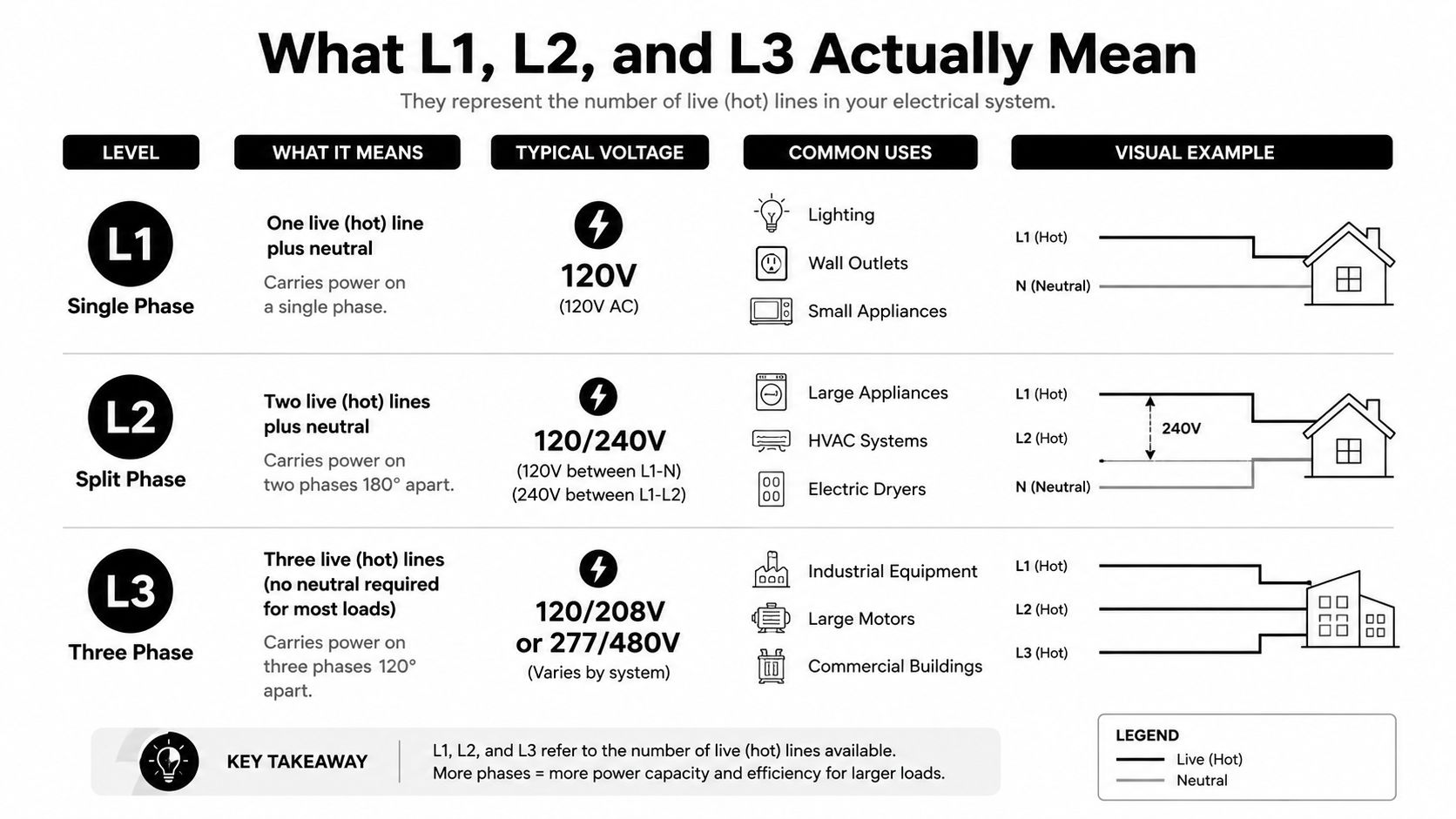
The easiest way to remember the hierarchy is this. L1 secures the system, L2 scales it, and L3 specializes it. Once that clicks, a lot of chain launches stop looking like new religions and start looking like design choices.
A good mental shortcut is to ask what problem the layer is trying to solve. If the goal is finality and settlement, you're talking about L1. If the goal is cheaper everyday execution, you're probably looking at L2. If the goal is custom economics or app-specific control, L3 starts to make sense.
For a clean overview of how people position these layers in practice, the discussion around Sei blockchain for active traders is a useful side read, because it shows how performance-oriented chains try to carve out a specific role in the stack.
How Security and Trust Differ Across the Stack
Security changes as you climb the stack, and that is the part many explainers flatten into one vague idea. Users and builders should care about the differences, because the trust model changes at each layer.
On L1, security comes from the base chain itself. Bitcoin and Ethereum do more than process transactions, they define the trust root. The chain's own validator or miner structure does the heavy lifting, so using an L1 feels closest to paying with cash in the crypto world.
On L2, the arrangement changes. The layer inherits security from the base chain through proofs and settlement mechanisms, but it also adds an extra system in the middle. That middle layer can be a sequencer, an operator set, or a proof process, and each one introduces its own assumptions. In many cases this is often accomplished using complex cryptographic methods like zero-knowledge proofs.
Cheaper execution usually comes with a longer trust path. The app can still settle back to the base chain, but users need to understand what sits between their transaction and that final anchor.
On L3, the chain of dependence goes one level deeper. An L3 depends on an L2, which depends on an L1. That can fit an app that needs its own rules, fees, or workflow, but it also means more bridges, more dependencies, and more points where design choices matter.
An L3 review should start with a simple question, what part of the stack is the app asking you to trust? If the answer includes a fresh sequencer, a new app chain, or a narrow set of operators, that is a real trade-off, not a footnote.
The modular-blockchain view makes this easier to see. Some systems push execution outward and keep settlement anchored underneath, while others keep more logic in the base layer itself. The first path makes the stack more modular, the second keeps the path shorter. Both can work, but they reward different priorities.
The same trust logic shows up outside crypto too. A system like secure AI agent pipelines depends on clear boundaries between steps, because each extra handoff creates a new place to check permissions and verify output. Crypto layers work in a similar way, every added layer needs its own scrutiny.
The practical question is not whether an L2 or L3 is secure in the abstract. It is what assumptions you accept in exchange for the app's benefits, and whether those assumptions match the amount of value you are moving. That matters even more when you are bridging funds, using a new sequencer design, or relying on an app chain with limited history.
Some teams treat more layers like a fix for market fragility. The trade-off is less comforting than that story suggests. More layers can spread load, reduce fees, and make specialized apps easier to build, but they also multiply dependencies and can hide weak points behind a cleaner interface. In other words, modularity helps with design pressure, yet it does not remove the need to judge the weakest trust link in the chain.
What the Layers Mean for DeFi, NFTs, and GameFi
The stack becomes more tangible once you look at actual use cases. DeFi, NFTs, and GameFi don't all want the same thing, which is why the winning layer is different in each category.
DeFi prefers cheap execution, but not every trade belongs off chain
Retail swaps, smaller perps activity, and frequent interaction with smart contracts often move to L2s because users hate paying mainnet-style fees for routine actions. That's why Arbitrum, Base, and similar networks became natural places for everyday execution. The friction is lower, the user can click around more freely, and the app can support more interactions without punishing every transaction.
But L1s still matter in DeFi because they hold deep liquidity and serve as the settlement destination for the most conservative users. A protocol like Uniswap can live across multiple layers, yet the deepest pools still carry weight on the base chain. The main trade-off is simple, cheaper execution often means you're one step removed from the richest liquidity.
NFTs split between prestige and frequency
NFT culture still gives Ethereum mainnet a prestige signal. Minting there can signal provenance, seriousness, or just a desire to stay as close to the base asset and the strongest settlement layer as possible. At the same time, active minting and trading often drift to cheaper layers because creators and traders don't want the fee burden attached to every move.
That's where L2s and L3s become practical. Lower cost means more frequent experimentation, and app-specific layers can make collectible or gaming assets feel less like a one-time event and more like a living economy. For creators, the question isn't just where the NFT exists. It's where the user can afford to interact with it repeatedly.
GameFi is where L3 starts to look natural
Games are the hardest test for a blockchain stack because they need lots of small actions, fast feedback, and room for custom logic. A game economy can't afford to be congested every time a popular market swings. That's why L3s are most compelling in gaming, where isolated execution and app-specific economics matter a lot.
A useful reference point for wallet logic in these environments is embedded MPC wallet use cases, because user custody and interaction design often determine whether a game or DeFi app feels smooth or clunky. In practice, if the wallet flow is painful, the layer choice won't save the product.
The Modular Stack and When an App Actually Needs an L3
The modular thesis is straightforward. L1s settle and concentrate liquidity, L2s execute at scale, and L3s specialize for one app or one narrow class of apps. That's a cleaner mental model than pretending every chain is competing on the same axis.
A simple decision framework
An app starts to need an L3 when the following pressures show up together.
- Custom economics: the app needs its own fee token, its own incentives, or a tightly controlled user loop.
- Very high throughput: the app's traffic is heavy enough that a shared execution layer starts to feel crowded.
- Isolated execution: the team wants one app's traffic kept away from unrelated activity.
- Fragmentation tolerance: the team is willing to accept extra bridging, thinner liquidity, and more complexity in exchange for control.
If none of those are true, an L2 is often the cleaner choice. It gives the team shared liquidity, easier onboarding, and a more familiar path for users already comfortable with Ethereum-adjacent tooling.
Rule of thumb: build on an L2 unless your product breaks on shared execution.
The cost of going to L3 is rarely technical alone. It also shows up in user acquisition, bridge design, ecosystem tooling, and the burden of explaining to people why your app needs another layer. That's a real product cost, not a theoretical one.
The clearest reason to choose L3 is when your app behaves more like a platform than a single contract. A trading game, an onchain game economy, or a specialized settlement system may benefit from its own execution domain. The clearer the need for separation, the stronger the case for L3.
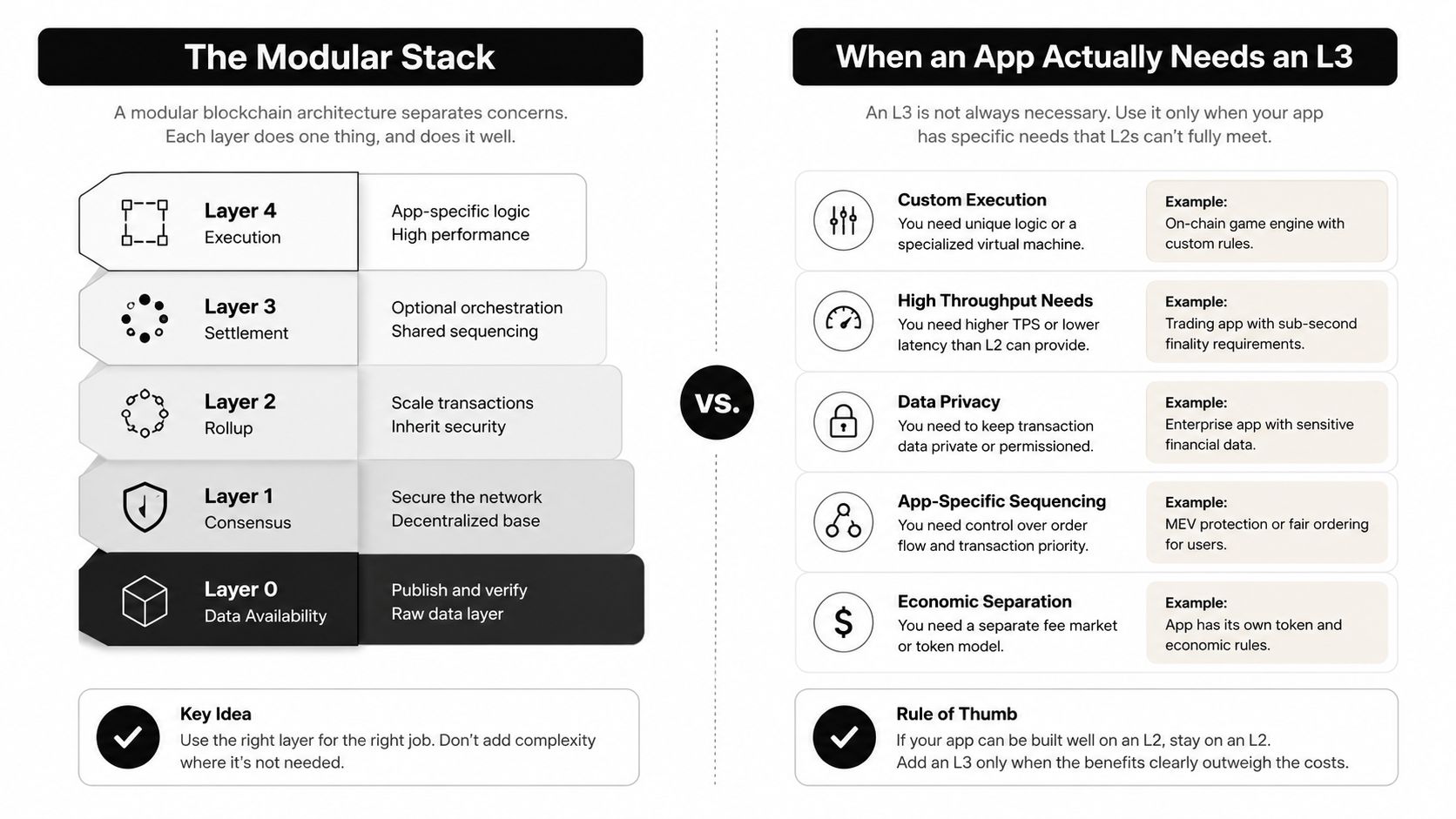
That said, more modularity doesn't automatically mean better product-market fit. A chain can be architecturally neat and still be hard to use. The best teams treat L3 as a precision tool, not a default upgrade.
Why More Layers Have Not Fixed Market Fragility
There's a comfortable story people like to tell about blockchain scaling. More layers mean lower fees, lower fees mean more activity, and more activity means healthier markets. Reality hasn't followed that script cleanly.
Binance Research's H1 2026 onchain summary reported that DeFi TVL fell by $43.4 billion, or 38%, and that six major layer-1s lost $246.5 billion, or 42%. That happened even as L2 and L3 capacity continued to expand, which tells you something important. Infrastructure can improve while demand remains unstable. Binance Research H1 2026 onchain summary
The lesson isn't that scaling failed technically. It didn't. The lesson is that scaling doesn't automatically solve liquidity retention, adoption quality, or the tendency of activity to cluster in a few venues. More chains can widen the surface area without deepening user commitment.
Why this matters for builders and investors
If you're building, lower fees can help acquisition, but they don't guarantee retention. A user who saved on gas today may still leave tomorrow if the product is fragmented or the liquidity is thin. If you're investing, the existence of a new layer doesn't automatically mean the ecosystem around it is durable.
A good related lens is MEV in crypto markets, because it highlights how execution quality and market structure can matter as much as headline throughput. The point is bigger than one mechanism. Every layer changes how value is routed, captured, and sometimes drained.
The healthiest takeaway is a more sober one. L1, L2, and L3 are infrastructure choices, not demand engines. They can make a system more usable, but they can't force users to stay.
Practical Guidance for Users and Developers
Users should treat every bridge and every new layer like a decision, not a default. Before moving value to an L2 or L3, check whether the proof system is explained clearly, whether the sequencer setup is transparent, and whether the bridge design is understandable enough that you can explain it back to yourself in plain English. If you can't tell how funds move back to the base layer, slow down.
Fees need context too. A cheap transaction on an L2 can look attractive until you account for bridging and the operational overhead of getting in and out. A “$5 swap” can be less attractive than an L1 swap if it locks you into a more complicated path or forces extra steps later.
A user checklist
- Check the bridge path: make sure you know where funds go and how they return.
- Read the app's security model: don't assume every L2 or L3 inherits risk in exactly the same way.
- Compare the total cost: include bridge friction, not just the visible transaction fee.
- Look at liquidity depth: thin markets can erase the fee savings you thought you were getting.
Developers should make the same kind of trade-off analysis before choosing a stack. If you want easy distribution, existing tooling, and a known user base, an L2 is often the pragmatic choice. If your app depends on isolated execution, custom incentives, or domain-specific throughput, an L3 can be worth the added complexity. If your product needs maximum sovereignty, a new L1 is still an option, but the burden of bootstrapping liquidity and adoption is much heavier.
A developer checklist
- Choose L2 when the product wants faster onboarding and shared liquidity.
- Choose L3 when app-specific logic and isolation are core to the product.
- Choose L1 when settlement control and ecosystem independence matter more than convenience.
- Expect toolchain trade-offs: hiring, integrations, and user acquisition all get harder as you move away from the default path.
The stack is also still evolving. Shared sequencing, cross-rollup messaging, and better bridge design could make the path between layers smoother over time. Even then, L1 settlement will still matter because it remains the anchor that higher layers point back to.
If you want more clear-eyed crypto explainers like this, along with practical coverage of Bitcoin, Ethereum, DeFi, Layer 2 networks, NFTs, GameFi, and emerging blockchain design, visit Coiner Blog and keep following the pieces that help you judge the stack, not just memorize the buzzwords.