
Top 7 Sources for Meme Coin News in 2026

In late 2025, meme coins accounted for roughly $192 billion in market value by the end of November, with the category up 83% from the start of the year, according to Binance Research. The same report found that the top 10 meme coins controlled more than 70% of the sector's value. For traders, that concentration changes how news should be read. Meme coin coverage is not just a stream of jokes, celebrity posts, and ticker symbols. It is also a market structure signal.
Price in this corner of crypto tends to react to attention before fundamentals, but attention itself is not random. It clusters around a few repeatable inputs: exchange listings, on-chain liquidity, community migration, influencer reach, and the speed at which a narrative jumps from Crypto Twitter to broader retail feeds. A weak source will show the headline after the move. A useful source helps you identify whether the move has depth, distribution, and staying power.
For that reason, your news stack matters.
The seven sources below do different jobs. Some are better at validating capital flows and institutional positioning. Others are better at picking up social momentum, token launches, or early shifts in trader behavior. Used together, they form a practical toolkit for meme coin traders who need both data and cultural context, especially in a segment where liquidity often moves before polished explanations catch up.
This guide focuses on that division of labor. The goal is not to rank general crypto publications in the abstract. It is to show which source is strongest for a specific meme coin task: scanning headlines, confirming structure, spotting cultural turns, or building a repeatable information edge in 2026.
Table of Contents
- 1. Coiner Blog
- 2. CoinDesk
- 3. Cointelegraph
- 4. Decrypt
- 5. The Block
- 6. CoinMarketCap Top Stories and Academy
- 7. CoinGecko News and News API
- Top 7 Meme Coin News Sources Compared
- Crafting Your Meme Coin Information Strategy
1. Coiner Blog

Meme coin trading runs on two clocks at once. One is price. The other is culture. Coiner Blog earns the top spot because it covers both sides of that equation better than many crypto publications that treat meme coins as isolated bursts of volatility.
That editorial approach matters. A meme coin rarely moves on jokes alone. Liquidity conditions, token design, chain selection, NFT community overlap, and gaming or AI narratives often shape whether attention fades in hours or compounds into a multiweek trade. Coiner Blog consistently frames meme coin news inside that wider Web3 context, which makes it more useful as an interpretation tool than as a simple headline feed.
Why Coiner Blog stands out
Coiner Blog's edge is contextual range. Traders who focus only on a ticker and its chart often miss the source of demand. A meme asset tied to an NFT brand, a GameFi loop, or a fast-growing Layer 2 can behave very differently from a token driven purely by short-term social momentum.
That broader lens improves decision-making.
The site is especially useful in areas that sit close to meme coin speculation:
- NFT crossover insight: NFT communities often act as early amplifiers for meme narratives and community identity.
- GameFi and crypto gaming coverage: Attention can build in gaming circles before it reaches larger crypto media outlets.
- Risk-aware education: Explanatory content and practical tools help readers assess volatility, liquidity, and position risk.
- Narrative breadth: Coverage of AI, tokenization, and infrastructure gives traders a better read on which adjacent themes may spill into meme coins next.
One practical advantage is that Coiner Blog does not force readers to choose between beginner accessibility and market relevance. A trader can read a guide on market mechanics, then apply the same framework to a meme coin launch, liquidity event, or sentiment shift. Its crypto predictions for 2025 analysis is a good example of that style. It connects speculative themes to broader market structure instead of treating every trend as a standalone craze.
Practical rule: If a meme coin story cannot be tied to community behavior, liquidity conditions, and token design, the trade thesis is still incomplete.
Best use for meme coin traders
Use Coiner Blog as a filter between raw noise and usable conviction. It is less valuable for being first by seconds, and more valuable for helping traders judge whether a meme coin move has ecosystem support behind it.
That makes it a strong fit for:
- Narrative traders who need to know whether a meme coin is attached to a durable community or a passing social spike.
- Cross-sector watchers tracking how NFTs, gaming, AI, and Layer 2 activity feed speculative flows.
- Risk-conscious readers who want educational context alongside market commentary.
The trade-off is straightforward. Coiner Blog has less legacy brand weight than older crypto media names, and some community-facing or premium features still appear to be developing. But for meme coin traders building a real information stack, its role is clear. It helps explain why a meme coin is moving, what adjacent sectors are contributing to that move, and whether the narrative has enough structure to matter beyond the next pump.
2. CoinDesk

CoinDesk becomes more useful as meme coin activity grows from a niche pocket of speculation into a market-wide risk signal. For traders, that distinction matters. A token can trend because a community is excited, but it can also rally because liquidity conditions, exchange positioning, and broader altcoin sentiment are all pointing in the same direction.
CoinDesk is better at identifying that second setup than many crypto-native news feeds. Its coverage usually places meme coin moves inside larger forces such as policy headlines, ETF sentiment, Bitcoin-led risk appetite, and shifts in trading activity across majors and altcoins. That makes it less useful for hunting the first whisper of a launch, and more useful for deciding whether a meme coin move has enough market support to persist.
Where CoinDesk earns its place
The practical edge is its editorial discipline. CoinDesk tends to ask whether a meme coin spike is isolated noise, part of a broader speculative rotation, or a response to a macro catalyst that could keep capital circulating across the sector.
That makes it a strong source for:
- Macro-aware traders who want meme coin headlines tied to rates, regulation, and broader crypto risk sentiment.
- Rotation-focused traders trying to separate a single-token frenzy from a wider move across altcoins, DeFi, or exchange-listed speculative assets.
- Readers who prefer verification over velocity when social media is outrunning the facts.
Used this way, CoinDesk fills a specific role in a meme coin trader's toolkit. It is the source you check after the first wave of hype, when the main question becomes whether the move is being absorbed by the wider market or rejected by it.
It also pairs well with more thematic analysis, such as Coiner Blog's crypto predictions for 2025 outlook, because the two formats answer different questions. One helps frame where speculative attention may go next. CoinDesk helps test whether that attention is showing up in flows, policy relevance, and market structure.
CoinDesk is most valuable when meme coin trading starts to look less like internet theater and more like cross-market positioning.
The trade-off is clear. Its tone can feel institutional, and traders focused on ultra-early meme coin culture will often find faster chatter elsewhere. But that restraint is part of the value. In a sector where attention moves faster than evidence, CoinDesk is useful for checking whether a narrative has moved beyond social momentum and into the part of the market where capital tends to stay longer.
3. Cointelegraph
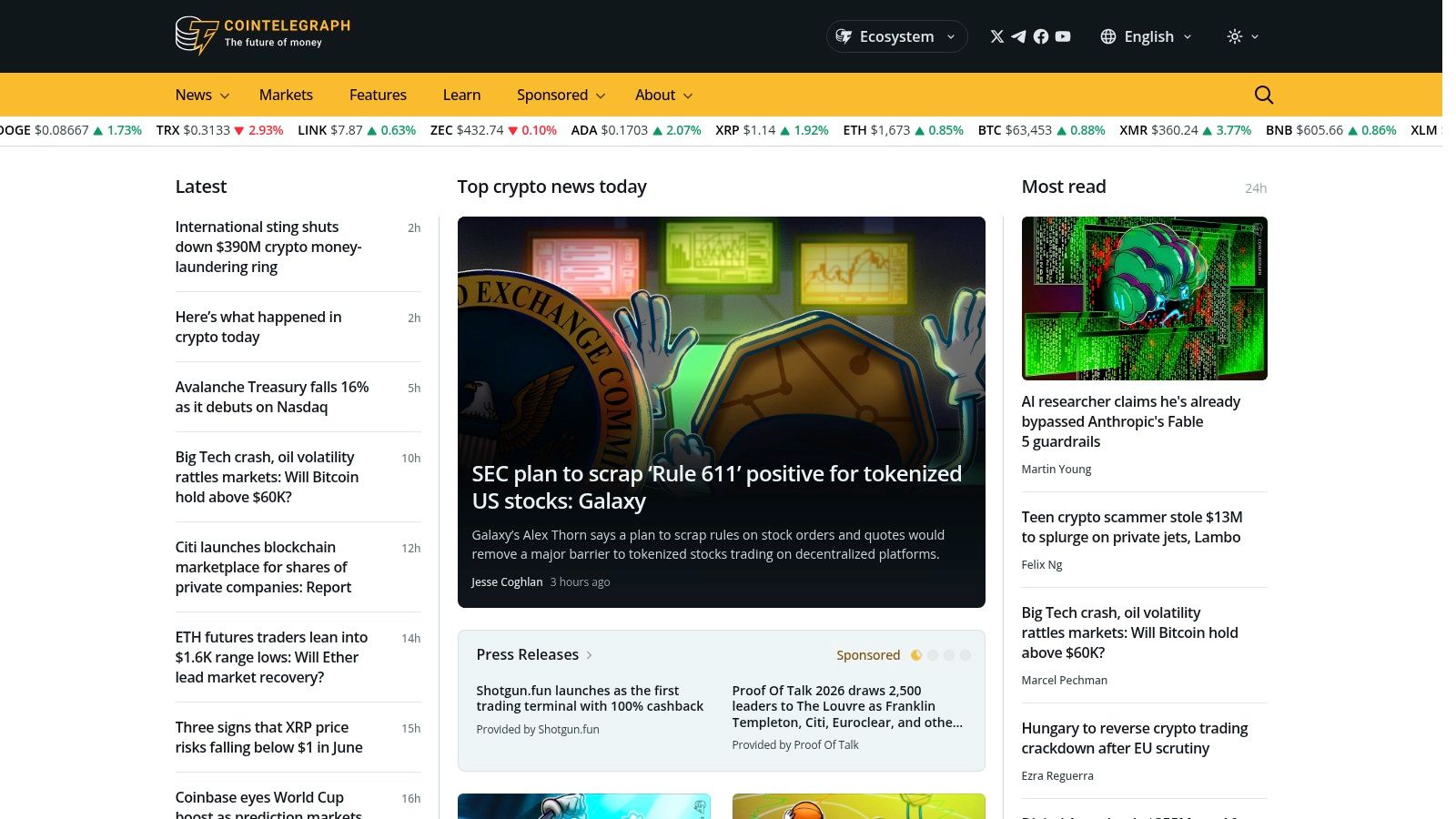
Cointelegraph publishes at a pace that matches meme coin trading. That matters because a meme coin move can shift from joke to breakout to reversal in a single session, and traders need a source that captures the narrative while it is still forming.
Its edge is not institutional depth. It is translation speed. Cointelegraph tends to turn fragmented market chatter into a readable framework quickly, especially around liquidations, exchange listings, social momentum, and altcoin rotation. For meme coin traders, that makes it less useful as a final authority and more useful as an early read on how the market is packaging a move.
That role is easy to underestimate. Meme coins rarely trade on fundamentals alone. They trade on attention structure, and attention structure has layers: price action, community memes, influencer amplification, and the broader risk appetite across smaller-cap crypto. Cointelegraph usually catches the middle of that chain well. It is often early enough to matter, but edited enough to be more usable than raw social feeds.
Best for fast narrative mapping
Cointelegraph works best right after a sudden spike in volume or mentions. A trader can scan it to judge whether a move is being treated as an isolated token pump, part of a broader meme basket rotation, or a spillover from adjacent themes such as AI, Layer 2 activity, or NFT speculation.
Its practical strengths include:
- High publication frequency: Useful during fast market repricing and headline-heavy sessions.
- Retail-readable framing: Good at explaining why traders are chasing a theme, not just that they are.
- Cross-sector context: Stronger than many general crypto outlets at linking meme coin activity to adjacent speculative pockets.
That last point matters in meme coin markets because leadership often shifts by narrative cluster, not by single token. A Binance market overview reported that in early January 2026, memecoin sector capitalization climbed sharply, with Base-related and AI-themed meme coins showing particularly strong momentum while older majors such as DOGE and SHIB advanced at a slower pace of roughly 20% (Binance Square market overview). Cointelegraph is useful in exactly that type of setup. It helps traders spot when capital is rotating inside the meme category rather than bidding up the most established names.
It also pairs well with thematic reading on digital culture. If a meme coin starts pulling energy from collectibles, creator communities, or NFT-native behavior, broader context from NFT market trends and digital ownership shifts can sharpen what Cointelegraph surfaces in headline form.
The trade-off is consistency. Volume creates noise, and article quality can vary depending on the writer and the speed of the news cycle. Still, for traders building a meme coin information stack, Cointelegraph fills a distinct slot. It is the source for quick narrative mapping, especially when price is moving faster than consensus.
4. Decrypt
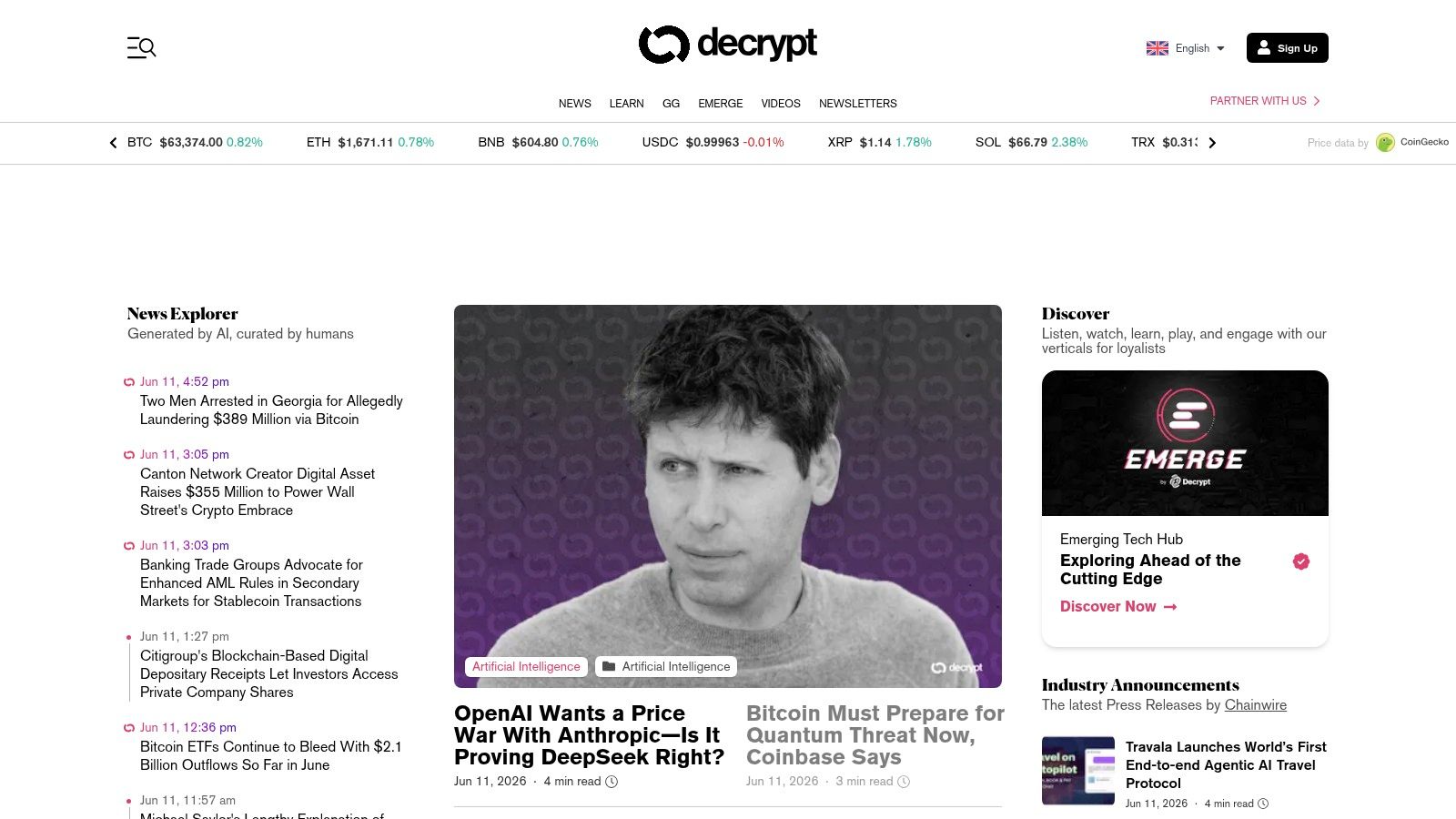
Decrypt is where meme coin news starts making cultural sense. That distinction matters more than many traders admit. Memecoins don't just rise because liquidity appears. They rise because culture gives liquidity a reason to care.
Decrypt has always been stronger than average at that overlap between markets, NFTs, gaming, and internet-native behavior. If a meme coin is gaining traction because it's attached to a creator economy story, a collectible brand, an AI narrative, or a gaming community, Decrypt is often better at reading the texture of that move than a pure market terminal.
Why Decrypt works for culture-driven trades
Decrypt's newsletters and concise article style make it a good morning read. It's useful when you want a curated pass through crypto without spending hours doomscrolling social feeds that are full of bots, shills, and recycled screenshots.
Its strongest use cases include:
- Culture-first signal detection: Helpful for NFT-linked and gaming-adjacent meme themes.
- Readable daily scanning: Good for busy traders who still want context.
- Multimedia learning: Podcasts and explainers work well when a narrative is still forming.
If you already track digital ownership trends, Coiner Blog's NFT market trends coverage pairs naturally with Decrypt's style of reporting. The combination works because many meme coin narratives now piggyback on brand communities, collectibles, and Web3 identity rather than pure token mechanics.
Some of the best meme coin signals appear before they look like finance. They first look like fandom, irony, or community status.
Decrypt isn't a specialist memecoin tracker, and readers should pay attention to labeling when sponsored or announcement-style content appears. But for cultural trend-spotting, it belongs in any serious meme coin information stack.
5. The Block
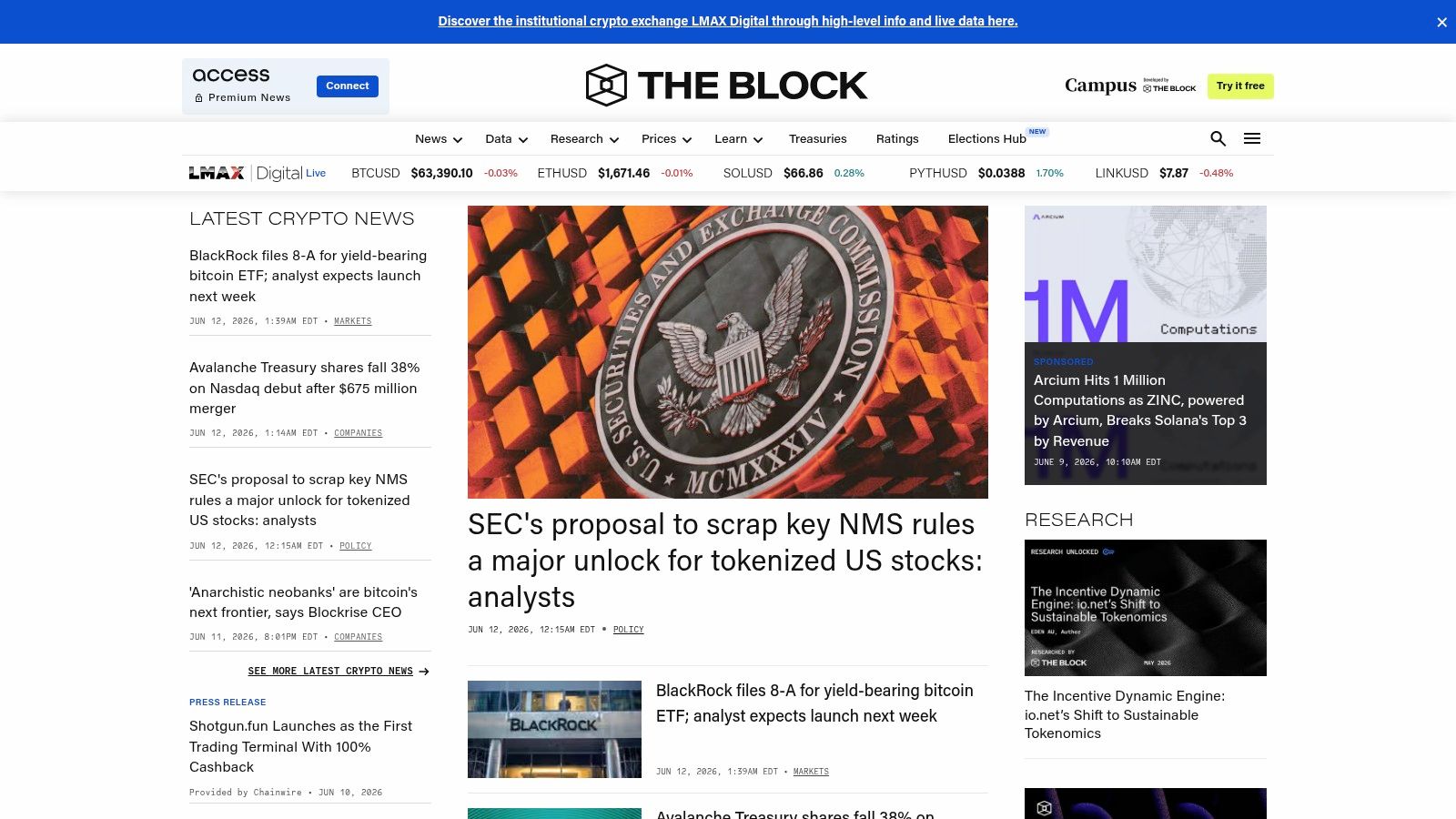
The Block is what you use after a meme coin move catches attention and you want to know whether the infrastructure supports it. That means exchange behavior, liquidity, policy risk, market structure, and the kind of reporting that helps validate or reject a narrative.
This is not the site I'd use to find the first whisper of a joke token. It's the site I'd use to decide whether the move has real legs, or whether it's being exaggerated by thin liquidity and social amplification.
Best for market structure and validation
The Block is especially valuable when meme coin news intersects with compliance and scam risk. ACAMS highlighted a side of the sector that many traders ignore: rug pulls, pump-and-dumps, wash trading, insider manipulation, and money-laundering exposure. It also noted that New York DFS warned in January 2025 that some meme coins are “incompatible” with its coin-listing and market-manipulation guidance, while consumers have suffered losses from these schemes.
That's exactly the sort of angle The Block tends to handle better than retail-first outlets.
Use it for three things:
- Narrative validation: Is a listing rumor credible, or just social noise?
- Policy awareness: Regulatory framing can matter fast when meme coins become mainstream headlines.
- Structural sanity checks: Useful when hype outpaces evidence.
Readers who want a practical retail counterpart should also spend time with Coiner Blog's guide on avoiding crypto scams. The combination is strong because The Block shows where the structural risks form, while a hands-on guide helps users build defensive habits.
The main drawback is access. Some of its best reporting sits behind premium products, and its tone is built more for professionals than for meme traders hunting raw energy. Still, that's exactly why it's useful.
6. CoinMarketCap Top Stories and Academy
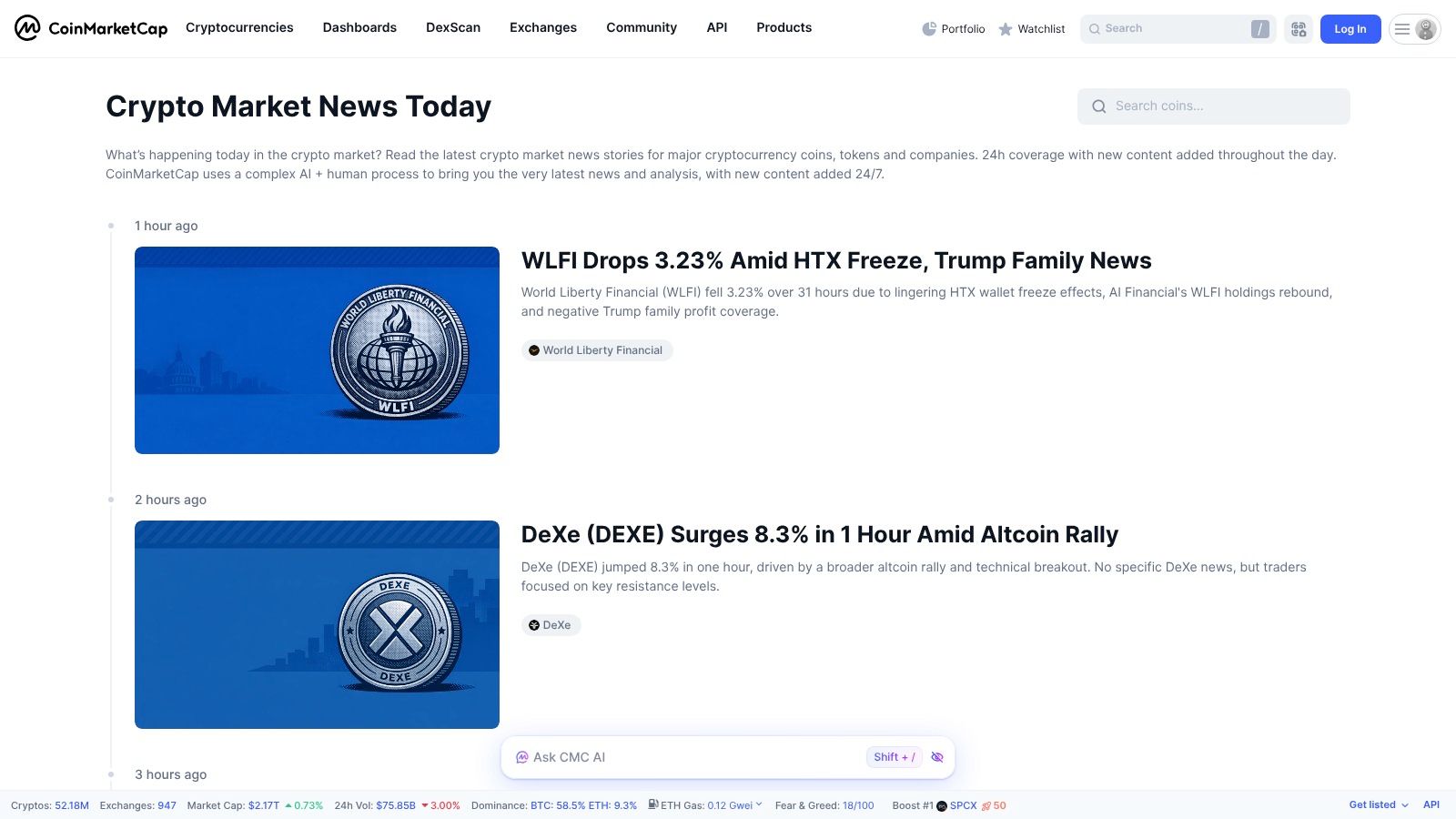
CoinMarketCap Top Stories is one of the best intraday utility tools on this list. It's not the deepest source, and it's not trying to be. Its strength is compression. You can scan headlines, jump to coin pages, compare price action, and move on.
That sounds basic, but it solves a real problem. Meme coin news is often consumed while traders are already watching charts, liquidity, and social feeds. In that environment, convenience becomes edge.
Best for intraday scanning
CoinMarketCap works well when you want immediate linkage between a headline and a live token page. If you're tracking a meme move and need a fast check on whether the market is confirming the story, this setup is efficient.
For beginners, it's also one of the easiest entry points into the sector because the Academy and educational content reduce the intimidation factor. Someone learning the basics can move from a headline to a token page to a concept explainer without changing platforms. That pairs well with foundational reading such as Coiner Blog's beginner guide to investing in cryptocurrency.
A more advanced reason to keep CoinMarketCap open is turnover monitoring. One 2026 market snapshot reported meme-coin market cap at $33.94 billion, down 4.22% in 24 hours, while 24-hour volume hit $8.22 billion and rose 87.67%. That kind of divergence tells analysts something important. Price alone may understate how aggressively traders are rotating through the sector.
Signal to watch: When volume expands faster than capitalization, headline-driven speculation may be intensifying even if broad price action looks weak.
The drawback is that short-form updates can stay high level, and readers need to watch for sponsored material. But as a speed layer inside a broader toolkit, CoinMarketCap is hard to ignore.
7. CoinGecko News and News API
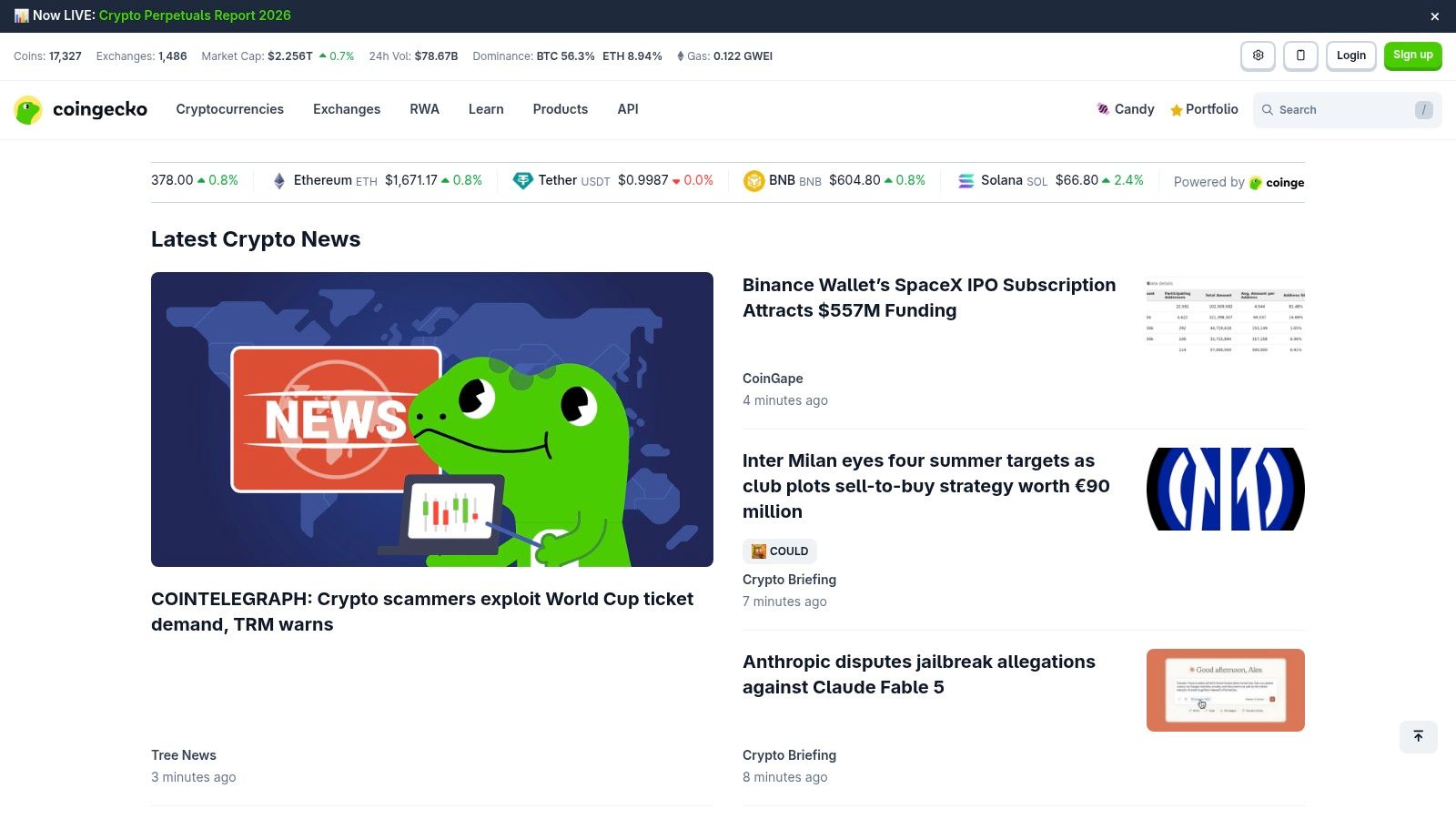
CoinGecko News is useful for one simple reason. Meme coin traders rarely lose money because no information exists. They lose money because the signal is scattered across too many places at once.
That is the strength of CoinGecko's setup. It pulls headlines from multiple crypto publishers and places them next to token data, market charts, and watchlist tools. For a meme coin trader, that makes it less of a reading destination and more of an operating screen.
Best for turning scattered headlines into a usable workflow
CoinGecko works well for traders who want breadth first, then verification. A rumor on X, a headline from a mainstream crypto outlet, and a sudden volume spike often appear within the same hour. Seeing news and market context in one interface helps you judge whether attention is staying social or starting to affect price discovery.
Its value is specific:
- Cross-publisher coverage: It reduces single-source bias, which matters in a sector where smaller tokens can get ignored by major editorial desks.
- Market context beside the headline: You can check whether a story lines up with price action, liquidity, or ranking changes on the token page.
- API access for custom monitoring: Developers and active desks can use the feed inside alerts, research dashboards, or internal scanners.
That matters more in meme coins than in larger-cap crypto. Coverage is fragmented, narratives form fast, and many tokens only become visible after social traction is already underway. As noted earlier, the category has become too crowded for any one newsroom to track cleanly on its own. Aggregation is not just convenient in that environment. It is a practical way to widen coverage without adding six more tabs to your screen.
There is also a cultural advantage here. CoinGecko does not replace original reporting, but it helps traders spot where attention is clustering. If three different outlets start covering the same token from different angles, the story has usually moved beyond a niche chat room and into the broader crypto conversation. That shift often matters more than the first post itself.
If you are actively trading, CoinGecko pairs well with a rules-based approach such as practical meme coin trading strategies. The platform is good at showing information flow. A strategy framework is what keeps that flow from turning into reactive trades.
The limitation is depth. Aggregated headlines are only as strong as the reporting behind them, and CoinGecko is better at surfacing developing stories than explaining them in full. Still, for traders building a meme coin information stack, it fills a distinct role. CoinDesk and The Block help with interpretation. CoinGecko helps you catch the spread early and organize it fast.
Top 7 Meme Coin News Sources Compared
| Source | Implementation complexity 🔄 | Resource requirements 💡 | Expected outcomes ⭐ | Speed / Efficiency ⚡ | Ideal use cases 📊 | Key advantages |
|---|---|---|---|---|---|---|
| Coiner Blog | Low, WordPress CMS, standard publishing stack | Minimal for readers; modest editorial/web resources | Actionable guides, NFT/GameFi depth, practical tools | Regular updates + CoinGecko live snapshots | Beginners → advanced readers seeking NFT/GameFi tutorials & tools | Niche focus on NFTs/GameFi; integrated market tools; balanced depth |
| CoinDesk | Medium, newsroom with data products & index ops | Moderate; free content + paid research/products | Authoritative, data-driven market context and indices | Frequent market-tied updates | Professionals and investors needing market context & indices | Strong editorial standards; CoinDesk Memecoin Index; broad coverage |
| Cointelegraph | Medium, global high-cadence newsroom | Low–Moderate; primarily free publishing | Rapid headlines with social/virality context | High cadence; fast coverage of big swings | Traders and readers tracking viral memecoin moves | Fast reporting; explainer pieces linking social trends to price |
| Decrypt | Medium, newsroom + newsletters & multimedia | Low; free newsletters and multimedia offerings | Concise, curated briefings with culture/gaming angles | Daily newsletters; quick curated updates | Busy readers who want a concise morning briefing | Clear newsletter formats; good balance of market and culture coverage |
| The Block | High, analytics-heavy newsroom with Pro tier | High; gated Pro subscription for full access | In-depth research, original scoops, policy coverage | Moderate (deep research slower; scoops timely) | Institutional readers, researchers, traders validating narratives | Data-backed reporting, research hub, original investigative scoops |
| CoinMarketCap (Top Stories & Academy) | Medium, integrates live market data + news | Low; free access, optional accounts for alerts | Quick price-linked headlines and basic explainers | 24/7 Top Stories with immediate price-news linking | Price-aware scanners and beginners using Academy materials | Tight news ↔ price integration; watchlists and intraday scanning |
| CoinGecko News (and News API) | High for integration (API); low for consumption | Moderate; free feed for readers, API key/paid tiers for developers | Comprehensive aggregated coverage across many publishers | Continuous aggregated feed; real-time API options | Builders/analysts needing multi-source feeds and integrations | Aggregation across 100+ sources, multi-language tagging, developer-friendly API |
Crafting Your Meme Coin Information Strategy
Meme coin edge usually comes from source selection before it comes from speed. Traders who read only one feed often confuse a culture-driven breakout with a liquidity event, or mistake a short-lived social spike for a broader market rotation.
A workable setup uses each outlet for a different job. CoinGecko and CoinMarketCap help you scan broad flows and connect headlines to price action quickly. CoinDesk and The Block are better once a move starts intersecting with market structure, policy, listings, or institutional attention. Decrypt and Cointelegraph add context around narrative spread, creator culture, gaming, and the social tone that often pulls retail attention into a trade. Coiner Blog fits a different role. It is useful when you want to connect meme speculation to adjacent sectors such as NFTs, GameFi, AI, DeFi, tokenomics, and the wider Web3 economy.
That mix matters because meme coin trading now sits at the intersection of two markets. One is onchain and liquidity-sensitive. The other is cultural and reflexive, shaped by memes, community identity, and platform-native attention. As noted earlier, meme coin activity has often appeared in decentralized trading flows before mainstream coverage catches up. That lag creates opportunity for traders who track both price-linked feeds and narrative-focused reporting.
The next phase of meme coin coverage will likely become more fragmented, not less. Large legacy meme coins should keep drawing headline attention, but sharper rotations may emerge from smaller chains, AI-adjacent themes, and new launch venues where culture forms faster than editorial coverage. A trader who builds a layered media stack will usually see those transitions earlier than someone watching chart candles and one news homepage.
The goal is not higher content volume. The goal is a repeatable filter that assigns each source a role.
If you want a smarter way to follow meme coin news without drowning in noise, visit Coiner Blog. It offers practical crypto analysis, blockchain trend coverage, NFT and GameFi commentary, DeFi and tokenomics explainers, AI-linked Web3 reporting, and clear discussion of the risk habits that matter when meme markets turn disorderly.