
When Will Crypto Recover? a 2026 Investor’s Guide

You're probably in the same position as many investors right now. Your portfolio has bounced, rolled over, teased a recovery, and left you asking the same question every cycle brings back to the surface: When will crypto recover?
That question matters more in 2026 than it did in earlier drawdowns because the market's character has changed. Crypto is no longer driven only by retail momentum, Bitcoin halving narratives, and social media reflexes. Institutional flows, ETF positioning, macro liquidity, and cross-asset risk appetite now shape the path of recovery in a much more direct way.
That shift changes how investors should think. A bounce isn't the same as a recovery. A sharp move higher in Bitcoin doesn't automatically mean altcoins, NFTs, DeFi tokens, and GameFi assets will follow on schedule. And the next sustained uptrend may reward patience, selectivity, and market structure analysis far more than broad speculation.
The smartest way to approach this market isn't to hunt for a single date. It's to build a framework. Investors who understand liquidity, trend structure, and sector rotation will be far better positioned than those still waiting for a simple “bull market starts now” signal.
Table of Contents
- The Question on Every Investor's Mind
- The Real Engine of Crypto Recovery Liquidity vs Narratives
- Lessons from History Analyzing Past Crypto Recoveries
- The Analyst's Toolkit On-Chain and Technical Recovery Signals
- The Macro Dashboard How Global Finance Dictates Crypto's Fate
- A Segmented Recovery Bitcoin vs Altcoins NFTs and GameFi
- Navigating the Next Cycle How to Build a Resilient Portfolio
The Question on Every Investor's Mind
When people ask when will crypto recover, they usually mean one of three things. Will Bitcoin reclaim trend strength? Will the broader market stop making new lows? Or will their own mix of altcoins, DeFi tokens, and NFT exposure recover enough to feel like the pain is over?
Those are different questions, and they don't resolve at the same time.
The market now operates in layers. Bitcoin sits at the center of institutional interest. Ethereum and major Layer 2 ecosystems occupy the next ring because they still anchor smart contracts, tokenization, decentralized finance, and much of Web3 infrastructure. Higher-risk sectors like GameFi, long-tail altcoins, and speculative NFTs tend to recover later, and sometimes only after capital feels safe moving down the risk curve.
Why this cycle feels different
This cycle doesn't look like the old retail-first booms. It looks more like a negotiation between crypto-native narratives and global capital conditions. That's why investors who only watch on-chain chatter or halving memes often miss the bigger signal.
A useful definition of recovery is stricter than “price went up this week.” A real recovery begins when the market stops behaving like a distribution zone and starts behaving like an accumulation phase. Buyers absorb sell pressure. Pullbacks get bought faster. Weak hands lose control of trend direction.
Practical rule: Don't ask only when crypto will recover. Ask which part of crypto is likely to recover first, and what conditions would make that recovery durable.
What matters now
If you want to think like an analyst instead of a speculator, focus on three filters:
- Macro conditions: Liquidity, rates, and broad risk appetite increasingly drive the ceiling for crypto rallies.
- Market structure: Higher highs and higher lows matter more than emotional narratives.
- Sector segmentation: Bitcoin, Ethereum, DeFi, NFTs, and GameFi won't move as one block.
That framework leads to a less exciting answer than most headlines promise, but it's a better one. Crypto recovery is no longer a single event. It's a process, and understanding that process is where edge starts.
The Real Engine of Crypto Recovery Liquidity vs Narratives
Most market commentary still treats the Bitcoin halving as the master switch for the next cycle. That view is too narrow. The halving still matters, but it's no longer enough to explain timing, strength, or breadth of recovery.
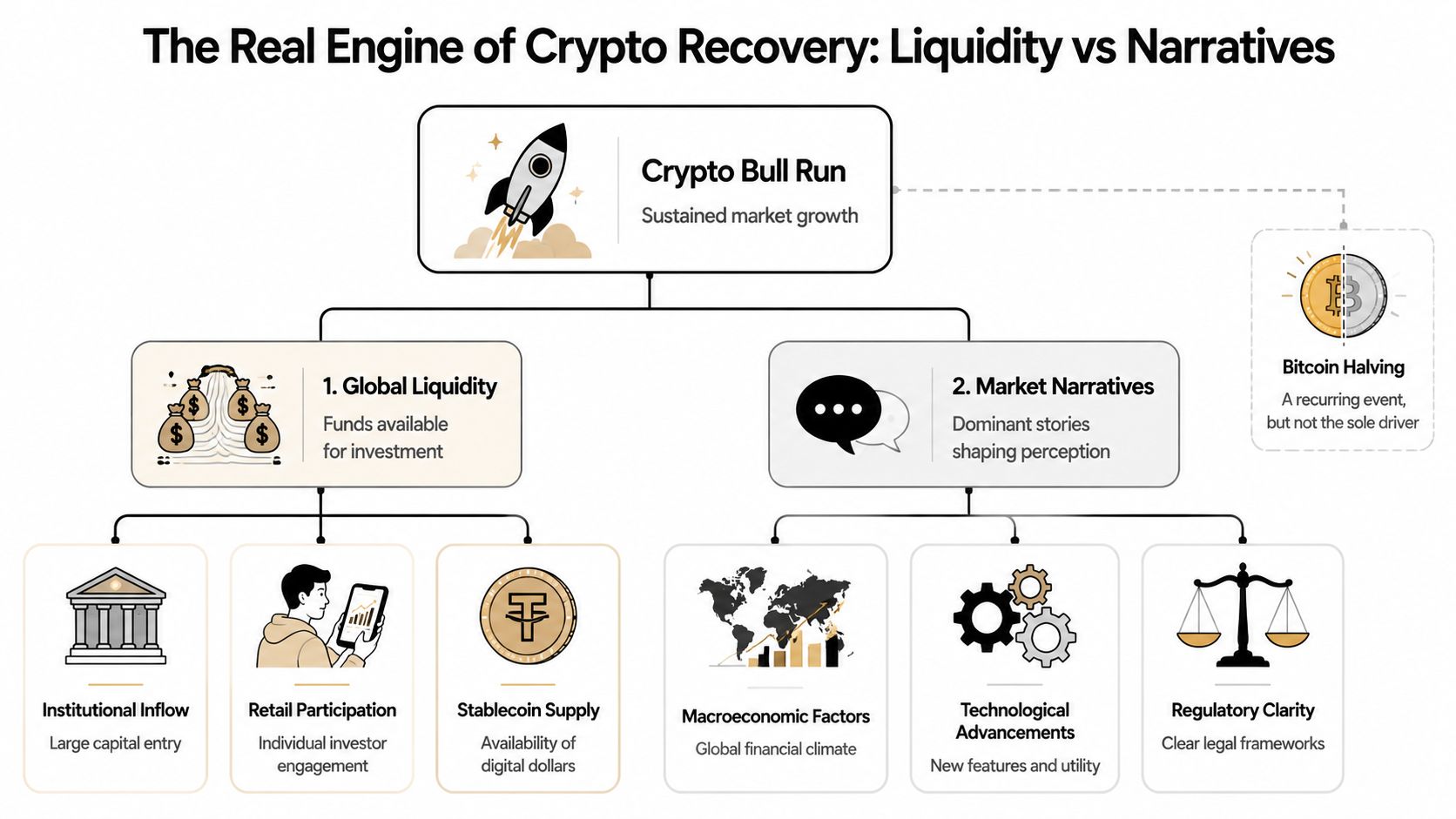
The more useful model starts with liquidity. When financial conditions loosen, capital becomes more willing to move into risk assets. That shift supports Bitcoin, large-cap crypto, venture-backed blockchain themes, and eventually more speculative corners of Web3. When conditions tighten, even strong narratives struggle to convert attention into sustained bids.
Why the halving story is incomplete
The current downturn has been linked to macro tightening and the unwinding of highly indebted positions, while a durable rebound depends more on macro easing than on a standalone halving story, according to Mudrex's analysis of whether crypto can recover in 2026. The same analysis notes that persistent tightening could push a more meaningful recovery into 2027, which is a projection, not a certainty.
That distinction matters because it separates a relief rally from a structural recovery. Relief rallies happen when oversold markets snap back. Structural recoveries happen when liquidity, sentiment, and market positioning align for a longer advance.
One of the clearest ways to understand this is to think about the halving as an internal supply narrative, while liquidity is an external demand condition. Supply changes can help. But if large pools of capital are defensive, cautious, or facing tighter funding conditions, they won't chase risk just because a crypto-native event occurred.
For a closer look at how capital conditions shape digital asset markets, this overview of cryptocurrency liquidity dynamics is worth reviewing.
What liquidity actually changes
Liquidity changes investor behavior at multiple levels:
- Institutional allocation: Funds become more willing to add macro-sensitive assets when conditions improve.
- Retail confidence: Traders usually return with more aggression after downside volatility fades and trend persistence improves.
- Stablecoin and exchange activity: More usable capital inside the ecosystem tends to support stronger participation across spot and derivatives markets.
The practical takeaway is simple. If you want to answer when will crypto recover, don't treat narratives as the engine. Treat them as accelerants. Narratives can explain why a market gets attention. Liquidity explains whether that attention turns into sustained buying pressure.
This is also why some of the most interesting growth stories in crypto, including AI-linked tokens, real-world asset tokenization, Layer 2 expansion, and new DeFi product design, may not fully rerate until macro conditions allow investors to pay for future potential again.
A short explainer on that relationship is worth watching:
A market can rally on hope. It usually recovers on liquidity.
Lessons from History Analyzing Past Crypto Recoveries
History doesn't provide a countdown clock, but it does give context. The most important lesson is that not all crashes belong to the same category.
Some declines are technical liquidation events. Others are chapters inside a broader bear market. Investors who confuse those two environments usually misread both risk and timing.
Fast recoveries usually follow forced unwinds
A data-driven review of major liquidation events found that three of the last four largest crashes in crypto history saw full recoveries within 1.5 to 3 months, while the outlier took about 2 years because it happened deep in a longer bear market, according to this review of major crypto liquidation events on YouTube.
The same analysis argued that after a technical liquidation event, a full recovery could happen within about 90 days, with some rebounds beginning in 20 to 30 days and others taking 60 to 90 days. That pattern is most relevant to liquid markets like Bitcoin.
Many investors make a mistake. They assume every violent selloff means years of pain. History suggests that if the decline was mainly a widespread unwinding of borrowed positions, the recovery window can be much shorter.
For readers studying previous downturn patterns, this guide to the crypto bear market cycle adds useful context.
The outlier matters more than it seems
The outlier is just as instructive as the fast rebounds. It recovered more slowly because the crash didn't happen in isolation. It happened near the bottom of a much larger bearish regime.
That tells us timing depends on context, not just magnitude. A brutal selloff in an otherwise improving environment can reverse quickly. A brutal selloff inside a prolonged macro contraction behaves differently because capital isn't ready to absorb supply.
| Crash context | Likely recovery behavior |
|---|---|
| Leverage unwind | Sharp bounce can turn into a full recovery over weeks or months |
| Broader bear market | Price may stay unstable for much longer before trend repair begins |
The right question isn't “how bad was the drop?” It's “what caused the drop, and did those conditions change?”
That historical lens leads to a better conclusion than simple cycle mythology. Crypto can recover faster than many investors expect, but only when the selloff was technical rather than structural.
The Analyst's Toolkit On-Chain and Technical Recovery Signals
Most investors notice recovery too late because they focus on headlines before they study structure. Analysts do the opposite. They start with price behavior, then look for confirmation.
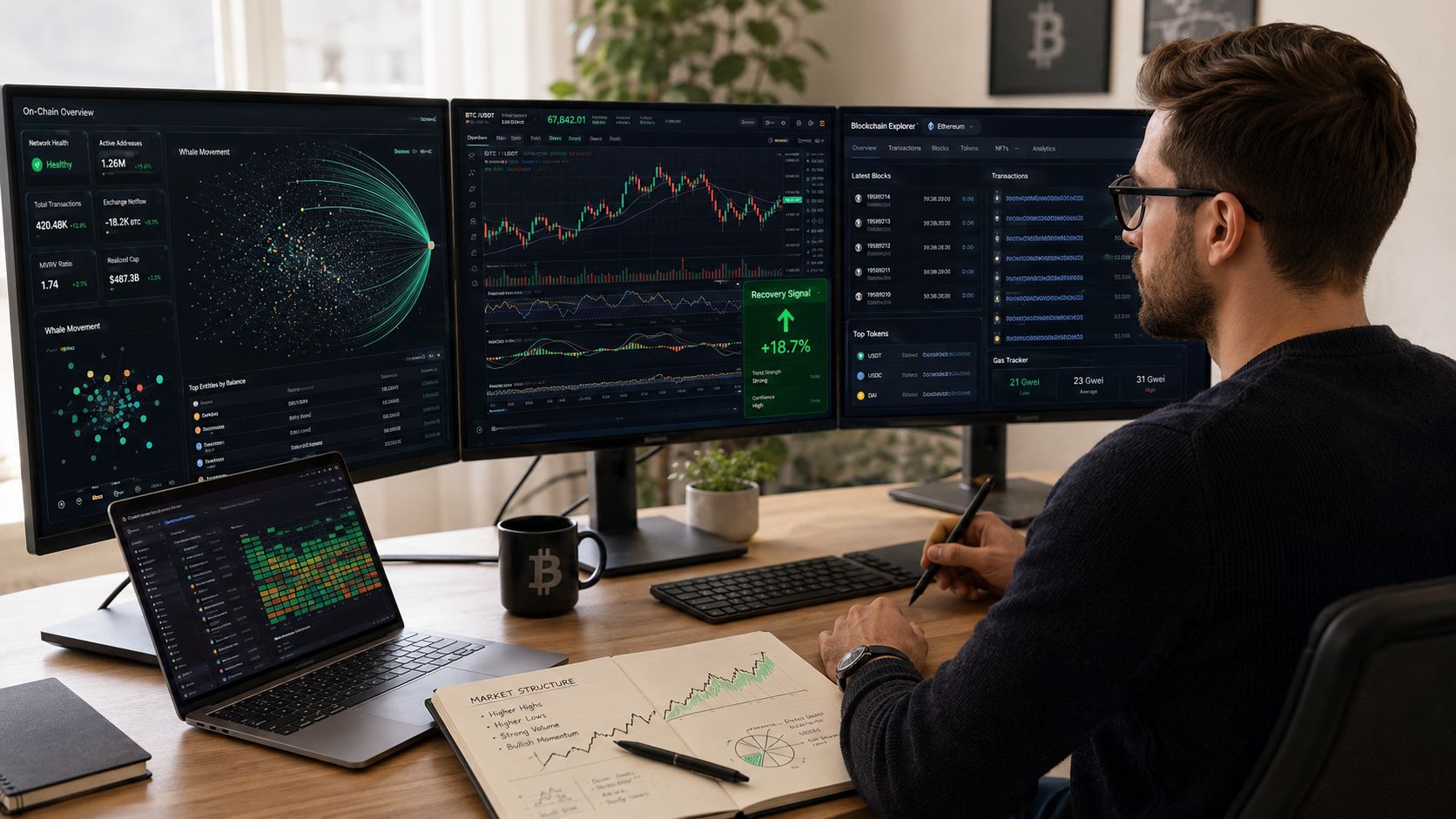
A true crypto recovery is marked by a shift in trend structure, featuring a sequence of higher lows and higher highs on daily and weekly charts, with added confirmation when RSI moves up from oversold territory below 30 and price reclaims key moving averages such as the 50-day and 200-day SMAs, according to Ultima Markets' recovery analysis. That confluence across timeframes is stronger than any single bounce.
Trend structure comes first
Price structure matters because it shows whether sellers still control the tape.
If an asset keeps making lower highs, every rally is suspect. If it stops making significant new lows and starts building higher lows, you're seeing evidence that supply is being absorbed. Once higher highs begin to stack on top of that base, trend reversal becomes more credible.
I look at recovery in stages:
- Sell pressure weakens: New lows stop extending with the same force.
- Buyers defend pullbacks: Dips get bought earlier.
- Breakout levels reclaim: Price holds above major moving averages instead of failing immediately.
- Trend persists across timeframes: Daily strength starts showing up on the weekly chart.
This matters for Bitcoin and Ethereum most of all, because their liquidity makes technical signals more dependable than they are in thin altcoin markets.
How to combine technical and on-chain signals
Technical tools are strongest when paired with crypto-native context. That means combining chart structure with on-chain and market-flow clues such as exchange inflows, exchange outflows, funding behavior, and miner stress.
A practical monitoring stack looks like this:
- RSI reset and recovery: Oversold conditions can mark exhaustion, but the stronger clue is RSI recovering and holding above the non-oversold zone.
- Moving average reclaim: The 50-day and 200-day SMAs help separate a tradeable bounce from a trend repair.
- Exchange flow behavior: Heavy inflows can suggest distribution pressure, while calmer flow patterns can signal reduced urgency to sell.
- Miner behavior: Capitulation can pressure price, while stabilization often supports a cleaner backdrop.
- Funding and positioning: Extreme speculative positions can create reflexive moves in both directions.
For active traders refining entries and exits, this resource on crypto trading strategies fits well alongside technical structure analysis.
Analyst habit: Wait for confirmation from multiple signals. One green candle means little. A series of higher lows with moving average reclaim means far more.
This framework also helps in adjacent sectors. If you're assessing Layer 2 tokens, DeFi governance assets, or AI-integrated Web3 projects, the same principle applies. Narrative strength can attract attention, but durable recovery still needs structure, liquidity, and sustained demand.
The Macro Dashboard How Global Finance Dictates Crypto's Fate
Bitcoin no longer trades like an isolated experiment sitting outside the financial system. It trades more like a macro-sensitive asset that responds to liquidity conditions, risk sentiment, and capital rotation across global markets.
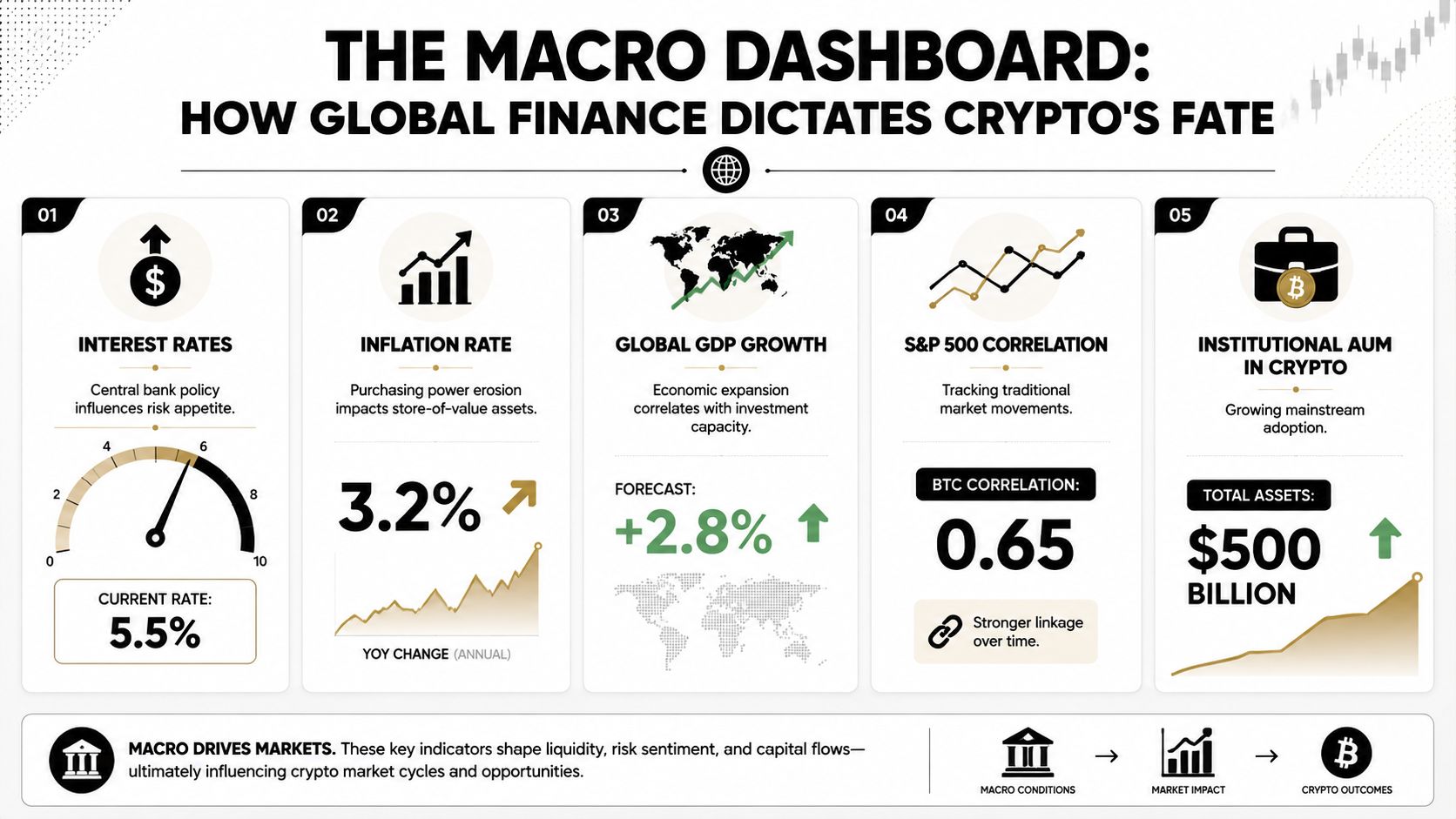
By May 22, 2025, Bitcoin traded above $110,000, and OANDA reported that its daily volatility had roughly halved since 2021, falling from about 5.3% to around 2.1%. The same OANDA analysis showed a +0.52 correlation with tech stocks, a +0.49 correlation with high-yield corporate bonds, and a -0.29 correlation with the U.S. dollar, all of which support the view that Bitcoin behaves more like a macro risk asset than in its earlier retail-dominated years, as detailed in OANDA's Bitcoin market structure review.
Bitcoin now trades like a macro asset
That shift changes how recovery should be evaluated.
Lower day-to-day volatility doesn't mean lower risk. It means the market may be maturing into a slower, broader, more institutionally influenced regime. Recoveries can still be strong, but they may look less explosive and more dependent on external capital conditions.
Investors who still treat Bitcoin as fully detached from stocks, credit, and currency dynamics are using an outdated map. A rising dollar can pressure risk assets. Tight financial conditions can reduce appetite for speculative exposures. Weakness in growth-sensitive equities can spill into crypto, especially when positioning is crowded.
For more context on the connection between market narratives and price action, this explainer on why Bitcoin is rising in different market environments is a useful companion read.
What investors should monitor outside crypto
When you're trying to answer when will crypto recover, mainstream finance becomes part of the workflow.
Focus on signals like these:
- Central bank tone: Markets react not only to policy decisions but to the expected path of future easing or tightening.
- Risk appetite in equities: Crypto often performs better when investors are already rotating into growth-sensitive assets.
- Dollar direction: The negative correlation with the U.S. dollar matters because stronger dollar conditions can weigh on risk sentiment.
- Credit market mood: Bitcoin's relationship with high-yield debt reinforces its macro sensitivity.
A modern crypto investor needs a dual screen. One screen tracks Bitcoin, Ethereum, stablecoin flows, and on-chain behavior. The other tracks rates, equities, credit, and the dollar. Recovery lives at the intersection.
A Segmented Recovery Bitcoin vs Altcoins NFTs and GameFi
One of the biggest mistakes in crypto analysis is treating the market as a single organism. It isn't. Recovery is rarely uniform, and this cycle may make that more obvious than ever.
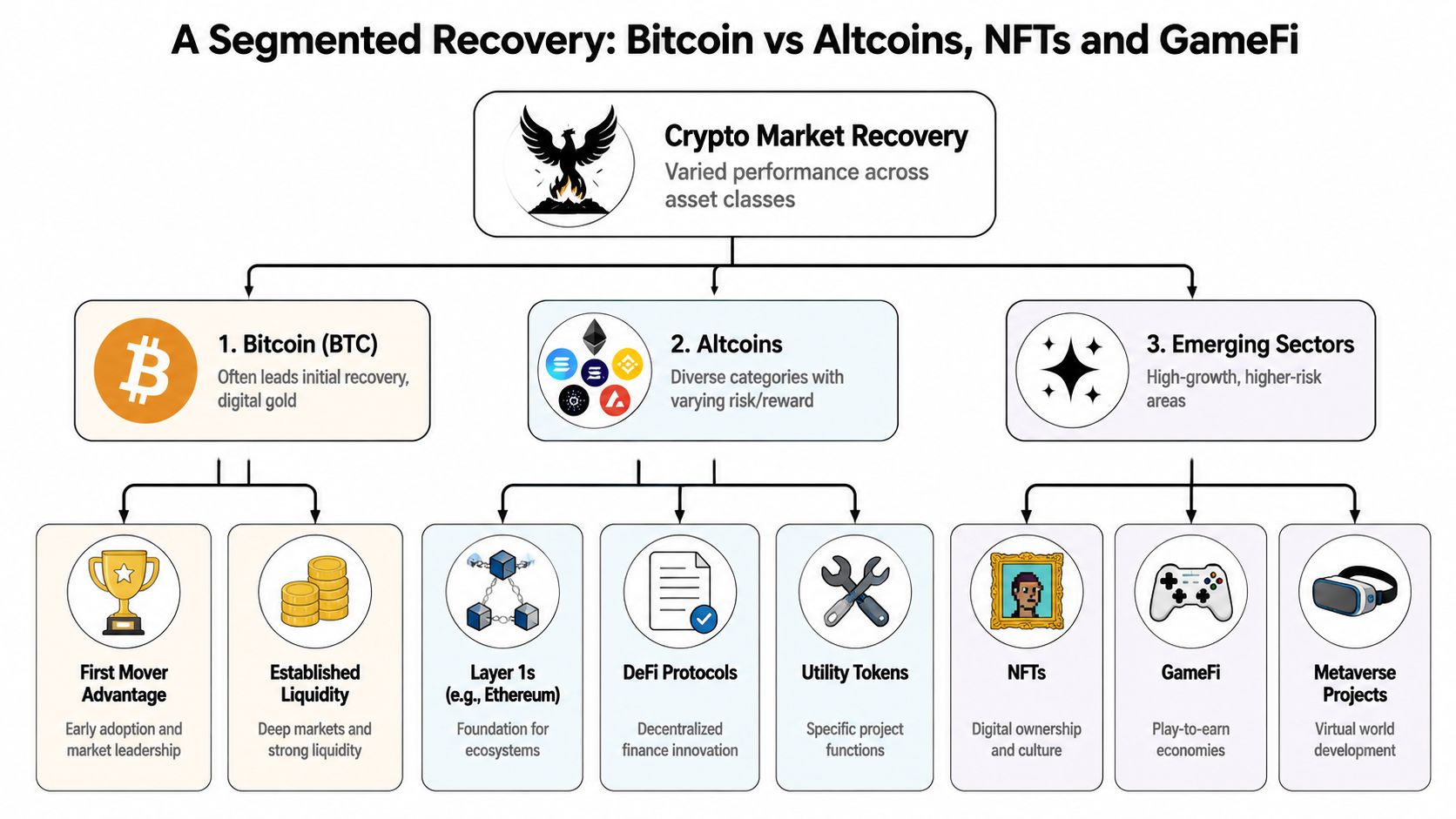
The market has become more segmented as institutional capital has moved toward the most established asset. According to KuCoin's discussion of whether crypto will go back up, spot Bitcoin ETFs now hold roughly 5 to 6% of circulating supply, more than 170 publicly traded companies reportedly hold Bitcoin, and Bitcoin dominance sits around 58%. That setup raises a critical issue: Bitcoin may recover first while altcoins, DeFi, NFTs, and GameFi lag.
Why Bitcoin may recover first
Institutional money usually prefers liquidity, clarity, and size. Bitcoin offers all three better than most of the market.
That doesn't mean Ethereum or major Layer 2 ecosystems can't perform well. They still anchor smart contracts, DeFi activity, real-world asset tokenization, and a large share of Web3 development. But they typically sit one tier lower on the risk ladder. Capital often enters Bitcoin first, then expands outward if confidence holds.
A simple comparison helps:
| Segment | Likely recovery profile |
|---|---|
| Bitcoin | Often leads because it attracts institutional flows and deep liquidity |
| Large-cap altcoins | Can follow if market confidence broadens beyond Bitcoin |
| DeFi, NFTs, GameFi | Usually need stronger risk appetite and clearer sector narratives |
For investors tracking cultural and speculative digital assets, this overview of NFT market trends helps frame how uneven that recovery can be.
Where Web3 risk sits now
This matters for portfolio construction because “crypto recovered” may become a misleading phrase. Bitcoin can trend strongly while many altcoins remain stuck. Ethereum can stabilize while lower-quality tokenomics still struggle. Some DeFi protocols may benefit from renewed on-chain usage, while older NFT collections never reclaim prior attention.
That's especially relevant in sectors driven by future adoption rather than current cash flow. AI and crypto integrations, modular infrastructure, tokenized real-world assets, and Layer 2 ecosystems may attract serious developer attention, yet token performance can still lag until broader capital rotation returns.
Market reality: A Bitcoin-led rebound doesn't guarantee a broad altseason. Investors need proof of rotation, not hope.
For GameFi and NFT investors, this is the hard truth. Recovery in those niches usually depends on both market liquidity and renewed user demand. It isn't enough for Bitcoin to rise. Investors also need speculative confidence to move further out the curve.
Navigating the Next Cycle How to Build a Resilient Portfolio
The strongest portfolios in this environment won't come from perfect predictions. They'll come from disciplined positioning.
If your plan depends on guessing the exact month crypto bottoms or tops, the market will probably punish you. If your plan is built around evidence, trend confirmation, and risk layering, you'll make better decisions even when volatility stays high.
A practical framework for 2026 investors
Start with a hierarchy of conviction.
Keep the highest-conviction allocation where liquidity, market structure, and institutional demand are strongest. For many investors, that means Bitcoin first, then selective exposure to Ethereum and other large-cap ecosystems that still matter for smart contracts, DeFi rails, Layer 2 growth, and tokenized asset infrastructure.
Then apply stricter standards as risk rises:
- For Bitcoin exposure: Watch macro tone and technical structure.
- For Ethereum and large caps: Look for improving network relevance and stronger relative performance.
- For DeFi and Layer 2 tokens: Focus on real utility, durable tokenomics, and evidence of user stickiness.
- For NFTs, GameFi, and speculative themes: Treat them as asymmetric opportunities, not core holdings.
There's also a behavioral advantage in this approach. Investors who separate core positions from speculative positions tend to panic less during drawdowns because every asset in the portfolio has a defined job.
The final answer to when will crypto recover is this: recovery begins before headlines confirm it, but only after structure, liquidity, and capital rotation start aligning. That means you shouldn't wait passively for a magic date. You should build a repeatable process for recognizing the turn.
Crypto's next cycle will likely be more macro-driven, more institutional, and more selective than many investors expect. That makes it harder for hype-driven traders. It also creates an edge for investors willing to think in regimes instead of headlines.
If you want more grounded crypto analysis, practical market frameworks, and deeper coverage of Bitcoin, altcoins, NFTs, Web3, DeFi, Layer 2s, and emerging blockchain trends, explore Coiner Blog. It's a strong resource for readers who want signal over noise and a smarter way to follow the next cycle.
3 Comments