
Next Crypto Bull Run: A 2026 Guide to the Signs

The most useful number in this debate isn't a flashy price target. It's the 12 to 18 month window that has historically followed Bitcoin's April 2024 halving and aligns the start of sustained momentum with the first quarter of 2026, according to DirectionsMag's cycle overview. That reframes the whole conversation.
Most writing about the next crypto bull run falls into two weak camps. One camp treats every green candle like confirmation. The other repeats old cycle charts without asking what's structurally different this time. Neither approach is enough for a market now shaped by spot Bitcoin ETFs, rising institutional participation, real-world asset tokenization, AI-linked narratives, and maturing Ethereum Layer 2 ecosystems.
A better approach is to treat a bull run as a system, not a slogan. Prices matter, but so do supply dynamics, on-chain confirmation, capital rotation, tokenomics, and the behavior of different market participants. If you're trying to make sense of where crypto goes next, that means looking beyond raw optimism and asking better questions. What confirms a real trend? What changes when Wall Street arrives? Which signals matter for investors, traders, and crypto-native users such as gamers and collectors?
For a broader read on recovery phases before full expansion returns, this crypto recovery guide is a useful companion.
Table of Contents
- Anticipating the Next Market Shift
- The Anatomy of a Crypto Bull Run
- Decoding History The Four-Year Cycle
- Your Bull Run Dashboard Key Indicators to Watch
- Catalysts for the Next Cycle What Is Different This Time
- Preparing for the Bull Run Strategies for Every Profile
- Navigating the Hype A Final Checklist for Risk Management
Anticipating the Next Market Shift
After every Bitcoin halving, the strongest phase of the market has historically arrived later, not immediately. That lag matters because it shifts the question from “Has the bull run started?” to “Which parts of the market are building the conditions for one?”
Crypto still moves in cycles, but this cycle is not a simple replay of 2017 or 2021. Bitcoin remains the center of gravity, yet the structure around it has changed. Spot ETF access has widened the path for institutional capital. Tokenized real-world assets are pulling crypto closer to traditional finance. AI-linked tokens and infrastructure plays are adding a new speculative and utility layer at the same time. For readers trying to place the current moment in context, our guide on when crypto may recover is a useful companion to this section.
That shift in structure is why timing alone is not enough. A market can rise on liquidity and still fail to produce durable leadership. What tends to sustain a cycle is broader participation across capital, users, developers, and credible revenue models.
Several signals make this setup different from prior recoveries:
- Institutional flows are more visible. ETF vehicles and regulated custody give large allocators cleaner access than in previous cycles.
- RWA is no longer a fringe narrative. Tokenized Treasuries, credit products, and onchain settlement tools tie blockchain adoption to existing financial demand.
- AI is changing where speculation gathers. Investors are not only chasing tokens. They are also pricing in demand for decentralized compute, data markets, and machine-to-machine payments.
- Market participants are more selective. After the collapses of 2022, buyers are paying closer attention to liquidity, vesting schedules, treasury management, and whether a protocol has actual users.
This creates a more segmented market. Bitcoin and Ethereum may still lead early, but the next expansion is less likely to reward every token equally. Capital is more likely to concentrate in assets with institutional access, clear utility, or strong cultural traction. That distinction matters for different personas. Long-term investors may focus on quality and patience. Traders may look for rotation and momentum confirmation. Gamers and collectors, a group macro commentary often ignores, may find opportunity where user engagement returns before broad market euphoria does.
Crypto bull markets strengthen when price, liquidity, and real participation start reinforcing one another.
The practical takeaway is straightforward. Instead of waiting for a single date that declares the next bull run, watch for structural confirmation. The next major move will likely be defined less by one narrative and more by how institutional money, RWA adoption, AI speculation, and user activity begin to converge.
The Anatomy of a Crypto Bull Run
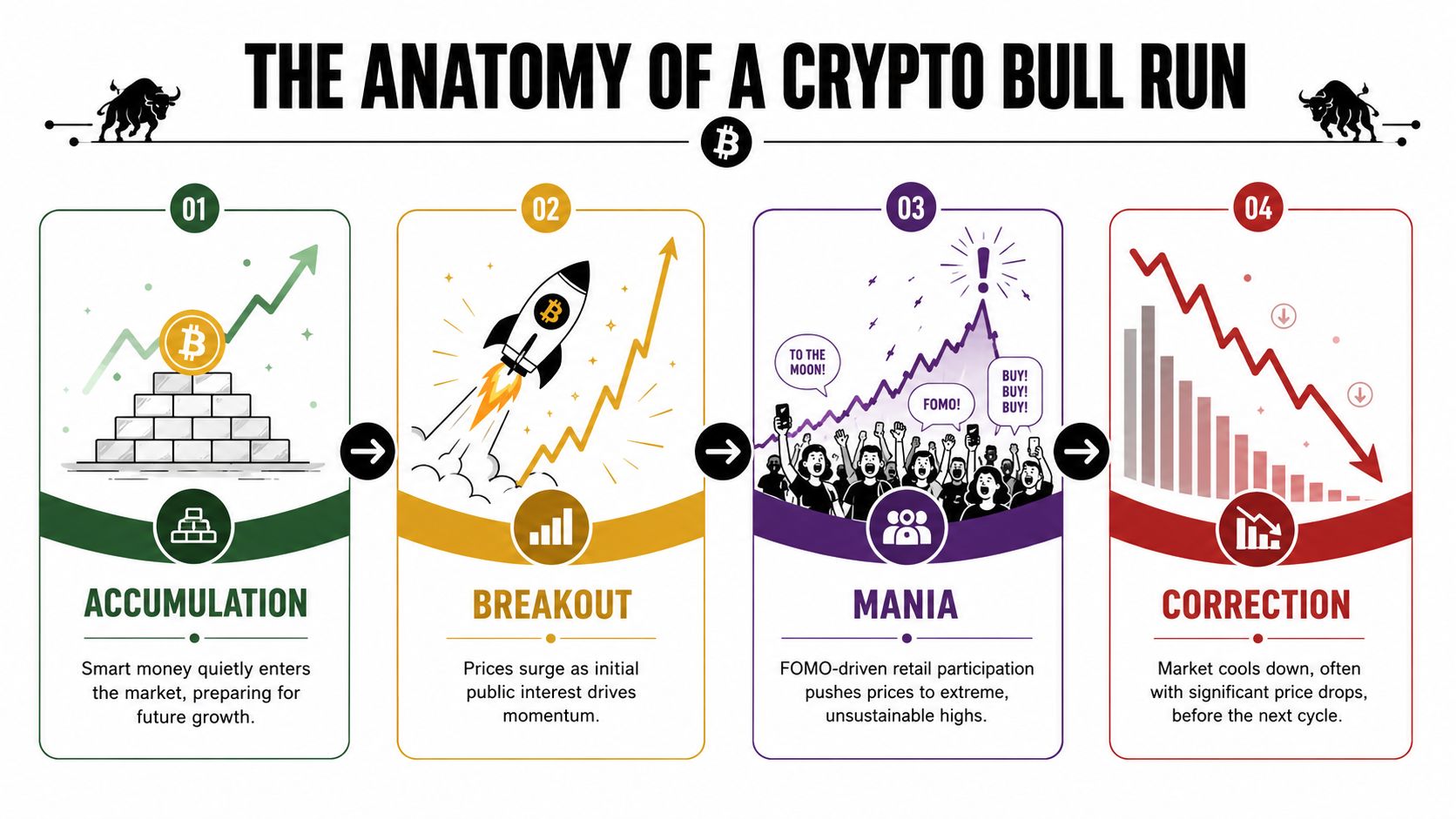
A bull run isn't one event. It's a sequence. The easiest way to understand it is to think of a rocket launch. Typically, only the moment the rocket leaves the pad is noticed. Professionals pay closer attention to fueling, ignition, ascent, and re-entry risk.
Accumulation
This is the quiet part. Prices stop collapsing, volatility cools, and the loudest participants usually lose interest. Long-term buyers start rebuilding positions because risk-reward looks better when sentiment is still skeptical.
You can often recognize accumulation by behavior rather than headlines. People stop asking which token will “moon” and start asking whether Bitcoin, Ethereum, or a handful of quality protocols are being mispriced. Builders keep shipping. Serious investors spend more time on custody, tokenomics, and chain activity than on social media narratives.
Breakout
Breakout is ignition. Price starts to matter again because the market proves it can hold strength instead of producing another fake rally. Confidence returns in layers. Bitcoin usually captures attention first, then Ethereum, then selected altcoins with strong liquidity or narrative momentum.
This phase often feels obvious in hindsight and unclear in real time. That's because breakouts don't arrive with certainty. They arrive with improved odds.
A practical consideration:
| Phase | What participants do | What tends to matter most |
|---|---|---|
| Accumulation | Build positions slowly | Valuation, conviction, patience |
| Breakout | Add on confirmation | Trend strength, liquidity, leadership |
| Mania | Chase upside | Narrative, momentum, emotion |
| Correction | Cut risk or reset | Discipline, cash management, survivability |
Mania
Mania is where the next crypto bull run becomes mainstream culture. Retail flows back in, influencers multiply, and lower-quality assets start moving because capital is rotating fast. This is usually where tokenomics get ignored, risk controls weaken, and “community” gets mistaken for product-market fit.
The danger is psychological, not just financial. People anchor to the highest recent price and assume every pullback is temporary. They stop distinguishing between Bitcoin, Ethereum, serious DeFi protocols, AI narratives, gaming tokens, and low-liquidity speculation.
Practical rule: If you can no longer explain in plain language why an asset is rising beyond “everyone is buying it,” you're probably late in the cycle.
Correction
Every rocket has gravity. Correction is where financial overextensions unwind, weaker narratives fade, and capital exits assets that never had durable support. Some projects recover. Many don't.
Correction isn't proof that crypto failed. It's proof that bull markets create excess. If you understand the sequence, you stop treating every rally as the beginning of infinite upside and every drop as the end of the industry.
Decoding History The Four-Year Cycle
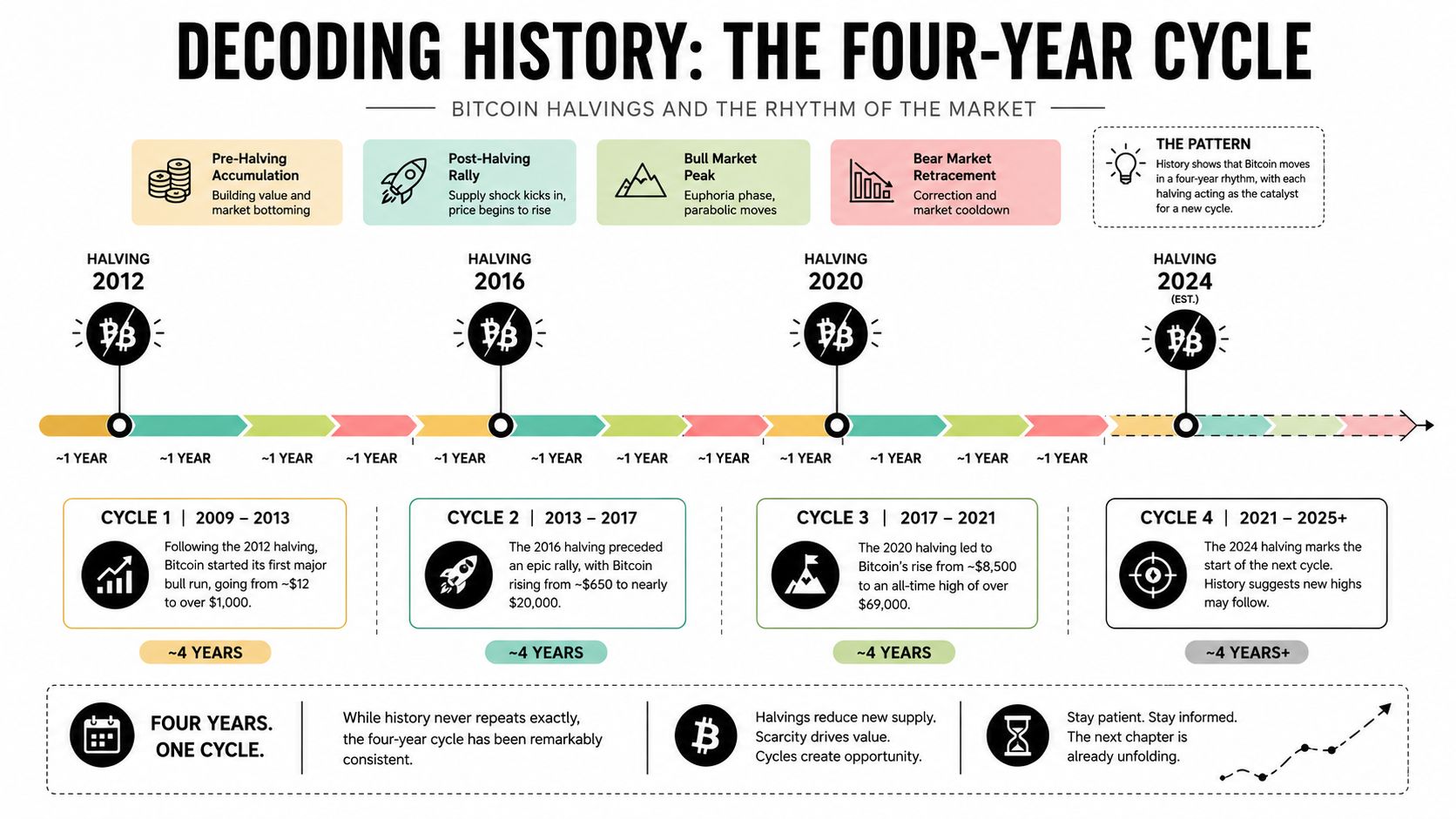
The most reliable historical framework in crypto remains the four-year Bitcoin cycle. It isn't magic. It's a market structure built around supply. Bitcoin's halving reduces the issuance of new coins by 50%, and historical data shows that major bull runs have typically peaked 500 to 550 days after the halving, according to Cryptohopper's review of prior rallies.
If you want a basic grounding in why that supply event matters, this Bitcoin halving explainer lays out the mechanics clearly.
What prior cycles actually show
The pattern has been unusually consistent. The major rallies in 2013, 2017, and 2021 all fit the post-halving expansion model cited above. The same source notes that the 2013 run lasted 11 months, the 2017 rally lasted 12 months, and the 2020 to 2021 cycle extended nearly 18 months before the November 2021 peak.
That last point matters. Crypto cycles haven't repeated on a fixed timer. They've stretched as the market matured.
Here's the cleanest way to read the precedent:
- 2013 showed that a post-halving expansion can move fast.
- 2017 reinforced the cycle and tied it to a broader speculative boom.
- 2020 to 2021 showed the cycle can persist longer when participation broadens and liquidity conditions help.
This cycle's timeline looks important for the same reason. The April 2024 halving places the next major market peak between October 2025 and early 2026, using the historical 500 to 550 day post-halving window cited by Cryptohopper. The same analysis argues that the current cycle's duration from breakout to peak may resemble the longer 2020 to 2021 pattern rather than the shorter early cycles.
Later in the same source, analysts project total crypto market capitalization in the $8 trillion to $14 trillion range during the projected 2026 peak window. That's a projection, not a fact, and readers should treat it as a scenario model rather than an outcome.
A short visual walkthrough can help frame how these cycles tend to unfold:
Why history matters without becoming a trap
The strongest use of cycle history is orientation, not certainty. History gives you a map of when supply compression has mattered. It does not tell you which narratives will lead, how hard altcoins will rotate, or whether Ethereum, Solana, Layer 2 ecosystems, DeFi, gaming, or AI-linked tokens will capture the most attention.
Markets repeat structure more often than detail. The halving may rhyme across cycles, while the leadership inside each cycle changes.
That distinction matters because investors often overlearn the wrong lesson. They remember that a bull market followed the halving. They forget that each expansion rewarded a different mix of infrastructure, applications, and narratives.
Your Bull Run Dashboard Key Indicators to Watch
If history gives you the map, indicators give you the instrument panel. The mistake many participants make is staring at price alone. Price tells you what has happened. A better dashboard helps you judge whether a move is broadening, overheating, or failing.
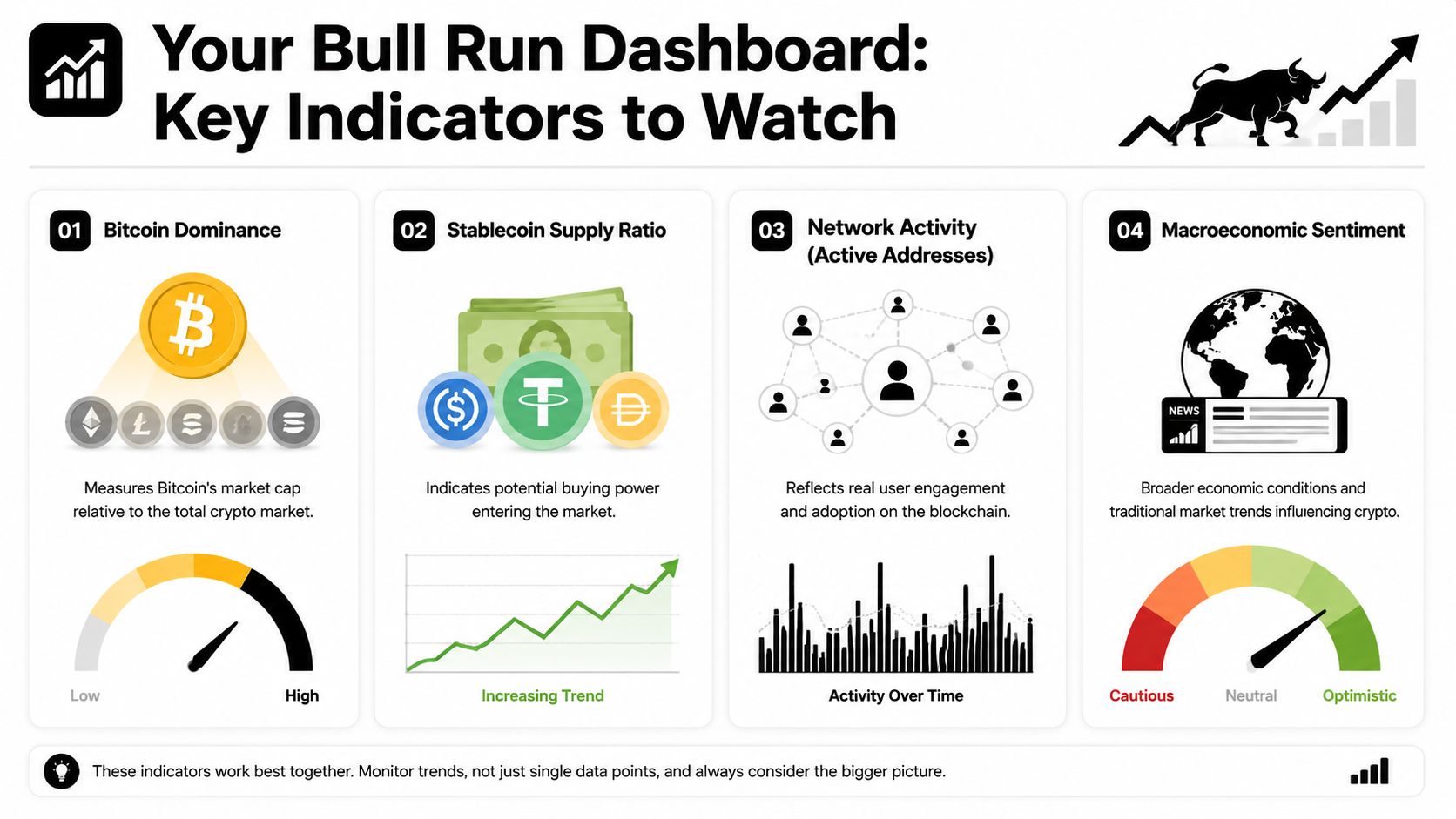
The most cited technical confirmation in the supplied research combines the Bitcoin MVRV ratio, Bitcoin dominance, and the Altcoin Season Index. According to this indicator-based market signal discussion, the next crypto bull run is technically signaled when the MVRV ratio stays above 1.0 and the Bitcoin Dominance Index peaks and then declines. Once dominance peaks and the Altcoin Season Index exceeds 75, the broader bull phase is historically well underway.
MVRV as the valuation gauge
MVRV compares market value to realized value. In plain English, it helps estimate whether Bitcoin is trading above or below the aggregate cost basis implied by on-chain movement. That makes it useful for identifying whether the market is recovering, expanding, or approaching overheated territory.
The same source says a ratio above 3.25 has typically marked a bull market top, while a sustained trend above 1.0 since early 2023 confirms that the 2022 bear market bottom had been reached and that the market was building toward a new expansion phase. You shouldn't use MVRV alone, but it's one of the cleanest context tools available.
Bitcoin dominance and altcoin rotation
Bitcoin dominance measures Bitcoin's share of total crypto market capitalization. Early in a cycle, dominance often rises because capital prefers the most liquid, most trusted asset. That's usually where institutions enter first, and it's where cautious capital tends to hide before broad confidence returns.
When dominance peaks and starts to fade, leadership can widen. That's often when Ethereum starts outperforming, followed by stronger Layer 2, DeFi, and selected altcoin ecosystems.
A more operational confirmation model comes from ChangeHero's bull-run checklist, which argues that three conditions should converge:
- Stablecoin supply expansion should exceed $150 billion in net issuance.
- Bitcoin ETF inflows should stay above $500 million weekly for eight consecutive weeks.
- Altcoin breadth should show at least 40% of top-100 tokens outperforming Bitcoin on a 30-day basis.
The same source adds two broader confirmation conditions. The CMC Altcoin Season Index should move above 75, and the Fear & Greed Index should stay in Greed territory at 65+ for six consecutive weeks.
Macro and liquidity still matter
Crypto never trades in a vacuum. WazirX's review of bull-run indicators points to improving global liquidity, falling rates, a weaker U.S. dollar, ETF inflows, and sustained exchange outflows into cold storage as conditions that can support a stronger cycle. The same source also references a macro trend signal using the 350-day SMA multiplied by 2 crossing above the 111-day SMA.
Not every reader needs to follow every metric. A simple dashboard works better than a crowded one.
Dashboard mindset: Watch valuation, leadership, liquidity, and breadth together. When all four align, the odds of a durable move improve.
Catalysts for the Next Cycle What Is Different This Time
The next crypto bull run probably won't look like 2017, and it may not even look like 2021. The biggest reason is structural. Capital entering the market now doesn't only come from crypto-native traders. It increasingly comes through institutional rails, regulated products, and investment mandates that didn't exist at comparable scale in earlier cycles.
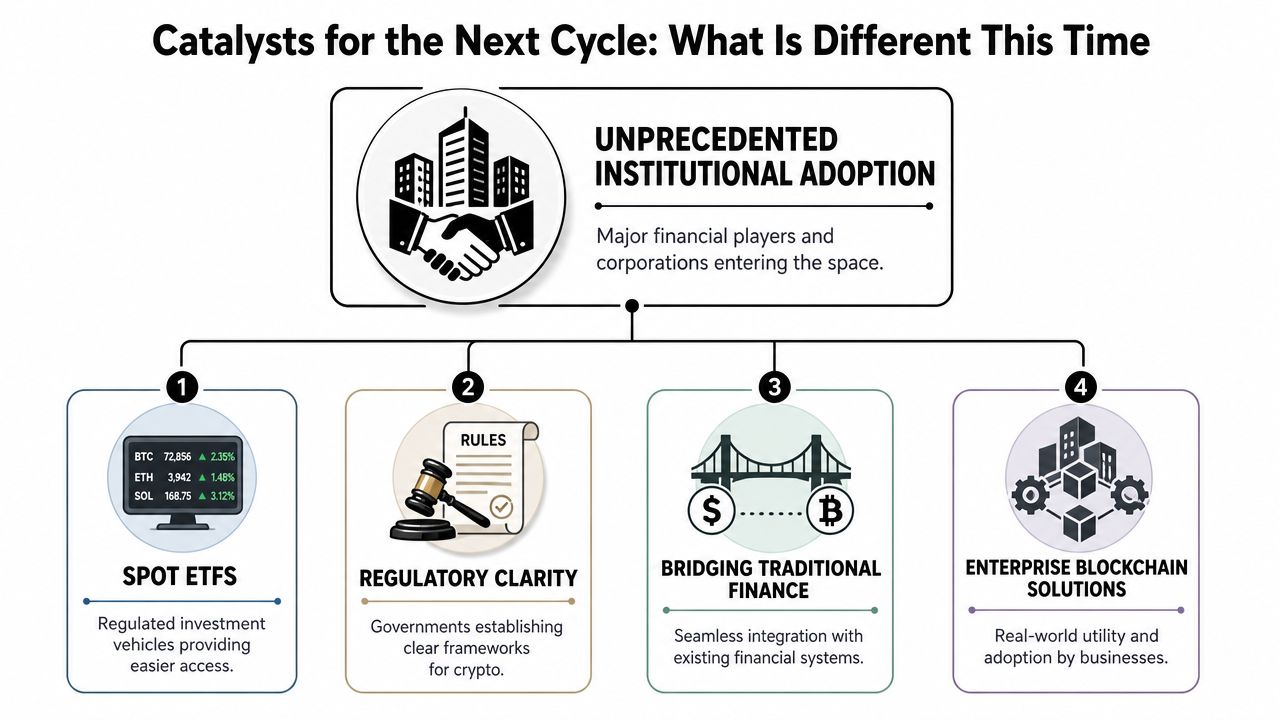
One of the clearest data-backed markers of that shift comes from Token Metrics' 2026 bull-run projection. That analysis projects Bitcoin reaching $150,000 to $200,000 in the next bull run, driven by the April 2024 halving and strong institutional inflows through U.S. spot ETFs. It also notes that MicroStrategy holds over 500,000 BTC, which it describes as about 2.5% of the total 21 million coin issuance. Those figures are projections and holdings data, not guarantees of price direction.
If you want to understand why ETF flows matter mechanically, this ETF creation and redemption explainer is worth reading.
Institutionalization changes market texture
Institutional capital changes more than demand. It changes behavior. A market led by more regulated vehicles, treasury allocations, and professional capital can trade differently from one dominated by retail speculation alone.
That's why CoinDesk's report on the next cycle's structure is so interesting. It argues the next bull run is expected to be slower and less volatile as investor appetite evolves and attention shifts toward real-world asset tokenization. That's a major departure from the assumption that every cycle must produce the same kind of parabolic retail frenzy.
This matters for asset selection:
| Structural driver | Why it matters | Likely effect |
|---|---|---|
| Spot Bitcoin ETFs | Easier access for traditional capital | More persistent demand in Bitcoin |
| Real-world asset tokenization | Connects blockchain rails to off-chain assets | More attention on infrastructure and compliance-friendly platforms |
| Ethereum Layer 2 growth | Cheaper execution for users and apps | Better conditions for DeFi and Web3 activity |
| AI and crypto narratives | Links compute, data, automation, and tokens | Stronger narrative competition, but uneven quality |
RWA, AI, and Ethereum's role
Real-world asset tokenization matters because it moves crypto closer to financial plumbing rather than just speculative trading. That tends to benefit chains and applications designed for issuance, compliance, settlement, and interoperability. Ethereum remains central here because of its smart contract depth, while Layer 2 networks help reduce cost friction for users and developers.
AI and crypto sit in a different bucket. The appeal is obvious. Decentralized coordination, data markets, on-chain incentives, and autonomous software fit naturally into crypto's design language. But this part of the market may be especially vulnerable to narrative overshoot. Readers should separate real usage and credible tokenomics from branding.
Why this cycle may feel less explosive
A structurally slower market can still be a powerful bull market. In fact, it may be healthier. Broader participation through ETFs and institutional channels could reduce the all-or-nothing swings that defined earlier peaks. The trade-off is that retail investors may need more patience and stronger filters.
That also means sectors such as DeFi, Web3 gaming, AI-linked infrastructure, and tokenized assets may not all move together. Capital could rotate more selectively. The winners may be the projects that combine liquidity, utility, and credible supply design rather than the loudest social narrative.
Preparing for the Bull Run Strategies for Every Profile
A good market can still produce bad decisions. Preparation depends on who you are, what you're trying to do, and how much time you can devote to crypto. The long-term investor, the active trader, and the gamer or collector aren't solving the same problem.
The Investor
Long-term investors usually don't need perfect timing. They need process. In a cycle driven by Bitcoin, Ethereum, and stronger institutional participation, that often means focusing on asset quality, custody, and position sizing rather than trying to catch every rotation.
Three habits matter most:
- Build gradually: Dollar-cost averaging can reduce the pressure to time entries around volatile headlines.
- Protect the core: Cold storage and clear wallet hygiene matter more as portfolio values rise.
- Review tokenomics: Even strong narratives can underperform if token releases, emissions, or treasury behavior work against holders.
For many investors, portfolio management also becomes a practical spending question. During stronger market phases, some people look at tools that connect digital assets to daily payments. If that's relevant to your setup, it's worth taking time to compare crypto debit and credit cards before relying on convenience features that may not match your region, spending habits, or tax situation.
Holding through a bull market sounds easy in theory. It gets harder when positions become meaningfully larger and every headline tries to pull you off plan.
The Trader
Active traders need a different playbook. Their edge usually comes from identifying leadership shifts early and exiting before the crowd assumes every trend is permanent. In this kind of cycle, that means watching rotation between Bitcoin, Ethereum, Layer 2 networks, DeFi, AI-linked tokens, and selective gaming ecosystems.
A simple comparison helps:
| Trader focus | Useful question |
|---|---|
| Narrative strength | Is capital moving into this theme or just talking about it? |
| Liquidity | Can you enter and exit without depending on thin order books? |
| Relative performance | Is the asset outperforming Bitcoin or only rising because the whole market is green? |
| Exit discipline | Do you know where you'll reduce risk before emotion takes over? |
Traders also need to accept that not every trend deserves participation. Some of the best trades in a noisy market are the ones you don't take. If tokenomics are weak, if liquidity is poor, or if the chart only works as long as social hype stays loud, pass.
The Gamer Collector
This group gets ignored in most macro analysis, even though bull markets often revive on-chain game economies, NFT liquidity, and broader interest in digital ownership. The mistake is assuming that a rising market makes every gaming token or collection investable. It doesn't.
Focus on the operating system of the project:
- Check the game loop: Is there a reason to play beyond token farming?
- Read the token design: Rewards, sinks, emissions, and utility all matter.
- Look for real community behavior: A healthy player base behaves differently from a short-term speculative crowd.
- Watch the chain choice: Ethereum, Layer 2 networks, and gaming-focused ecosystems each shape fees, speed, and accessibility differently.
For collectors, the right question isn't only whether floor prices can rise. It's whether the asset still matters once momentum fades. In Web3 gaming, the strongest projects usually combine product quality, asset utility, and a believable economy. That's far more durable than pure launch hype.
Navigating the Hype A Final Checklist for Risk Management
Bull markets reward conviction, but they punish carelessness. The biggest danger isn't missing the first leg up. It's abandoning discipline once profits make every decision feel easy. That's when people stop asking whether a move is confirmed and start buying because everyone else seems richer.
The sharper approach is to separate confirmation from excitement. Yahoo Finance's coverage of Ian Balina's view points to three necessary confirmation signals: strong breakouts in altcoins, increasing stablecoin inflows, and a resurgence of retail investors. That's useful because it shifts the conversation away from hype and toward observable behavior.
A grounded checklist
Before increasing risk, ask yourself:
- Trend confirmation: Are altcoins breaking out, or are a few headlines distorting your view?
- Liquidity check: Is stablecoin buying power expanding, or is the move running on thin participation?
- Crowd awareness: Has retail returned in a meaningful way, or are you mistaking crypto-native excitement for broad adoption?
- Position sizing: If this trade fails, does it damage your portfolio or just disappoint you?
- Profit plan: Do you know where you'll take partial profits before the market gets louder?
- Storage and counterparty risk: Are your most important holdings secured appropriately for a higher-value environment?
Psychology decides more than analysis
Most participants don't lose their plan because they lacked information. They lose it because euphoria changes behavior. They average up recklessly, rotate into weaker assets too late, or refuse to sell anything because someone online called the market “early.”
A confirmed bull market can still contain false starts, violent pullbacks, and entire sectors that never recover.
That's especially relevant in a market with Bitcoin, Ethereum, DeFi, smart contract platforms, AI narratives, and tokenized real-world assets all competing for attention. Strong themes can coexist with weak projects. Exciting technology doesn't eliminate execution risk.
The best way to manage the next crypto bull run is to decide in advance what would make you buy more, hold steady, trim exposure, or step aside. If you wait until everyone is euphoric, your emotions will write the plan for you.
Coiner Blog publishes the kind of crypto analysis that helps readers think clearly when the market gets noisy. If you want more grounded coverage of Bitcoin, Ethereum, DeFi, Web3 gaming, AI and crypto, tokenomics, and the actual risks behind major narratives, explore Coiner Blog.