
Crypto Bull Run 2026: Your Ultimate Investor Guide

Bitcoin has a habit of making investors focus on price alone. That's a mistake in this cycle. Historical crypto bull runs have typically lasted 12 to 18 months, with major moves often beginning 6 to 12 months after a halving and peaking around 500 to 550 days later, according to Cryptohopper's market-cycle breakdown and Supra's review of past bull runs. The edge in 2026 isn't just knowing that a crypto bull run may continue. It's recognizing that this one doesn't look fully synchronized.
Bitcoin, altcoins, ETF flows, stablecoin liquidity, regulation, DeFi activity, and macro policy are no longer moving in the neat sequence many investors expect. That changes timing, portfolio construction, and profit-taking. It also changes the tax reality of participating in a long, volatile cycle where paper gains and realized gains can diverge sharply.
Table of Contents
- The 2026 Crypto Bull Run Is Here What You Need to Know
- Understanding the Crypto Market Cycle
- A Look Back at Previous Crypto Bull Runs
- On-Chain and Macro Indicators to Watch
- Sector Rotation and Bull Run Narratives
- Strategies for Different Investor Profiles
- Crypto Bull Run FAQ and Future Outlook
The 2026 Crypto Bull Run Is Here What You Need to Know
A crypto bull run is a sustained market phase in which rising prices, stronger participation, and expanding liquidity reinforce each other across the digital asset ecosystem.
That definition sounds familiar. The current setup doesn't. This cycle has been shaped by two forces that materially changed market structure: institutional capital entering through spot Bitcoin ETFs, and the supply shock narrative tied to the 2024 Bitcoin halving. KuCoin notes that the current bull run has already been driven by those factors, that the total crypto market cap has surged, and that some analyst projections place Bitcoin above $150,000, with the broader run potentially lasting well into 2026 in that outlook (KuCoin bull run history and cycle analysis).
What matters for investors is that institutional access has compressed some parts of the old retail cycle while stretching others. Bitcoin can absorb large inflows through ETF channels while segments of the altcoin market trade on very different liquidity conditions. That's one reason many traders feel disoriented. Price action may be bullish at the index level while portfolio performance remains uneven.
Practical rule: Don't ask only whether the bull run is intact. Ask which part of the market is actually participating.
This guide treats the 2026 cycle as a structure, not a headline. That means reading market phases correctly, understanding where prior bull runs rhymed, tracking real confirmation signals, and adapting to two under-discussed realities: Altcoin-Bitcoin decoupling and the tax-adjusted outcome of taking profits in a volatile market.
If you're trying to judge whether momentum has room to continue, it helps to compare current conditions with broader recovery patterns in digital assets. A useful companion read is this overview of when crypto may recover.
Understanding the Crypto Market Cycle
Roughly every major crypto advance has followed the same broad sequence, but each cycle redistributes returns differently. That distinction matters more in 2026 than it did in earlier runs, because Bitcoin, Ethereum, and the rest of the altcoin market are no longer moving as one high-beta trade.
The four seasons of crypto
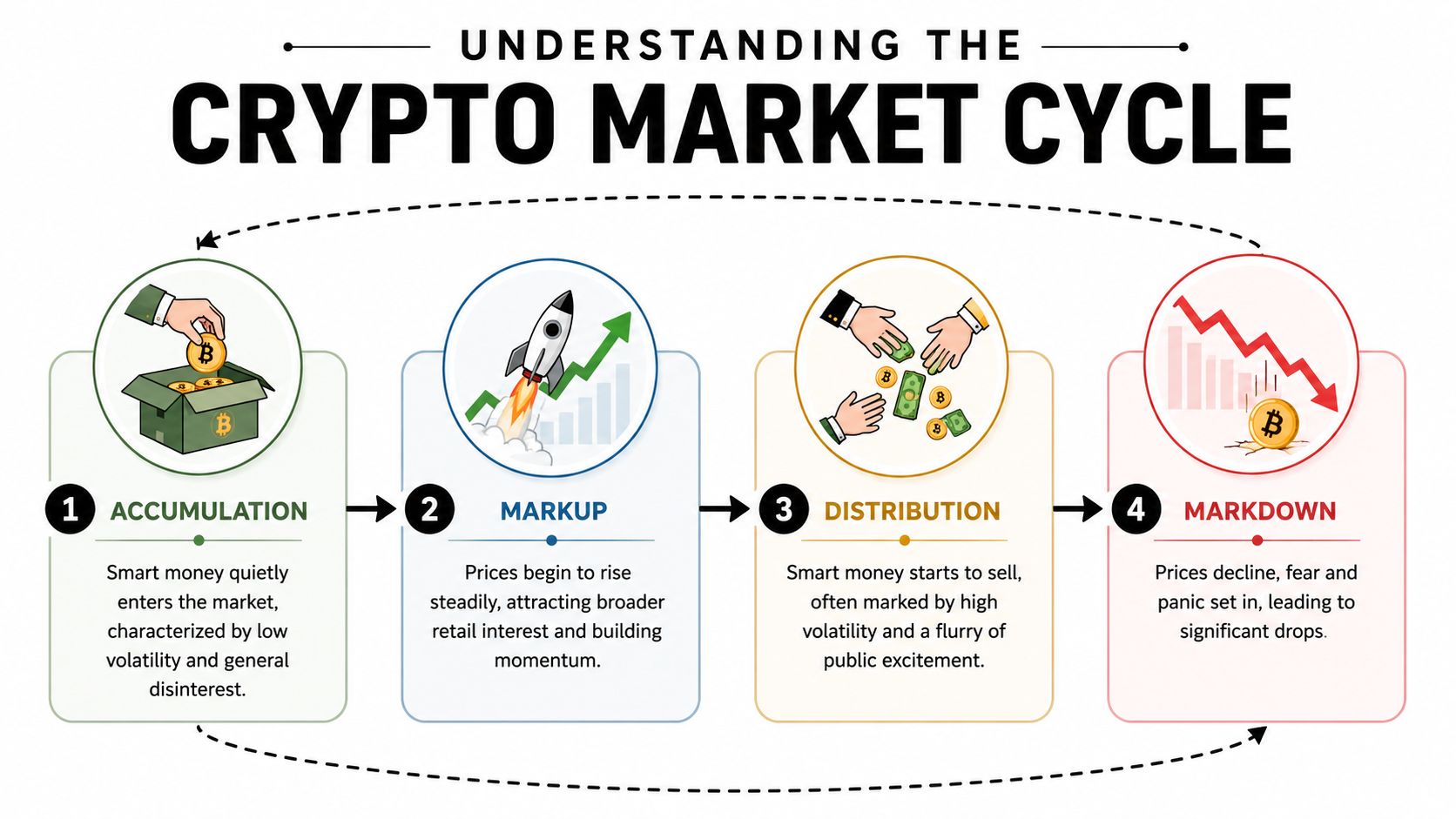
Accumulation is the phase most investors underestimate. Prices have already fallen hard, public interest is weak, and trading volumes tend to concentrate in Bitcoin and a small set of liquid large caps. Under the surface, long-term holders rebuild positions, developers keep shipping, and capital starts separating durable networks from narratives that only worked in a speculative boom.
Markup begins when that quiet positioning turns into a visible trend. Bitcoin usually establishes direction first because it is the market's main liquidity reserve and the asset institutions can access most easily. Ethereum often follows once risk appetite broadens. Altcoins do not all respond together. In this cycle, some sectors can lag for months even while headline market indices look strong, which is why the old assumption of automatic “alt season” deserves more skepticism.
That is the first major shift for 2026. Altcoin-Bitcoin decoupling means sector selection matters more than broad market exposure.
Distribution starts before the crowd admits it. Prices can still be rising, social sentiment can still be euphoric, and lower-quality tokens often outperform late because speculative capital is chasing reflexive upside rather than durable cash flow, fee generation, or user growth. This is also the phase where investors confuse unrealized gains with after-tax gains. A strong exit on paper can become a mediocre result once holding periods, local tax treatment, and slippage are factored in.
Markdown resets the market's standards. Liquidity pulls back, weak balance sheets and weak token design get exposed, and projects that relied on emissions or hype lose support quickly. For readers who want the reverse side of the cycle explained in more detail, this guide to a cryptocurrency bear market is a useful companion.
A helpful outside resource for readers interested in mastering crypto market cycles for traders gives a solid framework for reading these transitions in practice.
Why Bitcoin halving still matters
Bitcoin's halving still sets the market's long rhythm because it changes new supply, miner economics, and the timing of narrative attention. But halving alone no longer explains the full cycle. ETF flows, dollar liquidity, real yields, stablecoin issuance, and regulatory clarity now shape how quickly post-halving momentum spreads beyond Bitcoin.
That helps explain why the 2026 setup looks more fragmented than earlier bull markets. In past cycles, capital often moved in a cleaner sequence from Bitcoin to Ethereum to large-cap altcoins and then into increasingly speculative tokens. This time, that chain can break. Some altcoins may never reclaim prior highs if users, fees, and liquidity fail to recover with price.
For investors, the practical implication is straightforward. Reading the cycle correctly now means tracking both phase and participation. A portfolio can underperform badly in a bull market if it is concentrated in assets that are no longer benefiting from the old correlation structure.
That is also where a tax-efficiency framework becomes useful, not just for accountants but for return analysis. In a choppy markup or late distribution phase, the difference between rotating capital efficiently and reacting emotionally can determine whether a nominal gain translates into real retained profit.
A Look Back at Previous Crypto Bull Runs
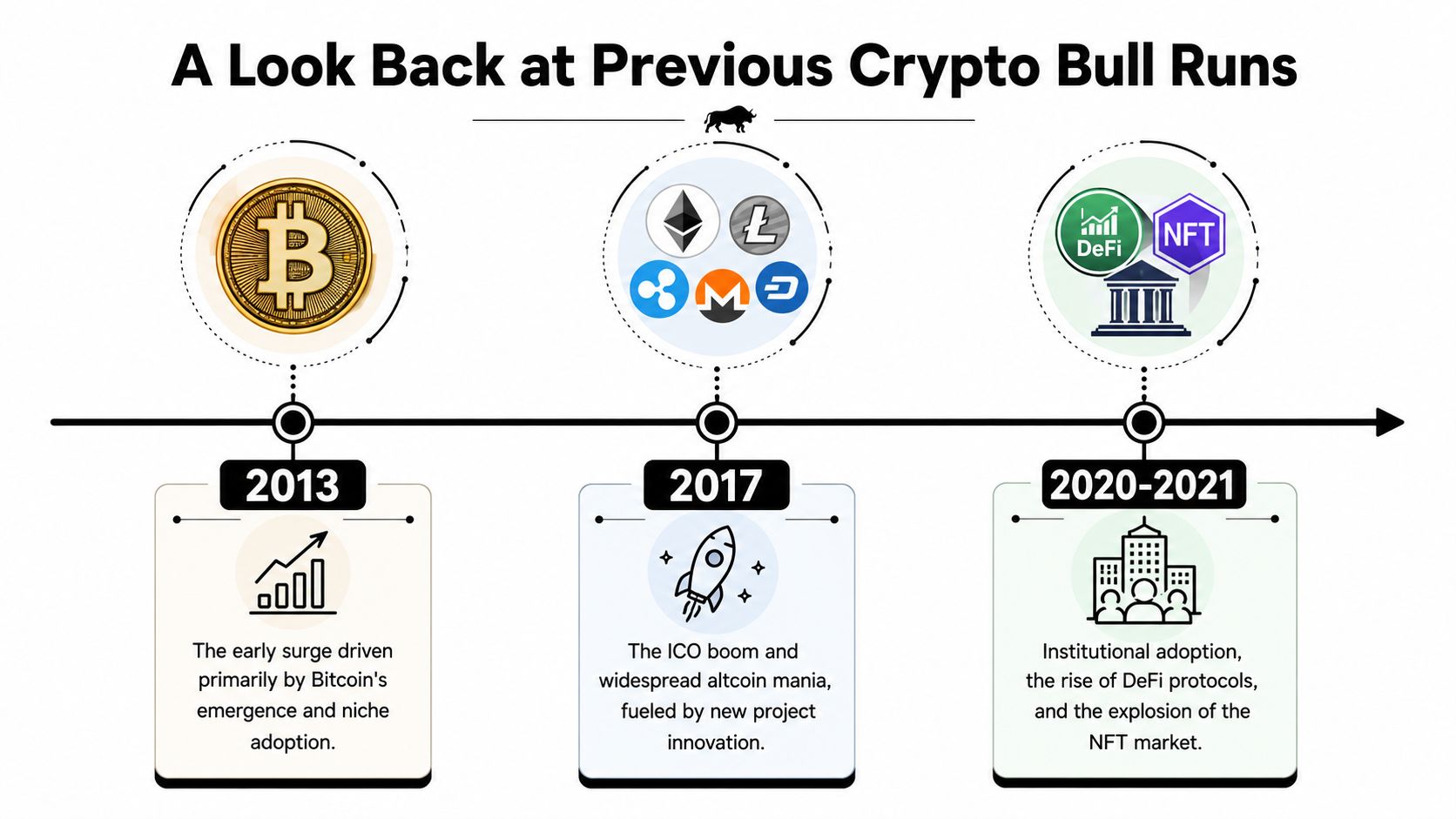
Bitcoin rose from about $145 to nearly $1,200 in 2013, then from under $1,000 to almost $20,000 in 2017, and later to roughly $69,000 in 2021. Those moves were dramatic, but the more useful lesson is not the magnitude. It is how the drivers changed from cycle to cycle.
2013 and the first mainstream shock
The 2013 bull run was a single-asset story. Bitcoin dominated attention, market infrastructure was thin, and the investment case centered on one idea: digital scarcity might support a new kind of money. As noted earlier, historical cycle data shows that this phase lasted about 11 months and produced a gain of roughly 730%.
That matters for 2026 because it shows what early crypto bull markets looked like before sector complexity, institutional flows, and token proliferation changed capital rotation. The market was narrow, reflexive, and highly narrative-driven. There was little distinction between Bitcoin strength and crypto strength because they were nearly the same thing.
2017 and the ICO era
The 2017 cycle lasted about 12 months, as noted earlier, but its real significance was structural. Ethereum introduced a scalable fundraising rail for speculative internet capital. ICOs multiplied token supply faster than investor due diligence could keep up.
This was the cycle that taught traders to expect an “altseason” after Bitcoin rallied. Capital tended to move in sequence from Bitcoin to Ethereum, then to large-cap altcoins, and finally to lower-quality tokens with little more than momentum behind them. That pattern became embedded in market behavior, even though it was partly a product of immature market structure rather than a permanent rule.
For readers comparing current conditions with past leadership, latest Bitcoin statistics provide a useful baseline before looking at broader crypto participation.
2020 to 2021 and institutional legitimacy
The 2020 to 2021 cycle was longer and more layered. As noted earlier, it ran for nearly 18 months, peaked around 550 days after the halving, and pushed Bitcoin to about $69,000. It also expanded the investable crypto universe in a way earlier cycles did not. DeFi generated real on-chain cash flow. NFTs brought retail attention from outside finance. Public companies, funds, and later ETF-related demand changed who was buying and why.
That shift is the key reference point for 2026. The market is no longer pricing only ideology or retail speculation. It is pricing product usage, liquidity access, regulatory pathways, and the relative credibility of different chains.
One conclusion stands out. Past bull runs shared a broad upward rhythm, but market breadth and capital dispersion changed sharply across cycles. In 2013, Bitcoin was the market. In 2017, altcoins rode a synchronized speculation wave. In 2021, multiple sectors ran at once, but leadership still clustered around a few dominant narratives.
The 2026 cycle is likely to break from that script further. Altcoin-Bitcoin decoupling is now a real possibility, not a theoretical edge case. Some tokens may rise because they capture users, fees, or treasury demand. Others may lag through a bull market because liquidity no longer spreads automatically across the entire asset class. That makes historical comparison useful, but only if investors separate recurring cycle timing from outdated assumptions about universal altcoin upside.
Studying supply shocks still helps. This guide to Bitcoin halving mechanics explains the issuance side of the cycle, but retained gains in 2026 will depend just as much on asset selection and tax treatment as on market direction.
On-Chain and Macro Indicators to Watch
Price is the final output. It isn't the best early signal. A healthier way to read a crypto bull run is to watch the plumbing underneath it and the policy backdrop above it.
The clearest on-chain confirmation signals
The most practical indicators are the ones that show whether liquidity is broadening or narrowing. ChangeHero identifies three concrete confirmation signals for a bull market: stablecoin supply expansion exceeding $150 billion in net issuance, sustained Bitcoin ETF inflows above $500 million weekly for eight consecutive weeks, and altcoin breadth expansion with at least 40% of top-100 tokens outperforming Bitcoin on a 30-day basis (ChangeHero bull market confirmation signals).
Those three markers matter because they each test a different layer of the market:
- Stablecoin issuance checks whether fresh deployable capital is entering the system.
- ETF inflows measure the persistence of institutional demand.
- Altcoin breadth reveals whether risk appetite is spreading beyond Bitcoin.
That last point is especially important in 2026. A rising Bitcoin price by itself doesn't guarantee broad market strength. Breadth does.
The macro backdrop now matters more
Macro conditions have become part of crypto's operating environment, not a side note. One future-facing catalyst comes from monetary policy. DirectionsMag notes that the Federal Reserve ended quantitative tightening in 2025, and that forecasts call for additional interest rate cuts in 2026, a policy shift that has historically coincided with Bitcoin advances of up to roughly 40% in that framing (macro policy and the next crypto bull run).
I wouldn't use that as a standalone trading signal. I would use it as context. Easier liquidity conditions can support risk assets, but crypto still needs internal confirmation. That's why the strongest approach is to combine macro and market structure rather than treating either one as sufficient.
Here's a practical dashboard.
| Indicator | What It Measures | Bullish Signal |
|---|---|---|
| Stablecoin supply | Deployable liquidity inside crypto markets | Expansion above the threshold cited by ChangeHero |
| Bitcoin ETF inflows | Institutional demand persistence | Weekly inflows staying above the threshold for the required streak cited by ChangeHero |
| Altcoin breadth | Whether participation is broad or narrow | A larger share of top tokens outperforming Bitcoin over a rolling window |
| Central bank policy | Liquidity conditions for risk assets | A more accommodative stance and lower policy pressure |
| Regulatory progress | Whether capital can enter with more certainty | Clearer market rules and reduced structural ambiguity |
Watch the combination: a healthy bull market usually needs both liquidity creation and wider participation.
For day-to-day interpretation of Bitcoin strength, this analysis of why Bitcoin is rising can help connect chart action with the broader indicator picture.
Sector Rotation and Bull Run Narratives
Sector rotation decides who outperforms inside a bull market. Bitcoin can set the direction while returns concentrate elsewhere, and that distinction matters more in 2026 than it did in earlier cycles.
Capital still tends to move in layers. Bitcoin usually absorbs the first wave because it is the deepest market, the clearest institutional product, and the asset most tied to macro liquidity expectations. Ethereum often follows once investors start pricing activity rather than only store-of-value demand. From there, flows split across large-cap altcoins, exchange and infrastructure tokens, sector leaders, and finally the highest-beta tail of the market.
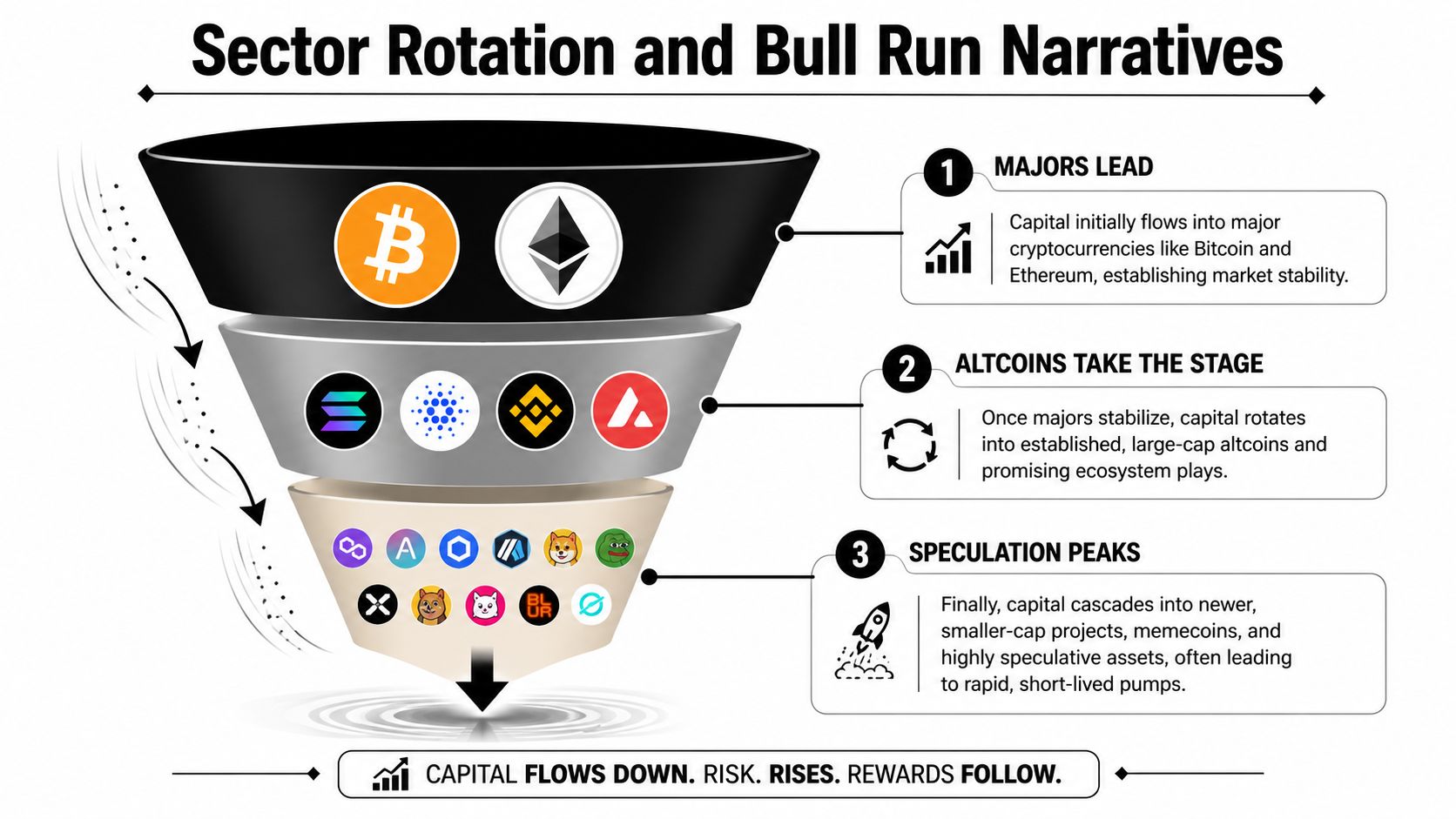
That sequence still helps, but the old “Bitcoin first, altcoins later” script is less dependable now.
Why 2026 may break the old altseason script
My view is that the current cycle is defined by partial Altcoin-Bitcoin decoupling. This is not a slogan borrowed from vague market commentary. It follows from a structural change in how capital enters crypto. Bitcoin now has a regulated ETF channel that can pull in allocators who never touch offshore exchanges, DeFi, or smaller tokens. Altcoins do not have that same demand pipe at scale, so they respond more directly to crypto-native liquidity, application usage, token emissions, and narrative momentum.
That creates two markets inside one asset class. Bitcoin can rally on institutional flows even if broad altcoin participation is mediocre. Altcoins can also outperform Bitcoin in pockets of the market without waiting for a full BTC blow-off top, especially when users are paying fees on-chain, developers are shipping, and sector-specific narratives attract fresh speculative capital.
The practical implication is simple. Relative strength matters more than calendar-based “altseason” calls. Investors who wait for a textbook handoff from Bitcoin to everything else can miss the first and often best part of rotation.
A better framework is to track which sectors are gaining against Bitcoin on a sustained basis, then ask why. If the answer is only attention, the move is fragile. If the answer includes revenue, users, fee growth, or clear supply constraints, the move has a stronger base. For traders building those comparisons into a repeatable process, these crypto trading strategies for volatile markets are more useful than broad bull-run slogans.
Narratives attracting attention in Web3
The strongest narratives in this cycle are not the loudest ones. They are the ones with a mechanism that converts attention into on-chain activity and, in some cases, token demand.
- AI and crypto integration has attracted capital because it sits at the intersection of two speculative themes. The distinction to watch is whether a token is attached to actual compute, data, inference, or verification demand, or whether AI is just a branding layer.
- Layer 2 scaling remains important because lower fees and faster execution still shape where users trade, borrow, and deploy capital. In a bull market, throughput is not a technical footnote. It affects where volume settles.
- Real-world asset tokenization stands out because it connects blockchain infrastructure to existing pools of collateral and yield. This sector may attract a different class of buyer than meme-driven rotations, which is one reason it can decouple from broader altcoin behavior.
- DeFi keeps reappearing each cycle because it creates internal cash-flow loops. Trading, lending, staking, and liquidity provision generate activity that can persist after a narrative cools.
- GameFi and consumer crypto apps tend to perform later and less consistently, but they can re-rate fast when user growth improves and token incentives are not the only retention tool.
Not all narratives deserve equal weight. Some sectors absorb capital because they have users, fees, and a clear reason for tokens to exist. Others rise because liquidity is loose and attention is cheap.
That distinction also matters after taxes. A rotation that looks successful in gross terms can produce mediocre real gains if investors churn through short-duration trades without planning disposals, offsetting losses, or jurisdiction-specific reporting. A 2026 bull-run strategy should include a tax-efficiency framework alongside sector selection, especially for anyone rotating across multiple narratives. For investors who want professional help structuring that side correctly, expert cryptocurrency tax advice is worth considering.
Strategies for Different Investor Profiles
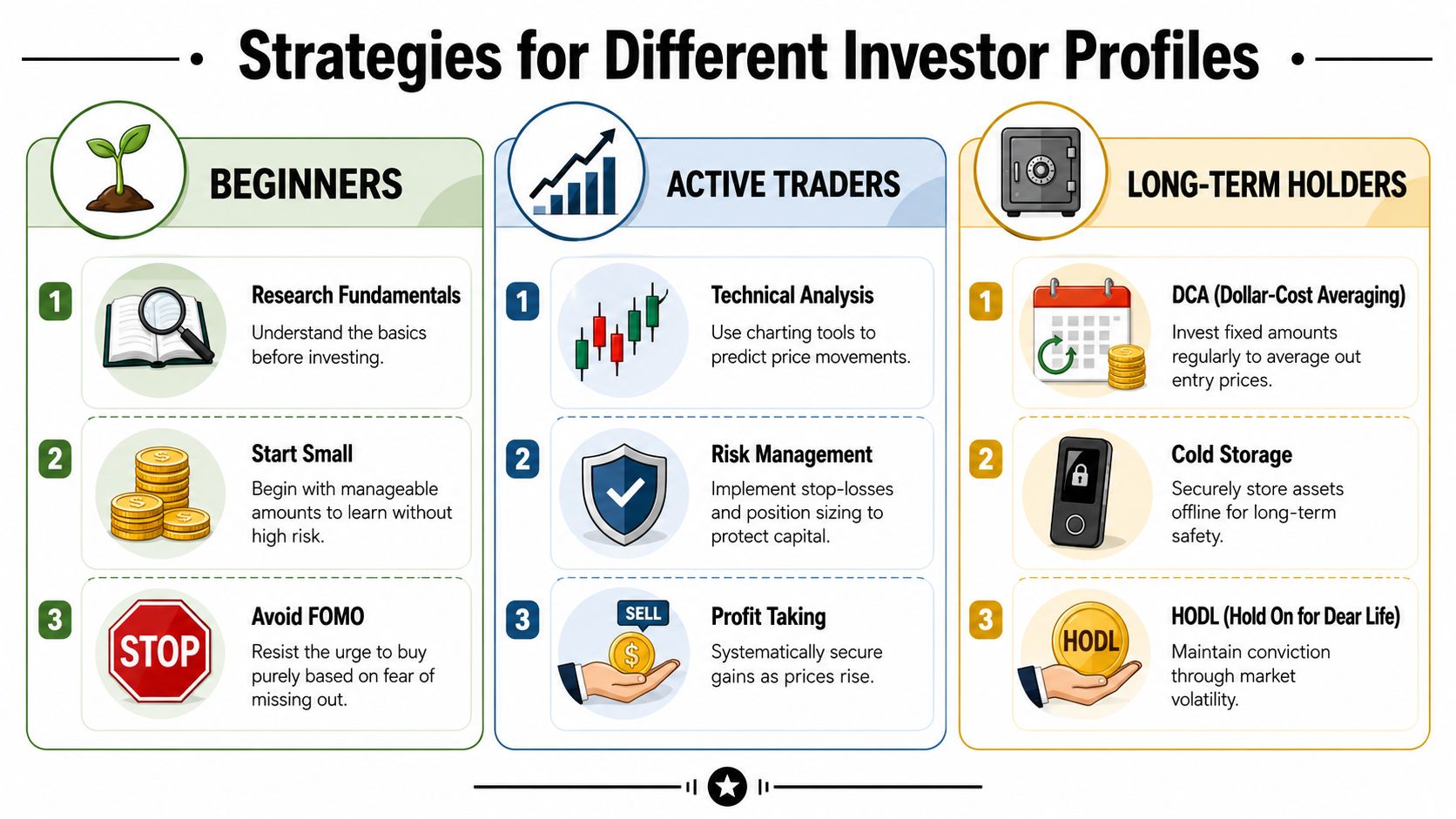
A good market thesis is useless if it doesn't match the person using it. Beginners, active traders, and long-term holders shouldn't run the same playbook in a volatile crypto bull run.
Beginners need process not predictions
Beginners usually lose money in bull markets for one reason. They mistake rising prices for proof that every purchase is a good one.
A better checklist looks like this:
- Learn the base layer first: Understand Bitcoin, Ethereum, wallets, exchanges, and basic tokenomics before moving into niche sectors.
- Start small: Small allocations make it easier to learn market behavior without emotionally overreacting.
- Avoid FOMO entries: If you only want to buy after a vertical move, you're probably reacting to attention rather than value.
- Use secure storage: Even a good investment thesis can be ruined by poor custody habits.
If you want to build a disciplined ruleset rather than improvise one, these trading strategy ideas are a useful starting point.
Active traders need rules not excitement
Traders need a different framework. The job isn't to be right about every move. The job is to survive volatility while capturing the cleanest setups.
I think traders should focus on three habits:
- Trade strength with context. A breakout means more when supported by wider breadth, rising sector participation, and supportive market structure.
- Take profits in stages. Crypto punishes people who confuse unrealized gains with banked gains.
- Respect narrative shifts. Capital can leave one theme and rotate into another quickly, especially when BTC pauses and altcoin leadership changes.
Good trading in a bull market is often boring. Entries are planned, size is controlled, and exits are decided before euphoria shows up.
Long-term holders need a tax-efficiency framework
Long-term holders often think taxes are a later problem. In a prolonged cycle, they're part of strategy from the beginning.
The overlooked issue is tax-adjusted reality. A portfolio can show strong gains on-screen while repeated profit-taking, staking rewards, lending income, and asset rotations create a messy tax profile. The extended nature of this cycle makes that harder, not easier, because more opportunities to act also mean more possible taxable events.
A practical framework looks like this:
- Prioritize fewer decisions: Constant switching between sectors may raise friction without meaningfully improving returns.
- Separate core holdings from tactical positions: That reduces impulsive selling of long-term conviction assets.
- Track yield carefully: DeFi rewards, liquidity incentives, and staking income can improve returns, but they can also complicate reporting.
- Review local tax treatment early: Waiting until after a euphoric phase usually means reconstructing activity under pressure.
For readers who want specialized help on reporting and planning, expert cryptocurrency tax advice can be useful, especially if your activity spans spot trades, DeFi, and long-hold positions.
The broader point is simple. Gross gains and net gains are not the same thing.
Crypto Bull Run FAQ and Future Outlook
What should investors watch if 2026 does not follow the old script
A key question for 2026 is not how closely this cycle matches prior ones. It is whether capital keeps flowing through crypto in a more selective way than in past retail-led rallies.
That distinction matters. Bitcoin now has stronger institutional channels, clearer treasury and ETF-related demand pathways, and a different buyer base than many altcoins. A rising Bitcoin price no longer guarantees broad participation across the rest of the market. The more useful framework is participation quality: which sectors are attracting fresh liquidity, which tokens are only rising on reflexive momentum, and where on-chain usage supports valuation.
This is the core of the Altcoin-Bitcoin decoupling thesis. In earlier cycles, traders often treated alt season as a delayed but widespread beta trade on Bitcoin strength. In 2026, that relationship may weaken. Some altcoin sectors could outperform on revenue, users, or fee generation while large parts of the market lag despite favorable headline conditions. That would produce a bull run in index terms, but a much narrower one at the asset level.
What are the biggest risks beyond price volatility
The obvious risk is drawdown. The less discussed risk is holding the wrong kind of exposure for the phase of the cycle.
Three risks stand out. First, liquidity can concentrate in a handful of assets while thinner tokens post sharp reversals on relatively small selling. Second, regulation may help large-cap assets and compliant infrastructure plays more than speculative long-tail tokens. Third, tax drag can materially reduce realized returns, especially for investors who trade frequently across spot, staking, airdrops, and DeFi positions.
That last point deserves more attention than it usually gets in bull run commentary. A portfolio can outperform on paper and still underperform after taxes if gains are repeatedly crystallized during sector rotation. For many investors, the next cycle will not be defined by top-ticking the market. It will be defined by how much of the gross return survives turnover, fees, and reporting complexity.
Is it too late to get involved if prices have already moved
Entry timing matters less than entry discipline.
Investors arriving after a strong advance still have choices, but the decision should be filtered through valuation, liquidity, and exit planning rather than headline momentum. Chasing the strongest recent performer usually works poorly late in a cycle. Building around higher-quality assets, limiting position size in narrative-driven trades, and defining sell conditions before the next acceleration tends to produce better outcomes.
The practical question is not whether someone is early or late. It is whether the expected return, after taxes and execution costs, still justifies the downside risk from current levels.
What could make the 2026 cycle different from prior bull runs
The macro backdrop may be more supportive for hard-asset alternatives, but the structure of the crypto market is also changing. CoinMarketCap Academy's report on Grayscale research head Zach Pandl argues that pressure from government debt and concern over fiat debasement could support the case for Bitcoin into 2026, while progress on U.S. market structure legislation could improve the environment for institutional participation (CoinMarketCap Academy's report on Grayscale research head Zach Pandl's view).
If that view proves right, the result may not look like the broad speculative surges seen in earlier eras. A more mature cycle would likely reward assets with stronger legal clarity, deeper liquidity, and clearer economic use. That points to a market where selectivity matters more than enthusiasm.
The future outlook, then, is constructive but narrower. Investors who treat 2026 as a simple replay of past bull runs may overestimate how much of the market will benefit. Investors who combine cycle awareness with a tax-efficiency framework, tighter asset selection, and a clear view of Bitcoin-altcoin decoupling are better positioned to keep more of what the market offers.
Coiner Blog publishes practical crypto analysis for readers who want more than hype. If you're tracking market cycles, Bitcoin, Ethereum, DeFi, Web3 trends, Layer 2 growth, AI-blockchain integration, or tokenized real-world assets, explore more insights at Coiner Blog.