
AI Crypto Trading: Your Realistic 2026 Investor Guide

Most advice on AI crypto trading gets the core issue backward. The problem isn't finding a bot with the best marketing page. The problem is surviving long enough to learn what these systems do under live market stress.
That matters because the gap between sales copy and user outcomes is wide. A 2026 study of 925,323 wallets using AI crypto trading agents found that 62.2% of participants realized losses, with users collectively losing $191.7 million. If you're trading through a weak model, a badly configured bot, or a strategy you don't understand, AI won't save you. It usually accelerates the mistake.
At the same time, AI is now embedded deep in trading infrastructure across crypto and traditional markets. That creates real opportunity, but it also creates false confidence. In bear phases, that confidence gets punished fast, especially when liquidity thins, narratives break, and everyone discovers their automated setup was tuned for a cleaner regime. That's why it's worth understanding how crypto behaves in a cryptocurrency bear market before trusting any automated system with real capital.
This guide takes the practitioner view. No magic-bot fantasy. No promise of passive income from a Telegram signal pack. Just what AI crypto trading is, where it helps, where it fails, and how disciplined traders use it without blowing up.
Table of Contents
- The Unspoken Reality of AI Crypto Trading
- What Is AI Trading and How Is It Different
- Core AI Models and Trading Strategies Explained
- Building the Engine Data and Infrastructure
- Mastering Risk The Secret to Not Losing Money
- A Practical Roadmap to Get Started Safely
- The Future of AI in DeFi and Web3
The Unspoken Reality of AI Crypto Trading
AI crypto trading gets sold as a shortcut to discipline and returns. In practice, it usually gives traders faster execution, tighter feedback loops, and more ways to lose money if the underlying system is weak.
That gap between what users expect and what these products can deliver is the primary narrative.
The trust gap is real
Recent user outcome data already made the headline clear earlier in this article. A large share of users still end up losing money. That matters more than polished dashboards, simulated win rates, or claims about autonomous agents.
The trust gap starts when product design implies a level of intelligence that the trading engine has not earned. Many systems marketed as AI are closer to wrappers around alerts, rule sets, and shallow sentiment scoring than serious prediction and execution stacks. Some can route orders and rebalance. Far fewer can hold up under changing volatility, thin liquidity, and correlation shocks.
I have seen this pattern repeatedly. The front end looks advanced. The model logic turns out to be brittle, poorly monitored, or too dependent on favorable conditions that did not last.
Practical rule: If a platform spends more time selling upside than explaining drawdown control, model decay, and execution limits, treat it as a sales funnel first and a trading system second.
The predictive ceiling is lower than the marketing suggests
Crypto is noisy, reflexive, and regime-driven. A model can have real signal and still fail to produce tradable profits after fees, slippage, spread, and missed fills. That is the predictive ceiling. Accuracy has value, but only up to the point where market microstructure and risk erase it.
This gets worse in stress periods. During a cryptocurrency bear market, liquidity thins out, correlations rise, and many signals that looked reliable in cleaner conditions stop behaving the same way. Traders who learned on bullish data often mistake exposure for skill. AI does not fix that. It often scales it.
The hard part is not finding a model that looks decent in a backtest. The hard part is keeping performance intact once the market changes character.
Why people still hand money to black boxes
The appeal is rational. Crypto trades nonstop. Information hits from exchange flows, on-chain activity, news, and social channels at a pace no discretionary trader can monitor consistently. Software can process more inputs, react faster, and enforce rules without fatigue.
But faster processing is not the same as durable edge.
Serious traders separate four things that retail users often blur together:
- Automation and prediction: Clean execution cannot save a bad signal.
- Paper performance and live performance: Backtests often miss slippage, latency, partial fills, and market impact.
- Signal quality and portfolio quality: A decent entry model can still lose money if sizing and correlation control are poor.
- Temporary fit and persistent edge: A model that works in one regime can break in the next.
Beginners usually blow up for boring reasons, not exotic ones. They size too aggressively, trust opaque systems, skip out-of-sample testing, and assume AI can replace judgment. It cannot. The better use case is narrower and less glamorous. AI can rank opportunities, filter noise, and automate execution inside hard risk limits set by a human who understands what can go wrong.
What Is AI Trading and How Is It Different
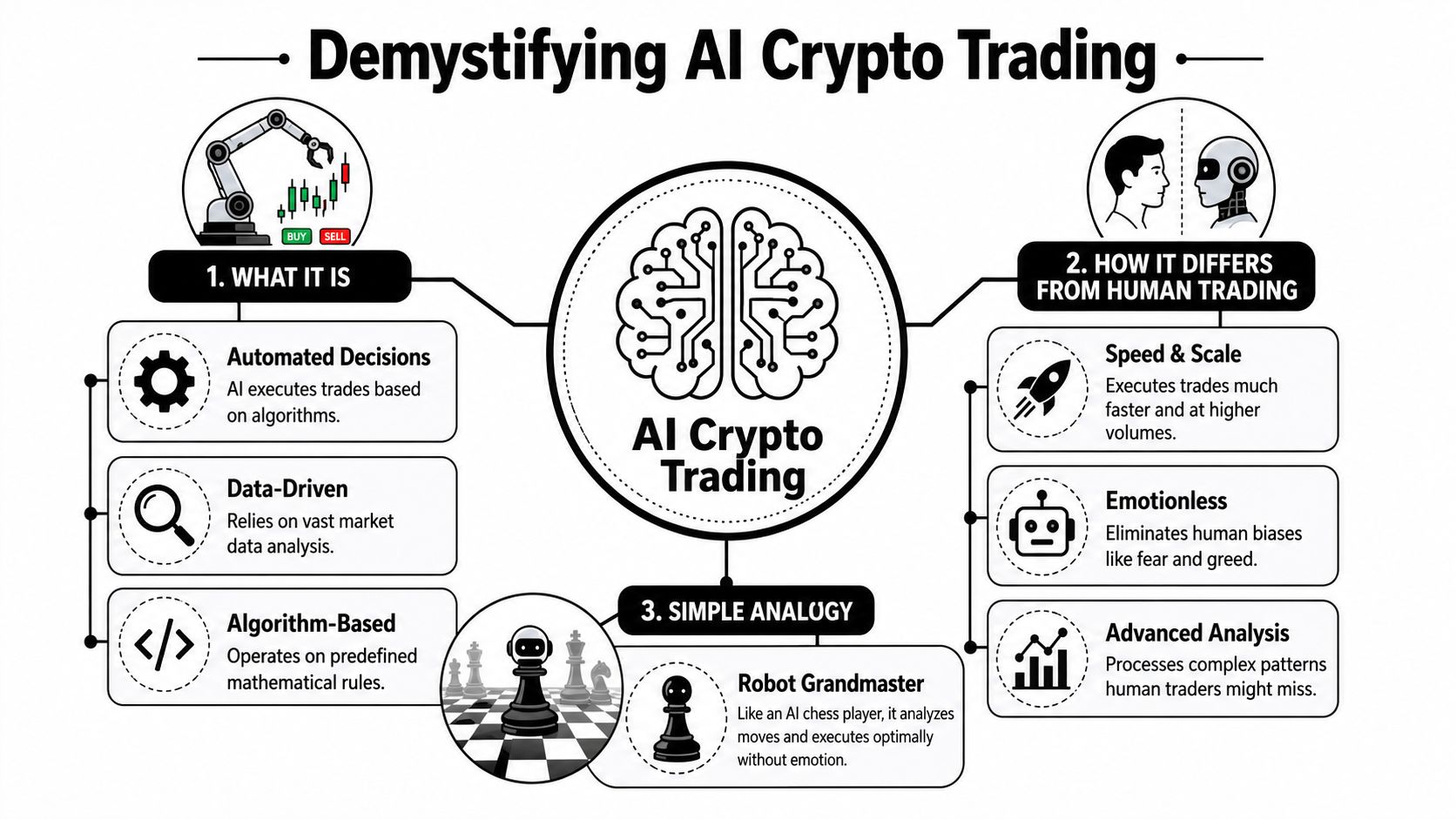
A basic trading bot is a machine that follows fixed instructions. An AI trading system is closer to an adaptive pilot. It doesn't just follow a route. It adjusts to turbulence, changing visibility, and shifting targets.
A simple bot follows rules
A traditional bot works on explicit logic. If BTC crosses a moving average, buy. If RSI enters a threshold, sell. If price drops past a predefined stop, exit. That's useful, and in many cases it's enough.
But a fixed-rule system breaks down when the market changes character. Crypto does that constantly. A trend-following script can do well in expansion, then churn itself to death in chop. A mean-reversion bot can print in quiet ranges, then get steamrolled during a breakout.
AI trading adapts to changing inputs
AI crypto trading adds machine learning, pattern recognition, and continuous model adjustment. According to Binance Academy's explanation of AI for crypto trading, AI bots use dynamic learning from history, volume, and news rather than relying only on static rules. The same source notes that AI systems can use NLP-based sentiment analysis and backtesting on large datasets to refine strategy behavior.
That's the key distinction. AI doesn't just ask, "Did condition X happen?" It asks, "Given this market context, what outcome is more likely, and how confident am I?"
Later in the trade lifecycle, that matters for:
- Signal ranking: The model can prioritize higher-confidence setups instead of treating every trigger equally.
- Context filtering: It can ignore low-quality entries when volatility, sentiment, or volume conditions don't match prior winning states.
- Adaptive execution: It can react faster when spreads widen or momentum suddenly fades.
This visual gives a good beginner-friendly frame for the concept:
Where the data edge comes from
In live crypto markets, edge usually comes from combining multiple data layers, not staring at a single candlestick chart. A practical AI stack often watches exchange price data, order flow, volatility clusters, on-chain movement, and social or news sentiment at the same time.
Good AI trading doesn't remove human thinking. It compresses signal processing so the trader can focus on regime, risk, and capital allocation.
That makes AI useful for retail traders, quant-minded investors, and builders in Web3 who already understand smart contracts, DeFi mechanics, tokenomics, and Layer 2 liquidity fragmentation. But the key word is useful. Not infallible.
Core AI Models and Trading Strategies Explained
Most AI crypto trading systems fall into three practical buckets. They may overlap in production, but the design goals are different. If you don't know which bucket you're using, you're probably evaluating the system the wrong way.
Signal prediction models
This is the model most retail traders imagine first. It takes inputs such as market structure, volume, sentiment, and on-chain features, then predicts direction, volatility, or a probability-weighted setup.
A signal model might forecast whether ETH is more likely to trend, mean-revert, or break support over the next interval. It doesn't need to be magical. It just needs to be useful enough to improve entries, exits, or position timing.
There are real examples of AI-driven systems posting strong outcomes. In a Forbes report on AI in crypto trading, specific AI trading robots showed annualized returns in 2025 of 85% for ETH.X, 56% for OM.X, and 49% for XRP.X. Those numbers prove that algorithmic strategies can work. They don't prove that your bot, on your exchange, with your settings, will work.
Algorithmic market-making systems
Market-making is a different game. The goal isn't solely to predict direction. It's to continuously quote buy and sell prices, capture spread, manage inventory, and avoid getting run over by informed flow.
These systems tend to perform best when a trader understands execution quality, fee structure, and liquidity behavior across venues. They're less beginner-friendly than directional bots, but they can be powerful in liquid markets or inside DeFi environments where smart contracts automate part of the routing logic.
If you're testing strategies in open-source environments, tools connected to execution frameworks can help you inspect assumptions and workflow design. One example is this AI tool for MCP servers, which is relevant for traders working with Freqtrade-style infrastructure and iterative strategy development.
Reinforcement learning agents
Reinforcement learning is the most misunderstood category. Instead of learning from labeled examples alone, the agent learns through repeated interaction, reward, and penalty. In plain English, it experiments within a simulated environment and adjusts behavior based on outcomes.
That sounds powerful, and it is. But it also creates a huge risk of overfitting. A reinforcement learning agent can become excellent at "winning" inside the training world you built and mediocre in the live market you face.
Here is the practical comparison traders should use:
| AI Model | Primary Goal | Methodology | Best For |
|---|---|---|---|
| Signal Prediction | Forecast direction or volatility | Supervised learning on price, volume, sentiment, and on-chain features | Swing trading, intraday filtering, timing entries |
| Algorithmic Market-Making | Capture spread while managing inventory | Continuous quoting, execution logic, inventory control | Liquid pairs, exchange-based execution, DeFi liquidity strategies |
| Reinforcement Learning | Learn adaptive behavior from reward feedback | Trial-and-error training in simulated environments | Advanced research, dynamic strategy discovery, complex execution problems |
A strong research process usually starts simpler than people expect. Before adding complexity, test whether the strategy has any edge at all under fees, slippage, and latency. That's still the foundation of the best strategies for trading, even when AI is in the stack.
Building the Engine Data and Infrastructure
Most failed AI crypto trading projects don't fail because the model was too simple. They fail because the surrounding machine was sloppy. Dirty data, weak execution, and missing risk controls destroy more systems than imperfect math.
The five-part architecture
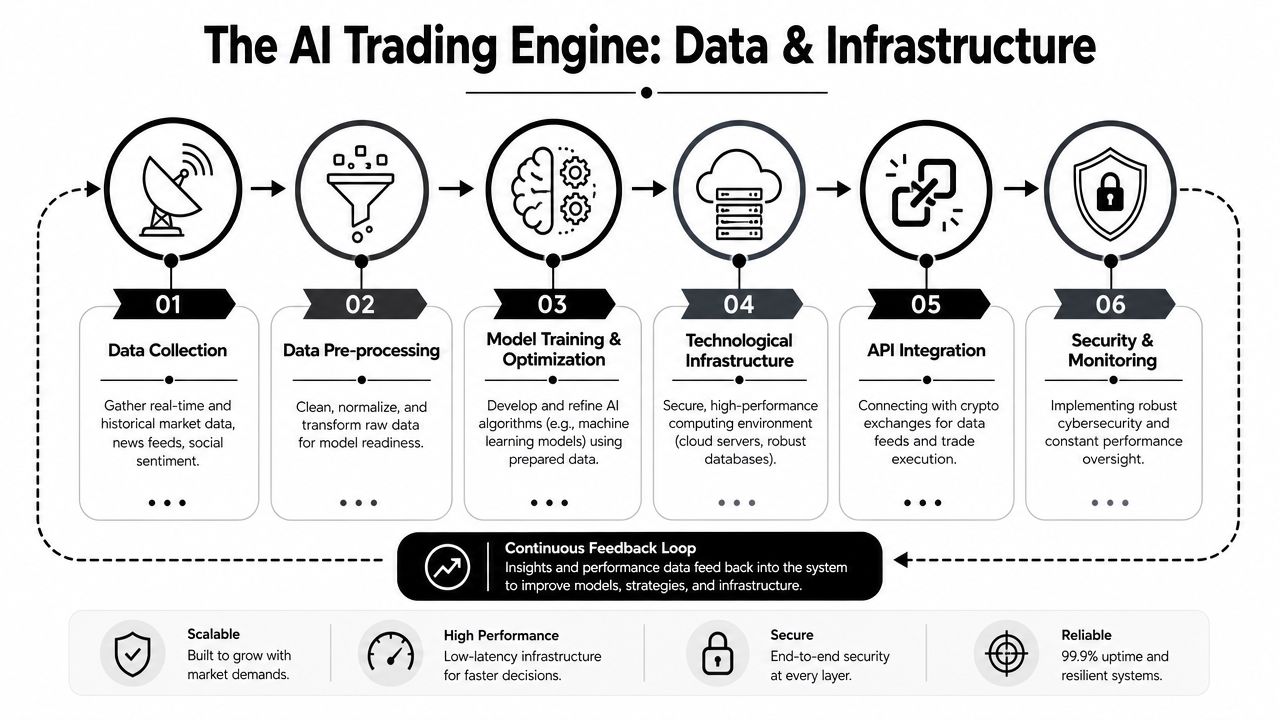
At the professional level, the architecture is straightforward. A 3Commas guide to real-time AI crypto analysis describes a five-part system: data ingestion engine, feature engineering layer, signal generation engine, execution module, and risk control system.
Each part has a job:
- Data ingestion engine: Pulls exchange feeds, order book snapshots, derivatives data, and on-chain activity into a usable pipeline.
- Feature engineering layer: Cleans noise, normalizes inputs, and converts raw information into model-ready variables.
- Signal generation engine: Produces trade probabilities, volatility estimates, or ranking outputs.
- Execution module: Places, modifies, and cancels orders through exchange APIs or DeFi routing logic.
- Risk control system: Caps exposure, limits concentration, and blocks trades that violate portfolio rules.
Why infrastructure decides outcomes
Many retail systems falter when traders obsess over model choice and ignore data quality. But garbage in still means garbage out. If your Layer 2 transaction data is delayed, your token flow classification is messy, or your venue data isn't synchronized, the model learns distorted patterns.
A few infrastructure habits separate hobby bots from durable systems:
- Use consistent schemas: Spot, perp, and on-chain data need matching timestamps and coherent labels.
- Treat latency as strategy-specific: A slower stack may be fine for swing systems and fatal for short-horizon execution.
- Monitor drift: Feature distributions change. If your model was trained in one regime, live predictions can decay gradually.
- Respect liquidity: A signal is only useful if the market can absorb your size without ugly execution.
Strong trading systems are built from boring components that work reliably under pressure.
This matters even more in crypto because liquidity is fragmented across centralized exchanges, decentralized exchanges, bridges, and Layer 2 ecosystems. If you're trading smaller-cap assets or DeFi tokens, liquidity conditions can change far faster than the chart suggests. Understanding the liquidity of cryptocurrency is often more valuable than adding one more feature column to your model.
AI can absolutely improve decision quality. But the edge usually comes from the full engine, not from a single clever neural network.
Mastering Risk The Secret to Not Losing Money
Most traders search for better entries. Professionals spend more time designing failure containment. In AI crypto trading, that difference decides who stays solvent.
The predictive ceiling changes everything
The hard truth is that AI prediction in crypto is much weaker than the marketing implies. According to Kraken's review of AI crypto trading bots, even advanced machine learning models only predict daily movements of top cryptocurrencies with 52.9% to 54.1% accuracy. That's the predictive ceiling most promotions ignore.
If your model is only modestly better than chance on daily movement, your edge has to come from trade selection, cost control, risk asymmetry, and disciplined exits. It won't come from blind faith in the forecast.
This is why people lose money with systems that looked fine in demos. They assume a small prediction edge guarantees profit. It doesn't. A barely positive model with loose stops, oversized positions, and bad execution can lose money faster than a human discretionary trader.
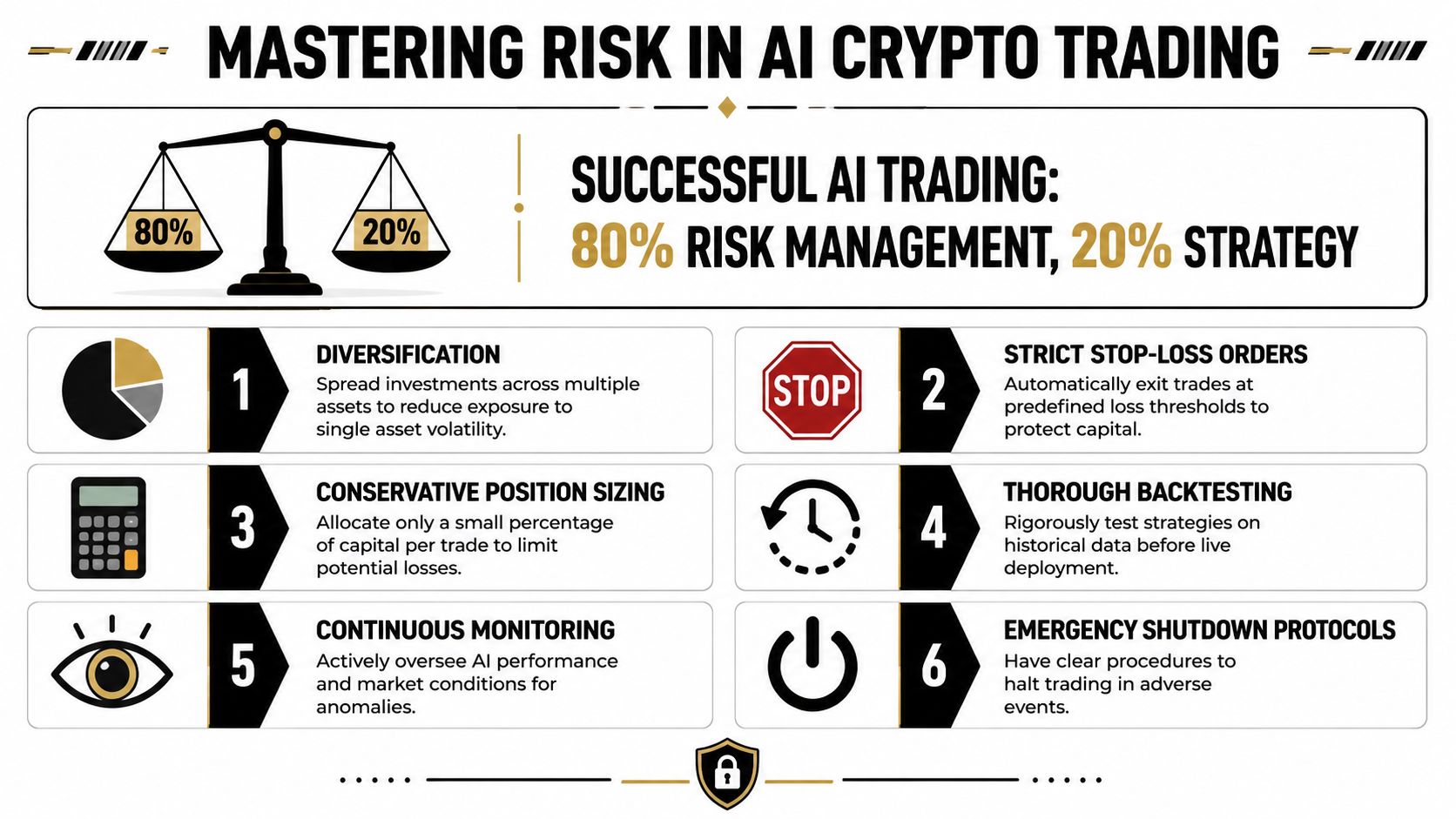
Risk controls that actually matter
A durable setup needs rules that are hard to override in the heat of the moment.
- Backtest with friction: Include fees, slippage, and realistic fills. If the strategy only works in ideal assumptions, it doesn't work.
- Size small enough to survive errors: Position sizing matters more than prediction confidence. One oversized loss can erase a long run of decent decisions.
- Use hard exits: If the system can enter automatically, it must also exit automatically when risk breaks your limits.
- Diversify logic, not just coins: Running three bots that all depend on the same trend regime isn't real diversification.
- Maintain a kill switch: If the market becomes disorderly or the model starts behaving abnormally, you need a clean shutdown path.
For traders working in AMM-heavy environments, especially Uniswap design spaces, this broader view of risk is useful. UBAMM.AI's insights on Uniswap V4 risk are worth reading because they frame risk as a system property, not just a stop-loss setting.
A bot doesn't need to be brilliant to be useful. It needs to be constrained.
One of the most neglected practices is continuous supervision. Markets mutate. Tokenomics change. DeFi incentives shift. A governance vote, a bridge issue, or a change in Layer 2 routing can alter behavior without warning. If you aren't reviewing bot performance and trade logs, you're outsourcing accountability to software.
For many traders, the most practical starting point is still learning how to set stop-losses properly and then building the AI workflow around that discipline, not the other way around.
A Practical Roadmap to Get Started Safely
The safest way to enter AI crypto trading is boring. That's a compliment. Boring processes keep accounts alive.

What to look for before funding anything
Before you deposit capital, check whether the platform behaves like a trading product or a lead-generation funnel.
Look for these signals:
- Transparent testing: The operator should show how strategies were validated, with assumptions that sound realistic.
- Control over risk settings: You want position sizing, stop logic, exposure limits, and the ability to pause execution.
- Clear strategy description: If you can't explain how the bot tries to make money, don't fund it.
- Operational maturity: Good tools expose logs, order history, and enough detail to audit what happened.
Prompt quality matters too, especially if you're using AI assistants to research markets, summarize tokenomics, or structure strategy ideas. Traders who use language models as research aides can benefit from resources on mastering crypto AI prompts, particularly when working through DeFi narratives, Web3 protocol analysis, or smart contract ecosystems.
A phased rollout beats a heroic launch
The return expectations also need to be reset. According to Altrady's analysis of AI crypto bot profitability in 2026, disciplined operators of well-configured AI crypto bots achieve net annual returns of 5–25% above a buy-and-hold strategy for the same asset. That directly undercuts the usual promise of "10% monthly" income.
That's a healthy benchmark because it sounds unexciting. Realistic performance usually does.
A safe rollout looks like this:
- Paper trade first. Learn the interface, signal behavior, and failure modes without risking capital.
- Move to a very small live account. Live execution teaches lessons paper trading hides, especially around fills and market impact.
- Review every trade cluster. Don't just track profit. Track why the bot entered, what conditions existed, and whether the behavior matched the design.
- Scale only after consistency. Increase capital slowly and only if the process stays stable through different market conditions.
Start with the assumption that the first version of your setup is a prototype, not a business.
If you're brand new to digital assets, the smarter move is often to learn the basics of custody, volatility, and portfolio construction before touching automation. A grounded primer on how to invest in cryptocurrency for beginners will do more for long-term survival than any flashy AI dashboard.
The Future of AI in DeFi and Web3
AI crypto trading is only one slice of a bigger shift. The more interesting story is how AI becomes a decision layer across Web3 infrastructure.
Where AI fits beyond trading
In DeFi, AI can help optimize yield routing, monitor lending risk, and adjust liquidity deployment across decentralized exchanges. That matters because DeFi isn't static. Rewards, volatility, and pool composition change constantly. An adaptive system can evaluate those moving parts faster than a manual operator.
The same logic extends to real-world asset tokenization. As more assets move on-chain, AI tools can support pricing analysis, monitoring, and portfolio-level risk review. In that setting, the value isn't just prediction. It's structured decision support inside transparent blockchain rails.
Why Layer 2 and tokenization matter
Layer 2 networks make this more practical. Lower transaction costs and faster execution create room for AI-driven agents to manage strategies that would be clumsy on slower or more expensive rails. That could influence everything from DAO treasury operations to dynamic liquidity management and automated policy-based smart contract actions.
There is also a market signal behind the trend. A LiquidityFinder overview of AI for trading in 2025 states that AI drives 89% of global trading volume as of 2025, and that the AI trading market is projected to reach $35 billion by 2030. Broad adoption doesn't mean easy profits for retail traders. It does mean AI is becoming core market infrastructure, not a side narrative.
The next phase probably won't reward traders who chase "superhuman" bots. It will reward people who combine AI tooling with sound risk management, clean data practices, and a realistic understanding of what machine intelligence can and can't do in volatile crypto markets.
Coiner Blog publishes grounded analysis for readers who want more than hype. If you want practical coverage of crypto, DeFi, Web3, tokenomics, Layer 2 trends, and the risks that most bullish content skips, explore Coiner Blog.