
How to Start Investing in Crypto: 2026 Beginner Guide

Most advice on how to start investing in crypto gets the first step wrong. It tells you to pick an app, buy Bitcoin, and watch the chart. That's not investing. That's placing yourself in front of one of the most volatile asset classes in the world without a framework.
A better starting point is this: crypto is a high-risk gateway into Bitcoin, Ethereum, Web3, DeFi, Layer 2 networks, smart contracts, and tokenized digital ownership, but none of that matters if your process is sloppy. The beginners who last aren't usually the ones who find the next tiny altcoin first. They're the ones who manage risk, learn custody, understand tokenomics, and build enough emotional discipline to survive both hype cycles and brutal drawdowns.
That matters even more now because crypto is no longer just about buying and holding coins on a centralized exchange. AI plus crypto integration is pushing new onchain automation use cases. Layer 2 ecosystems are making Ethereum cheaper to use. Real-world asset tokenization is pulling traditional finance ideas into blockchain rails. The opportunity set is broader than it used to be. The traps are too.
Table of Contents
- Before You Buy Your First Coin Read This
- Your On-Ramp to the Crypto Economy
- Mastering Custody and Digital Security
- Building Your Starter Portfolio
- Safely Exploring DeFi and Staking
- Playing the Long Game on Taxes and Trends
Before You Buy Your First Coin Read This
Buying a coin is the easy part. Building a decision-making process that keeps you from blowing yourself up is harder, and it's where real investing starts.
Crypto doesn't behave like a savings account or a broad stock index. Crypto assets are explicitly not insured by the Federal Deposit Insurance Corporation or the Securities Investor Protection Corporation, which changes the risk equation from day one, as Fidelity explains in its guide to buying crypto and understanding what protections do and don't exist. If an asset collapses, if a platform freezes, or if you make a bad transfer, there may be no safety net coming to save you.
Risk comes before returns
The first question isn't “what coin should I buy?” It's “what happens if this goes badly?” That sounds conservative, but in crypto it's practical. If you start with that mindset, you won't fund your account with money you need for rent, debt, or daily living.
That also helps you filter out nonsense. Any pitch built around guaranteed returns, recruiting others, or mysterious “passive income” with no clear mechanism deserves suspicion. If you want a useful primer on spotting fraud mechanics, read Kons Law's breakdown of understanding illegal pyramid schemes. Crypto changes the wrapper. It doesn't change the underlying scam logic.
Practical rule: If you can't explain where the value comes from, who controls the system, and how you exit, you're not investing. You're hoping.
What beginners usually misunderstand
Many individuals arrive during excitement. They see memes, green candles, YouTube thumbnails, AI tokens, DeFi yields, or a friend talking about a Layer 2 project that “hasn't run yet.” That environment teaches the wrong lesson. It makes speed look smarter than structure.
A better beginner framework looks like this:
- Protect downside first. Only use money you can afford to lose entirely.
- Learn the plumbing. Understand wallets, exchanges, private keys, gas fees, and settlement before chasing niche tokens.
- Stay skeptical. A slick interface, a Telegram group, or a celebrity mention doesn't make a project sound.
- Treat security as part of investing. Before your first purchase, it's worth reviewing a practical guide to avoiding crypto scams.
Crypto can absolutely be part of a serious portfolio. It can also punish casual behavior fast. The difference usually isn't intelligence. It's discipline.
Your On-Ramp to the Crypto Economy
Your first platform is more than a place to buy Bitcoin or Ethereum. It's your banking layer, your execution venue, and often your first security boundary. Choose it carelessly and you'll overpay, buy the wrong asset version, or create unnecessary custody risk before you've learned the basics.
How to choose your first platform
Start with legitimacy and fit. A good beginner platform supports your jurisdiction, uses identity verification, explains its asset listings clearly, and gives you enough transparency to understand what you're paying.
Cost matters more than most newcomers think. eToro notes that investors should assess the common cost categories in crypto investing including trading fees, spreads, deposit and withdrawal fees, and network fees. Ignore those and your return gets chipped away before your thesis has time to play out.
When comparing platforms, look for these trade-offs:
- Execution quality. Some apps feel simple but hide wide spreads.
- Asset access. A platform may offer BTC and ETH but not support withdrawals for every listed token.
- Fiat support. Bank transfer options, card purchases, and withdrawal rails vary by region.
- Security defaults. Strong login protections matter. So does withdrawal confirmation behavior.
- Bank compatibility. If your bank treats crypto transfers badly, funding becomes a recurring headache. A shortlist of crypto-friendly banks can save time here.
What a clean onboarding process looks like
KYC gets a bad reputation from people who confuse friction with danger. In reality, identity verification is often a signal that a platform is trying to operate within a regulated framework. For a beginner, that's usually better than chasing some shadowy exchange because signup feels faster.
A solid setup process is boring on purpose:
- Create the account with an email you secure properly.
- Enable two-factor authentication immediately.
- Complete identity checks with matching legal details.
- Link a payment method you control directly.
- Review fees before you place the order.
- Make a small first purchase so you can see the whole flow end to end.
Treat the first buy as a systems test, not a profit event.
For your first order, keep it plain. Market orders are easy, but on some platforms they can be less precise during fast movement. Limit orders give more control if you understand how they work. Neither fixes bad timing or emotional buying. They're just tools.
The point of the on-ramp isn't speed. It's building a reliable path from bank account to blockchain without surprises.
Mastering Custody and Digital Security
Once you own crypto, the next question is who controls it. That's the custody question, and it's one of the biggest lines separating casual app users from people who understand digital assets.
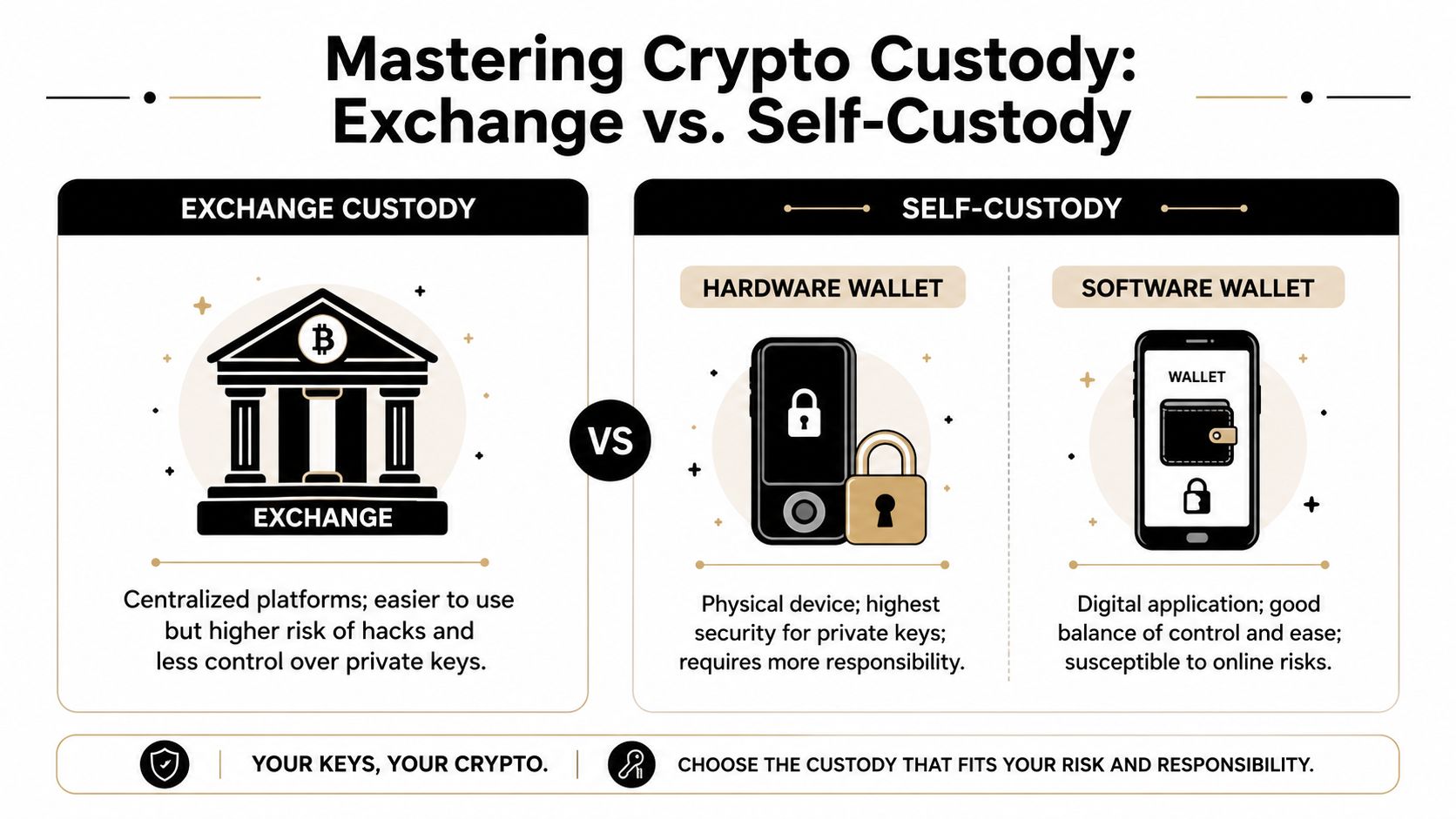
Exchange custody versus self-custody
Think of exchange custody like renting a serviced apartment. It's convenient. Someone else handles maintenance, access, and recovery. But your control is limited, and your security depends heavily on the operator.
Self-custody is closer to owning a house. You control the keys. You make the rules. You also carry the full responsibility if you lose access or mismanage security.
The old crypto phrase still matters because it's true. Not your keys, not your coins. If you want a deeper look at why that principle shapes the entire ownership model, read this explanation of not your keys, not your coin.
Here's the practical split:
- Exchange wallets suit people making their first buys, using recurring purchases, or staying in simple spot positions.
- Software wallets work well for active Web3 use such as DeFi, NFTs, smart contract interactions, and Layer 2 applications.
- Hardware wallets are better for larger long-term holdings where security matters more than convenience.
When each option makes sense
Most beginners don't need to sprint into self-custody on day one. They need to understand it, respect it, and move into it when they're ready. The mistake is either extreme. Leaving everything forever on an exchange is lazy. Moving everything to a wallet you don't know how to use is reckless.
Use a staged approach:
- Start small on exchange. Learn how deposits, withdrawals, and address formats work.
- Practice with a software wallet. Send a small amount. Confirm you understand networks and wallet prompts.
- Upgrade for long-term storage. If your conviction and position size grow, a hardware wallet starts making more sense.
A short visual walk-through helps. This overview breaks down the custody mindset and common security mistakes.
Self-custody gives you sovereignty, not forgiveness. One wrong network, one exposed recovery phrase, or one fake wallet app can be enough.
Crypto Custody Options Compared
| Feature | Exchange Wallet (Custodial) | Personal Wallet (Self-Custody) |
|---|---|---|
| Control of private keys | Platform controls them | You control them |
| Ease of setup | Easier for beginners | Requires more learning |
| Account recovery | Usually available through the provider | Depends on your recovery phrase management |
| Web3 and DeFi access | Often limited | Native access through wallet connections |
| Security model | Relies on platform operations | Relies on your own operational security |
| Best use case | First purchases, simple holding, fast trading | Long-term control, DeFi, staking, onchain activity |
Digital security in crypto is mostly operational. Use two-factor authentication. Double-check wallet addresses. Store recovery phrases offline. Never sign a transaction you don't understand. A lot of losses don't come from elite hackers. They come from rushed clicks and fake interfaces.
Building Your Starter Portfolio
A starter portfolio shouldn't try to prove that you're early, edgy, or smarter than the market. It should help you stay in the game long enough to learn.

Why Bitcoin and Ethereum deserve to be your base
For beginners, the strongest opening move is boring by crypto standards. Yahoo Finance notes that beginners should restrict their initial crypto portfolio to large, well-established coins like Bitcoin and Ethereum because their higher market capitalization and liquidity help them hold up better during volatility.
That doesn't mean BTC and ETH are safe in the way cash or short-term government bonds are safe. It means they're more battle-tested than the endless stream of low-cap narratives fighting for attention every cycle.
Why these two?
- Bitcoin is still the cleanest digital scarcity story in crypto.
- Ethereum is the base layer for huge parts of DeFi, NFTs, tokenization, and smart contract experimentation.
- Both assets trade on major platforms, have deep liquidity, and have already been stress-tested through severe downturns.
That resilience matters because new investors often confuse “cheaper per coin” with “more upside.” A token trading at a low unit price isn't automatically undervalued. That's where tokenomics matters. Supply structure, vesting schedules, utility, and sell pressure all matter more than the sticker price.
How to evaluate anything beyond the majors
If you decide to look past Bitcoin and Ethereum, use a checklist. Don't freestyle.
Start by asking:
- What does the project do? Does it power a Layer 2, a DeFi protocol, an AI-integrated marketplace, a gaming economy, or an infrastructure tool?
- Why does the token exist? A lot of tokens have branding, not necessity.
- Who uses it? Real usage beats social media heat.
- How is supply structured? Tokenomics can destroy a good-looking chart.
- Can you track it clearly? A portfolio tracker helps you separate conviction from chaos. If you need one, compare some of the best crypto portfolio trackers.
Don't build your first portfolio around “hidden gems.” Build it around assets you can still defend after the hype fades.
Position sizing matters just as much as coin selection. If one speculative token can wreck your confidence or force you out of the market, the position is too big. New investors usually need fewer assets, not more. A concentrated, understandable portfolio beats a cluttered wallet full of random experiments.
Safely Exploring DeFi and Staking
Holding crypto is only one layer of the ecosystem. The next layer is using it. That's where DeFi, staking, smart contracts, liquidity pools, and Layer 2 apps start to matter.
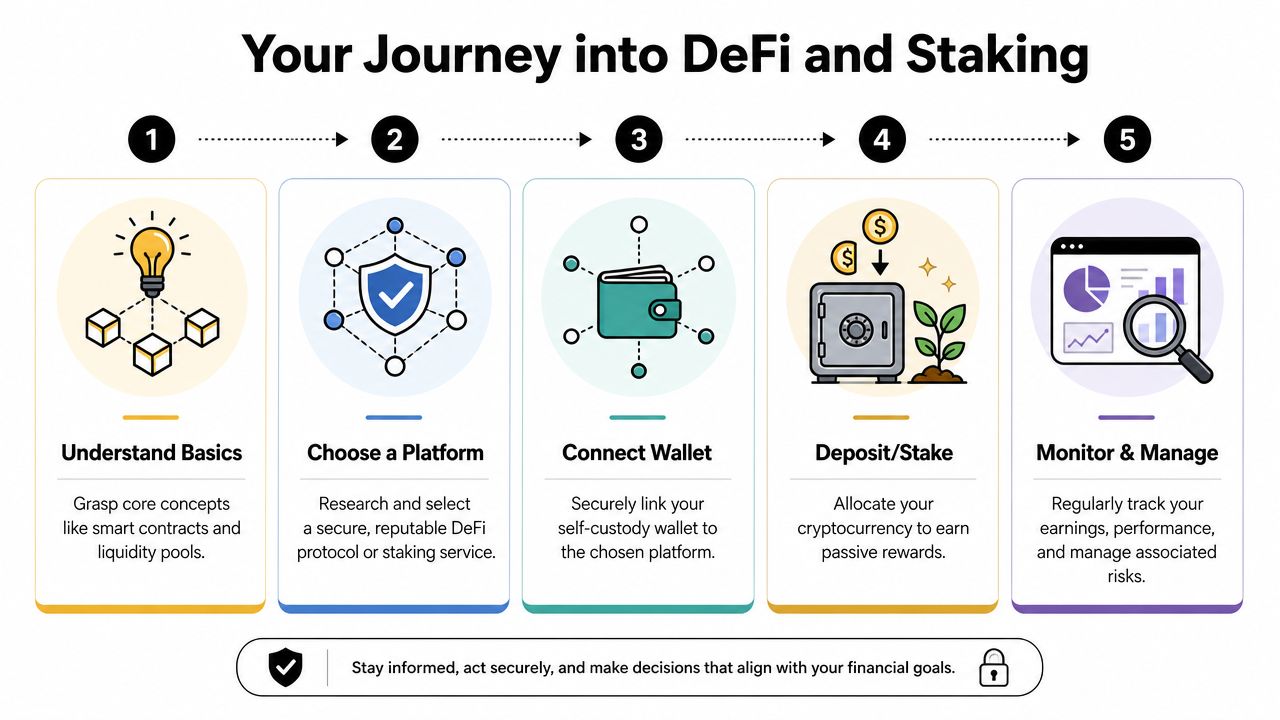
A beginner move into DeFi
Take a simple example. A new investor holds some ETH in a self-custody wallet and wants to do more than sit on it. They aren't chasing exotic yields. They want to learn how onchain finance works without making a heroic mistake.
The path usually looks like this:
- Move a small amount into a wallet used for Web3 activity.
- Choose a known DeFi app or staking interface.
- Connect the wallet and inspect every prompt before approving.
- Review what you are doing. Swapping, staking, lending, or providing liquidity are not the same thing.
- Confirm the transaction and wait for blockchain settlement.
At each step, the smart contract is the mechanism doing the work. In plain English, a smart contract is code on the blockchain that executes predefined rules. That's what lets DeFi platforms run swapping, lending, staking, and liquidity pool functions without a traditional intermediary.
A beginner-friendly first move is often staking a small amount of a major asset or using a well-known Layer 2 environment to reduce transaction costs and interact with Ethereum-based applications more efficiently. Layer 2 networks matter because they make experimentation cheaper and more practical for ordinary users.
What can go wrong in DeFi
DeFi is powerful because it removes gatekeepers. It's dangerous for the same reason.
A few common risks deserve respect:
- Smart contract risk. Code can have bugs, bad design, or hidden attack surfaces.
- Interface risk. Fake front ends and spoofed wallet prompts can drain funds.
- Liquidity pool complexity. If you don't understand impermanent loss, don't add capital just because the yield looks attractive.
- Bridging mistakes. Cross-chain transfers add another layer of operational risk.
- Governance and token risk. A protocol can look promising while its tokenomics are weak.
The best first DeFi experience is uneventful. Small size, clear purpose, known app, and no confusion during the transaction flow.
Use a vetting habit before interacting with any protocol. Check whether the product is established, whether the website domain is correct, whether the wallet request matches your action, and whether you'd still be comfortable if the funds were locked or impaired for a while.
DeFi, AI-driven onchain tools, and tokenized real-world assets are opening serious new rails for capital and coordination. But beginners should enter this part of crypto like a technician, not a tourist.
Playing the Long Game on Taxes and Trends
Crypto punishes people who think only in entries and exits. The long game includes recordkeeping, regulation, emotional control, and enough curiosity to track where the technology is heading.

Taxes are part of the investment process
A surprising amount of crypto content still assumes a U.S.-only reader, but the market is broader than that. Morgan Stanley's discussion of crypto asset allocation notes a recommended aggressive allocation of 4%, while the broader gap in beginner content remains obvious for non-U.S. investors dealing with local compliance, reporting, and tax treatment. That matters if you're navigating rules shaped by jurisdictions such as the EU, the UK, Singapore, or Australia.
The practical takeaway is simple. Keep records from the beginning. Track buys, sales, transfers, staking receipts, and wallet movements in a way you can reconstruct later. If you wait until tax season, your own transaction history can turn into a puzzle.
For readers dealing with country-specific obligations, region-focused explainers are useful. A clear example is EndureGo Tax's guide to Understanding crypto tax in Australia. If you also want to compare how tax-advantaged retirement wrappers are often discussed in U.S.-centric content, this overview of Roth IRA cryptocurrency rules and limitations shows why local context matters.
Behavior beats prediction
Most beginners lose control not because they picked the wrong blockchain thesis, but because they couldn't manage themselves once price started moving fast.
FCA's 2024 risk assessment confirms that 67% of new investors lose money due to FOMO-driven decisions, yet only 12% of guides address behavioral bias mitigation strategies like position sizing, rebalancing triggers, or emotional trading audits, according to the cited review at UGM's crypto education article. That gap is enormous, and it explains why so many “how to start investing in crypto” guides leave readers exposed to the part that does the most damage.
Use a discipline system:
- Define entry size before emotion hits.
- Set rebalancing rules when calm.
- Write down why you bought the asset.
- Review decisions after volatility, not during it.
Markets don't need to trick you if your own impulses do the job first.
Where crypto is heading next
The next phase of crypto won't be driven only by simple coin speculation. Expect serious attention around AI plus crypto integration, especially where autonomous agents, identity, and payment rails meet. Layer 2 scaling should keep pulling more activity into lower-cost environments. Real-world asset tokenization is likely to stay in focus because it connects blockchain settlement with familiar assets and financial workflows. And DeFi will keep maturing as interfaces improve and users demand better risk controls.
The investors who benefit most usually aren't the loudest. They're the ones who can adapt without abandoning discipline. They understand custody, respect tax reality, keep position sizes sane, and learn new sectors without treating every narrative like a guaranteed winner.
If you want more grounded analysis, beginner-friendly guides, and practical breakdowns of Bitcoin, Ethereum, DeFi, Web3, NFTs, GameFi, AI-crypto trends, and risk management, follow Coiner Blog. It's a strong resource for readers who want to stay informed without getting buried in hype.