
Play to Earn Crypto Games: Your 2026 Web3 Earning Guide
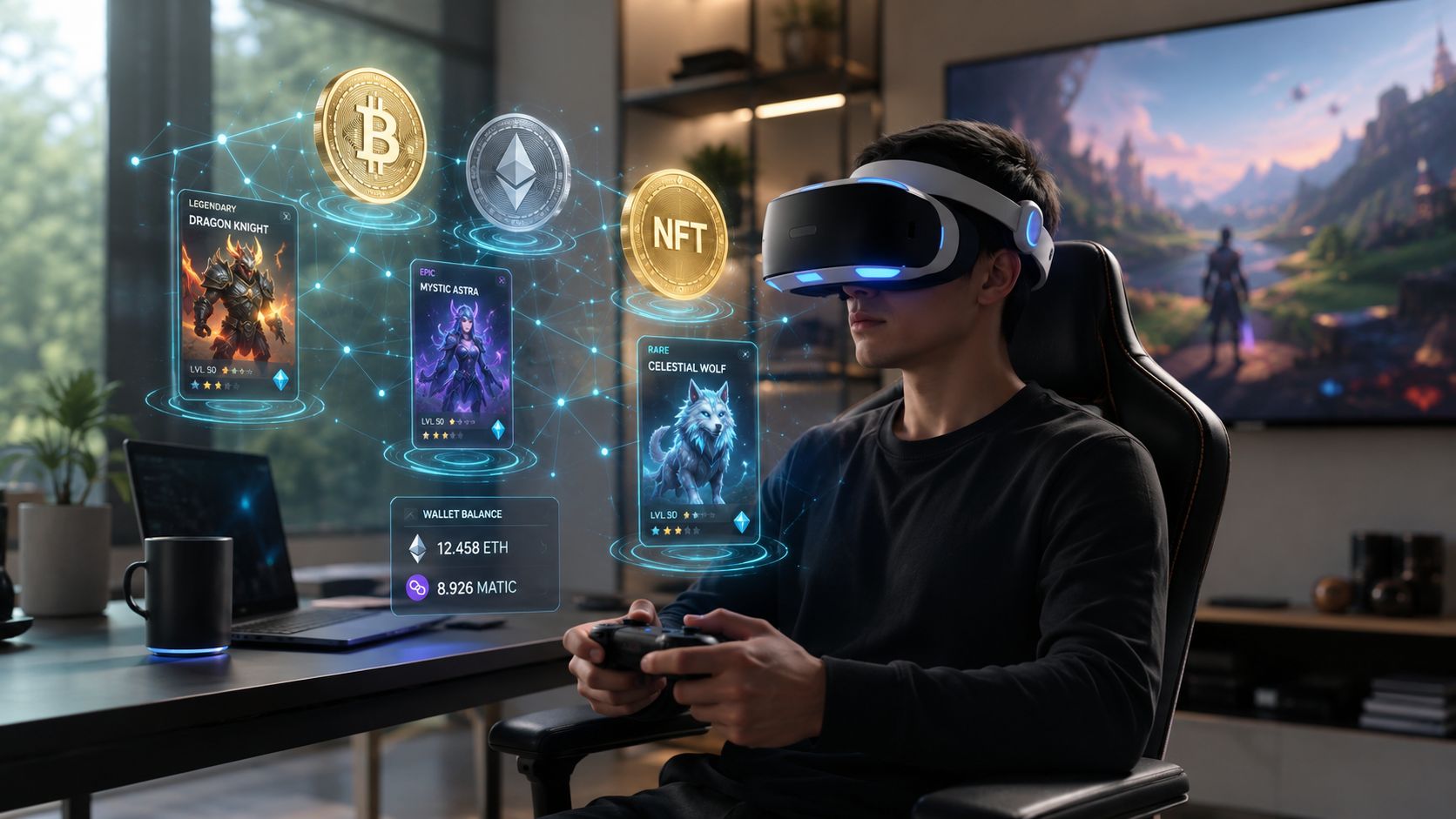
The number that should make investors pay attention isn't a token price. It's the size of the market. The global play-to-earn market was valued at $6.2 billion in 2025 and is projected to reach $28.4 billion by 2033, with a projected CAGR of 19.8% according to DataIntelo's play-to-earn market report. That projection matters because it signals a durable shift in how digital ownership, Web3 infrastructure, and game economies are converging.
But headline growth can hide bad economics. In blockchain gaming, the core question isn't whether players can earn. It's where the value comes from. Some games build functioning economies around gameplay, ownership, and player-to-player demand. Others print rewards until token inflation overwhelms the system and late entrants subsidize early ones.
That's why smart readers should stop treating play to earn crypto games as a single category. The better framework is economic design. If you can separate sustainable play-and-earn systems from extractive play-to-earn loops, you'll avoid a lot of expensive mistakes.
Table of Contents
- What Exactly Are Play to Earn Crypto Games
- Inside P2E The Tokenomics and Reward Models
- Major P2E Projects and Case Studies for 2026
- How to Evaluate and Choose a P2E Game
- Your Getting Started Checklist for P2E Gaming
- The Real Risks of P2E and How to Mitigate Them
- The Future of P2E Gaming and Web3 Economies
What Exactly Are Play to Earn Crypto Games
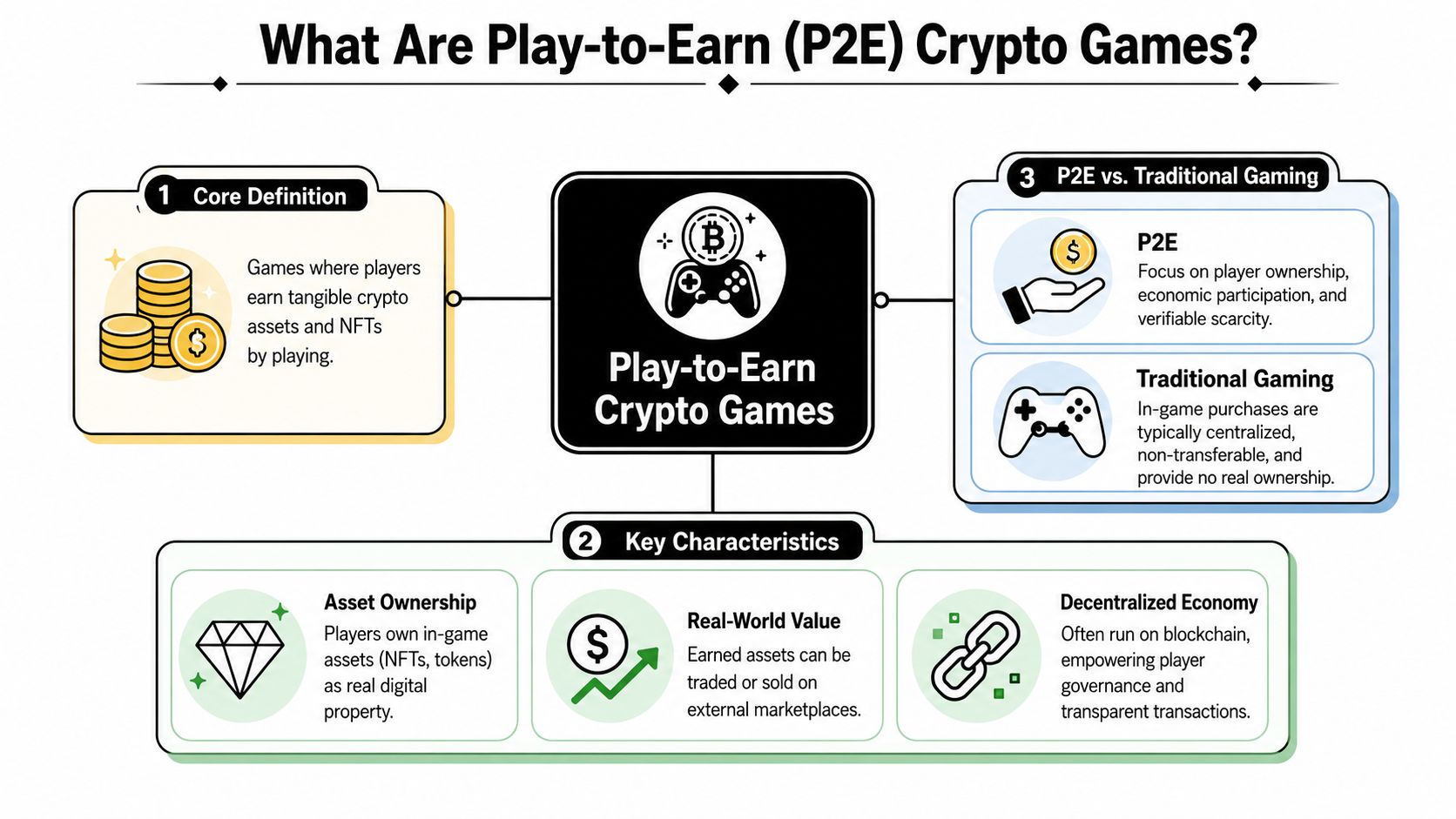
Play to earn crypto games flip the standard gaming model. In a traditional game, you buy skins, characters, or items, but the publisher keeps ultimate control. In a blockchain game, those assets can exist as NFTs or tokens that sit in your wallet, not inside a closed company database.
Consider the difference between renting a furnished apartment and holding the deed to a property. In one model, access depends on the landlord. In the other, ownership gives you transfer rights. That distinction is the foundation of GameFi.
Digital ownership changes the rules
According to Kraken's explanation of play-to-earn crypto games, P2E games differ from traditional gaming by tokenizing in-game assets as NFTs on decentralized Layer 1 blockchains such as Ethereum, Solana, or BNB Chain. That structure enables players to hold and transfer digital items outside the publisher's ecosystem, sell them on secondary markets, or swap them through decentralized exchanges.
That changes incentives in a meaningful way:
- Ownership becomes portable. A sword, land parcel, or character can live in a wallet rather than a game account.
- Markets become external. Players aren't limited to an in-game store controlled by the developer.
- Scarcity becomes verifiable. Smart contracts define supply and issuance in public code.
- Gameplay creates economic output. Battling, crafting, and leveling up can produce transferable assets.
If you want a broader grounding in this model, a good primer on what GameFi is helps connect the gaming layer with the financial layer.
How the system works in practice
The mechanics are simpler than the jargon makes them sound. A player usually connects a wallet such as MetaMask, approves transactions, and interacts with smart contracts that execute reward logic. That contract might mint a token after a battle win, issue an NFT after a quest, or allow the player to upgrade an item using a utility token.
Practical rule: If a blockchain game requires no wallet, no on-chain asset control, and no real transferability, it may use crypto branding without delivering crypto ownership.
For beginners, the critical point is this: blockchain doesn't magically make a game valuable. It just creates digital property rights. Whether those rights matter depends on gameplay, demand, liquidity, and tokenomics. That's where investors need to look next.
Inside P2E The Tokenomics and Reward Models
The heart of every blockchain game is its economy. Graphics can attract attention, but tokenomics decides whether the system can survive. In strong projects, rewards, spending, governance, and asset sinks work together. In weak ones, emission overwhelms demand and the game turns into a withdrawal queue.
Why dual-token design exists
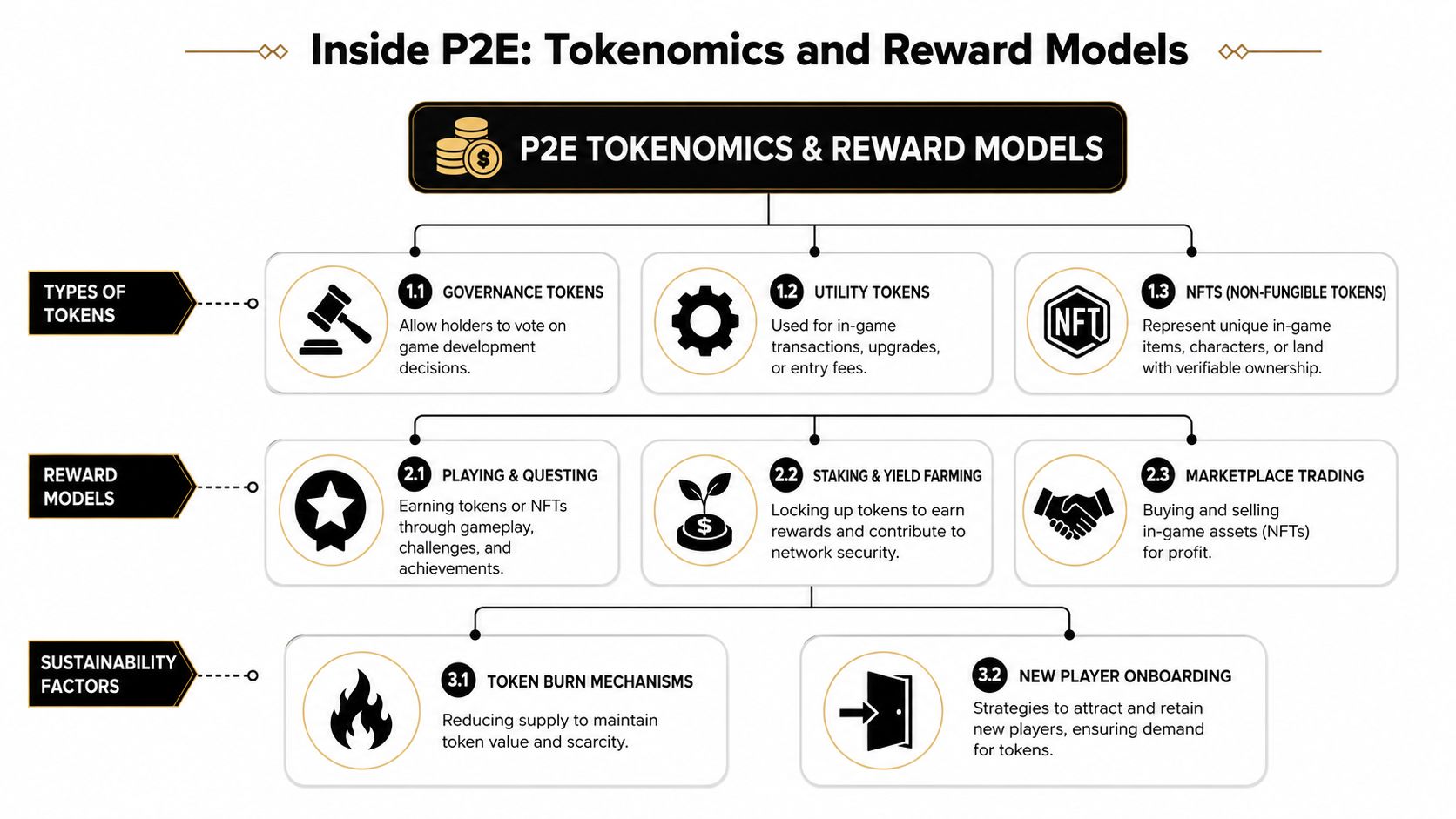
According to HyroTrader's overview of play-to-earn crypto games, most P2E crypto games use a dual-token economy. The governance token typically has a fixed or deflationary supply and gives holders voting rights on development decisions. The utility token functions as in-game currency for transactions, upgrades, breeding, and reward payouts.
That's not just cosmetic design. It solves a real problem. If a single token has to act as reward currency, governance asset, and speculative store of value at the same time, the economy becomes unstable fast.
A useful analogy is a national economy:
- Governance token acts more like political influence plus long-term capital exposure.
- Utility token acts more like circulating money inside the game.
- NFTs function like scarce property, equipment, or land deeds.
A deeper look at how NFTs work helps explain why unique items and land plots often sit outside the fungible token layer.
Later in the stack, these game assets may interact with broader crypto infrastructure. That includes marketplaces, staking systems, and even merchant rails. If you want context on how digital assets move into real transactions, this guide to crypto payment solutions for e-commerce is worth reading because it shows the other side of token utility: spending, settlement, and off-platform acceptance.
Where reward loops break down
Here's the section many promotional guides avoid. Reward models usually come from one or more of these loops:
- Gameplay rewards such as quest completion, PvP wins, or resource gathering
- Marketplace trading through NFT sales between players
- Staking or yield mechanisms that lock assets for future rewards
The model works only if players have reasons to spend, not just earn. Utility token sinks matter. Upgrade fees, breeding costs, crafting requirements, access passes, and marketplace fees can reduce circulating supply pressure. Without those sinks, the utility token becomes a faucet with no drain.
This explainer is useful if you want to see a visual breakdown of the moving parts:
A P2E economy fails when players treat the game as a mine and nobody treats it as a world worth staying in.
That's why tokenomics can't be analyzed in isolation. Good blockchain games tie rewards to actual engagement. Bad ones turn the token into the product and gameplay into the pretext.
Major P2E Projects and Case Studies for 2026
Investors don't need an endless list of titles. They need recognizable projects that illustrate different approaches to blockchain gaming economics. The current market still revolves around a small set of names that act as sector reference points.
The projects that still matter
The broadest sector snapshot comes from CoinGecko's play-to-earn category, which lists the category at a total market valuation of $2.18 billion and identifies major assets such as Gala (GALA), WEMIX (WEMIX), and Undeads Games (UDS). The same sector view notes token prices around $0.00227 for GALA, $0.23 for WEMIX, and $1.14 for UDS. Those numbers alone don't tell you which project wins, but they do show how wide the pricing spectrum is in blockchain gaming.
A few names also show up repeatedly in broader market discussions. Axie Infinity, Eldarune, and Iguverse are often cited as examples of how P2E turned gameplay into tradable digital output. They aren't identical. That's the point. They represent different paths inside the same category.
For readers comparing current titles, curated lists of the best play to earn games can help narrow the field before you dig into the token model.
P2E Game Comparison 2026
| Game Project | Genre | Blockchain | Key Token(s) | Unique Feature |
|---|---|---|---|---|
| Gala | Gaming ecosystem platform | Not specified here | GALA | Broad ecosystem exposure rather than a single game loop |
| WEMIX | Gaming platform ecosystem | Not specified here | WEMIX | Multi-game network approach with token-centered infrastructure |
| Undeads Games | Blockchain game project | Not specified here | UDS | Distinct project token tied to a specific gaming economy |
| Axie Infinity | Creature battle and collection | Not specified here | Not specified here | Early proof that player-owned game assets could reach mainstream attention |
| Eldarune | RPG-style blockchain gaming project | Not specified here | Not specified here | Shows how blockchain gaming can lean into progression-based design |
| Iguverse | Crypto gaming project | Not specified here | Not specified here | Illustrates social and collectible mechanics within Web3 gaming |
Takeaway isn't genre. It's structure. Ecosystem platforms like Gala and WEMIX behave differently from single-game economies because they can spread attention across multiple titles. Single-title projects live or die by gameplay retention, community durability, and token sink design.
The best case study signal isn't hype. It's whether people would still play if rewards dropped sharply.
That question cuts through almost every glossy pitch deck in the sector.
How to Evaluate and Choose a P2E Game
Most investors evaluate blockchain games backward. They start with token price, then look for a story that justifies it. The right order is the reverse. Start with the economic engine, then ask whether the token deserves attention.
P2E versus PAE is the key filter
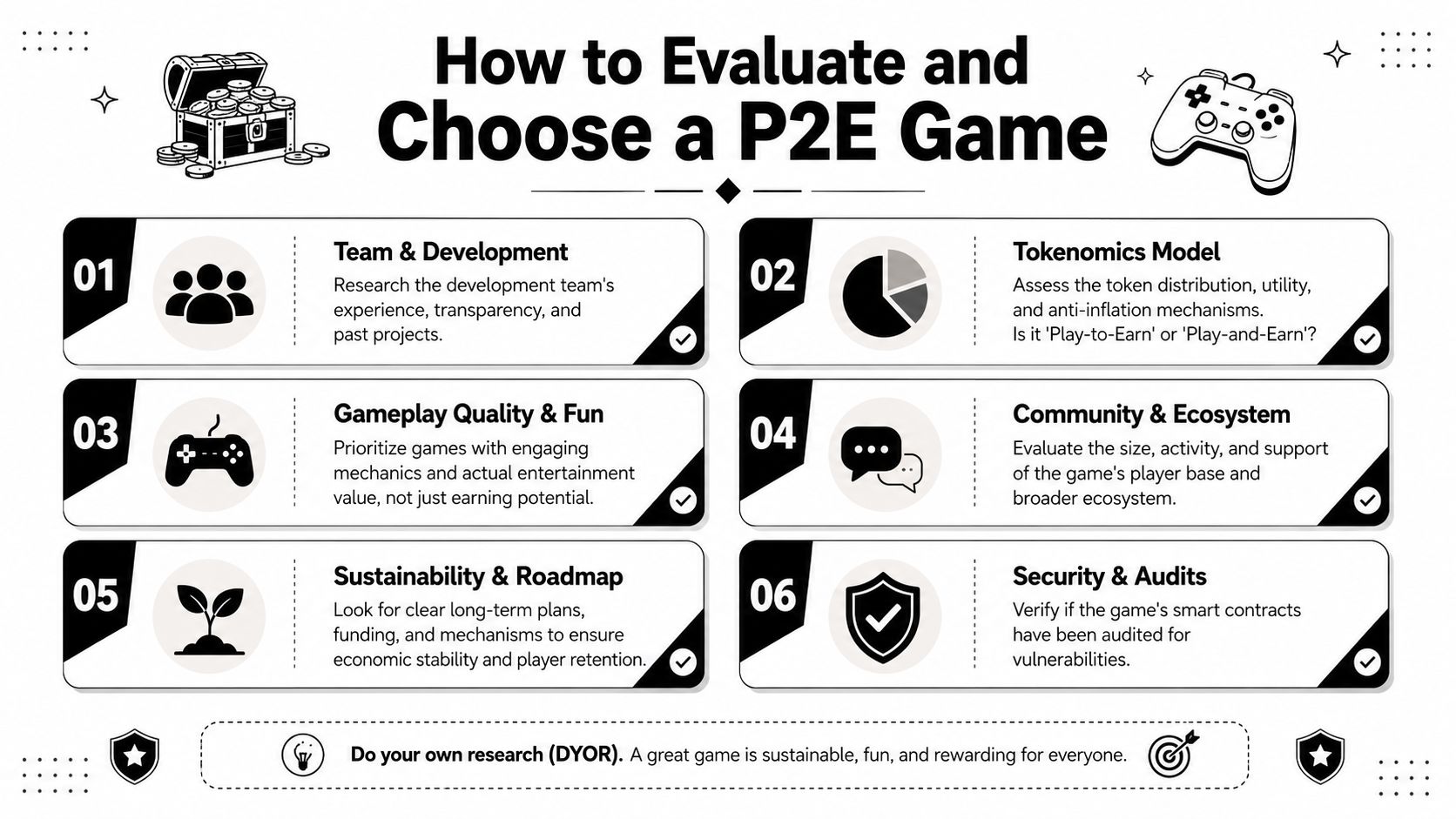
The most important distinction in this market is the difference between Play-to-Earn and Play-and-Earn. According to this discussion of P2E versus PAE economics, many P2E models rely on token debasement. In plain English, developers print rewards, new players arrive, sellers cash out, and token value weakens as issuance outruns real demand. The economic logic becomes circular.
A healthier Play-and-Earn model works differently. Players earn because other players value assets, access, status items, or progression advantages inside a game they already want to play. Revenue comes from demand inside the ecosystem, not from endless token printing.
That's the model seasoned investors should prefer.
A practical evaluation framework
Don't ask whether a game lets you earn. Ask these questions instead:
- Would people play it without rewards? If the answer is no, the game may be a speculative wrapper around emissions.
- What creates buy-side demand? Cosmetic demand, land demand, crafting demand, access demand, and competitive demand all matter more than marketing slogans.
- How visible is token utility? Governance rights sound good, but utility has to show up in actual player behavior.
- Who captures value? In a weak design, early extractors win. In a stronger design, developers, active players, and asset holders all have reasons to stay.
- Is the roadmap about gameplay or token events? A roadmap dominated by listings, staking, and reward campaigns is a warning sign.
A fast due-diligence pass should also cover:
| Checkpoint | What you want to see |
|---|---|
| Team quality | Public operators, credible execution, clear communication |
| Smart contracts | Audits or at least transparent contract architecture |
| Community | Active users discussing gameplay, not only price |
| Economy | Sinks, demand drivers, and reasons not to dump rewards |
| UX | Wallet flow, onboarding, and fee clarity |
Investor lens: Treat many P2E economies like small central banks with weak discipline. If issuance is easy and demand is vague, depreciation usually follows.
The market doesn't need more games that pay people to leave. It needs games that give people reasons to remain.
Your Getting Started Checklist for P2E Gaming
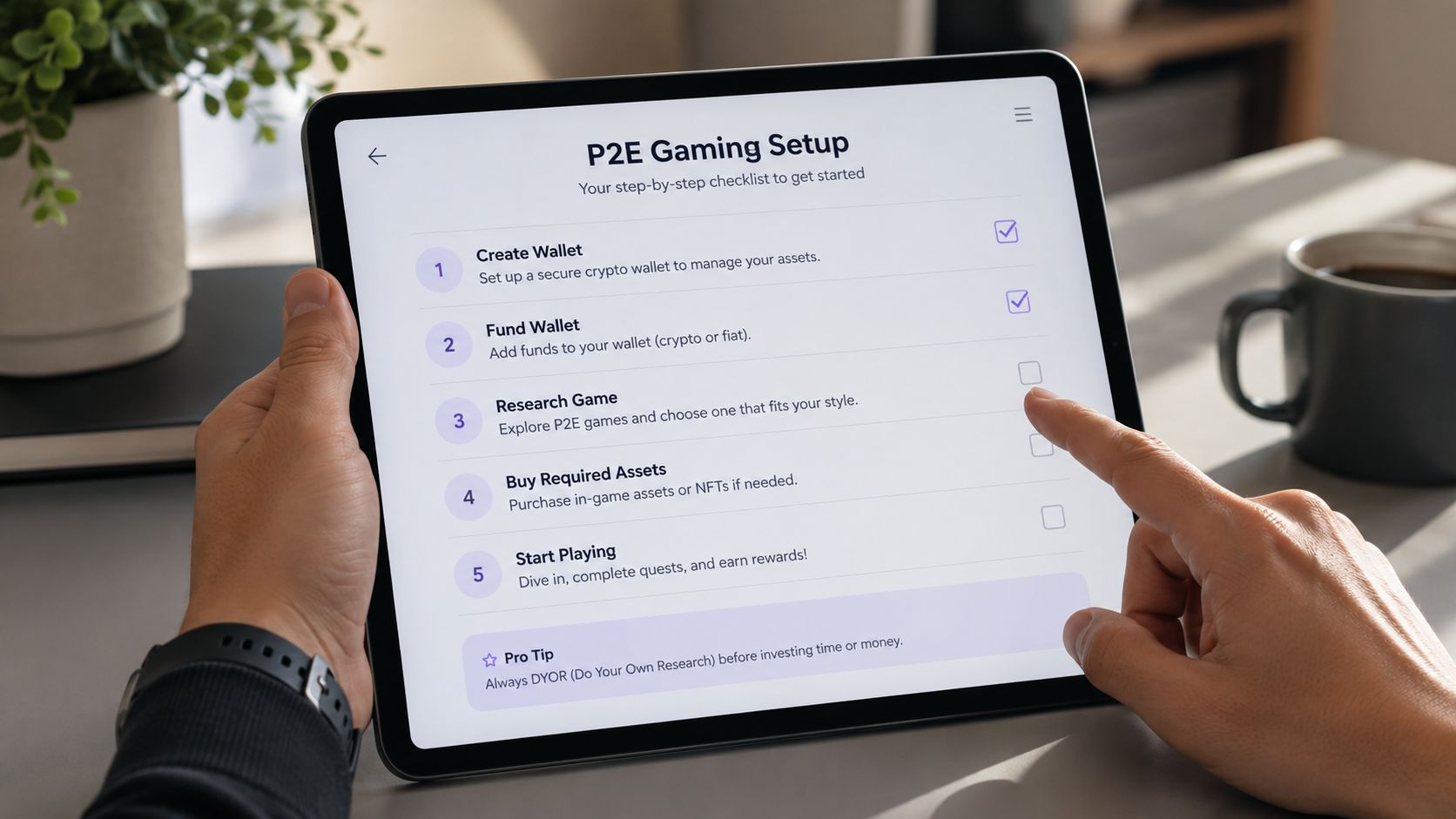
New users usually overestimate how hard wallet setup is and underestimate how hard withdrawal is. The first part is technical friction. The second part is economic friction.
Setup comes before earnings
Start with the boring infrastructure. It matters.
Choose a wallet you understand. For most beginners, that means a mainstream wallet with clear backup flow and broad ecosystem support. This guide to the best crypto wallets for beginners is a practical place to compare options before connecting to any game.
Fund the correct network. Some games sit on Ethereum, some on Solana, some on BNB Chain, and others use sidechains or Layer 2 systems. Sending the wrong asset to the wrong network creates avoidable risk.
Read the game's entry requirements. Some titles are free to start. Others require NFT purchases, token balances, or access items before gameplay begins.
Connect your wallet only through the official interface. Wallet connection is the doorway into both the game and the scam layer around it.
Cash-out friction is part of the game
The uncomfortable truth is that earning isn't the same as withdrawing. According to Chainstack's discussion of P2E earning friction, many games pay in proprietary tokens with low liquidity, and users often face network, marketplace, and bridge fees before they can cash out. For beginners, that can make small earnings negligible.
That's why your checklist needs a second half:
- Check withdrawal rules before you begin grinding. Thresholds, claim windows, and anti-bot controls can change the effective economics.
- Look at liquidity, not only token balance. A wallet showing rewards doesn't mean there's clean exit demand.
- Understand bridge risk. Moving assets across chains adds complexity and often extra fees.
- Track marketplace costs. NFT sales can involve listing friction, spread risk, and delayed fills.
Small balances often look exciting on a dashboard and disappointing at withdrawal.
A smart beginner treats the first month as a learning phase. Focus on wallet hygiene, transaction flow, and economic reality. If earnings survive those tests, then the game deserves more of your time.
The Real Risks of P2E and How to Mitigate Them
This sector can create value, but it also compresses several forms of risk into one user experience. You're not just evaluating a game. You're evaluating a token economy, a smart contract stack, a marketplace, and a management team at the same time.
The main failure modes
CoinGecko's sector view notes that P2E rewards can collapse in value when token emissions, weak gameplay, low liquidity, or scams outweigh real demand. It also highlights the traits that tend to support healthier projects: playable products, active communities, clear token utility, and visible liquidity. I agree with that framework because it maps closely to how these economies fail in practice.
The major risks usually fall into four buckets:
- Market risk. Token prices can move sharply when sentiment changes or sellers overwhelm thin liquidity.
- Economic design risk. If rewards are easy to mint and hard to spend, inflation pressure builds quickly.
- Project risk. Anonymous teams, abandoned roadmaps, and cash-grab launches remain common.
- Technical risk. Wallet approvals, malicious contracts, and unaudited systems can all harm users.
Hardware also matters more than some readers assume. If you're planning to spend serious time in more demanding Web3 titles, a guide on how to build a gaming PC for performance can help on the practical side, especially if your bottleneck is frame stability rather than token research.
How experienced users reduce damage
Experienced users don't eliminate risk. They contain it.
- Cap your exposure per game. Don't let one title dominate your time or capital.
- Review token utility before token price. If utility is vague, price action is often unstable.
- Study the player community. A Discord filled only with price talk is different from one filled with build guides, strategy, and trade discussion.
- Use clean wallet practices. Separate gaming wallets from long-term holdings.
- Research scam patterns. This guide on how to avoid crypto scams is a useful refresher because many P2E losses start with fake links and wallet approvals, not with market moves.
Good risk management in GameFi starts with a simple mindset. Your time is capital too.
That last point gets ignored. A bad blockchain game doesn't just burn money. It burns hours, attention, and opportunity cost.
The Future of P2E Gaming and Web3 Economies
A large share of first-wave P2E economies collapsed once token emissions slowed. That pattern matters because it exposed a structural flaw, not a temporary market mistake. Many early systems paid users from inflation and new buyer flow rather than from gameplay demand, which made their economies fragile by design.
The next phase of Web3 gaming looks more selective. The category is shifting from pure play-to-earn toward play-and-earn, where rewards sit on top of a game loop that can retain players without financial incentives. That distinction sounds semantic, but it is economic. In a speculative P2E model, the token is the product. In a sustainable PAE model, the game is the product and the token supports access, trading, governance, or progression.
That difference is similar to the gap between a store with customers and a store that only survives by issuing coupons. One can absorb lower demand. The other breaks as soon as growth slows.
Where Web3 gaming is heading
The strongest projects are converging on a simpler formula. Gameplay comes first. Ownership is native. Earnings are variable, not promised. That design reduces reflexive selling pressure and gives developers more room to balance their economies around retention, spending, and player-to-player trade instead of constant token distribution.
Several developments support that shift:
- Layer 2 scaling lowers transaction costs and makes blockchain activity less visible to the player, which helps games feel like games instead of financial dashboards.
- Selective DeFi features can support game economies where they fit, especially in lending, rentals, or guild coordination, but fewer teams are treating staking as a substitute for content.
- Better economic design is becoming a competitive advantage. Teams now get judged less on token launch excitement and more on sinks, asset durability, and whether demand exists without subsidy.
- Interoperable identity and digital goods may matter more than single-game reward loops, especially in ecosystems where reputation, access rights, and collectible assets carry value across multiple products.
The projects with staying power will look less like yield farms with avatars and more like actual games with programmable ownership.
That change also affects how investors should read the sector. A rising token price can still happen in weak ecosystems, especially during speculative cycles. The harder question is whether the economy can function after rewards are reduced, user growth flattens, and secondary market volume cools. If the answer is no, the model is still P2E in the most brittle sense.
The useful filter from here is straightforward. Look for games where players would stay even if token rewards dropped sharply. Those are closer to sustainable Web3 economies. If you are allocating time or capital into play to earn crypto games, focus on durable demand, disciplined token sinks, and teams building for player retention rather than emission-driven hype.
If you want more grounded analysis like this, Coiner Blog is worth bookmarking. It covers crypto gaming, NFTs, Web3, DeFi, AI-blockchain trends, and the practical risks that hype-heavy coverage often ignores.