
Top 7 Crypto Friendly Banks to Watch in 2026
You’ve already done the hard part. You learned self-custody, moved funds across exchanges, maybe used DeFi, maybe bridged into a Layer 2 to dodge ugly fees. Then reality hits when you need payroll, a wire, a debit card, or a clean fiat off-ramp. The crypto stack might be global and always on, but your bank still decides whether your transfer clears or gets flagged.
That’s why “crypto friendly bank” is one of the most abused labels in the industry. Some banks tolerate exchange transfers. Some support institutional clients but don't want retail flow. Some advertise innovation but still route crypto firms into slow manual reviews. After the collapse of major crypto banking names, a lot of businesses learned the same lesson: friendly marketing isn't the same thing as durable banking access.
The broader shift is real. In 2023, 74% of the 50 largest global banks by assets under management, specifically 37 out of 50, supported crypto trading by connecting customers to regulated exchanges, according to CoinGecko’s research on crypto-friendly banks. But retail on-ramping directly inside a bank platform is still rare, and compliance posture matters more than branding.
This guide gets straight to the banks and bank-like institutions worth watching in 2026. Some are built for Web3 operators that need treasury and payment rails. Others fit retail users who want bank-grade simplicity. A few sit in the middle, where tokenization, stablecoins, AI-driven compliance, and real-world asset settlement are starting to merge into the next financial operating system.
Table of Contents
- 1. Cross River Bank CRB
- 2. Customers Bank cubiX platform
- 3. Western Alliance Bank Blockchain and Digital Assets Group
- 4. SoFi Bank N.A.
- 5. PNC Bank PNC Private Bank Coinbase CaaS
- 6. Anchorage Digital Bank N.A.
- 7. Kraken Financial Kraken Bank
- Top 7 Crypto-Friendly Banks Comparison
- Your Next Move Choosing Your Fiat Gateway
1. Cross River Bank CRB
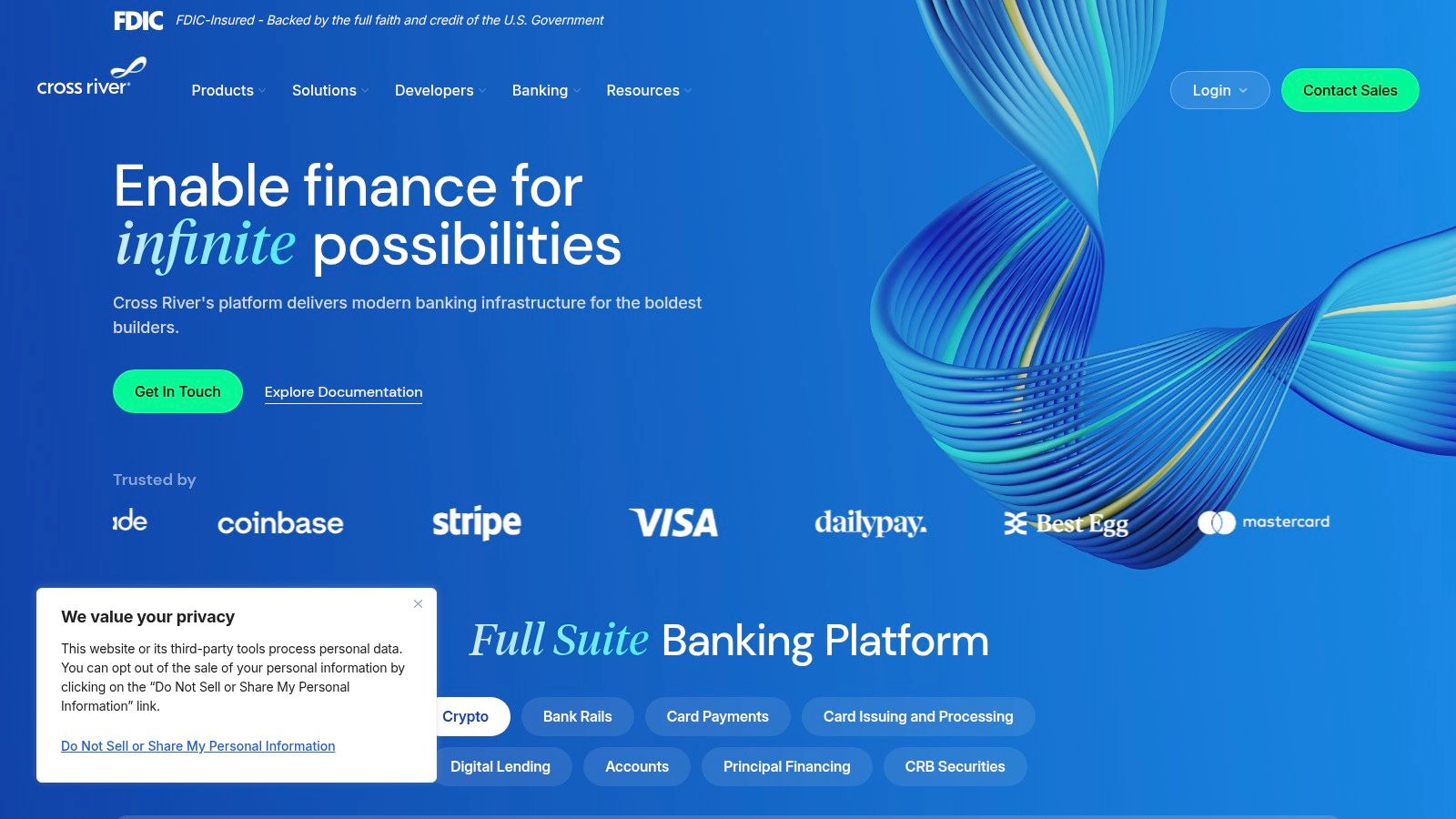
Cross River sits in the part of the market most retail users never see, but a lot of crypto infrastructure depends on it. If you run a platform and need compliant fiat movement, card programs, bank rails, and settlement logic that doesn't collapse under compliance scrutiny, CRB is the kind of counterparty people prioritize.
Start with the official platform at Cross River Bank.
Why CRB matters
Cross River’s edge is its embedded finance DNA. It’s much closer to an API-first banking layer than a branch-first institution trying to retrofit crypto support after the fact. That matters when you need ACH, wires, card issuance, real-time payouts, and controls that can survive audits.
For crypto businesses, the attraction isn't hype. It's operational continuity. If your product handles on-ramps, off-ramps, stablecoin payouts, marketplace disbursements, or treasury movement, you need a bank that understands why blockchain activity doesn't map neatly to legacy fraud models.
- API-first architecture: Better suited to fintechs, exchanges, wallets, and Web3 apps than to ordinary consumer banking.
- Multi-rail processing: Useful when you need flexibility across ACH, wires, and faster payment flows.
- Compliance-native posture: KYC and AML workstreams are part of the product reality, not an afterthought.
Practical rule: If your team is still choosing banks based on “they said they’re crypto friendly,” you're too early in your diligence process. Ask how they underwrite your flow types, counterparties, wallet exposure, and transaction monitoring.
Best fit and trade-offs
Cross River is best for platforms, not casual investors. A startup building smart contract-powered payments, a stablecoin payroll tool, or a tokenized asset app will usually get more value here than a retail user who just wants to buy BTC from a checking account.
The trade-off is straightforward. This isn't a self-serve product for someone dabbling in memecoins on weekends. Onboarding and pricing depend heavily on risk profile, business model, geography, and transaction patterns. That's normal in serious banking, but it frustrates founders who expect SaaS-style instant approval.
CRB works when you need a regulated U.S. banking partner that understands where Web3 is going. It’s especially relevant as tokenization, AI-assisted compliance review, and programmable payout logic become standard infrastructure rather than niche experiments.
2. Customers Bank cubiX platform
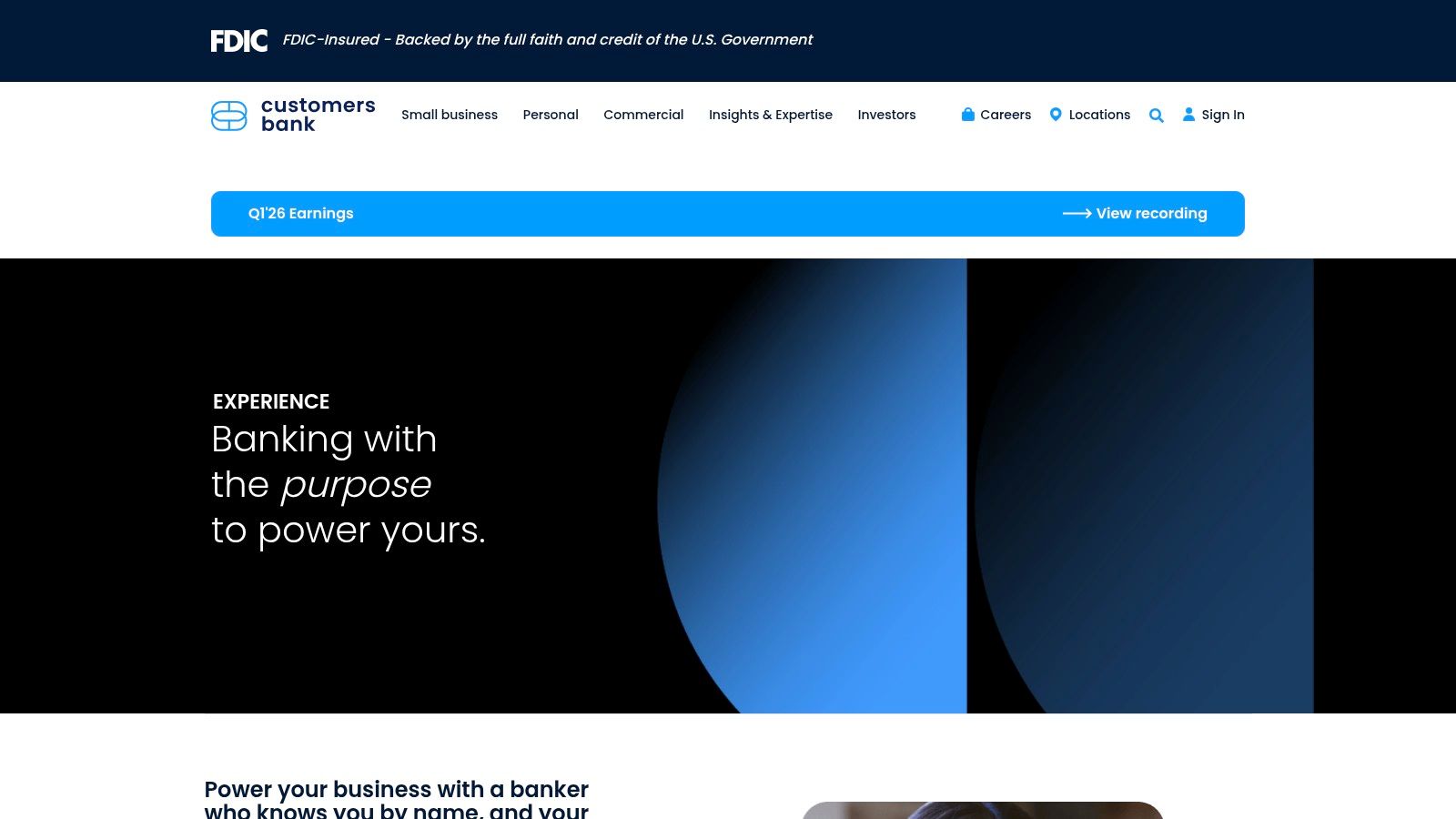
Customers Bank is one of the more practical names in this space because it solves a very specific pain point. Crypto firms don't just need a bank account. They need money movement that doesn't stop being useful outside normal banking hours.
The commercial banking side lives at Customers Bank.
Where cubiX stands out
The cubiX platform is built around unified payment orchestration across ACH, wires, FedNow, RTP, and internal instant transfers. That mix matters for OTC desks, funds, market makers, and treasury teams that can't afford cutoff drama while markets keep trading.
In practice, this is about timing risk. If you’ve ever had to move USD around a volatile market while waiting on traditional rails, you already know the problem. Fast internal transfer capabilities and access to multiple payment paths can reduce friction that turns good execution into operational slippage.
A lot of active traders obsess over entries and forget settlement mechanics. That's a mistake. If you're tightening your market process, trading strategy discipline matters, but so does the bank on the other side of the fiat leg.
Who should use it
Customers Bank makes sense for firms with real treasury needs, not for people looking for a consumer crypto app. It’s a relationship-driven setup. If your business has regular volume, multiple counterparties, and a legitimate need for near-real-time USD movement, the value is obvious.
- Best for OTC and institutional flows: Stronger fit for firms moving cash between desks, custodians, and partners.
- Useful rail diversity: More options means less dependence on one payment window or one clearing path.
- Commercial banking support: Better than patching together fintech tools when your operations are growing.
Fast settlement doesn't fix a weak treasury process. It amplifies a good one and exposes a sloppy one.
The downside is that onboarding won't feel lightweight. Expect diligence, documentation, and a more traditional relationship model than many crypto-native teams want. Still, among crypto friendly banks for operational USD movement, Customers Bank remains one of the more credible options to watch.
3. Western Alliance Bank Blockchain and Digital Assets Group
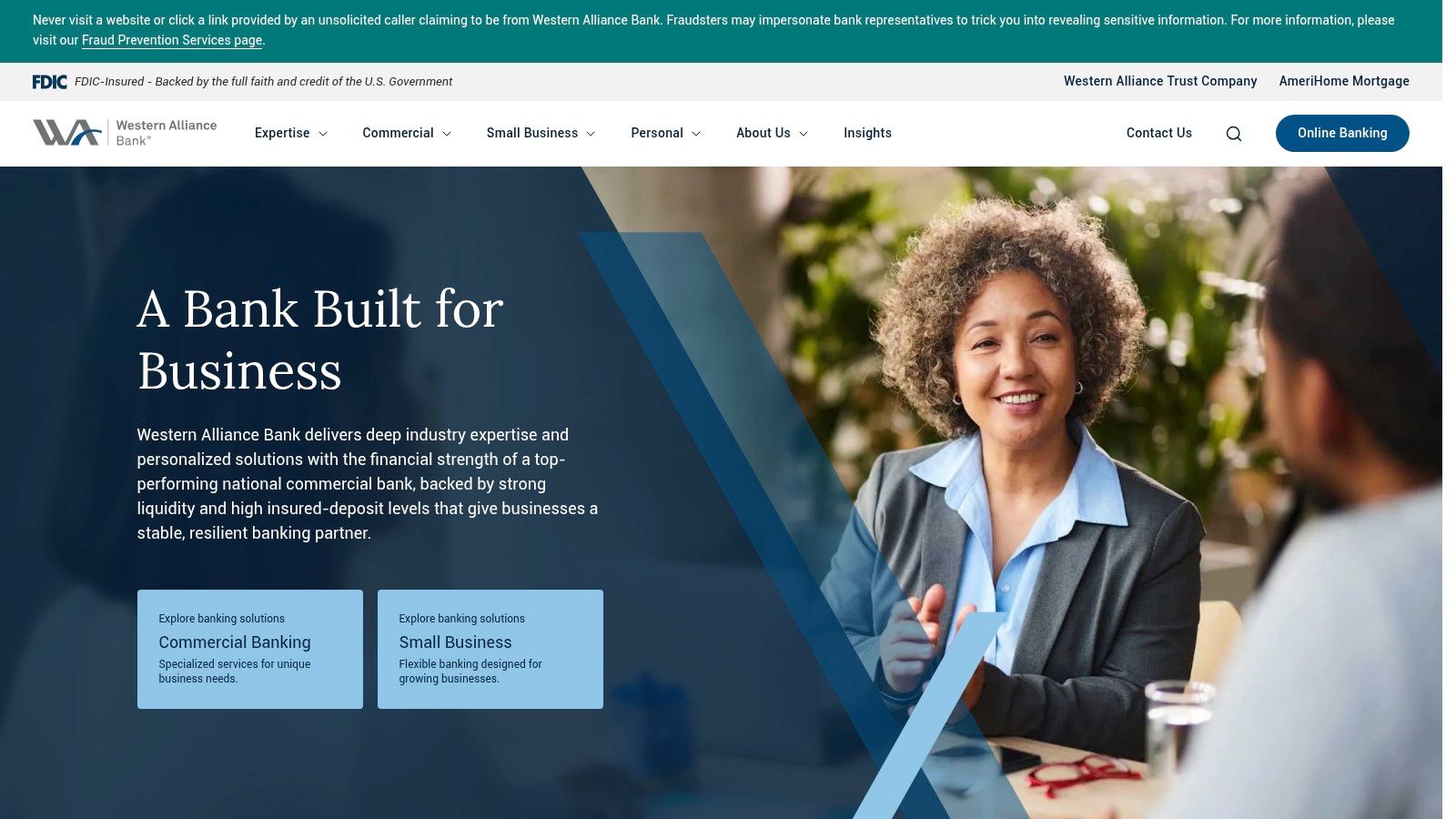
Western Alliance matters because it approached digital assets as a business line, not just a compliance exception. That distinction sounds small until you're trying to open and maintain an account as a Web3 company.
You can review its commercial banking presence through Western Alliance Bank.
What it does well
Western Alliance has maintained a dedicated blockchain and digital assets practice, which is exactly what many crypto companies want from a bank. Not excitement. Not vague innovation copy. A named team that understands treasury, cash management, payments, and the extra diligence that comes with blockchain-linked activity.
That’s useful for Web3 firms building things that don’t fit old buckets cleanly. Think NFT infrastructure, DeFi analytics, tokenization platforms, payment processors, or AI tools that monitor wallet behavior for compliance teams. These businesses need a bank that can understand what the company does, not just react to the word “crypto.”
For teams building long-term products, especially around security and infrastructure, the deeper issue is trust architecture. That's one reason the future of cryptography matters far beyond wallets and private keys. It shapes how banks think about custody, authentication, and permissioned access.
What to expect in onboarding
Western Alliance is still a bank. That means institutional review, risk segmentation, and more paperwork if your flows involve exchanges, stablecoins, DAOs, or cross-border payment activity. Firms that show clean documentation, source-of-funds clarity, and a coherent compliance narrative tend to fare better.
- Dedicated digital asset coverage: Better than teaching a generic banker what your business model is.
- Enterprise payment options: Helpful for larger treasury and B2B payment needs.
- Conservative terms are possible: That's not always a negative. It often means the bank intends to keep the relationship sustainable.
Some of the best crypto banking relationships feel slower at the start because the bank is doing real diligence instead of pretending risk doesn't exist.
Western Alliance isn't the flashiest name on this list. It is one of the more serious ones for enterprise-grade operators.
4. SoFi Bank N.A.
A retail investor gets paid on Friday, moves cash into savings, and wants a small bitcoin position without opening a new account, wiring money to an exchange, and learning a different interface. That is the lane where SoFi makes sense.
The consumer product is available through SoFi Bank.
Why retail users keep coming back to SoFi
SoFi works best for people who want crypto access inside a familiar banking stack. Checking, savings, and digital asset exposure sit closer together, which cuts account sprawl and reduces the friction that often pushes newer buyers into poor decisions.
That matters during volatile stretches. Retail buyers who are trying to understand why Bitcoin is rising or falling often react faster than their systems can keep up. A simpler setup will not fix bad discipline, but it does remove some operational noise. The same logic applies in a crypto bear market, when scattered balances across banks and exchanges make it harder to manage risk calmly.
Post Operation Choke Point 2.0, this category deserves a more realistic reading. SoFi is not trying to be the bank for exchanges, stablecoin issuers, or high-risk crypto businesses. That restraint is part of the product. For a retail user, a controlled offering can mean fewer surprises, clearer disclosures, and a lower chance that ordinary banking activity gets tangled up in business-model questions the bank never intended to support.
The biggest limitation
The trade-off is straightforward. SoFi gives access, not full crypto freedom.
Users who care about self-custody, open-ended token selection, direct DeFi participation, or moving assets across wallets will hit limits fast. The platform is curated, and the rules are set by the bank.
- Best for beginners and passive buyers: Good fit for users who want basic exposure inside an app they already trust.
- Stronger for simple portfolio habits: Easier to monitor cash and crypto in one place than across multiple services.
- Weak fit for crypto-native activity: Self-custody focused users and active onchain participants will likely outgrow it.
I would place SoFi in the retail gateway bucket, not the crypto-native banking bucket. That distinction matters. If the goal is first exposure with less operational complexity, SoFi is a practical option. If the goal is sovereignty, token mobility, or advanced execution, choose a bank and platform stack built for that from day one.
5. PNC Bank PNC Private Bank Coinbase CaaS
PNC’s private banking crypto offering is one of the cleaner examples of how traditional wealth management is absorbing digital assets without pretending every client wants a native exchange account. This model is less about crypto culture and more about portfolio access, reporting, and client service.
Eligible clients can start with PNC Bank.
Why this model works for wealth clients
High-net-worth clients don't always want another login, another compliance workflow, and another place where assets need to be reconciled. Embedded bitcoin access inside a private banking relationship solves a real operational problem. It keeps execution, custody, and portfolio visibility closer to the wealth stack clients already use.
That matters more now because institutions are driving more of the conversation. Coincub’s 2024 crypto banking report says crypto banking services have proliferated to 131+ firms globally, with Europe at 64, North America at 30, Asia at 24, and Latin America at 13, as detailed in Coincub’s crypto banking report. In other words, wealth channels are no longer peripheral to digital assets.
If you're tracking macro allocation flows and sentiment, it also helps to understand why Bitcoin rises in certain market regimes. Wealth clients usually care less about on-chain culture and more about how the asset behaves inside a broader portfolio.
Where it falls short
PNC’s offer is intentionally narrow. That’s part of its appeal and one of its limits. This isn't built for altcoin hunters, active DeFi users, or someone chasing yield across staking, lending, and Layer 2 ecosystems.
- Great for integrated reporting: Especially useful for family offices, advisors, and private clients who value clean portfolio views.
- Blue-chip trust factor: Some clients prefer bank-mediated access.
- Limited access model: If you’re not already an eligible private banking client, this isn't really an option.
For the right user, PNC removes friction. For the wrong user, it feels too filtered. That's normal in private banking.
6. Anchorage Digital Bank N.A.
A fund wants to hold digital assets, stake selected positions, and settle through a setup its auditors and board can understand. That is the use case Anchorage was built for.
Institutions can review the platform at Anchorage Digital Bank.
Why Anchorage is in a different category
Anchorage sits closer to regulated market infrastructure than to a typical crypto-friendly bank account. Its importance comes from structure, not marketing. It is the only U.S. crypto-native bank with a federal OCC charter, and that changes the conversation for institutions evaluating counterparty risk, custody standards, and internal approval.
Post-Operation Choke Point 2.0, that distinction matters. Banks, funds, fintechs, and corporates are not just asking whether a provider supports digital assets. They are asking who holds the assets, under what supervisory framework, how controls are documented, and what happens when compliance wants a full paper trail.
That is where Anchorage stands out. It combines qualified custody with trading, staking on supported networks, and settlement capabilities inside a model built for regulated entities. If a firm is working on tokenized assets, stablecoin treasury operations, or governance participation, the banking question quickly becomes a control question.
Who benefits from this model?
Anchorage is best for institutions that need crypto access without improvising policy, reporting, and oversight after the fact.
- Best fit for institutional users: Asset managers, venture funds, corporates, fintech platforms, and banks evaluating digital asset services.
- Strong choice for controlled on-chain exposure: Useful for firms exploring staking, tokenization, and selected DeFi-adjacent activity inside a supervised framework.
- Heavy onboarding is part of the product: Expect detailed reviews of entity ownership, source of funds, compliance controls, and intended activity.
For individual investors, this is usually the wrong tool. A retail user looking for wallet-first simplicity will get more value from understanding tools like Phantom Wallet for self-custody and on-chain access.
Regulated custody feels expensive and slow until legal, finance, and audit teams start asking the hard questions. Then the control framework becomes the product.
Anchorage earns its place on this list because it serves a different buyer. If Cross River or SoFi are fiat access points for broader user groups, Anchorage is built for institutions that need crypto infrastructure to survive compliance review, not just work on demo day.
7. Kraken Financial Kraken Bank
Kraken Financial is one of the most important names to watch if you care about the bank-exchange boundary disappearing. Most crypto firms still rely on layers of intermediaries to touch core payment rails. Kraken’s banking arm points in a different direction.
You can follow the banking initiative through Kraken Financial.
Why the charter matters
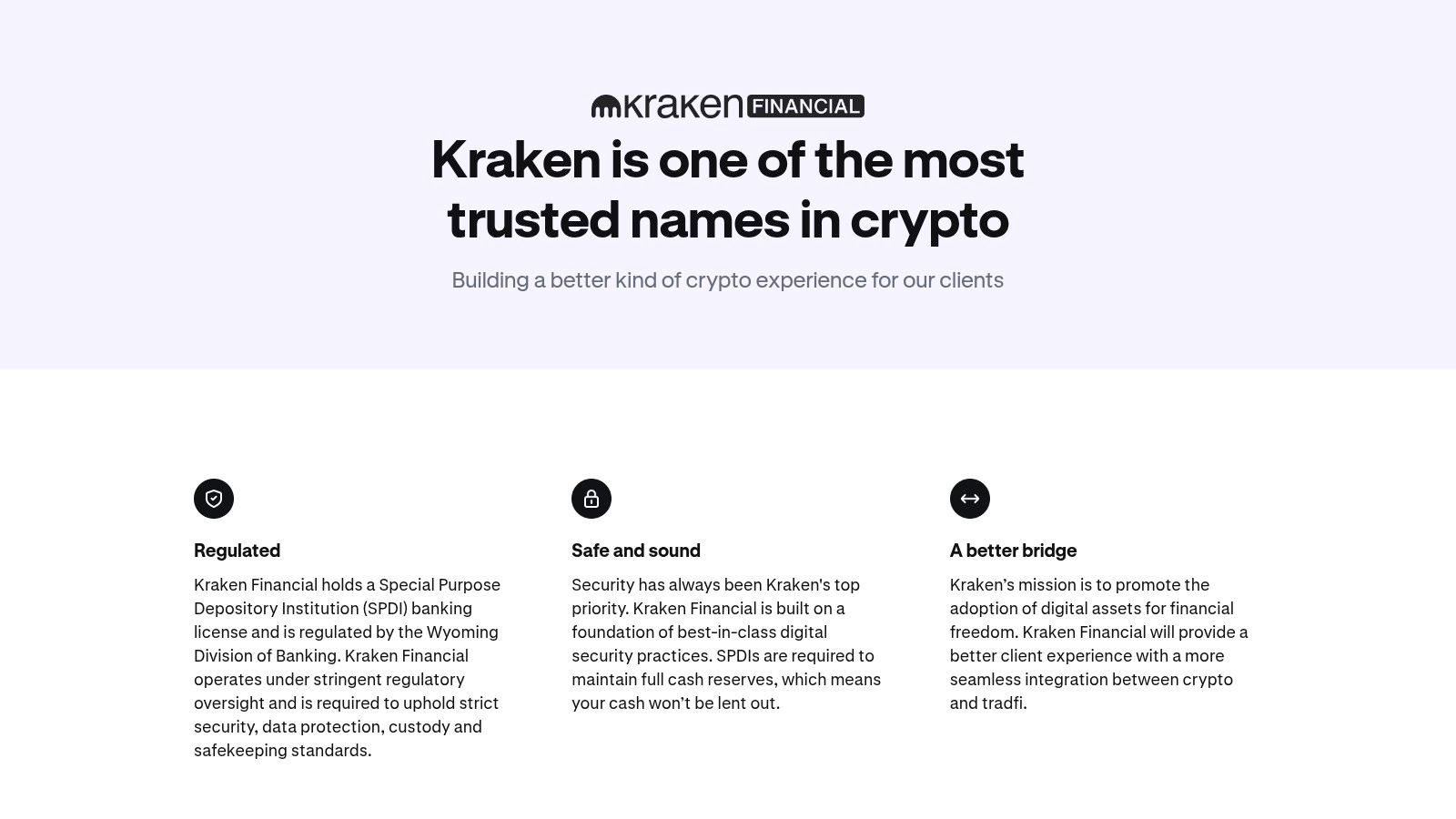
Kraken Financial is a Wyoming SPDI, which means full-reserve design and a legal structure built around safekeeping digital assets and fiat rather than making conventional loans. The broader significance of that framework shows up in adjacent examples too. The Wyoming SPDI model is cited in market analysis as an important step for compliant digital asset banking and tokenized deposit innovation, as noted earlier in the HTF material.
For crypto-native operators, this model is compelling because it narrows intermediary risk. It also aligns better with how digital asset users think about segregation, settlement finality, and balance-sheet transparency. That doesn't make it a universal answer. It does make it strategically important.
If you’re already living inside the Kraken ecosystem or using self-custody tools, this sits naturally beside wallet-first workflows like Phantom Wallet, where the expectation is control, speed, and cleaner movement between fiat and on-chain environments.
The practical caveat
Kraken Financial isn't a broad retail replacement for your everyday bank. Access is phased, eligibility matters, and SPDI design comes with a major caveat: deposits are not FDIC-insured. Some users will be comfortable with that structure. Others won't.
- Best for institutions and qualified ecosystem users: Stronger fit for entities that value directness and regulated crypto-native banking logic.
- Compelling architecture: Full-reserve design has obvious appeal in a post-crisis market.
- Not mainstream consumer banking: If you need a standard branch network and retail banking features, look elsewhere.
Kraken Financial is worth watching because it doesn't just add crypto to banking. It rebuilds banking around digital asset assumptions.
Top 7 Crypto-Friendly Banks Comparison
| Provider | Implementation complexity 🔄 | Resource requirements ⚡ | Expected outcomes 📊 | Ideal use cases 💡 | Key advantages ⭐ |
|---|---|---|---|---|---|
| Cross River Bank (CRB) | Moderate, API‑first integrations, platform work | Engineering + compliance teams; moderate onboarding | Production‑grade fiat↔crypto rails and stablecoin payouts | Fintechs and crypto platforms needing BaaS | Deep crypto/fintech track record; US‑regulated counterparty ⭐⭐⭐ |
| Customers Bank (cubiX) | Medium, relationship onboarding, platform integration | Treasury, liquidity and account relationships; possible balance requirements | Near‑real‑time USD settlement; 24/7 intra‑bank transfers | OTC desks, liquidity providers, funds needing fast USD settlement | Multi‑rail connectivity (RTP, FedNow); reduces cutoff risk ⭐⭐ |
| Western Alliance Bank, Blockchain & Digital Assets Group | High, enterprise diligence and integration | Enterprise compliance, liquidity and treasury support | Enterprise B2B payments and regulated cash management | Web3 enterprises and large firms needing treasury services | Dedicated digital‑assets practice and strong liquidity ⭐⭐ |
| SoFi Bank, N.A. | Low, consumer onboarding and standard KYC | Minimal for end users; custody managed by bank | Integrated checking/savings + in‑app crypto trading | Retail customers wanting single‑app fiat + crypto | One‑app experience with clear fees and disclosures ⭐ |
| PNC Bank, PNC Private Bank (Coinbase CaaS) | Medium, wealth onboarding and account eligibility | Wealth management teams; high‑net‑worth client requirements | Embedded bitcoin trading/custody and consolidated reporting | HNW/UHNW clients, family offices, RIAs | Blue‑chip bank + Coinbase execution/custody integration ⭐⭐ |
| Anchorage Digital Bank, N.A. | High, institution‑grade onboarding and controls | Institutional compliance, custody ops, custom integrations | Qualified custody, trading, staking under federal oversight | Institutions, asset managers, fintechs needing qualified custody | OCC‑chartered qualified custody and institutional security ⭐⭐⭐ |
| Kraken Financial (Kraken Bank) | Medium‑High, SPDI framework, phased eligibility | Integration with Kraken ecosystem; compliance and onboarding | Full‑reserve fiat with Fed rail access; reduced intermediary risk | Institutions and qualified clients requiring Fed access | Fed master account access and full‑reserve model ⭐⭐⭐ |
Your Next Move Choosing Your Fiat Gateway
The era of one-size-fits-all banking is over, especially in crypto. The right option depends less on who has the loudest “crypto friendly” branding and more on what job you need the bank to do. That sounds obvious, but a lot of failed setups start with the wrong assumption that one account can serve retail investing, DAO treasury ops, startup payroll, and institutional custody at the same time.
If you're a retail user who wants the simplest bank-grade route into digital assets, SoFi is the cleanest fit on this list. It won't satisfy people who want full self-custody, DeFi composability, or direct access to every Layer 2 and token launch. But for straightforward buy-and-hold exposure in a familiar app, it solves the right problem.
If you're building a crypto company, the decision changes fast. Cross River, Customers Bank, and Western Alliance are more relevant because the core challenge isn't just account access. It's payment rails, treasury timing, counterparty resilience, and whether your compliance story will hold up when transaction patterns get more complex. Stablecoin payouts, smart contract-driven workflows, AI-assisted monitoring, and tokenized asset settlement all put pressure on a bank relationship in ways ordinary startups don't face.
For private clients and family-office style investors, PNC shows where wealth management is heading. Embedded access matters because many clients want bitcoin exposure without breaking their reporting stack or introducing another operating layer. For institutions, Anchorage and Kraken Financial sit closer to the future of the market. They matter because custody, settlement, staking, tokenization, and regulated on-chain access are converging into a single infrastructure conversation.
The bigger backdrop is clear. Traditional finance isn't fully native to crypto yet, but it isn't standing outside the door anymore either. Large banks have already moved toward exchange connectivity, specialized crypto banking infrastructure continues to expand, and the strongest operators are building around real compliance instead of slogans. That’s especially important as real-world asset tokenization, DeFi integrations, and programmable finance move from experimental to operational.
Choose the bank that matches your actual workflow. If you need a trusted retail interface, use one. If you need institutional-grade fiat rails, choose a platform built for treasury and settlement. If you need qualified custody and regulated digital asset infrastructure, don't compromise just because a generic bank says it “supports crypto.”
In this market, your bank isn't just a parking place for cash. It's part of your stack.
Coiner Blog keeps tracking the part of crypto most sites oversimplify: the messy intersection of banks, compliance, DeFi, self-custody, tokenization, and real market structure. If you want practical breakdowns that help you make smarter moves in Web3, follow the latest analysis on Coiner Blog.