
Cronos Crypto Price Prediction: 2026 CRO Forecast

Cronos has already shown the kind of price range that makes simple forecasts unreliable. A token that has traded through a full boom-bust cycle can produce eye-catching upside targets, but those targets mean little unless they are tied to adoption, liquidity, and token demand.
That is why a useful Cronos crypto price prediction needs more than a single number. It should separate what comes from market sentiment from what comes from ecosystem usage, and it should test multiple scenarios instead of assuming one straight path higher.
For anyone assessing whether 2026 could become an important year for CRO, the better question isn't only whether price can rebound. It is whether Cronos can turn exchange-driven visibility, on-chain activity, developer traction, and real token utility into sustained demand across a full market cycle.
That also means placing CRO inside the wider cycle. Investors watching altcoins often get the timing wrong because they focus on token-specific narratives while ignoring macro conditions, Bitcoin dominance, and liquidity trends. For that broader context, it helps to review when the crypto market could recover.
This article takes a more disciplined approach. Rather than pushing one headline target, it lays out bull, base, and bear cases for CRO, then explains the assumptions behind each one so readers can judge which path looks most credible.
Table of Contents
- Is a Cronos Surge Coming in 2026
- Understanding The Cronos Ecosystem and CRO Token
- Fundamentals Driving CRO Value Tokenomics and Ecosystem
- Technical Analysis and Current Market Sentiment
- Cronos Crypto Price Prediction Scenarios 2026 to 2030
- Key Catalysts and Major Risk Factors for CRO
- Final Verdict and Actionable Insights for Investors
Is a Cronos Surge Coming in 2026
A Cronos surge in 2026 is possible. A clean, evidence-based case for it is harder than many headlines suggest.
The market has already shown that CRO can trade at extremes. But historical upside alone doesn't make a future breakout likely. It mainly tells us that CRO should be analyzed through scenarios, not certainty. That's a subtle but important difference. Many investors see past highs and assume mean reversion. In crypto, old highs often reflect a specific cycle, a specific liquidity regime, and a specific narrative mix that may not return in the same form.
What matters more than old headlines
For 2026, I'd focus on three filters:
- Network relevance: Cronos needs sustained smart contract and Web3 activity, not just exchange-brand visibility.
- Liquidity quality: A token can rally on excitement, but durable repricing usually needs deeper market participation.
- Narrative conversion: Themes like DeFi growth, tokenized real-world assets, and AI-adjacent blockchain tooling only matter if users transact on-chain.
That leads to a more grounded version of the Cronos crypto price prediction debate. The issue isn't whether CRO has upside. It does. The issue is what type of upside is realistic without assuming peak-cycle euphoria returns on schedule.
CRO is best viewed as a chain-and-token ecosystem bet, not just a rebound trade.
A serious 2026 move would likely require two things happening together. First, technical structure would need to improve enough to attract traders. Second, ecosystem usage would need to improve enough to justify holding the token beyond a momentum window.
That combination is why I'm cautiously optimistic rather than aggressively bullish.
Understanding The Cronos Ecosystem and CRO Token
Cronos often gets misunderstood because people use one name to describe several related pieces. If you don't separate them, any Cronos crypto price prediction becomes fuzzy from the start.
Cronos is not just one thing
Think of the broader ecosystem like a company with different product lines under one brand.
One layer is the CRO token itself. That's the asset investors buy, stake, spend on fees, and evaluate for long-term value.
Another layer is the Cronos Chain, which is the environment associated with EVM compatibility and smart contracts. That matters because Ethereum developers generally understand how to work in EVM-based environments. In practice, that lowers friction for dApp deployment, DeFi experimentation, NFT projects, Web3 consumer apps, and blockchain gaming.
There's also the Crypto.org Chain, which is commonly associated with payment-oriented functionality inside the wider ecosystem. Newcomers often blur this with Cronos, but the distinction matters because token value comes from how these parts support different forms of usage.
For readers interested in interoperability and asset movement between networks, this broader topic connects naturally with cross-chain swaps and how they work.
Why CRO utility matters
CRO has to do real work inside the ecosystem or the valuation case weakens.
Its utility is generally tied to functions such as:
- Gas and transaction use: Users need the token to interact with on-chain applications.
- Staking role: Holders can lock tokens to participate in network-related incentives.
- Governance and ecosystem alignment: Utility tokens often become a way to coordinate user incentives with chain growth.
- Platform connection: CRO also carries brand and ecosystem significance because of its link to the broader Crypto.com universe.
This distinction changes how I think about valuation. If CRO were only a speculative exchange token, the long-term case would be narrower. Because it sits closer to a usable blockchain ecosystem, the thesis is broader. It can benefit from DeFi, NFT infrastructure, Web3 payments, and application-layer growth.
Beginners usually ask, “Will CRO go up?” Better investors ask, “What activity would force more people to hold and use CRO?”
That second question is the one that matters.
Fundamentals Driving CRO Value Tokenomics and Ecosystem
Network value in smart contract platforms usually comes from a simple equation. More useful applications create more recurring transactions, and recurring transactions create a steadier reason to hold the native token. CRO should be judged on that basis.
What creates demand for CRO
As noted earlier, CRO has enough market depth and exchange visibility to stay relevant across market cycles. That matters, but liquidity alone does not create durable value. Sustainable demand comes from usage that repeats even when speculation cools.
The core question is straightforward. Are users coming to Cronos because the chain offers applications they return to, or are they only passing through during risk-on periods?
Demand can build through several channels:
- DeFi activity: Borrowing, lending, swapping, and liquidity provision can create routine transaction demand if protocols retain users over time.
- Consumer-facing apps: NFTs, loyalty mechanics, and creator tools matter less for headline volume than for wallet retention and repeat engagement.
- Gaming and app-layer experimentation: These segments can broaden the user base if fees remain low and onboarding stays easy enough for non-technical users.
- Payments and exchange-adjacent services: Cronos benefits from its connection to the broader Crypto.com orbit, which gives it a larger funnel than many mid-tier chains.
That last point deserves more attention than it usually gets. Many Layer 1 and EVM-compatible networks have technical capability, but far fewer have a recognizable consumer brand feeding users into the ecosystem. Brand alone is not a valuation model. It can, however, lower customer acquisition friction for wallets, apps, and staking products.
A useful comparison is how analysts assess utility-centered exchange ecosystems such as BNB and its role across a broader token ecosystem. The token is stronger when multiple products reinforce demand from different directions rather than relying on one narrative.
Why supply only matters with usage
Tokenomics shape the upside and downside, but they do not determine either one by themselves.
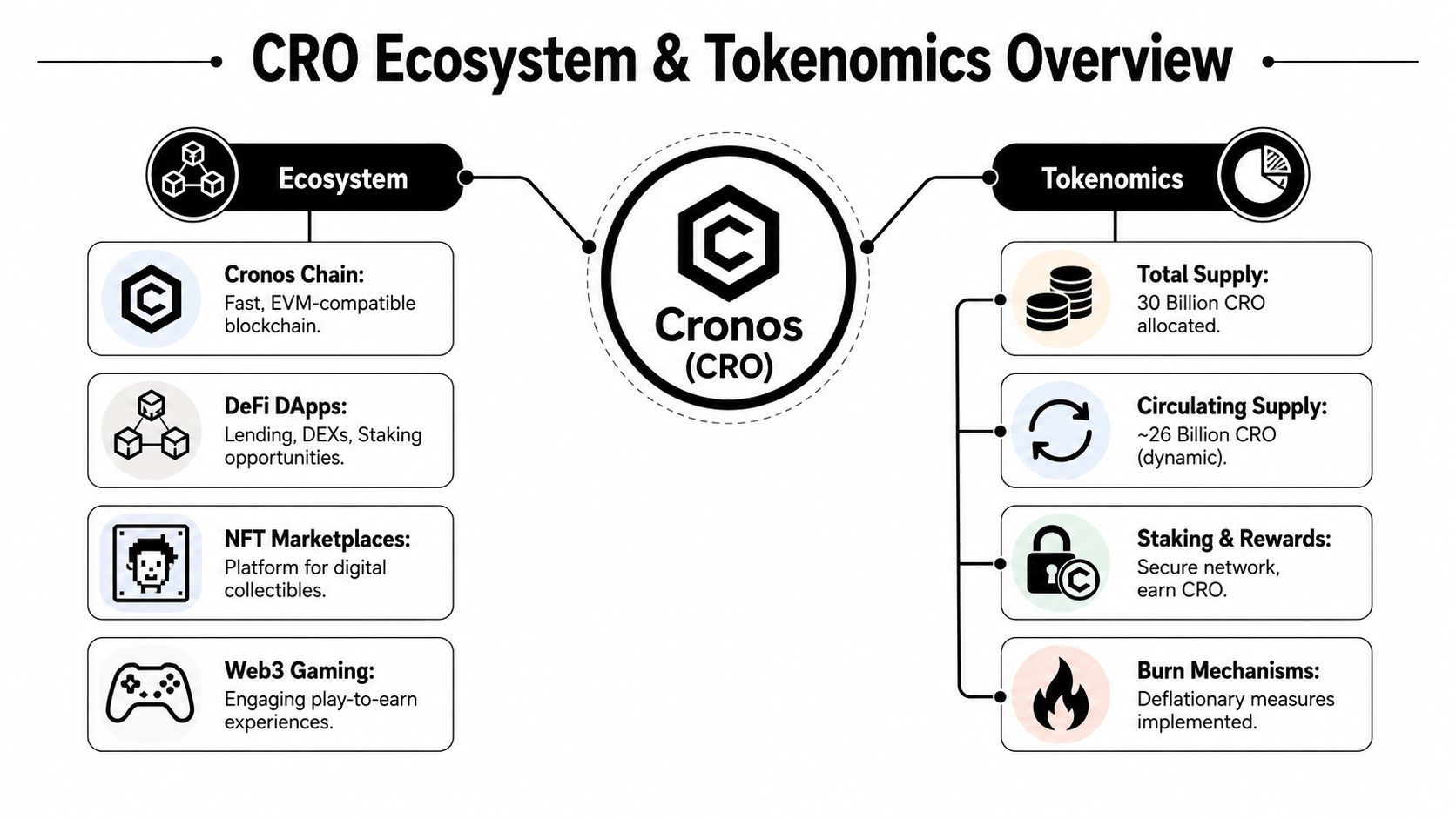
The infographic highlights supply allocation, circulating supply, staking, rewards, and burn mechanisms. Those variables influence how much CRO is available to trade at any given time and how strong holder incentives remain. Still, supply-side mechanics matter most when there is real competition for the token from users, validators, and applications. Without that, staking can look more like parked capital than productive network participation.
Scenario analysis offers a helpful perspective. In a bull case, dApp activity rises, more CRO gets used for gas and staking, and reduced liquid supply strengthens price sensitivity to demand. In a base case, Cronos keeps a stable niche tied to Crypto.com distribution, but on-chain growth stays moderate, which limits repricing. In a bear case, tokenomics remain intact while user activity stalls, and the market stops assigning a premium to supply design.
| Fundamental driver | Why it matters for CRO |
|---|---|
| Utility in smart contracts | Supports recurring on-chain use rather than one-off speculation |
| Staking participation | Can lower liquid supply if holders stay committed |
| DeFi and dApp retention | Signals whether network demand is organic and repeatable |
| Crypto.com ecosystem reach | Expands distribution and user acquisition beyond crypto-native traders |
The non-obvious conclusion is that CRO does not need to dominate the Layer 1 field to justify higher valuations. It needs to defend a credible niche where exchange distribution, consumer-facing products, and on-chain utility reinforce one another. If that flywheel strengthens, tokenomics can amplify the effect. If usage stays flat, tokenomics alone will not carry the thesis.
Technical Analysis and Current Market Sentiment
Nearly half of Cronos's widely watched momentum signals are neutral or conflicting right now. That matters because markets usually trend cleanly only when technicals and sentiment point in the same direction.
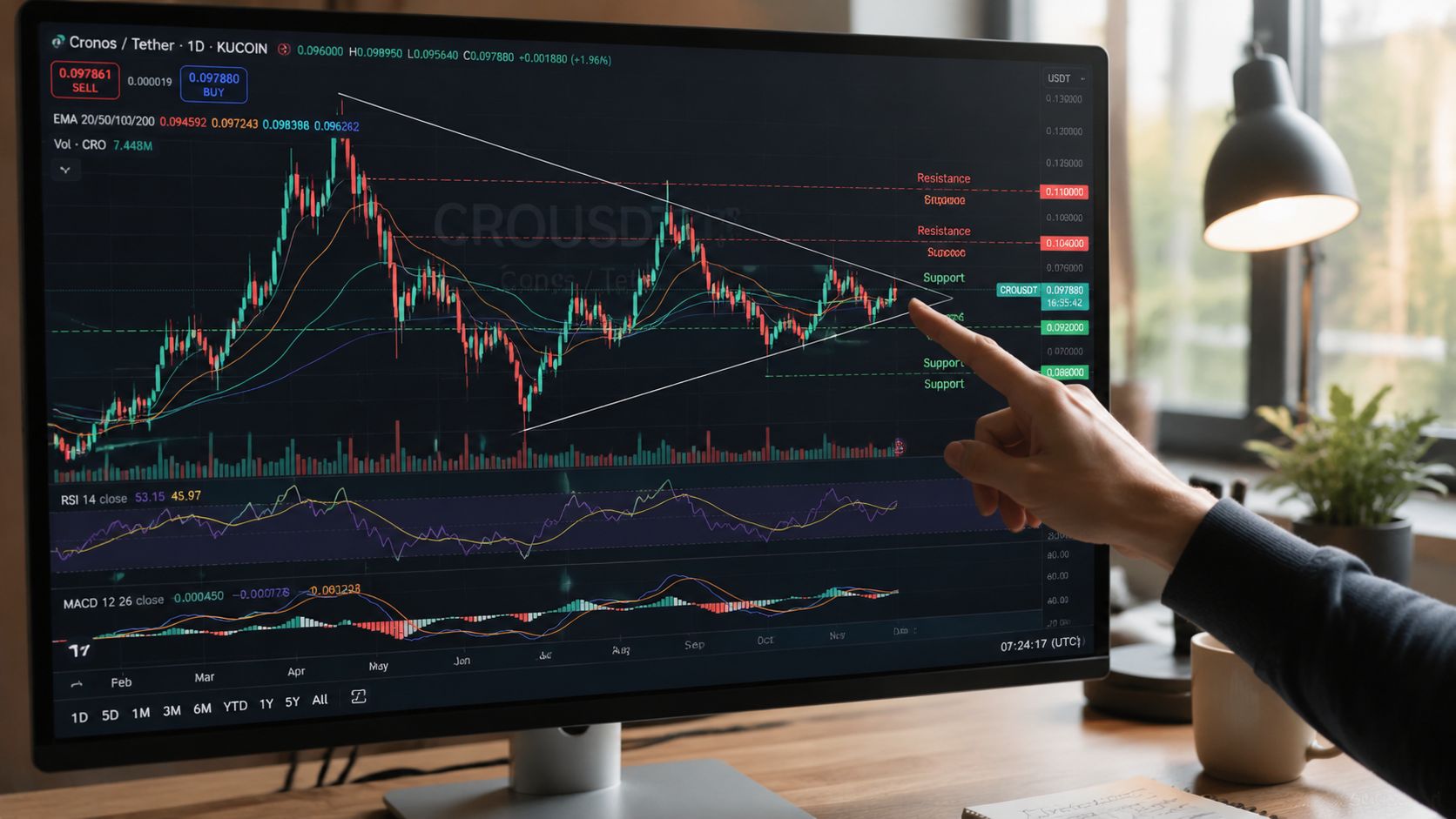
What the chart is saying now
According to Investing.com's Cronos technical indicators, RSI(14) is 49.95, which is neutral. STOCH is 33.365, marked sell. STOCHRSI is 15.871, which signals oversold conditions. MACD is 0, marked buy. Moving averages are split 6 buy vs 6 sell. The resistance area to watch is $0.06321 to $0.06554.
This setup points to consolidation, not trend confirmation. A neutral RSI suggests CRO is not stretched. Split moving averages show that short-term and medium-term trend signals still disagree. Oversold stochastic readings can support a bounce, but they often appear before conviction returns, not after it.
That distinction matters for scenario building. In a stronger market, oversold conditions near support can mark the start of a recovery leg. In a weaker market, the same readings often produce only brief relief rallies that fail near resistance.
For traders, the practical takeaway is simple. A clean move above the current resistance band would carry more weight than trying to predict a breakout early. If you actively manage entries and exits, that discipline fits well with broader crypto trading strategies.
How sentiment fits the picture
Sentiment appears cautious, and that caution lines up with the chart. Fearful positioning often creates short-term upside if sellers are exhausted, but it can also reflect a market that needs a fresh catalyst before buyers commit in size.
That is why mixed technicals should be read alongside sentiment rather than in isolation. Weak sentiment with stable support can become the base for a reversal. Weak sentiment with repeated rejection at resistance usually signals hesitation, not accumulation.
A measured reading is more useful than a dramatic one:
- Neutral-to-mixed momentum suggests CRO has not earned a trend call yet.
- Oversold signals increase the chance of a bounce, but not necessarily a durable reversal.
- Fearful sentiment can support upside if selling pressure fades, though it can also persist longer than traders expect.
Practical rule: When technicals are mixed and sentiment is weak, wait for confirmation through price structure, volume, or a clear reclaim of resistance.
This is also where many one-number forecasts go wrong. They treat every oversold reading as a bargain and every fear reading as a contrarian buy. A better approach is to ask what would need to change for the bull case to gain credibility, what would keep CRO range-bound, and what would invalidate the setup. At the moment, the chart supports caution more than conviction.
Cronos Crypto Price Prediction Scenarios 2026 to 2030
The best Cronos crypto price prediction is a set of scenarios tied to assumptions, not a single heroic target.
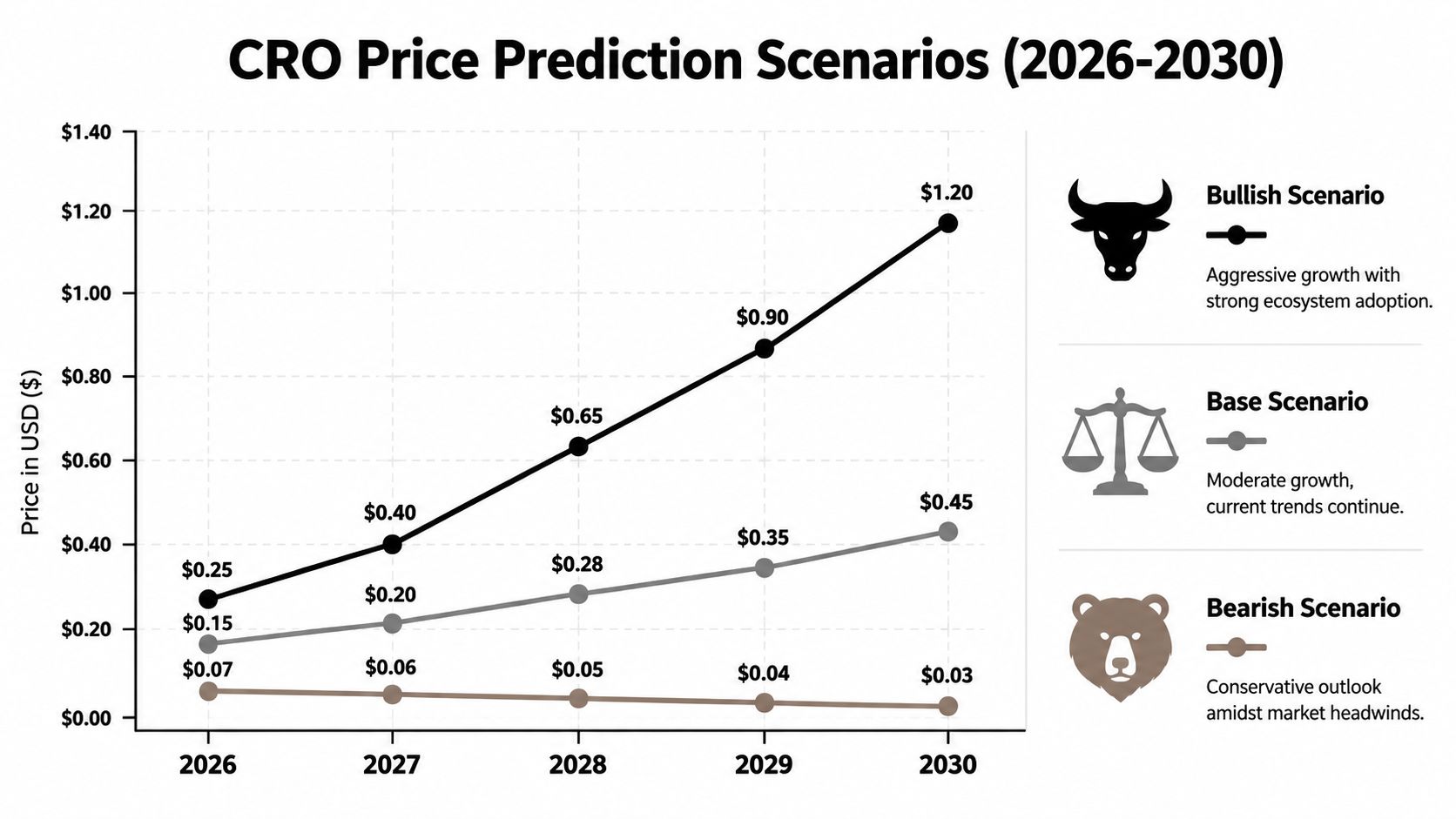
A visual summary helps frame the range:
Why CRO forecasts disagree so much
One reason prediction content is so messy is that published targets vary wildly. As noted in Rubic's survey of CRO forecasts, some sources project $1.08 by 2030, while more conservative models assume 5% annual growth and place CRO around $0.08 to $0.23 by 2030 to 2040. That gap isn't just disagreement. It reflects different assumptions about adoption, liquidity, cycle timing, and whether Cronos becomes a durable application layer or remains mostly narrative-driven.
That's why I prefer explicit scenarios.
Here's the embedded market commentary for additional context:
Scenario table for 2026 and 2030
| Scenario | Key Assumptions | 2026 Target | 2030 Target |
|---|---|---|---|
| Bear case | Cronos struggles to differentiate, ecosystem growth stays modest, and broader market conditions remain uneven | $0.07 | $0.03 |
| Base case | Steady dApp usage, respectable DeFi traction, and healthier cycle conditions support gradual rerating | $0.15 | $0.45 |
| Bull case | Strong ecosystem execution, better liquidity, narrative alignment around Web3 and tokenization, and sustained adoption push CRO into a stronger growth phase | $0.25 | $1.20 |
My read on the most realistic path
The bear case assumes Cronos remains relevant but not essential. In that world, the chain retains users yet fails to capture enough developer energy or application gravity to command a premium multiple. CRO doesn't collapse because it still has utility and brand association, but upside remains capped. This scenario is plausible if competing Layer 1 and Layer 2 ecosystems absorb most of the new capital and user attention.
The base case is the one I currently find most credible. It doesn't require perfect execution. It only requires Cronos to remain functional, improve its application layer, and benefit from a better market regime. In that setup, CRO can appreciate meaningfully without needing to revisit peak-hype conditions. This is the path where cautious optimism makes sense.
The bull case requires a lot to go right at once. Cronos would need stronger evidence of network activity, more compelling DeFi or tokenization use cases, and enough liquidity depth to support repricing. It's achievable in theory, but investors should treat it as an upside scenario, not a baseline expectation.
Two things stand out from these ranges.
First, the gap between scenarios constitutes the forecast. CRO is highly sensitive to execution and market mood. Second, the base and bull cases become much more believable if Cronos can prove that demand is coming from active users and builders, not only from brand familiarity.
Key Catalysts and Major Risk Factors for CRO
The next twelve months matter more for CRO than another round of distant price tables. What changes the token's trajectory isn't abstract optimism. It's whether key narratives turn into measurable ecosystem traction.
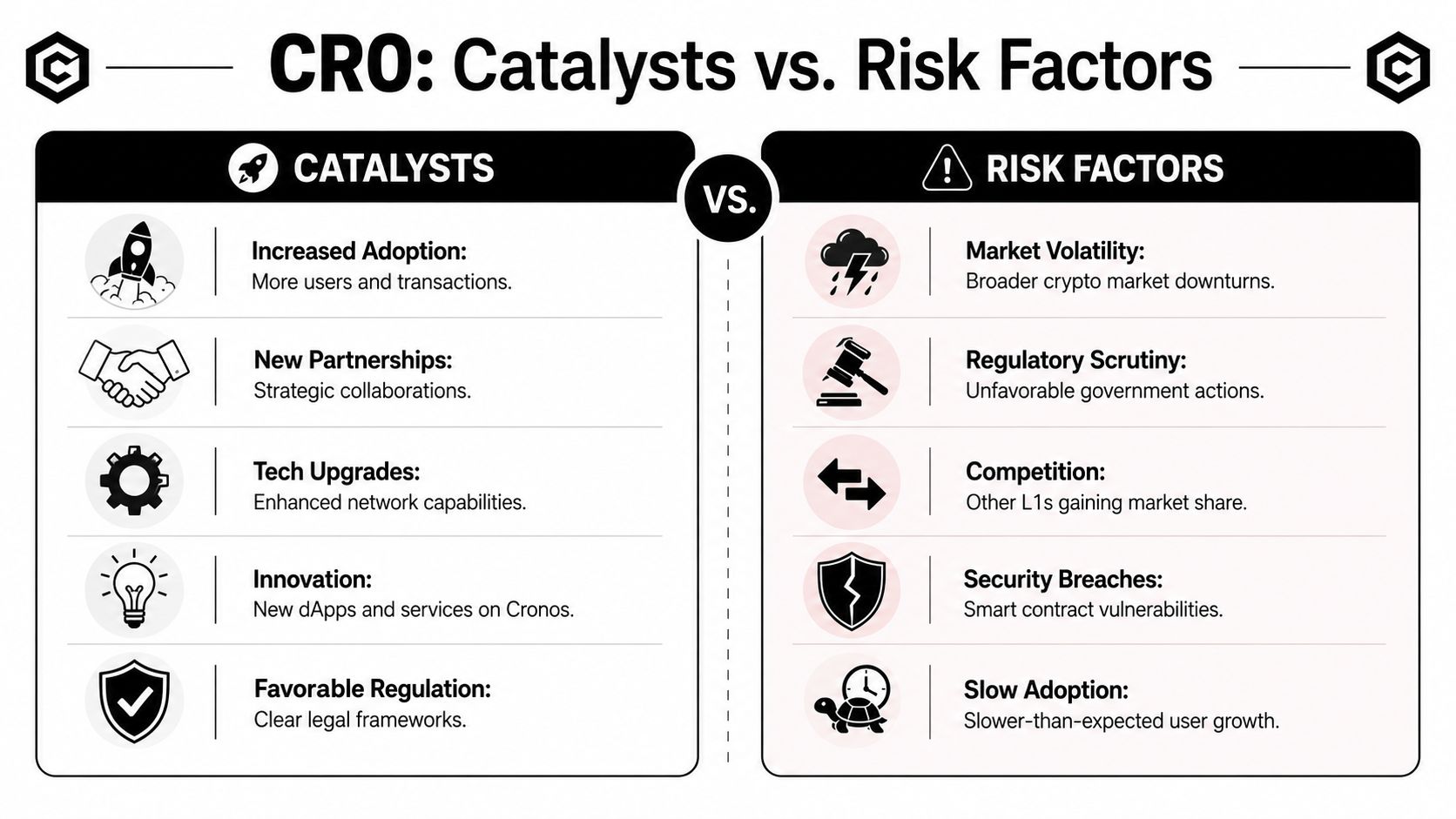
Catalysts worth monitoring closely
Late-2025 forecast coverage tied CRO upside to partnerships, roadmap execution, ETF speculation, and RWA tokenization, while also floating broad targets like $0.40 to $0.75 by end-2025, according to Phemex's review of CRO catalysts and forecasts. The problem is that these narratives aren't equally investable.
I'd split the upside drivers into two groups.
Potentially evidence-backed catalysts
- Roadmap execution: If Cronos ships useful improvements that make the chain easier for developers and users, that can lift real activity.
- Partnership quality: Strategic integrations matter when they produce wallets, transactions, or application usage.
- RWA tokenization: This is a serious theme across crypto because it connects blockchain rails to assets outside native crypto speculation.
- DeFi depth: Stronger lending, swapping, and staking activity would make CRO utility easier to justify.
More narrative-driven catalysts
- ETF speculation: It can move attention quickly, but it often runs ahead of fundamentals.
- Brand halo effects: Publicity helps, yet it doesn't automatically convert to sticky on-chain demand.
- Theme chasing: AI, Web3 consumer apps, and tokenization can all support sentiment, but only if Cronos captures actual builders and users.
If you're thinking through downside scenarios in the current cycle, it also helps to understand how assets behave in a broader cryptocurrency bear market environment.
Risks that could cap upside
CRO faces a familiar but serious set of risks:
- Competition gets tougher. Cronos isn't competing in a vacuum. It has to win attention against other smart contract chains and scaling ecosystems.
- Adoption can lag the story. A chain can have good branding and still fall short on user retention.
- Regulation can change the payoff profile. Favorable frameworks help. Unclear or restrictive rules can compress demand across the sector.
- Security and execution still matter. In DeFi and Web3, poor app quality or smart contract concerns can cool user activity fast.
Watch whether each bullish headline changes usage behavior. If it doesn't bring developers, liquidity, or transactions, it's mostly narrative.
My view is that Cronos has enough ecosystem logic to stay in the conversation. The risk is that it remains a secondary option rather than becoming a destination chain.
Final Verdict and Actionable Insights for Investors
A single headline can lift CRO for a few sessions. Sustained repricing usually needs something harder to fake: rising usage, durable liquidity, and evidence that Cronos is becoming more useful, not just more visible.
My conclusion is measured. CRO is more compelling as a scenario-based position than as a simple bet on a full return to prior-cycle valuations. That distinction matters because the bull, base, and bear cases in this article do not hinge on the same assumptions. The bullish path needs stronger ecosystem traction and better market conditions. The base case assumes slower progress with periodic bursts of sentiment. The bearish case reflects a chain that stays relevant but fails to become a clear destination for users and developers.
For long-term investors, the practical question is not whether Cronos can rally. It is whether the chain can convert brand recognition and exchange adjacency into repeat on-chain activity. If you hold that view, build the position around milestones you can track: application growth, DeFi participation, liquidity depth, and user retention. A thesis tied to those signals is easier to defend than one tied to old price memory.
Active traders need a different framework. CRO still looks like an asset that reacts sharply to sentiment shifts, which means entries matter more than conviction. As noted earlier, momentum has been mixed and confirmation still matters. That favors a rules-based approach around key levels and invalidation points, rather than assuming every bounce marks the start of a larger breakout.
Cautious newcomers should treat CRO as a speculative allocation with asymmetric outcomes. The upside case is real, but it depends on several things lining up at once: execution by the Cronos team, healthier risk appetite across crypto, and visible improvement in ecosystem usage. Small sizing and a clear reason for owning it are more sensible than chasing aggressive targets.
The most useful question is not “Can CRO go higher?” It is “What has to improve on-chain for a higher valuation to hold?”
That is the core investment takeaway. Cronos has credible upside into 2026, but the stronger case comes from measured ecosystem progress, not hype alone. Investors will likely make better decisions if they compare each new development against the three scenarios laid out earlier, then ask which assumptions are being validated and which are still missing.
Nothing here removes the underlying risk. Crypto remains volatile, and any CRO position should reflect your tolerance for drawdowns, time horizon, and confidence in the chain's ability to earn a larger role in the smart contract market.
If you want more balanced crypto analysis, practical guides, and plain-English breakdowns of Web3, DeFi, NFTs, Layer 2s, and emerging blockchain trends, visit Coiner Blog.