
Paris Blockchain Week 2026 The Complete Guide

You’re probably weighing the same trade-off most serious attendees face with paris blockchain week. Flights aren’t cheap, hotels around central Paris move fast, and every major crypto event promises “the room where it happens.” Most of them deliver noise, sponsor booths, and a calendar full of panels you could have watched later online.
Paris Blockchain Week is different when your goal is access, not entertainment.
What makes it worth serious attention in 2026 isn’t just branding or venue prestige. It’s the concentration of people working on regulation, institutional market structure, tokenization, custody, DeFi infrastructure, AI plus Web3 products, and the business side of scaling blockchain into the wider economy. If you want to leave with useful contacts, sharper theses, and a better read on where European digital assets are headed, this is one of the few events where preparation changes your outcome dramatically.
Table of Contents
- Why Paris Blockchain Week Is the Unmissable Web3 Event of 2026
- Key Dates Schedule and Venue for PBW 2026
- Navigating the Must-See Sessions for Your Niche
- A Practical Guide to Tickets Travel and Accommodation
- How to Network and Pitch Your Project Effectively
- Beyond the Conference Turning Connections into Capital
- Your On-Site Survival Guide and FAQs
Why Paris Blockchain Week Is the Unmissable Web3 Event of 2026
A lot of crypto conferences still run on old assumptions. Big crowd, louder branding, vague “future of Web3” panels, and very little signal once you strip away the production. Paris blockchain week has moved in the opposite direction. It has become a meeting point for people who can approve budgets, partnerships, listings, integrations, and compliance pathways.

That shift matters more in 2026 than it did a few years ago. Europe isn’t discussing blockchain as a speculative side market anymore. The live conversation now centers on digital asset infrastructure, regulated adoption, tokenization, stablecoins, custody, and how AI tools intersect with onchain systems.
Paris Blockchain Week has the credibility to host those conversations at a high level. It launched in 2019 and by 2025 had optimized for “decision density,” with over 70% C-level attendees, while drawing 10,000 decision-makers annually, according to the European Blockchain Association’s event profile. That’s the strongest practical reason to attend. You’re not just meeting enthusiasts. You’re meeting people who can say yes.
Why the attendee mix changes the value
If you're a founder, product positioning gets tested against institutional reality. If you're an investor, narratives meet compliance, operational constraints, and actual distribution channels. If you're a builder, you get a cleaner read on which parts of the stack are getting traction and which are still conference theater.
A useful way to think about PBW is this:
- For investors: it compresses market intelligence into a few days of conversations.
- For founders: it reveals whether your pitch survives contact with allocators and enterprise buyers.
- For operators: it shows where regulated Europe is setting expectations around digital assets.
- For technical teams: it exposes the gap between elegant architecture and deployable infrastructure.
Practical rule: Attend paris blockchain week if you need business leverage, not just content.
Another advantage is thematic overlap. You don’t need to be “just” a DeFi person or “just” an NFT person anymore. The best sessions often sit at the intersection of tokenization, AI tooling, compliance, Layer 2 design, and data privacy. That’s also why side reading on topics like zero-knowledge proofs in blockchain systems pays off before you arrive. The more context you bring, the better questions you ask, and the better rooms you end up in.
Key Dates Schedule and Venue for PBW 2026
The essential planning details are straightforward, but they matter because paris blockchain week tends to attract people who schedule tightly and move fast. If you wait too long to structure your trip, you’ll spend the event catching up instead of using it well.
According to Cryptoworth’s PBW 2026 overview, the 2026 edition is scheduled for April 14 to 16 at the Carrousel du Louvre, with projections of 9,500+ attendees and over 420 speakers from financial institutions, blockchain companies, and regulatory bodies worldwide. Treat that as a strong signal that the agenda will be broad, but your time shouldn’t be.
The dates that matter
Here’s the clean planning version:
- April 14: Arrival day and side-event positioning. Many attendees will use this window for private meetings and evening networking.
- April 15 to 16: Core summit activity. These are the days to guard your calendar carefully.
- During the event window: Startup activity, investor conversations, and informal dinners usually create as much value as the main stage.
The venue also shapes the experience. Carrousel du Louvre isn’t just a recognizable Paris location. It creates a central, high-traffic conference environment where hallway collisions are common and useful. That’s good for networking, but it also means you need a plan for where to take important conversations off the main flow.
How the event is usually structured in practice
Most attendees should think in three layers, not one:
Main summit sessions
Expect to hear the high-level positioning on regulation, institutional adoption, tokenization, stablecoins, Web3 product strategy, and AI integration.Exhibition and ecosystem floor
Good for quick reconnaissance. Less useful for deep conversation unless you’ve already booked a meeting.Startup and investor activity
Critical if you’re fundraising, scouting partnerships, hiring, or testing market appetite.
The biggest mistake at paris blockchain week is treating the agenda as the event. The real event is the combination of stage content, scheduled meetings, and the conversations that happen between them.
Build your calendar around energy, not just topics
Use a simple schedule filter before you arrive:
- Morning: reserve for highest-priority sessions or pre-booked meetings.
- Midday: keep space for walk-up intros and chance encounters.
- Late afternoon: use for deeper conversations once the exhibition traffic settles.
- Evening: focus on one dinner, one side event, or one focused meetup. Don’t try to collect invitations.
That approach works better than overloading your day. In Paris, transit is manageable, but moving between venues or social events still takes time. A calendar with breathing room beats a packed one every time.
Navigating the Must-See Sessions for Your Niche
The smartest way to handle paris blockchain week isn’t to chase famous speakers. It’s to match session themes to the actual problem you’re trying to solve. Investors need different rooms than protocol builders. NFT teams need different signals than compliance leaders. If you go in without that filter, you’ll hear plenty and retain little.
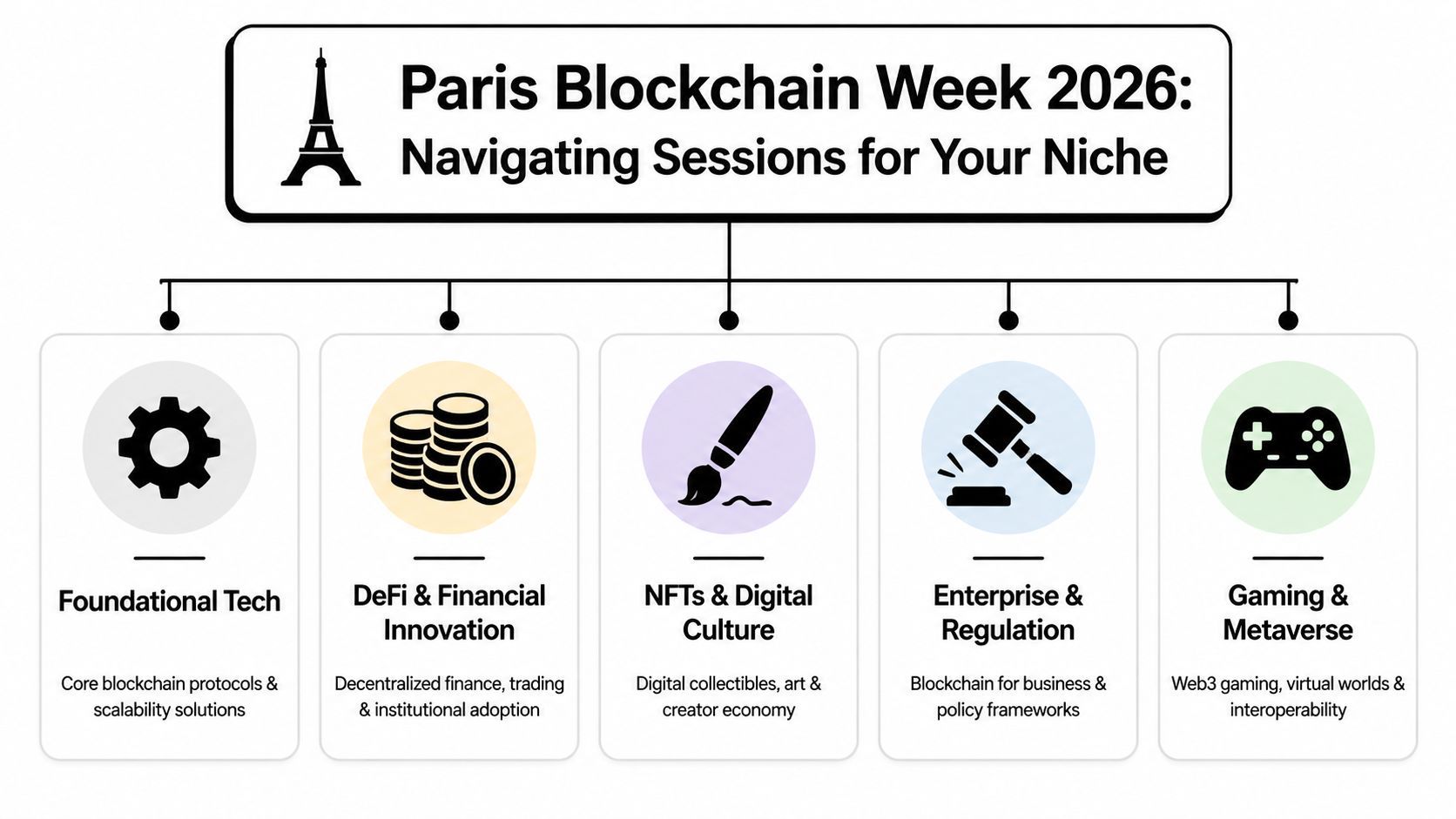
A major reason this event matters is the regulatory context around France and the wider European market. MiCA became fully effective in December 2024, and by Q1 2026 France had approved 12 digital asset service providers and launched €2.5B in tokenized RWAs, according to this PBW-related market analysis on MEXC. That gives many panels a practical edge. They’re not discussing regulation in the abstract. They’re discussing operating conditions.
For DeFi investors and tokenomics analysts
Look for sessions on stablecoin infrastructure, market structure, onchain credit, tokenization, and the institutional edge of DeFi rather than pure yield narratives.
What usually pays off:
- Panels on tokenized real-world assets: These help you understand where capital formation and regulated distribution may converge.
- Discussions around custody and compliance architecture: They reveal what it takes for capital to move onchain at scale.
- AI plus crypto sessions: Useful when they focus on workflow automation, risk systems, or data tooling instead of slogans.
What often disappoints:
- Broad “future of DeFi” panels with no discussion of settlement, governance risk, or legal packaging.
- Sessions that talk about adoption without naming the bottlenecks.
For builders working on infrastructure and smart contracts
Protocol engineers and product teams should prioritize sessions that expose implementation friction. That means Layer 2 scaling, interoperability, smart contract security, wallet UX, identity, and the boring operational pieces that users only notice when they fail.
A good builder session answers one of three questions:
- What can ship in regulated markets?
- What can scale without breaking user experience?
- What can integrate into systems that already exist?
That’s where adjacent reading such as the future of cryptography for blockchain builders becomes useful. PBW discussions often assume you already understand the difference between elegant design and production-grade cryptographic infrastructure.
Don’t judge a session by how advanced it sounds. Judge it by whether it helps you make a product, architecture, or integration decision.
For NFT GameFi and Web3 gaming teams
Gaming and digital culture teams need to be selective. A lot of conference content still underweights the operational realities of Web3 gaming, creator economics, Layer 2 cost structure, and sustainable in-game tokenomics.
The sessions worth your time usually sit at the intersection of:
- Digital ownership
- Interoperability
- Marketplace design
- Creator monetization
- User onboarding without heavy wallet friction
Skip panels that use “metaverse” as a branding shortcut but never talk about retention, liquidity loops, or cross-platform utility.
For institutions compliance teams and market operators
Paris Blockchain Week distinguishes itself. If you work at a bank, asset manager, exchange, payments firm, or legal and policy function, the strongest sessions will likely be on MiCA, digital asset servicing, tokenization rails, and the integration of blockchain within existing financial systems.
Those rooms usually produce the clearest practical value because attendees ask harder questions. Not “Will institutions come?” but “What does custody architecture look like under actual supervision?” Not “Is tokenization big?” but “Which assets, wrappers, controls, and reporting structures are realistic?”
That’s where PBW earns its reputation.
A Practical Guide to Tickets Travel and Accommodation
The logistics around paris blockchain week can either support your ROI or damage it. Ticket choice affects who you can meet and how much flexibility you have. Where you stay affects your energy, your punctuality, and whether you’ll accept or decline last-minute dinners that turn into useful relationships.
Choosing the right pass
The official pass structure can change, and pricing can move over time. Don’t lock your decision around assumptions from older editions. Compare access based on your goal, not your ego.
| Paris Blockchain Week 2026 Ticket Comparison | Estimated Price | Key Benefits |
|---|---|---|
| General | Check official event sales page | Main conference access, standard sessions, expo access |
| Pro | Check official event sales page | Broader networking access, stronger fit for active operators and founders |
| VIP | Check official event sales page | Best fit for attendees prioritizing premium networking environments and high-level access |
How to choose:
- Go General if your main objective is learning, trend-mapping, and making a limited number of organic connections.
- Go Pro if you already know you need structured networking and more room to work the event seriously.
- Go VIP if you’re raising capital, managing a portfolio, representing a fund, or know that private-access environments are where your best conversations happen.
If you’re unsure, decide based on one question. Will restricted access block the meetings you need? If yes, pay for access. If no, keep budget for lodging and dinners instead.
Travel strategy that actually reduces friction
Paris is easy to reach and not always easy to get around effectively if you overcomplicate your plan.
Use these working rules:
- Fly in early if possible: Arriving the night before your first serious meeting reduces the risk of spending day one recovering from travel delays.
- Prioritize predictable transit: Metro access often beats car reliance around central event traffic.
- Keep one backup route: Paris transit is efficient, but strikes, congestion, and event clustering can still disrupt timing.
For most attendees, the best move is simple. Stay central enough to avoid long commutes, but not so close that you pay a premium you don’t need.
Where to stay for convenience versus cost control
There are two workable accommodation strategies.
Stay close to the venue
This works best for speakers, founders with packed calendars, investors running back-to-back meetings, and anyone attending morning side events plus late dinners.
Pros:
- Short commute
- Easier wardrobe changes or device charging runs
- Better flexibility for spontaneous meetings
Cons:
- Higher room cost
- More competition for good hotels
- More noise and event spillover
Stay slightly outside the center with strong transit
This works for solo attendees, technical teams, and anyone who values budget control over convenience.
Pros:
- Better room value
- Often calmer at night
- More options if you book later
Cons:
- Less flexibility between sessions
- Harder to squeeze in quick off-calendar meetings
- Easier to skip useful evening events because the return trip feels annoying
Your hotel is part of your conference strategy. If your day depends on five-minute pivots, convenience matters more than saving a little on the room.
A few practical choices help regardless of location:
- Book a cancellable rate first: You can optimize later.
- Check walk time to a Metro station: Don’t just look at a map radius.
- Make sure your room setup supports work: Reliable Wi-Fi and a decent desk matter if you’re doing follow-ups each night.
How to Network and Pitch Your Project Effectively
Many attendees go to paris blockchain week with a networking plan that’s too vague. They want to “meet investors,” “find partners,” or “get visibility.” That isn’t a strategy. Good event networking is more like pipeline management. You identify targets, book early, control your positioning, and make follow-up easy.

Networking before you arrive
The highest-value meetings are usually set before badge pickup.
Do this before travel:
- Build a target list: Investors, market makers, potential clients, wallet partners, compliance advisors, builders, or gaming studios.
- Write a short message template: Two sentences on who you are, one sentence on why the meeting is relevant now.
- Use LinkedIn and the event app if available: Don’t rely on random booth walk-ups.
- Book around anchors: Coffee before the venue opens, lunch windows, and late-afternoon quieter slots often work better than trying to grab someone after a packed keynote.
What works is specificity. “We’re building omnichain infrastructure for creator economies and want feedback on EU distribution assumptions” gets better responses than “Would love to connect.”
How to pitch without sounding like everyone else
Founders often lose the room by pitching features before they establish context.
A better event pitch has three parts:
- What problem you solve
- Who feels that problem most
- Why your approach is credible now
Keep it conversational. No one wants your full deck in a hallway.
Good:
- “We help gaming studios add digital ownership without forcing users through clunky wallet onboarding.”
Weak:
- “We’re a revolutionary AI-powered Web3 ecosystem redefining engagement.”
If you're in NFT, metaverse, or gaming verticals, sharpen your category language beforehand. The fastest way to get dismissed is to sound trend-led and fuzzy. It helps to know how your work fits into adjacent areas like crypto gaming and Web3 economies.
Say less, but make each sentence do work. Conference pitches fail when they try to prove everything at once.
Here’s a useful session clip to review before you practice your conversations:
Using Start in Block as a visibility engine
For startups, Start in Block is more than a side attraction. According to the official startup competition page, it offers $10,000,000 in aggregate prize capital. Even if you don’t win, the format matters because it concentrates investor attention, public scrutiny, and comparative positioning in a short timeframe.
That creates several practical advantages:
- Signal: If you make progress in the competition, people assume your project is worth a closer look.
- Feedback: Judges and side conversations often reveal what experienced buyers or allocators still don’t understand about your product.
- Momentum: It gives you a reason to re-contact people after the event.
If you apply, optimize for clarity over ambition. Judges see many projects. The teams that stand out usually explain one painful problem cleanly, show why they can solve it, and avoid bloated roadmaps.
Beyond the Conference Turning Connections into Capital
The event isn’t the finish line. It’s the sorting mechanism. Paris blockchain week gives you a compressed environment where interest surfaces quickly, but value only compounds if you run a disciplined follow-up process after you leave.
That matters because real outcomes do happen. Paris Blockchain Week’s own cited analysis of PBW 2025 outcomes says 15% of participating French blockchain startups secured over €150M in VC funding from institutional attendees. The lesson isn’t that everyone should expect funding. The lesson is that conference relationships can convert when the post-event work is handled well.
The follow-up window that matters most
The best follow-up starts while the event is still fresh.
Use a three-bucket system each night:
- Hot contacts: People who requested a deck, next meeting, intro, or proposal
- Warm contacts: Useful conversations with clear future relevance
- Watchlist contacts: Interesting people with no immediate next step
Then follow up with different messages for each. Don’t send the same “great meeting you” note to everyone.
A strong follow-up email or DM should include:
- where you met
- the topic you discussed
- the exact next step
- one useful asset, such as a deck, memo, product screenshot, or short note
Most conference follow-up fails because it asks for too much or says too little. Make the next step obvious and light.
Turn conference notes into decisions
The other post-event mistake is treating notes like souvenirs. They should become operating inputs.
Review your notes through these lenses:
- Market thesis: Did sessions change your view on DeFi, tokenization, AI plus crypto, or Layer 2 adoption?
- Product roadmap: Did buyers repeat the same objection or requirement?
- Partnership fit: Which conversations showed real commercial overlap?
- Risk mapping: Which compliance or security issues came up repeatedly?
If you trade or allocate capital personally, turn those observations into written scenarios rather than impulse moves. A conference can sharpen a thesis, but it can also create excitement bias. Good investors separate useful conviction from event-driven FOMO. That discipline is similar to the mindset behind better trading strategies in volatile crypto markets.
Keep momentum by checking for session replays, slide decks, official recaps, and speaker posts after the event. Some of your most useful takeaways won’t be obvious until you review them outside the conference rush.
Your On-Site Survival Guide and FAQs
A good paris blockchain week plan can still break down on site if you ignore the basic mechanics. Low phone battery, bad shoes, no meeting notes, and poor security habits ruin more conference value than is commonly recognized.
What to carry and what to skip
Pack for movement, not for style points alone.
Bring:
- Comfortable business casual clothing: You’ll likely move more than expected.
- A power bank: Your phone is your map, badge companion, calendar, and networking tool.
- Water and light snacks: Event days run long.
- Digital business card or NFC setup: Faster than searching for profile links in a loud hallway.
- Compact notebook or notes app system: Use whatever you’ll review later.
Skip:
- Heavy bags: You’ll regret them by midday.
- Printed decks: Almost nobody wants them.
- Overcomplicated swag or promo items: They rarely survive the trip home.
Security matters too. Use common-sense conference hygiene. Lock devices, verify who you’re talking to before sharing sensitive product details, and avoid discussing treasury, security architecture, or wallet permissions casually. If your work touches infrastructure, custody, or protocol operations, a strong grounding in blockchain security practices isn’t optional.
FAQ for first-time and repeat attendees
Is paris blockchain week beginner-friendly
Yes, if you arrive with clear goals. Beginners can get a lot from major sessions, ecosystem exposure, and general networking. The key is not trying to absorb every topic at once. Pick two or three themes and stay focused.
Can side events be more valuable than the main conference
Sometimes, yes. Smaller dinners, meetups, and private gatherings often produce better conversations than crowded expo hours. The best approach is balance. Use the summit for signal and the side events for depth.
Should you attend every keynote
No. Some keynotes are useful for macro framing and speaker access. Others are better reviewed later if recordings become available. Don’t sacrifice a high-value meeting for a session you can summarize from public coverage afterward.
What should you wear
Business casual works best in most cases. Founders and builders can dress slightly more relaxed, but polished still helps. Comfortable shoes matter more than most first-timers expect.
Is it worth attending if you’re not fundraising
Yes, if your goal is intelligence, partnerships, hiring, distribution, compliance understanding, or product feedback. Not every strong conference outcome is capital. Often the better result is finding the person who removes your next bottleneck.
What’s the most common mistake on site
Trying to do too much. The strongest attendees protect their energy, leave room for chance conversations, and know which meetings matter most.
A final practical checklist helps:
- Confirm meetings each morning
- Charge everything overnight
- Screenshot important QR codes and tickets
- Write follow-up notes immediately after strong conversations
- Leave one gap in your afternoon schedule for the unexpected
If you want more practical crypto guides, market analysis, and grounded takes on Web3, NFTs, DeFi, tokenomics, AI integration, and blockchain infrastructure, follow Coiner Blog for upcoming articles and updates.
1 Comment