
Options Trading Cryptocurrency: A Complete 2026 Guide

Crypto options still look niche if you compare them with spot and futures, but that's exactly why they matter now. In the 12 months through May 2025, global crypto options trading averaged about $3 billion in daily volume, while centralized exchanges pushed average monthly volume from $83 billion in May 2024 to $123 billion in May 2025, a 48% increase according to Crypto.com's crypto options market review. That combination matters. It says the market is no longer a curiosity, but it's also not so saturated that retail traders can't still gain an edge by learning the mechanics properly.
Traders often enter crypto through spot, then graduate to perpetuals, and only later notice options sitting in the corner like the advanced desk at a trading firm. That's backwards. If you care about risk, defined downside, hedging a volatile portfolio, or generating structured income, options trading cryptocurrency deserves attention much earlier.
A lot of newcomers also arrive with the wrong mental model. They think options are just “amplified bets.” Sometimes they are. More often, they're closer to precision tools. You can use them to cap downside during a rough market phase, shape a directional trade without owning more tokens, or collect premium against assets you already hold. If you've spent time navigating a cryptocurrency bear market, you already know why flexible risk tools matter.
Table of Contents
- Welcome to the Next Frontier of Crypto Trading
- The Building Blocks of Crypto Options
- Decoding Option Prices The Greeks Explained
- Practical Trading Strategies and Use Cases
- Choosing Your Arena CEX vs DeFi Platforms
- Advanced Risk Management and Tax Considerations
- Your Quick-Start Checklist to Your First Trade
- Frequently Asked Questions About Crypto Options
Welcome to the Next Frontier of Crypto Trading
Spot trading teaches you direction. Options teach you structure.
That's the shift. In spot, your choices are blunt. Buy, sell, hold, maybe rebalance. In crypto options, you can shape a trade around time, volatility, and downside tolerance. You stop asking only, “Will BTC go up?” and start asking, “How far, by when, and what if I'm wrong?”
Retail traders often assume this is institutional territory because the terminology sounds dense and the interfaces look technical. But the product itself is straightforward once you focus on what hits your actual P&L. You pay a premium for a defined right. You choose a strike. You choose an expiry. After that, time and price do the rest.
Practical rule: If you can explain your payoff at expiry in one sentence, you probably understand the trade. If you can't, you're renting complexity you don't control.
This is also where options fit into the broader crypto stack. In Web3 and DeFi, traders increasingly want modular tools that behave more like programmable risk layers than simple buy-and-sell instruments. That aligns with how more advanced participants already think about smart contracts, tokenomics, and Layer 2 execution. The options mindset is native to that world. You define conditions, limit damage, and optimize for specific scenarios.
The catch is that most education stops too early. It explains calls and puts, then jumps straight to “bullish” or “bearish” examples. The missing part is trade mechanics. How you enter matters. How the exchange settles matters. Whether your contract is cash-settled or physically settled matters. Those details decide whether a trade that looked right on paper produces the result you expected.
The Building Blocks of Crypto Options
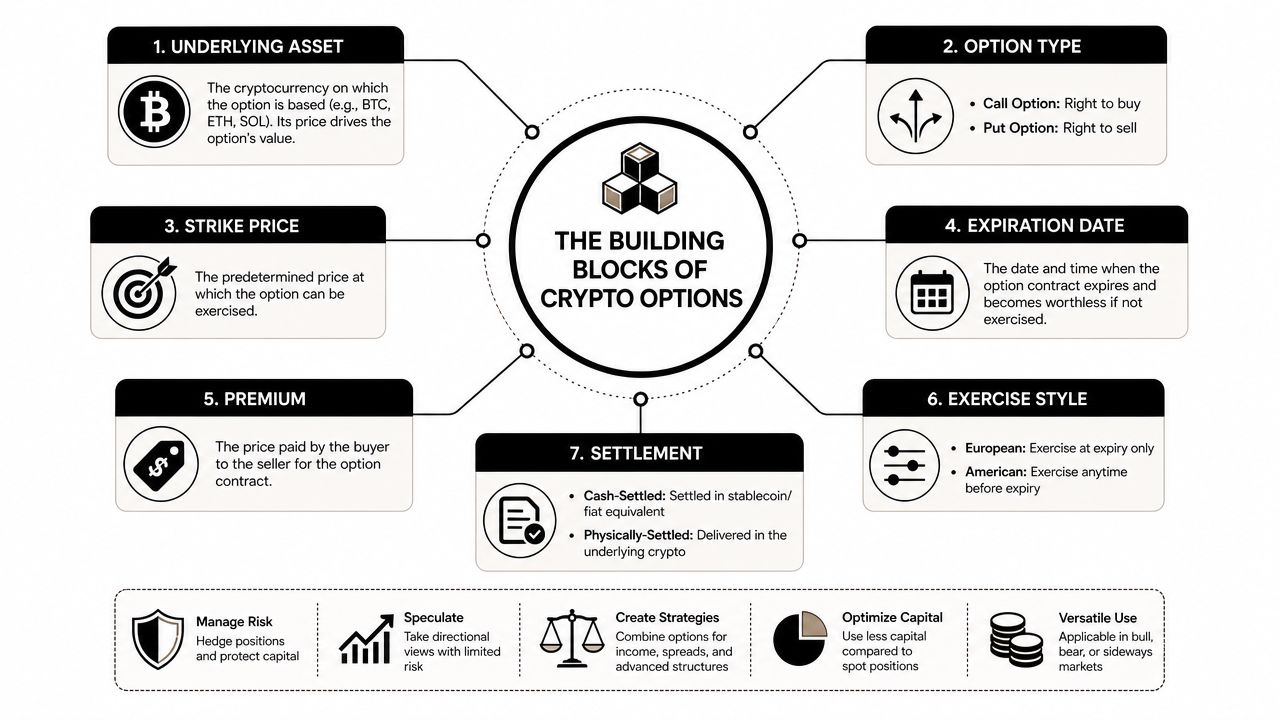
The fastest way to get comfortable with options trading cryptocurrency is to stop treating contracts like abstract finance jargon. A crypto option is just a standardized agreement with a few moving parts that determine your rights and your risk.
According to Amberdata's crypto options primer, crypto options are standardized derivatives that give the buyer the right, but not the obligation, to buy or sell a specified quantity of an underlying crypto asset at a fixed strike price before or at expiration. The premium is the trader's maximum loss if the option expires worthless. That last part is the anchor. Buyers know their worst-case loss up front.
What a contract actually gives you
A call option gives you the right to buy the underlying at the strike price. Traders use calls when they want upside exposure with defined downside.
A put option gives you the right to sell the underlying at the strike price. Think of a put like insurance on a portfolio. If you hold BTC or ETH and worry about a drawdown, a put can offset part of that pain.
The useful beginner distinction is this:
- Buying options means you're paying for a right.
- Selling options means you're collecting premium in exchange for taking on an obligation.
That obligation is where many new traders get sloppy. Buying a call can expire worthless and your loss is the premium you paid. Selling a naked call is a different animal entirely. You've moved from controlled risk to open-ended exposure.
If you need a refresher on how underlying blockchain assets and market rails work, this guide to blockchain technology basics helps connect derivatives back to the assets they reference.
The terms that control your payout
Three contract terms matter most on day one.
- Strike price: The price level written into the contract.
- Expiration date: The last day the option remains alive under that contract's rules.
- Premium: The upfront price paid by the buyer to enter the trade.
A simple way to think about it is booking a hotel room with cancellation rules. The strike is your reserved rate. The expiry is the last valid day of the reservation. The premium is the non-refundable amount you paid for flexibility.
A good options trader doesn't just ask whether price will move. They ask whether price will move far enough, fast enough, to beat the premium they paid.
That last point matters more than most beginners realize. You can correctly predict direction and still lose money if the move is too small or arrives too late.
Settlement changes the real outcome
Many explainers stop just before the part that affects your account balance.
Cash-settled options pay the value difference at expiry in cash or a cash-equivalent balance, depending on venue rules. You don't receive the underlying coin. You receive the contract's settled value.
Physically settled options can result in delivery of the underlying asset if exercised or assigned, again depending on venue design. That changes how much inventory, collateral, and balance-sheet exposure you carry after expiry.
Here's why that matters in practice:
- Cash-settled contracts: Cleaner for traders who want exposure without handling the asset after expiry.
- Physically settled contracts: More relevant if you want the asset itself or need it for a broader trading book.
- Exercise style and venue rules: These determine whether exercise happens automatically, whether early exercise is possible, and how assignment works if you sold the contract.
For a buyer, the expiry-day decision tree is usually simple. If the contract has no value at expiry, it expires worthless and the premium is gone. If it has value, the exchange's settlement rules determine whether that value turns into a cash credit or a position in the underlying.
For a seller, settlement mechanics matter even more because assignment can turn an options position into a spot or futures exposure you didn't plan to hold overnight.
Decoding Option Prices The Greeks Explained
A new trader usually sees an options chain and asks one question: why is this contract so much more expensive than that one when the strike looks similar?
The answer sits in volatility, time, and sensitivity. dYdX's crypto options overview notes that Bitcoin crypto options monthly volumes have regularly ranged between about $10 billion and $35 billion, and that deeper markets generally narrow bid-ask spreads and improve execution. The same overview also points out that premium pricing is highly sensitive to volatility and time decay, which is why two contracts with the same strike can trade very differently.
Start with the visual map below, then tie it back to live execution.
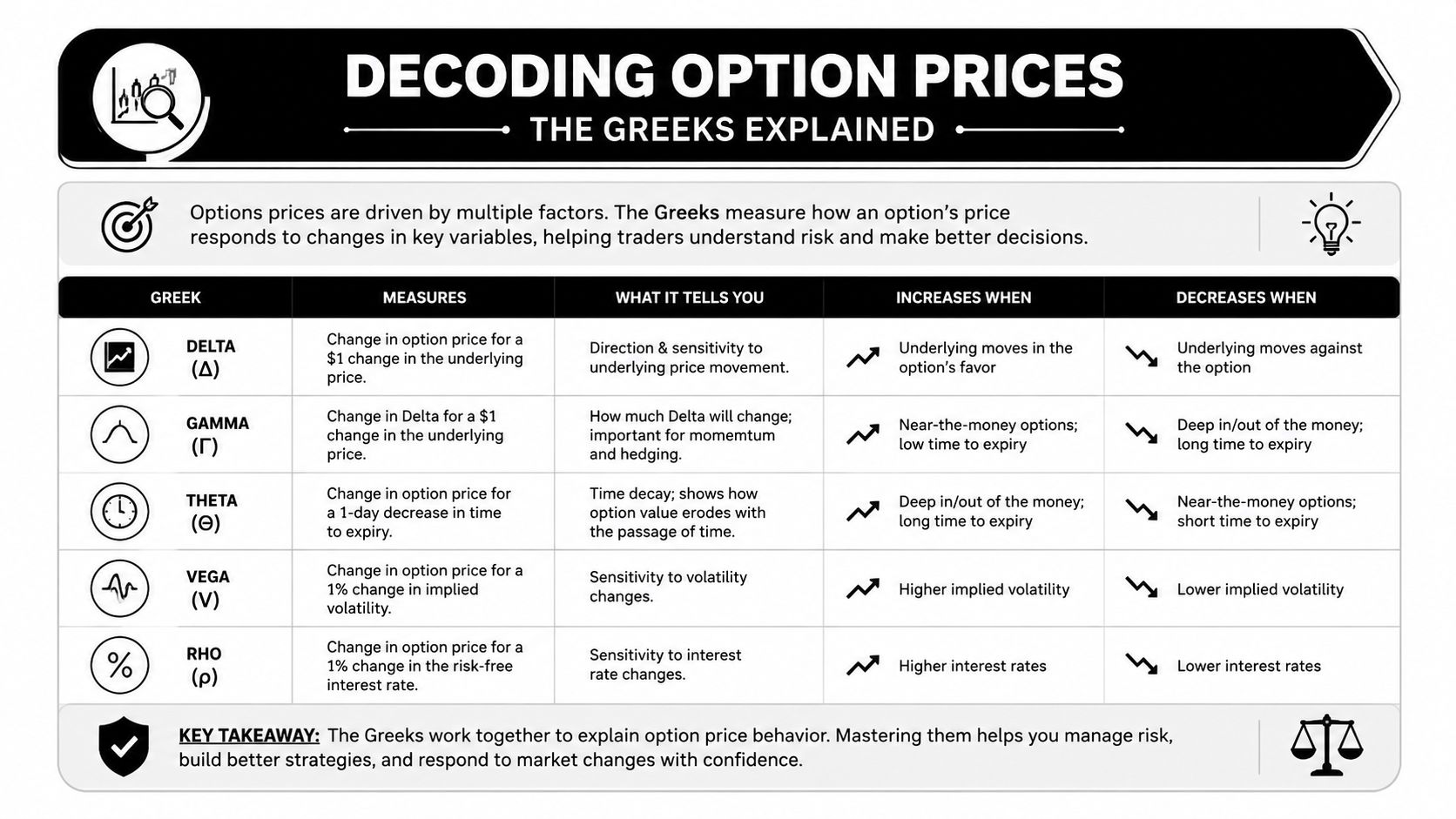
Why the same strike can trade at different prices
An option premium isn't just a bet on direction. It's the price of possibility.
If expiry is far away, the contract has more time for the trade to work. If implied volatility rises, the market is pricing in a wider range of future moves. That makes optionality more valuable. Short-dated contracts with little time left behave differently because the clock starts pressing on every decision.
The practical takeaway is simple. Don't compare premiums in isolation. Compare them in context:
- Time left: More time usually means more premium.
- Implied volatility: Higher implied volatility often means a richer contract.
- Liquidity: Better turnover usually means cleaner fills and less slippage.
- Moneyness: A contract already close to profitable behaves differently from one that needs a large move.
Here's a useful explainer for newer desks before going deeper into the math.
The Greeks that matter in live trading
You don't need to become a quant to use the Greeks well. You need to read them like dashboard instruments.
Delta tells you how responsive the option is to moves in the underlying. If BTC moves and your option barely reacts, delta explains why.
Gamma shows how fast delta itself changes. Gamma matters most when markets move quickly and your position starts changing character faster than you expected.
Theta is the daily drag from time passing. Buyers feel theta as decay. Sellers often benefit from it, assuming price and volatility don't move against them.
Vega measures sensitivity to implied volatility. If the market gets nervous, options can get more expensive even before the underlying moves much.
Desk habit: Before entering a long option, check whether you're paying mostly for direction or mostly for volatility. Those are not the same trade.
How execution quality changes your edge
Execution doesn't get enough attention in beginner guides. It should.
When the market is deep, spreads are tighter and it's easier to build positions without donating edge to the order book. That matters even more in multi-leg trades like vertical spreads or iron condors, where a poor fill on one leg can distort the entire setup.
What works in practice:
- Use limit orders: Market orders can punish you in thinner books.
- Check open interest and turnover: Thin contracts often look cheap until you try to exit.
- Avoid random strike selection: Pick strikes that match a specific thesis on direction or volatility.
- Respect theta near expiry: Short-dated lottery tickets decay brutally if the move stalls.
What usually doesn't work is buying far out-of-the-money options just because the premium feels inexpensive. Cheap contracts often stay cheap for a reason.
Practical Trading Strategies and Use Cases
Options become useful when you stop asking, “What's the best strategy?” and start asking, “What problem am I solving?”
That's how experienced traders frame them. Coinmetro's overview of crypto options strategies and platforms reflects the same shift. Exchanges and educators increasingly position options around volatility, portfolio hedging, and income generation from selling contracts like covered calls, rather than pure speculation. That's a healthier way to use the product.
Protective put for downside defense
You own spot crypto and want to stay in the position, but you don't want an unprotected drawdown. A protective put is the cleanest answer.
You hold the asset and buy a put underneath it. If price falls hard, the put gains value and helps offset the drop. If price rallies, your put may expire worthless, but your spot position benefits.
This trade works best when you want to remain invested through uncertainty, not when you're already planning to sell the underlying.
Covered call for disciplined income
You already hold a coin and would be comfortable selling it at a higher price. A covered call turns that willingness into premium income.
You hold the asset, then sell a call against it at a strike where you'd be satisfied exiting. If price stays below the strike through expiry, you keep the premium. If price rises above it, your upside is capped because you may be assigned or otherwise settled according to venue rules.
This is one of the few strategies many ordinary investors can use sensibly, provided they accept the capped upside. People get frustrated with covered calls when they say they want income but emotionally react like long-only holders the moment the asset rallies through the strike.
Long straddle for volatility events
Sometimes your edge isn't direction. It's movement.
A long straddle means buying a call and a put at the same strike and expiry. You're paying for the chance that the market makes a large move in either direction. This can make sense around major catalysts, policy shifts, scheduled token releases, protocol governance moments, or big macro events that affect crypto broadly.
The risk is straightforward. If the move is muted, both options lose value through time decay and the total premium outlay can shrink quickly.
Here's a side-by-side view.
| Strategy | Goal | Ideal Market | Max Risk | Who It's For |
|---|---|---|---|---|
| Protective Put | Hedge a spot holding | Uncertain or bearish near term | Premium paid for the put | Spot holders who want downside protection |
| Covered Call | Generate income on held crypto | Neutral to mildly bullish | Opportunity cost from capped upside, plus downside in the held asset | Investors already willing to sell at a target level |
| Long Straddle | Trade a large move either way | High-event, high-uncertainty conditions | Total premium paid for both options | Traders with a volatility thesis |
A few rules separate solid strategy use from random experimentation:
- Match the strategy to the portfolio: Don't sell calls on assets you aren't willing to part with.
- Know the trade-off: A hedge costs money. Income strategies cap something in return.
- Define the exit before entry: Will you hold to expiry, close early, or roll?
- Start with one-leg logic: If you don't understand a single option cleanly, don't jump to a multi-leg structure.
If you want a broader directional framework before adding derivatives, this guide on the best strategies for trading helps clarify when options improve a plan and when they only complicate it.
Choosing Your Arena CEX vs DeFi Platforms
Where you trade options matters almost as much as what you trade.
The platform determines liquidity, custody model, settlement experience, collateral handling, and the speed at which you can adjust risk. In crypto, that choice often comes down to centralized exchanges versus DeFi options platforms built into the broader Web3 stack.
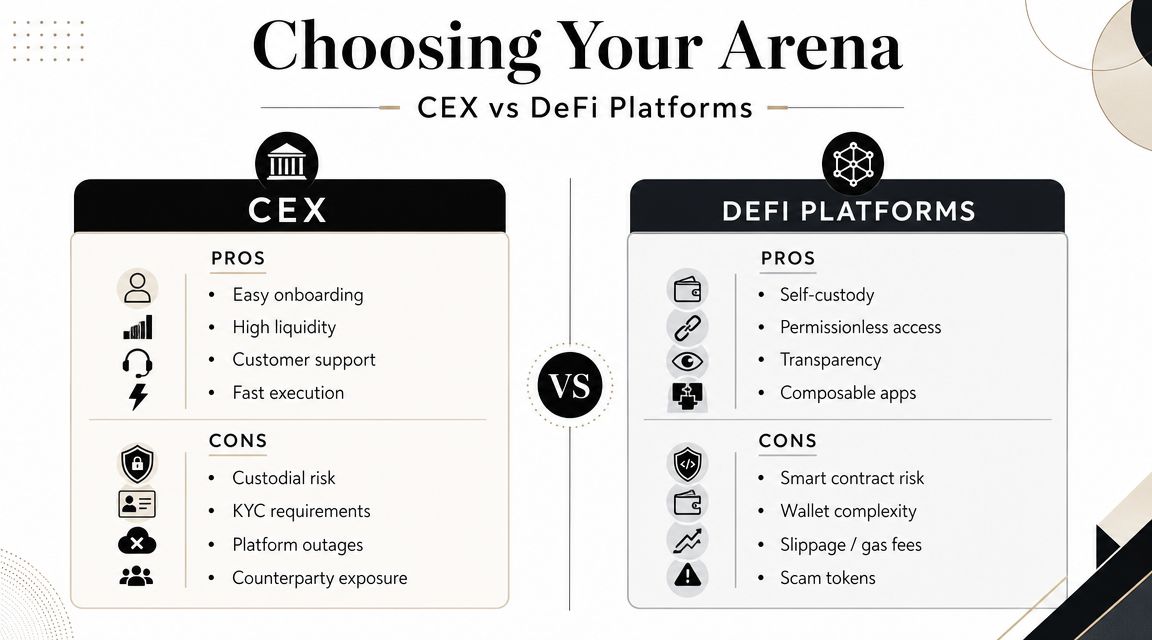
Why many traders still choose centralized venues
For active options trading cryptocurrency, centralized venues usually offer the smoother professional workflow.
The interface is often better, order books are typically deeper, and complex order handling is more familiar to anyone who has traded futures or traditional options. That matters when you care about execution, not just access.
You also usually get:
- More extensive market structure: Better chain visibility, more strikes, and more expiries.
- Faster adjustments: Easier rolling, closing, and repositioning under pressure.
- Simpler onboarding for new traders: Less wallet friction and fewer on-chain steps.
The downside is custody. You're trusting the exchange with funds and operational controls. That can be acceptable for many traders, but it's still a trade-off.
If you want to understand why market depth matters so much before choosing a venue, this article on the liquidity of cryptocurrency is worth reviewing.
When DeFi options make more sense
DeFi platforms appeal to traders who value self-custody, transparency, and composability with the rest of the on-chain ecosystem.
That matters if your broader workflow already lives in Web3. Maybe you manage collateral through a self-custody wallet, move between DeFi lending markets, or prefer on-chain execution because you want direct interaction with smart contracts instead of exchange custody. In that setup, DeFi options can fit naturally.
Layer 2 infrastructure also matters here. Lower-cost and faster execution environments make on-chain derivatives more practical than they were in earlier market cycles. If tokenized real-world assets, AI-driven trading agents, and modular DeFi rails keep expanding, on-chain options will likely become a more native part of that stack.
How to decide based on your workflow
Don't frame this as ideology. Frame it as operational fit.
Choose a CEX if you care most about execution quality, broad product access, and a trading interface that supports active management.
Choose DeFi if you care most about self-custody, on-chain transparency, and integrating derivatives into a wider DeFi or Layer 2 strategy.
A venue should match your process. If your platform makes it hard to understand collateral, expiry, or settlement, it will eventually make you trade worse.
For most beginners, centralized venues are easier to learn on. For traders already fluent in smart contracts and Web3 wallet operations, DeFi can be a better long-term fit.
Advanced Risk Management and Tax Considerations
Most traders blow up from sizing, not from being wrong once.
That's especially true in options because the product can make risk look smaller than it is. A modest premium can feel harmless. A short option can look like easy income. A multi-leg structure can seem “safe” because it's complicated. None of that protects you if you don't manage the position like a professional.
Trade sizing is where survival starts
The first rule is brutally simple. Size trades so a bad outcome doesn't force you into emotional decisions.
For long options, that means treating the premium as money that can go to zero. For short options, it means thinking in obligation terms, not income terms. The premium collected is visible and immediate. The exposure you've accepted is larger and often less emotionally obvious.
Use these filters before every trade:
- Define the thesis: Direction, hedge, volatility, or income. Pick one primary purpose.
- Set a loss line: Decide the account-level pain you'll tolerate before entering.
- Avoid stacking correlated bets: Five different BTC-related options trades can still be one big BTC view.
- Respect event risk: If a major catalyst is approaching, assume pricing already reflects that uncertainty.
Exit plans beat strong opinions
A strong market opinion is not a risk plan.
For long premium trades, decide whether you'll take profits early, reduce exposure after a volatility spike, or hold into expiry only when the payout profile clearly justifies it. For short premium trades, define when you'll buy back the option, when you'll roll, and when you'll accept the loss and move on.
A few habits improve outcomes quickly:
- Use pre-set decision points. Don't improvise under stress.
- Review the contract's remaining time. A thesis can be right while the clock still kills the trade.
- Watch settlement and assignment exposure. Don't let expiry create an unwanted position.
- Keep a trade journal. Record what you expected, what happened, and whether the process was sound.
Most trading mistakes don't start with analysis. They start when a trader changes the plan mid-trade to avoid admitting the original idea is failing.
Taxes and records are part of the trade
Tax treatment depends on jurisdiction, exchange structure, and how the instrument is classified where you live. That means the right move is practical, not theoretical. Keep detailed records from the start.
Track entries, exits, premiums paid or received, fees, settlement outcomes, and any assignment or delivery event. If the contract changes into spot exposure or another instrument at expiry, document that transition carefully. Waiting until tax season is how traders lose clarity and overpay professionals to reconstruct their own activity.
This matters for retirement and long-term portfolio planning too. If you also think about crypto exposure through tax-advantaged structures, it helps to understand the separate considerations around a Roth IRA and cryptocurrency.
Get tax advice from a qualified local professional. That isn't a disclaimer cliché. It's operational hygiene.
Your Quick-Start Checklist to Your First Trade
Your first option trade should feel like a pre-flight check, not a casino spin.
Pre-trade checks
- Pick one objective: Hedge a holding, express a directional view, or trade volatility. Don't mix all three in your first trade.
- Choose the venue carefully: Make sure you understand the platform's collateral rules, settlement method, and exercise behavior.
- Select a contract you can explain: If you can't describe the max loss, likely outcome, and expiry result in plain English, skip it.
Execution checks
- Use a limit order: Don't surrender pricing control on your first entry.
- Check the full cost: Include premium, fees, and the effect of spread.
- Know your expiry plan: Are you closing before expiry, holding through settlement, or rolling if the thesis stays intact?
Post-trade checks
- Track the drivers: Watch price, time decay, and implied volatility.
- Review the position daily: Especially if expiry is close.
- Write a short trade note: Why you entered, what would prove you wrong, and what action you'll take at each decision point.
A clean first trade is usually small, boring, and easy to monitor. That's exactly what you want. The goal isn't to hit a home run. The goal is to learn how the contract behaves when real money and real market movement are involved.
Frequently Asked Questions About Crypto Options
Can I lose more than the premium I paid
If you buy an option, your maximum loss is the premium you paid. That's one of the most attractive features of long options.
If you sell an option, your risk can be much larger because you've taken on an obligation. That's why short options require much more caution, especially when they're not covered by an existing asset position.
What is the difference between American and European style options
The key difference is when exercise can happen.
American-style options can generally be exercised before expiry, subject to the venue's contract rules. European-style options are generally exercised only at expiry. In practice, you still need to read the exact exchange specifications because platform mechanics matter as much as textbook definitions.
How are crypto options different from crypto futures
Options give you a right without an obligation if you're the buyer. Futures are bilateral obligations tied more directly to the underlying price path.
That creates very different payoff shapes. Options are nonlinear and can define downside for buyers. Futures are more direct and typically better for traders who want linear exposure. If your main concern is hedging with a known maximum premium outlay, options often fit better. If your goal is simple directional exposure, futures may be cleaner.
What is assignment and should I be worried about it
Assignment is what happens when the seller of an option is required to fulfill the contract under the venue's rules.
If you're buying options only, assignment is usually not your main concern. If you're selling options, especially calls against an asset or puts that could turn into a purchase obligation, assignment matters a lot. You need to know whether your venue allows early exercise, how settlement works, and what position may appear in your account after expiry.
A good habit is to ask three questions before selling any contract:
- What can I be assigned into
- When can that happen
- Do I want to own or deliver that exposure if it happens
If you can answer those clearly, you're operating like a trader. If not, you're still guessing.
Coiner Blog is building a strong library for readers who want clear, practical crypto education without the fluff. If you're exploring digital assets, Web3, DeFi, tokenomics, Layer 2 ecosystems, or the mechanics behind trading tools like options, bookmark Coiner Blog and check back for more in-depth analysis.
1 Comment