
What Is AI Integration and Why It Matters in Web3

AI integration means embedding AI models into existing systems so they can read data, make decisions, and trigger actions inside real workflows, not just run a chatbot on the side. McKinsey reported that 72% of organizations had adopted AI in at least one business function in early 2024, showing that integration has moved from experiment to mainstream operations across industries (McKinsey).
That distinction matters in crypto. A model that summarizes governance proposals is useful, but an AI system that reads wallet activity, evaluates a risk rule, and submits a signed transaction changes who or what can act. The first is a productivity feature. The second is an operational system with custody, security, compliance, and accountability implications.
For readers asking what is AI integration, the practical answer is a layered stack. It connects data sources, models, software tools, permissions, monitoring, and human review. In Web3, it adds blockchain nodes, indexers, smart contracts, wallets, oracles, and transaction-signing policies to that stack.
Table of Contents
- What AI Integration Actually Means
- The Integration Stack Layers Most Guides Skip
- Which Workflows Deserve AI in the First Place
- On-Chain and Off-Chain AI Models Compared
- How AI Integration Shows Up Across Web3
- Early Agent Identity Layers on Ethereum and Beyond
- What AI Agents Mean for Tokenomics and Governance
- Practical Takeaways Before You Build or Invest
What AI Integration Actually Means
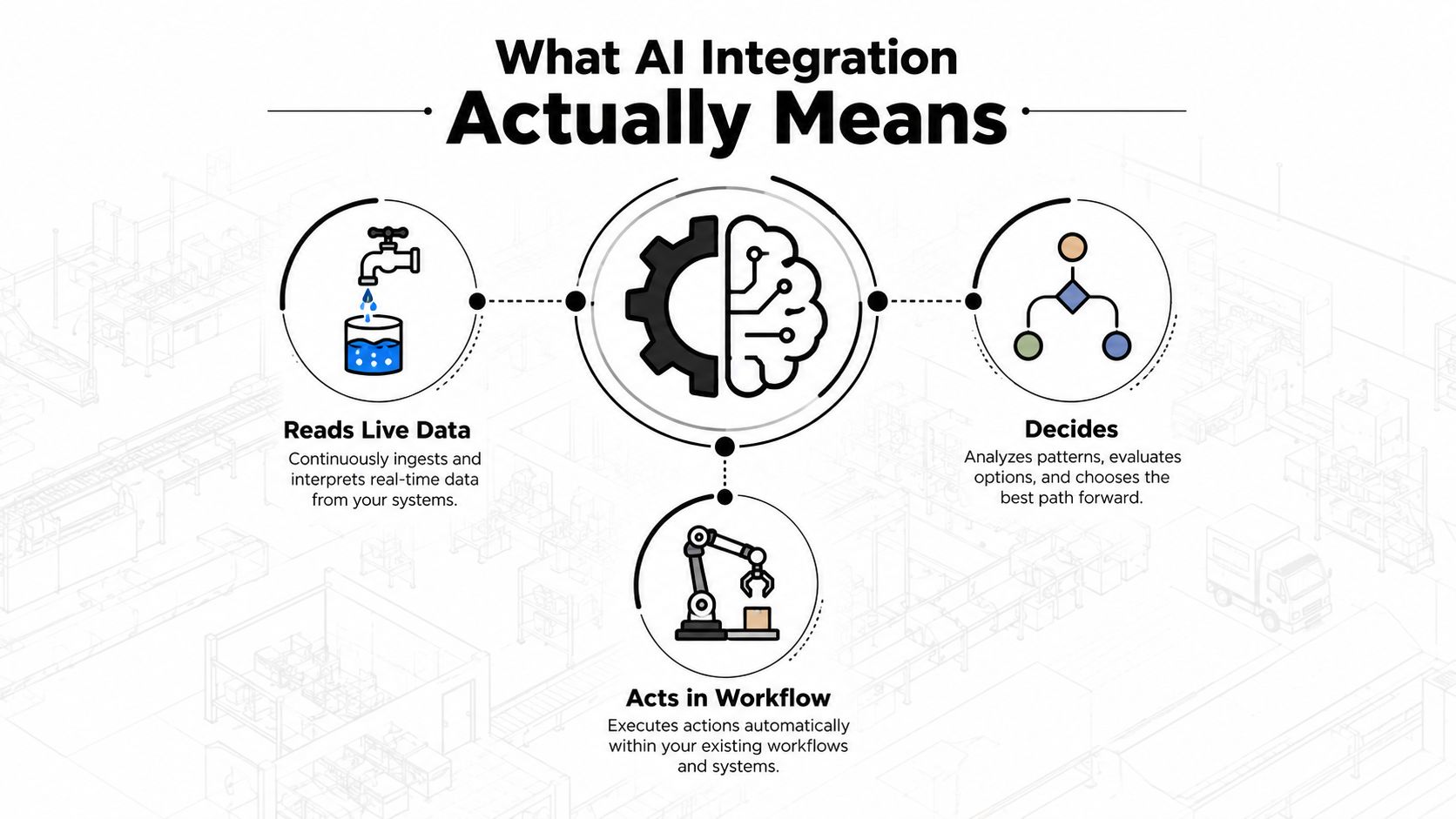
An AI model can generate text, classify information, detect patterns, or make a recommendation. AI integration begins when a business connects that model to the systems where work already happens. The model reads relevant data, produces an output, and passes that output into a workflow that a person or another software component can use.
A kitchen provides a useful analogy. The model is the chef, but integration is the full restaurant. The ordering system collects requests, the supply chain provides ingredients, the kitchen prepares the meal, and the point-of-sale system records the transaction. A chef without those connections can't serve customers reliably, just as a model without data access, permissions, and action pathways can't operate inside a business process.
A practical integration usually has three depths:
- Assistive: The model suggests an answer, drafts NFT metadata, summarizes a DAO proposal, or flags an unusual wallet. A human decides what happens next.
- Augmented: The model's output triggers downstream code. A classification can route a support case, update a risk dashboard, or initiate a review.
- Autonomous: An agent can call tools, move through a workflow, or submit a transaction under predefined permissions. This requires much stronger controls.
For a foundation in how organized information supports model responses, Sokko's AI knowledge base offers useful context. In crypto, the equivalent knowledge layer might combine smart-contract documentation, protocol events, wallet history, token permissions, and current market data.
The European Union's official statistics show that adoption isn't evenly distributed. In 2024, 13.48% of enterprises with 10 or more employees and self-employed persons used AI, compared with 41.17% of large firms. Usage was especially concentrated in information and communication companies at 48.72%, and professional, scientific, and technical services at 30.53% (McKinsey's referenced AI report). Those differences point to a central lesson: integration depends as much on data maturity, systems, and operating controls as on access to a capable model.
Crypto adds another layer of difficulty. Transactions are public but often irreversible, private keys control assets, and smart contracts execute rules without understanding intent. An AI integration therefore has to answer not only, “Can the model make a good recommendation?” but also, “Who authorizes the action, what happens when the model is wrong, and how can anyone audit the result?”
The Integration Stack Layers Most Guides Skip
Many explainers reduce integration to an API call. That misses the components that determine whether a system is useful in production.
The data and retrieval foundation
The first layer collects source material. This can include documents, databases, event streams, wallet balances, blockchain logs, and market feeds. Teams may create embeddings so related information can be searched by meaning, then store those representations in a vector database.
Retrieval sits above ingestion. A retrieval-augmented generation system selects relevant context before the model responds. Poor retrieval can produce a confident answer based on incomplete or stale information, even when the underlying model performs well.
Orchestration connects reasoning to tools
Orchestration decides which step happens next. Frameworks such as LangChain, AutoGPT-style agent patterns, and event-driven pipelines can route a request to a search tool, an indexer, a calculation service, or a transaction simulator. The model becomes one component in a controlled process rather than the entire application.
Crypto systems make this layer especially important. An indexer can expose contract events, a subgraph query can organize protocol data, and a wallet service can return balances or permissions. The application then needs explicit rules for what the agent may read and which tools it may call.
Practical rule: Treat every tool call as a permission boundary, not as a harmless extension of the prompt.
Inference and action are different jobs
Model inference generates an answer or decision. Action execution applies it. In a Web3 application, that action could mean updating a database, creating metadata, sending a notification, or preparing a transaction for human approval. A signed transaction is more consequential than a generated paragraph, so it needs separate policy checks.
Latency also comes from more than model inference. One academic benchmark found that generation accounted for 75% to 91% of total latency across tested large language model configurations (academic RAG benchmark). Teams should measure p50, p95, and p99 latency separately for retrieval, generation, and post-processing, then compare those results with real production traffic.
A published RAG benchmark recorded request-level latency of about 1.95 seconds at concurrency 1, while token-level throughput exceeded 100 tokens per second (River Group performance benchmark). The result illustrates why high token throughput doesn't guarantee a fast user experience. Network calls, orchestration, retrieval, and delivery can dominate what users feel.
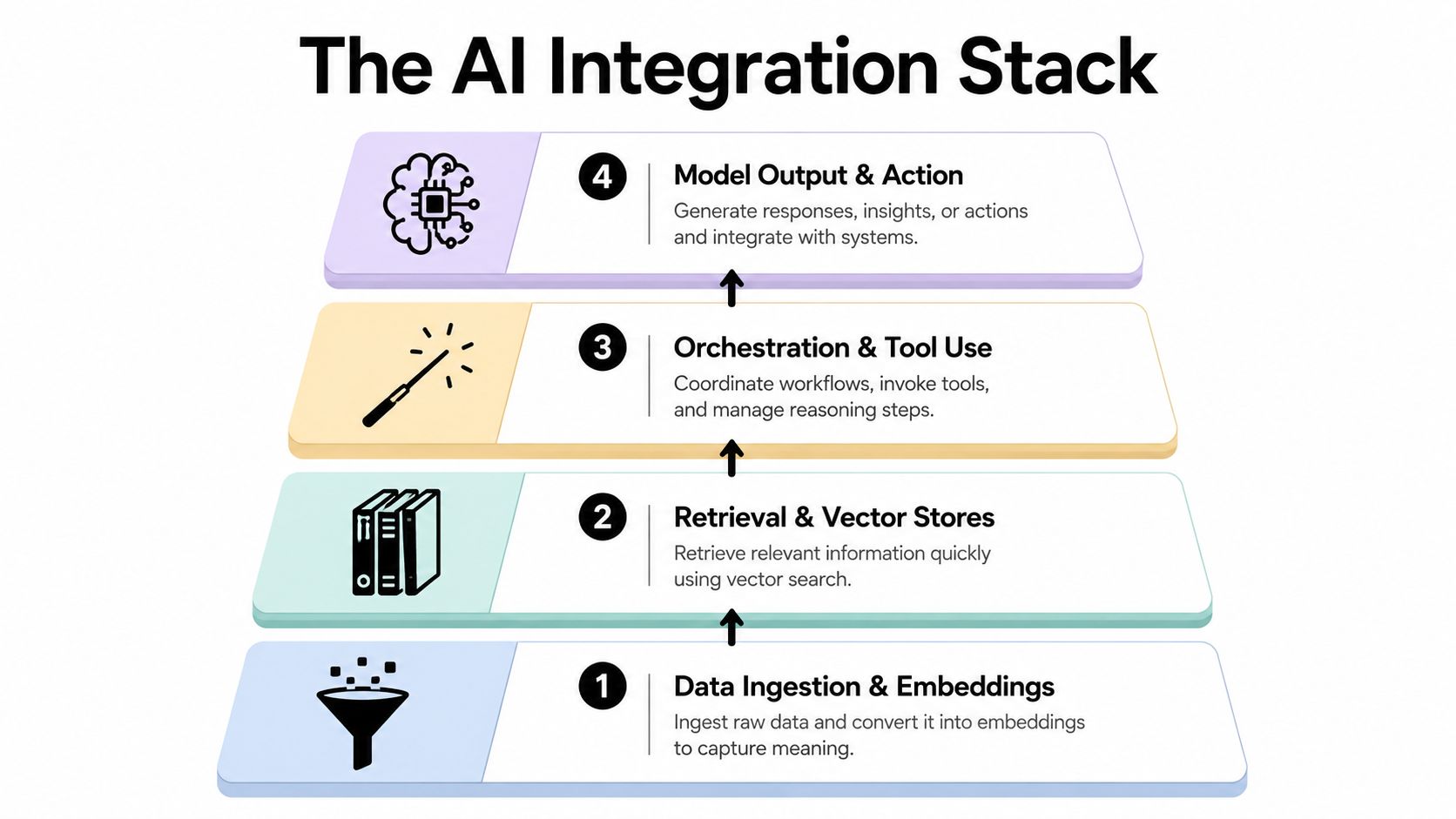
Readers exploring how newer tool-connection patterns relate to coding agents can use Agentable's WebMCP and Codex signal explained as additional background. The key architectural idea remains simple: data, retrieval, orchestration, inference, action, and observability must work together. Monitoring should record inputs, retrieved context, model outputs, tool calls, failures, overrides, and transaction outcomes without exposing secrets.
Which Workflows Deserve AI in the First Place
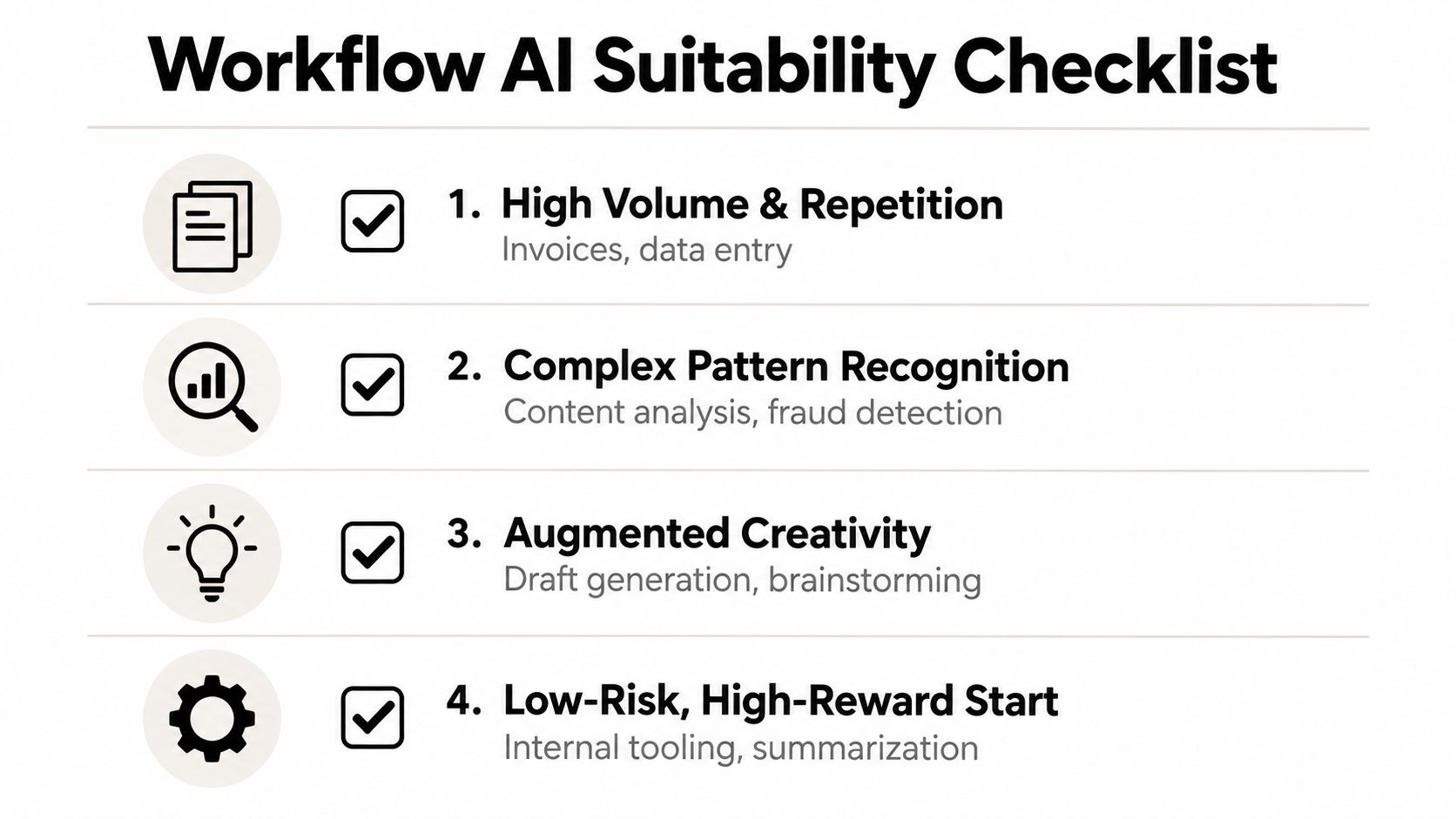
The wrong question is often, “Where can we add AI?” A better question is, “Which workflow has enough repetition and structure to benefit, while keeping the consequences manageable?”
A useful triage starts with four tests:
- High volume: Does the workflow handle recurring requests, records, or events?
- Low ambiguity: Can the team define what a good result looks like?
- Reversible consequences: Can someone correct the result before it causes lasting harm?
- Reviewability: Can a human or a second system inspect the reasoning, evidence, and action?
When those conditions align, assistive or augmented integration is usually a sensible starting point. Summarizing governance proposals, classifying support tickets, generating draft NFT descriptions, and detecting unusual contract activity can all benefit from pattern recognition without handing an agent unrestricted control.
The risk profile changes when the workflow controls assets or protocol parameters. Treasury management, bridge validation, oracle signing, liquidation triggers, and governance execution can create irreversible consequences. An AI may help analyze proposals or simulate outcomes, but a human checkpoint, multisignature process, spending limit, or timelock should remain in the control path.
That doesn't mean every high-stakes workflow must exclude AI. It means the integration should separate analysis from authorization. An agent can identify a suspicious transfer, explain why it looks unusual, and prepare a proposed response. A designated signer or governance process can decide whether to execute it.
In crypto, selective integration beats maximalism. A good Web3 team treats an AI agent like a junior analyst with useful speed and broad pattern recognition, not like a replacement CFO. The team gives it a narrow brief, checks its work, limits its permissions, and records its decisions.
This approach also protects users from unwanted automation. AI should be visible, configurable, and subject to explicit consent when it touches personal data, funds, or public identity. Convenience isn't a substitute for control.
On-Chain and Off-Chain AI Models Compared
The central architectural choice isn't which model to use. It's where the trust boundary sits.
On-chain AI places inference inside smart contracts or a dedicated blockchain environment. That can make computation and inputs easier to inspect, but blockchain execution is constrained by cost, available computation, and deterministic execution requirements. Large language models and advanced generative systems generally don't fit comfortably inside ordinary smart-contract execution.
Off-chain AI runs the heavy model on conventional servers or decentralized compute networks such as Akash or Render. The application can then publish a result, signature, attestation, or proof on-chain. This improves speed and flexibility, but users must evaluate the operator, model version, data pipeline, and verification method.
A hybrid design keeps the model off-chain while anchoring critical facts on-chain. A contract might recognize an oracle address, require a result signed by an approved key, and reference a verifiable model hash or policy version. The chain doesn't need to run the entire model to enforce who may submit an output and under what conditions.
| Dimension | On-Chain AI | Off-Chain AI |
|---|---|---|
| Cost | Execution can be expensive and constrained by blockchain resources. | Compute is more flexible, with costs managed through infrastructure or decentralized providers. |
| Trust | Results can be more directly inspectable within the chain's rules. | Results require trust in operators, signatures, attestations, or proofs. |
| Latency | Network confirmation and execution constraints can limit responsiveness. | Inference can be faster, especially for larger models, but data and transaction delivery add delays. |
| Privacy | Public execution can expose inputs or outputs unless additional privacy techniques are used. | Sensitive data can remain outside the chain, although the service operator becomes part of the trust model. |
| Model size | Practical designs favor compact, deterministic logic. | Servers can run larger models and update them more easily. |
Layer 2 networks can change the cost and throughput trade-offs, but they don't remove the need to define authorization and verification. A plain-language introduction to the scaling concept is available in this guide to what a rollup is.
The right choice depends on the workflow. If users need transparent verification of a narrow rule, on-chain logic may fit. If they need private, fast, complex analysis, off-chain inference is more practical. If the result controls money, a hybrid design with explicit proof and human override may offer the strongest balance.
How AI Integration Shows Up Across Web3
AI integration in Web3 is an integration-and-governance problem, not only a model-selection problem. The model generates an observation or recommendation, while contracts, wallets, registries, and human operators decide what that output can change. Four workflows make the division of labor concrete.
Smart-contract augmentation
An AI service can monitor mempool activity, inspect contract events, compare deployed code with known patterns, or flag behavior associated with a potential rug pull. It might recommend pausing a contract after detecting an anomaly, but the recommendation should enter a defined approval path rather than control the protocol directly.
A safer design sends the alert or proposed action through a multisignature wallet, timelock, or emergency policy. The smart contract enforces the final permission, even when the model's reasoning is wrong. This preserves a boundary between inference, which interprets changing information, and execution, which changes shared state.
ERC-8004, Ethereum's draft standard for AI-agent identity, defines three on-chain registries: an identity registry, a reputation registry, and a validation registry (ERC-8004 specification). The identity registry works like a portable passport for identifying an agent, the reputation registry stores feedback connected to its behavior, and the validation registry records evidence that specified work was completed correctly. Registration can help an application distinguish an identified service from an anonymous script, although it does not establish competence by itself.
NFT metadata and dynamic assets
Generative models can draft artwork, descriptions, traits, and supporting metadata for NFT collections. A dynamic asset can change in response to holder activity, game events, or other permitted signals. The blockchain preserves ownership records and content references, while off-chain systems usually handle generation and rendering.
Provenance determines what users can verify. A project should record which content was created, which model or prompt version produced it, and how later revisions connect to the original asset. Hashes and signed metadata can help users check whether a displayed file matches an anchored reference. They do not settle copyright, licensing, or source-data quality, so those questions require separate policies.
GameFi agents
In a GameFi environment, AI can drive non-player characters, adapt quests, classify player behavior, or help balance an in-game economy. The model runs off-chain for responsiveness, while game contracts record ownership, rewards, scarce items, and settlement rules.
ERC-8126, an Ethereum standard published in January 2026, builds on ERC-8004 by defining verification interfaces for registered AI agents (ERC-8126 specification). Its listed paths include Ethereum Token Verification, Media Content Verification, Solidity Code Verification, Web Application Verification, and Wallet Verification. A game agent could use these interfaces to support checks involving an asset, application, code component, or wallet. Developers still need to specify the claim being checked and what evidence counts.
Oracle and trading workflows
An AI system can read price feeds, liquidity conditions, governance proposals, and protocol metrics, then produce a recommendation or signed intent for a decentralized exchange aggregator. A natural-language explanation can clarify why a strategy proposes a trade, but explanation and suitability remain separate questions.
Automated trading can amplify bad data, model errors, market manipulation, or a flawed risk policy. A safer workflow separates signal generation from execution, applies slippage and exposure limits, simulates the transaction, and assigns signing authority explicitly. The model proposes. A configured policy, wallet, or human reviewer decides whether the proposal can reach the chain.
Across these patterns, the model is one layer in a larger system. The durable integration connects identity, data, permissions, verification, and recovery, so an AI feature has defined authority, inspectable inputs, and a controlled response when its output fails.
Early Agent Identity Layers on Ethereum and Beyond
On-chain agent identity remains an early and uneven infrastructure layer. One analysis found that only 3% of agents on Ethereum exposed a valid registration file with at least one live service endpoint, compared with 4% on BSC and 15% on Base (Concordium's ERC-8004 analysis). The finding suggests that many listings are placeholders rather than active, reachable agents.
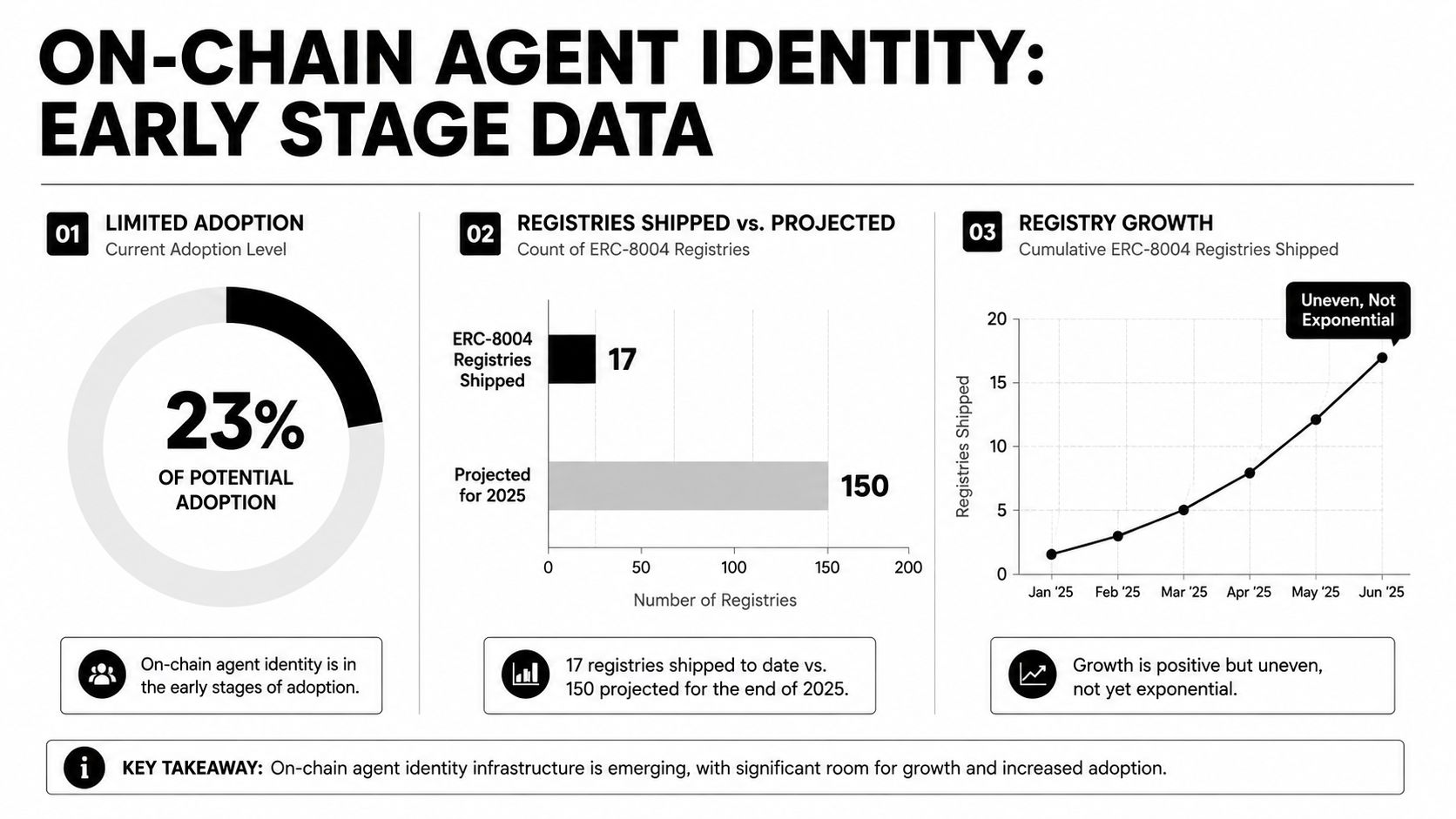
A registry matters because an agent that can move funds, call contracts, or vote needs more than a wallet address. Users may want to know which public key represents the agent, what capabilities it claims, which service endpoint responds to requests, and whether independent systems have validated its work.
ERC-8004 separates those functions. The identity registry answers, “Which agent is this?” The reputation registry answers, “How have others evaluated its behavior?” The validation registry answers, “What evidence supports a particular result?” None of those questions should be collapsed into a single score.
The distinction is important for investors and protocol designers. A registered agent can still use a poor model, rely on stale data, lose control of its endpoint, or behave differently after an update. Identity creates an accountability surface, not an automatic guarantee.
A practical identity record might connect a public key with capability declarations, model or policy references, endpoint information, reputation feedback, and validation evidence. Developers must also decide how to revoke a compromised key, challenge a false result, and prevent an operator from creating a new identity after poor behavior.
Readers looking for a broader foundation can review this guide to blockchain identity verification. For AI agents, the core issue is not whether a registry exists. It is whether applications use identity and validation before granting authority.
What AI Agents Mean for Tokenomics and Governance
AI agents can change tokenomics by turning reputation and service quality into protocol-level signals. A reputation registry could collect attestations about whether an agent completed a task accurately, responded within policy, or caused a failed transaction. A validation registry could add evidence for specific outputs rather than relying only on general impressions.
That information could support risk controls. An AI oracle might submit a verified inference result that helps a smart contract adjust a collateral parameter, pause a market, or route a treasury proposal for review. The contract still needs bounded rules, because a reputation score isn't the same as a guarantee and an oracle can fail.
DAO voting introduces a separate design problem. Agents might summarize proposals, help delegates compare positions, or filter spam before a vote. A protocol could also explore reputation-aware delegation or liquid democracy, but those mechanisms risk giving too much influence to agents that coordinate, copy one another, or acquire identities cheaply.
Anyone designing a DAO should define decision rights before adding automation. Which actions can an agent execute? Which require a human veto? What evidence must accompany a recommendation? How can the community revoke a key or challenge an output?
Open risks include agent collusion, model opacity, Sybil attacks through rented compute, and accountability gaps when an AI rather than a human keyholder signs a transaction. Governance teams studying compliance with Averta OS can use that policy-oriented perspective to think about controls, but each protocol still needs its own authority model, audit trail, bonding rules, and incident response process.
Practical Takeaways Before You Build or Invest
Builders should start with one workflow where data volume, repetitive tasks, latency, or analytical complexity justifies AI. Keep inference off-chain at first, then move only publicly verifiable outputs into smart contracts. Set auditable prompts, versioned policies, deterministic fallbacks, transaction simulation, spending limits, and clear human override paths. These controls define the integration, while model choice supports it.
Investors should examine the operating system behind the branding. Does an actual agent serve users? Does the protocol record meaningful activity? Are identity, validation, and accountability defined? Does revenue come from useful services, or mainly from token emissions? A roadmap can describe architecture, but it cannot replace operating controls.
Readers can monitor agent identity standards, agent-to-agent communication, verifiable compute, reputation systems, and proof mechanisms. Together, these layers show whether a project is building infrastructure that can be checked, revoked, and governed, or just attaching AI language to a token.
AI integration in Web3 remains early infrastructure. Durable projects will treat it as systems engineering and governance, using models to support defined workflows rather than letting model selection define the product.
Coiner Blog publishes practical guides and analysis on AI, Ethereum, Web3, NFTs, DeFi, GameFi, tokenomics, and blockchain infrastructure. Visit Coiner Blog for explanations of emerging crypto systems, their risks, and the implementation details that deserve review.