
Dollar Cost Averaging Crypto: A Practical Guide
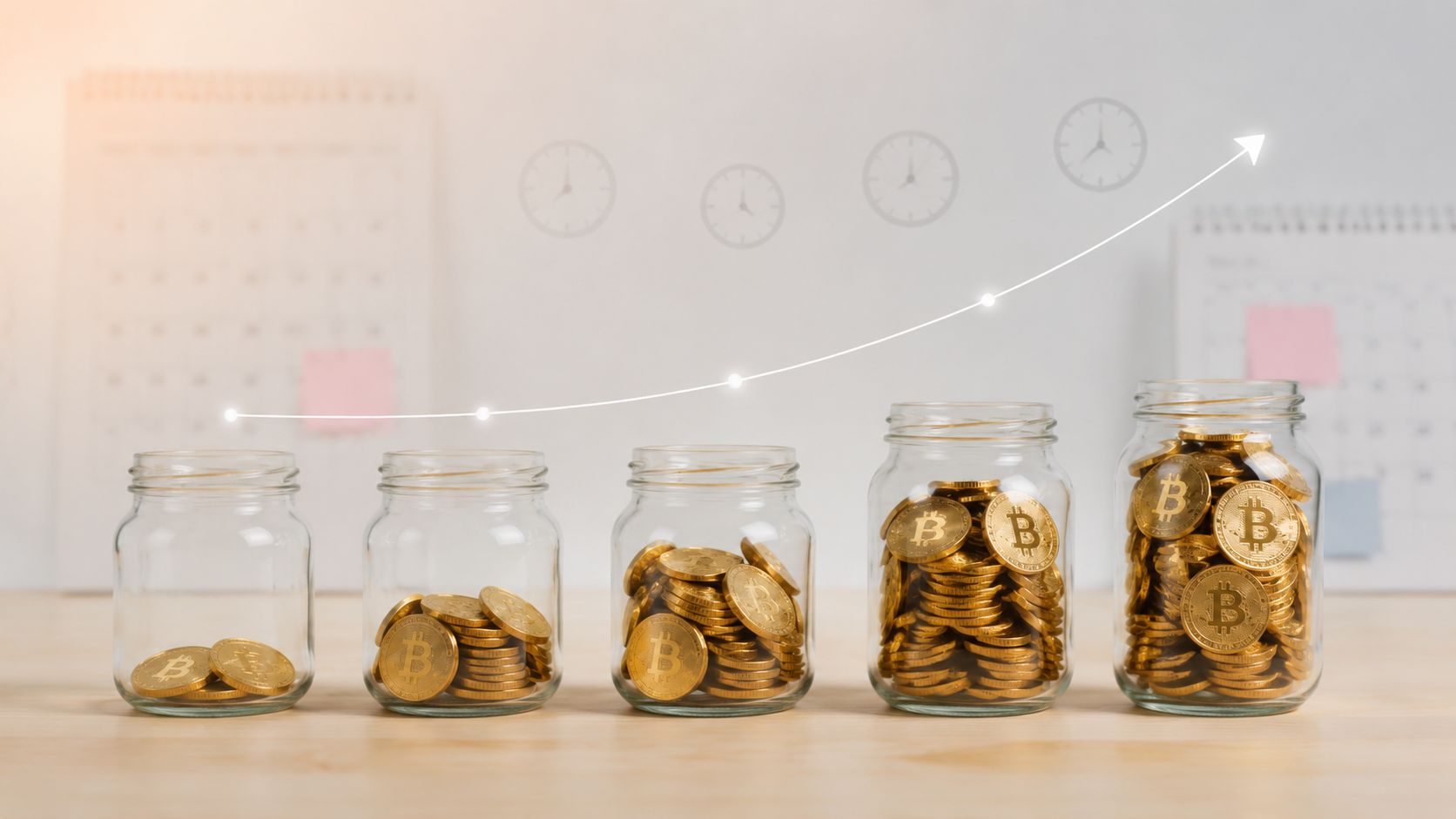
Lump-sum investing beat 12-month dollar cost averaging in about 73% of historical Bitcoin entry dates, while the same study found average future returns of 422% for lump-sum versus 174% for DCA. DCA still has a useful role because it spreads entry timing across changing prices instead of forcing one high-stakes decision.
You've got money ready to invest, perhaps $3,000, and Bitcoin is moving sharply in both directions. Buying everything today could feel reckless if the market drops tomorrow. Waiting for a dip sounds sensible until the price rises without you. Dollar cost averaging crypto offers a calmer middle path: buy a fixed dollar amount on a regular schedule, so the same cash buys more coins when prices are low and fewer when prices are high.
That approach won't make Bitcoin, Ethereum, or any other token safe. It won't prevent losses, predict the next rally, or guarantee that your average purchase price will beat a single entry. What it can do is replace frantic decisions with a repeatable process.
The important question isn't whether DCA is always better than lump-sum investing. The backtested evidence says it isn't. The better question is which approach matches the market regime, your time horizon, your cash flow, and your ability to stay invested when crypto becomes uncomfortable.
Table of Contents
- Why Crypto Investors Turn to Dollar Cost Averaging
- How Dollar Cost Averaging Actually Works
- The Real Benefits and Honest Drawbacks of DCA
- DCA vs Lump-Sum vs Value Averaging in Backtests
- Building Your Own Crypto DCA Plan Step by Step
- Taxes, Records, Platforms, and Common DCA Mistakes
- A Simple Decision Framework Before You Start
Why Crypto Investors Turn to Dollar Cost Averaging
A first-time Bitcoin buyer often faces an awkward choice. They may have $3,000 available and believe the asset belongs in a long-term portfolio, but they don't know whether to invest all at once, wait for a pullback, or divide the money into smaller purchases. Each option carries a different kind of regret.
Buying the full amount creates immediate exposure. If Bitcoin rises, the investor participates fully. If it falls, the investor experiences the entire decline from one entry price. Waiting creates a different problem, because a dip may never arrive, or the investor may keep moving the target lower while the market climbs.
DCA changes the question. Instead of asking, “Can I predict tomorrow's price?” the investor asks, “Can I commit a manageable amount on a schedule and hold through several market conditions?” The strategy means buying a fixed amount at regular intervals, whether the market feels exciting, boring, or frightening. The mechanical effect is simple: lower prices purchase more units, higher prices purchase fewer units, which spreads entry timing across the schedule. Finary's explanation of crypto DCA describes this as a way to smooth volatility exposure, not a promise of profit.
Practical rule: DCA manages the timing decision. It doesn't manage the quality, custody, or long-term prospects of the asset you buy.
Crypto makes this behavior especially appealing because the market trades continuously and sentiment can reverse quickly. Bitcoin can move from optimism to fear while traditional markets are closed, and Ethereum, DeFi tokens, Layer 2 assets, and smaller altcoins can carry even greater project-specific risk. A recurring schedule removes that risk. It prevents one decision from determining the entire entry.
This is why disciplined investors often use DCA as a behavioral tool. Automation can reduce FOMO buying after a rally and panic avoidance after a selloff. Kraken's survey coverage reported that 83% of crypto investors had used DCA, while 59% said it was their main strategy, suggesting that the challenge for many investors is no longer discovering DCA, but adapting it to different assets and market conditions. The survey coverage should be read as evidence of adoption, not proof that DCA produces superior returns.
The rest of the decision comes down to mechanics and trade-offs. DCA can make participation easier to repeat, but lump-sum investing can win when the market rises soon after the available cash arrives.
How Dollar Cost Averaging Actually Works
Think about buying coffee for $50 every Monday. Some weeks, coffee costs more and the amount buys a smaller drink. Other weeks, a discount or lower price lets you buy more. Your spending stays fixed, while the quantity changes.
Bitcoin DCA follows the same pattern:
- Choose a fixed contribution.
- Choose a schedule, such as weekly or monthly.
- Buy the selected asset regardless of short-term price movement.
- Track the units acquired and total cost.
- Judge the result against the eventual selling price, not against the purchase price alone.
Suppose you invest $500 per month for six months. The table below uses a simplified Bitcoin price path and ignores fees so the unit calculation stays clear.
Six-month DCA worked example
| Month | BTC Price | USD Spent | BTC Acquired | Cumulative BTC | Avg Cost / BTC |
|---|---|---|---|---|---|
| 1 | $30,000 | $500 | 0.016667 BTC | 0.016667 BTC | $30,000 |
| 2 | $40,000 | $500 | 0.012500 BTC | 0.029167 BTC | $34,286 |
| 3 | $25,000 | $500 | 0.020000 BTC | 0.049167 BTC | $30,508 |
| 4 | $35,000 | $500 | 0.014286 BTC | 0.063452 BTC | $31,519 |
| 5 | $28,000 | $500 | 0.017857 BTC | 0.081310 BTC | $30,749 |
| 6 | $45,000 | $500 | 0.011111 BTC | 0.092421 BTC | $32,460 |
The simple average of the six listed prices is $33,833, but the portfolio's average cost is about $32,460 per BTC. Why? The fixed $500 contribution bought more Bitcoin at the lower prices of $25,000 and $28,000, and less at $40,000 and $45,000.
That difference is the core DCA mechanic. It doesn't mean the investor has made money. If Bitcoin later trades below the average cost, the position can still show a loss. If the investor sells above it, the price increase creates the gain, reduced by trading fees, spreads, taxes, and any withdrawal costs.
For a second explanation of the method, Wealth Collective's DCA guide provides a useful beginner-oriented reference on spreading purchases over time. The underlying calculation remains the same whether the asset is Bitcoin, Ethereum, or a token in a Web3 ecosystem. The asset's volatility and long-term outcome still matter more than the automation button.
The Real Benefits and Honest Drawbacks of DCA
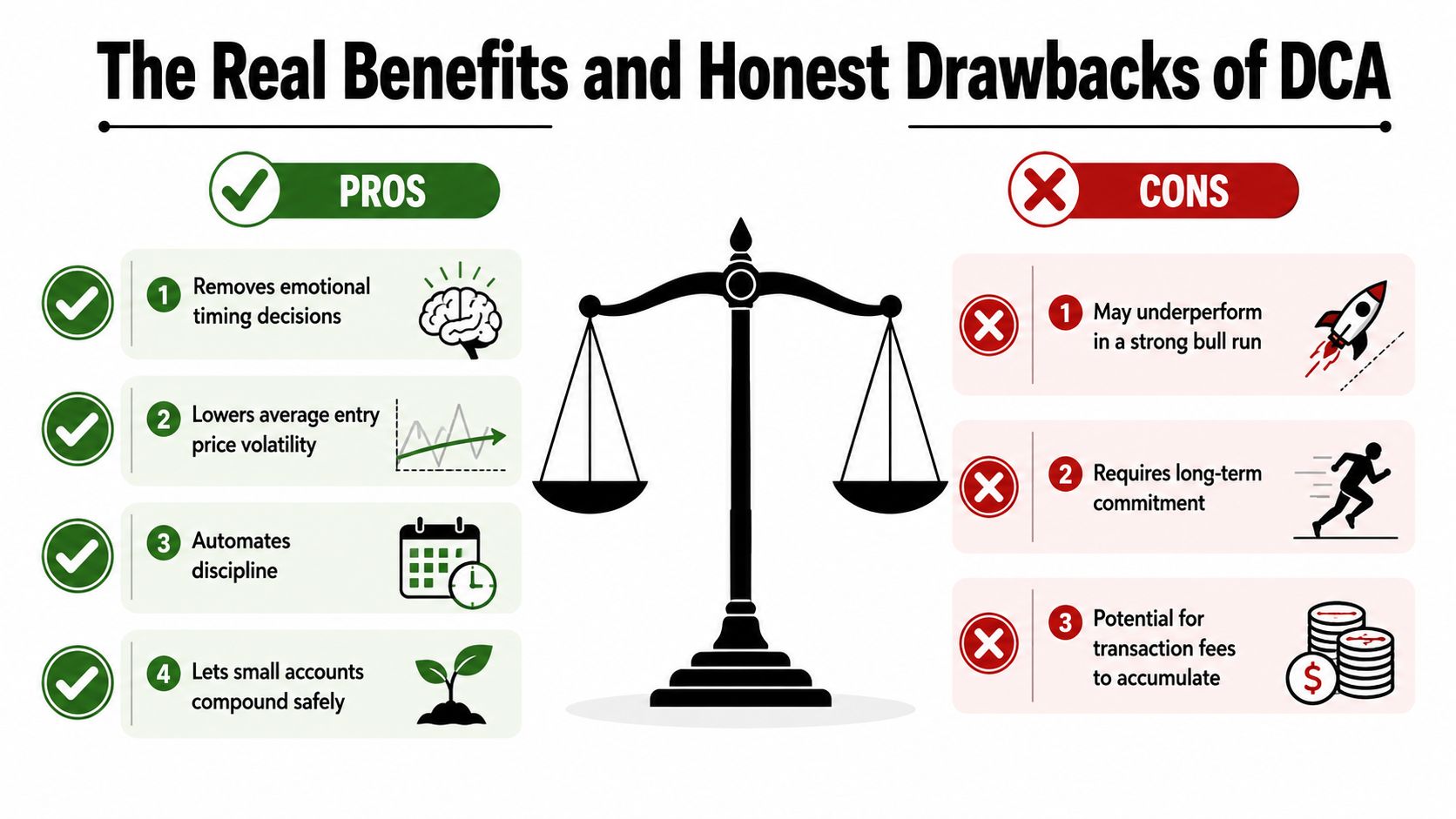
DCA's strongest advantage is behavioral, not mathematical. It gives an investor a rule to follow before the market starts shouting. That matters because many people who intend to buy rationally end up FOMO-buying into strength, then abandoning the plan after a sharp decline.
What DCA can improve
- Timing pressure: Scheduled purchases reduce the need to identify one perfect entry.
- Budget discipline: A fixed contribution can fit around regular income better than an unpredictable all-in purchase.
- Entry-price variability: Buying across several prices can make one unusually expensive entry less important.
- Emotional consistency: Automation can keep the process running when headlines become dramatic.
- Position sizing: Smaller accounts can build exposure without a single large commitment.
That last point has limits. DCA doesn't turn an unsuitable asset into a suitable one. A recurring buy of a highly speculative altcoin still exposes the investor to tokenomics risks, smart-contract failures, liquidity problems, governance decisions, and permanent capital loss. Bitcoin and Ethereum have different networks and use cases, while DeFi and Layer 2 tokens add their own technical and execution risks.
Where DCA can disappoint
The first drawback is fee drag. Repeated purchases may incur a trading fee or spread each time, and higher-frequency orders can be more expensive on centralized exchanges. Kraken's DCA guide warns that frequent orders can increase cumulative fees. A recurring-buy example shows how a £3 fee on a £30 weekly purchase equals 10% of each order, or £156 in fees over 52 weeks on £1,560 invested. The recurring-buy example illustrates why order size matters.
The second drawback is opportunity cost. Cash waiting for future DCA purchases isn't fully exposed to a rapid recovery. In a strong upward trend, lump-sum investing may get more time in the market. DCA can also create false comfort when an investor keeps “averaging down” into an asset whose fundamentals are deteriorating.
A useful way to assess the method is to ask whether you value lower timing regret more than maximum immediate exposure. If your answer changes every time Bitcoin moves, automation may help. If you already have a long-term allocation and can tolerate a large early drawdown, a lump-sum decision may deserve serious consideration.
For context on the emotional conditions that make scheduled buying difficult, review this guide to the cryptocurrency bear market. The key is to understand the plan before the decline arrives, not invent new rules while watching the portfolio fall.
Here's the relevant video explanation for readers who prefer a visual walkthrough:
DCA vs Lump-Sum vs Value Averaging in Backtests
The supplied Bitcoin evidence doesn't support a universal winner. A 2019 case study compared 12-month DCA with investing the full amount at once across historical entry dates through April 5, 2019. Lump-sum investing produced higher future returns in about 73% of the dates examined, with average future returns of 422% for lump-sum and 174% for DCA. The Bitcoin DCA case study also shows the trade-off clearly: spreading purchases reduced timing exposure but often lagged during a sustained long-term uptrend.
The result changes when the starting conditions change. A Bitcoin savings study found that DCA beat lump-sum investing when entering in 2018, a bear-market period, while an entry in 2020 produced the opposite result during a bull market. The study also found that Bitcoin outperformed traditional indices over a five-year window, while shorter horizons were weaker. The study slides frame DCA as a drawdown-control and entry-smoothing tool rather than a guaranteed outperformer.
What the historical comparisons actually show
| Strategy | Favorable environment | Main strength | Main weakness |
|---|---|---|---|
| Weekly DCA | Choppy or falling markets | Frequent entry smoothing | More transactions and possible fee drag |
| Monthly DCA | Investors with regular income | Simple budgeting and fewer orders | Less granular exposure across sudden moves |
| Lump-sum | Strong recoveries or sustained rallies | Immediate market exposure | Full timing and drawdown risk at entry |
| Value averaging | Investors willing to adjust contributions | Targets a changing portfolio value | More complex funding and execution decisions |
Value averaging is often presented as a third route, but it requires a target portfolio path and variable contributions. The investor buys more when the portfolio falls below its target and less when it rises above it. That can demand extra cash during declines, so it isn't “better DCA” and shouldn't be treated as passive automation.
A five-year analysis of 300 DCA variants across Bitcoin, the S&P 500, gold, crude oil, and the NASDAQ found that an RSI-weighted Bitcoin strategy achieved a Sharpe ratio of 1.984, compared with 1.424 for pure DCA, with a reported p-value of 0.0330. The research paper describes a technical overlay that increases buying after weakness and trims buying after strength. That result is relevant for experienced investors, but it introduces model risk, execution choices, and the danger of overfitting.
A practical regime rule is more modest. Use lump-sum when your priority is immediate exposure and you can withstand an early decline. Use DCA when the entry point creates too much emotional or financial stress, especially in an uncertain or falling market. Consider a tactical overlay only if you can define its rules in advance and follow them without turning every price move into a new strategy.
Building Your Own Crypto DCA Plan Step by Step
A workable plan starts with constraints, not coin selection. Decide what you can contribute without touching emergency savings, rent money, debt payments, or cash needed for near-term obligations. A DCA schedule that breaks your budget will eventually force a sale at the worst possible moment.
Choose the cadence
Recurring-buy programs commonly support daily, weekly, biweekly, or monthly schedules, and some platforms offer minimum orders around $5 to $10. The recurring-buy overview shows why very small orders need a fee check before activation.
| Cadence | Buys per Year | Avg Fee Impact | Slippage Risk | Behavioral Fit |
|---|---|---|---|---|
| Weekly | 52 | Can accumulate quickly | More frequent execution | Good for routine income |
| Biweekly | 26 | More moderate | Moderate | Fits many pay cycles |
| Monthly | 12 | Usually simpler to monitor | Fewer execution points | Easy for long-term budgeting |
There isn't a universally correct frequency. Weekly buying spreads execution more finely, but monthly buying can reduce the number of fee events. Check whether the platform uses a spread, a percentage fee, a flat fee, or a combination. The scheduled amount should be large enough that the total cost doesn't dominate the purchase.
Set the amount and asset mix
Many investors choose a contribution as a small portion of their investable assets, but the right amount depends on income stability, existing exposure, and risk tolerance. Don't use a borrowed amount, and don't assume a small recurring order is harmless just because each individual purchase feels small.
For the asset mix, start with a thesis rather than a menu. Bitcoin may serve as the primary network exposure, Ethereum adds smart-contract and application exposure, and a limited altcoin basket can add higher project risk. DeFi, Web3, AI and crypto, Layer 2 networks, and real-world asset tokenization may be relevant themes, but a theme isn't a substitute for researching token supply, liquidity, governance, and actual usage.
Select a platform with transparent fees, recurring-buy controls, two-factor authentication, exportable transaction records, and a custody arrangement you understand. This beginner guide to investing in cryptocurrency can help readers organize the broader decisions around account setup and asset selection.
Automate, then document
Market orders usually prioritize execution, while price-limited orders prioritize the maximum price you're willing to accept. A limit order may not fill, so automation can become inconsistent if the platform doesn't handle missed purchases clearly. Before committing, test the schedule, confirm the funding source, and save the order confirmations.
A sample $200 monthly plan could divide contributions between Bitcoin and Ethereum, with a smaller allocation for selected higher-risk assets. The exact split should reflect your own research rather than a universal formula. Readers building a broader financial independence plan can also use this step-by-step FIRE calculation to separate long-term savings goals from speculative crypto contributions.
For the first three months, keep a simple checklist:
- Confirm funding: Make sure the scheduled cash is available before each order.
- Review costs: Record the fee and effective execution price.
- Avoid headline changes: Don't alter the plan because of one dramatic news cycle.
- Check custody: Verify where the assets sit and how withdrawals work.
- Save records: Export transaction history on a regular schedule.
Taxes, Records, Platforms, and Common DCA Mistakes
Frequent purchases create frequent records. Each buy can establish a separate tax lot with its own date, quantity, price, and fee. The exact reporting treatment depends on your jurisdiction, so don't assume an exchange's portfolio display is a complete tax report.
Some platforms offer FIFO or specific-identification tools, while others may display recurring purchases as separate lots. Coinbase Recurring Purchases can create separate lots, while Kraken and Gemini may handle batches differently. These platform behaviors can change, so verify the current documentation for the account you use rather than relying on a generic spreadsheet template.
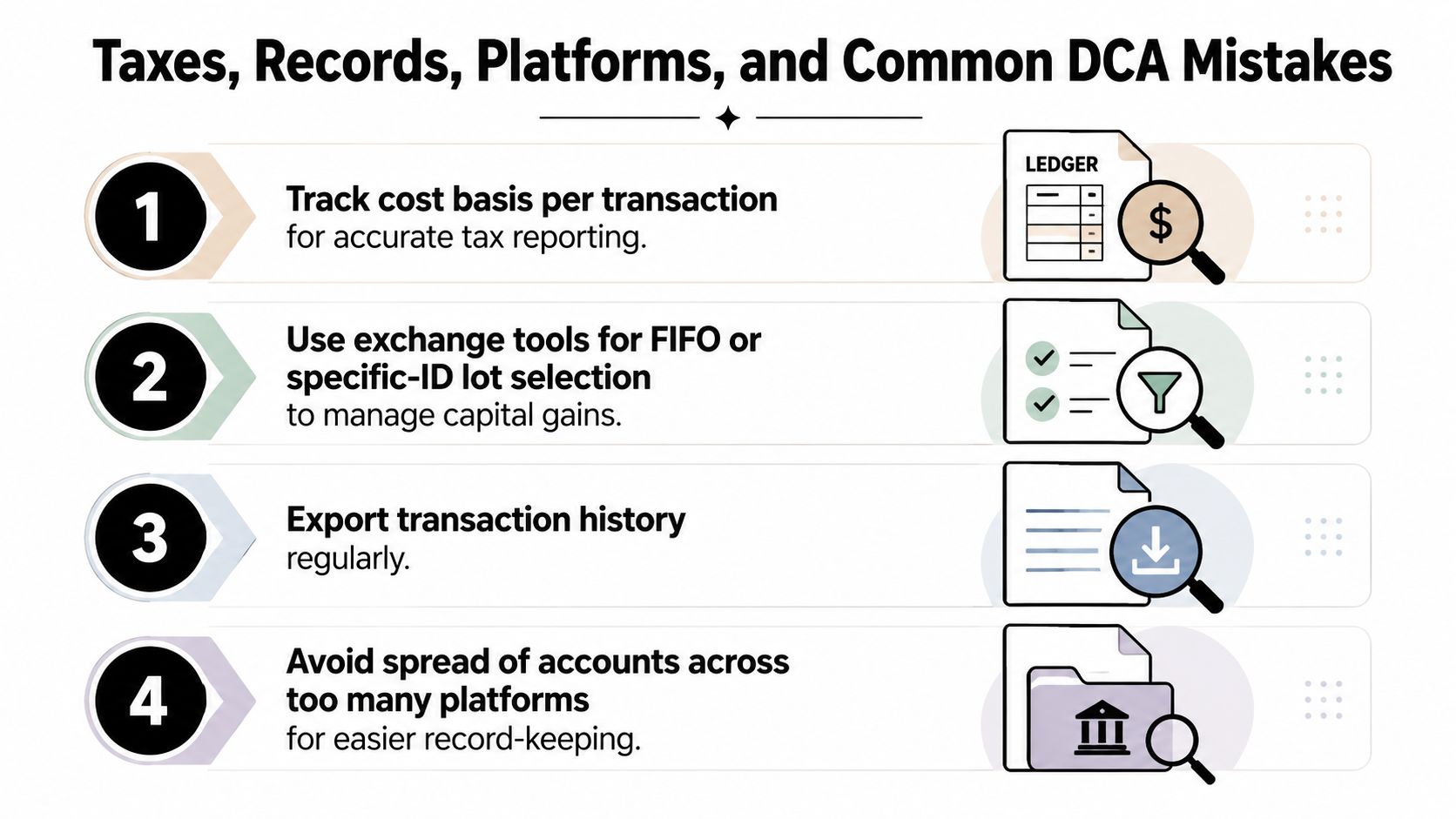
Keep a transaction ledger
At minimum, record:
- Date: When the order executed.
- Amount: The fiat value and crypto quantity.
- Price: The execution price per unit.
- Fee: Trading, spread, network, or withdrawal cost where applicable.
- Cost basis: The amount assigned to the tax lot.
- Disposition details: If you later sell, swap, transfer, or spend the asset.
A dedicated crypto portfolio tracker can reduce manual work, but it still needs clean exchange connections and periodic review. This guide to the best crypto portfolio trackers is a useful starting point for comparing record-keeping workflows.
Avoid the predictable failures
- Canceling during a drawdown: Stopping after a large decline converts a schedule into an emotional market call.
- Chasing staking yield: Don't move unsettled DCA funds into a yield product without understanding lockups, smart-contract risk, and liquidity.
- Ignoring tiny-order costs: Flat fees and spreads can consume a disproportionate share of small purchases.
- Rebalancing too aggressively: Constantly changing allocations can recreate the timing problem DCA was meant to reduce.
- Panic-selling during outages: An exchange outage can be stressful, but rushed action may create tax and execution problems.
- Skipping software integration: If you use tax software, connect accounts early and check imported transactions for duplicates or missing transfers.
DCA is only as clean as the records behind it. Automation handles order timing, not tax classification, custody decisions, or portfolio supervision.
A Simple Decision Framework Before You Start
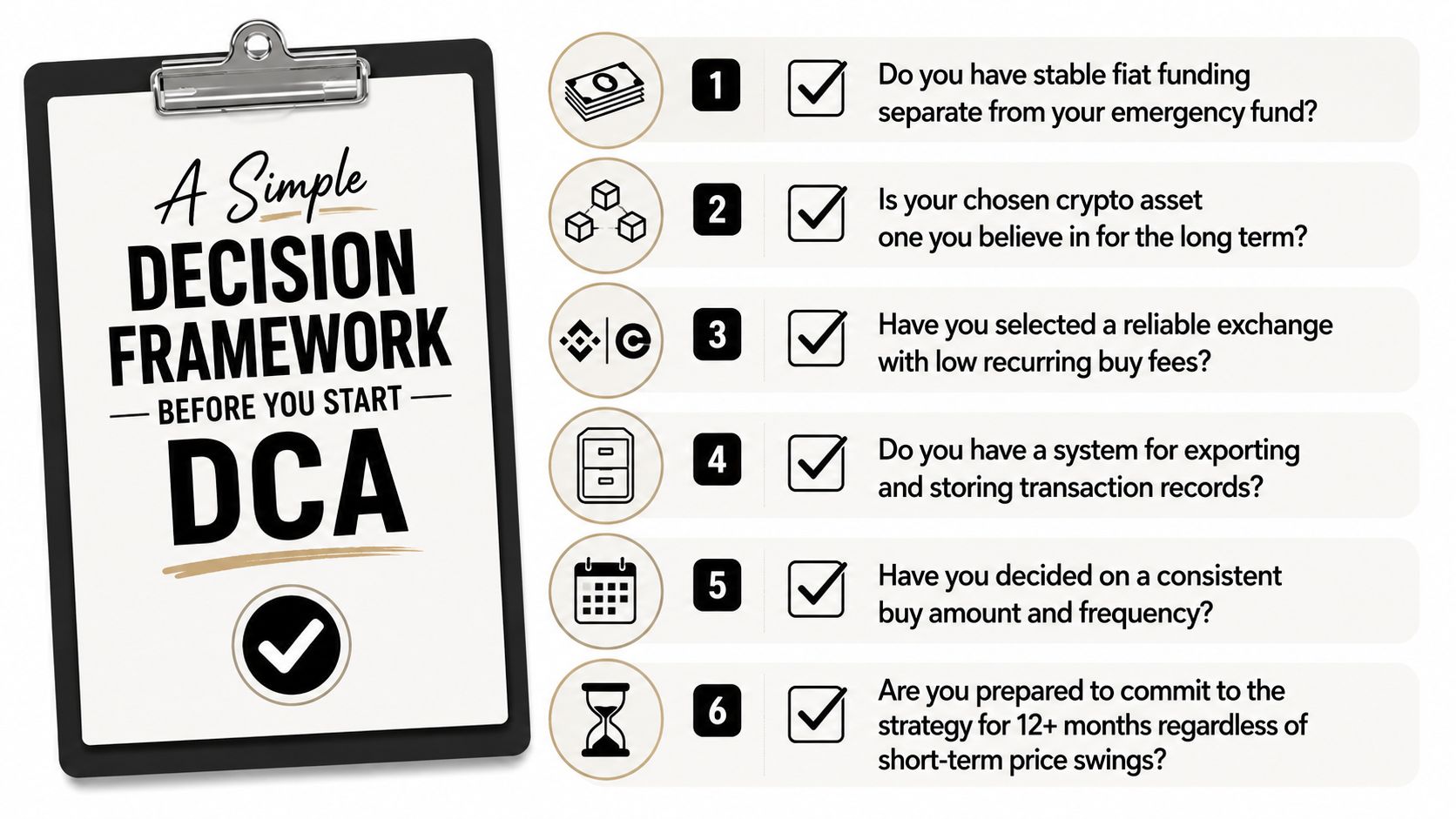
Before activating a recurring purchase, answer six questions in writing. The answers should remain understandable even during a sharp market decline.
- Is your funding stable? Keep crypto contributions separate from your emergency fund and essential expenses.
- Can you hold for a full market cycle? A multi-year horizon is more compatible with volatile assets than a short-term cash need.
- What amount can you lose entirely? Treat this as a risk boundary, not as a prediction that the loss will happen.
- What will the platform charge? Confirm recurring-buy fees, spreads, minimums, withdrawal costs, and order execution rules.
- Which assets belong in the mix? Decide whether your research supports Bitcoin, Ethereum, a small altcoin basket, or another defined approach.
- What is your exit rule? Write down when you will reduce or close a position so fear doesn't make every decision for you.
DCA may be the wrong tool for short-term traders who need active entries and exits. It also may not fit someone expecting to predict the next halving-related move, someone with a sudden windfall who can't afford to miss a rapid recovery, or someone whose cash flow is too erratic to honor a schedule.
The central trade-off is simple. DCA usually reduces regret more reliably than it maximizes return. Lump-sum investing can win when prices rise after the cash becomes available. DCA can help when the market falls or remains choppy after the plan begins. Neither approach protects you from choosing a weak asset, paying excessive fees, losing custody access, or selling in panic.
The best strategy is the one you can repeat when the market stops rewarding confidence and starts testing patience.
Use DCA when its structure solves a real problem in your behavior or cash flow. Use lump-sum when immediate exposure fits your risk capacity and market view. Whatever you choose, write the rules before you buy, keep accurate records, and treat crypto as a volatile asset class rather than a guaranteed path to a particular outcome.
Coiner Blog publishes practical guides and balanced analysis on Bitcoin, Ethereum, DeFi, Web3, tokenomics, Layer 2 networks, AI and crypto, and other blockchain developments. Visit Coiner Blog to keep building your crypto knowledge with explanations that focus on mechanics, risks, and decisions you can apply.