
Position Sizing Strategies for Crypto Traders

You open your phone before breakfast and see Bitcoin moving sharply while an altcoin position sits on your exchange account. The thesis still looks reasonable, yet the position is so large that every candle feels personal. In crypto, a trade can fail even when the analysis is sound, because 24/7 volatility can move an asset dramatically while you sleep.
Position sizing strategies set the risk before the order reaches the book. They convert account equity, risk tolerance, stop distance, volatility, and correlation into a trade amount you can defend mathematically. The familiar fixed-percentage method risks only a small portion of capital on one trade, commonly 1% to 2%, then calculates position size from the stop rather than confidence, as outlined in this position-sizing formula reference.
That distinction matters in crypto. Bitcoin, Ethereum, altcoins, and perpetuals can move sharply around the clock, so sizing must leave room for sudden gaps, thinner liquidity, and changing correlations. The goal is a position small enough to survive the market's next violent move without forcing a sound plan out of the account.
Table of Contents
- The Trade That Survived a 40% Drawdown
- What Position Sizing Means in Crypto
- The Five Core Position Sizing Strategies Explained
- Kelly Criterion and Volatility-Based Sizing in Practice
- Worked Position Size Calculations for Bitcoin and Ethereum
- Crypto-Specific Risks That Change Your Sizing Math
- Building Your Personal Sizing Framework
- Common Sizing Mistakes and Final Guardrails
The Trade That Survived a 40% Drawdown
Marek had a familiar retail-trader setup. He found an altcoin whose chart supported a bullish thesis, opened a long position equal to 60% of his account, and added 10x borrowed capital. He went to sleep believing the invalidation level was far enough away to protect the trade.
While he slept, Bitcoin flash-crashed 18% overnight. The altcoin followed the broader market, liquidity thinned, and Marek woke to a 40% equity drawdown and a margin call. His analysis may still have been directionally right. The position was sized as if the thesis couldn't lose.

That distinction matters. A bad coin selection can lose money, but oversized exposure can turn an ordinary adverse move into an account-threatening event. Amplification magnifies the notional position, while the exchange's liquidation engine can close the trade before the trader has a chance to reassess the thesis.
Marek's mistake wasn't only choosing leverage. It was allowing the market to decide his maximum loss.
Position sizing is the single major trade variable you control before price moves. You can't control whether Bitcoin sells off during the night, whether an altcoin order book disappears, or whether funding turns expensive. You can control how many dollars, coins, or contracts sit behind your idea.
The rest of this guide uses concrete crypto math to show how disciplined sizing could separate a manageable 4% drawdown from a destructive 40% drawdown. The numbers are examples, not promises or personalized financial advice, and margin trading crypto can lose capital rapidly.
What Position Sizing Means in Crypto
A position is the amount of capital placed behind one trade. Position sizing sets that amount relative to total account equity. In spot markets, size may be expressed in dollars or coins. In perpetual futures, it also affects notional exposure, margin usage, liquidation distance, and the dollar value of each price move.
Crypto requires tighter control because the market trades continuously. Bitcoin, Ethereum, and altcoins keep moving through weekends and overnight hours. A position based only on conviction can become too large when a wide stop, thin liquidity, and borrowed funds combine during a fast move. An asset that doubles or halves in a few days can change the account math before a trader has time to reassess.
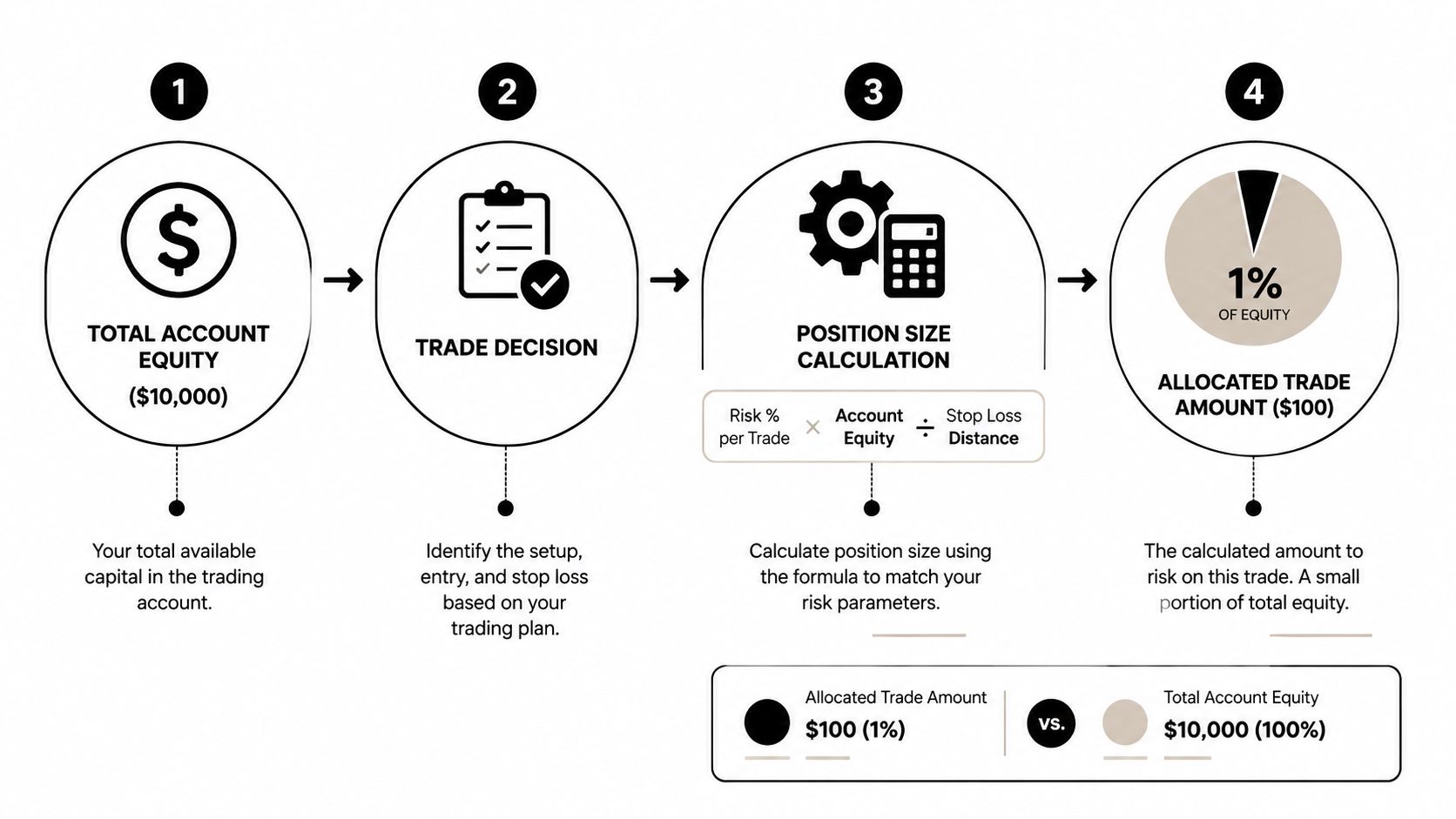
The fixed-percentage calculation
The standard formula is:
Position Size = (Account Equity × Risk %) ÷ (Entry Price − Stop Price)
A $5,000 account risking 1% creates a planned loss limit of about $50. Suppose a Bitcoin long enters at $60,000 and places the stop at $58,500. The stop distance is $1,500.
- Risk budget: $5,000 × 1% = $50
- Position size: $50 ÷ $1,500 = $0.0333 BTC
- Notional value: approximately $2,000
The same calculation appears in this fixed-percentage position-sizing explanation. Fees, funding, slippage, and execution quality can increase the realized loss, so the result is a ceiling for planned risk, not a guarantee of the final outcome.
Risk-based versus allocation-based sizing
Risk-based sizing starts with the amount you can lose and works backward from the stop. It suits active traders who define an invalidation level and want each trade to carry a specific loss budget.
Allocation-based sizing starts with the capital assigned to an asset or theme. A portfolio builder might cap exposure to an Ethereum position, DeFi basket, or Layer 2 token regardless of the stop. That limits concentration, but it does not define the loss between entry and stop.
The fixed-percentage rule puts the decisions in a useful order: account equity, acceptable loss, then invalidation distance. Size comes last. This sequence stops a trader from choosing a coin amount first and forcing the stop to fit afterward.
The Five Core Position Sizing Strategies Explained
No single method fits every crypto trader. A discretionary Bitcoin swing trader, a systematic Ethereum strategy, and a long-term Web3 portfolio have different decisions to make. The five approaches below differ mainly in what they hold constant.
| Strategy | Core Formula | Best For | Crypto Caveat |
|---|---|---|---|
| Fixed fractional | Equity × risk percentage ÷ stop distance | Beginners building consistent process | A tight stop on a volatile altcoin can create an impractically large position |
| Fixed ratio | Increase size after predefined profit increments | Traders with a consistent winning record | A drawdown can arrive after a size increase and erase recent gains quickly |
| Kelly criterion | Size from estimated edge and payoff odds | Quant-oriented traders with measured statistics | Win rate and payoff estimates can be unreliable in changing crypto regimes |
| Volatility-based | Risk budget ÷ volatility-derived stop distance | Crypto swing traders facing changing ranges | ATR reacts to past movement and may lag a sudden market shock |
| Percent of equity | Equity × allocation cap | Portfolio builders holding correlated assets | It limits exposure, but a stop is still needed to define loss |
Fixed fractional is the clean starting point. A trader risks the same percentage of current equity on each setup, so the dollar amount contracts during a drawdown and expands only as the account grows.
Fixed ratio changes size after a profit threshold rather than after every equity fluctuation. Ryan Jones is associated with this approach, which can suit a trader whose execution and results are stable enough to justify gradual scaling. It requires strict rules, because a winning streak can make a larger position feel emotionally normal just before variance changes.
Kelly criterion connects size to estimated win probability and payoff. It can be useful for a data-driven trader, but full Kelly is aggressive when the inputs are uncertain. Fractional Kelly reduces that sensitivity.
Volatility-based sizing makes the position smaller when the asset's measured range expands. This suits crypto swing trading, where BTC and an altcoin can have very different movement profiles even when the trade idea is similar.
Percent-of-equity allocation works better for investors managing a basket of Bitcoin, Ethereum, DeFi, and tokenized real-world assets. It caps concentration, but it doesn't replace risk-based sizing for short-term trades.
A practical overview of strategies for trading can help place sizing inside a broader process. Most experienced traders blend methods, such as fixed fractional risk at the trade level and allocation caps at the portfolio level.
Kelly Criterion and Volatility-Based Sizing in Practice
A Bitcoin strategy can show a 55% win rate and still produce a position that is too large for crypto's 24/7 price swings. Kelly and ATR-based sizing address different parts of that problem. Kelly asks how much capital an estimated edge can justify. Volatility sizing asks how much exposure the current market range can tolerate. Neither method makes uncertain inputs reliable.
A cautious Kelly example
The Kelly formula is:
f = (bp − q) ÷ b*
Here, b is the net payoff relative to the stake, p is the estimated win probability, and q is the estimated loss probability. Suppose a Bitcoin strategy has a 55% win rate, an average win of 1.8R, and an average loss of 1R.
Using b = 1.8, p = 0.55, and q = 0.45:
- Kelly fraction = ((1.8 × 0.55) − 0.45) ÷ 1.8
- Full Kelly is approximately 30% of equity
- Dividing that output by 4 gives fractional Kelly of roughly 7.5%
The arithmetic produces roughly 7.5%, not a 1.2% allocation on a $10,000 account. That distinction matters. A formula should be checked against its inputs, especially when a result could put too much capital at risk during a fast crypto drawdown.
A 7.5% fractional-Kelly output can still be too aggressive for a discretionary trader. The win rate and payoff ratio are estimates, not permanent properties. A short sample, changing market regime, or weaker execution can reduce the edge that justified the calculation.
Use Kelly as an upper-bound research tool, not as permission to deploy the full result.
A trader can cap the output at a half or a quarter of the calculated fraction, then compare it with a conservative fixed-risk baseline. The cap helps account for regime changes, small samples, execution differences, and a strategy whose historical edge weakens.
ATR-based sizing
Volatility sizing begins with the Average True Range on the timeframe used for the trade. On a 4-hour BTC chart, a trader might define the stop as 2× ATR. The same process applies to an altcoin, but its ATR can be wider relative to price and its order book can be thinner. That combination can turn a normal-looking order into significant market exposure.
The calculation is straightforward:
- Set risk dollars from account equity and the chosen risk percentage.
- Measure ATR for BTC or the altcoin.
- Multiply ATR by 2 to establish the stop distance.
- Divide risk dollars by that stop distance.
- Reduce the result for fees, slippage, funding, and liquidity concerns.
| Dimension | Kelly Criterion | Volatility-Based Sizing |
|---|---|---|
| Main input | Estimated edge and payoff | Current market range |
| Strength | Connects size to expected advantage | Adapts to changing movement |
| Weakness | Sensitive to estimation error | Backward-looking |
| Crypto use | Systematic strategies with records | Swing trades in variable volatility |
| Safety adjustment | Use a fraction of the output | Widen stops and reduce size when ranges expand |
Kelly is model-dependent, while ATR is market-condition-dependent. A trader can combine them by using fractional Kelly as a maximum risk budget and ATR to translate that budget into coins. The result is a process that respects both the estimated edge and crypto's rapid, round-the-clock volatility.
Worked Position Size Calculations for Bitcoin and Ethereum
The stop distance determines how many units the account can carry. A wider stop requires a smaller position if the dollar risk stays unchanged. That relationship is the practical core of position sizing.
Bitcoin long
Assume:
- Account equity: $12,000
- Risk: 1%
- Entry: $65,000
- Stop: $63,500
- Stop distance: $1,500
- Stop placement: 1.5 ATR
The arithmetic is:
- Risk dollars = $12,000 × 1% = $120
- BTC quantity = $120 ÷ $1,500 = 0.08 BTC
- Notional value = 0.08 × $65,000 = $5,200
- Notional-to-equity ratio = $5,200 ÷ $12,000, or about 0.43× equity
The trade uses approximately $5,200 of market exposure while the planned loss at the stop is $120 before costs and slippage. The margin posted may be reduced, but the economic exposure of the 0.08 BTC position remains unchanged.
Ethereum swing long
Now consider:
- Account equity: $9,000
- Risk: 0.75%
- Entry: $3,200
- Stop: $3,050
- Stop distance: $150
- Stop placement: 1.5 ATR
The calculation becomes:
- Risk dollars = $9,000 × 0.75% = $67.50
- ETH quantity = $67.50 ÷ $150 = 0.45 ETH
- Notional value = 0.45 × $3,200 = $1,440
- Notional-to-equity ratio = $1,440 ÷ $9,000, or 0.16× equity
| Variable | BTC Long | ETH Swing Long |
|---|---|---|
| Account equity | $12,000 | $9,000 |
| Risk percentage | 1% | 0.75% |
| Risk dollars | $120 | $67.50 |
| Entry price | $65,000 | $3,200 |
| Stop price | $63,500 | $3,050 |
| Stop distance | $1,500 | $150 |
| Position size | 0.08 BTC | 0.45 ETH |
| Notional value | $5,200 | $1,440 |
Notice what stays constant. If volatility widens the stop, the position must shrink to preserve the same dollar risk. Don't keep the coin amount constant and pretend the risk hasn't changed. Adjust the risk budget only when your framework allows it, not because a wider stop makes the original position feel smaller.
Crypto-Specific Risks That Change Your Sizing Math
Crypto's continuous market changes the meaning of a “normal” stop. Traditional markets close, while Bitcoin and Ethereum keep trading through weekends, overnight news, liquidations, and sudden changes in perpetual futures positioning. The market may not gap in the same session-based way, but it can cascade through multiple price levels before an order fills.
Four adjustments for live crypto conditions
- 24/7 trading: Weekend or off-hours setups deserve a wider expected adverse-move allowance or a smaller position. The rule is simple, widen the stop only when the structure supports it, then reduce units so the risk budget stays intact.
- Liquidity gaps: Thin altcoin order books can turn a planned stop into a slippage event. Use smaller exposure, avoid oversized market exits, and verify that the venue can absorb your order without moving sharply against you.
- Perpetual funding: When funding becomes expensive for longs, reduce the position or shorten the holding window. Funding is a recurring holding cost that can weaken an otherwise attractive trade.
- Correlation: Several altcoins can act as one Bitcoin beta trade during a selloff. Treat correlated exposure as a combined risk bucket, not as independent positions.
The final point is where many portfolios become overextended. Three altcoin positions may look diversified by ticker, yet their losses can arrive together when BTC falls. The suggested 40% to 60% haircut for correlated altcoin sizing is a specific risk-control input, not a verified market statistic, so apply it only as a conservative personal rule and test it against your own portfolio behavior.
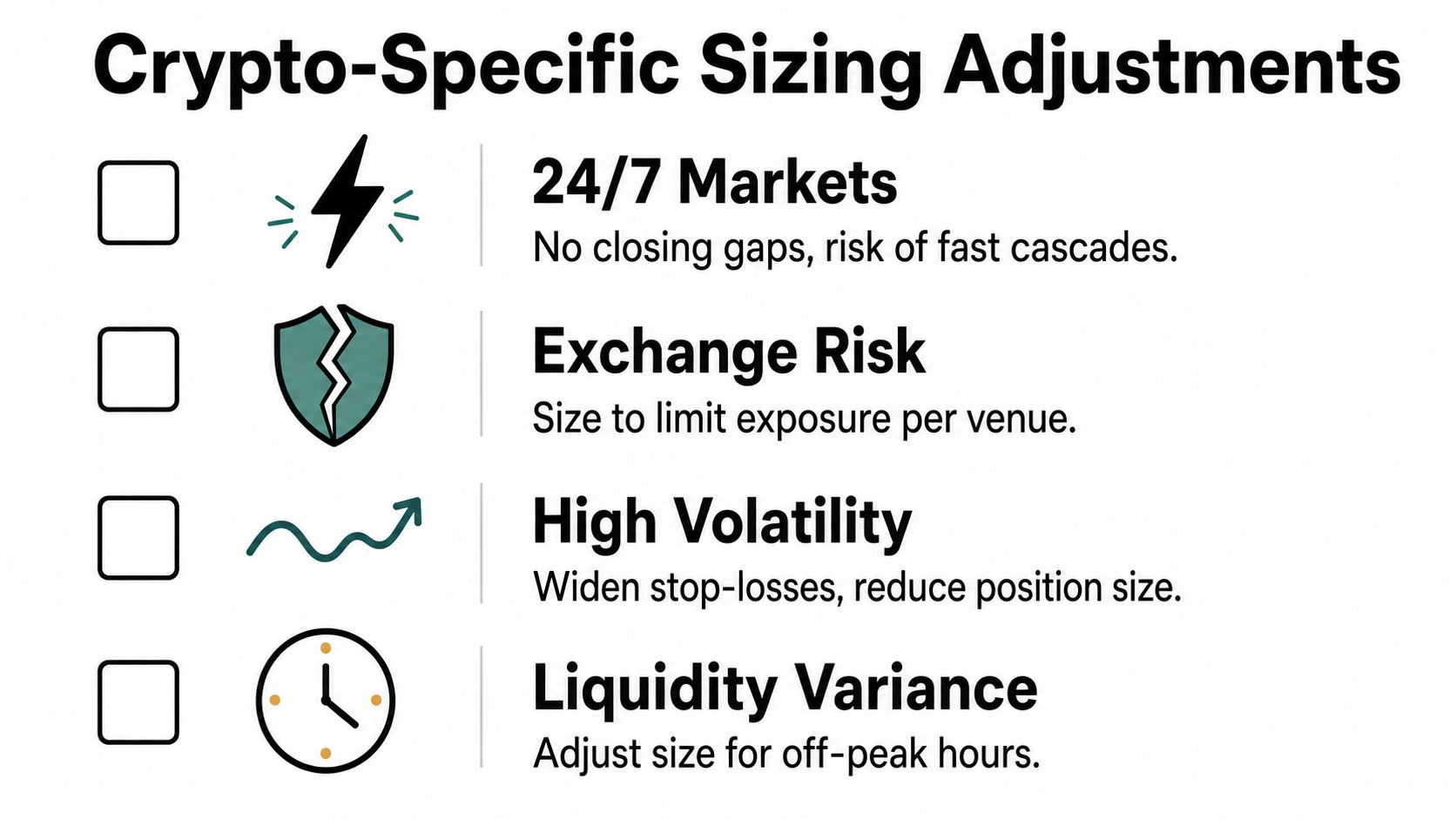
For a broader framework, compare these decisions with crypto risk management principles. The useful habit is to attach one adjustment to each risk: smaller size for thin liquidity, lower exposure for costly funding, wider structural stops for volatility, and a portfolio haircut for correlation.
Building Your Personal Sizing Framework
A personal framework should work when you're tired, distracted, or watching a violent market move. If the method requires a fresh emotional decision on every trade, it isn't a system yet.
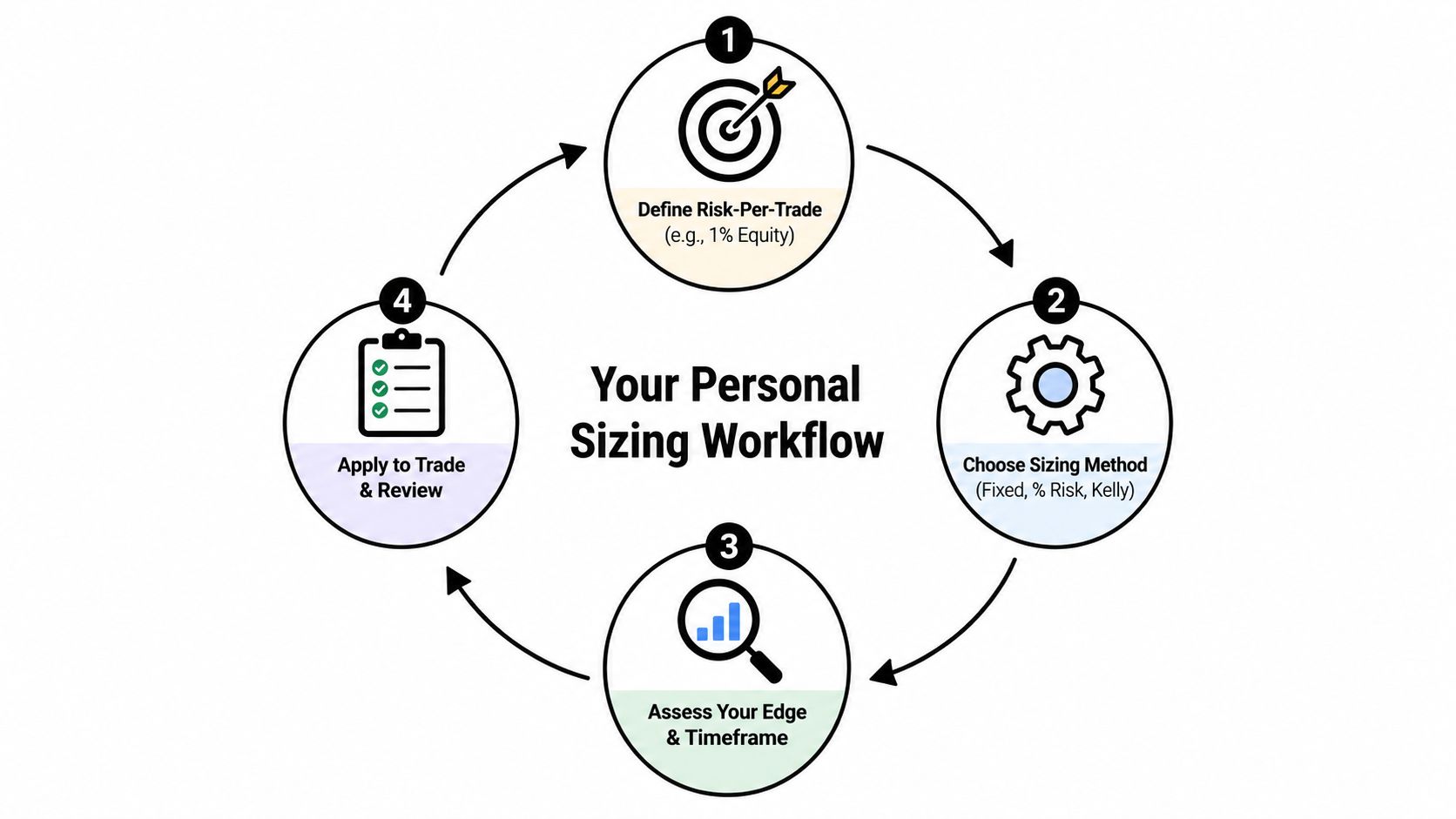
Start with a baseline. Many traders use 1% of equity as an example of fixed-percentage risk, while a more cautious operator may choose less. Then select the method that matches your edge and timeframe. A swing trader may combine ATR-based sizing with a fixed risk budget, while a portfolio investor may add allocation caps across Bitcoin, Ethereum, DeFi, and Layer 2 exposure.
A workable checklist
- Define risk per trade. Write the percentage and the maximum dollar loss before looking at the desired coin amount.
- Choose the sizing method. Use fixed fractional for a simple process, volatility-based sizing for changing ranges, or a fractional Kelly overlay only when your data supports it.
- Set concentration caps. The proposed 5% total exposure per correlated bet and 20% portfolio-wide crypto exposure are personal guardrails, not verified universal standards. Treat them as starting limits, then adapt them to your capital structure and objectives.
- Record the trade. Log entry, stop, quantity, notional value, R-multiple, fees, and funding cost.
- Rebalance on a schedule. A weekly review can stop a winning streak from inflating every position.
Use a spreadsheet, exchange export, or a journaling tool such as TradesViz to compare planned risk with actual fills and slippage. The framework has to survive a sleepless night and a 30% overnight gap in your stress test before you trust it with meaningful capital. That scenario is a planning exercise here, not a claim about typical crypto behavior.
Historical research helps explain why sizing became a central portfolio question. Modern discussions often trace its roots to Kelly's 1956 work on information theory and gambling, while Anderson and Faff's 2004 study examined fixed-fraction asset allocation and reinvestment effects across markets including the S&P 500, U.S. T-Bonds, British Pound, COMEX Gold, and Corn, as described in this fixed-fraction futures research paper. Crypto traders can borrow the principle without assuming that older-market results transfer directly to digital assets.
Common Sizing Mistakes and Final Guardrails
A winning streak doesn't prove that your next trade deserves a larger position. Doubling size increases the dollar effect of both outcomes, so confidence after recent wins isn't a mathematical edge.
Fixed-dollar risk also sounds safer than percentage risk, but it can become too large after an account drawdown and too small after growth. Percentage risk keeps the rule tied to current equity, which is why the fixed-percentage framework remains a practical default.
A 2% risk cap doesn't mean the portfolio can lose only 2% when several correlated altcoins share the same exposure. Correlation stacks risk even when each ticket appears compliant. Use stop-loss placement guidance to define invalidation before calculating units.
Useful guardrails include:
- Individual risk: Keep trade risk within your predefined range, such as 0.5% to 1%, as a personal control rather than a universal law.
- Correlated exposure: Keep a combined cap, such as 5%, for positions that effectively express the same BTC-sensitive view.
- Drawdown response: If equity falls beyond 10%, consider halving size until your review shows that the original assumptions still hold.
The rule you can apply today is simple: define the stop first, then calculate the size, never the reverse.
Coiner Blog publishes practical guides on Bitcoin, Ethereum, DeFi, Web3, tokenomics, Layer 2 networks, AI and crypto, and real-world asset tokenization, including risk-focused material for changing market conditions. Visit Coiner Blog to keep building a more disciplined crypto research and trading process.