
Network Congestion Solutions for Faster Blockchain

You submit a transaction during a popular NFT mint, a DeFi liquidation wave, or a sudden market move. The wallet shows “pending,” the fee estimate changes, and every minute creates more uncertainty. The problem may not be that the blockchain has failed. More often, demand has arrived in a short burst while blockspace remains limited, turning transaction ordering into a competitive queue.
That matters beyond one delayed swap. Retail users want lower fees and predictable confirmations. Developers need applications that use blockspace efficiently. Infrastructure teams need to identify whether a slowdown comes from a crowded mempool, a poorly optimized contract, a congested geographic hotspot, or a scaling design that sends too much activity to the base layer.
The strongest network congestion solutions don't rely on one magic setting. They combine fee markets, smarter routing, active queue management, Layer 2 networks, batching, data availability improvements, and better observability. The same design principle appears in traditional internet engineering, mobile networks, and blockchain systems: solve the bottleneck where it occurs instead of adding capacity everywhere.
Table of Contents
- Introduction to Network Congestion in Blockchain
- How Blockchain Networks Get Congested
- Root Causes Behind Rising Fees and Delays
- Major Network Congestion Solutions Compared
- Practical Ways to Reduce Congestion and Save on Fees
- Real World Case Studies of Congestion Fixes in Action
- Choosing the Right Strategy for Your Needs
Introduction to Network Congestion in Blockchain
A blockchain transaction usually follows a simple path. Your wallet signs it, a node receives it, the transaction enters a pending pool, and a validator or miner selects transactions for a block. If many users submit activity at once, the pending queue grows and transaction inclusion becomes more selective.
Ethereum users often see this during a token launch or DeFi surge. Bitcoin users may experience it when demand for ordinary payments competes with additional blockspace demand. On a Layer 2 network, the visible transaction may confirm quickly while the system later competes for space when batches or data are posted to the base chain.
The highway analogy helps, but blockchain adds an important twist. A normal highway can sometimes add lanes or redirect cars immediately. A blockchain's block production rules create a more rigid supply of usable space. Validators can choose among pending transactions, but they can't expand the next block because a crowd has arrived.
Practical rule: A pending transaction is a queueing problem first, and a fee-setting problem second.
That distinction prevents common mistakes. Raising a fee can improve priority when the transaction is waiting behind higher bids, but it won't repair an application that generates unnecessary operations. Switching wallets won't solve a chain-wide demand spike. Moving activity to a rollup may help, but users still need to understand bridging, withdrawal timing, sequencer design, and the relationship between the rollup and its settlement chain.
This guide treats congestion as a localized peak-load and design problem. It explains how blockspace and mempools create queues, why fees rise, how Layer 1 and Layer 2 approaches differ, and what users and developers can do without confusing a temporary workaround with a durable scaling solution. The aim is practical: better timing, lower waste, faster confirmation, and more informed choices around Bitcoin, Ethereum, DeFi, NFTs, smart contracts, and Web3 applications.
How Blockchain Networks Get Congested
Start with a highway. The road has a fixed number of lanes, and each lane can carry only so many cars during a given period. A blockchain block works similarly. Blockspace is the usable room inside a block, while block production rules determine how much activity can fit before the next block arrives.
Now add a toll booth. Cars reach the booth, but the operator has limited processing capacity. In a blockchain, nodes receive transactions and hold those that haven't yet been included in a confirmed block. That waiting area is the mempool, although each node can have its own view of pending transactions.
Fees act like toll bids. Users who offer more attractive fees may receive priority when validators select transactions, especially during a rush. The fee doesn't create more blockspace. It changes who gets served first.
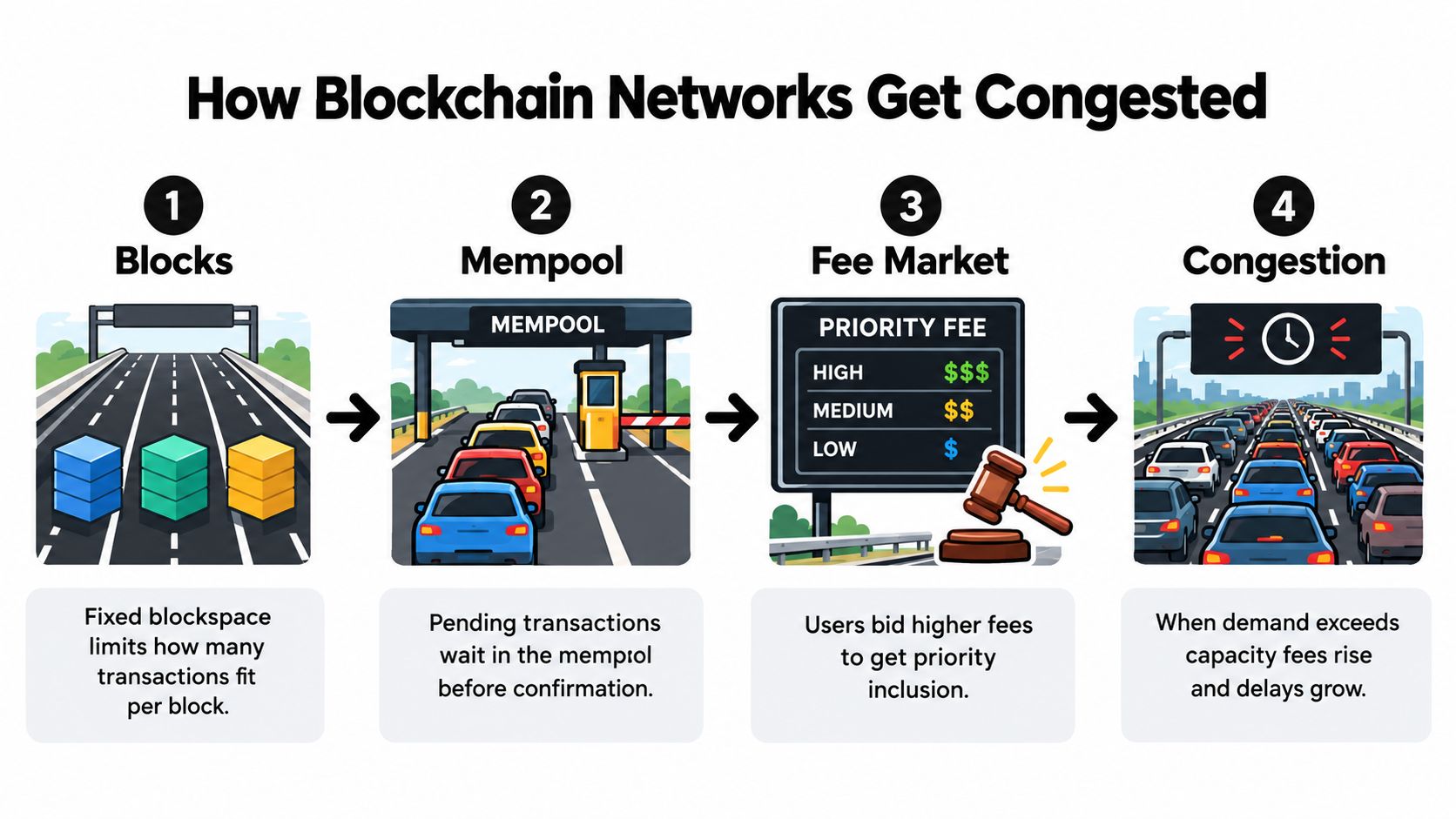
The sequence looks like this:
- Blocks impose capacity. Each block can include only a bounded amount of transaction data and execution work.
- Demand enters the mempool. Pending transactions wait when users submit more activity than the next blocks can absorb.
- The fee market prioritizes demand. Users compete for inclusion through transaction fees or fee components.
- Delays and costs appear. Lower-priority transactions may wait, expire, or require replacement, while users who need speed pay more.
Ethereum complicates the toll analogy because users pay for computational work as well as data. A simple transfer and a complex smart-contract interaction consume different resources. A decentralized exchange swap, NFT mint, or lending transaction can require considerably more execution than a basic payment, so application design affects congestion even when transaction counts look similar.
Capacity is fixed in the short term. Demand is not.
That is the reusable mental model. Congestion occurs when demand arrives faster than the network can process it, and the visible symptom depends on the system. Users may see higher fees, slower confirmations, failed transactions, longer rollup posting queues, or delayed settlement. The right remedy depends on which resource is scarce.
Root Causes Behind Rising Fees and Delays
Blockchain congestion usually begins with a demand shock, but the shock becomes painful because the protocol and application create a narrow processing path. A popular NFT mint can send many users toward the same contract at nearly the same time. An airdrop can produce a large wave of claims. DeFi liquidations can arrive during volatile markets, when users and automated systems compete for execution.
The network then applies its limits. Blocks have bounded capacity, smart contracts require execution, and validators must process transactions consistently. Sequential dependencies can make some workloads harder to parallelize, while inefficient contracts consume blockspace without delivering proportional user value.
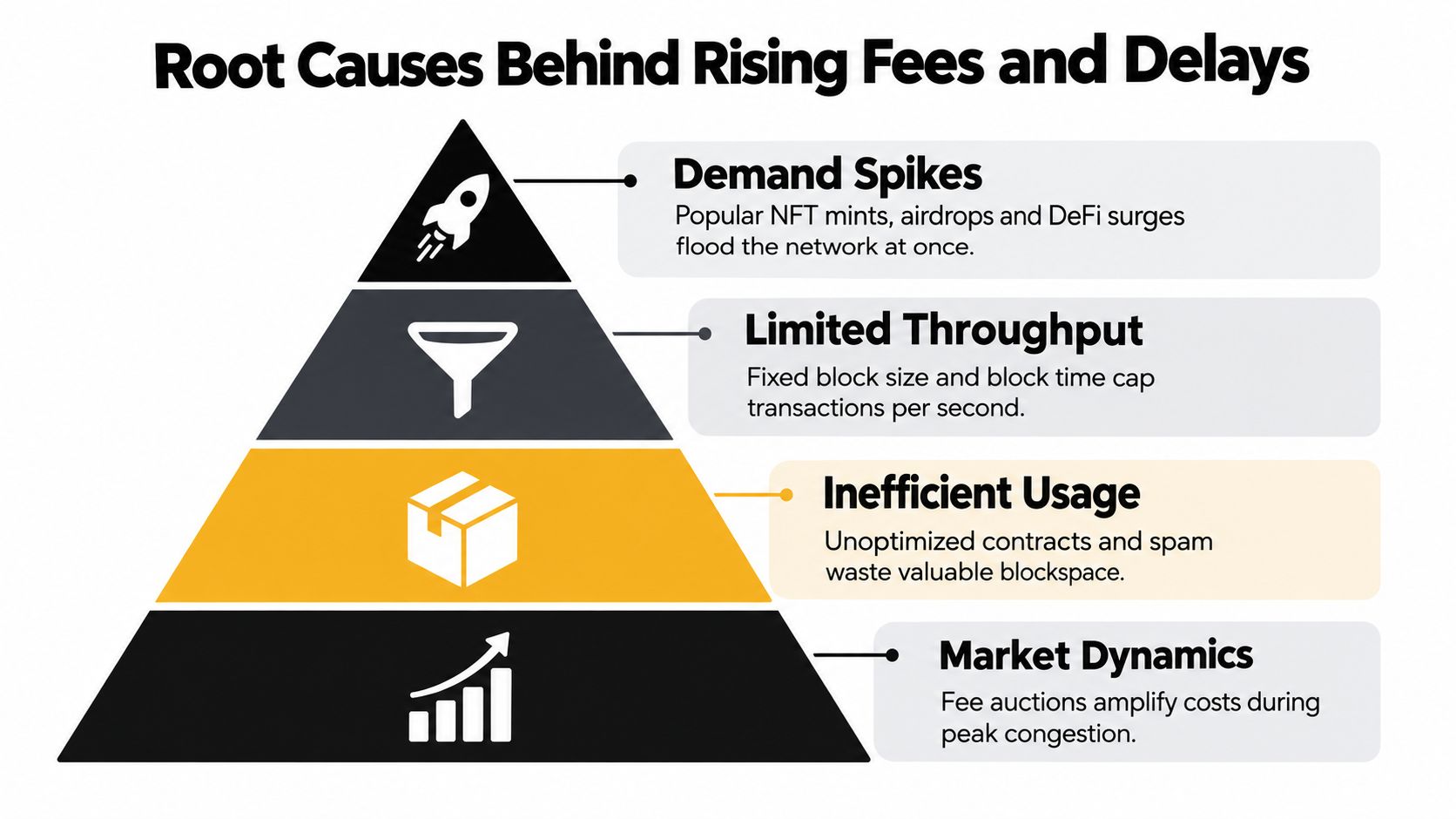
Demand, throughput, and application behavior
Four causes often overlap:
- Demand spikes: Popular mints, airdrops, and DeFi activity can flood a network in a short period.
- Limited throughput: Block limits and block timing cap how much work validators can complete.
- Inefficient usage: Poorly designed contracts, repeated calls, and spam consume scarce blockspace.
- Market dynamics: Fee bidding becomes more aggressive when users value immediate inclusion.
The last category includes MEV, or maximal extractable value. Searchers and arbitrage systems may compete to place transactions in profitable positions, adding further pressure around certain contracts and market events. A concise explanation of that mechanism is available in this guide to MEV.
Developers should also separate transaction throughput from network quality. Counting transactions alone can hide differences in execution complexity, confirmation behavior, and user experience. Teams measuring a blockchain application can borrow operational discipline from this DevOps guide to throughput metrics, especially when they need to distinguish a saturated service from an inefficient workload.
Why the slowdown may be local
Congestion isn't always a uniform, network-wide condition. The Nigeria Communications Commission's network performance reporting describes localized congestion in dense urban areas that can disrupt streaming, video calls, and mobile payments even when nationwide capacity remains generally sound. The blockchain parallel is important: a specific contract, bridge, sequencer, rollup batch, validator path, or geographic access route may become the practical bottleneck while the broader network appears healthy.
This changes diagnosis. If only one application is slow, inspect its contract and RPC path. If fees rise across many applications, examine the chain-wide fee market. If the problem appears at recurring periods or locations, operators need targeted capacity planning, observability, traffic shaping, or infrastructure densification rather than a blanket claim that the entire network needs more capacity.
Major Network Congestion Solutions Compared
The main solution families operate at different layers. A Layer 1 upgrade changes the base protocol and can improve the underlying resource model, but it may involve governance, validator, and security tradeoffs. A Layer 2 moves execution or transaction handling away from the base chain, then uses the base chain for settlement, data, or dispute resolution.
Rollups are useful when many users need application activity without every individual transaction occupying equivalent Layer 1 space. State channels and Bitcoin's Lightning Network take a different route by allowing participants to transact off-chain and settle selected results on-chain. Batching and compression reduce the amount of data applications submit in the first place.
Ethereum's EIP-4844 introduced temporary blob data for rollups. Blobs use a fee market separate from ordinary calldata, so rollups can access a more suitable data pricing mechanism when regular blockspace is under pressure. That doesn't eliminate congestion, but it targets one specific cost and data-availability bottleneck.
Operators also use traffic management concepts familiar from infrastructure engineering. Traffic shaping controls how flows enter a system, while congestion-aware routing tries to avoid paths that are already overloaded. Readers who want the networking background can explore shaping network traffic with GoReplay. In blockchain, analogous ideas appear in sequencer queues, RPC load balancing, fee policies, and path-aware routing systems.
| Solution Type | How It Reduces Congestion | Best For | Tradeoff to Consider |
|---|---|---|---|
| Layer 1 upgrades | Expands or reorganizes base-layer processing and data handling | Networks seeking foundational scaling | Protocol complexity, coordination, and security assumptions |
| Sharding and data availability improvements | Distributes workload or provides specialized space for data | Rollup-centric ecosystems and high-volume applications | More complex tooling and data-management requirements |
| Layer 2 rollups | Executes or batches activity away from the base layer, then settles on-chain | DeFi, gaming, payments, and Web3 applications | Bridging, withdrawal, sequencer, and interoperability considerations |
| State channels and Lightning | Keeps repeated activity off-chain and settles channel results later | Repeated payments or interactions among known participants | Liquidity, routing, channel management, and participant assumptions |
| Batching and compression | Combines actions and removes redundant data | Exchanges, wallets, protocols, and smart-contract developers | More complicated transaction logic and error handling |
| Queue management and routing | Prioritizes useful traffic and avoids overloaded paths | Nodes, RPC providers, sequencers, and infrastructure teams | Requires accurate telemetry and careful policy design |
A deeper discussion of these architectural choices appears in this guide to Layer 2 scaling solutions. The central choice isn't just “more transactions.” It's deciding which work belongs on the base layer, which work can move elsewhere, and which trust or availability assumptions users will accept.
Practical Ways to Reduce Congestion and Save on Fees
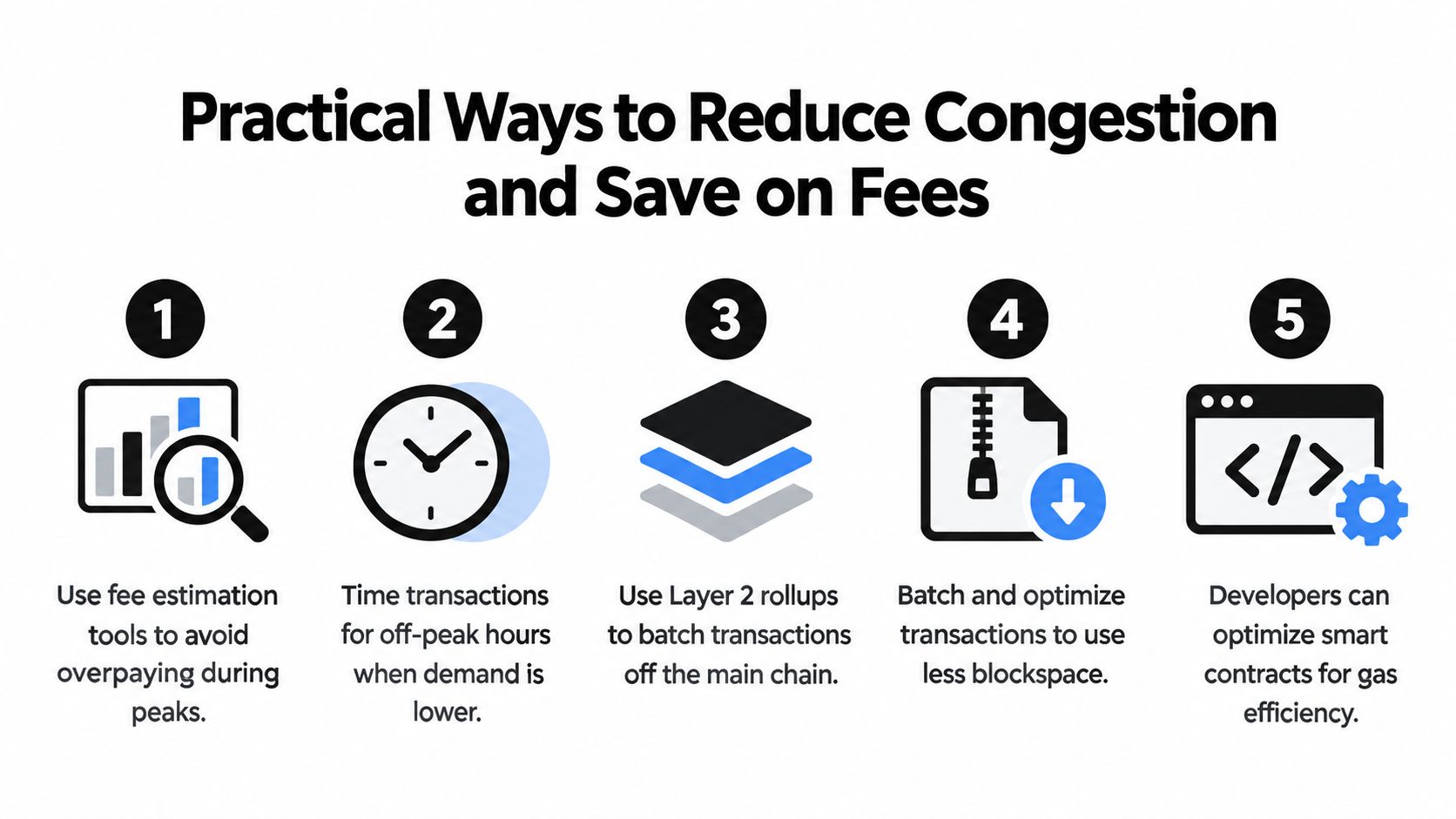
Users can often reduce wasted fees without changing chains or waiting for a protocol upgrade. The first step is to identify whether the transaction is genuinely urgent. A time-sensitive liquidation or market trade has a different priority from a routine transfer or collectible purchase.
A practical user checklist
- Check fee estimates: Compare the wallet's recommendation with current network conditions, and avoid blindly selecting the highest setting.
- Choose timing carefully: Routine transfers may be cheaper when demand is lower. This won't help if the transaction is urgent, but it can prevent unnecessary bidding.
- Use an appropriate Layer 2: A rollup can move much of the activity away from Ethereum mainnet. Learn the mechanics in this guide to what a rollup is, then verify supported assets, bridges, withdrawal conditions, and application availability.
- Batch related actions: Exchanges, wallets, and protocols can combine operations instead of submitting many separate transactions.
- Review failed transactions: A failed smart-contract call can still consume a fee. Check contract conditions, slippage settings, approvals, and gas limits before resubmitting.
A higher fee isn't always the answer. If the transaction has already become stale, replacing it may require the correct nonce and a suitable fee structure. Users should also be wary of unofficial “speed-up” services, phishing links, and wallet prompts that request unnecessary approvals.
What developers can change
Developers should profile contract execution rather than optimize by guesswork. Remove redundant storage writes, reduce unnecessary calls, use batching where the application can tolerate it, and avoid forcing users through several transactions for one logical action. Compression helps when data submission is the bottleneck, but compressed data must remain recoverable and verifiable.
Infrastructure teams can apply lessons from internet congestion engineering. Active queue management, per-flow fairness, congestion-aware routing, and cache placement can prevent one workload from monopolizing a shared path. In datacenter networks, ECMP is a common baseline, but hash-based path selection doesn't account for downstream queue occupancy. Large flows can collide on one path and create hotspots even when other equal-cost paths are available. Systems such as CONGA were designed to track path congestion and steer traffic more intelligently, a useful analogy for blockchain RPC routing and sequencer infrastructure.
Operational rule: Measure the queue before changing the fee.
Track pending transactions, confirmation time, failed calls, execution cost, RPC latency, and geographic variation. A dashboard that only shows average throughput can miss the localized peak that users feel.
Real World Case Studies of Congestion Fixes in Action
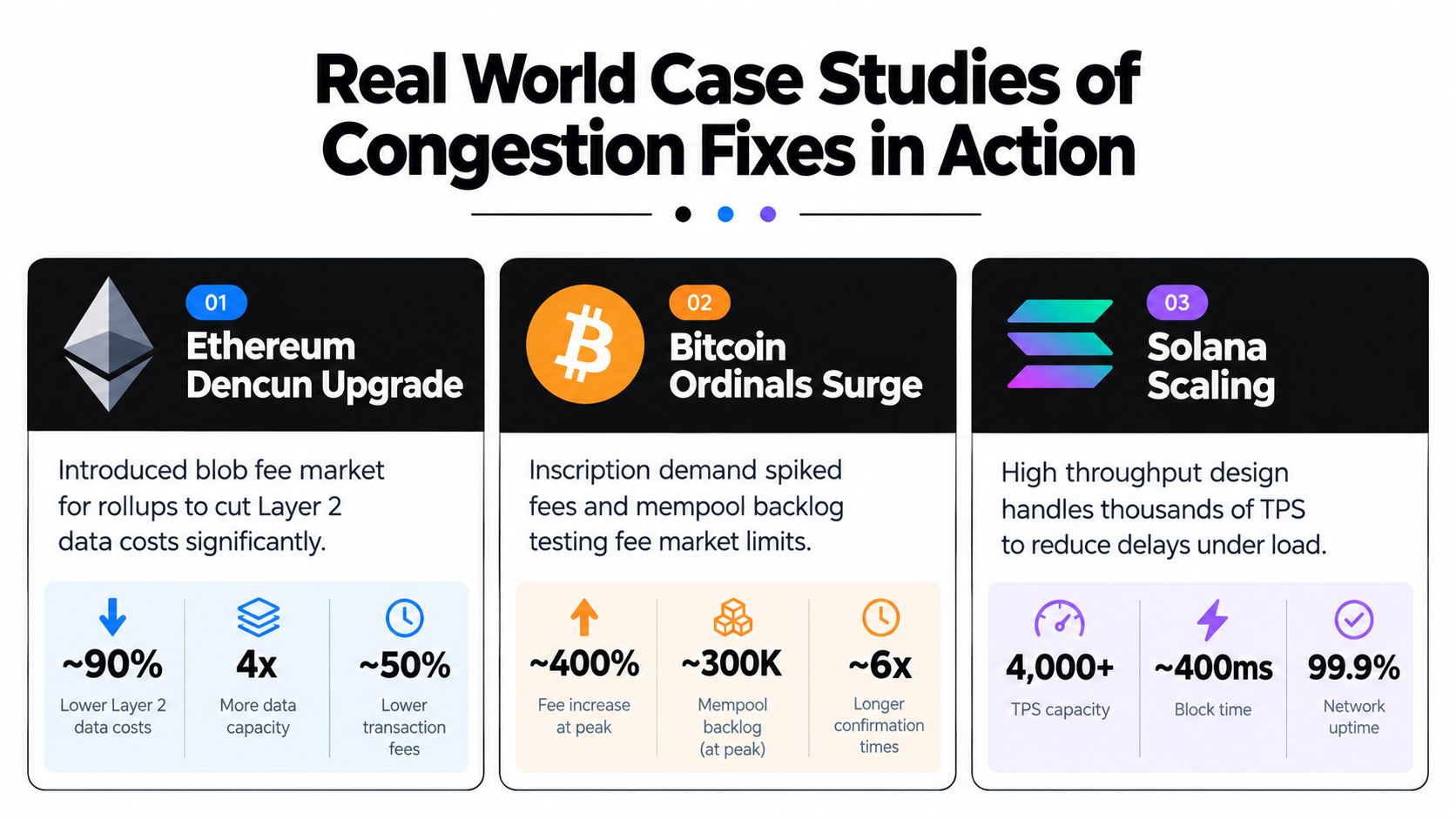
Ethereum's post-Dencun design illustrates a targeted fix. EIP-4844 added temporary blob data that rollups can use for data availability, with blobs priced in a separate fee market from ordinary calldata. The architectural lesson is more important than any short-term fee outcome: rollup ecosystems needed a data path suited to their workload, so Ethereum introduced a resource designed specifically for that purpose.
The change doesn't make every Ethereum transaction cheap. A user interacting directly with a congested Layer 1 application still competes for ordinary blockspace. Rollups also need reliable data publication and settlement, so the system shifts the bottleneck rather than making resource constraints disappear.
Bitcoin's Lightning Network demonstrates a different approach. Payment channels allow participants to route payments off-chain, reducing the need to record every payment directly on Bitcoin's base layer. Public channel capacity was measured at about 4,898 BTC across 41,080 channels and 17,438 nodes in May 2026, according to Spark's Lightning Network state report. The same report noted public capacity near 5,637 BTC at its record high in December 2025.
Capacity can also move in the opposite direction. Hoge's Lightning reporting placed public channel capacity around 2,620 to 2,646 BTC in August 2026, down roughly 3% to 6% over 30 days and well below the earlier record. That volatility shows why off-chain scaling depends on liquidity providers keeping funds routed into usable channels. More nominal capacity doesn't automatically mean better routing for every payment.
These examples share a pattern. Ethereum separated rollup data from ordinary calldata, while Lightning moved repeated payments into channels. Both reduce base-layer pressure by changing where activity happens, but neither removes operational tradeoffs around liquidity, data availability, settlement, routing, or user access.
Choosing the Right Strategy for Your Needs
The right strategy starts with the bottleneck, not the trend.
If you're a retail user making a routine transaction, check the fee market, consider off-peak timing, and use a reputable Layer 2 when the application and asset support it. Keep enough native gas token for the destination network, and confirm bridge and withdrawal details before moving funds.
If you're building a dApp, reduce unnecessary execution first. Batch compatible actions, optimize storage and calldata, and decide whether users need direct Layer 1 settlement or whether a rollup, state channel, or application-specific network fits better. Security assumptions, liquidity, interoperability, and recovery paths matter as much as nominal throughput.
If you operate infrastructure, prioritize observability. Monitor mempool conditions, queue depth, confirmation behavior, RPC latency, geographic hotspots, and peak-period performance. AI can help with anomaly detection, traffic prediction, and operational triage, but simulated improvements shouldn't be treated as proof of broad production superiority. In practice, AI is more credible as an assistant to telemetry, planning, and incident response than as a replacement for protocol fundamentals.
The durable lesson is simple: network congestion solutions work best when they match the layer where demand exceeds capacity. Fee tactics help with immediate prioritization. Contract optimization reduces waste. Layer 2 systems move execution. Blob markets target rollup data. Lightning changes payment settlement. Capacity planning and congestion-aware routing address infrastructure hotspots.
Verify current fees, supported networks, bridge conditions, and protocol documentation before acting. Congestion changes quickly, and a solution that fits one transaction or application may be unsuitable for another.
Explore Coiner Blog for clear guides and balanced analysis on Bitcoin, Ethereum, Layer 2 networks, DeFi, smart contracts, and emerging blockchain infrastructure. Visit the site to follow practical explanations of crypto technology and the risks that shape real-world adoption.