
What Is a Metaverse and How It Actually Works
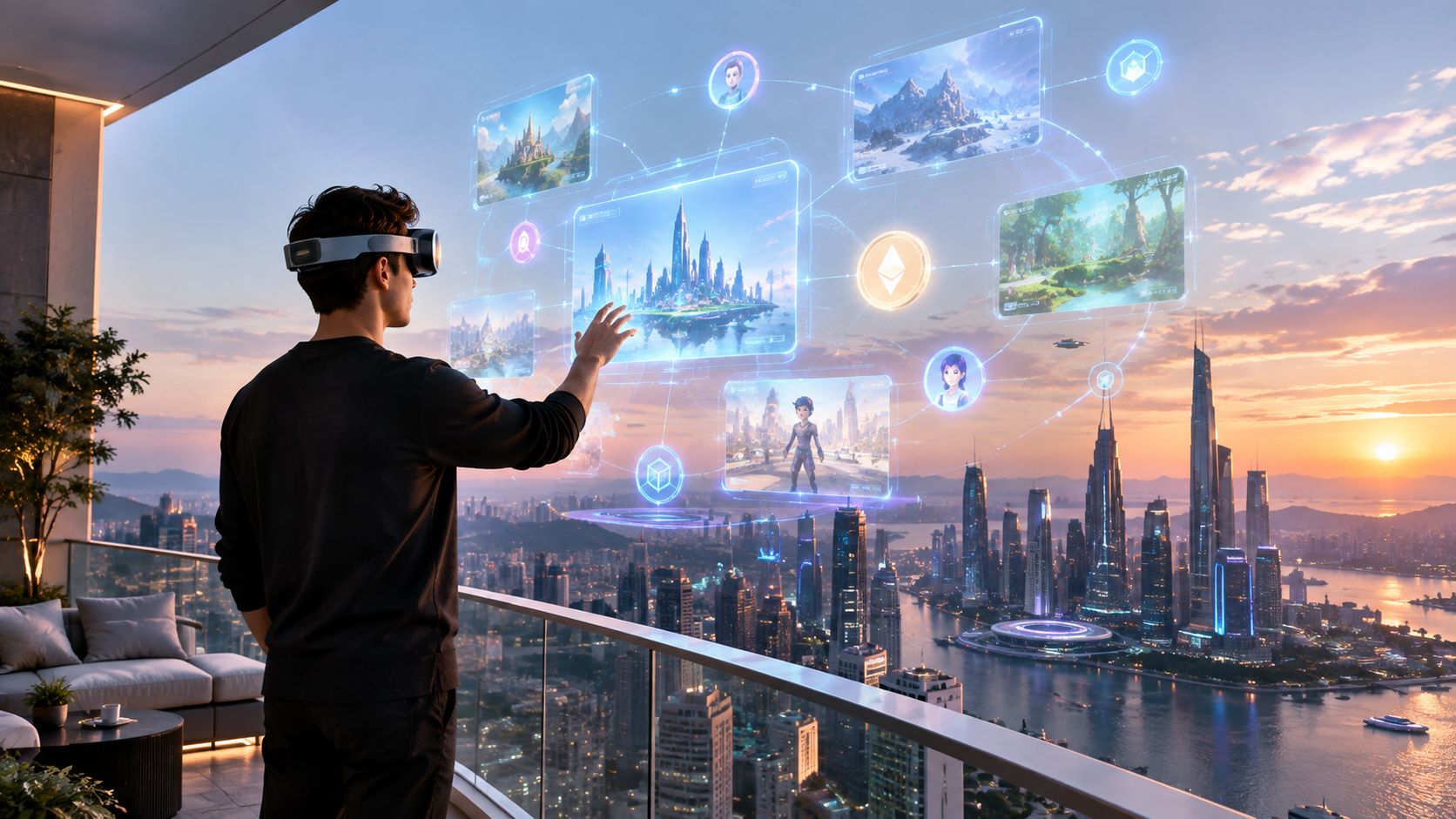
The metaverse is an always-on network of immersive, shared virtual worlds where users interact through avatars and own digital assets, a market valued at USD 105.40 billion in 2024 and projected to reach USD 936.57 billion by 2030. It isn't one headset, game, or website. It's a connected model for digital spaces, identities, economies, and experiences that can overlap with the physical world.
You may already have encountered a version of it without calling it the metaverse. You join friends inside a game, customize an avatar, attend a digital event, buy an in-game item, or move between a phone screen and a headset. The experience feels less like visiting a page and more like entering a place.
That shift explains why the term matters to crypto users. Bitcoin introduced digitally native scarcity, Ethereum made programmable ownership possible through smart contracts, and Web3 added the idea that users could hold identity-linked assets rather than merely rent access from a platform. Those pieces don't automatically create an open metaverse, but they help explain the economic and technical direction.
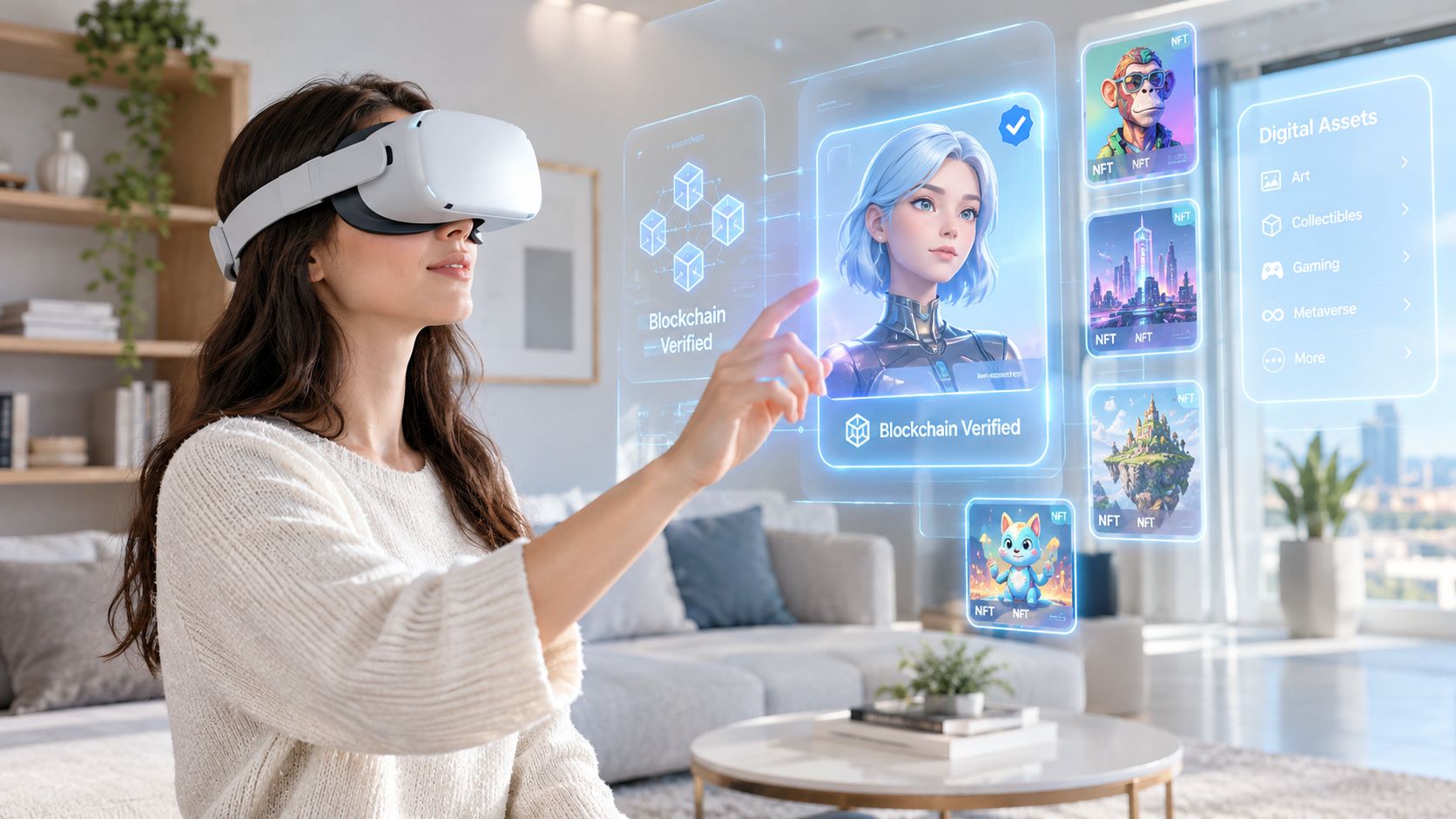
Table of Contents
- Introduction to the Metaverse Beyond the Hype
- What the Metaverse Really Means in Plain Language
- How the Metaverse Evolved From Fiction to Mass Platforms
- Key Building Blocks That Make the Metaverse Work
- Major Metaverse Platforms and Real World Examples
- Risks Challenges and Why Adoption Still Faces Hurdles
- Future Outlook and Practical Takeaways for Crypto Users
Introduction to the Metaverse Beyond the Hype
A useful way to understand the metaverse is to follow a normal session. You open an application, enter a persistent environment, see other people represented by avatars, communicate in real time, and interact with objects that may have social, functional, or economic value. The environment may run on a phone, computer, augmented reality device, or virtual reality headset. The hardware changes the level of immersion, but it doesn't define the entire concept.
The Grand View Research metaverse market analysis describes a market that includes hardware, software, services, and content. Its estimate places the global market at USD 105.40 billion in 2024, with a projection of USD 936.57 billion by 2030, based on a 46.4% CAGR from 2025 to 2030. Those figures don't prove that every metaverse project will succeed. They do show that spatial computing, virtual experiences, and digital content have become a substantial commercial category.
A network, not a single destination
The common mental image is a giant virtual city where everyone logs in through goggles. That image is too narrow. Standards work from the International Telecommunication Union and the IEEE metaverse standards initiative treats the metaverse as a broader ecosystem involving persistence, real-time interaction, immersion, and interoperability.
This distinction matters because a closed game can provide a metaverse-like experience without offering portable identity or assets. Conversely, an open network could connect virtual worlds that use different graphics, devices, business models, and blockchain infrastructure.
The rest of the subject becomes easier once you ask four practical questions:
- What persists? Does the world, object, or social state remain available after you leave?
- Who are you there? Can your avatar, reputation, credentials, or identity continue across environments?
- What do you control? Are digital items yours, or can a platform revoke access at any time?
- How do worlds connect? Can systems exchange identity, data, assets, and permissions safely?
Those questions move the discussion away from headset enthusiasm and toward the infrastructure that could make shared digital places useful.
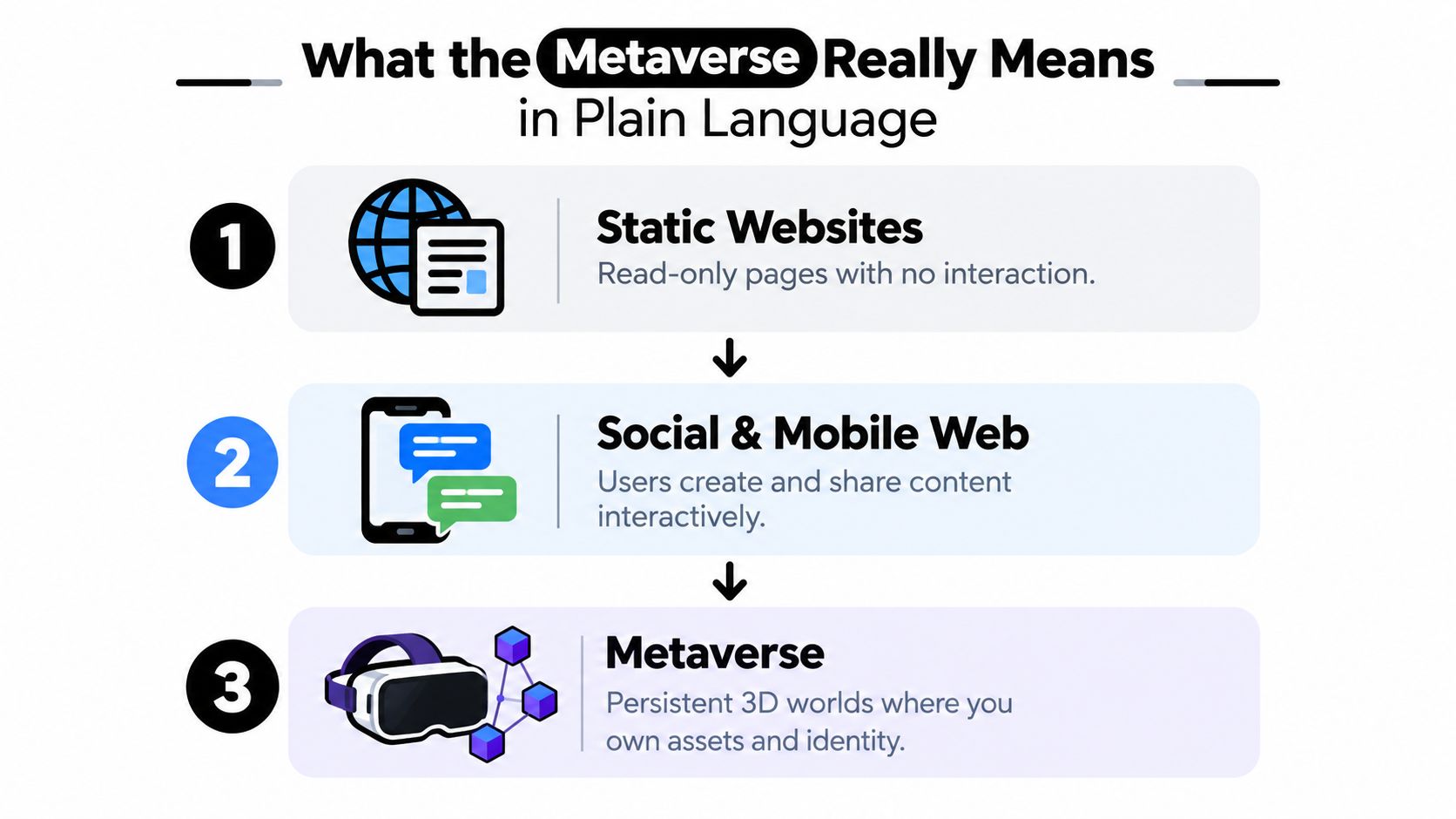
What the Metaverse Really Means in Plain Language
The easiest analogy is the internet's transition from pages to places. Early websites mostly delivered information. Social and mobile platforms made the web interactive, letting users create profiles, publish content, message one another, and participate in communities. The metaverse pushes that interaction into spaces that feel inhabited rather than merely viewed.
Start with persistence
A persistent environment continues to exist when an individual user logs out. That doesn't mean every object must remain unchanged forever. It means the world can preserve relevant state, relationships, inventory, events, and social context rather than resetting entirely after each session.
The European Union Interoperable Europe Portal identifies persistence and real-time operation as core aspects of metaverses. A virtual classroom, factory simulation, concert venue, or game world becomes more useful when people can return to an evolving environment instead of starting from a blank screen.
Add immersion and presence
Immersion doesn't require a headset in every case. A three-dimensional game viewed on a monitor can still provide an avatar, spatial movement, social interaction, and a sense of place. VR increases embodied presence by tracking the user's head and, in some systems, hands or other movements. AR overlays digital elements onto the physical environment.
Practical rule: VR is an access method, gaming is a major use case, and the metaverse is the wider networked system.
This is why calling every VR application a metaverse creates confusion. A solitary VR video may be immersive but not social or persistent. A multiplayer game may contain a persistent social world but remain controlled by one company. The broader metaverse idea combines these traits with an economic layer and the possibility of interoperability.
Understand the economic layer
The generalized economic system highlighted by the EU portal can include platform credits, subscriptions, creator payments, NFTs, cryptocurrencies, digital services, or non-financial exchanges such as reputation and access. Blockchain isn't mandatory for every virtual world, but it can provide public records for ownership, transfers, and programmable rules.
For a crypto-native reader, the distinction resembles the difference between an application and an open protocol. A closed platform can issue items inside its database. A blockchain-based system can let a smart contract define how an asset is created, transferred, or used, subject to the limits of wallets, marketplaces, standards, and platform support. The plain-language guide to Web3 technology offers useful background on that ownership model.
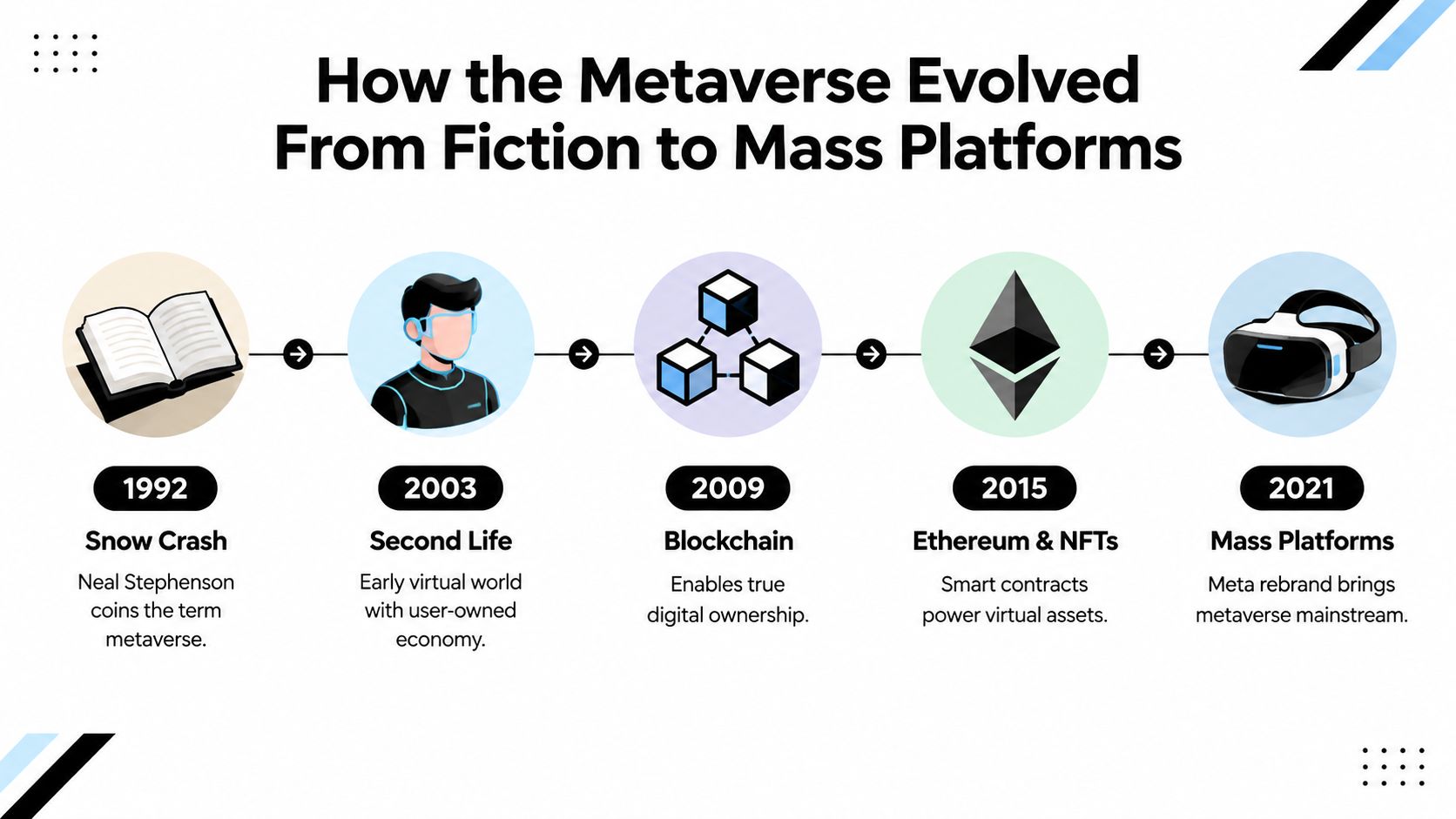
How the Metaverse Evolved From Fiction to Mass Platforms
The word came from fiction, but the underlying idea wasn't created from nothing. Neal Stephenson popularized metaverse in his 1992 novel Snow Crash, where users entered a persistent virtual world through avatars. Earlier virtual environments had already explored online presence, social interaction, and user-created spaces, which shows that the concept grew from several technical and cultural threads.
From virtual worlds to programmable ownership
Early platforms demonstrated that people would spend time in avatar-based environments when those environments offered social status, creative control, or an economy. Gaming later became the strongest adoption engine because games already provide objectives, feedback loops, communities, and reasons to return.
Blockchain changed the ownership conversation. Instead of treating every item as a record inside a publisher's private database, developers could represent selected assets with tokens and use smart contracts to manage transfers. That model supports NFTs, marketplace transactions, creator royalties, and token-based access, although it doesn't guarantee portability or value.
Ethereum became especially relevant because its programmable contracts allowed developers to build more complex asset and identity systems than a simple payment rail. Tokenomics then entered the discussion, covering supply, utility, incentives, governance, and the relationship between a token and the activity it is supposed to support.
Adoption now has multiple layers
The ReportPrime metaverse market overview states that the Consumer Metaverse market reached USD 114.7 billion in 2024, with North America holding 37.3% of that market. The same source reports over 600 million global active users and more than 70 million daily active users on Roblox alone. These figures point to a key reality: much of today's metaverse activity happens through familiar gaming and social platforms, not exclusively through dedicated VR hardware.
Gaming works as an anchor because it makes participation intuitive. Users already understand avatars, inventories, virtual currencies, multiplayer spaces, and digital status. Platforms can then extend those behaviors into concerts, branded environments, education, creator tools, and commerce.
That progression also changes the investment question. The important issue isn't whether a project uses the word metaverse. It's whether people have a compelling reason to return, creators can build sustainably, and the underlying systems can preserve identity, assets, and social context across devices and platforms.
Key Building Blocks That Make the Metaverse Work
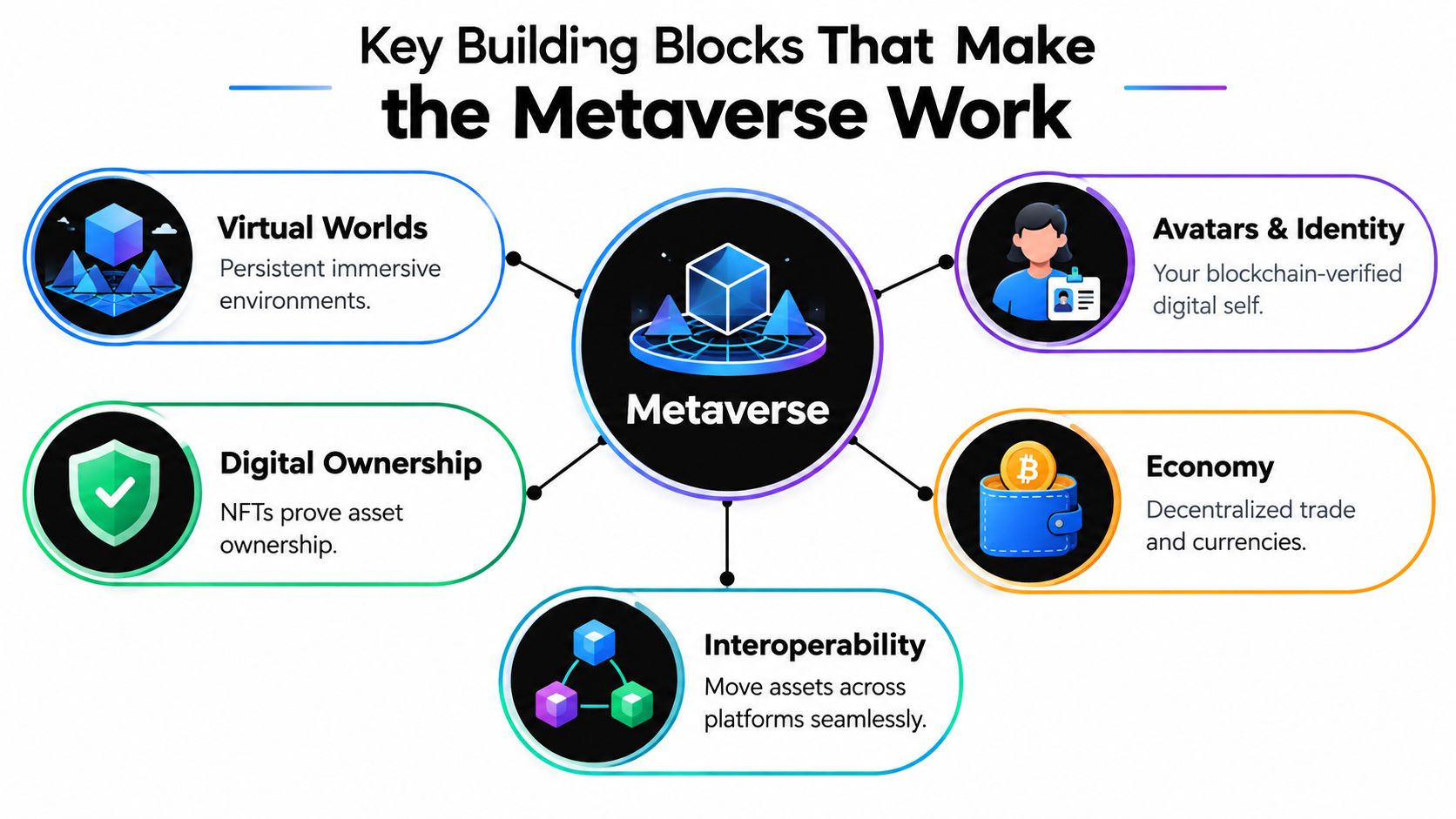
A functioning metaverse depends on several layers operating together. A beautiful 3D scene isn't enough if users can't meet reliably, carry a consistent identity, trust the asset system, or move between environments.
Virtual worlds and presence
The visible layer includes environments, objects, movement, sound, user interfaces, and social interactions. Developers build these experiences with game engines, XR devices, network services, and increasingly AI-assisted creation tools. A virtual world can represent a game arena, a training facility, a museum, a workplace, or a digital twin of a physical asset.
Avatars provide continuity. They can express appearance, movement, social signals, permissions, and reputation. The important distinction is between an avatar as a costume and an identity as a durable set of credentials and relationships. A user may want different appearances in different contexts while still controlling a consistent underlying identity.
For a deeper look at avatar identity in online worlds, see this guide to avatars in virtual environments.
Ownership and programmable rules
NFTs can represent unique digital items such as clothing, land, tickets, collectibles, or access credentials. A smart contract can define transfer rules, permissions, or interactions with other applications. Yet the token alone doesn't guarantee that every platform will recognize the item. Ownership has at least three layers: control of the wallet, legal or contractual rights, and technical support from the environment.
That distinction is central to Web3. A token may be cryptographically controlled by a user while the associated image, game function, or access privilege remains dependent on another service. Serious analysis must examine the whole stack rather than treating an NFT as automatic portability.
Economies and interoperability
A metaverse economy can combine platform currencies, crypto assets, creator income, DeFi services, and tokenized real-world assets where the legal and technical structure supports them. Layer 2 networks may help reduce transaction friction for high-volume activity, but scaling doesn't solve poor game design, weak moderation, or unclear ownership.
Interoperability is the connective tissue. The TU Wien research survey describes the need for low-latency, high-bandwidth synchronization involving XR, IoT, AI, and digital twins. As more users and objects interact simultaneously, systems must exchange state quickly and consistently.
Standards such as ISO/IEC 23005 and IEEE P2048 matter because they address interfaces, categories, data formats, and information exchange between real and virtual worlds. Without shared technical conventions, each platform becomes an island.
The architecture can be summarized like this:
| Building Block | Role in the Metaverse | Why It Matters |
|---|---|---|
| Virtual worlds | Provides persistent spaces and activities | Gives users a reason to participate |
| Avatars and identity | Represents people, credentials, and reputation | Supports continuity across experiences |
| Digital ownership | Records control of selected assets | Enables collection, access, and programmable use |
| Economy | Coordinates trade, incentives, and creator payments | Gives activity economic structure |
| Interoperability | Connects platforms, identities, and data | Prevents every world from becoming a closed silo |
Teams working on immersive environments also need production expertise beyond blockchain. A resource on virtual reality production can help clarify the creative and technical demands of VR, mixed reality, and augmented reality projects.
Major Metaverse Platforms and Real World Examples
The word metaverse covers platforms with very different designs. Comparing them by ownership, audience, and openness is more useful than ranking them by graphics.
Roblox represents a gaming-led social ecosystem. Users create avatars, play experiences made by developers, and participate in a platform economy. Its strength is the combination of discovery, social activity, and creator tools. Its limitations include platform dependence and the fact that assets and identity don't automatically travel to unrelated worlds.
Decentraland takes a more Web3-native approach. Wallets, NFTs, virtual land, and a token-based economy sit closer to the user experience. That creates a clearer connection between digital ownership and blockchain, but it also adds wallet management, transaction considerations, and the challenge of attracting activity beyond speculation.
The Sandbox similarly emphasizes user-created worlds, branded experiences, virtual land, and digital assets. Its model illustrates how tokenized objects can support creator economies, while also showing why utility matters. Land or collectibles become more meaningful when people have reasons to visit, build, collaborate, or play.
The guide to Web3 gaming provides useful context for the difference between traditional game economies and blockchain-enabled ownership.
Beyond consumer entertainment
The metaverse isn't limited to games. The EU portal identifies applications in education, leisure, design and manufacturing, health, and cultural heritage. A medical training environment can let students practice procedures in a controlled simulation. A manufacturer can use a digital twin to inspect a design before changing a physical production process. A museum can create an interactive reconstruction that would be impossible in a conventional exhibition.
Industrial and government settings often prioritize requirements that consumer projects can overlook:
- Security: Sensitive data and operational systems need protection.
- Compliance: Organizations must meet legal, safety, and sector-specific obligations.
- Integration: A virtual environment has to connect with existing software, records, and workflows.
- Reliability: A demonstration can tolerate novelty, but a professional tool must perform consistently.
This creates two broad paths. Consumer worlds compete for attention and community. Enterprise environments compete for useful outcomes, integration, and trust. Both may use immersive interfaces, but their success criteria differ sharply.
The practical lesson is simple. Don't assess a metaverse platform only by whether it has land sales, NFT drops, or impressive visuals. Ask who uses it, what they do there, which assets or credentials matter, and whether the platform's economic model supports genuine activity.
Risks Challenges and Why Adoption Still Faces Hurdles
A technically impressive world can still fail as a place people want to visit regularly. The main obstacles increasingly involve trust, safety, and continuity rather than visual quality alone.
The DIN study on safe consumer-oriented metaverse and extended reality design says users most often report problems including trolling, extremist content, discrimination, and cyberbullying. Privacy, addiction, and mental-health concerns also remain prominent fears. These aren't secondary community-management issues. They directly influence whether people feel comfortable returning.
The safety layer is part of the product
Avatars can make interaction expressive, but they can also make harassment feel immediate and personal. Moderation systems need to handle voice, text, gestures, virtual objects, user-generated content, and coordinated abuse. A platform that protects transactions while ignoring social safety hasn't solved the complete trust problem.
Privacy creates another challenge. Immersive devices can process information about movement, surroundings, voice, attention, and social behavior. Users need understandable controls over collection, retention, sharing, and deletion. Businesses need clear boundaries around workplace, health, educational, and customer data.
Identity and interoperability remain unfinished
The ITU interoperability draft defines identity interoperability as transferring entity IDs between different metaverse platforms. Its architecture guidance recommends blockchain for securely and transparently recording creation, authentication, validation, and updates, with the aim of supporting a unified identity experience across worlds.
That doesn't mean a blockchain identity automatically works everywhere. Platforms still need compatible standards, permission systems, wallet recovery, privacy protections, and governance. A portable identity can be useful, but users may not want every activity permanently linked across every context.
Technical constraints compound the problem. Real-time shared environments require synchronized rendering and data exchange. Network delays, device limitations, incompatible formats, and centralized service outages can interrupt presence or make assets inaccessible.
The metaverse won't become durable because it looks realistic. It will become durable when users trust the people, rules, infrastructure, and ownership systems behind it.
Buyers in industrial and government settings are especially likely to focus on security, compliance, and integration. Consumer users may tolerate friction during experimentation, but regular use depends on convenience and safety. Adoption therefore has to be judged by the entire experience, not by hardware launches or token activity.
Future Outlook and Practical Takeaways for Crypto Users
The metaverse's most credible future may be less theatrical than the original hype suggested. Instead of one universal world, expect a collection of persistent environments connected unevenly through identity, standards, assets, and data. Some will be closed games. Others will use Ethereum or Layer 2 networks for NFTs, payments, governance, or creator contracts. Bitcoin may remain relevant as a digital monetary asset without becoming the default engine for every virtual economy.
Crypto users should evaluate projects through a practical filter:
- Check the activity: Look for a clear reason people return, not just a token launch.
- Inspect the ownership model: Confirm what the NFT or token grants and which services it depends on.
- Study tokenomics: Review supply, incentives, unlocks, utility, and who controls upgrades.
- Test the infrastructure: Ask whether the platform addresses latency, security, identity, and interoperability.
- Separate narrative from evidence: AI integration, DeFi features, and real-world asset tokenization can be useful, but each needs a specific role rather than a decorative label.
- Manage risk: Treat virtual land, collectibles, and metaverse tokens as volatile assets, and don't confuse participation with investment advice.
The strongest projects will probably combine compelling experiences with boring but essential infrastructure. Smart contracts, wallets, standards, moderation, privacy controls, and reliable servers matter more than a cinematic trailer. The metaverse is best understood as a long-term digital transformation, not a guaranteed market outcome.
Coiner Blog publishes clear guides and balanced analysis on digital assets, NFTs, Web3 gaming, tokenomics, and the infrastructure shaping crypto economies. Visit Coiner Blog to follow practical coverage of metaverse projects, blockchain developments, and the risks behind the headlines.