
Infinite World Game: A Deep Dive Into Web3’s New Frontier
Most “infinite world” games aren’t solely about permanence. They’re about reconstruction. A seed, a chunk system, and noise functions can keep generating terrain on demand, but that isn’t the same as a world that remembers what players did inside it. The more interesting shift is happening where procedural generation meets blockchain, AI memory, and player ownership.
That’s why the infinite world game thesis matters right now. Coverage usually stops at terrain algorithms, render distance, or map size. Yet one of the most underserved angles is the role of blockchain and NFTs in creating persistent, player-owned infinite worlds, even as emerging projects push AI-powered infinite canvases and some platforms have already reached 19 million peak monthly users, with this direction framed as a trend shaping gaming in 2026 according to analysis of AI-powered infinite canvases and Web3 ownership.
A good blockchain game doesn’t just let you roam forever. It lets your actions remain economically and narratively relevant after you log off.
Table of Contents
- The Next Evolution of Gaming Is Here
- Beyond the Hype Defining the Infinite World Game
- How an Infinite Universe Is Built and Played
- Understanding the On-Chain Soul of the Game
- The Player Economy and Play-to-Earn Model
- Evaluating Investment Risks and Future Potential
- How to Enter the Infinite World Today
The Next Evolution of Gaming Is Here
An infinite world game used to mean one thing. You could keep moving, and the system kept building more space around you. That solved scale, but it didn’t solve history.
The stronger claim today is that gaming is moving from endless maps to endless continuity. That’s a bigger leap. If a player’s actions become durable assets, durable memories, or durable governance inputs, then the world stops being a disposable instance and starts behaving like a persistent digital society.
Persistence changes the genre
Traditional procedural games excel at environmental abundance. They let players explore, mine, build, fight, and repeat inside a world that feels functionally limitless. But most of that persistence remains platform-controlled. If the game operator changes the rules, closes servers, or resets progression systems, the player’s “history” often becomes a database entry with no independent life outside the publisher’s stack.
Blockchain changes that design space.
NFTs and smart contracts make it possible to treat land, items, achievements, and event history as owned digital objects rather than licensed account states. That doesn’t automatically create a good game, but it does create a new category of game infrastructure. In that category, a player’s reputation, assets, and narrative record can survive beyond a single session or even beyond one content cycle.
Practical rule: A world isn’t meaningfully persistent if the player can’t verify ownership, transfer value, or carry reputation across systems.
That’s why the infinite world game conversation now overlaps with Web3, Layer 2 scaling, and AI-native worldbuilding. The overlap isn’t cosmetic. It’s structural.
Why this matters for Web3 investors
For crypto investors, this model matters because it reframes GameFi from speculative token loops into stateful economies. The best opportunity may not be a token pump tied to a launch. It may be infrastructure that supports long-lived identity, asset provenance, and player-generated history.
Readers tracking broader crypto gaming analysis and trends will recognize the pattern. Markets keep rewarding projects that turn user activity into reusable digital property. In an infinite world game, that principle becomes more powerful because the content surface is effectively open-ended while the ownership layer remains portable and verifiable.
That's the shift. Infinite terrain was impressive. Infinite consequence is more valuable.
Beyond the Hype Defining the Infinite World Game
The easiest mistake is to hear “infinite world game” and think “Minecraft clone with NFTs.” That framing misses the point. The more advanced version combines procedural scale, AI-driven narrative systems, and on-chain ownership into a single gameplay loop.
Not just another procedural sandbox
A normal sandbox gives players room. A stronger infinite world game gives players room and memory.
Minecraft popularized the feel of boundless procedural exploration. Decentraland pushed the ownership side by tying digital space to blockchain assets. AI-native world systems introduce another layer by making the game react to player behavior in more flexible ways than fixed quest trees ever could.
That combination creates a different value proposition:
- Procedural generation supplies new environments and replayability.
- AI systems can interpret what happened and preserve meaning.
- Blockchain rails can turn selected outcomes into portable, player-owned records.
The result is less like a static metaverse mall and more like a persistent simulation where history accumulates.
A clearer comparison with familiar models
The most useful way to evaluate an infinite world game is side by side.
| Model | What it does well | Where it falls short |
|---|---|---|
| Procedural sandbox | Endless exploration and content variety | History often stays trapped inside the game database |
| NFT world platform | Clear ownership and tradable assets | World activity can feel static or financially over-engineered |
| AI narrative game | More adaptive storytelling | Memory and ownership may remain centralized |
| Infinite world game with blockchain integration | Combines scale, adaptive memory, and owned history | Technically harder to build and harder to balance |
That last category is where things get interesting for GameFi. If the world remembers what happened, and if that memory can affect future gameplay or asset value, then players are no longer just consuming content. They’re contributing to a living ledger of world events.
A small but telling parallel comes from older franchise-based games. Dragon Ball Z: Infinite World opened strongly in Japan with 76,452 first-week unit sales, then reached 200,000 total copies sold in Japan by August 2010, while the United States reached 80,000 copies as of August 2010, according to the sales summary for Dragon Ball Z Infinite World. That pattern highlights a familiar issue in games: early attention doesn’t guarantee durable engagement.
For Web3 games, that distinction matters even more. Launch hype can sell a token or NFT collection. It can’t by itself produce a world players want to inhabit for years.
A related example from adjacent NFT culture is the way branded digital assets often attract initial attention faster than they create durable ecosystems, something collectors can see in projects tied to recognizable IP such as Hot Wheels NFT coverage. Ownership alone isn’t enough. The world needs systems that keep player history useful.
A compelling infinite world game doesn’t win because it says “infinite.” It wins because the world keeps remembering why the player matters.
How an Infinite Universe Is Built and Played
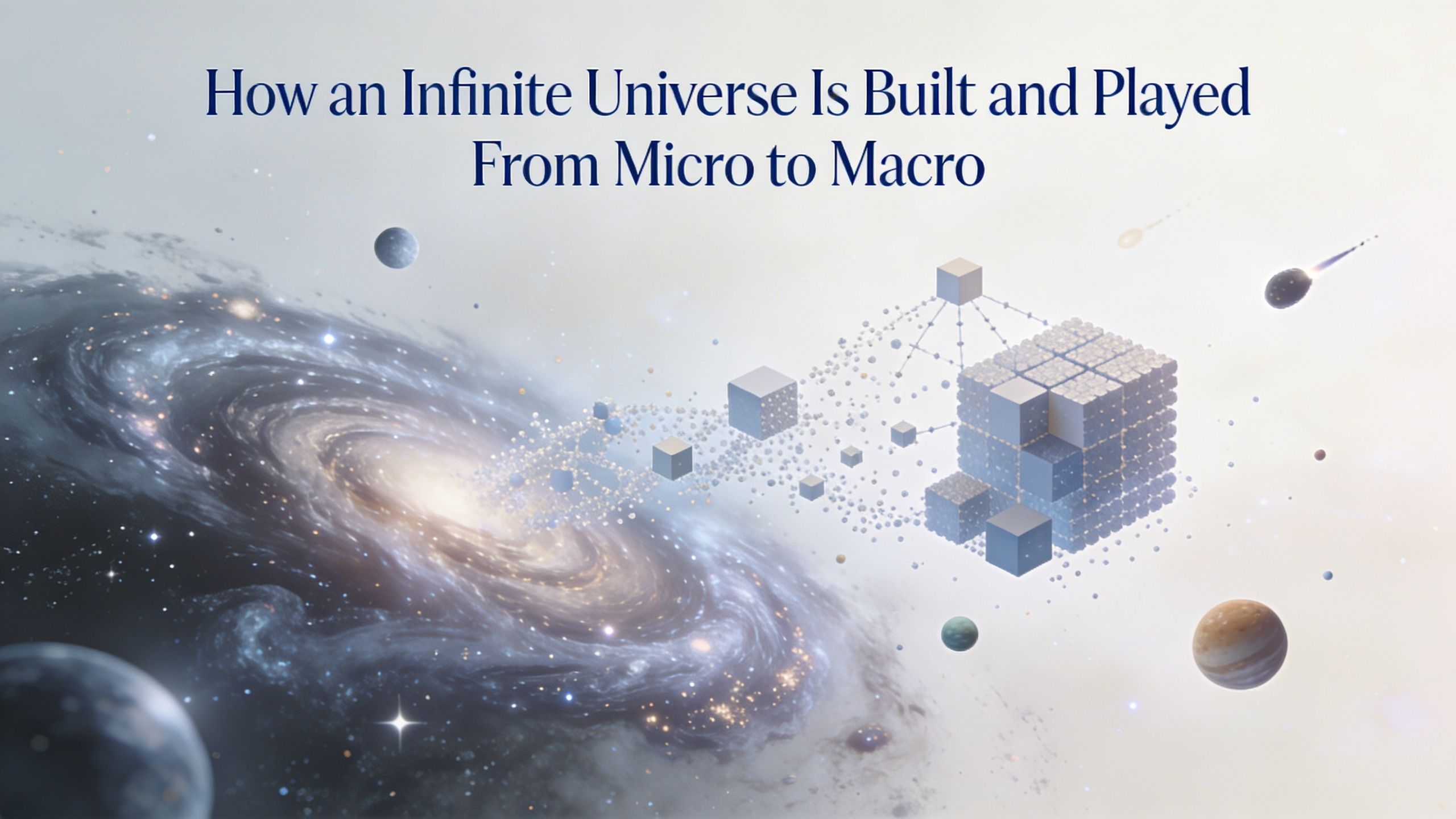
An infinite world game only works if the technical design stays invisible to the player. You should feel exploration, not database strain. You should feel discovery, not asset loading logic.
What players actually do
At the player level, the loop is familiar. You explore. You gather resources. You build, fight, craft, or negotiate. You move into new territory and the game keeps extending the frontier.
That familiarity matters because GameFi often gets distracted by token wrappers and forgets the underlying product. If movement, survival, combat, and social coordination aren’t satisfying, no tokenomics model can save the experience.
The ideal design keeps the early gameplay readable:
- Explore new terrain and identify useful locations.
- Collect or craft assets that improve mobility, defense, or production.
- Leave lasting impact through structures, territorial claims, or event outcomes.
- Re-enter the world later and find that earlier actions still matter.
How chunking and seeds create scale
The technical backbone usually starts with chunking and deterministic generation. In procedural generation for games like this, the world is often divided into chunks of 16x16x384 blocks, generated on demand from a fixed seed and shaped with Perlin noise, which lets the game create natural-looking terrain while loading only nearby active chunks, saving over 99.9% of memory instead of storing a world that would otherwise require petabytes, according to this procedural generation breakdown covering chunks, seeds, and memory efficiency.
That’s the key to practical infinity on consumer hardware.
Think of the seed as the master instruction. The game doesn’t need to save every hill, cave, and valley as a giant file. It saves the rule set, then rebuilds local terrain as needed. Chunking makes this manageable because the engine only handles the area around the player rather than the whole world at once.
Why this technical design matters
This design has three implications that matter for blockchain gaming:
- Efficient clients matter more than grand promises. A Web3 game still has to run well on ordinary hardware.
- On-chain storage should be selective. Terrain generation belongs off-chain. High-value state, ownership, and proofs are what belong on-chain.
- Determinism supports shared worlds. If multiple players can reference the same seed logic, the system can coordinate persistence without storing every square inch as immutable blockchain data.
Analyst view: The smartest architecture in GameFi stores scarce facts on-chain and computes abundant world detail off-chain.
That’s why the blockchain angle should complement procedural generation, not replace it. Terrain is cheap to regenerate. Reputation, ownership, and consequential events are the expensive layer. Conflating those layers leads to poor design and unnecessary transaction costs.
For readers following broader blockchain infrastructure themes, this is the same optimization logic seen across Web3. Put settlement and verification where they belong. Keep high-frequency computation where it’s efficient.
An infinite world game becomes viable when these layers are disciplined. The engine generates space. The game loop generates meaning. The chain records what’s worth preserving.
Understanding the On-Chain Soul of the Game
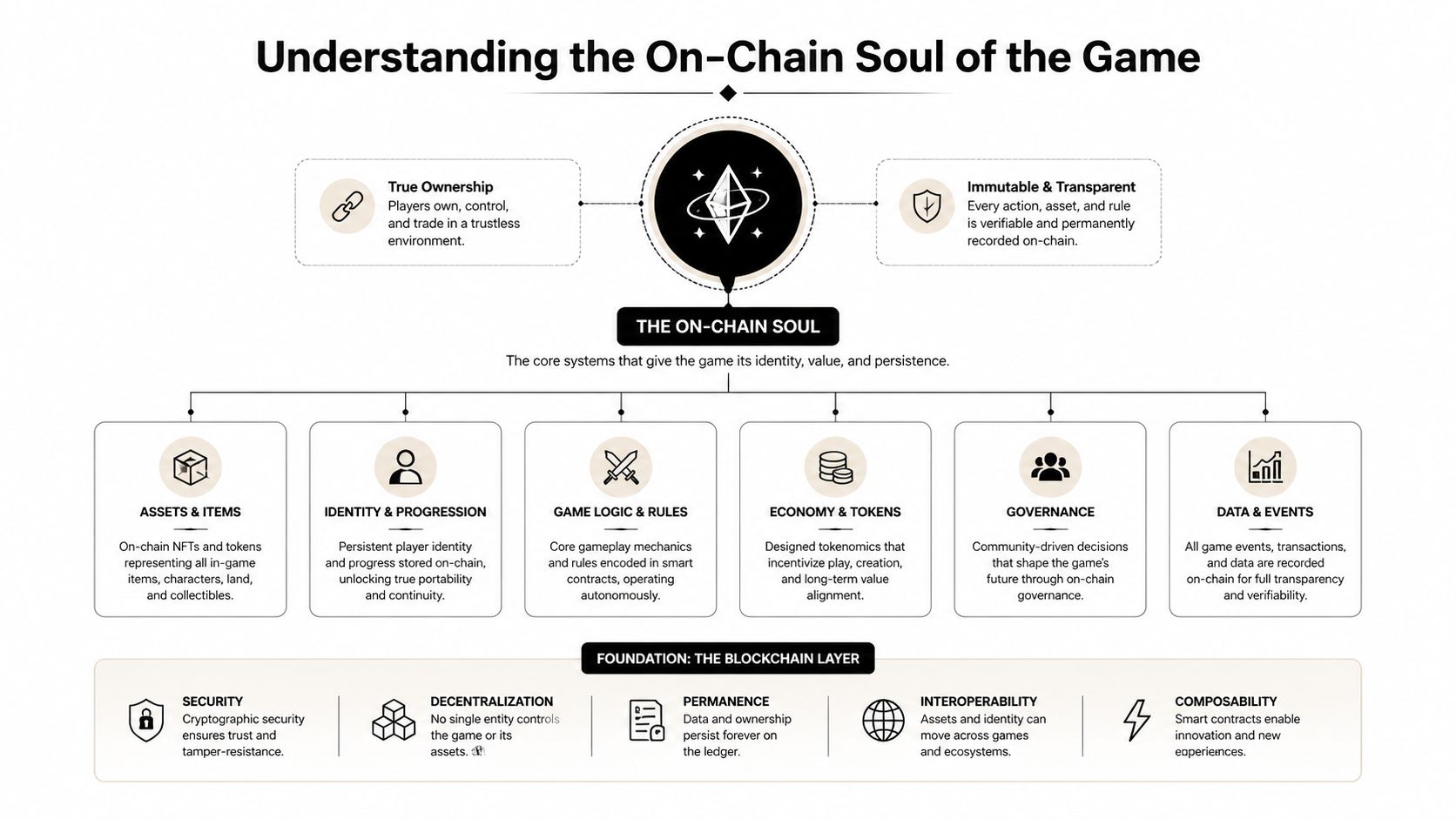
The strongest blockchain games don’t put everything on-chain. They put the right things on-chain. In an infinite world game, that usually means identity, ownership, selected event outcomes, governance rights, and marketplace logic.
From world state to owned history
The most distinctive feature here is the treatment of narrative memory as an asset layer. The engine described for Infinite Worlds uses an AI-driven event tagging system that analyzes gameplay moments, compresses them into indexed memories, and can represent major events as owned records. One example given is a key battle being tokenized as a “Veteran’s Badge” NFT on a Layer 2 network, with the system able to handle thousands of events per session and keep query times under 50ms, according to this description of AI event tagging and tokenized gameplay memory.
That is a major design break from older multiplayer systems.
In most games, your past matters only if the server says it matters. In this model, parts of your past can become durable objects with utility. A battle survived, a territory defended, a rare discovery made, or a civic role earned can become a tradable, inspectable part of your on-chain identity.
This opens new mechanics:
- Reputation systems tied to historical achievements
- Access control for guilds, zones, or missions based on owned event badges
- Cross-world interoperability if partner applications choose to recognize those assets
- Secondary markets for status-rich collectibles, not just cosmetic skins
Why Layer 2 architecture fits this model
A world with heavy event throughput can’t rely on expensive, slow settlement for every micro-action. That’s why a Layer 2 or similarly efficient execution environment makes more sense than forcing every interaction directly onto a congested base chain.
The logic is straightforward.
| On-chain candidate | Better location |
|---|---|
| Land deeds, rare items, governance rights | On-chain |
| Combat ticks, movement, environmental calculations | Off-chain |
| Compressed event proofs and milestone memories | Often best on Layer 2 |
| AI inference and narrative compression | Off-chain with verifiable linkage |
That architecture keeps smart contracts focused on what they do best: ownership, settlement, permissioning, and transferability.
It also creates a more defensible tokenomics model. If a project launches both a utility token and a governance token, investors should ask whether each token has a distinct job. A utility token can support in-game actions, fees, or crafting. A governance token can support voting, treasury direction, or protocol-level rule changes. If the functions blur together, the economy usually gets noisier, not stronger.
Tokenomics needs restraint not spectacle
The temptation in GameFi is to financialize everything. That usually backfires. A healthy infinite world game should reward players for meaningful participation, but it shouldn’t turn every task into a yield farm.
The more durable model uses tokenomics to support a functioning world:
- Utility first. Tokens should enable or mediate actions players already want to take.
- Clear sinks. Crafting, repair, upgrades, land services, or governance staking can absorb supply.
- Selective NFT issuance. Not every event deserves a token. Scarcity should map to significance.
- Governance with limits. DAOs can guide rules and treasury choices, but live game balance still needs coherent stewardship.
Readers interested in long-horizon infrastructure should watch the cryptographic side too. Better identity, proof systems, and asset verification can make player-owned history more secure over time, which is why broader discussions about the future of cryptography matter to this category.
The “on-chain soul” of a game isn’t its token ticker. It’s the set of facts the player can actually keep, prove, and use.
That’s the heart of the thesis. Infinite terrain gives the world scale. On-chain memory gives it permanence.
The Player Economy and Play-to-Earn Model
Most Play-to-Earn systems fail for a simple reason. They pay for activity before they create enough reasons for anyone to value the output of that activity. An infinite world game has a chance to do better because the economy can emerge from territory, memory, crafting, access, and reputation at the same time.
Where value comes from
A credible player economy doesn’t start with emissions. It starts with demand.
In this type of game, value can come from several overlapping behaviors:
- Exploration can uncover rare zones, strategic routes, or event-rich regions.
- Crafting and production can supply tools, structures, defenses, or consumables.
- Combat and protection can create demand for mercenary, guild, or escort functions.
- Curation and governance can shape communities, settlements, and rule enforcement.
- Narrative participation can create event records or status assets with social utility.
That final category is where this model gets interesting. If history itself becomes valuable, then players aren’t only farming resources. They’re building identity capital.
What a healthier game economy looks like
The strongest economies mix market activity with constraints. Without sinks, inflation erodes rewards. Without scarcity, NFTs become clutter. Without utility, governance turns ceremonial.
A healthier loop often looks like this:
- A player earns or acquires useful assets through play.
- Another player wants those assets because they improve outcomes, save time, or enable access.
- A marketplace clears that trade through smart contracts.
- Fees, crafting burns, upgrades, or maintenance create sinks that stop runaway oversupply.
That structure is much closer to a functioning digital economy than the old model of “play task, receive token, sell token.”
Players will tolerate volatility. They won’t tolerate an economy where everything they earn becomes irrelevant two updates later.
The DeFi connection matters here too. Secondary liquidity, lending, staking, collateralization, and composable market tools can deepen the economy, but only if the underlying game items have durable demand. If not, DeFi just accelerates speculation.
A practical way to assess the model is to ask three questions:
| Question | Why it matters |
|---|---|
| Is the asset useful inside the game before it is tradable outside it? | Prevents pure speculation from dominating utility |
| Does the economy have sinks as well as rewards? | Helps preserve long-term balance |
| Can non-whale players participate meaningfully? | Supports retention and social legitimacy |
That framework also helps when evaluating marketplace activity. Land, gear, event badges, governance rights, and access passes all behave differently. Investors should avoid treating every NFT category as equally valuable. A battle-earned badge with social signaling power may hold value for a different reason than a land parcel tied to production rights.
The best Play-to-Earn design in an infinite world game doesn’t promise passive income. It creates a world where skill, coordination, discovery, and historical significance can all become economically relevant.
Evaluating Investment Risks and Future Potential
The bullish case is easy to see. The risk case deserves equal attention.
The hard problems investors shouldn't ignore
A blockchain-native infinite world game has to solve several difficult problems at once. It needs stable gameplay, working infrastructure, fair marketplaces, resilient smart contracts, and coherent economic incentives. Most projects struggle to execute even two of those simultaneously.
The major risks are practical:
- Smart contract risk. Asset ownership and market logic can fail if contracts are flawed.
- Economic imbalance. Rewards that look attractive at launch can become unsustainable if sinks are weak.
- Narrative inflation. If every player action becomes a tokenized event, scarcity disappears and memory loses value.
- Onboarding friction. Wallet setup, gas fees, custody concerns, and bridging remain barriers for mainstream players.
- Speculative distortion. Communities can start treating the game as a financial chart rather than a world worth inhabiting.
That last issue is especially important. A game economy can survive volatility. It usually can’t survive a player base that values extraction more than participation.
For market context, the lesson from game launches in general is that strong early interest doesn’t guarantee a durable ecosystem. That’s why investors should separate attention from retention, and trading volume from world vitality. In crypto terms, bear-market discipline matters. Anyone allocating capital here should think with the caution used during a broader cryptocurrency bear market, even when sentiment looks euphoric.
Why the upside still attracts capital
The upside case remains compelling because the category touches several strong themes at once: Web3 ownership, AI-assisted content systems, Layer 2 scalability, creator economies, and digital identity.
The strategic opportunity is larger than one token launch. If a project successfully links procedural world generation, AI memory systems, and player-owned state, it can produce a more durable moat than games built only on graphics, marketing, or emissions. Players may stay because their history matters. Builders may integrate because the asset layer is programmable. Investors may care because network effects around identity and ownership can compound.
The biggest future catalyst isn’t just a roadmap bullet. It’s proof that the world can maintain coherence as more players, more assets, and more recorded events enter the system.
A serious GameFi investment thesis starts with infrastructure quality, not with APR fantasies.
If that quality shows up, the infinite world game category could become one of the most important intersections between AI and crypto. If it doesn’t, the space will produce another wave of expensive demos with weak retention.
How to Enter the Infinite World Today
Most newcomers don’t need more theory. They need a clean entry path.
A practical beginner checklist
Start with the wallet. MetaMask is the usual default for Ethereum-compatible ecosystems. Phantom is common in ecosystems with a different wallet culture. Use the official app or extension, secure the recovery phrase offline, and never share it.
Then fund the wallet through a regulated exchange or on-ramp you trust. Send only a small amount first. If the game uses a Layer 2, make sure your assets are on the correct network before trying to connect.
Your next steps are usually straightforward:
- Visit the game’s official site or launcher. Verify the URL through the project’s official social channels or documentation.
- Connect your wallet carefully. Review every signature request before approving it.
- Check whether play requires a token, a starter NFT, or neither. Good projects make this easy to understand.
- Start with the minimum commitment. Don’t buy premium land or speculative assets before testing the actual game loop.
What to verify before spending
A few checks will save you money and frustration:
- Read the asset utility. If an NFT has no clear in-game role, treat it as a collectible, not an investment.
- Inspect network costs. A low-priced asset can still be inconvenient if transaction flow is clumsy.
- Watch community behavior. If every discussion is about floor price, that’s a warning sign.
- Test retention for yourself. Ask whether you’d still play if token prices were flat.
Beginners should also separate three decisions that often get bundled together by hype: playing the game, buying the token, and collecting the NFTs. You can do one without doing all three.
The best entry strategy is simple. Learn the mechanics. Observe the economy. Spend slowly. In an infinite world game, patience is an edge because the strongest opportunities usually become clearer after the first wave of speculation fades.
If you want more grounded analysis on crypto gaming, NFTs, Web3 infrastructure, and emerging blockchain trends, follow Coiner Blog for practical guides and clear-eyed market commentary.
2 Comments