
How to Avoid Crypto Scams: Your 2026 Guide to Web3 Safety
Crypto scams didn't just grow. They exploded. The FTC says they've increased by 900% since the start of the pandemic, and regulators have warned that crypto is especially attractive to scammers because it's “hard-to-trace, decentralized, anonymized” according to California DFPI's summary of consumer guidance.
That's the right starting point because many individuals still treat security like a settings menu problem. It isn't. Security in Web3 is a behavior problem first, a tooling problem second, and only then a technical problem. The scammer doesn't need to break Ethereum, Solana, a Layer 2, or your exchange. They just need to make you click, sign, approve, trust, rush, or get greedy.
If you want the top-tier insight on how to avoid crypto scams, stop asking “Is this website legit?” and start asking “What is the attacker trying to make me feel right now?” That one shift catches more bad setups than any generic checklist.
Web3 still matters. DeFi, NFTs, tokenized real-world assets, smart contracts, AI-driven products, and Layer 2 ecosystems are opening real opportunities. If you need a clean primer on the broader shift, this overview of Web3 technology is a useful foundation. But none of that innovation protects you from your own impulse to chase fast money or obey fake authority.
This guide is the operational playbook. Not vague “be careful” advice. The actual mindset, filters, and habits that keep your wallet intact.
Table of Contents
- Welcome to Web3 Your First Lesson is Security
- Know Your Enemy The Modern Crypto Scammer's Playbook
- Developing Your Sixth Sense Spotting Scams Before They Strike
- Fortifying Your Fortress Wallet Exchange and NFT Security
- The Emergency Protocol What to Do When Scammed
- From Victim to Veteran Building a Lifelong Security Mindset
Welcome to Web3 Your First Lesson is Security
Crypto scams keep working for a simple reason. Greed speeds people up, and speed gets them hurt.
Web3 sells a powerful idea. You control your assets, your identity, and your access. That part is real. So is the other part. There is no fraud department reversing your mistake because you clicked fast, trusted the wrong DM, or signed something you did not understand.
If you're still getting oriented, start with a plain-English breakdown of what Web3 technology actually includes. Then accept the first rule of participating here. Security is not a side topic. It is the price of admission.
Why security comes before strategy
New users usually focus on upside first. Which chain is hot, which token has momentum, which app has the best yield. That is how scammers want you thinking. They make money when your attention stays on profit and skips over process.
The better frame is operational. Before asking, "Can this make me money?" ask, "How would this steal from me?" That one question filters out a shocking amount of nonsense.
Web3 keeps adding fresh attack surface. New L2s bring in users who have not built good habits yet. NFT mints appear fast, disappear faster, and often ask for broad approvals. Real-world asset platforms borrow the language of regulation and trust. AI now writes cleaner phishing messages, clones team voices, and makes fake support feel polished enough to pass a rushed gut check.
That is the trade-off in this market. Open systems create real opportunity, but they also remove a lot of the guardrails people assume exist.
The rule that cuts through noise
A simple filter catches a large share of retail scams. If someone contacts you out of the blue and wants crypto, treat it like a hostile act until you prove otherwise.
Do not debate the story. Check the claim somewhere else, through a channel you found yourself, or walk away.
That rule covers a lot of familiar bait:
- Investment pitch: early access, guaranteed returns, secret allocations
- Giveaway claim: send first, connect first, verify first
- Job offer: pay onboarding fees, gas deposits, or “equipment” costs
- Romance setup: help move funds, test a platform, invest together
- Fake support: transfer assets to “secure” the account or fix a wallet issue
Scammers use the same features that attract serious users. Fast settlement. Pseudonymity. Global reach. Once you see that clearly, security stops feeling like paranoia and starts feeling like basic competence.
Rule #1: seed phrases belong offline.
Know Your Enemy The Modern Crypto Scammer's Playbook
The fastest way to learn how to avoid crypto scams is to study the machine from the attacker's side. Most scams look different on the surface, but the engine is usually the same. Hook attention. Create trust. Add urgency. Push the victim into a transfer, a login, or a wallet approval.
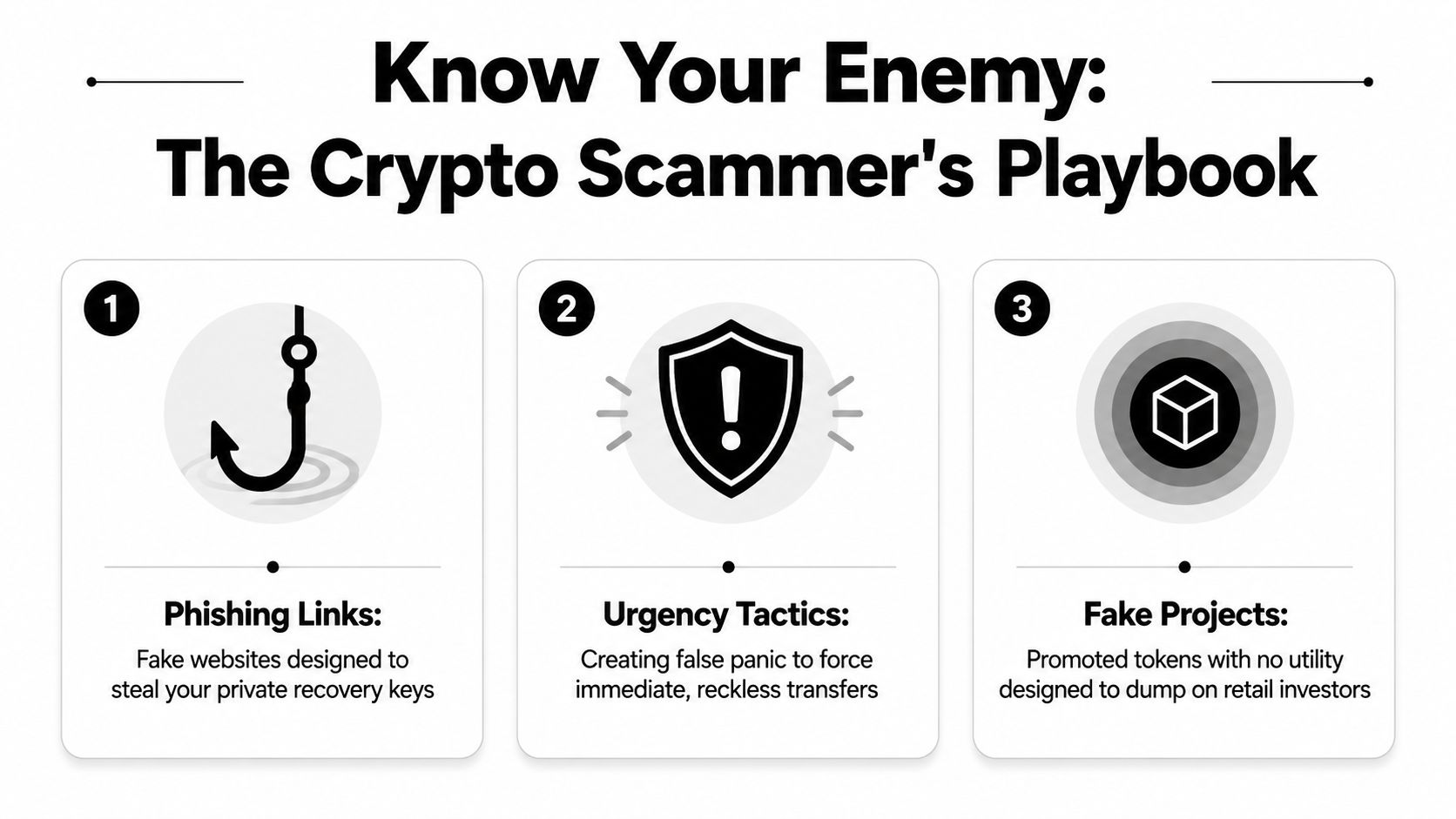
Phishing works because people want convenience
You get a message that looks like exchange support. Your account is “at risk.” There's a link to verify activity. The page looks right. The logo is right. The countdown timer is there to help manufacture panic. You log in, or worse, you enter a seed phrase.
That's the scam. No exploit needed. Just a fake front end and a victim who wants the stress to end quickly.
Phishing succeeds because users crave shortcuts. They trust inboxes, search ads, Telegram replies, Discord DMs, and “helpful” links. That habit gets expensive in crypto because the scam doesn't need your full device. It only needs credentials or a signature.
A lot of people learn this lesson after rough market cycles because bear markets attract desperation, recovery scams, and fake insider calls. If you've watched how fear distorts judgment, this take on a crypto bear market shows why scammers love bad sentiment.
Fake projects sell dreams not products
The fake project scam has evolved. It's no longer just a sloppy meme coin with a broken website. Now it can look polished. Nice branding. Clean smart contract language. AI-generated founder photos. Fancy roadmap. “Utility” in gaming, DeFi, identity, or real-world asset tokenization.
The weak point is usually not the homepage. It's the substance.
One common pattern looks like this:
- Narrative first: The token rides a hot sector such as AI plus crypto, Layer 2 infrastructure, or GameFi.
- Community theater: Bots fill the comments, moderators hype urgency, and influencers post vague excitement.
- Liquidity trap: Buyers can enter easily, but exits become painful, delayed, or impossible.
- Insider advantage: The team or connected wallets dump while retail keeps “believing.”
Real projects can be early, messy, and speculative. Fake projects rely on that truth as cover. They don't need to prove legitimacy. They only need you to confuse novelty with credibility.
Impersonation scams borrow trust
Impersonation is lazy and effective. A fake founder account. A fake admin in Discord. A fake exchange support handle. A spoofed recruiter from a known crypto company. Same profile photo, same tone, same urgency.
The scammer doesn't build trust from scratch. They borrow it.
Nobody important in crypto needs your seed phrase, your private key, or a rushed transfer “for verification.”
That applies whether the message comes from X, Telegram, Discord, LinkedIn, email, or a deepfake video clip pushing a “limited” giveaway.
Pig butchering is social engineering with patience
This one isn't a smash-and-grab. It's a campaign. The scammer starts with casual conversation. Maybe wrong-number outreach. Maybe a dating app. Maybe social media. The vibe is warm, competent, and patient.
Then the transition happens. The person is suddenly good at trading. They know a platform. They can help you. Your first small deposit appears to “work.” The dashboard shows profits. You start thinking you found a legitimate edge.
You didn't. You found a staged environment designed to increase your deposit size.
The reason this works is ugly but simple. People trust consistency. If someone talks to them daily, remembers details, and seems emotionally invested, they drop their guard. The scammer understands that greed alone is unreliable. Relationship pressure is stronger.
Developing Your Sixth Sense Spotting Scams Before They Strike
Scam prevention gets easier when you stop evaluating offers and start evaluating behavior. Bad actors repeat the same tells because human psychology doesn't change much.
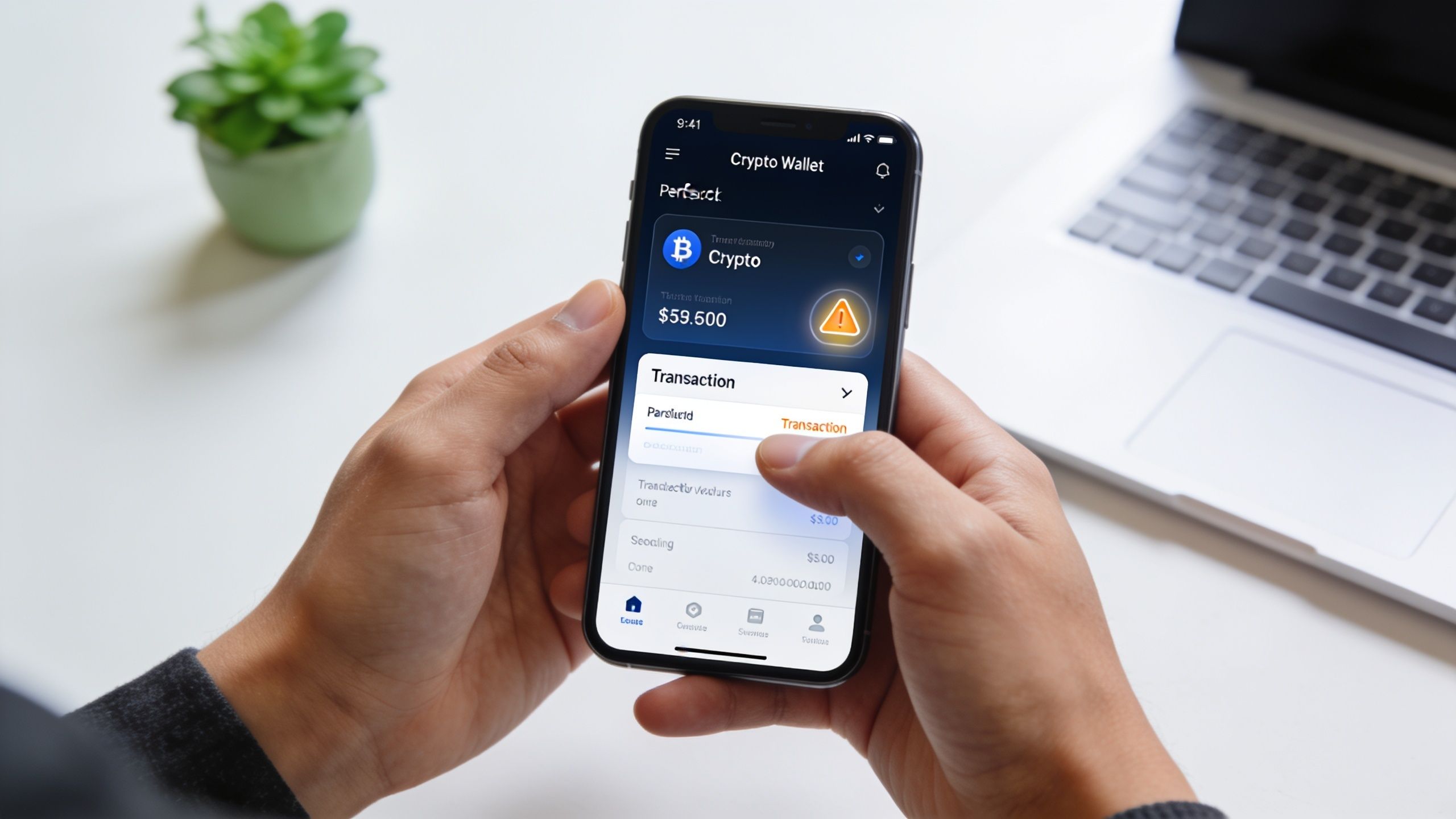
The universal red flags
You don't need to memorize every scam type. You need to memorize the pressure patterns.
Never share your seed phrase, private keys, or wallet passwords. A real wallet provider or exchange has no reason to ask for them.
When I review scam setups, the same signals keep showing up:
- Guaranteed upside: Crypto has volatility, not guarantees. Any promise of easy money, fixed returns, or “risk-free” gains is bait.
- Artificial urgency: “Only today.” “Claim now.” “Your account will be frozen.” Urgency is there to block verification.
- Unsolicited contact: Support doesn't need to find you in DMs. Admins don't need private chats. Recruiters don't need you to connect a wallet.
- Confusing transaction requests: If the process is fuzzy on purpose, assume the confusion is part of the weapon.
- Status theater: Blue checks, polished UI, trending posts, and impressive tokenomics graphics can all be faked.
A useful mindset is to treat every unexpected approach as hostile until proven otherwise. That isn't paranoia. It's operational hygiene.
How to vet a platform before you deposit
A polished site means almost nothing. The FTC warns that scammers buy ads that rank above real companies, so a top search result isn't proof of legitimacy. Practical due diligence means checking regulator registrations, transparent ownership and licensing, and whether the platform has any real customer service and withdrawal history, according to the FTC's cryptocurrency scam guidance.
If you're new, beginner investing advice often falls short here. You don't just need to know how to buy. You need to know how to refuse. This beginner guide to investing in cryptocurrency is useful only if you pair it with platform skepticism.
Use this short decision table before any deposit:
| Check | What you're looking for | What should worry you |
|---|---|---|
| Ownership | Named company, visible operators, clear legal presence | Anonymous team with glossy branding only |
| Registration | Verifiable regulatory footprint where relevant | Vague claims about being “fully compliant” |
| Withdrawal history | Real user reports of successful withdrawals | Lots of deposit talk, little withdrawal proof |
| Support channels | Official help center, documented process | DMs, Telegram-only support, disappearing admins |
| App presence | Legit listings and consistent branding | Clone apps, lookalike names, broken links |
Projects in DeFi and NFTs often blur the line between experimental and reckless. That's fine for risk capital. It's not fine for blind trust.
Fortifying Your Fortress Wallet Exchange and NFT Security
Security tools matter, but architecture matters more. Your goal isn't to create a perfect setup. Your goal is to make one mistake non-fatal.
Best-practice guidance emphasizes layered protection: verify contacts through official channels, avoid logging in through links in emails or texts, and use separate wallets so that a compromised wallet does not expose all holdings. Experian also recommends using an authenticator app instead of text-message codes because scammers can perform SIM swaps and bypass SMS-based 2FA, as explained in Experian's crypto scam prevention guide.
Wallet security that actually works
Your main wallet should behave like cold storage, not like a daily driver. If you use the same wallet for long-term holdings, random mint sites, governance votes, airdrop farming, and experimental smart contracts, you're doing the scammer's job for them.
The practical setup looks like this:
- Vault wallet: For long-term holdings. Minimal interactions. Hardware wallet preferred.
- Active wallet: For normal DeFi use, swaps, staking, and repeated dApp activity.
- Burner wallet: For new mints, unknown NFT claims, test transactions, and anything that feels even slightly sketchy.
That wallet separation is one of the few habits that consistently reduces damage. If a malicious approval hits your burner, your primary holdings stay isolated.
If you use Phantom, MetaMask, Rabby, or another wallet, the same principle applies. Wallet brand matters less than wallet discipline. For Solana users, this overview of Phantom Wallet is a useful starting point, but setup choices still decide your real risk.
Non-negotiable: Seed phrases belong offline. Not in cloud notes, not in screenshots, not in your email drafts, not in a chat with “support.”
Exchange habits that reduce blast radius
Exchanges are convenient, and convenience is always a risk trade-off.
You should still use them, just with rules:
- Use app-based 2FA: Authenticator apps are better than SMS because phone numbers can be hijacked through SIM swap attacks.
- Whitelist withdrawal addresses when available: It adds friction. That's the point.
- Use a dedicated email for exchange accounts: Don't recycle the same address you use for public social accounts.
- Ignore inbound support messages: If there's an issue, go to the platform yourself through a known official route.
- Treat API keys like loaded weapons: If you use trading bots or portfolio tools, scope permissions tightly and delete keys you no longer need.
The right mindset is simple. Every connection between systems expands your attack surface. Every unnecessary permission is future regret.
A short explainer is useful here if you want to see common user-side mistakes in action:
NFT and GameFi risks people keep underestimating
NFT and GameFi users get hit by a different flavor of scam. The bait usually isn't “send me money.” It's “connect wallet,” “mint now,” “claim reward,” or “approve token access.”
Those flows feel harmless because they mimic normal Web3 behavior. You're not typing a bank password. You're signing something. That abstraction makes people lazy.
Watch for these traps:
- Fake mint pages: The collection is trending, the art looks right, and the timer pushes haste.
- Malicious airdrops: A token appears in your wallet and dares you to interact with it.
- Approval abuse: A smart contract asks for permissions broader than the action requires.
- Support impersonation in community channels: “Open a ticket” turns into “verify your wallet.”
NFT culture trains users to move fast. Scammers know it. Slow down enough to inspect what your wallet is asking you to sign.
The Emergency Protocol What to Do When Scammed
If you realize you've been scammed, your first job isn't justice. It's containment. Panic wastes time, and time matters.

Containment comes before investigation
Expert guidance recommends preserving transaction IDs, wallet addresses, screenshots, and message logs because blockchain transfers are irreversible and evidence quality determines whether exchanges, law enforcement, or regulators can act quickly. Guidance also notes that recovery odds are generally poor once funds leave the wallet, so rapid reporting matters more than DIY recovery attempts, according to Binance's scam response guidance.
Start with this order of operations:
- Revoke suspicious approvals immediately. Tools like Revoke.cash can help you identify and remove token permissions or contract allowances you no longer trust.
- Move remaining assets to a fresh wallet. If your seed phrase may be exposed, the old wallet is done. Don't try to “watch it closely.” Replace it.
- Lock down connected accounts. Change passwords, rotate 2FA, and review linked sessions if an exchange login or email may be involved.
- Stop talking to the scammer. They'll often pivot into a fake recovery pitch.
The people who lose the most after the initial hit are often the ones who hesitate, negotiate, or trust a second scammer offering help.
Evidence is part of recovery
Treat incident documentation like a case file, not like a memory exercise.
Save:
- Transaction IDs: For every suspicious transfer or approval
- Wallet addresses: Yours and the recipient's
- Screenshots: Chats, websites, profile pages, and wallet prompts
- URLs and app names: Even if the site is already gone
- Timeline notes: What happened first, what you clicked, what you approved
If the compromise touched an exchange account, report it there immediately. If you need to keep tabs on unaffected holdings while rotating accounts and wallets, a clean setup with one of the best crypto portfolio trackers can help you monitor balances without improvising under stress.
Move fast, document carefully, and assume anyone promising guaranteed recovery is probably running the next scam.
From Victim to Veteran Building a Lifelong Security Mindset
The people who last in crypto train a habit: they ask who benefits if they act fast, feel special, or stop asking questions.
Trust slower
A strong security mindset is disciplined suspicion. It comes from understanding how scammers think. They do not need elite code or perfect infrastructure. They need greed, urgency, ego, and a victim who wants the story to be true.
That is the actual shift from victim to veteran. Veterans stop asking, "Could this be legit?" and start asking, "What is the angle?" A fake airdrop wants a signature. A private deal wants secrecy. A recovery service wants a second payment. The wrapper changes. The motive does not.
This mindset costs money sometimes. You will miss a mint. You will pass on a token that later runs. You will annoy people by verifying things twice. Good. Those are cheap costs in a market full of professional manipulators and amateurs copying them.
Build instincts, not superstition
Crypto security is not a collection of rituals. It is pattern recognition.
The useful question is simple: what pressure is being applied right now? Time pressure, social pressure, status pressure, or greed pressure. Once you can spot the pressure, the scam starts to look obvious.
Attackers will keep improving their tools. Messages will read better. Impersonation will get cleaner. Interfaces will look more polished. Human weakness is still the entry point, and that means your best defense is a calmer brain and a stricter standard for trust.
Web3 still offers real upside. It also punishes sloppy behavior faster than almost any other corner of tech. People who stay in the game accept both truths.
Operate with optimism if you want. Just make sure your optimism is expensive to exploit.
Coiner Blog covers the side of crypto that matters to users in the physical world: smart analysis, practical guides, honest takes on DeFi, NFTs, Web3, AI integration, Layer 2 ecosystems, and digital asset risk. If you want more clear-eyed crypto content without the fluff, explore Coiner Blog.
5 Comments