
BTC to GBP: Your 2026 Guide to Cashing Out Bitcoin in the UK
You're probably in a familiar spot. You've held Bitcoin for a while, the balance looks meaningful, and now the question isn't whether BTC has value. It's how to turn that value into actual pound sterling in your bank account without getting clipped by spreads, fees, slow withdrawals, or sloppy execution.
That gap matters more than most guides admit. The number on a chart is only the starting point. The amount of GBP you finally receive depends on the platform you use, the order type you choose, the timing of the sale, the withdrawal route, and whether the platform's quoted rate is even the one you can execute at.
For UK users, btc to gbp conversion has become more mainstream, but it hasn't become simpler. Bitcoin still trades like a global macro asset, while sterling adds its own local banking and tax considerations. If you've also been tracking broader market momentum, this look at why Bitcoin has been rising lately helps explain why people suddenly decide it's time to de-risk or take profits.
Table of Contents
- From Digital Gold to Pound Sterling
- Decoding the Real BTC to GBP Exchange Rate
- Choosing Your Path CEX P2P or Broker
- The Universal Process Wallet to Bank Account
- Minimizing Costs UK Fees and Tax Obligations
- Essential Security and Troubleshooting Tips
- Frequently Asked Questions
From Digital Gold to Pound Sterling
Selling Bitcoin feels simple until you try to do it well. A friend checks a BTC price app, does the rough mental math, and assumes that's the GBP they'll get. Then they open a different app, see another number, send coins to a platform, sell in a hurry, and wonder why the bank deposit lands lower than expected.
That's the btc to gbp problem. It isn't just conversion. It's execution.
Bitcoin can move hard even inside a relatively short holding window. BullionByPost's six-month BTC/GBP page showed a range from £57,651.16 to £91,269.65, which is exactly why timing and strategy matter when you convert.
The chart price is not your bank balance
A trader sees BTC near a local high and decides to cash out enough to cover a tax bill, rent deposit, or a large purchase. That decision can be smart. The mistake comes when they focus only on the headline quote.
What matters is:
- The venue price: One platform's displayed BTC to GBP rate may differ from another.
- The sale method: A rushed market sell can produce a worse result than a patient limit order.
- The cash-out path: Some services are good at crypto trading but clumsy on fiat withdrawals.
- The paperwork: Tax records get harder to reconstruct after the fact.
Practical rule: Before you sell, decide the exact goal. Are you exiting fully, taking partial profit, covering a GBP expense, or reducing risk? The right cash-out method depends on that answer.
Why this matters more now
Bitcoin sits at the center of the wider crypto stack. It influences sentiment across Web3, DeFi, tokenomics discussions, Layer 2 flows, and even AI-linked crypto narratives. But when it's time to convert to sterling, none of that market storytelling protects you from a bad fill or hidden spread.
The smart approach is mechanical. Pick the right route, verify the accurate price, execute with intention, and get the pounds out cleanly.
Decoding the Real BTC to GBP Exchange Rate
If five sites show five BTC to GBP prices at the same moment, that's not a glitch. It's normal market structure.
Why one bitcoin has several pound prices
At one point, quotes for a single bitcoin ranged from £56,818 on Crypto.com to £58,697 on Xe.com, a difference of over £1,800 according to Xe's BTC to GBP converter comparison context. For a small test sale, that might be tolerable. For a full bitcoin, it's substantial.
This happens because platforms are not all showing the same thing:
| Platform type | What you often see | What can differ |
|---|---|---|
| Exchange | Active market quote | Order book depth, spread, execution price |
| Broker or app | Simplified headline rate | Embedded spread, service fee, FX markup |
| Converter site | Reference conversion | Not always a tradable buy or sell price |
That's why reading about crypto liquidity and market depth helps. In practical terms, liquidity determines how closely your sale tracks the visible price once you hit the button.
The rate that matters is the executable one
Think of btc to gbp like changing cash at an airport versus a competitive FX desk. Both can tell you the pound is worth something. Only one gives you a rate you'll be happy to trade on.
The two terms that matter most are spread and depth.
- Spread is the gap between what buyers are paying and what sellers are asking.
- Order book depth is how much volume sits near the current price.
- Executable rate is the actual price you receive after those two realities meet your order size.
A lot of retail users get trapped by polished interfaces. The app looks clean, the conversion button is easy, and the displayed number feels final. It isn't always final.
The displayed spot price is useful. The price you can actually sell at is the one that pays your bills.
What works and what doesn't
What works:
- Checking two or more venues at the same time
- Looking for a proper BTC/GBP market, not just a generic converter
- Using the trading interface when available instead of instant-convert tools
- Comparing the quoted rate with the actual order preview before confirming
What doesn't:
- Assuming Google, a wallet app, and an exchange all mean the same thing by “price”
- Selling directly from the first app you open
- Ignoring fee disclaimers and spread-heavy convenience tools
- Treating all liquidity as equal
If you remember one thing, remember this. There is no single universal btc to gbp price. There are competing live quotes, and your job is to find the route that leaves the most sterling in your account after all frictions.
Choosing Your Path CEX P2P or Broker
The best cash-out route depends on what you care about most. For many users, that's some mix of speed, simplicity, and confidence that the bank transfer will arrive. For others, privacy or flexibility matters more.
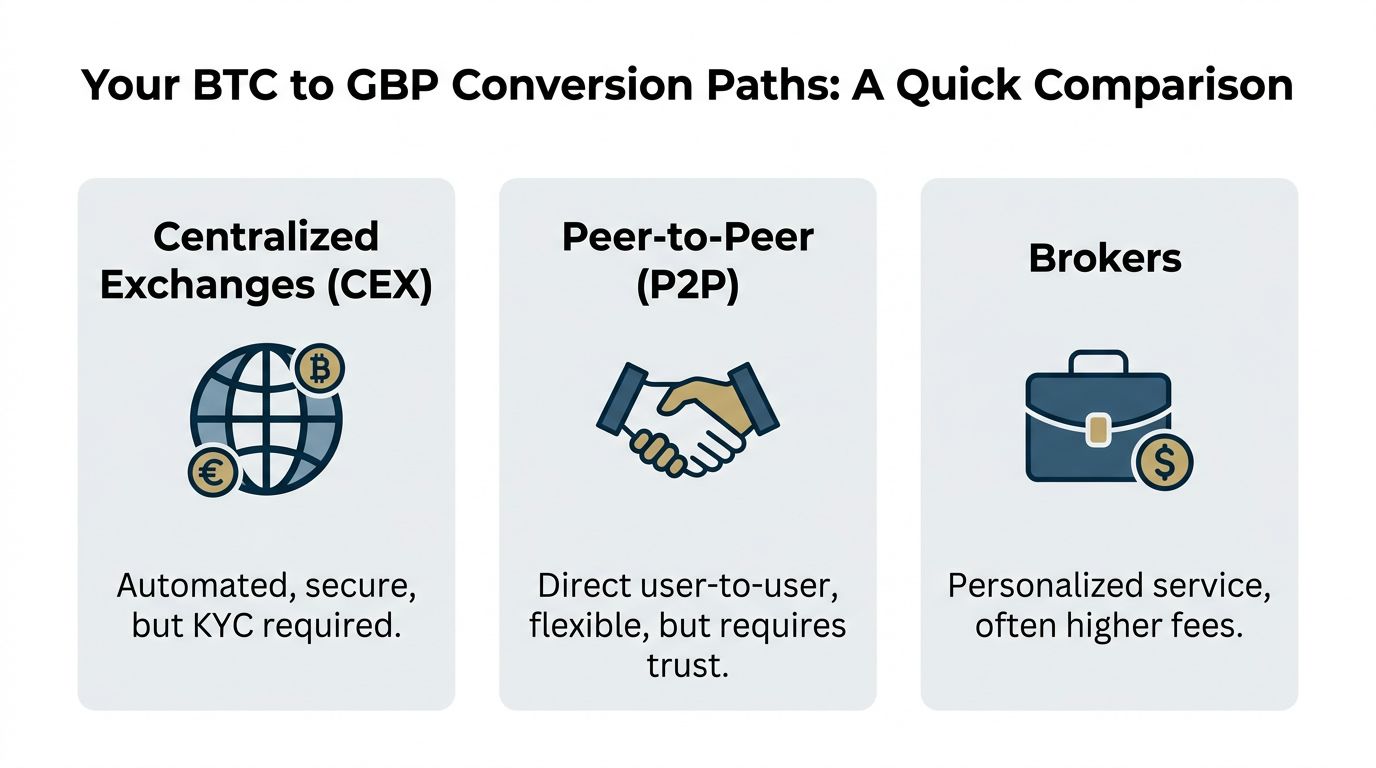
If you're newer to crypto infrastructure, a solid primer on how to invest in cryptocurrency for beginners gives useful context before you decide which route fits your risk tolerance.
Centralized exchanges for most people
Platforms like Kraken or Coinbase are usually the cleanest route for btc to gbp.
They tend to work best when you want:
- Reliable market access: You can place market or limit orders on a real trading venue.
- Better transparency: Trading screens usually expose price, pair, and order type more clearly.
- Direct fiat rails: GBP withdrawal options are often built in.
- Operational support: If something goes wrong, there's at least a formal support path.
The downside is obvious. You'll usually face identity checks, account reviews, and possible withdrawal holds if your activity triggers compliance checks. That doesn't mean the platform is broken. It means regulated exits come with friction.
P2P for flexibility and privacy trade-offs
Peer-to-peer platforms attract users who want more control over counterparties, payment methods, or privacy. That can work, but it also shifts more responsibility onto you.
P2P may suit you if:
- you understand escrow mechanics,
- you know how to evaluate counterparty reputation,
- you're comfortable handling communication and dispute risk,
- and you're prepared for slower, more manual execution.
Where people get burned is trying to optimize for privacy while underestimating fraud risk. Fake payment confirmations, chargeback attempts, and social engineering are all more likely when there isn't a strong platform-mediated process.
P2P can be useful. It is not the easiest place to learn basic selling discipline.
Brokers and app-based services for convenience
Brokers and consumer finance apps sit on the opposite end of the spectrum. They usually make conversion feel effortless. Tap, confirm, withdraw.
That convenience comes at a cost. You may get:
- a wider embedded spread,
- less clarity on how the rate was formed,
- limited order controls,
- and less flexibility if you want to optimize execution.
Which route matches which user
| Priority | Best fit | Main trade-off |
|---|---|---|
| Fast and straightforward cash-out | CEX | KYC and compliance friction |
| Privacy and flexible deal structure | P2P | More scam risk and manual work |
| Simplicity and familiar interface | Broker or app | Often worse pricing |
If a friend asked me which path to choose, I'd say this. Start with a reputable centralized exchange unless you have a strong reason not to. It gives you the best balance of visibility, control, and bank-withdrawal practicality.
The Universal Process Wallet to Bank Account
Once you've chosen the route, the process itself should be boring. That's a good thing. A repeatable workflow usually protects more money than chasing tiny market moves.
Early in the process, this visual helps keep the sequence straight.
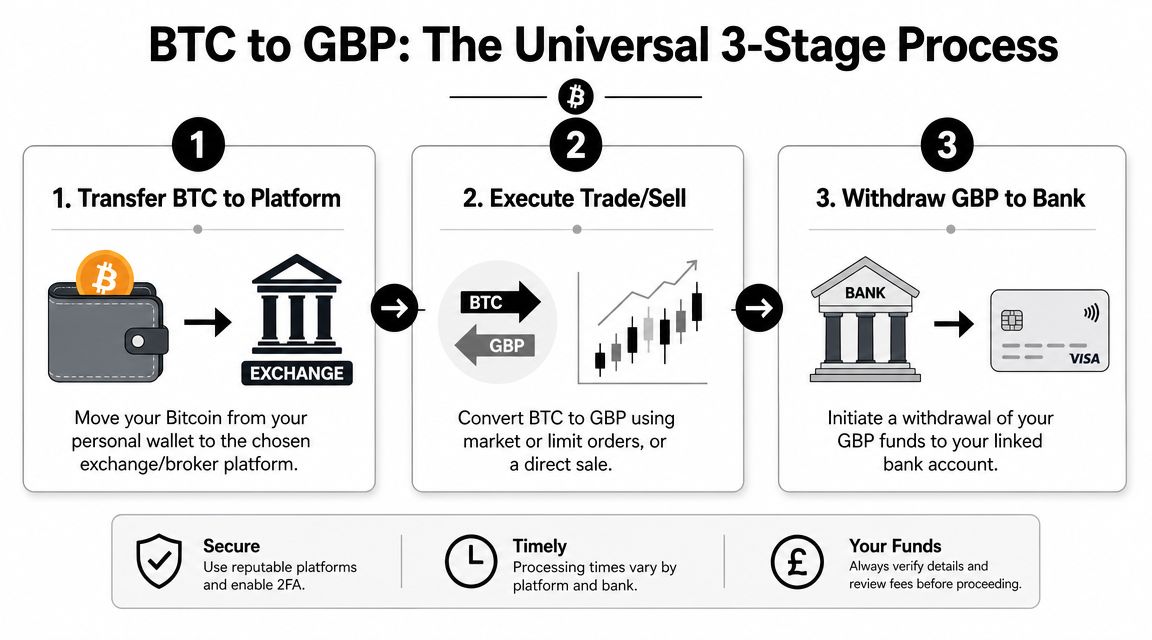
Stage one move btc safely
Send your BTC from your self-custody wallet or current platform to the exchange or broker you've chosen. Before sending the full amount, many experienced users prefer a small test transaction first. It adds one step, but it can save a painful mistake.
Do the boring checks:
- Confirm the asset and network: BTC must go to a Bitcoin deposit address, not a different chain by accident.
- Verify the address carefully: Don't trust copied text blindly.
- Use address whitelisting if the platform offers it: That adds friction in the right place.
- Keep screenshots and confirmations: They help if support gets involved later.
A lot of bank-friction issues begin upstream. If the deposit looks unusual, the eventual withdrawal can trigger extra review.
Stage two execute the sale properly
Once the BTC lands, don't rush straight into the first sell button.
The practical workflow from Kraken's BTC to GBP conversion page is simple: choose a reference exchange like Kraken or Coinbase, verify the quoted spot rate, multiply your BTC holdings by that GBP price, and compare across at least two venues to estimate the spread and fees before committing.
That's the point where order type matters.
Market order versus limit order
A market order sells immediately at the best available bids. It's fast, but the final execution can slip if the book is thin or moving.
A limit order sets your minimum acceptable price. It gives you more control, but it might not fill if the market doesn't trade there.
For many retail users:
- use market orders for small urgent sales on liquid venues,
- use limit orders when price discipline matters,
- split larger sells if you want cleaner execution.
Here's a practical explainer before you move to the banking side:
Stage three withdraw gbp without surprises
After the sale, you're holding GBP on the platform. That doesn't mean the job is done. Now the priority is getting funds to a bank account that won't create unnecessary stress.
Using one of the more established crypto-friendly banks in the UK ecosystem can make this smoother, especially if your bank tends to question crypto-linked incoming transfers.
A clean withdrawal routine looks like this:
- Link your bank account correctly and make sure names match exactly.
- Review any withdrawal limits or compliance prompts before you initiate the transfer.
- Avoid sudden changes in behavior such as cashing out a large amount through a brand-new account.
- Download trade and withdrawal records while they're easy to find.
Sell with the trading engine. Withdraw with the payments rails. Treat them as two separate jobs.
Minimizing Costs UK Fees and Tax Obligations
Investors often focus on market timing and neglect the quieter drains on performance. Fees and taxes don't feel dramatic, but they decide how much GBP you keep.
Where the pounds leak out
A poor btc to gbp exit usually loses money in layers, not all at once.
Watch for these pressure points:
- Trading spread: The visible quote and your real fill can differ.
- Convenience conversion tools: Instant sell features are often simple, but simplicity can be expensive.
- Withdrawal charges: Some platforms are cheap to trade on and awkward to withdraw from.
- FX confusion: If a service handles crypto and fiat across multiple currencies, check whether you're being pushed through an unnecessary conversion path.
- Bank friction: A delayed or rejected transfer can force you into support loops and timing risk.
The safest habit is to estimate the full path before acting. Don't just ask, “What's BTC worth in pounds?” Ask, “What will hit my bank after spread, fees, and any platform quirks?”
The uk tax side you should prepare for
Selling BTC for GBP is usually a taxable event in the UK. The broad concept is straightforward. If you dispose of Bitcoin for more than your acquisition cost, you may have a capital gain. If you sell for less, you may have a loss.
You don't need to be a tax specialist to do the basics well, but you do need records.
Keep:
- Purchase history
- Sale confirmations
- Wallet transfer logs
- Bank withdrawal records
- Notes on fees paid
What doesn't work is trying to rebuild everything months later from memory and old screenshots.
Keep tax records as you trade, not when HMRC becomes the reason you're suddenly organized.
If your situation is complex, multiple wallets, old transfers, DeFi activity, wrapped BTC exposure, or cross-platform history, get professional UK tax advice. That isn't legal or tax advice. It's just the practical move when the history is messy.
Essential Security and Troubleshooting Tips
When people lose money during a btc to gbp conversion, it's often not because Bitcoin crashed. It's because they trusted the wrong message, copied the wrong address, or panicked when a delay hit.
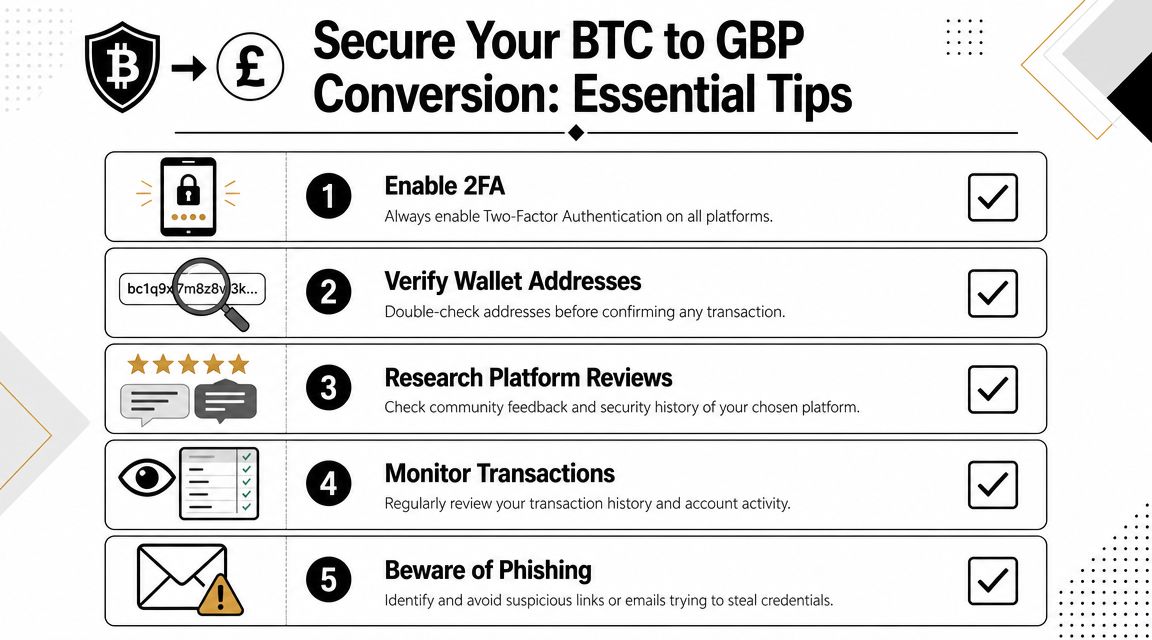
If you want a deeper checklist on fraud patterns, this guide on how to avoid crypto scams is worth reading before moving any funds.
Security habits that matter
- Enable 2FA: App-based two-factor authentication should be standard on every exchange and email account tied to it.
- Check addresses character by character: Address poisoning scams rely on you recognizing only the first and last few digits.
- Ignore DMs from “support”: Real support doesn't solve sensitive account issues in random messages.
- Use bookmarks for exchange logins: Phishing pages often win with tiny URL lookalikes.
- Separate devices if needed: If your phone is cluttered with wallets, trading apps, and social links, operational mistakes become easier.
What to do when something gets delayed
A delayed withdrawal doesn't automatically mean funds are gone. It often means the platform wants more review.
When that happens:
- Check transaction status first inside the platform
- Review your email carefully for verification requests
- Avoid duplicate withdrawal attempts
- Contact support only through official channels
- Keep your transaction IDs and screenshots ready
Most problems get worse when users react emotionally and start clicking whatever message appears first.
Frequently Asked Questions
Can I sell btc to gbp without using an exchange?
Yes, but it changes the risk profile. P2P sales and broker services exist, yet exchanges are usually the easiest way to combine price visibility, execution tools, and direct GBP withdrawal.
Why does my app show a different BTC to GBP rate from another site?
Because there isn't one universal price. Different platforms use different liquidity sources, spreads, pricing models, and fee structures.
Should I use a market order or a limit order?
Use a market order when speed matters more than precision and the venue is liquid. Use a limit order when you care about controlling the minimum price you'll accept.
Will my UK bank question a crypto cash-out?
It can happen. Banks vary in how comfortable they are with crypto-related transfers. Clean records, name matching, and using a well-known platform all help.
Do I need to think about tax before cashing out?
Yes. The sale itself can have tax consequences, so keep records before, during, and after the conversion.
If you want more practical crypto guides that skip hype and focus on execution, risk, and real-world usability, explore Coiner Blog. It's a solid resource for staying sharp on Bitcoin, DeFi, Web3, Layer 2 trends, tokenomics, AI-crypto developments, and the everyday decisions that affect your results.
1 Comment