
No KYC Crypto Wallet: A 2026 Privacy Guide
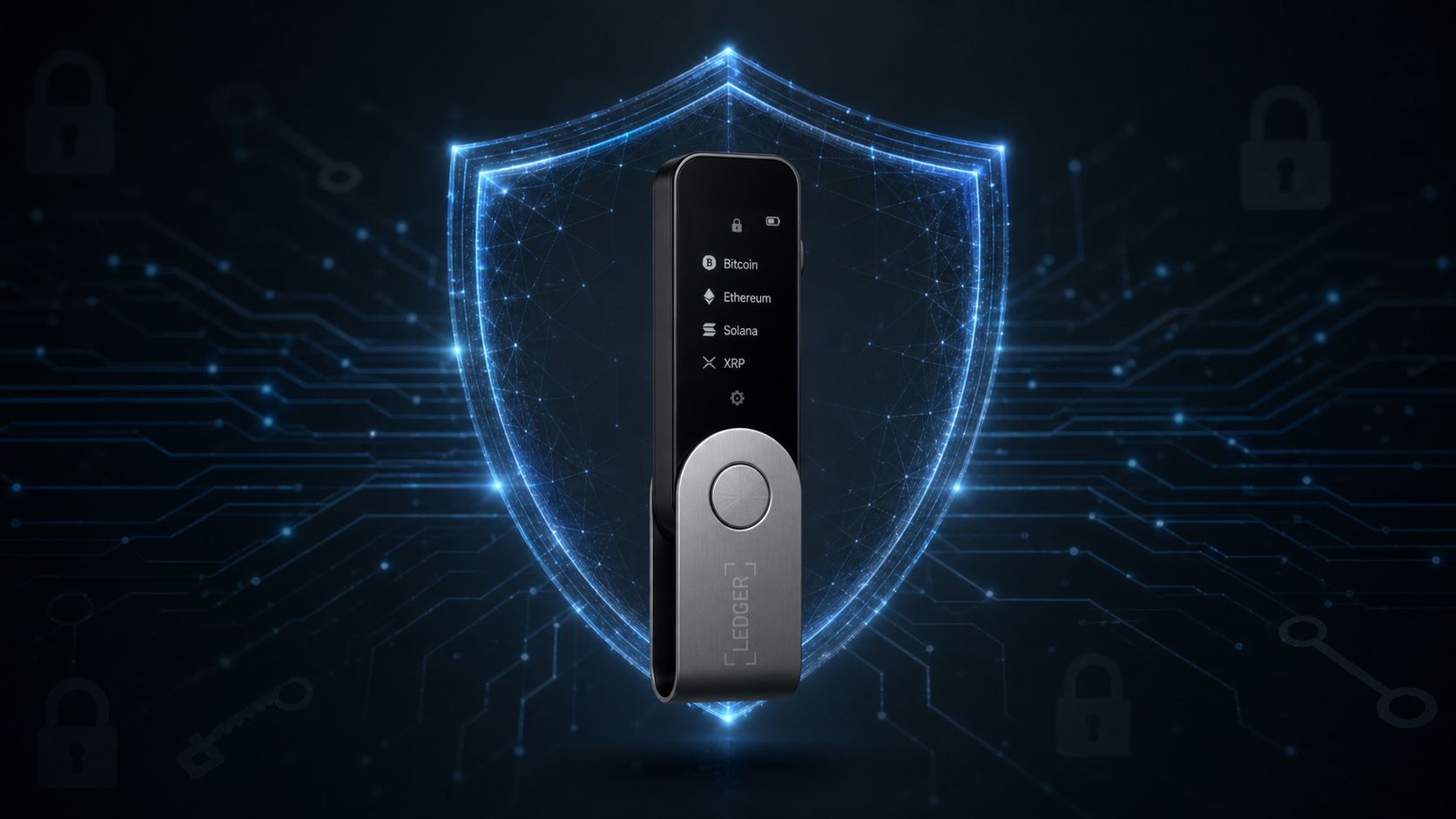
A lot of advice about a No-KYC crypto wallet starts with the same promise: no ID upload means anonymity. That's the part beginners remember, and it's also the part that causes the most confusion.
Skipping identity verification does matter. It removes one major link between your legal identity and your wallet provider. But it doesn't make your activity invisible. The blockchain is still public. Your transaction patterns are still visible. And recent analysis highlighted the privacy illusion gap, meaning many services that skip document uploads can still collect behavioral patterns and wallet metadata, so true invisibility usually requires more than just avoiding KYC (analysis of the privacy illusion gap).
That distinction matters whether you use Bitcoin, Ethereum, a DeFi wallet on a Layer 2 network, or a hardware wallet for long-term storage. A wallet can give you self-custody without giving you perfect privacy. Those are related ideas, but they aren't the same thing.
This is why a good privacy guide has to be more honest than most “top wallet” roundups. A No-KYC crypto wallet is best understood as a tool for self-custody and reduced data exposure, not a magic invisibility cloak. Used carefully, it can reduce what intermediaries know about you. Used carelessly, it can still leave a very clear trail.
Table of Contents
- Introduction Beyond the Promise of Anonymity
- Core Concepts Custodial vs Non-Custodial Wallets
- How Non-Custodial Wallets Uphold Privacy
- Navigating Privacy Risks and Security Best Practices
- The Fiat Reality Check On-Ramps and Regulations
- Top No-KYC Crypto Wallets in 2026 A Comparison
Introduction Beyond the Promise of Anonymity
The most popular advice on this topic is also the most misleading. People say, “Just use a no-KYC wallet and you'll stay anonymous.” That isn't how blockchains work.
Bitcoin, Ethereum, and most public chains are transparent ledgers. Anyone can inspect wallet addresses, transaction history, and fund flows. Analysts can often cluster addresses together, and the earlier point still applies: avoiding ID upload doesn't stop metadata collection or behavioral tracking. That's the center of the privacy illusion gap.
Practical rule: A no-KYC wallet removes one identity checkpoint. It doesn't remove blockchain visibility.
That doesn't make these wallets useless. Far from it. They matter because they reduce reliance on centralized platforms and put key control back in the user's hands. For people active in self-custody, DeFi, smart contracts, or cross-chain activity, that's a meaningful difference.
The problem is expectation management. If someone installs a wallet, buys coins on a KYC exchange, sends them to that wallet, and then later sends them back to a bank-linked service, they've created a trail that's much easier to connect than many beginner guides admit.
Where readers usually get confused
Two ideas often get blended together:
- Self-custody: You control the private keys.
- Privacy: Other parties have less information about you and your transactions.
They overlap, but they aren't identical. Self-custody protects you from a custodian freezing access. Privacy depends on how you fund the wallet, how you broadcast transactions, whether you reuse addresses, and whether you later touch regulated fiat rails.
A better way to think about it
A No-KYC crypto wallet is like using cash in a store with security cameras instead of swiping a bank card. You reveal less to the payment processor, but you aren't automatically untraceable. Context still matters. So do your habits.
Core Concepts Custodial vs Non-Custodial Wallets
The simplest way to understand this topic is to stop thinking about wallets as apps and start thinking about key ownership.
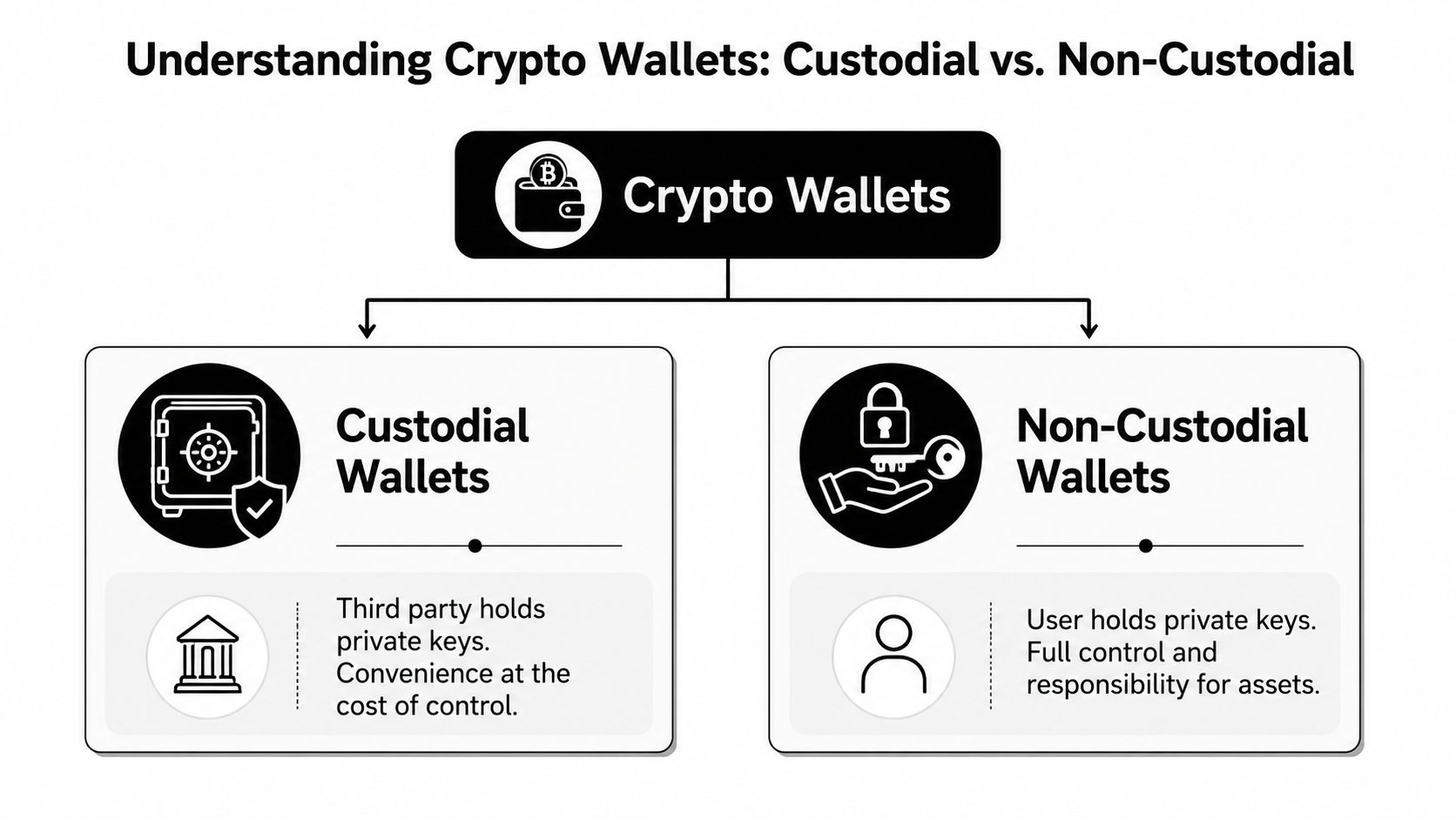
A custodial wallet is like storing valuables in a bank vault. The institution manages access. A non-custodial wallet is more like a personal safe in your home. You control the key, but you also carry the risk if you lose it.
Who holds the keys
With a custodial wallet, the provider controls the private keys on your behalf. That setup is common on centralized exchanges. It's convenient. Password resets may be possible, and the interface is often easier for new users. But control is indirect.
With a non-custodial wallet, you hold the keys. Wallets such as MetaMask, Ledger, and Trezor typically fall into this category. The core idea behind not your keys, not your coins is straightforward: if another company controls the keys, that company controls the final access path to the assets.
Convenience and control usually move in opposite directions.
Why exchanges ask for ID
Regulation becomes a key factor. Over 85% of regulators worldwide mandate that crypto exchanges implement KYC checks, and about 92% of major crypto exchanges are fully KYC-compliant, while non-custodial wallets like MetaMask, Ledger, and Trezor typically don't require identity verification because users control their own funds directly (regulatory overview of KYC in crypto).
That difference explains why people searching for a No-KYC crypto wallet often end up frustrated when they look at exchange accounts instead. They're comparing two different categories of service.
Here's the clean distinction:
- Custodial service: Holds funds for users, acts like a financial intermediary, and usually falls under KYC rules.
- Non-custodial wallet: Provides software or hardware for self-custody, so the provider doesn't directly hold customer funds in the same way.
- Fiat gateway: Often sits between the two worlds and usually reintroduces checks when money moves to or from traditional banking.
This matters beyond Bitcoin. The same logic shows up in Ethereum wallets used for DeFi, Web3 logins, NFT activity, and smart contract interactions. If you sign transactions yourself, you keep control. If an exchange signs or processes on your behalf, you're operating inside a more regulated model.
How Non-Custodial Wallets Uphold Privacy
A non-custodial wallet protects privacy at the account level because it doesn't need your identity to create the wallet in the first place. The wallet isn't opening a customer account in the traditional sense. It's generating secrets locally.
The seed phrase is the root secret
During setup, a true no-KYC wallet generates a seed phrase locally on your device, usually 12 or 24 words, and that seed phrase derives the wallet's private keys and addresses offline (how no-KYC wallets generate seed phrases locally). Think of the seed phrase as the master blueprint for every lock and key your wallet will ever use.
If the wallet provider never receives that seed phrase, it can't log in to your wallet, freeze your assets, or recover funds for you. That's the trade-off. Independence goes up. Safety nets go down.
Signing happens on your device
The actual transaction process is less mysterious than it sounds.
First, the wallet prepares a transaction. Then it signs that transaction using private keys stored locally on your device. After that, it broadcasts the signed transaction to the network, sometimes with privacy enhancements such as routing traffic through Tor to obscure metadata, as described in this explanation of self-custodial wallet architecture.
That sequence matters because the provider doesn't need your legal identity to make it work. Your device creates the authorization. The network verifies the signature. No central help desk needs to approve the transfer.
For readers who've heard privacy discussed alongside advanced cryptography, there's a useful conceptual link with zero-knowledge proofs. They aren't required for a No-KYC crypto wallet to function, but they reflect the same design instinct: prove what needs to be proven while revealing as little extra information as possible.
The wallet can help hide who controls the keys from the provider. It cannot hide the fact that a public blockchain records transactions.
That's why privacy in crypto has layers. Self-custody is one layer. Network privacy is another. On-chain behavior is another. People often stop at the first layer and assume they've completed the job.
Navigating Privacy Risks and Security Best Practices
Most privacy failures don't happen because the wallet “leaks” by default. They happen because users connect the wallet to identifiable services, reuse addresses, or broadcast transactions in ways that reveal more than they realize.
A wallet can be private in design and still be exposed in practice.
Privacy fails through habits
The clearest example is address reuse. If you receive multiple payments to the same visible address, you make clustering easier. Another common mistake is sending funds directly from a self-custody wallet to a service already tied to your legal identity. That creates a clean bridge between the “private” side and the identified side.
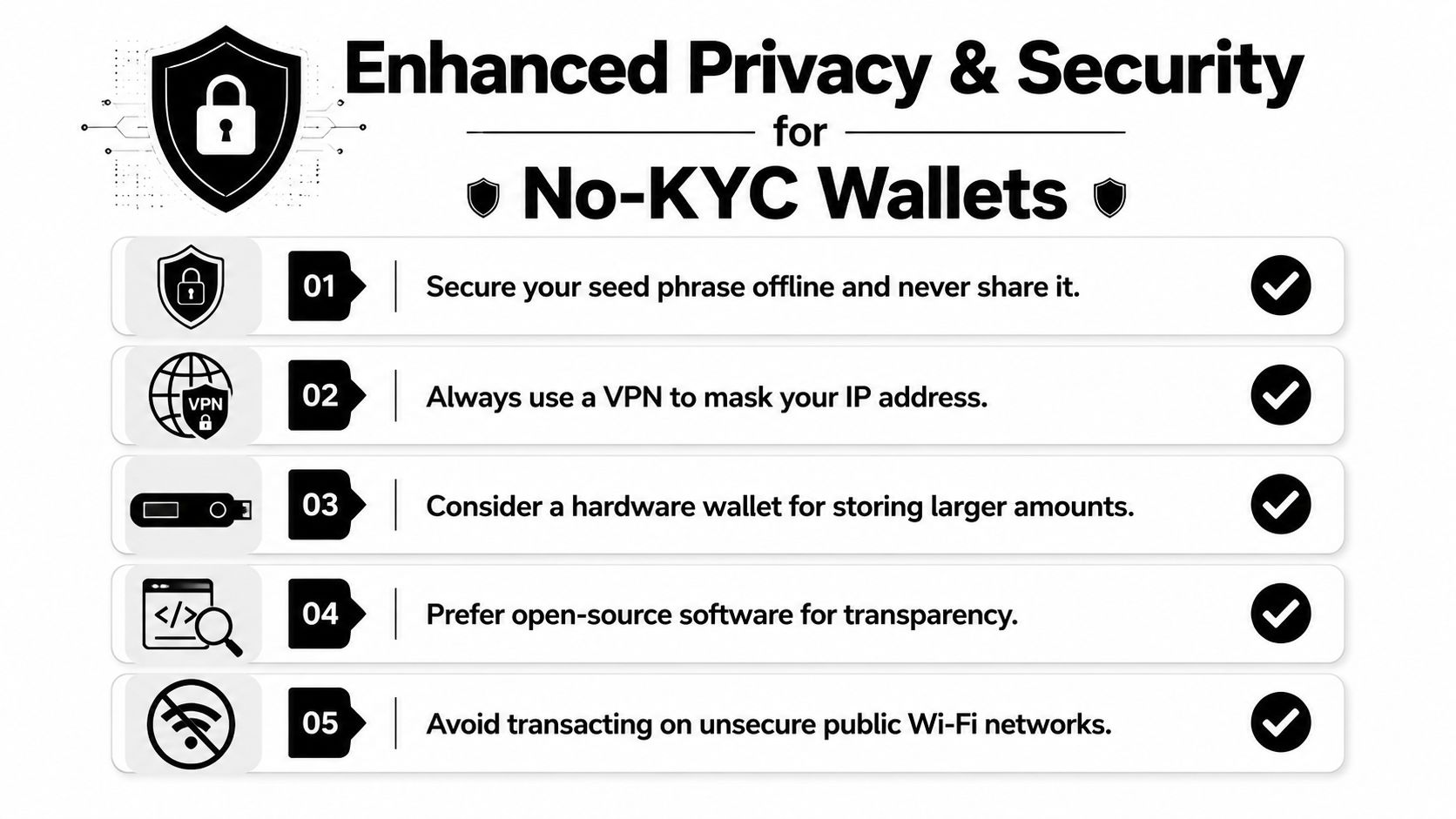
Network exposure matters too. Guidance for stronger privacy recommends broadcasting transactions through a VPN or Tor, using HD wallet structures that generate a new address for each transaction, and avoiding direct transfers to bank-linked accounts that can create identity linkage (privacy operating practices for no-KYC wallets).
Later in this section, this walkthrough is useful if you want a visual primer on wallet safety and privacy habits:
A practical operating routine
You don't need paranoia. You do need consistency.
- Protect the seed phrase offline: Write it down and store it somewhere secure. Don't keep screenshots in cloud storage, and don't send it through email or messaging apps.
- Use fresh addresses: HD wallets are useful because they can create a new receiving address automatically. That limits address reuse and makes your wallet history less easy to map at a glance.
- Separate identities: Don't mix your private wallet with exchange deposit addresses, public donation addresses, and wallets you use for everyday social Web3 activity.
- Control the network path: Use a VPN or Tor when you broadcast transactions if privacy is part of your goal.
- Reserve hardware for size and duration: If you're storing larger holdings or long-term positions, a hardware wallet reduces online attack surface.
Your threat model should determine your setup. A DeFi user on Ethereum has different risks from a Bitcoin user focused on long-term cold storage.
There's another subtle risk in modern crypto usage. Web3 apps, Layer 2 bridges, DeFi protocols, and even AI-linked on-chain tools often create behavioral fingerprints. A wallet may not know your name, but a pattern of bridge activity, timing, and exchange interactions can still narrow the field.
That doesn't mean privacy is impossible. It means privacy is operational. You build it through small choices.
The Fiat Reality Check On-Ramps and Regulations
The hardest privacy boundary in crypto isn't the wallet. It's the moment crypto touches the banking system.
Where anonymity usually breaks
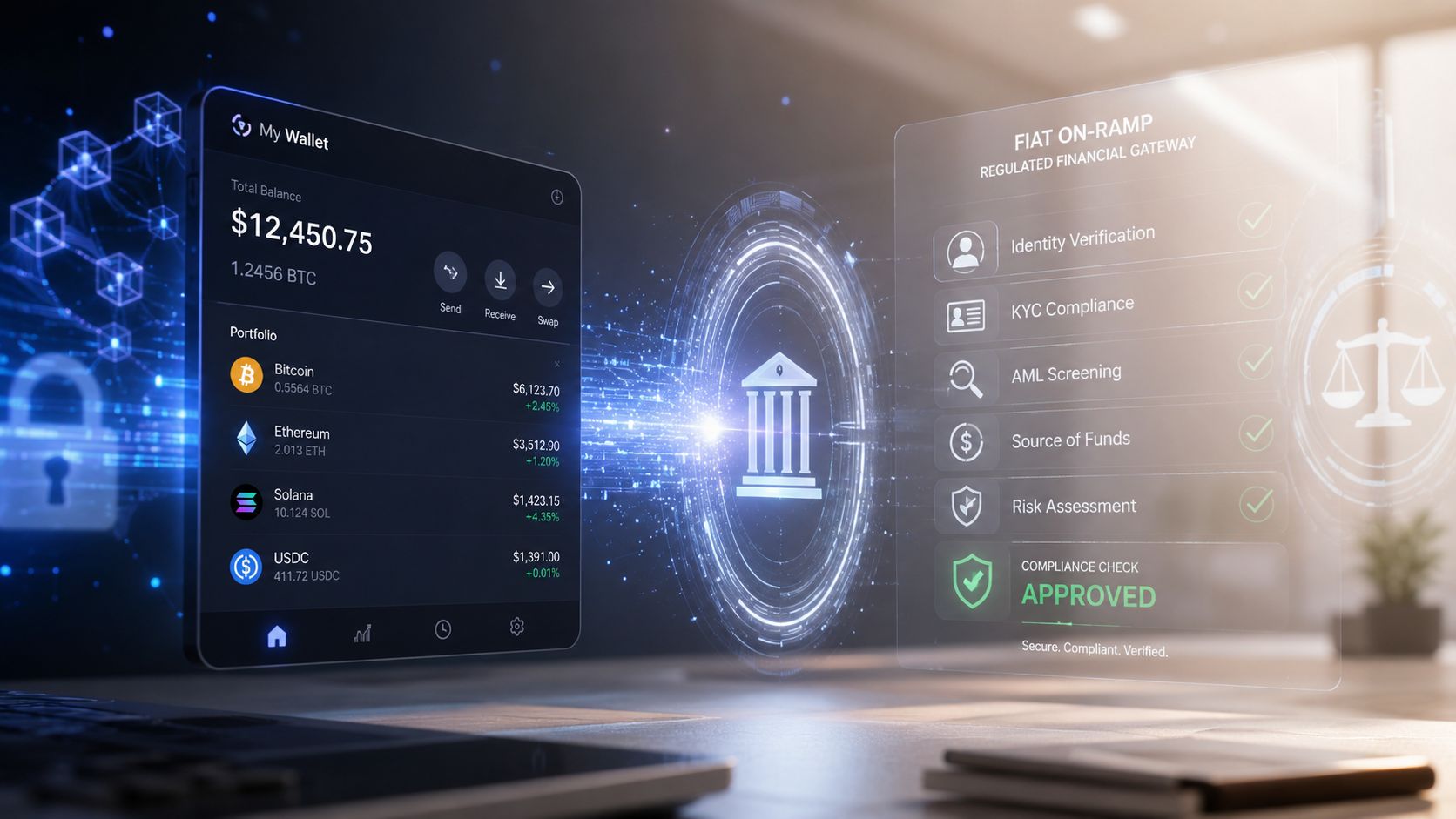
Nearly all methods for converting crypto to fiat, or fiat to crypto, require KYC. Analysis from 2026 also notes that fully anonymous, legally compliant crypto cards don't exist in regulated markets because Visa and Mastercard products must comply with financial rules (why the fiat boundary breaks wallet privacy).
That's why many marketing claims around “spend crypto privately without ID” need to be treated carefully. A private wallet can hold and move crypto without collecting your passport. But once you want card rails, bank withdrawals, or conventional consumer payment networks, regulated intermediaries usually step in.
Why wallet privacy and spending privacy differ
If your goal is to buy crypto more discreetly, peer-to-peer methods are usually discussed more often than bank-linked retail rails. For a practical overview of that side of the process, this guide on how to purchase Bitcoins anonymously is a helpful companion.
The broader lesson goes beyond crypto. Privacy isn't only about wallet design. It's also about your digital footprint over time. If you're thinking about identity exposure more broadly, this guide to digital privacy and content removal is worth reading because it frames privacy as an ecosystem problem, not just a payments problem.
A realistic expectation helps. A No-KYC crypto wallet is strongest inside crypto-native environments such as self-custody, peer-to-peer transfers, and some DeFi workflows. It gets weaker when you need regulated fiat access, everyday card spending, or account-based financial services.
Top No-KYC Crypto Wallets in 2026 A Comparison
This category isn't a niche anymore. By 2025, no-KYC wallet adoption had grown to over 2.8 million users worldwide, with monthly transaction volumes reaching $4.2 billion, or 12% of total Bitcoin transaction volume. Projections indicate 8.5 million users by the end of 2026 (market growth for no-KYC wallets). That growth doesn't mean every wallet offers the same privacy quality. It means more users are actively looking for tools that reduce dependence on custodians.
Some people want mobile convenience. Others want strong Bitcoin privacy features. Others care most about hardware integration or broad asset support across Ethereum, Layer 2 ecosystems, and multichain DeFi.
What the market growth actually means
The growing user base tells us something important. People aren't only chasing anonymity. They're also choosing self-custody, portability, and reduced platform dependence. That's relevant across Bitcoin and increasingly relevant across Ethereum-based Web3 usage, especially when users want to interact with smart contracts directly rather than through exchange accounts.
Still, wallet choice should match your threat model. A great wallet for a beginner who wants broad token support isn't automatically the best wallet for someone who cares mainly about Bitcoin transaction privacy.
Comparison of Top No-KYC Wallets for 2026
| Wallet | Type | Key Privacy Feature | Supported Assets | Best For |
|---|---|---|---|---|
| Trust Wallet | Software wallet | No KYC for sending, receiving, or holding crypto | Multiple crypto assets | Beginners who want an easy mobile wallet |
| Ledger Nano X | Hardware wallet | Offline key storage with strong separation from online activity | Supports over 2,000 cryptocurrencies natively and 5,500+ via external services | Long-term holders and higher-security setups |
| Trezor | Hardware wallet | Non-custodial self-custody with hardware-based key protection | Multiple crypto assets | Users who want hardware security and simple custody control |
| MetaMask | Software wallet | Non-custodial control for Ethereum and Web3 activity | Ethereum ecosystem and compatible networks | DeFi, NFTs, and Layer 2 users |
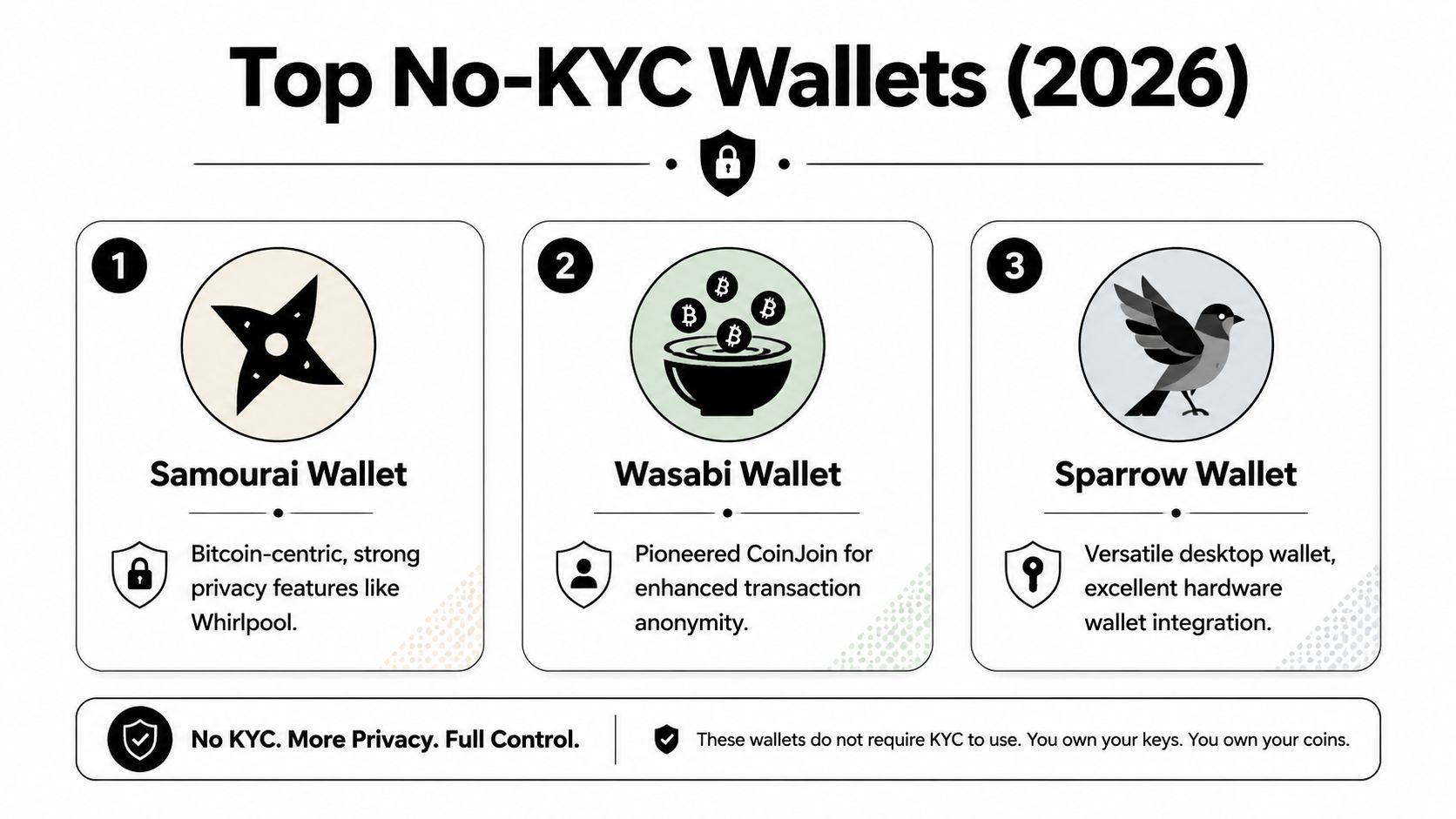
| Samourai Wallet | Software wallet | Bitcoin-focused privacy tooling | Bitcoin | Users prioritizing Bitcoin privacy workflows |
| Wasabi Wallet | Desktop wallet | CoinJoin-oriented privacy design | Bitcoin | Desktop users focused on transaction obfuscation |
| Sparrow Wallet | Desktop wallet | Strong hardware wallet integration and advanced Bitcoin controls | Bitcoin | Power users who want control and hardware compatibility |
Which wallet fits which user
Trust Wallet stands out for accessibility. It's a verified non-custodial wallet that explicitly doesn't require KYC for sending, receiving, or holding cryptocurrencies (Trust Wallet no-KYC overview). If someone is new to self-custody and wants a relatively simple mobile experience, it's an easy starting point.
Ledger Nano X suits users who place security first. Hardware wallets don't make blockchain activity private by themselves, but they reduce exposure by keeping signing keys off everyday internet-connected devices. The same source cited earlier also notes support for over 2,000 cryptocurrencies natively and 5,500+ via external services, which makes it useful for people holding assets across several ecosystems rather than just Bitcoin.
MetaMask remains one of the most recognizable non-custodial wallets for Ethereum, Layer 2 networks, tokens, NFTs, and DeFi. It isn't a privacy-specialist wallet, but it does give users direct key control for Web3 interactions. That matters if your activity centers on smart contracts rather than simple peer-to-peer transfers.
Samourai Wallet, Wasabi Wallet, and Sparrow Wallet appeal to more privacy-conscious Bitcoin users, but for different reasons. Samourai is known for Bitcoin-centric privacy tooling. Wasabi is widely associated with CoinJoin-style transaction obfuscation. Sparrow has earned a following among users who want a more advanced desktop interface and strong hardware wallet integration.
One more nuance belongs here because people often confuse wallets with exchanges. A platform can skip KYC at account opening and still impose meaningful limits. For example, Bybit doesn't require KYC to open an account or start trading, but non-KYC users face a daily withdrawal limit of 20,000 USDT and lose access to several fiat and yield-related features (Bybit non-KYC limits explained). That isn't a wallet example. It's a reminder that “no KYC” can mean very different things depending on the product category.
The best choice comes down to what you're trying to protect. If you want mobile simplicity, use a broad multichain wallet. If you want higher security for larger holdings, use hardware. If you care most about Bitcoin privacy, choose tools built around that use case and combine them with disciplined operating habits.
Coiner Blog covers crypto with that same practical lens. If you want more clear, research-driven guides on Bitcoin, Ethereum, DeFi, Web3 security, AI and crypto, and the actual trade-offs behind self-custody tools, explore Coiner Blog.